
Safeguarding is Everyones Business ISLE OF MAN SAFEGUARDING
Safeguarding is Everyone’s Business ISLE OF MAN SAFEGUARDING FORUM Friday 19 th February 2016 Sefton Hotel, Douglas

WELCOME BACK
PROGRAMME FOR REST OF THE DAY 1. Introduction: Paul Burnett, Independent Chair 2. Opening remarks: Minister Crookall, Minister for Education and Children 3. Domestic Abuse: Pathway Implementation 4. Flip the Script- Allies not Enemies 5. Priorities for 2016/17: Interactive session with the Independent Chair 6. Close
Hon. Tim Crookall MLC Minister for Education and Children
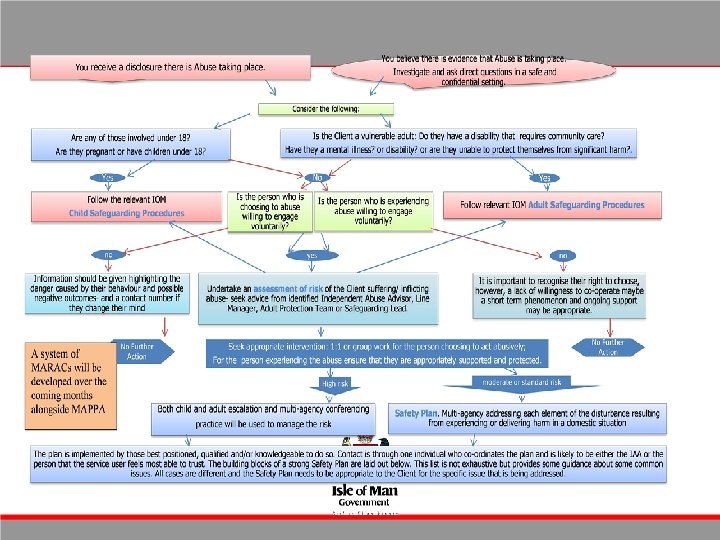
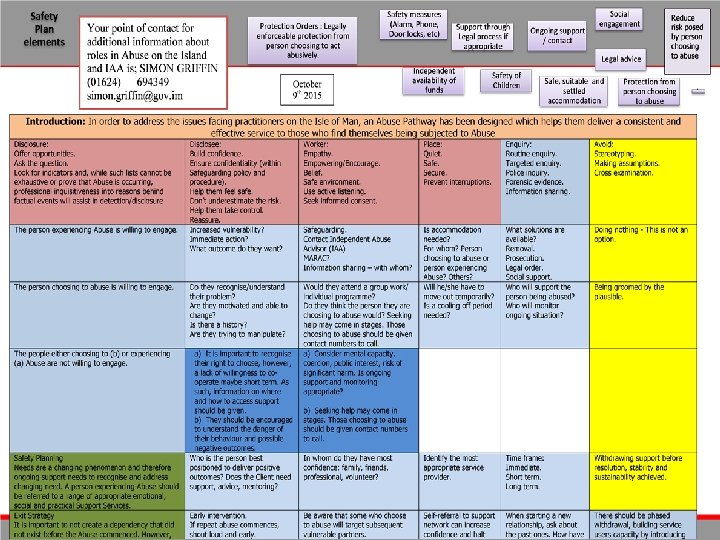
Session 1 Domestic Abuse: Pathway Implementation Simon Griffin and Marcia Brabbs
Session 2 Flip the Script: Allies not Enemies Voices in Partnership
Paul Burnett Independent Chair Safeguarding Children Board (SCB) and Safeguarding Adults Partnership (SAP)
Presentation outline 1. Progress Report on Business Plans 2015/16 2. Priorities for action for 2016/17 3. Other issues to be raised by Forum members
The Safeguarding Forum Engage managers and practitioners in the work of the SCB and SAP Include both children and adult services from across the public, third sector and private sector agencies Meet twice a year: • To consider the priorities for action in the annual business plan (Feb) • To receive annual report, review progress and test impact from a practitioner perspective (Oct) Keynote addresses on significant safeguarding issues from invited speakers
How do we have our say? You should all have a voting Handset, When you see this icon Go green you can vote. To vote press the number next to the answer you have chosen and press ok. Lets test the handset you have, all press 1 followed by OK 99
How do we have our say? Results from our test vote 100%
Question 1 126 Do you: 1 - Work with children only 2 - Work with adults only 3 - Work with both children and adults
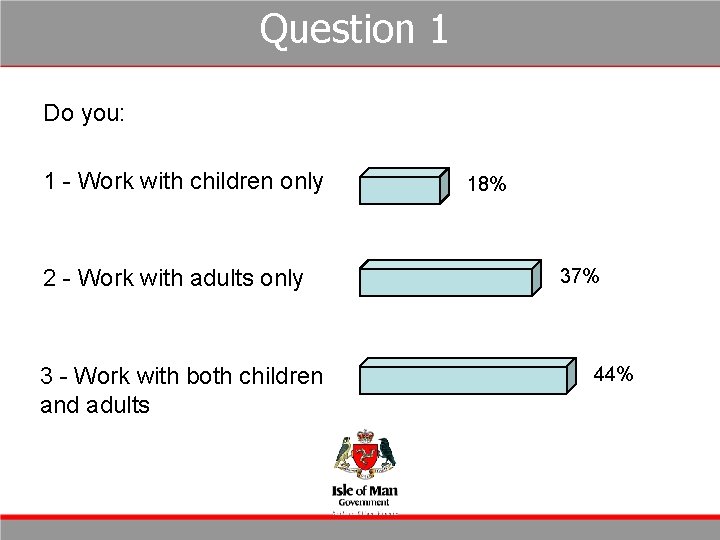
Question 1 Do you: 1 - Work with children only 2 - Work with adults only 3 - Work with both children and adults 18% 37% 44%
Question 2 How many Safeguarding Forum events have you attended? 1 - This is my first Safeguarding Forum 2 - This is my second Safeguarding Forum 3 - This is my third Safeguarding Forum 127
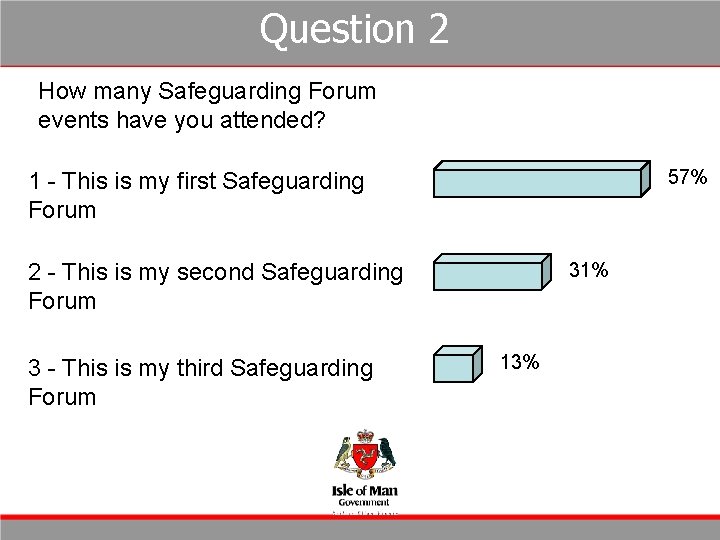
Question 2 How many Safeguarding Forum events have you attended? 57% 1 - This is my first Safeguarding Forum 31% 2 - This is my second Safeguarding Forum 3 - This is my third Safeguarding Forum 13%
Safeguarding Board Effectiveness SCB AND SAP BUSINESS PLANS 2015/16
KEY STRATEGIC PRIORITIES • Safeguarding is Everyone’s Business • Children, Young People and Adults are safe through effective policies, procedures and practice • Areas of safeguarding risk are addressed • The workforce is ‘fit for purpose’ • The voice of service users is heard and acted on
Question 3 The SCB and SAP are proposing that we retain these 5 key strategic priorities. Do you agree? 1 - Yes 2 - No. This is too many priorities 3 - No. There is an important issue missing 127
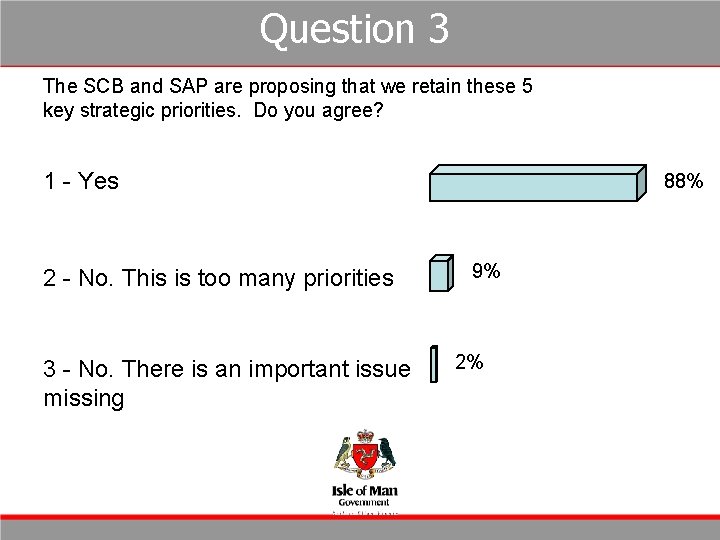
Question 3 The SCB and SAP are proposing that we retain these 5 key strategic priorities. Do you agree? 1 - Yes 2 - No. This is too many priorities 3 - No. There is an important issue missing 88% 9% 2%
Safeguarding is Everyone’s Business Boards’ Effectiveness • Statutory status for SCB and SAP • 80% attendance rates at Board and subgroups • Assessment of impact of meetings on progress • Raise profile of Board through effective communications and engagement • Safeguarding priorities evident in agency plans
Safeguarding is Everyone’s Business Board Effectiveness – Progress • Statutory status agreed but delayed • Attendance levels at 80% to date – and Third Sector represented at both SCB and SAP • Profile of Board raised through Safeguarding Forums and revised SCB website • Safeguarding priorities evident in Departmental plans • New SAP website will be launched on Monday • Member views on meetings effectiveness yet to be tested
Safeguarding Website https: //beta. gov. im/safeguarding
Question 4 How would you rate your knowledge and understanding of the safeguarding boards’ work and impact now compared to a year ago? My knowledge and understanding are: 1 - Significantly improved 2 - Better than a year ago but could be further improved 3 - About the same 4 - I don’t feel I know much about the work of the Boards 127
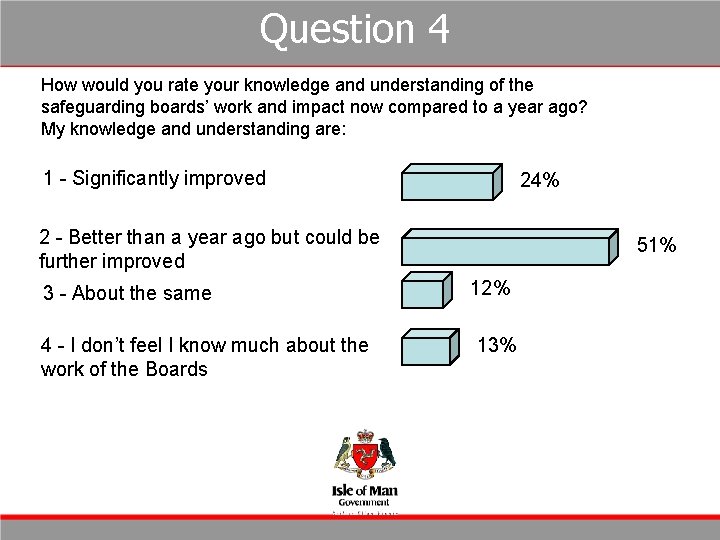
Question 4 How would you rate your knowledge and understanding of the safeguarding boards’ work and impact now compared to a year ago? My knowledge and understanding are: 1 - Significantly improved 24% 2 - Better than a year ago but could be further improved 3 - About the same 4 - I don’t feel I know much about the work of the Boards 51% 12% 13%
Question 5 What would help to improve your knowledge and understanding of the work and impact of the safeguarding boards? 1 - A wider range of information on the website 2 - A quarterly newsletter headlining key developments and their impact 3 - Reporting through existing staff communications and briefings – including team meetings 4 - Social media presence e. g. Twitter 5 - I don’t need any more information than I receive now 124
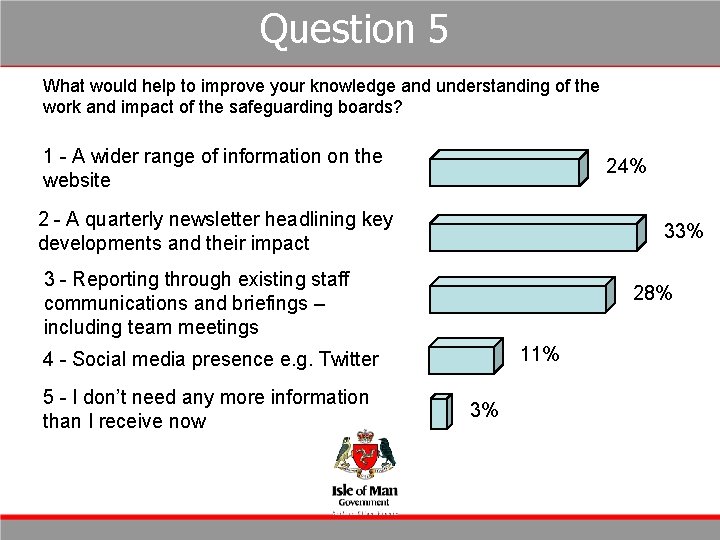
Question 5 What would help to improve your knowledge and understanding of the work and impact of the safeguarding boards? 1 - A wider range of information on the website 24% 2 - A quarterly newsletter headlining key developments and their impact 33% 3 - Reporting through existing staff communications and briefings – including team meetings 28% 11% 4 - Social media presence e. g. Twitter 5 - I don’t need any more information than I receive now 3%
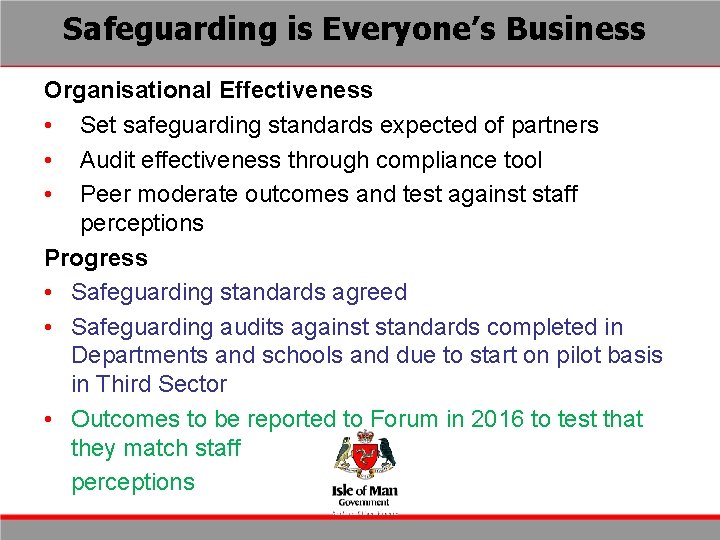
Safeguarding is Everyone’s Business Organisational Effectiveness • Set safeguarding standards expected of partners • Audit effectiveness through compliance tool • Peer moderate outcomes and test against staff perceptions Progress • Safeguarding standards agreed • Safeguarding audits against standards completed in Departments and schools and due to start on pilot basis in Third Sector • Outcomes to be reported to Forum in 2016 to test that they match staff perceptions
Safeguarding is Everyone’s Business Information Sharing and Data Protection • Develop information sharing policy for adult services and produce practice guidance for both children and adult services to resolve issues with effective implementation Progress • Information sharing protocol for adults agreed by SAP • Practice guidance to be agreed with Information Commissioner
Safeguarding is Everyone’s Business SCB • Monitor and scrutinise post-inspection action plan Progress • Monitoring and scrutiny of action plan has been regularly undertaken and all areas relating to SCB are completed or on track for completion with the exception of statutory status • Review inspection imminent
Safeguarding is Everyone’s Business SAP Ensuring emergency planning arrangements are robust from a safeguarding perspective. Considering whether to develop an Adult Services Partnership to reflect Children’s Services Partnership Progress • Emergency planning arrangements reviewed • Proposals for an adult services partnership developed for consideration
Question 6 How confident do you feel in your understanding and use of information sharing and data protection policy and procedures: 1 - Very confident 2 - Quite confident 3 - Would value some additional guidance, support and training to improve my confidence 4 - Unclear 5 - Very unclear 126
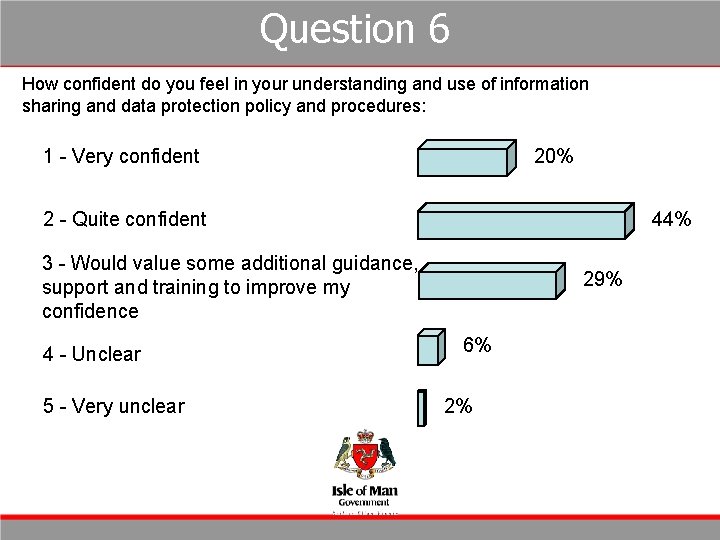
Question 6 How confident do you feel in your understanding and use of information sharing and data protection policy and procedures: 1 - Very confident 20% 2 - Quite confident 44% 3 - Would value some additional guidance, support and training to improve my confidence 4 - Unclear 5 - Very unclear 29% 6% 2%
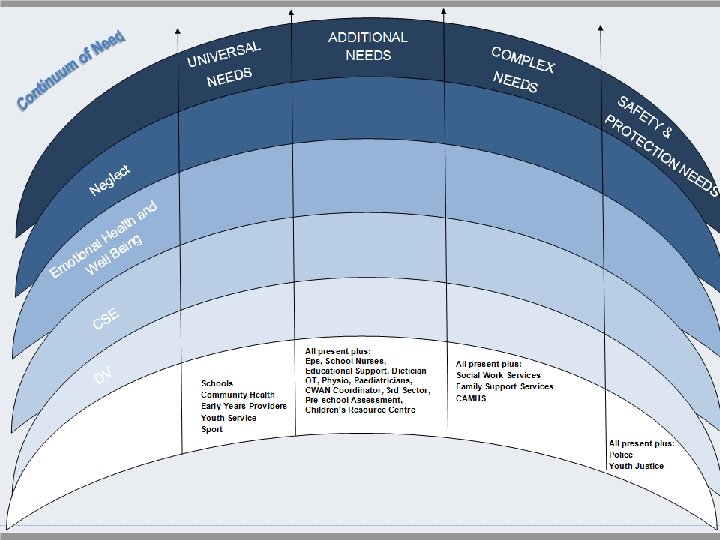
Assurance that policies and procedures keep children safe • Pilot and implement NARRATES • Secure consistent cross-agency understanding of thresholds and categories of need/abuse • Develop the Quality Assurance and Performance framework to reflect the new Business Plan • Develop a multi-agency audit programme and toolkit to test quality of safeguarding practice
Question 7 How would you describe your level of understanding of the NARRATES framework? 1 - Very good 2 - Improving but I need further information and support 3 - Requires improvement 4 - Poor 5 - I don’t work with children 124
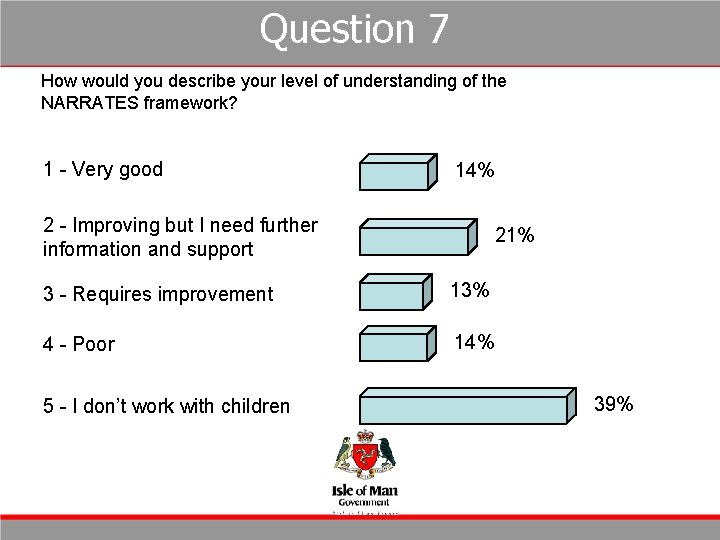
Question 7 How would you describe your level of understanding of the NARRATES framework? 1 - Very good 14% 2 - Improving but I need further information and support 21% 3 - Requires improvement 13% 4 - Poor 14% 5 - I don’t work with children 39%
Question 8 How would you describe your level of understanding of thresholds used in children’s services? 1 - Very good 2 - Good 3 - Adequate 4 - Requiring improvement 5 - Poor 6 - I don’t work with children 126
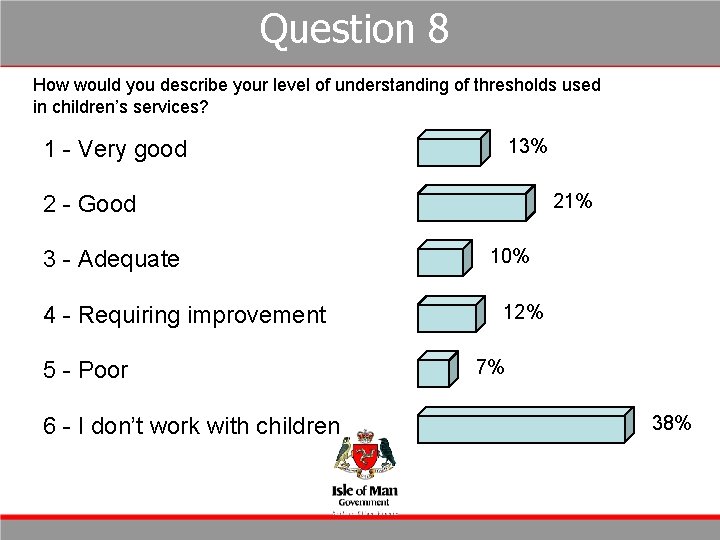
Question 8 How would you describe your level of understanding of thresholds used in children’s services? 13% 1 - Very good 21% 2 - Good 3 - Adequate 4 - Requiring improvement 5 - Poor 6 - I don’t work with children 10% 12% 7% 38%
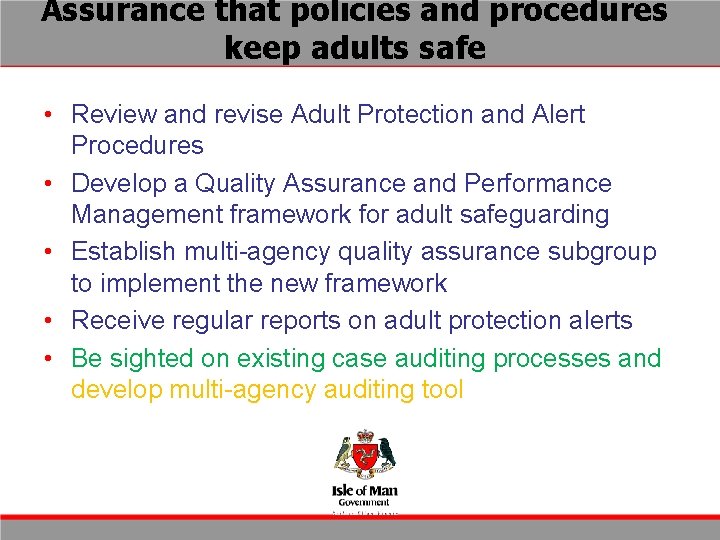
Assurance that policies and procedures keep adults safe • Review and revise Adult Protection and Alert Procedures • Develop a Quality Assurance and Performance Management framework for adult safeguarding • Establish multi-agency quality assurance subgroup to implement the new framework • Receive regular reports on adult protection alerts • Be sighted on existing case auditing processes and develop multi-agency auditing tool
Question 9 Thinking about the new Adult Protection Policy and Procedures, before I came to the Forum today: 1 - Was aware of the new policy and procedures and had engaged in the consultation on them 2 - Was aware of the new policy and procedures 3 - Was unaware that there was a new policy and procedures for adult protection 4 - I don’t work with adults 124
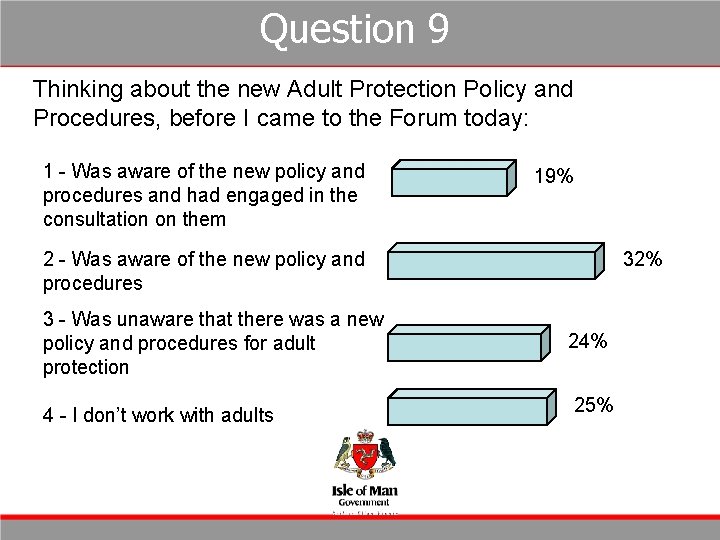
Question 9 Thinking about the new Adult Protection Policy and Procedures, before I came to the Forum today: 1 - Was aware of the new policy and procedures and had engaged in the consultation on them 19% 2 - Was aware of the new policy and procedures 32% 3 - Was unaware that there was a new policy and procedures for adult protection 24% 4 - I don’t work with adults 25%
Question 10 What would be your preferred way of ensuring that you understand feel confident in implementing the new policy and procedure. 1 - Practice guidance on-line 2 - Training and development activity delivered by the Board 3 - Incorporated in training opportunities within your own agency 4 - Paper-based guidance 5 - Practitioner Events 115
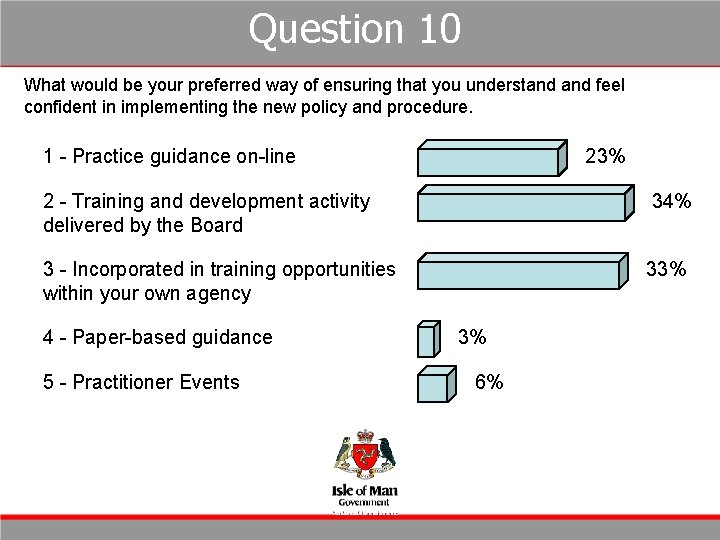
Question 10 What would be your preferred way of ensuring that you understand feel confident in implementing the new policy and procedure. 1 - Practice guidance on-line 23% 2 - Training and development activity delivered by the Board 34% 3 - Incorporated in training opportunities within your own agency 33% 4 - Paper-based guidance 5 - Practitioner Events 3% 6%
Identify and address risk – children and young people • Current risk areas identified and monitored: emotional health and well-being; neglect; looked after children and care leavers; children with disabilities and children missing from home and school; • Understand challenge the root causes of existing priority risk areas; • Investigate emerging areas of safeguarding risk: bullying; e-safety; child sexual exploitation.
Question 11 In undertaking your work to safeguard children in which area of need would you feel most confident? 1 - Neglect 2 - Emotional health and well-being 3 - Learning disabilities 4 - Looked after children 5 - Children missing 6 - Child sexual exploitation 7 - Bullying (including e-bullying) 8 - I don’t work with children 124
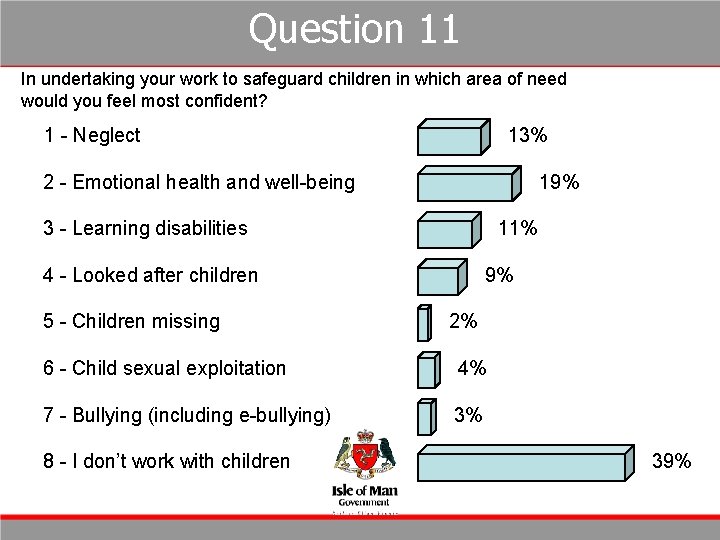
Question 11 In undertaking your work to safeguard children in which area of need would you feel most confident? 1 - Neglect 13% 2 - Emotional health and well-being 19% 3 - Learning disabilities 11% 4 - Looked after children 5 - Children missing 9% 2% 6 - Child sexual exploitation 4% 7 - Bullying (including e-bullying) 3% 8 - I don’t work with children 39%
Question 12 In undertaking your work to safeguard children in which area of need would you feel most confident? 1 - Neglect 2 - Emotional health and well-being 3 - Learning disabilities 4 - Looked after children 5 - Children missing 6 - Child sexual exploitation 7 - Bullying (including e-bullying) 8 - I don’t work with children 119
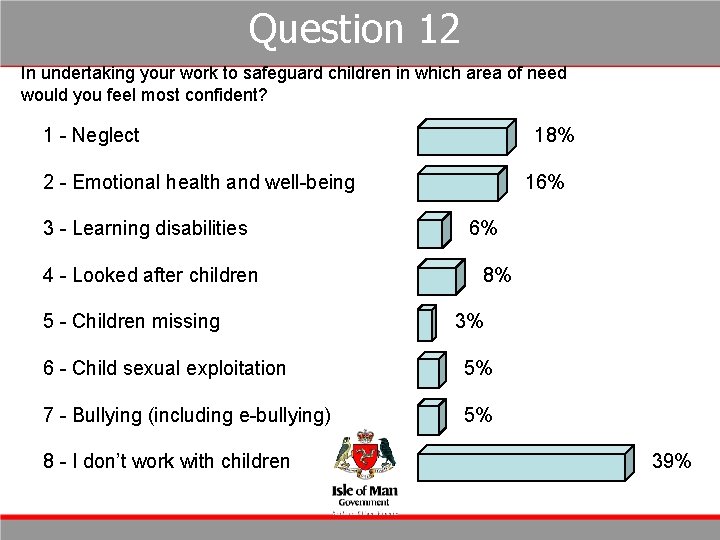
Question 12 In undertaking your work to safeguard children in which area of need would you feel most confident? 1 - Neglect 18% 2 - Emotional health and well-being 3 - Learning disabilities 4 - Looked after children 5 - Children missing 16% 6% 8% 3% 6 - Child sexual exploitation 5% 7 - Bullying (including e-bullying) 5% 8 - I don’t work with children 39%
Question 13 In undertaking your work to safeguard children in which area of need would you feel least confident and seek additional support and development? 1 - Neglect 2 - Emotional health and well-being 3 - Learning disabilities 4 - Looked after children 5 - Children missing 6 - Child sexual exploitation 7 - Bullying (including e-bullying) 8 - I don’t work with children 118
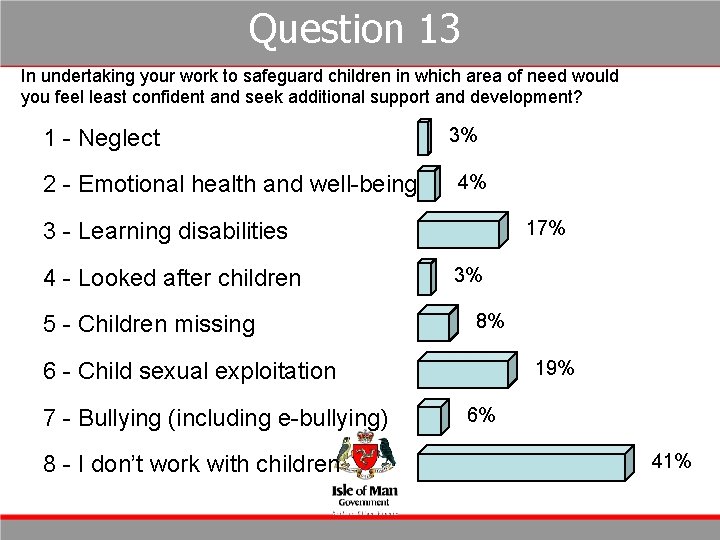
Question 13 In undertaking your work to safeguard children in which area of need would you feel least confident and seek additional support and development? 1 - Neglect 2 - Emotional health and well-being 3% 4% 17% 3 - Learning disabilities 4 - Looked after children 5 - Children missing 3% 8% 19% 6 - Child sexual exploitation 7 - Bullying (including e-bullying) 8 - I don’t work with children 6% 41%
Question 14 In undertaking your work to safeguard children in which area of need would you feel least confident and seek additional support and development? 1 - Neglect 2 - Emotional health and well-being 3 - Learning disabilities 4 - Looked after children 5 - Children missing 6 - Child sexual exploitation 7 - Bullying (including e-bullying) 8 - I don’t work with children 116
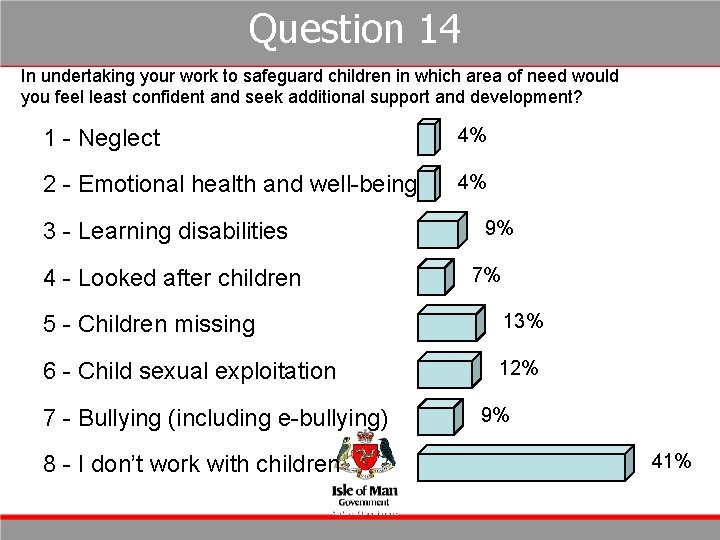
Question 14 In undertaking your work to safeguard children in which area of need would you feel least confident and seek additional support and development? 1 - Neglect 4% 2 - Emotional health and well-being 4% 3 - Learning disabilities 4 - Looked after children 9% 7% 5 - Children missing 13% 6 - Child sexual exploitation 12% 7 - Bullying (including e-bullying) 8 - I don’t work with children 9% 41%
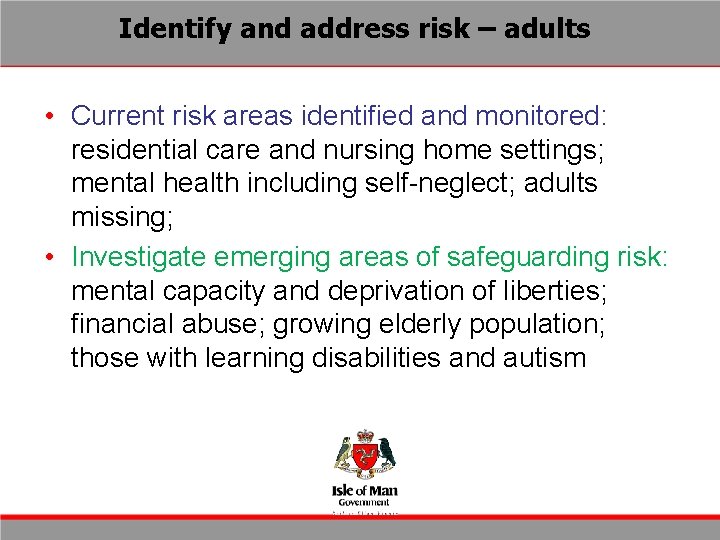
Identify and address risk – adults • Current risk areas identified and monitored: residential care and nursing home settings; mental health including self-neglect; adults missing; • Investigate emerging areas of safeguarding risk: mental capacity and deprivation of liberties; financial abuse; growing elderly population; those with learning disabilities and autism
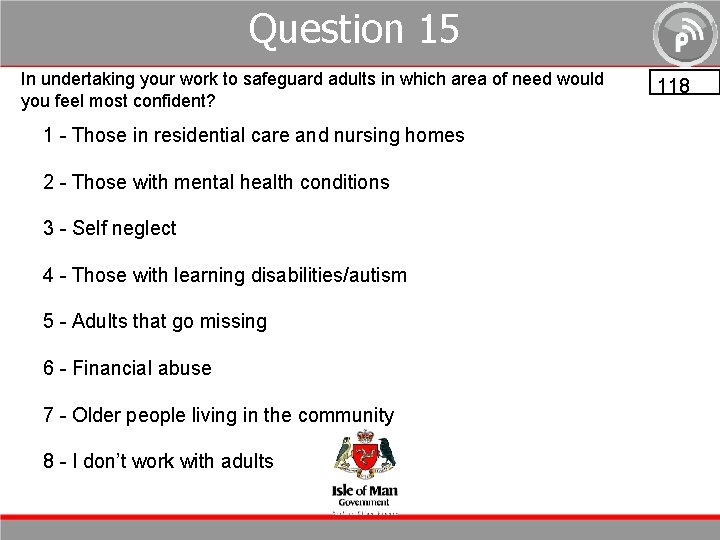
Question 15 In undertaking your work to safeguard adults in which area of need would you feel most confident? 1 - Those in residential care and nursing homes 2 - Those with mental health conditions 3 - Self neglect 4 - Those with learning disabilities/autism 5 - Adults that go missing 6 - Financial abuse 7 - Older people living in the community 8 - I don’t work with adults 118
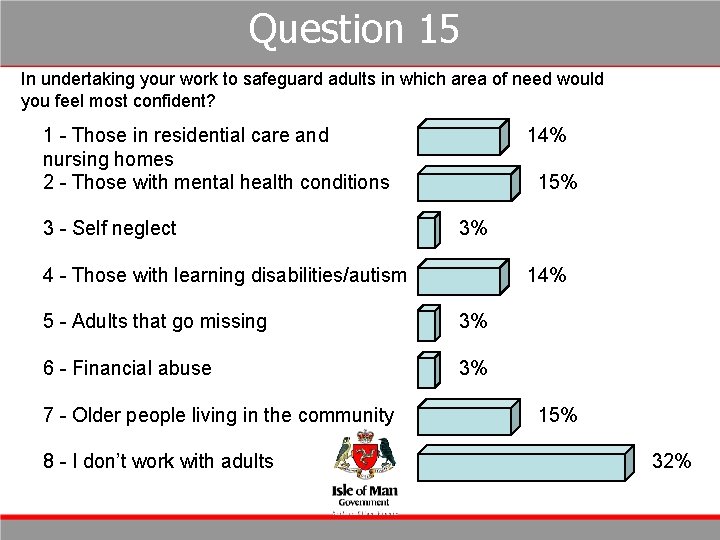
Question 15 In undertaking your work to safeguard adults in which area of need would you feel most confident? 1 - Those in residential care and nursing homes 2 - Those with mental health conditions 3 - Self neglect 14% 15% 3% 4 - Those with learning disabilities/autism 14% 5 - Adults that go missing 3% 6 - Financial abuse 3% 7 - Older people living in the community 8 - I don’t work with adults 15% 32%
Question 16 In undertaking your work to safeguard adults in which area of need would you feel most confident? 1 - Those in residential care and nursing homes 2 - Those with mental health conditions 3 - Self neglect 4 - Those with learning disabilities/autism 5 - Adults that go missing 6 - Financial abuse 7 - Older people 8 - I don’t work with adults 114
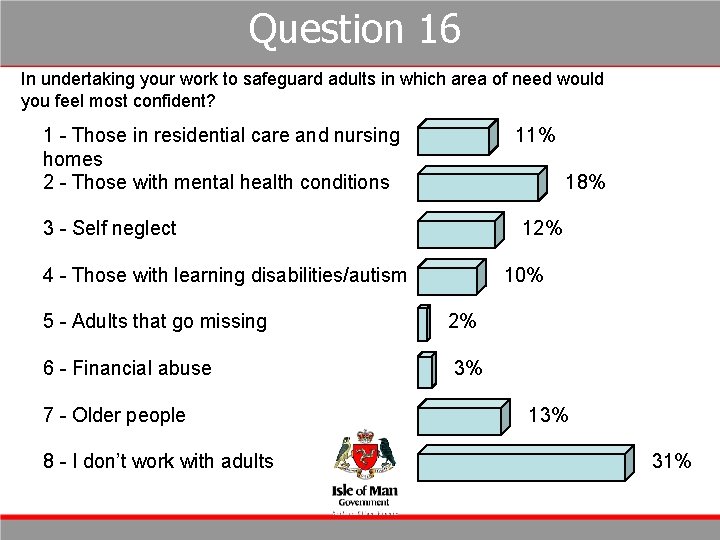
Question 16 In undertaking your work to safeguard adults in which area of need would you feel most confident? 1 - Those in residential care and nursing homes 2 - Those with mental health conditions 11% 18% 3 - Self neglect 12% 4 - Those with learning disabilities/autism 5 - Adults that go missing 6 - Financial abuse 7 - Older people 8 - I don’t work with adults 10% 2% 3% 13% 31%
Question 17 In undertaking your work to safeguard adults in which area of need would you feel least confident and seek support and development? 1 - Those in residential care and nursing homes 2 - Those with mental health conditions 3 - Self neglect 4 - Those with learning disabilities/autism 5 - Adults that go missing 6 - Financial abuse 7 - Older people living in the community 8 - I don’t work with adults 108
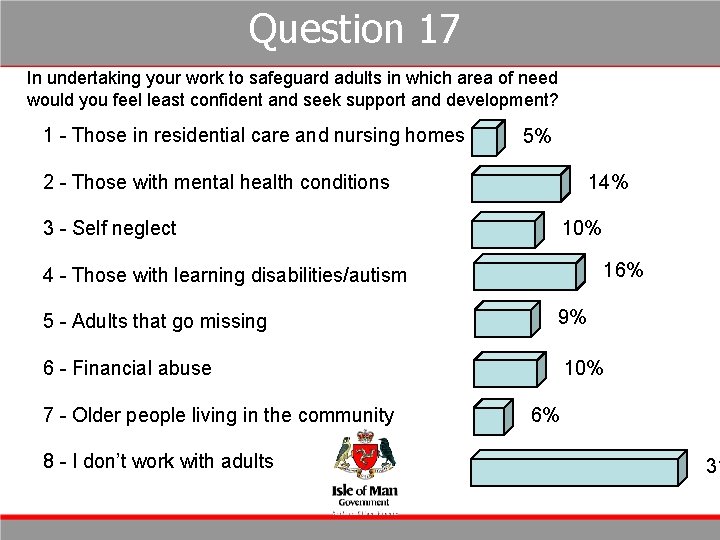
Question 17 In undertaking your work to safeguard adults in which area of need would you feel least confident and seek support and development? 1 - Those in residential care and nursing homes 5% 2 - Those with mental health conditions 14% 3 - Self neglect 10% 16% 4 - Those with learning disabilities/autism 5 - Adults that go missing 9% 6 - Financial abuse 10% 7 - Older people living in the community 8 - I don’t work with adults 6% 31
Question 18 In undertaking your work to safeguard adults in which area of need would you feel least confident and seek support and development? 1 - Those in residential care and nursing homes 2 - Those with mental health conditions 3 - Self neglect 4 - Those with learning disabilities/autism 5 - Adults that go missing 6 - Financial abuse 7 - Older people 8 - I don’t work with adults 104
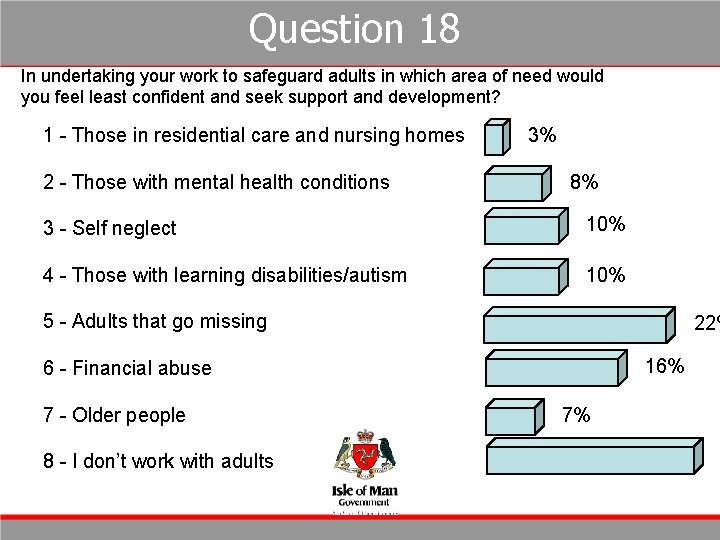
Question 18 In undertaking your work to safeguard adults in which area of need would you feel least confident and seek support and development? 1 - Those in residential care and nursing homes 2 - Those with mental health conditions 3% 8% 3 - Self neglect 10% 4 - Those with learning disabilities/autism 10% 5 - Adults that go missing 22% 16% 6 - Financial abuse 7 - Older people 8 - I don’t work with adults 7%
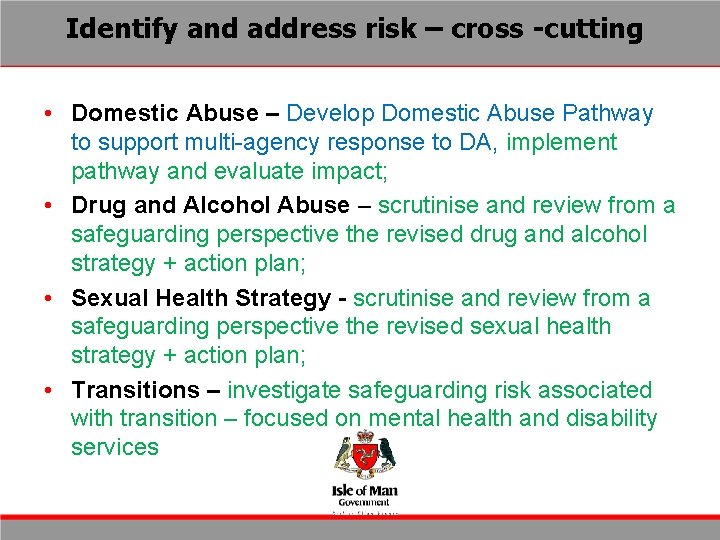
Identify and address risk – cross -cutting • Domestic Abuse – Develop Domestic Abuse Pathway to support multi-agency response to DA, implement pathway and evaluate impact; • Drug and Alcohol Abuse – scrutinise and review from a safeguarding perspective the revised drug and alcohol strategy + action plan; • Sexual Health Strategy - scrutinise and review from a safeguarding perspective the revised sexual health strategy + action plan; • Transitions – investigate safeguarding risk associated with transition – focused on mental health and disability services
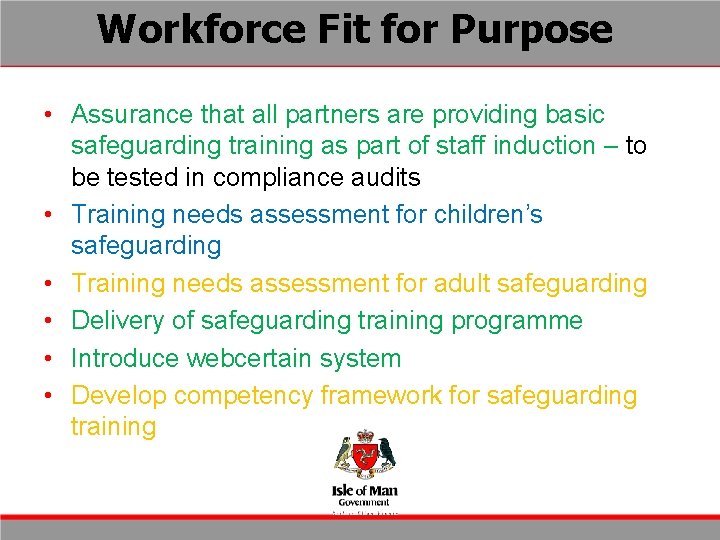
Workforce Fit for Purpose • Assurance that all partners are providing basic safeguarding training as part of staff induction – to be tested in compliance audits • Training needs assessment for children’s safeguarding • Training needs assessment for adult safeguarding • Delivery of safeguarding training programme • Introduce webcertain system • Develop competency framework for safeguarding training
Voice of service users and staff • Engagement with children and young people – Vi. P initiative to establish Investors in Children • Questions on safeguarding included in Youth Survey • Voice of child/young person from reviews • Audit of current engagement arrangements in children and adult services • Three safeguarding forums • Visits to provision and to meet teams
Voice of service users and staff • Audit of information provided to users/families/parents and carers and plan to fill gaps – adult safeguarding leaflet/guidance for parents whose children attend sports clubs. • Engagement with politicians – business plans to Social Policy and Children’s Committee. • Awareness raising initiative for politicians • Website developments
Question 19 My service/organisation has: 1 - Robust arrangements to hear the voice of the service user both individually and collectively and acts on these views 2 - Arrangements to hear the voice of service user representatives 3 - Arrangements to hear the voice of individual service users 4 - Has yet to develop arrangements to engage service users 110
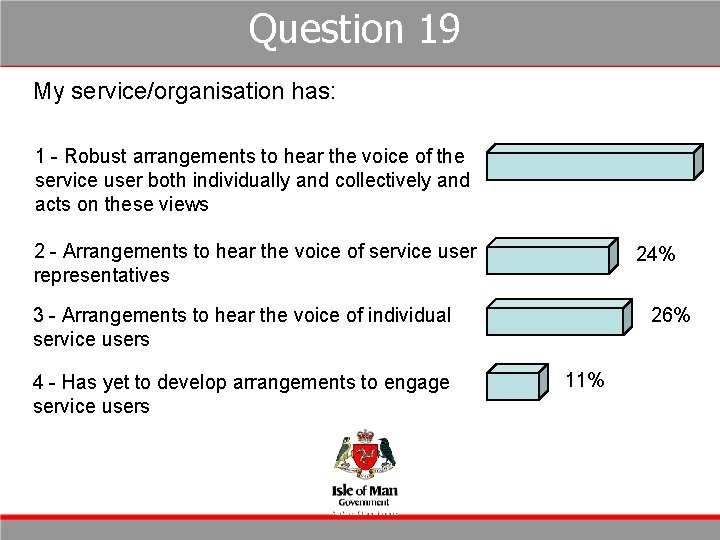
Question 19 My service/organisation has: 1 - Robust arrangements to hear the voice of the service user both individually and collectively and acts on these views 2 - Arrangements to hear the voice of service user representatives 24% 3 - Arrangements to hear the voice of individual service users 4 - Has yet to develop arrangements to engage service users 26% 11%
Question 20 Getting my voice heard. The SCB and SAP want to ensure the voice of staff is heard as they undertake their work. What would be your preferred method of achieving this: 1 - Staff forums such as this one today 2 - Inter-active e-forums e. g. on the website 3 - Staff surveys on key issues 4 - Feedback through existing team/departmental meeting arrangements 5 - Other methods 113
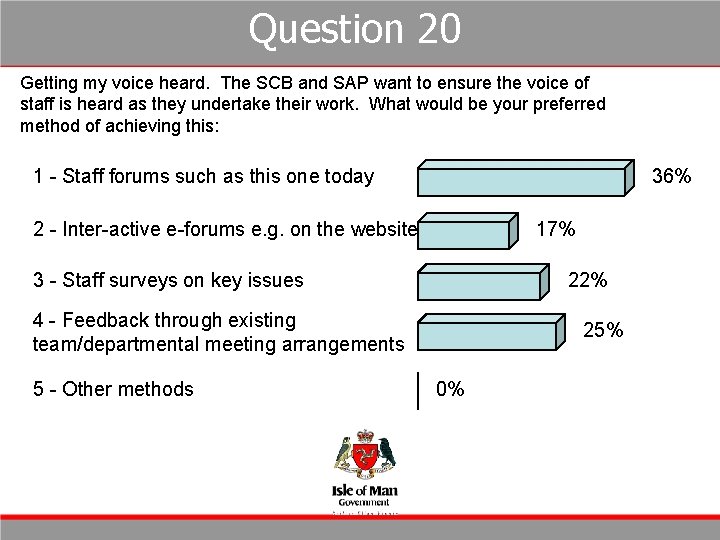
Question 20 Getting my voice heard. The SCB and SAP want to ensure the voice of staff is heard as they undertake their work. What would be your preferred method of achieving this: 1 - Staff forums such as this one today 36% 2 - Inter-active e-forums e. g. on the website 17% 3 - Staff surveys on key issues 22% 4 - Feedback through existing team/departmental meeting arrangements 5 - Other methods 25% 0%
OPEN FORUM
THANKYOU
- Slides: 73