
Safeguarding and Protection in Care Settings Your starter












- Slides: 57
Safeguarding and Protection in Care Settings Your starter activity: The Million Pound Drop Yes, you read it right… £ 1, 000!!!!
HOUSEKEEPING • • PLEASE SWITCH OFF OR SILENCE ALL PHONES AND DO NOT ANSWER DURING CLASS TIME PLEASE LEAVE THE BUILDING IN AN ORDELY MANNER IF YOU HEAR THE FIRE ALARM AND HAVE NOT BEEN TOLD IT IS A TEST PLEASE RESPECT EACH OTHERS CONFIDENTIALITY PLEASE SHOW RESECT TO EACH OTHER…. WE ARE ALL DIFFERENT, WE LEARN DIFFERENTLY AND WE HAVE DIFFERENT BELIEFS PLEASE DO NOT HAVE ANY DRINKS NEAR THE COMPUTERS LEAVE ON THE MAIN TABLES AND ONLY BOLLTLED WATER IS ALLOWED IN THE CLASSROOM NO EATING DURING LESSONS…. NOT EVEN MARSHMALLOWS (this will make sense at a later date)!!! FINALLY………PLEASE CLEAR AWAY YOUR RUBBISH INTO THE BINS AND LEAVE THE CLASS AS WE FOUND IT
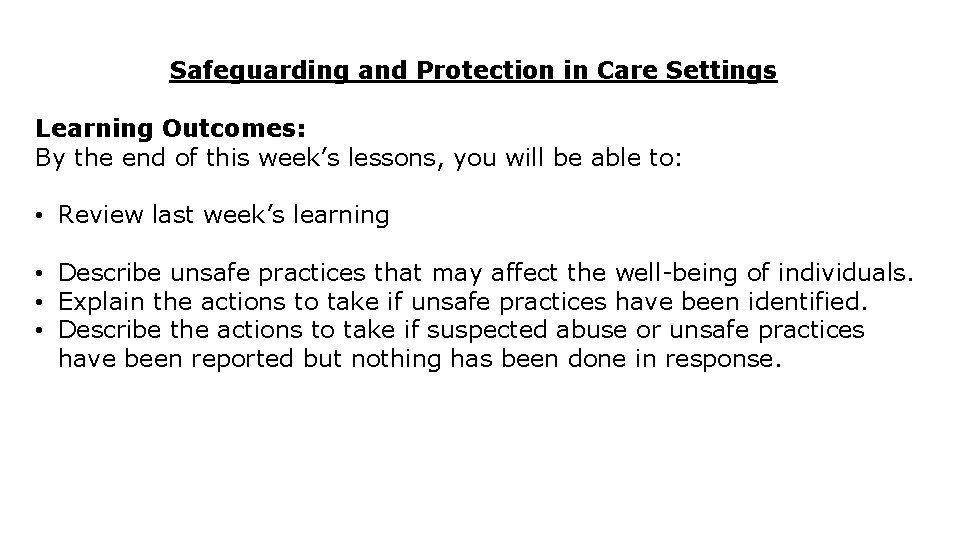
Safeguarding and Protection in Care Settings Learning Outcomes: By the end of this week’s lessons, you will be able to: • Review last week’s learning • Describe unsafe practices that may affect the well-being of individuals. • Explain the actions to take if unsafe practices have been identified. • Describe the actions to take if suspected abuse or unsafe practices have been reported but nothing has been done in response.
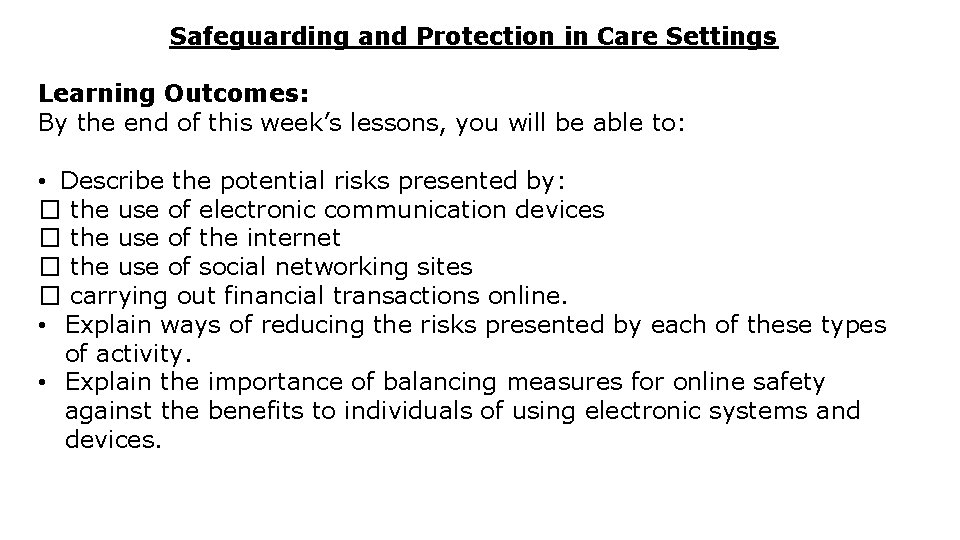
Safeguarding and Protection in Care Settings Learning Outcomes: By the end of this week’s lessons, you will be able to: • Describe the potential risks presented by: � the use of electronic communication devices � the use of the internet � the use of social networking sites � carrying out financial transactions online. • Explain ways of reducing the risks presented by each of these types of activity. • Explain the importance of balancing measures for online safety against the benefits to individuals of using electronic systems and devices.
Safeguarding and Protection in Care Settings Learning Outcomes: By the end of this week’s lessons, you will be able to: • Examine the assignment for this unit • - Develop employability skills such as: team working communication skills analytical skills literacy skills • Link safeguarding to British values
Reliable sources of information • • BBC News - www. bbc. co. uk/news The Guardian (newspaper) - www. theguardian. com/uk www. communitycare. co. uk www. scie. org. uk www. nhs. uk www. gov. uk www. hse. gov. uk (Health and Safety Executive)
Recap activity The Million Pound Drop!!!
Recap activity You were asked to read through last week's work and: 1. Write questions based on things you didn't understand 2. Write a question (based on something you did understand) which you think no one else can answer On a post-it note, write down a question which you think no one else can answer and keep that.
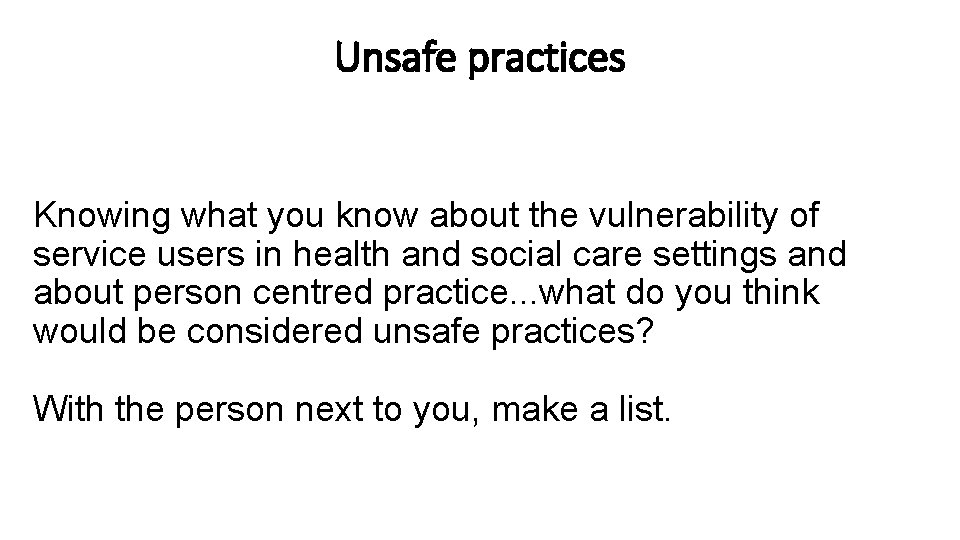
Unsafe practices Knowing what you know about the vulnerability of service users in health and social care settings and about person centred practice. . . what do you think would be considered unsafe practices? With the person next to you, make a list.
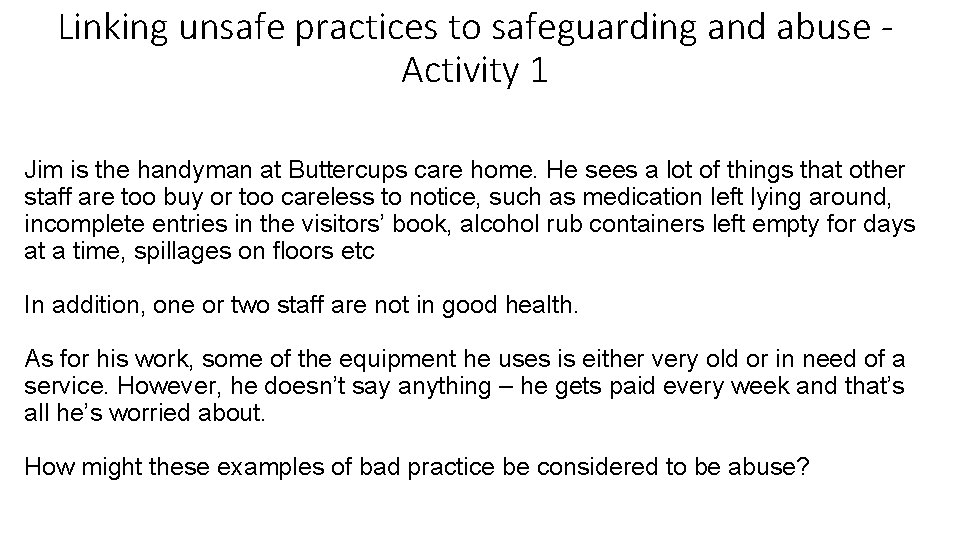
Linking unsafe practices to safeguarding and abuse Activity 1 Jim is the handyman at Buttercups care home. He sees a lot of things that other staff are too buy or too careless to notice, such as medication left lying around, incomplete entries in the visitors’ book, alcohol rub containers left empty for days at a time, spillages on floors etc In addition, one or two staff are not in good health. As for his work, some of the equipment he uses is either very old or in need of a service. However, he doesn’t say anything – he gets paid every week and that’s all he’s worried about. How might these examples of bad practice be considered to be abuse?
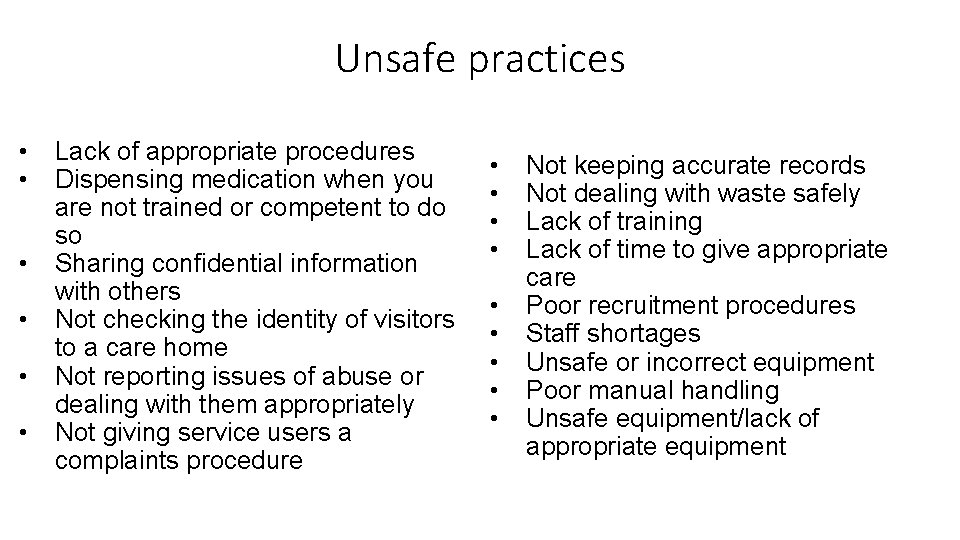
Unsafe practices • • • Lack of appropriate procedures Dispensing medication when you are not trained or competent to do so Sharing confidential information with others Not checking the identity of visitors to a care home Not reporting issues of abuse or dealing with them appropriately Not giving service users a complaints procedure • • • Not keeping accurate records Not dealing with waste safely Lack of training Lack of time to give appropriate care Poor recruitment procedures Staff shortages Unsafe or incorrect equipment Poor manual handling Unsafe equipment/lack of appropriate equipment
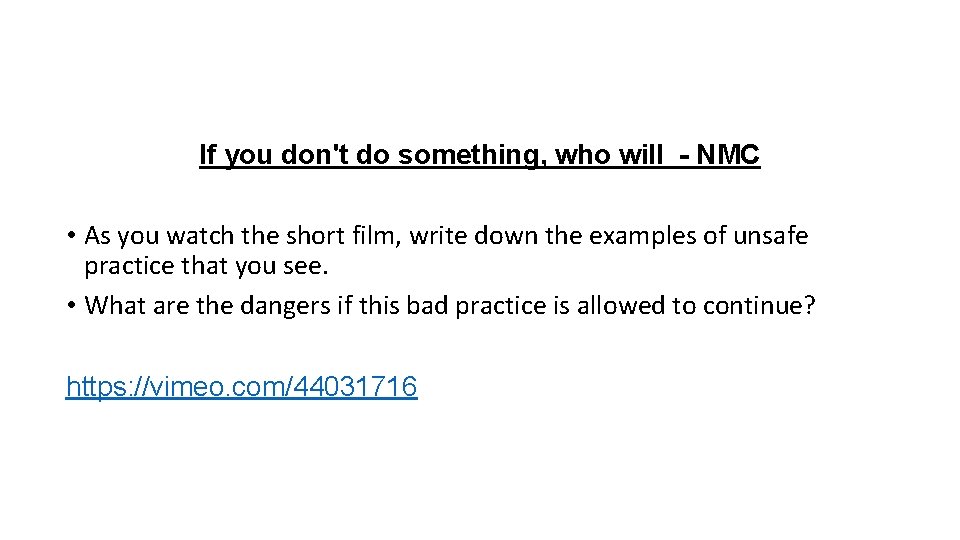
If you don't do something, who will - NMC • As you watch the short film, write down the examples of unsafe practice that you see. • What are the dangers if this bad practice is allowed to continue? https: //vimeo. com/44031716
Action to take if you identify unsafe practices Activity 2 In your pairs, you will be given one of the three case studies. Read through the case study and write down what action you would take in the given situation.
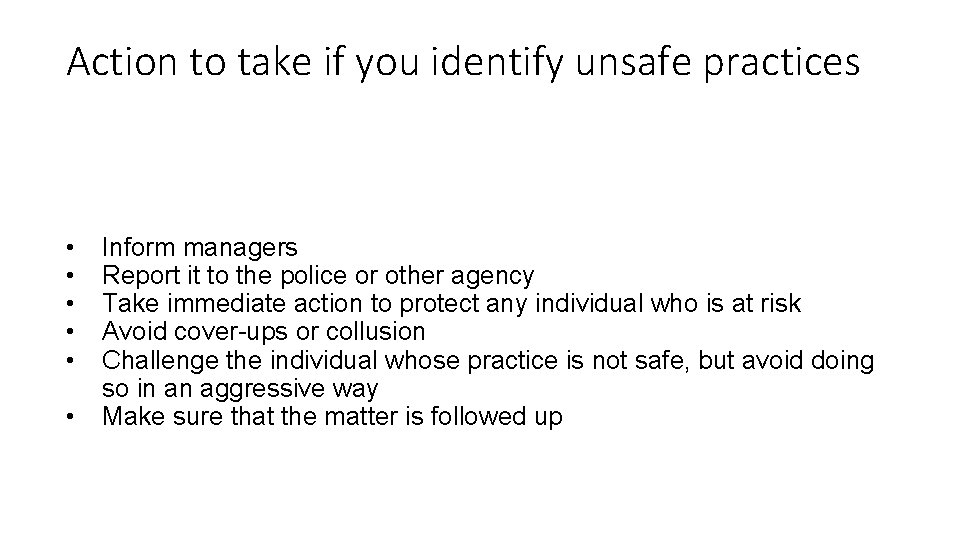
Action to take if you identify unsafe practices • • • Inform managers Report it to the police or other agency Take immediate action to protect any individual who is at risk Avoid cover-ups or collusion Challenge the individual whose practice is not safe, but avoid doing so in an aggressive way Make sure that the matter is followed up
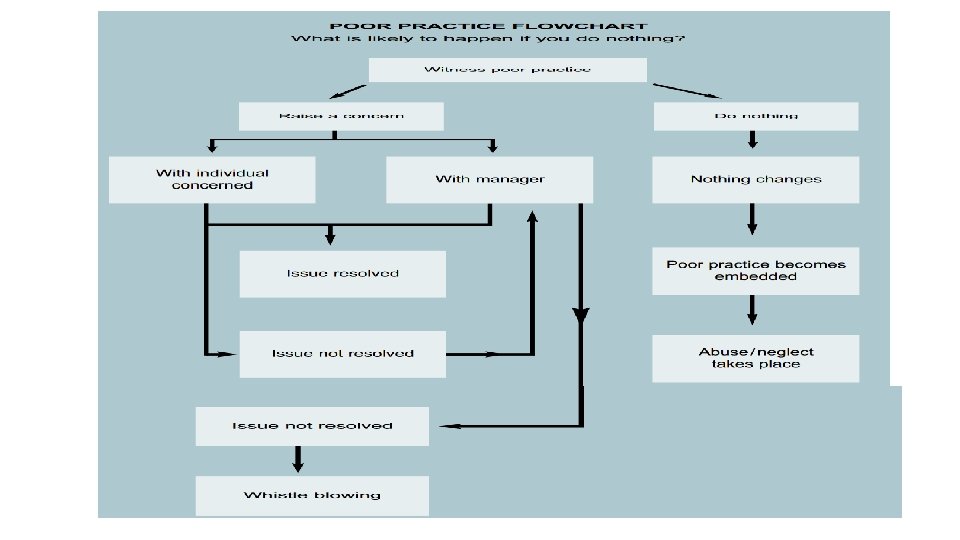
What to do if suspected abuse or unsafe practices have been reported but nothing has been done in response In pairs, you have three minutes to list the actions you should take if you report abuse but no action is taken. Take it in turns to write an answer for your list.
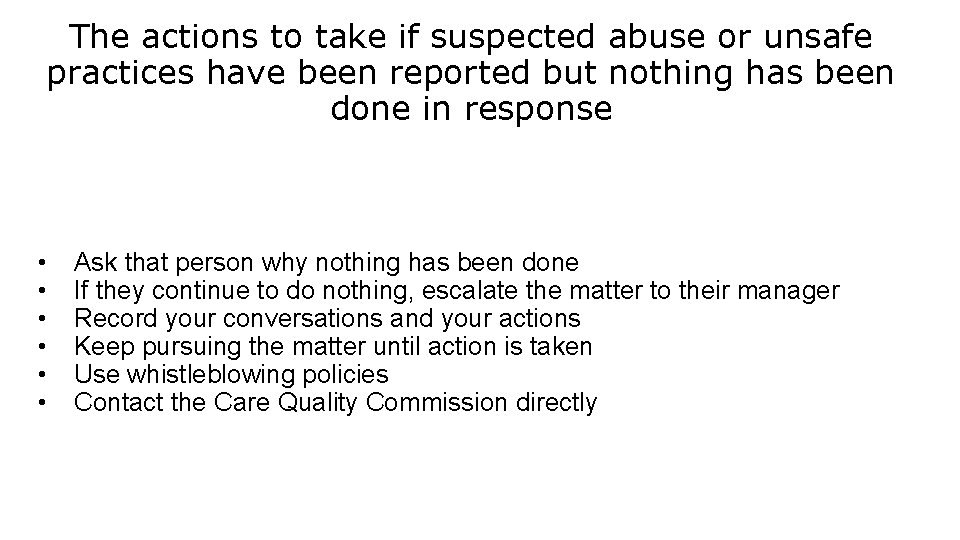
The actions to take if suspected abuse or unsafe practices have been reported but nothing has been done in response • • • Ask that person why nothing has been done If they continue to do nothing, escalate the matter to their manager Record your conversations and your actions Keep pursuing the matter until action is taken Use whistleblowing policies Contact the Care Quality Commission directly
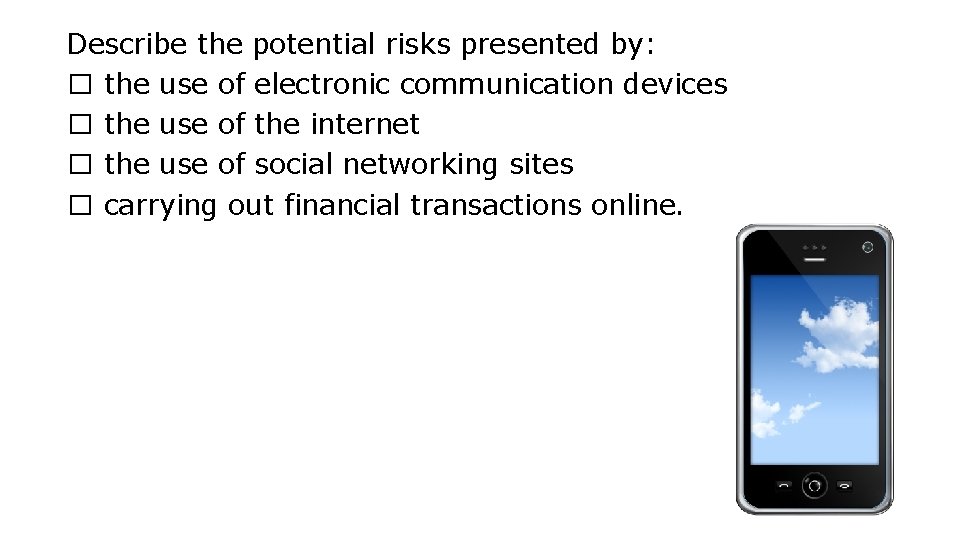
Describe the potential risks presented by: � the use of electronic communication devices � the use of the internet � the use of social networking sites � carrying out financial transactions online.
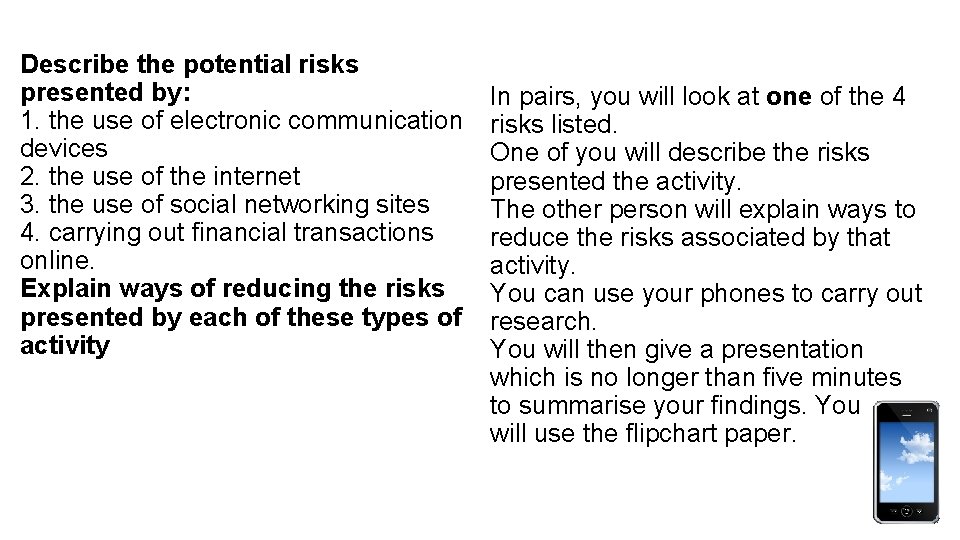
Describe the potential risks presented by: 1. the use of electronic communication devices 2. the use of the internet 3. the use of social networking sites 4. carrying out financial transactions online. Explain ways of reducing the risks presented by each of these types of activity In pairs, you will look at one of the 4 risks listed. One of you will describe the risks presented the activity. The other person will explain ways to reduce the risks associated by that activity. You can use your phones to carry out research. You will then give a presentation which is no longer than five minutes to summarise your findings. You will use the flipchart paper.
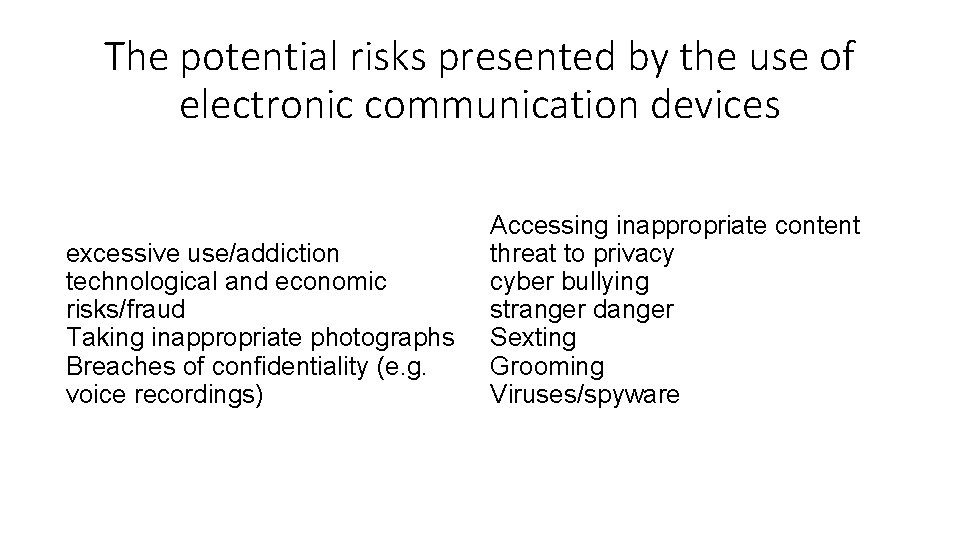
The potential risks presented by the use of electronic communication devices excessive use/addiction technological and economic risks/fraud Taking inappropriate photographs Breaches of confidentiality (e. g. voice recordings) Accessing inappropriate content threat to privacy cyber bullying stranger danger Sexting Grooming Viruses/spyware
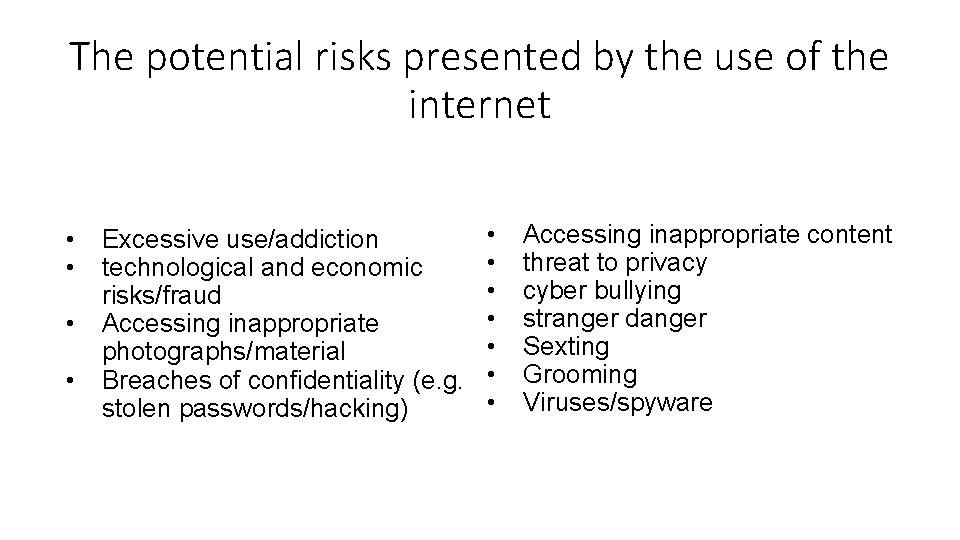
The potential risks presented by the use of the internet • • Excessive use/addiction technological and economic risks/fraud Accessing inappropriate photographs/material Breaches of confidentiality (e. g. stolen passwords/hacking) • • Accessing inappropriate content threat to privacy cyber bullying stranger danger Sexting Grooming Viruses/spyware
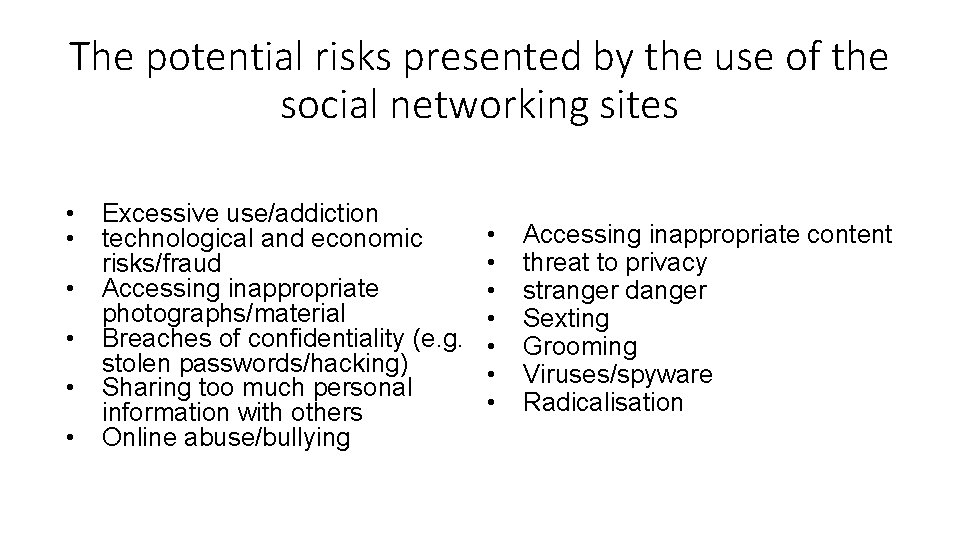
The potential risks presented by the use of the social networking sites • • • Excessive use/addiction technological and economic risks/fraud Accessing inappropriate photographs/material Breaches of confidentiality (e. g. stolen passwords/hacking) Sharing too much personal information with others Online abuse/bullying • • Accessing inappropriate content threat to privacy stranger danger Sexting Grooming Viruses/spyware Radicalisation
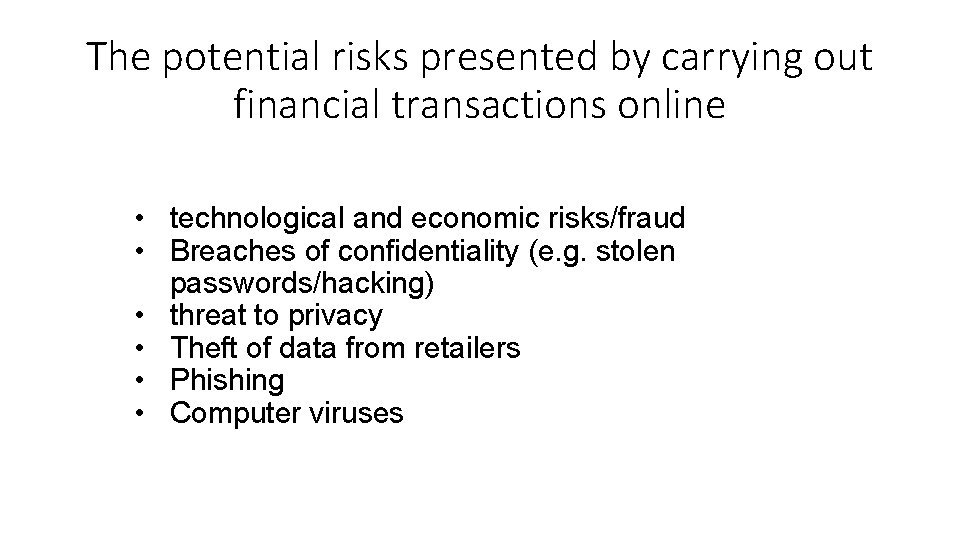
The potential risks presented by carrying out financial transactions online • technological and economic risks/fraud • Breaches of confidentiality (e. g. stolen passwords/hacking) • threat to privacy • Theft of data from retailers • Phishing • Computer viruses
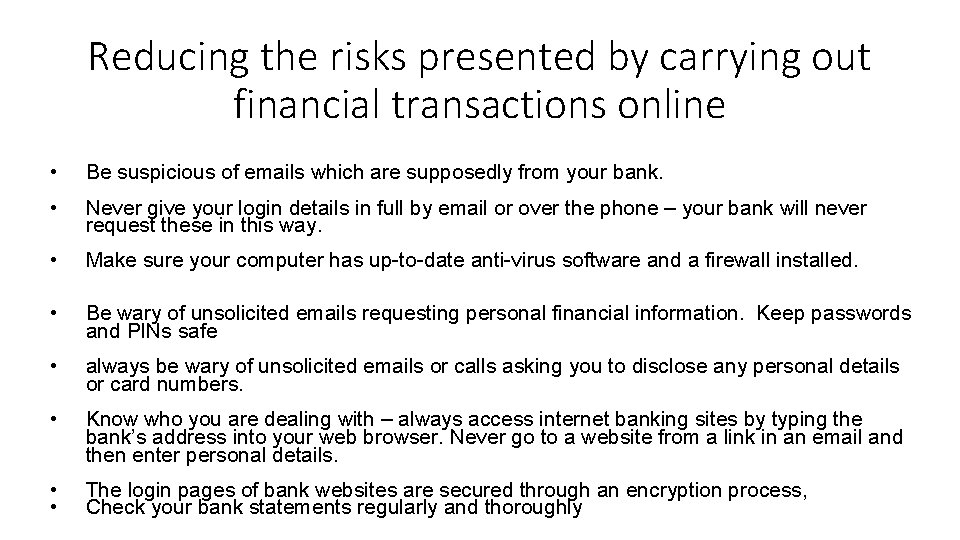
Reducing the risks presented by carrying out financial transactions online • Be suspicious of emails which are supposedly from your bank. • Never give your login details in full by email or over the phone – your bank will never request these in this way. • Make sure your computer has up-to-date anti-virus software and a firewall installed. • Be wary of unsolicited emails requesting personal financial information. Keep passwords and PINs safe • always be wary of unsolicited emails or calls asking you to disclose any personal details or card numbers. • Know who you are dealing with – always access internet banking sites by typing the bank’s address into your web browser. Never go to a website from a link in an email and then enter personal details. • • The login pages of bank websites are secured through an encryption process, Check your bank statements regularly and thoroughly
Balancing measures for online safety against the benefits to individuals of using technology You work in a children's care home. One of your residents is a 14 -year-old girl. She has a smart phone and she needs access to the internet on the computer so that she can do her homework. 1. What are the benefits for her of having a smart phone and access to the Internet? 2. As you are aware of the dangers that are associated with the Internet and mobile phones, you take the following action: you suggest buying her a Nokia 3310 (ie this is not a smart phone). You also decide that, while she is doing her homework, you will stay in the room and monitor her. How do you think she will react to this? What can you do to balance your need to keep her safe against her wish and need to use technology?
RECAP ON THE OBJECTIVES FOR TODAY Learning Outcomes: By the end of this week’s lessons, you will be able to: • Recap and remember last week’s learning • Describe unsafe practices that may affect the well-being of individuals. • Explain the actions to take if unsafe practices have been identified. • Describe the actions to take if suspected abuse or unsafe practices have been reported but nothing has been done in response.
Recap
Review the 7 learning objectives… and time for questions
Common themes • Protection • Balancing health and safety with human rights and dignity • Privacy • Independence • Having one’s need met • Being listened to • Safe services/safe practices • Being prepared • Reducing risks • Openness and accountability so that others can see that services work safely • Duties on employers to keep staff and services users safe (eg risk assessments)
PUT YOUR HANDS UP IF……. . • YOU WERE BORN IN THIS COUNTRY • YOU HAVE CHILDREN • YOU HAVE BROWN EYES • YOU HAVE BLONDE HAIR • YOU SPEAK ANOTHER LANGUAGE • YOU ARE MARRIED • YOU HAVE STUDIED BEFORE AT THE MANCHESTER COLLEGE • YOU EAT MEAT • YOU ARE A VEGATARIAN
WHAT MAKES UP OUR PERSONAL IDENTITY • THE CLUBS WE ARE PART OF • THE LANGUAGE WE SPEAK • OUR BELIEFS • OUR CULTURE • THE COUNTRY WE ARE FROM • OUR HOPES FOR THE FUTURE • OUR ASPIRATIONS • THE WAY WE DRESS • THE WAY WE SPEAK • WHO IS IMPORTANT TO YOU…….
Activity…. . make a leaflet for new staff You will be developing a leaflet for new staff in relation to safeguarding. It will include… • Types of abuse including a few of the signs and symptoms • What harm and restrictive practices mean 60 • Factors that can lead to abuse minutes to • Actions to take if you suspect abuse complete • How to preserve evidence • At least 3 pieces of legislation with a brief explanation • Where help can be accessed • How person centred values, active participation and promoting rights, choice and personal safety can help a service user • The complaints procedure. Telling them in bullet point what they need to do and what will happen when a complaint is made • What unsafe practice is • How to protect themselves and the service user from online risks • How to ensure the service users wellbeing is maintained
WELLBEING? ? • Why is it important to ensure the person’s wellbeing is protected when monitoring and ensuring risks are not too high for the individuals you will be caring for? ? ? • What ensures a person’s wellbeing? • What can we do to ensure it is protected? • What aspects of a person’s wellbeing will we be supporting them with eg social…. ?
SO WHAT IS WELLBEING? ? • The state of being comfortable, healthy, or happy. • And may also include a persons perception on their………. . welfare, health, good health, happiness, comfort, security, safety, protection, prosperity, success, fortune, good fortune, advantage, interest. • This will differ from individual to individual.
Wellbeing Well-being may include aspects that are: • Social • Emotional • Cultural • Spiritual • Intellectual • Economic • Physical • mental
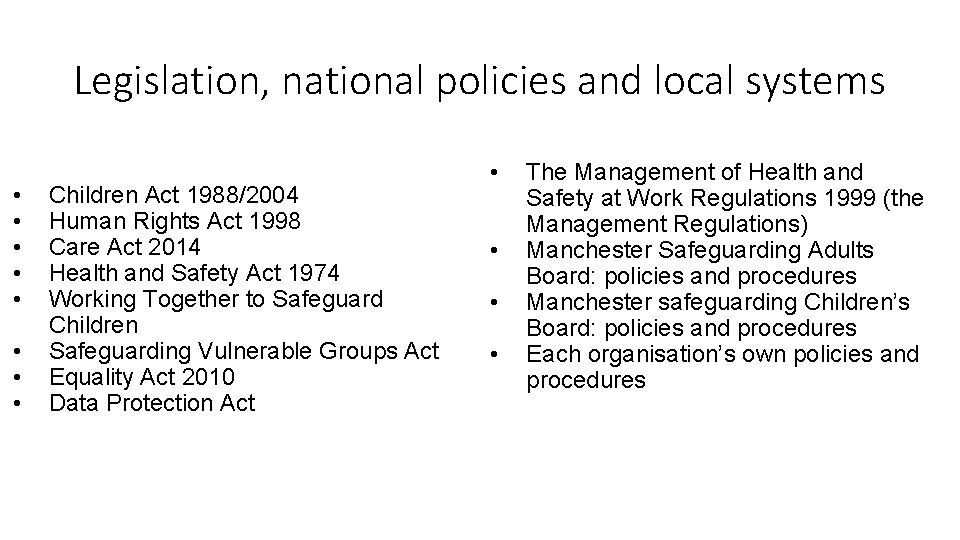
Legislation, national policies and local systems • • Children Act 1988/2004 Human Rights Act 1998 Care Act 2014 Health and Safety Act 1974 Working Together to Safeguard Children Safeguarding Vulnerable Groups Act Equality Act 2010 Data Protection Act • • The Management of Health and Safety at Work Regulations 1999 (the Management Regulations) Manchester Safeguarding Adults Board: policies and procedures Manchester safeguarding Children’s Board: policies and procedures Each organisation’s own policies and procedures
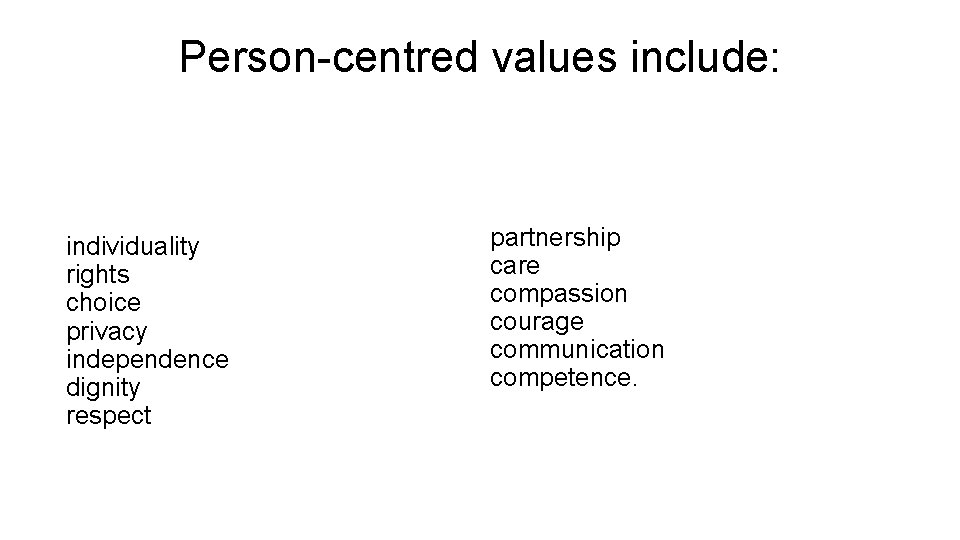
Person-centred values include: individuality rights choice privacy independence dignity respect partnership care compassion courage communication competence.
Workbook tasks
What have you learnt. . ? 2 stars and a wish… • On paper, write down • 2 things that you have learnt 1 thing about which you are unsure You will share these with the rest of the class
ON YOUR OBJECTIVES SHEET • Please tick the boxes on your objective sheet • Tick the ones we have covered and that you understand
Safeguarding and Protection in Care Settings Learning Outcomes: By the end of this week’s lessons, you will be able to: • Review last week’s learning • Describe unsafe practices that may affect the well-being of individuals. • Explain the actions to take if unsafe practices have been identified. • Describe the actions to take if suspected abuse or unsafe practices have been reported but nothing has been done in response.
Safeguarding and Protection in Care Settings Learning Outcomes: By the end of this week’s lessons, you will be able to: • Describe the potential risks presented by: � the use of electronic communication devices � the use of the internet � the use of social networking sites � carrying out financial transactions online. • Explain ways of reducing the risks presented by each of these types of activity. • Explain the importance of balancing measures for online safety against the benefits to individuals of using electronic systems and devices.
Safeguarding and Protection in Care Settings Learning Outcomes: By the end of this week’s lessons, you will be able to: • Examine the assignment for this unit • - Develop employability skills such as: team working communication skills presentation skills literacy skills • Link safeguarding to British values