
Safeguarding and Child Protection Annual Update August 2017
![Agenda • National Guidance for Child Protection in Scotland [2014] Safeguarding and Child Protection,](https://slidetodoc.com/presentation_image_h2/9d33fb8b244acf76a1a06372afcb1f3f/image-2.jpg "Agenda • National Guidance for Child Protection in Scotland [2014] Safeguarding and Child Protection,")
![MARAC process List of names to Education Services. [week before MARAC] Identify those young](https://slidetodoc.com/presentation_image_h2/9d33fb8b244acf76a1a06372afcb1f3f/image-35.jpg "MARAC process List of names to Education Services. [week before MARAC] Identify those young")
- Slides: 37
Safeguarding and Child Protection Annual Update August 2017
Agenda • National Guidance for Child Protection in Scotland [2014] Safeguarding and Child Protection, HGIOS MC 57 • Child Sexual Exploitation/Trafficking • Domestic Abuse and M. A. R. A. C.
National Guidance for Child Protection in Scotland 2014 • This document provides a national framework within which agencies and practitioners at a local level can understand agree processes for working together to support, promote and safeguard the wellbeing of children. • It sets out expectations for strategic planning of services to protect children and young people and highlights key responsibilities for services and organisations. ’ • All agencies that deliver child services and work with children and families have a responsibility to recognise and actively consider potential risks to a child. They are expected to identify and consider the child’s needs, share information an concerns with other agencies to improve outcomes or the child. ’ • www. gov. scot/Publications/2014/05/3052
National Guidance for Child Protection 2014 The guidance is in 4 parts. Part 1 – The context for child protection which addresses the definitions, principles, standards and legislative framework that underpin the approach to keeping children safe and promoting their wellbeing. Part 2 – Roles and Responsibilities for child protection outlines the core responsibilities of services and organisations including statutory and non statutory services. The role and functions of Child protection Committees are outlined. Effective leadership and staff development and training are also outlined. National Guidance for Child Protection in Scotland Page 3
National Guidance for Child Protection 2014 Part 2 Education Staff School staff play a crucial role in the support and protection of children as well as the development of their wellbeing. School staff ‘are likely to have the greatest level of day to day contact with children and so are well placed to observe the physical, and psychological changes in a child that could indicate abuse and to contribute to the assessment of vulnerable children. ’ National Guidance for Child Protection in Scotland Page 50
National Guidance for Child Protection 2014 Part 3 – Identifying and responding to concerns about children provides a framework for identifying and managing risk and outlines the stages of responding to concerns about a child’s safety. Part 4 – Child protection in specific circumstances gives additional information on dealing with specific circumstances that may adversely impact on children as well as addressing operational considerations. National Guidance for Child Protection in Scotland Page 3
Safeguarding and Child Protection ‘Safeguarding is the golden thread that runs through the curriculum. The aim is to support the development of learners knowledge, skills and resilience to keep themselves safe and protect themselves and to develop an understanding of the world so that they can respond to a range of issues and potential risky situations arising throughout their lives. ’ Education Scotland Policy, Procedures and Guidance for Safeguarding 2016 P 1
‘Education Scotland Policy, Procedures and Guidance for Safeguarding’ Sept 2016 Safeguarding ‘Safeguarding is a much wider concept than child protection and includes supporting and protecting the safety, wellbeing and dignity of all children, young people and protected adults. Education Scotland Policy, Procedures and Guidance for Safeguarding 2016 P. 14 Child Protection Protecting a child from child abuse or neglect. Abuse or neglect need not have taken place: it is sufficient for a risk assessment to have identified a likelihood or risk of significant harm from abuse or neglect. Education Scotland Policy, Procedures and Guidance for Safeguarding 2016 P. 1
Safeguarding and Child Protection- HGIOS 4 2. 1 SAFEGUARDING AND CHILD PROTECTION Themes: • Arrangements for safeguarding, including child protection • Arrangements to ensure wellbeing • National guidance and legislation
Safeguarding and Child Protection- HGIOS 4 ‘This indicator focuses on the wide range of duties required of all staff and partners to ensure that all children and young people are safe, well cared for and enabled to flourish. This indicator looks to how the school takes account of statutory requirements in relation to child protection to ensure the needs of all learners are met. ’
Safeguarding and Child Protection- HGIOS 4 Safeguarding all children and young people requires strong partnerships to be established between the school and its local community. This includes well-planned progressive learning opportunities so that children and young people can become more resilient and develop a sound understanding of how they can keep themselves safe. ’ HGIOS 4 Page 32
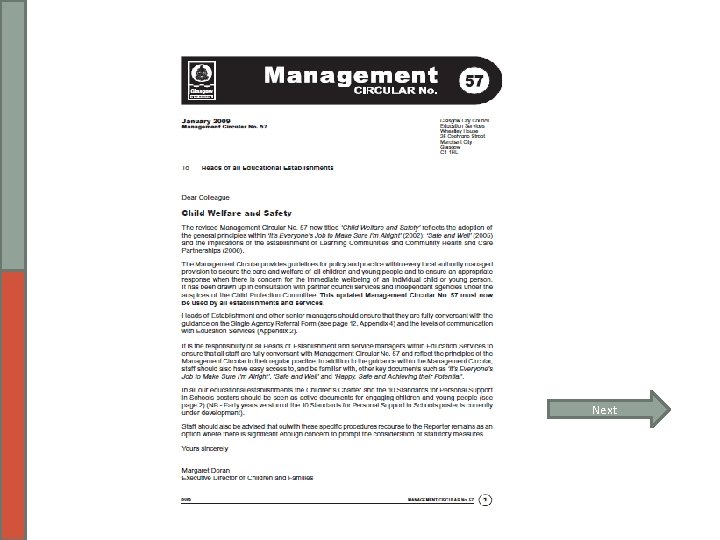
Management Circular 57: Child Welfare and Safety • Describes the roles and responsibilities of all staff working in GCC education establishments in securing the care and welfare of all children and young people and in ensuring an appropriate response when there is concern for the immediate wellbeing of an individual child or young person.
Next
• All staff should know who the Child Protection coordinator is in their establishment. • The August in-service days must include a session on Safeguarding and Child protection, including revisiting MC 57. • Record of attendance at this annual update. • Arrangements must be in place for staff joining the establishments throughout the year including students and supply staff. Next
You have a concern because of • a specific incident, something you see or hear about • a disclosure made by a child or young person or parent/carer • information from a third party • adult behaviour/circumstances that may place the child or young person at risk of harm • child/young person behaviour/circumstances that may place the child or young person at risk of harm • a culmination of minor concerns over a period of time. Next
What to do if you have a concern… • • Consider the well being and safety of the child or young person - listen and reassure Be calm, don’t panic. Act on your concern. Don’t ignore. Don’t agree to keep it secret. Do not interrogate but note what you observe, what you hear, what you are told. Be specific re concerns. Don’t discuss generally with colleagues but do Inform the CP coordinator without delay Don’t feel daft – your concern might be part of a bigger picture Complete MC 57 Appendix 3 and give to Child protection Coordinator.
Its everyone’s job… ‘Everyone has a responsibility to protect children and young people. Every child, young person has a right to feel safe and protected from any situation or practice which may result in harm. Above all, the welfare of children and young people is the paramount consideration and we must work together to ensure they are protected. ’ Education Scotland Policy. Procedures and Guidance for Safeguarding, Sept 2016
CHILD SEXUAL EXPLOITATION/TRAFFICKIN G
Child Sexual Exploitation Political, media and professional contexts have been shaped by a series of high profile allegations against “celebrities”, alongside reports of young women being sexually abused in major cities in the UK Rochdale, Missing from care, Rotherham, Oxford “…Despite increased awareness and a heightened state of alert regarding CSE, children are still slipping through the net and falling prey to sexual predators. Serious gaps remain in the knowledge, practice and services required to tackle this problem…. ” (Berelowitz, 2013)
Defining CSE (2016) Child sexual exploitation is a form of child sexual abuse in which a person(s), of any age takes advantage of a power imbalance to force or entice a child into engaging in sexual activity in return for something received by the child and/or those perpetrating or facilitating the abuse. As with other forms of child sexual abuse, the presence of perceived consent does not undermine the abusive nature of the act.
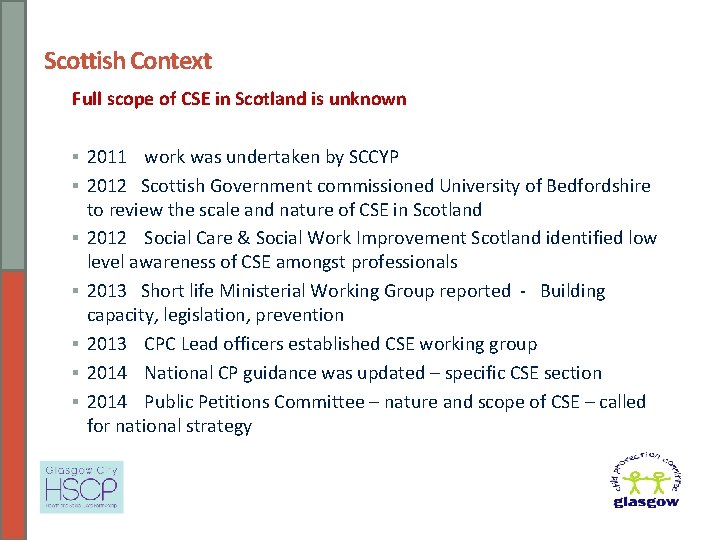
Scottish Context Full scope of CSE in Scotland is unknown § 2011 work was undertaken by SCCYP § 2012 Scottish Government commissioned University of Bedfordshire § § § to review the scale and nature of CSE in Scotland 2012 Social Care & Social Work Improvement Scotland identified low level awareness of CSE amongst professionals 2013 Short life Ministerial Working Group reported - Building capacity, legislation, prevention 2013 CPC Lead officers established CSE working group 2014 National CP guidance was updated – specific CSE section 2014 Public Petitions Committee – nature and scope of CSE – called for national strategy
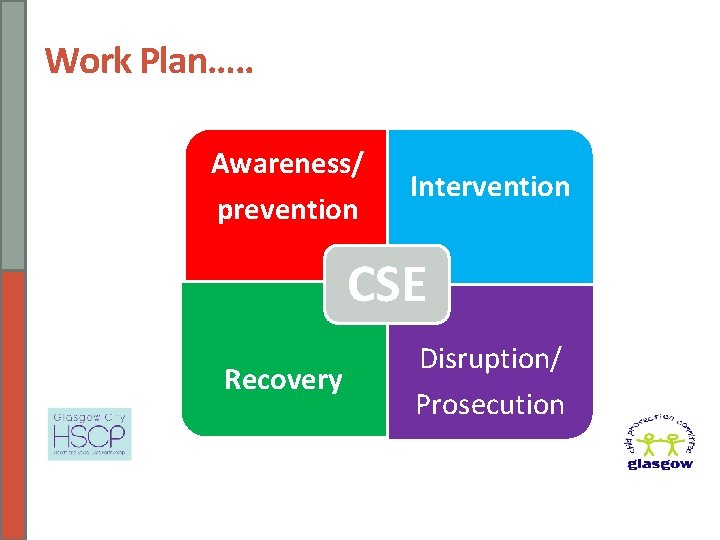
Work Plan…. . Awareness/ prevention Intervention CSE Recovery Disruption/ Prosecution
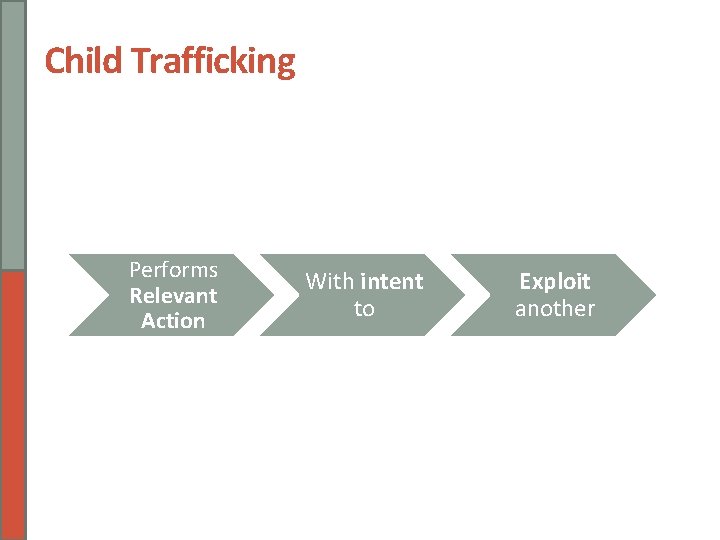
Child Trafficking Performs Relevant Action With intent to Exploit another
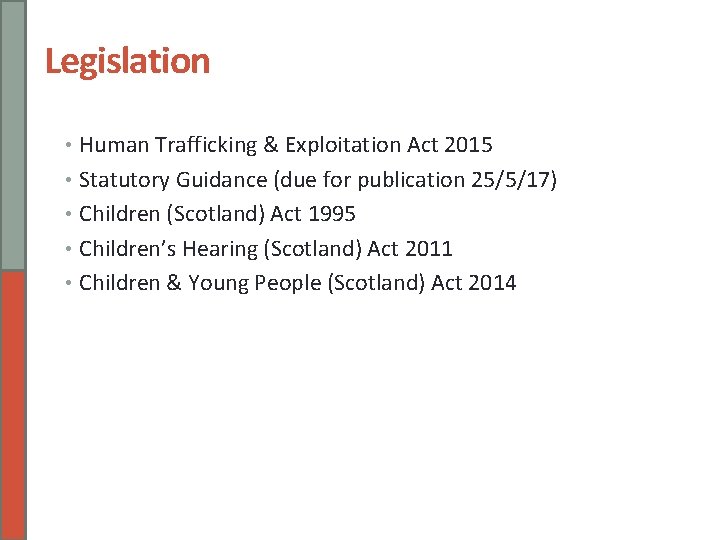
Legislation • Human Trafficking & Exploitation Act 2015 • Statutory Guidance (due for publication 25/5/17) • Children (Scotland) Act 1995 • Children’s Hearing (Scotland) Act 2011 • Children & Young People (Scotland) Act 2014
STOP TO LISTEN …. TEST OF CHANGE
What is Stop to Listen? “A system which allows children and young people more control over, and involvement in, the process of responding to and investigating their disclosures of sexual abuse. It goes at their own pace as far as possible, responds to their own fears and gains their trust while offering them support throughout the process”
What do we want to achieve? • Protect children and young people from abuse and violence • Enable children/young people to tell what has happened to them at their own pace. • Create a truly child-centred child protection system • Offer children a better means of finding safety and support • Improve the quality of evidence gathering • Raise the morale and sense of efficacy of professionals involved in child protection • Avoid repeating the mistakes of the past • Ensure Glasgow remains at the leading edge of child centred practice and protection
What are we going to do to make change happen in Glasgow? • Raising awareness amongst professionals • Worker confidence to support the child • Processes are firmed up so everyone is clear what happens next • Services are based on what would be best for the young person • Sharing/Gathering of Intelligence
DOMESTIC ABUSE AND MARAC
Domestic Abuse, as gendered based violence, can be perpetrated by partners or ex partners and can include physical abuse (assault and physical attack involving a range of behaviour), sexual abuse (acts which degrade and humiliate women and are perpetrated against their will, including rape) and mental and emotional abuse (such as threats, verbal abuse, racial abuse, withholding money and other types of controlling behaviour such as isolation from family and friends. http: //www. scotland. gov. uk/Topics/People/Equality/violence-women/Key-Facts OFFICIAL
Typologies of domestic abuse: • Intimate Terrorism • Situational Couple Violence • Violent Resistance OFFICIAL
Domestic Abuse Statistics from February 2017 regarding numbers of children on the child protection register. 33% of all children, were registered because of domestic abuse i. e. 169 children in February 2017 MARAC is the multi agency risk assessment conference where agencies come together to support the client and any children affected by the Domestic Abuse.
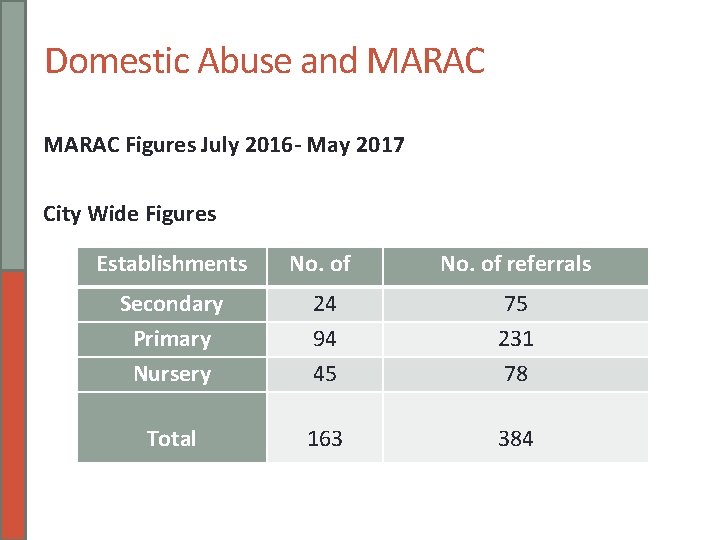
Domestic Abuse and MARAC Figures July 2016 - May 2017 City Wide Figures Establishments No. of referrals Secondary Primary Nursery 24 94 45 75 231 78 Total 163 384
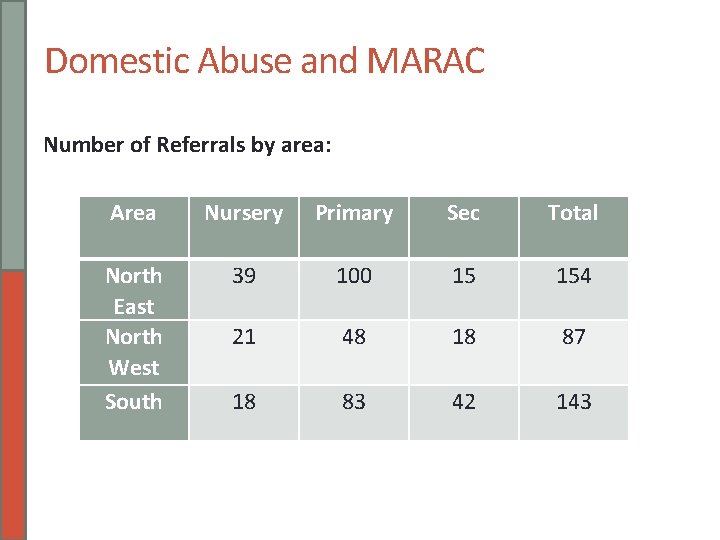
Domestic Abuse and MARAC Number of Referrals by area: Area Nursery Primary Sec Total North East North West South 39 100 15 154 21 48 18 87 18 83 42 143
MARAC process List of names to Education Services. [week before MARAC] Identify those young people who are GCC and which establishment child/young person attends. Collect information about children and young people through SEEMIS and through contacting establishments and speaking to relevant person. Attend MARAC meeting and present information from Education Record and feedback action/information to schools. Schools then ensure information is factored into supporting young person and relevant staff are advised.
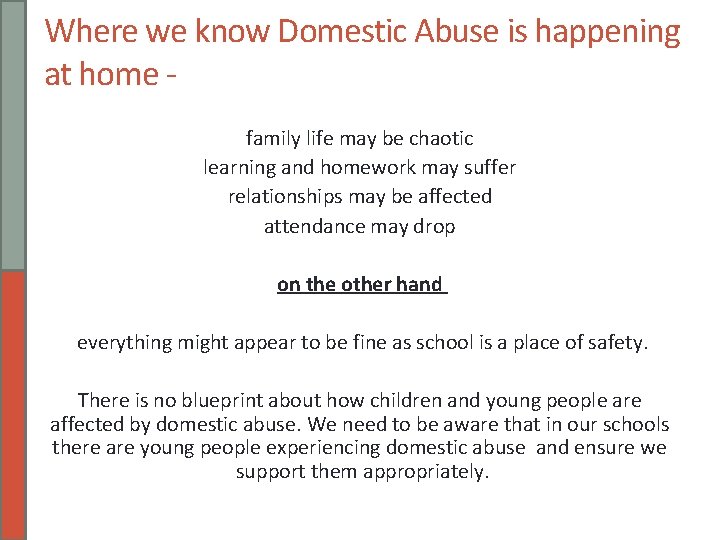
Where we know Domestic Abuse is happening at home family life may be chaotic learning and homework may suffer relationships may be affected attendance may drop on the other hand everything might appear to be fine as school is a place of safety. There is no blueprint about how children and young people are affected by domestic abuse. We need to be aware that in our schools there are young people experiencing domestic abuse and ensure we support them appropriately.
Final thought. . The difference between child abuse and child protection could be you.