
Safeguard training November 2018 Working Together No single
Safeguard training November 2018
Working Together No single professional can have a full picture of a child’s needs and circumstances and if children and families are to receive the right help at the right time, everyone who comes into contact with them has a role to play in identifying concerns, sharing information and taking prompt action (Working Together 2015)
Aims and Objectives n n Reminder of the legal framework for child protection Refresh knowledge of recognising and reporting abuse and the child protection process Outline the importance of partnership working, roles and responsibilities and effective collaboration between agencies including information sharing Be able to identify and report any safeguarding concerns confidently
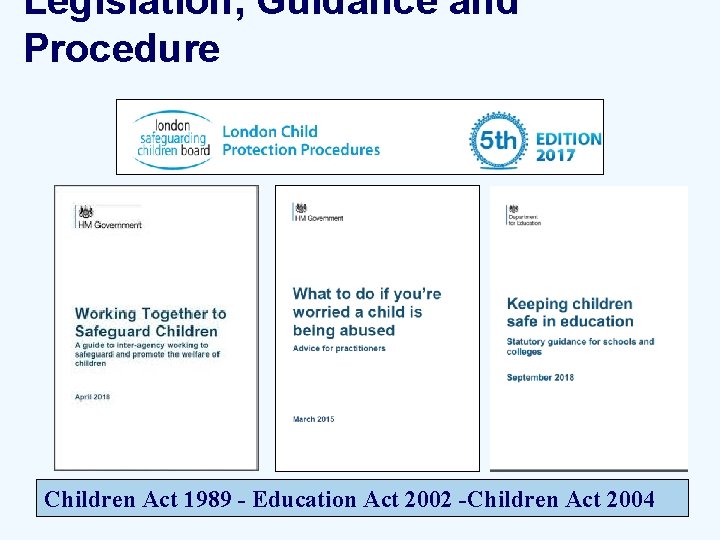
Legislation, Guidance and Procedure Children Act 1989 - Education Act 2002 -Children Act 2004
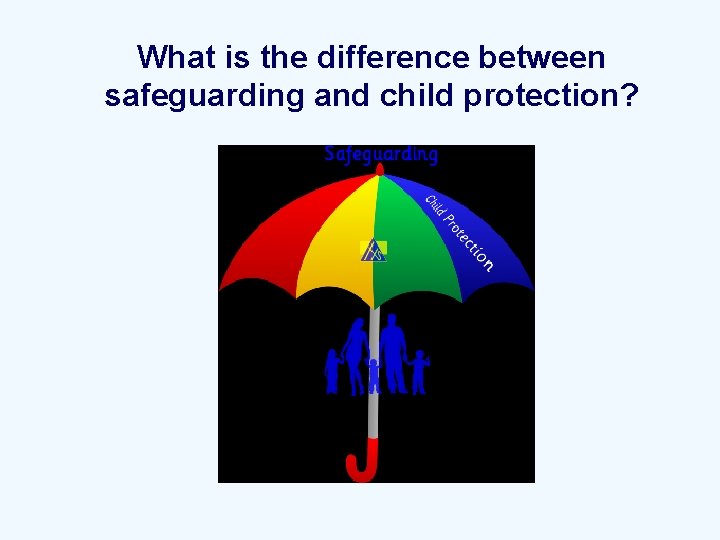
What is the difference between safeguarding and child protection?

Safeguarding is protecting children from harm, preventing damage to children’s health or development, making sure they grow up safely and taking action to make sure all children have the best start in life. Child Protection is part of Safeguarding and refers to the action taken to protect specific children who are being abused or who are at risk of abuse and/or significant harm.

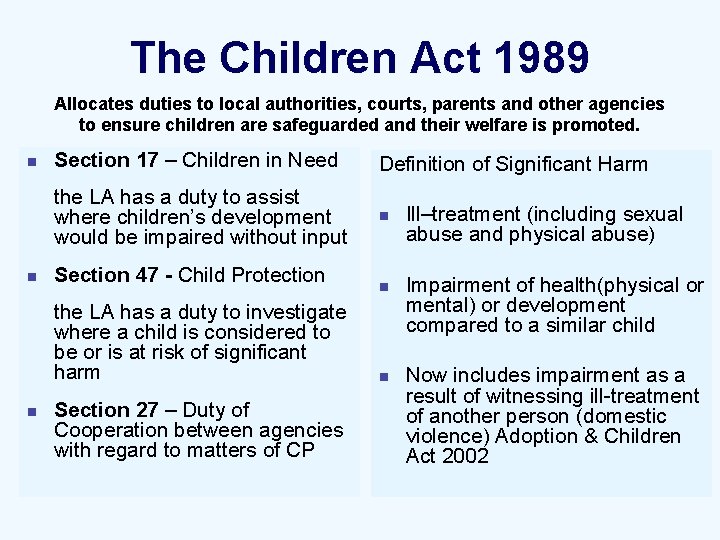
The Children Act 1989 Allocates duties to local authorities, courts, parents and other agencies to ensure children are safeguarded and their welfare is promoted. n n Section 17 – Children in Need Definition of Significant Harm the LA has a duty to assist where children’s development would be impaired without input n Section 47 - Child Protection the LA has a duty to investigate where a child is considered to be or is at risk of significant harm n Section 27 – Duty of Cooperation between agencies with regard to matters of CP n n Ill–treatment (including sexual abuse and physical abuse) Impairment of health(physical or mental) or development compared to a similar child Now includes impairment as a result of witnessing ill-treatment of another person (domestic violence) Adoption & Children Act 2002
Talk on your tables… n n What are the signs and symptoms of possible abuse? Which children are more vulnerable to abuse? How should we talk to children about whom there are concerns? Who are the designated Safeguarding and Deputy Safeguarding Leads are our school?
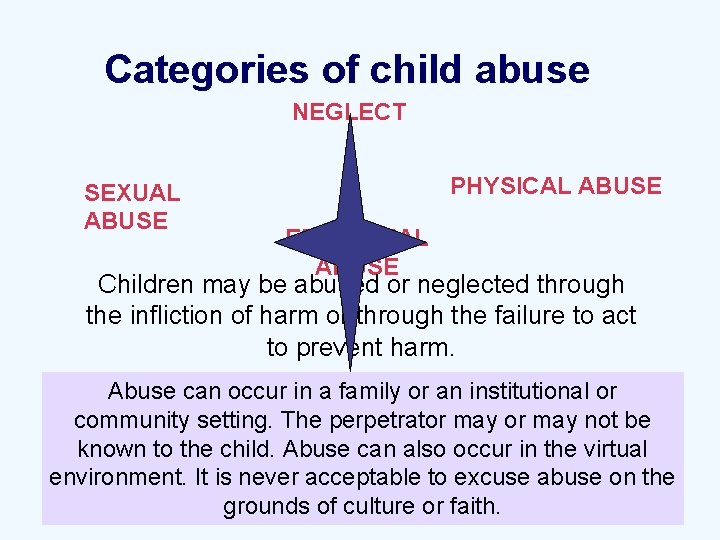
Categories of child abuse NEGLECT SEXUAL ABUSE PHYSICAL ABUSE EMOTIONAL ABUSE Children may be abused or neglected through the infliction of harm or through the failure to act to prevent harm. Abuse can occur in a family or an institutional or community setting. The perpetrator may not be known to the child. Abuse can also occur in the virtual environment. It is never acceptable to excuse abuse on the grounds of culture or faith.
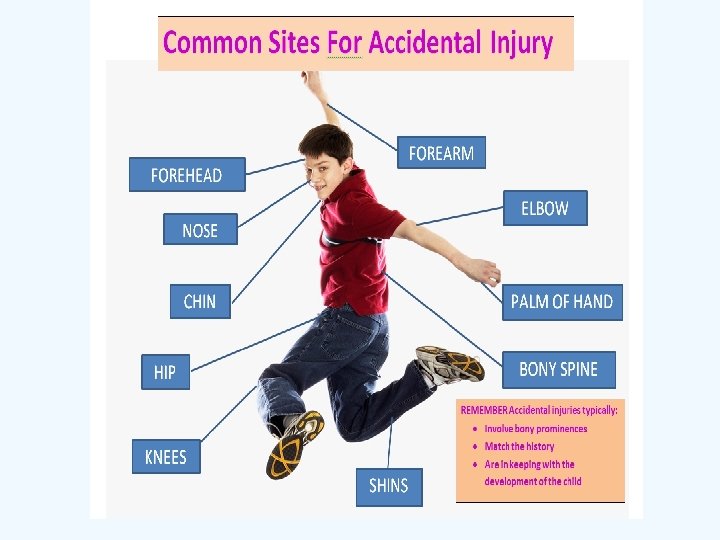
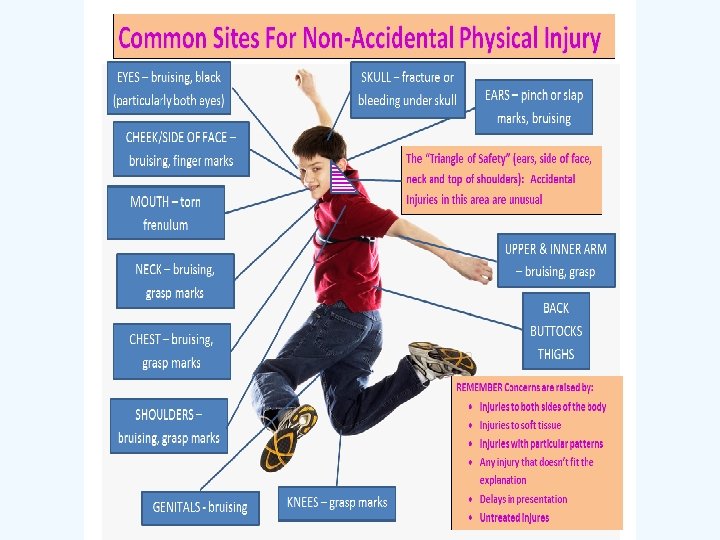
Look at the sheets on your tables and read through the signs of the different types of abuse. Do any stand out to you? Are there any you’ve not really thought about before? Are there any children in your classes that have exhibited any of these signs? Do they definitely mean a child is being abused?
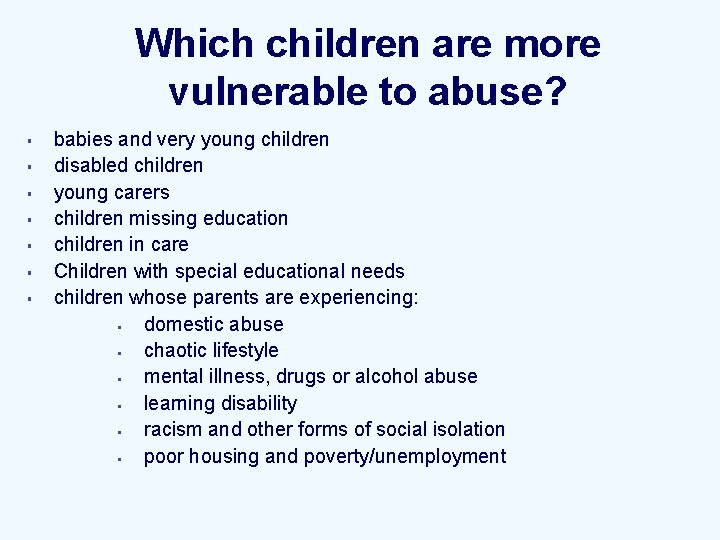
Which children are more vulnerable to abuse? § § § § babies and very young children disabled children young carers children missing education children in care Children with special educational needs children whose parents are experiencing: § domestic abuse § chaotic lifestyle § mental illness, drugs or alcohol abuse § learning disability § racism and other forms of social isolation § poor housing and poverty/unemployment
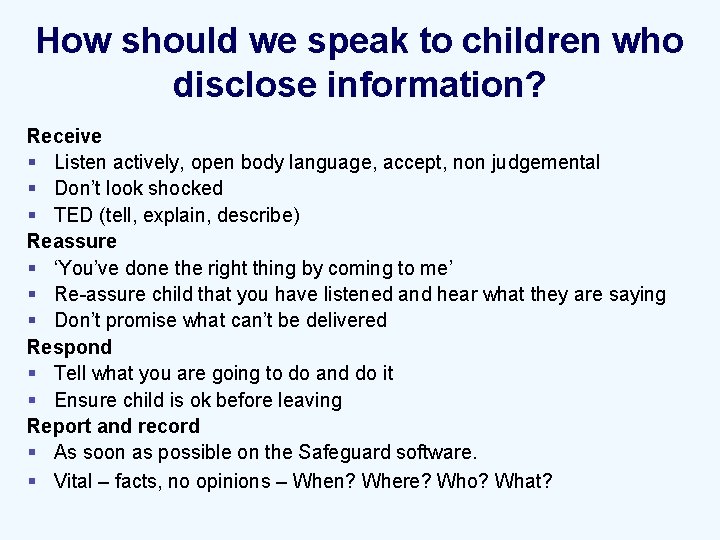
How should we speak to children who disclose information? Receive § Listen actively, open body language, accept, non judgemental § Don’t look shocked § TED (tell, explain, describe) Reassure § ‘You’ve done the right thing by coming to me’ § Re-assure child that you have listened and hear what they are saying § Don’t promise what can’t be delivered Respond § Tell what you are going to do and do it § Ensure child is ok before leaving Report and record § As soon as possible on the Safeguard software. § Vital – facts, no opinions – When? Where? Who? What?
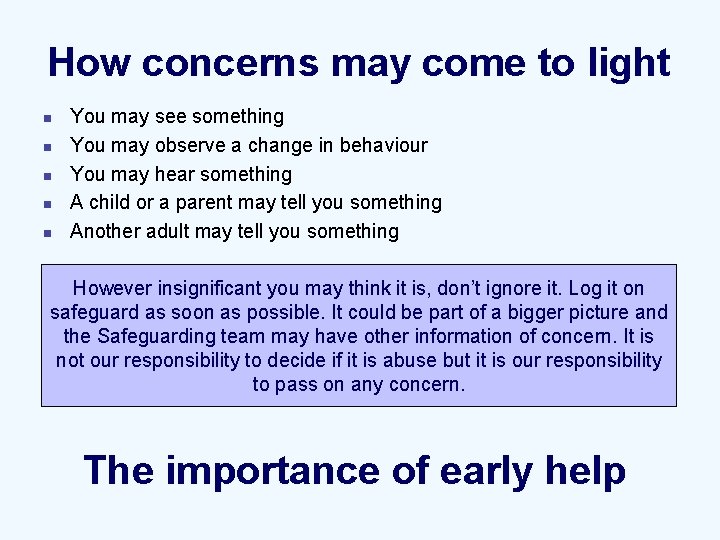
How concerns may come to light n n n You may see something You may observe a change in behaviour You may hear something A child or a parent may tell you something Another adult may tell you something However insignificant you may think it is, don’t ignore it. Log it on safeguard as soon as possible. It could be part of a bigger picture and the Safeguarding team may have other information of concern. It is not our responsibility to decide if it is abuse but it is our responsibility to pass on any concern. The importance of early help
What are the school procedures for reporting concerns? Discuss and feedback
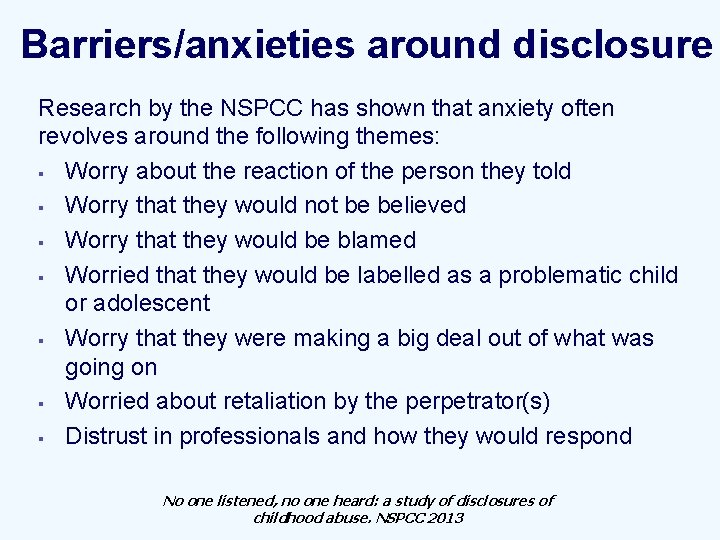
Barriers/anxieties around disclosure Research by the NSPCC has shown that anxiety often revolves around the following themes: § Worry about the reaction of the person they told § Worry that they would not be believed § Worry that they would be blamed § Worried that they would be labelled as a problematic child or adolescent § Worry that they were making a big deal out of what was going on § Worried about retaliation by the perpetrator(s) § Distrust in professionals and how they would respond No one listened, no one heard: a study of disclosures of childhood abuse. NSPCC 2013
Children have said that they need: § § § § Vigilance: to have adults notice when things are troubling them Understanding and action: to understand what is happening; to be heard and understood; and to have that understanding acted upon Stability: to be able to develop an on-going relationship of trust with those helping them Respect: to be treated with the expectation that they are competent rather than not Information and engagement: to be informed about and involved in procedures, decisions, concerns and plans Explanation: to be informed of the outcome of assessments and decisions and reasons when their views have not met with a positive response Support: to be provided with support in their own right as well as a member of their family Advocacy: to be provided with advocacy to assist then in putting forward their views
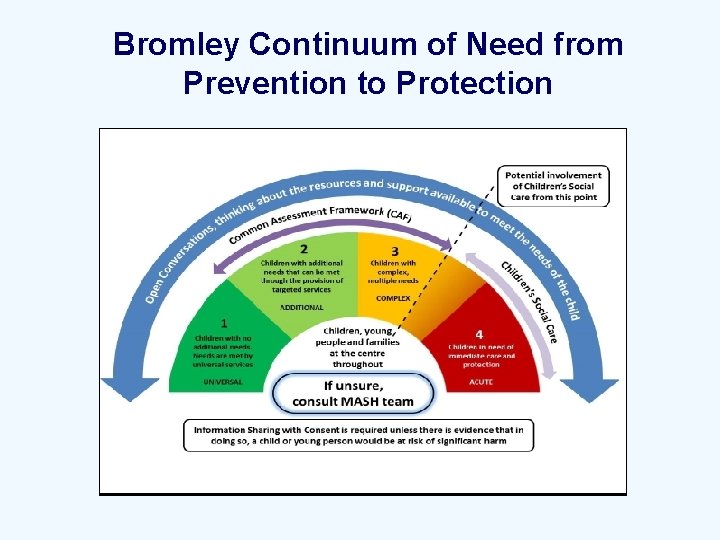
Bromley Continuum of Need from Prevention to Protection
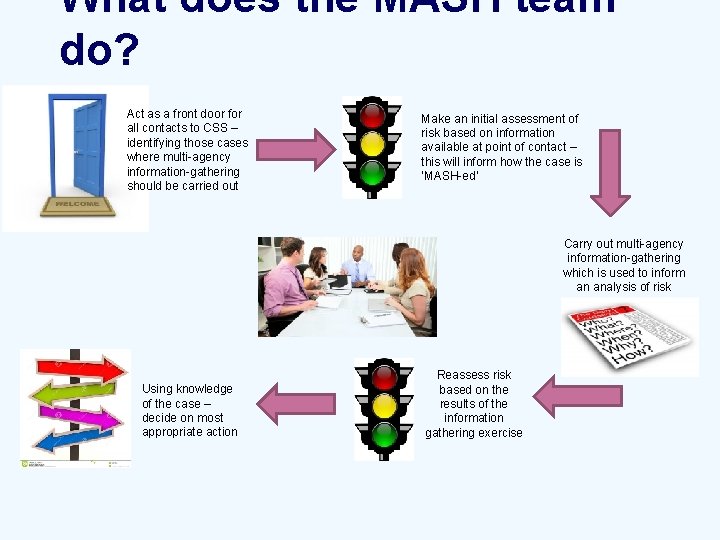
What does the MASH team do? Act as a front door for all contacts to CSS – identifying those cases where multi-agency information-gathering should be carried out Make an initial assessment of risk based on information available at point of contact – this will inform how the case is ‘MASH-ed’ Carry out multi-agency information-gathering which is used to inform an analysis of risk Using knowledge of the case – decide on most appropriate action Reassess risk based on the results of the information gathering exercise
Possible outcomes of a referral n n n n Take no further action Note the concern and agency/school monitor/provide early help Refer onto another service Take emergency action – including police Strategy Meeting Children and Family Assessment Child Protection Conference
Any questions?
- Slides: 23