
SAFE VEHICLE OPERATION Bureau of Workers Compensation PA
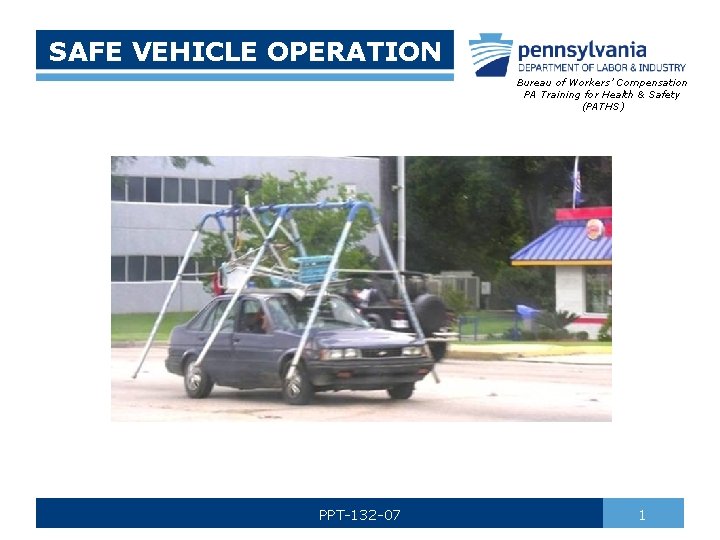
SAFE VEHICLE OPERATION Bureau of Workers’ Compensation PA Training for Health & Safety (PATHS) PPT-132 -07 1
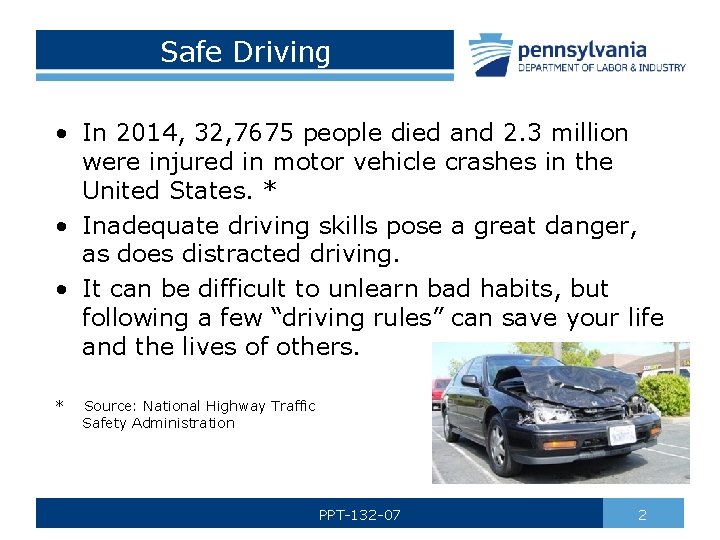
Safe Driving • In 2014, 32, 7675 people died and 2. 3 million were injured in motor vehicle crashes in the United States. * • Inadequate driving skills pose a great danger, as does distracted driving. • It can be difficult to unlearn bad habits, but following a few “driving rules” can save your life and the lives of others. * Source: National Highway Traffic Safety Administration PPT-132 -07 2
Before we Start - Seat Belts • Buckling up is the single most effective thing you can do to protect yourself in a crash. • In 2014, seat belts saved more than 12, 000 lives nationwide. From 2008 to 2014, seat belts saved over 85, 000 lives - enough people to fill a large sports arena. • During a crash, being buckled up helps keep you safe and secure inside your vehicle, whereas being completely thrown out of a vehicle is almost always deadly. • Seat belts are the best defense against impaired, aggressive, and distracted drivers. PPT-132 -07 3
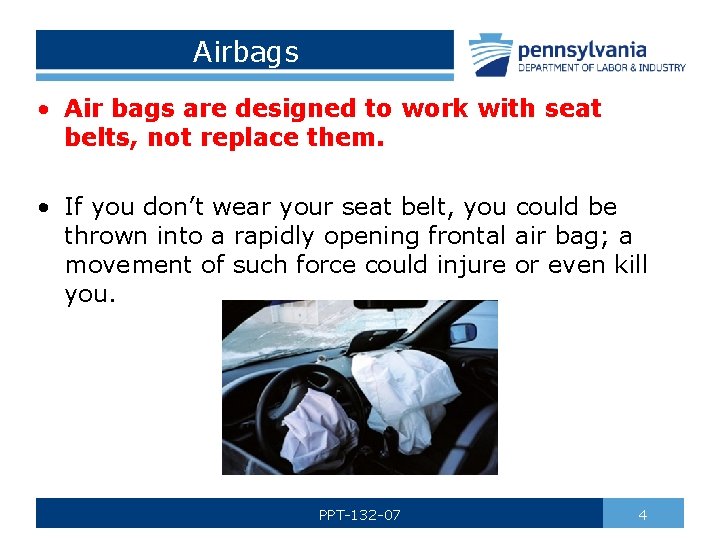
Airbags • Air bags are designed to work with seat belts, not replace them. • If you don’t wear your seat belt, you could be thrown into a rapidly opening frontal air bag; a movement of such force could injure or even kill you. PPT-132 -07 4
Setting Up • Adjust your seat so your arms are slightly bent at the elbows when gripping the wheel. • Keep your hands at the quarter to 3: 00 (2: 45) position on the steering wheel (i. e. 9 and 3). • Hold the wheel tightly enough so your palms do not slip off. • Adjust side mirrors so you can either see the door handles or angled away to cover blind spots. PPT-132 -07 5
Adjusting Side Mirrors for Blind Spots • Park car and have someone walk in both left & right blind spots. • Set mirrors so person is in view. • Check mirrors to see which areas remain invisible. • Re-adjust and check again. PPT-132 -07 6
Safe Driving Tips - Merging requires attention to many different factors. • Traffic moving at posted speeds = use the acceleration lane to speed up and match traffic flow. • Use your signal and look for an opening where you can smoothly ease into traffic. • If traffic is congested and moving slowly, proceed down the ramp slowly and look for an opening. • Try to avoid stopping at the bottom of the ramp because it can disrupt traffic flow. PPT-132 -07 7
Safe Driving Tips - Intersections • Do not closely follow a large vehicle through an intersection with traffic lights: you can’t see if the light has changed. • Leave enough space so you have a clear view of everything before proceeding. • When making a left turn slow down and yield if there is not a green arrow giving you the right-ofway. • Don’t turn your wheels until you’re ready to move (if your vehicle is hit from behind, you could be pushed into oncoming traffic). PPT-132 -07 8
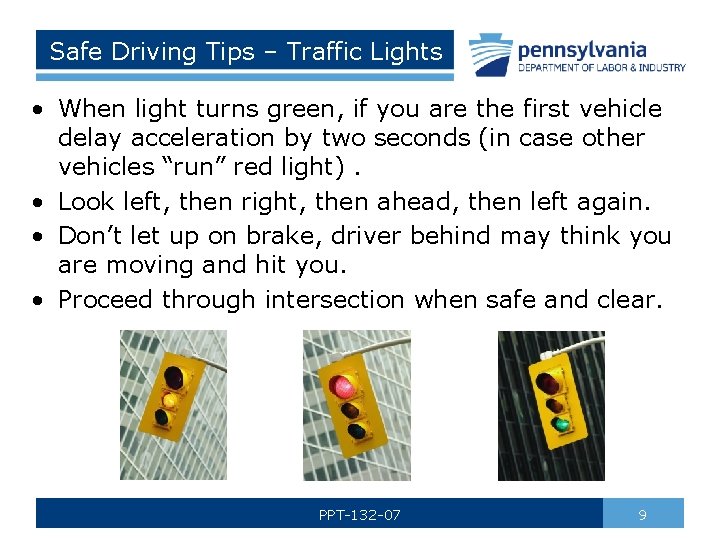
Safe Driving Tips – Traffic Lights • When light turns green, if you are the first vehicle delay acceleration by two seconds (in case other vehicles “run” red light). • Look left, then right, then ahead, then left again. • Don’t let up on brake, driver behind may think you are moving and hit you. • Proceed through intersection when safe and clear. PPT-132 -07 9
Safe Driving Tips - Four-way Stop • First car to arrive at an intersection with a fourway stop (whether sign or traffic light) should be first to go. • When it's unclear which vehicle arrived first, general rule is driver to the right has the rightof-way. • Don’t count on other drivers: proceed with caution. PPT-132 -07 10
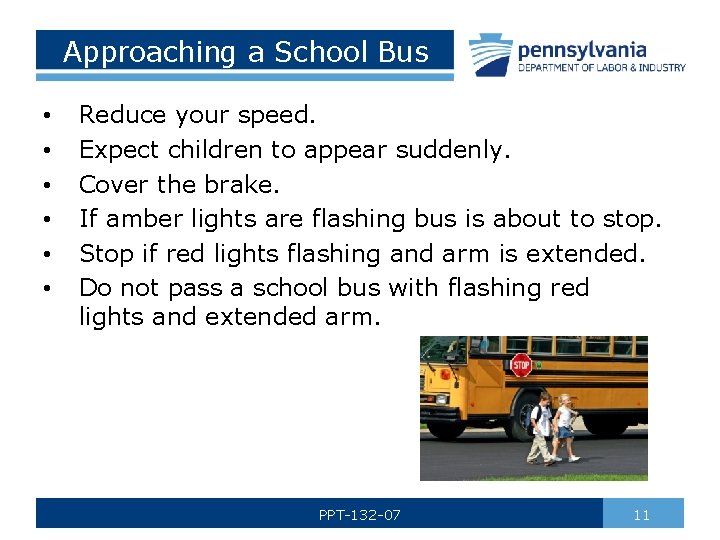
Approaching a School Bus • • • Reduce your speed. Expect children to appear suddenly. Cover the brake. If amber lights are flashing bus is about to stop. Stop if red lights flashing and arm is extended. Do not pass a school bus with flashing red lights and extended arm. PPT-132 -07 11
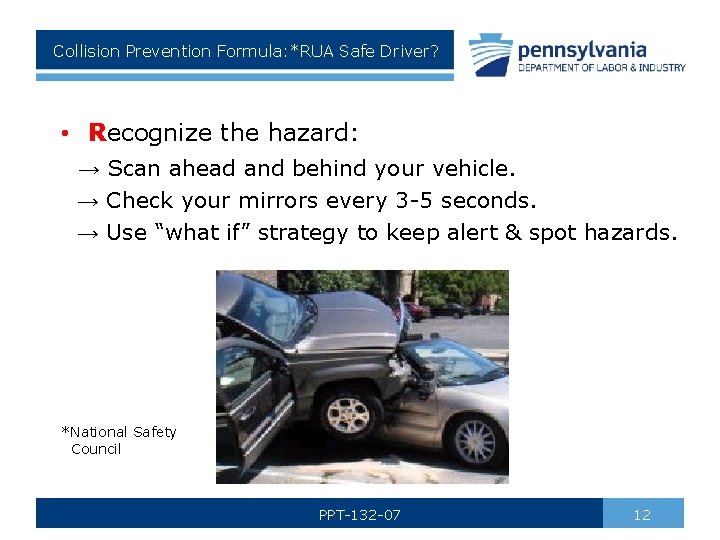
Collision Prevention Formula: *RUA Safe Driver? • Recognize the hazard: → Scan ahead and behind your vehicle. → Check your mirrors every 3 -5 seconds. → Use “what if” strategy to keep alert & spot hazards. *National Safety Council PPT-132 -07 12
Collision Prevention Formula: *RUA Safe Driver? • Understanding the defense: → Know what to do to avoid a traffic hazard. → Know the consequences of your driving choices. → Know the basic defenses = - Use effective scanning patterns - Slow down - Use a safe following distance PPT-132 -07 13
Collision Prevention Formula: *RUA Safe Driver? • Act Correctly, in time: → Always stay alert – focus on the driving task. → Choose the safest driving maneuver to avoid a crash. → Remember: other drivers may act in time, but not correctly. PPT-132 -07 14
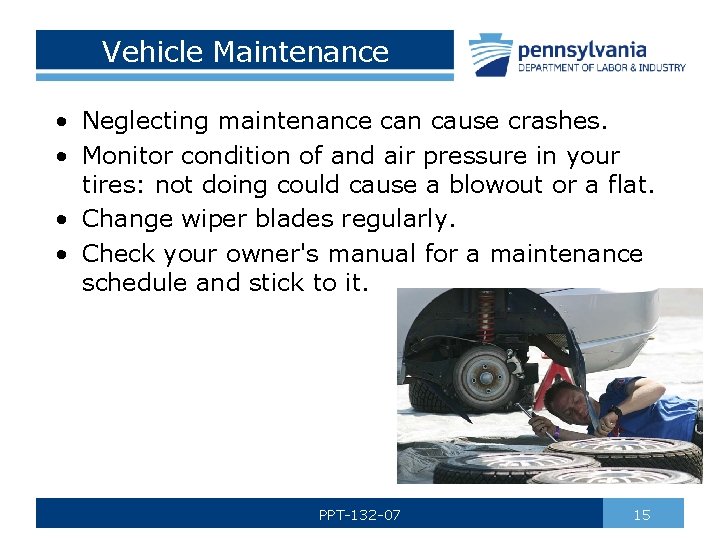
Vehicle Maintenance • Neglecting maintenance can cause crashes. • Monitor condition of and air pressure in your tires: not doing could cause a blowout or a flat. • Change wiper blades regularly. • Check your owner's manual for a maintenance schedule and stick to it. PPT-132 -07 15
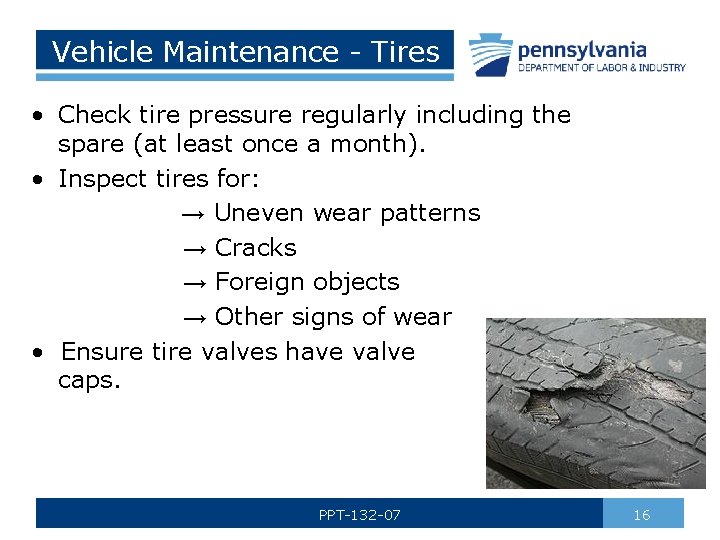
Vehicle Maintenance - Tires • Check tire pressure regularly including the spare (at least once a month). • Inspect tires for: → Uneven wear patterns → Cracks → Foreign objects → Other signs of wear • Ensure tire valves have valve caps. PPT-132 -07 16
Vehicle Maintenance - Tires • Check tire pressure before long trip. • Do not overload vehicle – check tire info placard for maximum recommended load. • If towing a trailer remember some weight of loaded trailer is transferred to vehicle. • Try not to strike the curb when parking. PPT-132 -07 17
Flat Tire/Blowout - Highway At the first sign of trouble: • • • Firmly grip steering wheel Do not slam on brakes Take foot off gas pedal Work vehicle toward shoulder or exit If changing lanes use turn signals Steer as vehicle slows down PPT-132 -07 18
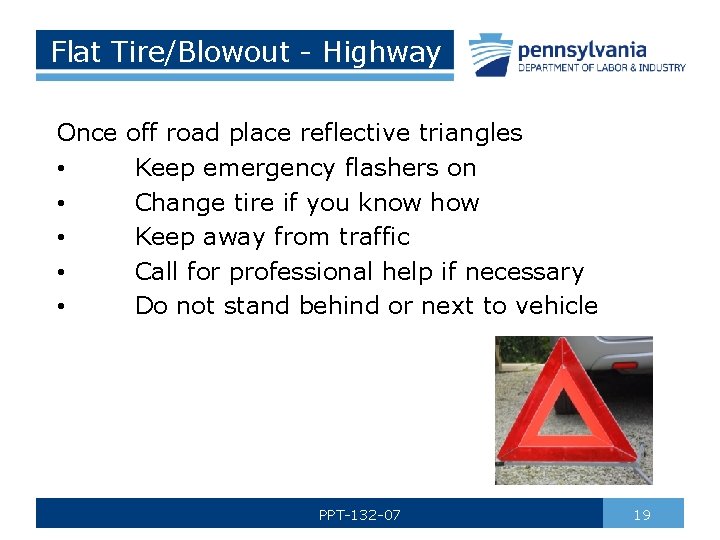
Flat Tire/Blowout - Highway Once • • • off road place reflective triangles Keep emergency flashers on Change tire if you know how Keep away from traffic Call for professional help if necessary Do not stand behind or next to vehicle PPT-132 -07 19
Safe Driving Skills • Keep your eyes constantly moving: Look up and down the road Look to the sides of the road Look into the rear view mirror • Always leave yourself an out: - Try to find place to head if a crash occurs Think about other drivers’ blind spots • Don’t linger while passing - - • Don’t follow too closely (“tailgate”) • Avoid “packs” of vehicles PPT-132 -07 - 20
Safe Driving Skills • Ensure other drivers see you – keep headlights on both day & night. • Always use turn signals well ahead of time. • Never assume what other drivers will do. • Maintain average speed on highways; going too fast or too slow creates a hazard. PPT-132 -07 21
Safe Driving Skills • Use average traffic speed when merging. • Think ahead – avoid making sudden movements when exiting highways. • Obey all traffic signs and signals. • Keep your eyes on the road, not on a cell phone or music device. • Watch for pedestrians, bicyclists, and motorcyclists. • Scan the road ahead for animals. PPT-132 -07 22
Safe Driving Skills Stopping on Highways: • Don’t be a stationary object or semistationary obstacle. • Stopping at the end of an entrance ramp is dangerous, learn to time a safe merge. • Avoid stopping on shoulder of road; exit highway before stopping if possible. PPT-132 -07 23
Safe Driving Skills – Following Distance Use the safe “ 3 second rule: ” • Glance at an object on the right side of the road ahead of you (e. g. traffic sign). • Look at the vehicle in front of you and watch when it comes to that object. • If following safely it should take you at least 3 seconds before you come to that object. PPT-132 -07 24
Safe Driving Skills - Passing • Scan ahead and read the road. • Check your mirrors to ensure it is safe to pass and no vehicle is in your blind spot. • Use your turn signal to indicate your intention. • Swing out and speed up to a safe speed. • When you see the front tires of the vehicle you’re passing in your rearview mirror signal and return to the lane. • Turn off your signal and maintain your speed after passing. PPT-132 -07 25
Avoiding a Head-on Crash THE FOUR R’s: • READ THE ROAD AHEAD: Scan ahead to recognize hazards – allows you to see and react faster if oncoming vehicle crosses center line. • DRIVE TO THE RIGHT: Drive slightly to the right of the center of your lane – creates an extra “cushion” of space between you and other vehicles. PPT-132 -07 26
Avoiding a Head-on Crash THE FOUR R’s (Continued): • REDUCE YOUR SPEED: If you see a hazard ahead, immediately reduce your speed – gives you extra time and oncoming driver time to recover and get back in his/her lane. • RIDE OFF THE ROAD: Chances of surviving a head-on crash much greater if you steer onto the shoulder. PPT-132 -07 27
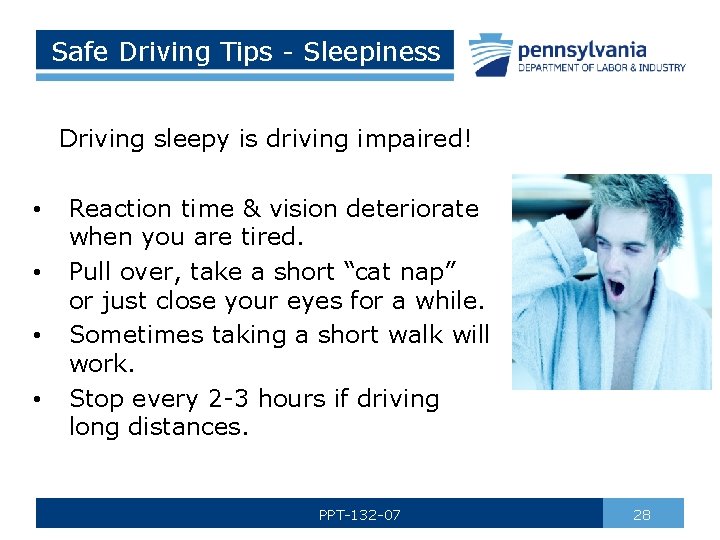
Safe Driving Tips - Sleepiness Driving sleepy is driving impaired! • • Reaction time & vision deteriorate when you are tired. Pull over, take a short “cat nap” or just close your eyes for a while. Sometimes taking a short walk will work. Stop every 2 -3 hours if driving long distances. PPT-132 -07 28
Safe Driving Tips - Familiarization Be Familiar with your Vehicle: • Know what every button, switch, and lever does. • Know where the oil, brake fluid, engine coolant, and window washer reservoirs are. • Know how to fill those reservoirs. • Know what every indicator light means. • Know how to operate basic items such as the defroster, wipers, radio, and headlights. PPT-132 -07 29
Safe Driving Tips - Nighttime Driving • Traffic deaths are 3 times greater at night than during the day (National Safety Council). • Prepare car for nighttime driving: clean headlights, taillights, signal lights & windows (at least weekly). • Have vehicle headlights properly aimed. • Don’t drink & drive! • Reduce speed & increase following distances. • Don’t overdrive headlights – should be able to stop inside illuminated area. PPT-132 -07 30
Safe Driving Tips – Nighttime Driving • When following a vehicle keep your headlights on low beam. • If oncoming vehicle doesn’t turn high beams down, look to right side of road. • If tired, stop & rest. • If car problems, pull to side of road and place reflective devices; turn on emergency flashers. PPT-132 -07 31
Safe Driving Tips – Seasonal Changes • Winter driving = slippery roads, visibility issues, cold, etc. • Spring = rain cause slippery roads. • Summer = high temps can cause vehicle problems; more traffic on roads. • Fall = wet leaves on road can make it slippery. • Daylight saving time, sun's position in sky changes = darkness and glare. PPT-132 -07 32
Safe Driving Tips - Rain • Drive slowly and carefully – especially on curves. • Steer & brake with a light touch. • When slowing/stopping be careful not to lock the wheels while braking – could cause skid. • Maintain mild pressure on the brake pedal. • Adjust your speed to the wet road conditions. PPT-132 -07 33
Safe Driving Tips - Skids • Remain calm. • Ease your foot off the gas. • Steer in the direction you want the front of the vehicle to go (“steering into the skid”). • If vehicle does not have anti-lock brakes, avoid slamming on the brakes. • If vehicle has ABS, brake firmly while steering into skid. PPT-132 -07 34
Safe Driving Tips – Hydroplaning • Occurs when water in front of tires builds up faster than vehicle’s weight can push it out of the way. • Water pressure causes vehicle to rise up and slide on thin layer of water between tires and road. • Can cause skidding, drifting out of lane, leaving roadway. • To avoid: keep tires properly inflated, maintain good tread, slow down, avoid puddles. PPT-132 -07 35
Safe Driving Tips – Hydroplaning • If hydroplaning do not brake or turn suddenly. • Ease foot off gas until vehicle slows down and you can feel road again. • If need to brake without anti-lock brakes, do so gently with light pumping actions. • If vehicle has anti-lock brakes, brake normally. PPT-132 -07 36
Safe Driving Tips - Winter • Ensure vehicle wiper blades are in good condition & washer fluid is filled. • Ensure vehicle battery is in good condition and appropriately charged. • Clear snow/ice from all windows, lights, hood, trunk, and top of your vehicle before driving. • Adjust your speed accordingly. • Check tire pressure regularly. • Dress warmly with layered clothing that is loose-fitting and lightweight. PPT-132 -07 37
Safe Driving Tips - Winter If in vehicle and stranded due to road conditions: • Stay in the vehicle. • Display trouble sign (ex: brightly colored cloth on antenna). • Occasionally run engine with heater on to keep warm. • Watch for signs of frostbite and hypothermia. PPT-132 -07 38
Safe Driving Tips - Winter If in vehicle and stranded due to road conditions: • • Do minor exercises to keep up circulation. Clap hands & move arms & legs frequently. Try not to stay in one position too long. Use newspapers, maps, mats, etc. for warmth. • Avoid drinking fluids containing caffeine or alcohol: can quicken effects of cold. PPT-132 -07 39
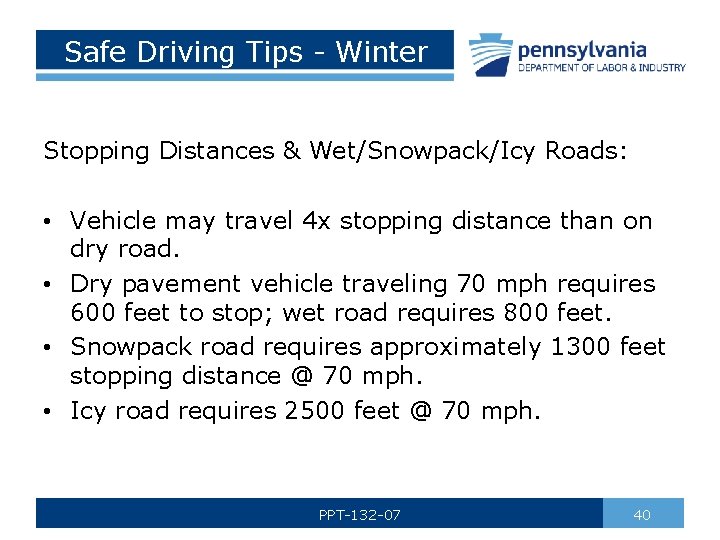
Safe Driving Tips - Winter Stopping Distances & Wet/Snowpack/Icy Roads: • Vehicle may travel 4 x stopping distance than on dry road. • Dry pavement vehicle traveling 70 mph requires 600 feet to stop; wet road requires 800 feet. • Snowpack road requires approximately 1300 feet stopping distance @ 70 mph. • Icy road requires 2500 feet @ 70 mph. PPT-132 -07 40
Safe Driving Tips - Winterizing Vehicles: • Ensure ice scraper and windshield de-icer on board. • Carry spare set of wiper blades. • Carry kitty litter, oil dry, or sand for traction. • Carry blankets, flashlight, road flares. • Have lock de-icer available. PPT-132 -07 41
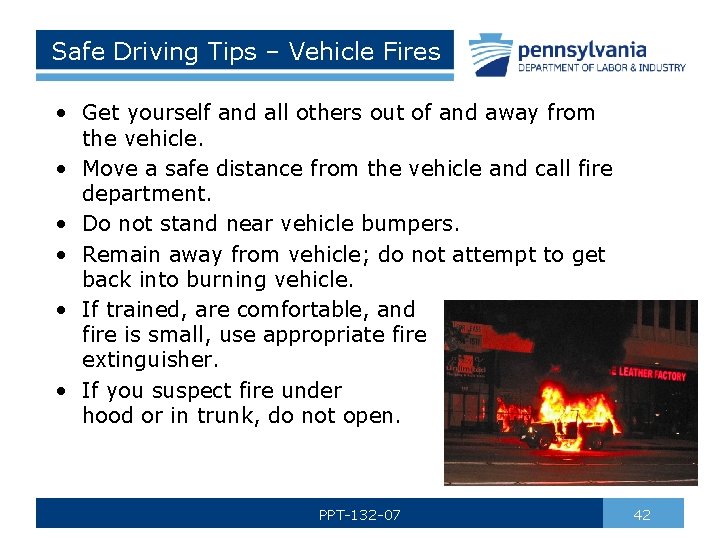
Safe Driving Tips – Vehicle Fires • Get yourself and all others out of and away from the vehicle. • Move a safe distance from the vehicle and call fire department. • Do not stand near vehicle bumpers. • Remain away from vehicle; do not attempt to get back into burning vehicle. • If trained, are comfortable, and fire is small, use appropriate fire extinguisher. • If you suspect fire under hood or in trunk, do not open. PPT-132 -07 42
Vehicle Safety - General • Always use seatbelts! • When backing up use caution: if you have passenger ask them to get out and direct; if not get out and check area before backing. • If vehicle not operating properly, report and discontinue use. • Shut off motor and do not smoke or use cell phone while refueling. • Do not leave engine running in an unattended vehicle. • Report all work accidents, no matter how minor, to your Supervisor. PPT-132 -07 43
Vehicle Safety - General Inspect vehicle before driving: • • • Ensure the horn, lights, and turn signals work. Ensure tires are in good condition. Ensure brakes are working (test upon moving). Ensure emergency brake works. Check gauges after starting (e. g. fuel, battery, temperature, etc. ) to ensure they’re working. PPT-132 -07 44
Vehicle Safety - General Distracted Driving: • Over 3, 000 people killed and 424, 000 injured as a result of distracted driving (2013; USDOT). • Distracted driving a factor in more than 20% of crashes. • Drivers on cell phones fail to see up to ½ of information in driving environment. • Do not text while driving, pull over! • Pull over to talk on phone, even using a “hands free” device is distracting. PPT-132 -07 45
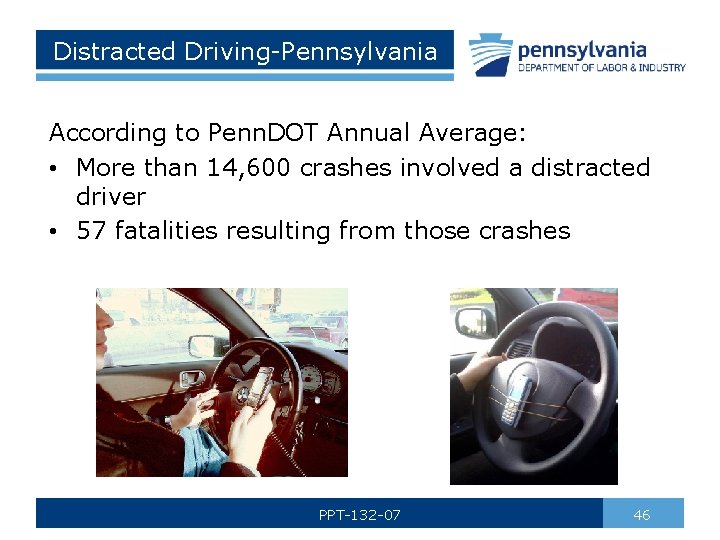
Distracted Driving-Pennsylvania According to Penn. DOT Annual Average: • More than 14, 600 crashes involved a distracted driver • 57 fatalities resulting from those crashes PPT-132 -07 46
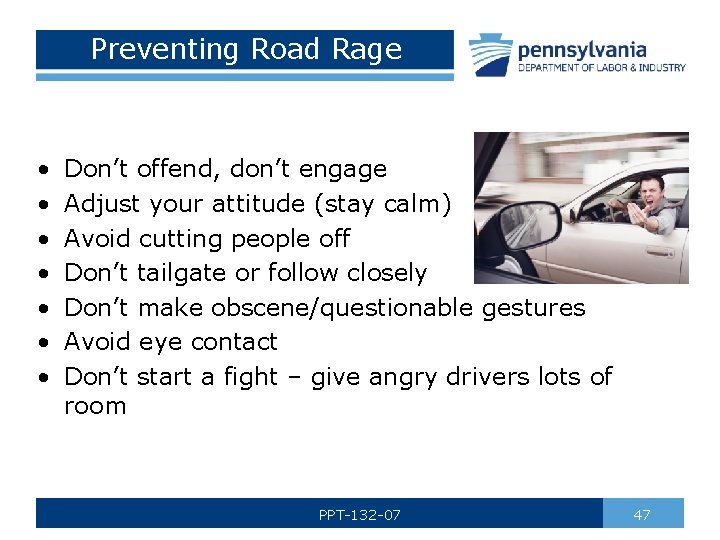
Preventing Road Rage • • Don’t offend, don’t engage Adjust your attitude (stay calm) Avoid cutting people off Don’t tailgate or follow closely Don’t make obscene/questionable gestures Avoid eye contact Don’t start a fight – give angry drivers lots of room PPT-132 -07 47
Preventing Road Rage – Regaining Control If you find you’re becoming aggravated or are choosing unsafe, aggressive behaviors: • Reflect – Ask yourself, “Why am I feeling this way or choosing this behavior? Is this situation something I can control? ” • Reframe the situation – Create a more positive and safe situation (e. g. “it could be worse”). • Refocus – Think about something else, not the situation that is causing you stress. PPT-132 -07 48
Summary • Operating a motor vehicle is dangerous, but it can also be a pleasant experience. • Use common sense, obey speed limits, drive defensively, and observe “road safety rules. ” • Distracted driving can be just as dangerous as alcohol-impaired driving. • Be careful, alert, courteous, and safe. • Have a safe trip! PPT-132 -07 49
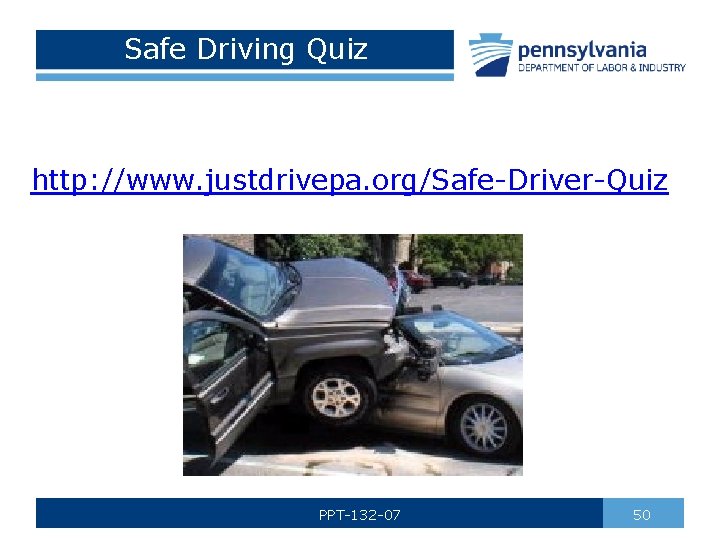
Safe Driving Quiz http: //www. justdrivepa. org/Safe-Driver-Quiz PPT-132 -07 50
Contact Information Health & Safety Training Specialists 1171 South Cameron Street, Room 324 Harrisburg, PA 17104 -2501 (717) 772 -1635 RA-LI-BWC-PATHS@pa. gov Like us on Facebook! https: //www. facebook. com/BWCPATHS PPT-061 -02 51
Questions PPT-132 -07 52
- Slides: 52