
Safe Sport Part 2 Mandatory Reporting SAFESPORT 2

- Slides: 37
Safe. Sport Part 2 Mandatory Reporting
SAFESPORT 2 MANDATORY REPORTING: UNDERSTANDING YOUR RESPONSIBILITIES Please note: This course contains information about various forms of abuse. The content may be uncomfortable or trigger trauma for some participants. If you have personally experienced sexual abuse and need help, please contact the RAINN national sexual abuse hotline at 1 -800 -656 HOPE (4673) or visit rainn. org The U. S. Center for Safe. Sport’s Minor Athlete Abuse Prevention Policies include exceptions to the Education & Training Policy, which may be made on a case-by-case basis for victims/survivors. Requests may be made directly to the U. S. Center for Safe. Sport, training@safesport. org, or to the relevant National Governing Body.
INTRODUCTION OBJECTIVES Objectives In this course, you will learn: • When and how to report a concern about child sexual abuse—to legal authorities and your organization • The legal requirements for reporting child sexual abuse • What barriers prevent people from reporting abuse • How to respond if an athlete discloses abuse to you
INTRODUCTION PRE-TEST 1. Before reporting a concern about sexual abuse to law enforcement, you should be absolutely certain that the allegation is true. o A. True o B. False
INTRODUCTION PRE-TEST 2. Which of the following are situations in which sexual abuse should be reported to law enforcement? o A. A minor discloses that have been sexually abused. o B. A minor discloses that have been sexually abused, but it happened over a year ago. o C. A minor was asked to text an adult a sexually explicit photo of themselves. o D. Both A and C o E. All of the above
INTRODUCTION PRE-TEST 3. If a minor reports to you that one of their friends has told them in confidence that they were sexually abused, you cannot make a report to law enforcement because this information is second-hand. o A. True o B. False
INTRODUCTION PRE-TEST 4. Only mandatory reporters (as defined by local, state or federal laws) need to know the guidelines for reporting child sexual abuse. o A. True o B. False
INTRODUCTION PRE-TEST 5. Which of the following is good advice to follow when a child comes to you with a report of sexual abuse? o A. Reassure the child that everything is going to be absolutely fine. o B. Avoid looking shocked by what the child tells you. o C. Ask the child lots of specific follow-up questions so you can verify if their story is true. o D. All of the above
INTRODUCTION PRE-TEST 6. Studies show that young children often falsely report abuse, probably due to over-active imaginations. o A. True o B. False
UNIT 1: WHEN TO REPORT INTRODUCTION Introduction • This course will help you understand when and how to report a concern about abuse. State and federal law specify mandatory reporters—these are usually people who work with minors on a regular basis, such as teachers and, often, coaches. • Regardless of whether you are a mandatory reporter, it is the responsibility of everyone working with athletes to be aware of reporting guidelines and know what to do if a minor discloses sexual abuse to you or if you are concerned abuse is occurring or has occurred. • The information that follows in this section was designed for use by mandatory reporters, although anyone who suspects child sexual abuse is strongly encouraged to report it to the proper authorities.
UNIT 1: WHEN TO REPORTING SCENARIOS THIS LESSON WILL PRESENT YOU WITH A SERIES OF SCENARIOS TO GET YOU THINKING ABOUT THE KINDS OF SITUATIONS WHERE YOU MIGHT NEED TO REPORT A CONCERN ABOUT ABUSE OR MISCONDUCT TO THE AUTHORITIES OR YOUR ORGANIZATION. Scenario #1 A 16 -year-old athlete comes to you and says that one of your team volunteers kissed and fondled her in the hallway outside the locker room after practice the other day. You have noticed this athlete and volunteer getting a little flirtatious lately. Still, you’ve known this volunteer for years and can’t believe they would do something like this. What would you do? o Talk to the athlete and coach and try to figure out if the story is true. o Report the incident to your organization (per your organization’s policies) o Contact law enforcement o Let the incident go and see if anything else happens. o Not sure
UNIT 1: WHEN TO REPORTING SCENARIOS THIS LESSON WILL PRESENT YOU WITH A SERIES OF SCENARIOS TO GET YOU THINKING ABOUT THE KINDS OF SITUATIONS WHERE YOU MIGHT NEED TO REPORT A CONCERN ABOUT ABUSE OR MISCONDUCT TO THE AUTHORITIES OR YOUR ORGANIZATION. Scenario #2 An athlete comes to you and says he needs to tell you about something that happened to a friend. After a particularly tough practice a couple of weeks ago, the friend claims one of the assistant coaches offered to give him a rub-down. This coach helped the athlete remove his shirt and the rubdown didn’t feel like the usual athletic massage. The friend said it made him feel “weird” and it was maybe sexual, but he wasn’t sure. The friend begged his teammate not to tell anyone, but this athlete has been bothered by the story since his friend shared it, and he thought someone ought to know about it. What would you do? o Talk to the athlete and coach and try to figure out if the story is true. o Report the incident to your organization (per your organization’s policies) o Contact law enforcement o Let the incident go and see if anything else happens. o Not sure
UNIT 1: WHEN TO REPORTING SCENARIOS THIS LESSON WILL PRESENT YOU WITH A SERIES OF SCENARIOS TO GET YOU THINKING ABOUT THE KINDS OF SITUATIONS WHERE YOU MIGHT NEED TO REPORT A CONCERN ABOUT ABUSE OR MISCONDUCT TO THE AUTHORITIES OR YOUR ORGANIZATION. Scenario #3 A rumor is going around the club that one of your athletes, who is 15, is saying that she had sex with one of the coaches, who is 20. This athlete is known for being difficult and a bit of a drama queen. The consensus among your colleagues and other athletes is that the story was probably made up to get attention. What would you do? o Talk to the athlete and coach and try to figure out if the story is true. o Report the incident to your organization (per your organization’s policies) o Contact law enforcement o Let the incident go and see if anything else happens. o Not sure
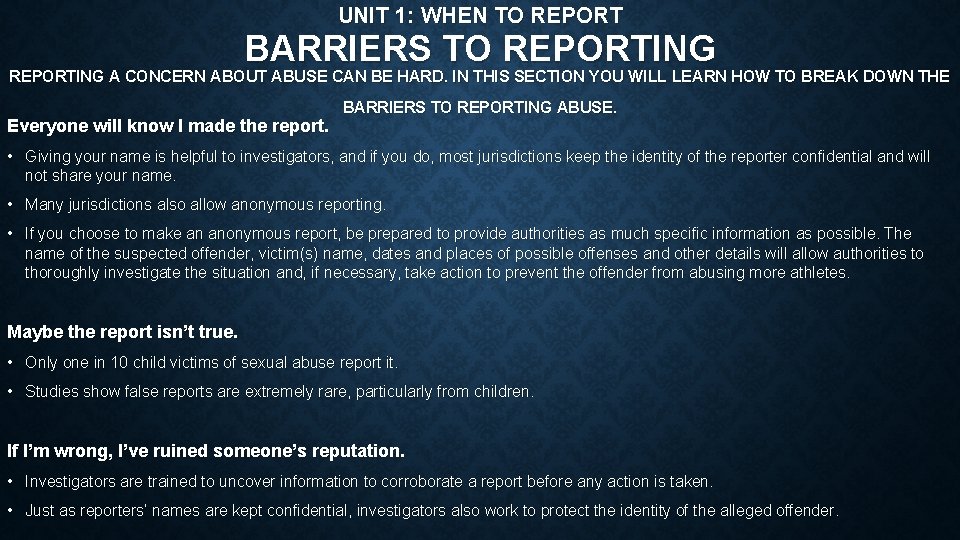
UNIT 1: WHEN TO REPORT BARRIERS TO REPORTING A CONCERN ABOUT ABUSE CAN BE HARD. IN THIS SECTION YOU WILL LEARN HOW TO BREAK DOWN THE Everyone will know I made the report. BARRIERS TO REPORTING ABUSE. • Giving your name is helpful to investigators, and if you do, most jurisdictions keep the identity of the reporter confidential and will not share your name. • Many jurisdictions also allow anonymous reporting. • If you choose to make an anonymous report, be prepared to provide authorities as much specific information as possible. The name of the suspected offender, victim(s) name, dates and places of possible offenses and other details will allow authorities to thoroughly investigate the situation and, if necessary, take action to prevent the offender from abusing more athletes. Maybe the report isn’t true. • Only one in 10 child victims of sexual abuse report it. • Studies show false reports are extremely rare, particularly from children. If I’m wrong, I’ve ruined someone’s reputation. • Investigators are trained to uncover information to corroborate a report before any action is taken. • Just as reporters’ names are kept confidential, investigators also work to protect the identity of the alleged offender.
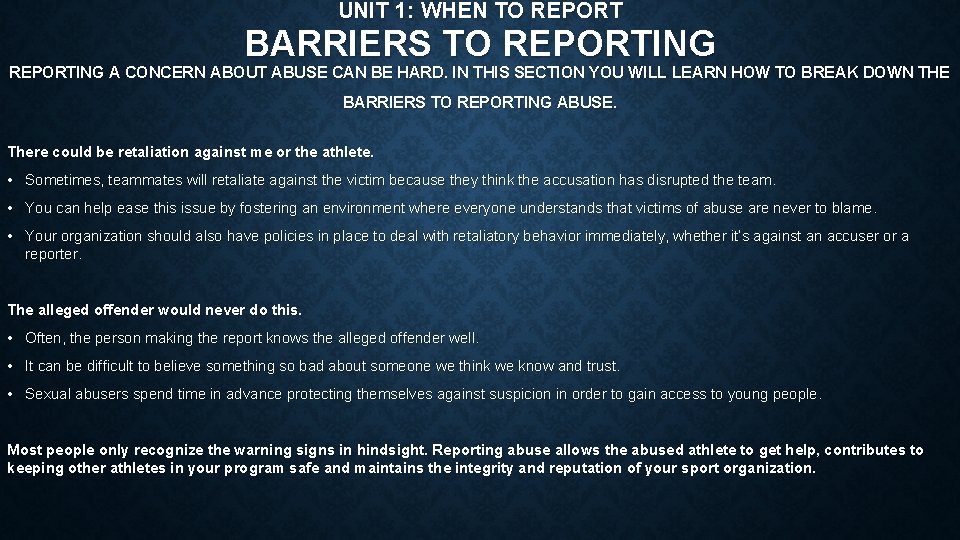
UNIT 1: WHEN TO REPORT BARRIERS TO REPORTING A CONCERN ABOUT ABUSE CAN BE HARD. IN THIS SECTION YOU WILL LEARN HOW TO BREAK DOWN THE BARRIERS TO REPORTING ABUSE. There could be retaliation against me or the athlete. • Sometimes, teammates will retaliate against the victim because they think the accusation has disrupted the team. • You can help ease this issue by fostering an environment where everyone understands that victims of abuse are never to blame. • Your organization should also have policies in place to deal with retaliatory behavior immediately, whether it’s against an accuser or a reporter. The alleged offender would never do this. • Often, the person making the report knows the alleged offender well. • It can be difficult to believe something so bad about someone we think we know and trust. • Sexual abusers spend time in advance protecting themselves against suspicion in order to gain access to young people. Most people only recognize the warning signs in hindsight. Reporting abuse allows the abused athlete to get help, contributes to keeping other athletes in your program safe and maintains the integrity and reputation of your sport organization.
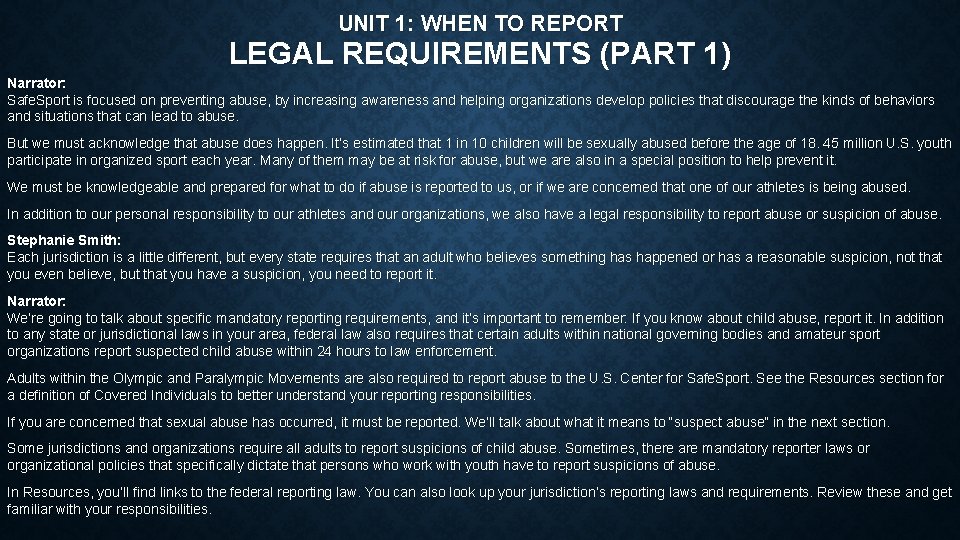
UNIT 1: WHEN TO REPORT LEGAL REQUIREMENTS (PART 1) Narrator: Safe. Sport is focused on preventing abuse, by increasing awareness and helping organizations develop policies that discourage the kinds of behaviors and situations that can lead to abuse. But we must acknowledge that abuse does happen. It’s estimated that 1 in 10 children will be sexually abused before the age of 18. 45 million U. S. youth participate in organized sport each year. Many of them may be at risk for abuse, but we are also in a special position to help prevent it. We must be knowledgeable and prepared for what to do if abuse is reported to us, or if we are concerned that one of our athletes is being abused. In addition to our personal responsibility to our athletes and our organizations, we also have a legal responsibility to report abuse or suspicion of abuse. Stephanie Smith: Each jurisdiction is a little different, but every state requires that an adult who believes something has happened or has a reasonable suspicion, not that you even believe, but that you have a suspicion, you need to report it. Narrator: We’re going to talk about specific mandatory reporting requirements, and it’s important to remember: If you know about child abuse, report it. In addition to any state or jurisdictional laws in your area, federal law also requires that certain adults within national governing bodies and amateur sport organizations report suspected child abuse within 24 hours to law enforcement. Adults within the Olympic and Paralympic Movements are also required to report abuse to the U. S. Center for Safe. Sport. See the Resources section for a definition of Covered Individuals to better understand your reporting responsibilities. If you are concerned that sexual abuse has occurred, it must be reported. We’ll talk about what it means to “suspect abuse” in the next section. Some jurisdictions and organizations require all adults to report suspicions of child abuse. Sometimes, there are mandatory reporter laws or organizational policies that specifically dictate that persons who work with youth have to report suspicions of abuse. In Resources, you’ll find links to the federal reporting law. You can also look up your jurisdiction’s reporting laws and requirements. Review these and get familiar with your responsibilities.
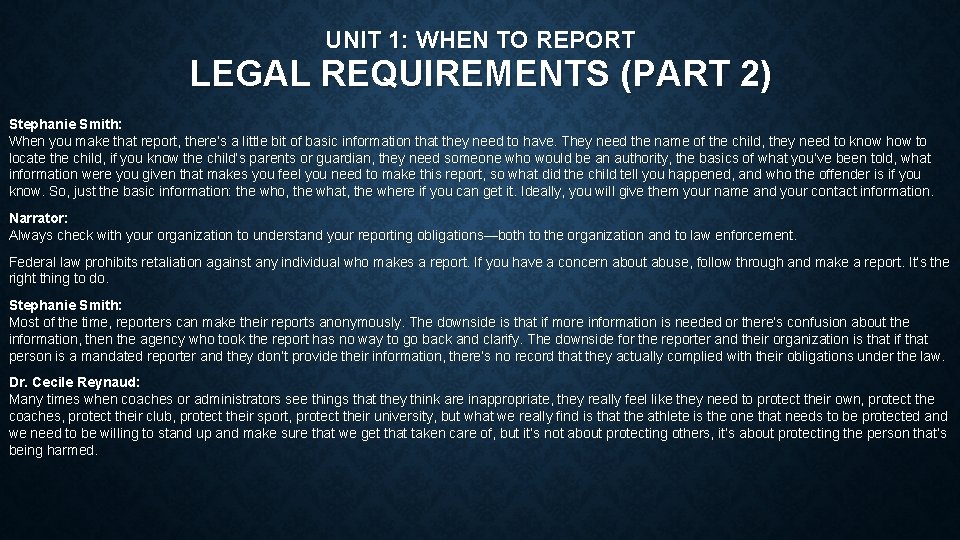
UNIT 1: WHEN TO REPORT LEGAL REQUIREMENTS (PART 2) Stephanie Smith: When you make that report, there’s a little bit of basic information that they need to have. They need the name of the child, they need to know how to locate the child, if you know the child’s parents or guardian, they need someone who would be an authority, the basics of what you’ve been told, what information were you given that makes you feel you need to make this report, so what did the child tell you happened, and who the offender is if you know. So, just the basic information: the who, the what, the where if you can get it. Ideally, you will give them your name and your contact information. Narrator: Always check with your organization to understand your reporting obligations—both to the organization and to law enforcement. Federal law prohibits retaliation against any individual who makes a report. If you have a concern about abuse, follow through and make a report. It’s the right thing to do. Stephanie Smith: Most of the time, reporters can make their reports anonymously. The downside is that if more information is needed or there’s confusion about the information, then the agency who took the report has no way to go back and clarify. The downside for the reporter and their organization is that if that person is a mandated reporter and they don’t provide their information, there’s no record that they actually complied with their obligations under the law. Dr. Cecile Reynaud: Many times when coaches or administrators see things that they think are inappropriate, they really feel like they need to protect their own, protect the coaches, protect their club, protect their sport, protect their university, but what we really find is that the athlete is the one that needs to be protected and we need to be willing to stand up and make sure that we get that taken care of, but it’s not about protecting others, it’s about protecting the person that’s being harmed.
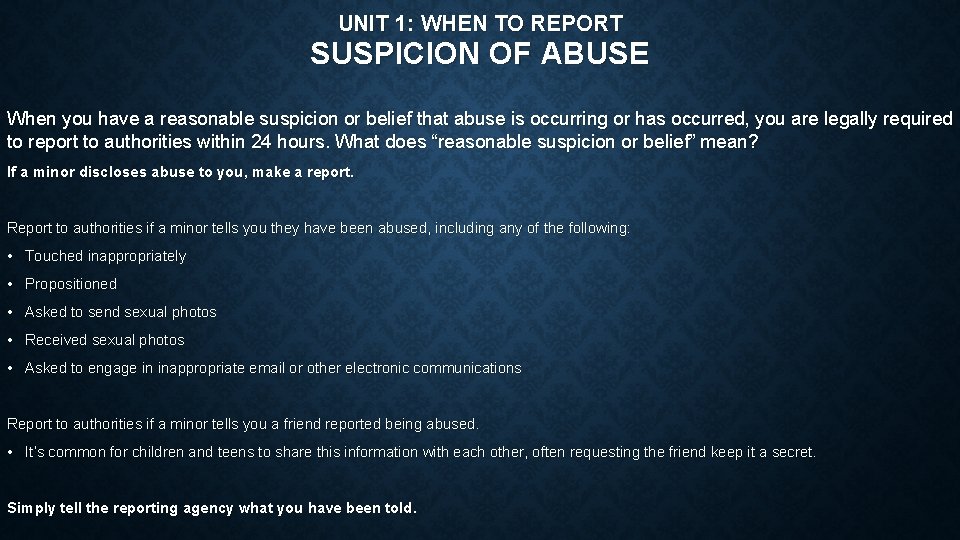
UNIT 1: WHEN TO REPORT SUSPICION OF ABUSE When you have a reasonable suspicion or belief that abuse is occurring or has occurred, you are legally required to report to authorities within 24 hours. What does “reasonable suspicion or belief” mean? If a minor discloses abuse to you, make a report. Report to authorities if a minor tells you they have been abused, including any of the following: • Touched inappropriately • Propositioned • Asked to send sexual photos • Received sexual photos • Asked to engage in inappropriate email or other electronic communications Report to authorities if a minor tells you a friend reported being abused. • It’s common for children and teens to share this information with each other, often requesting the friend keep it a secret. Simply tell the reporting agency what you have been told.
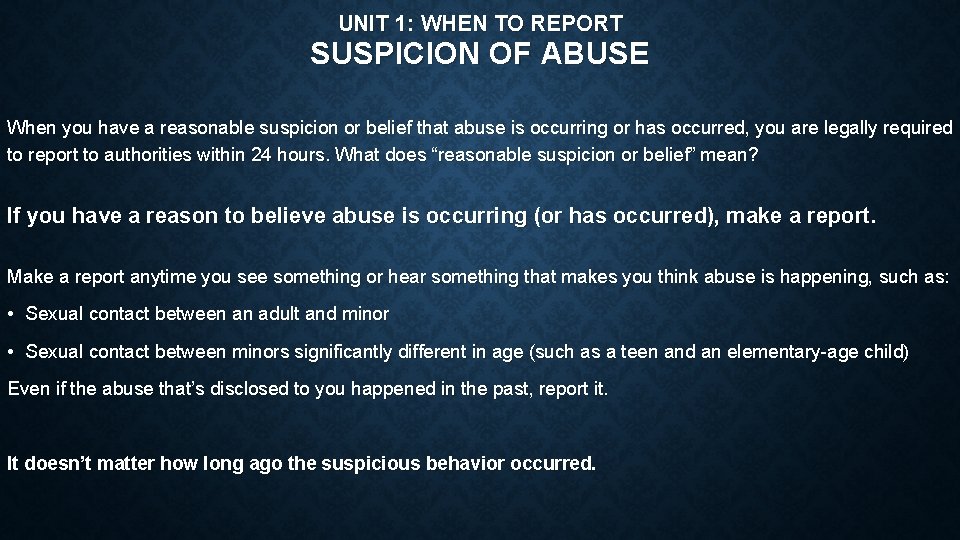
UNIT 1: WHEN TO REPORT SUSPICION OF ABUSE When you have a reasonable suspicion or belief that abuse is occurring or has occurred, you are legally required to report to authorities within 24 hours. What does “reasonable suspicion or belief” mean? If you have a reason to believe abuse is occurring (or has occurred), make a report. Make a report anytime you see something or hear something that makes you think abuse is happening, such as: • Sexual contact between an adult and minor • Sexual contact between minors significantly different in age (such as a teen and an elementary-age child) Even if the abuse that’s disclosed to you happened in the past, report it. It doesn’t matter how long ago the suspicious behavior occurred.
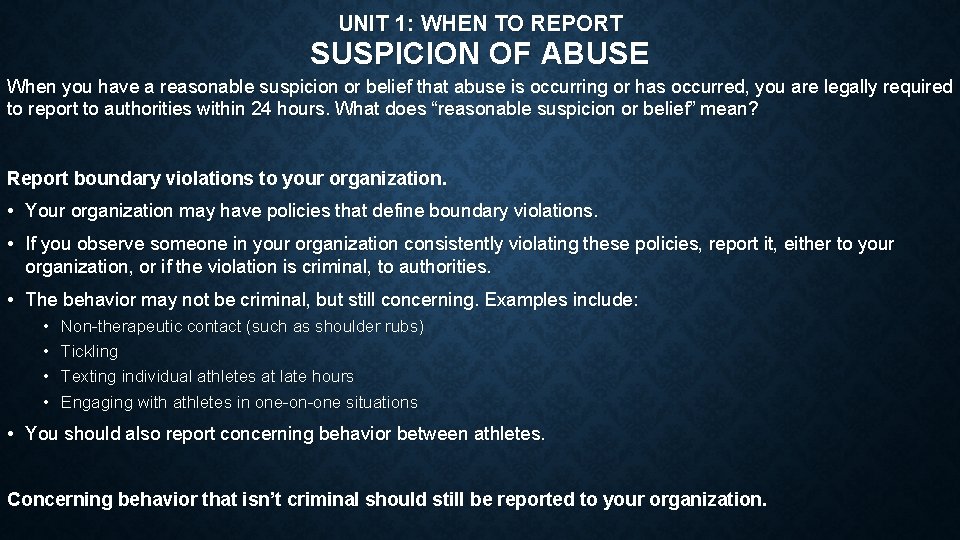
UNIT 1: WHEN TO REPORT SUSPICION OF ABUSE When you have a reasonable suspicion or belief that abuse is occurring or has occurred, you are legally required to report to authorities within 24 hours. What does “reasonable suspicion or belief” mean? Report boundary violations to your organization. • Your organization may have policies that define boundary violations. • If you observe someone in your organization consistently violating these policies, report it, either to your organization, or if the violation is criminal, to authorities. • The behavior may not be criminal, but still concerning. Examples include: • • Non-therapeutic contact (such as shoulder rubs) Tickling Texting individual athletes at late hours Engaging with athletes in one-on-one situations • You should also report concerning behavior between athletes. Concerning behavior that isn’t criminal should still be reported to your organization.
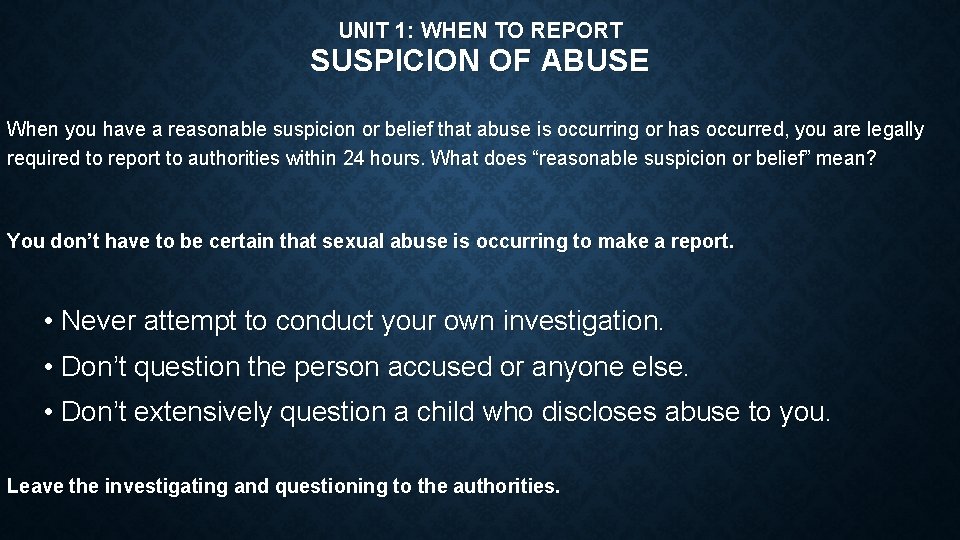
UNIT 1: WHEN TO REPORT SUSPICION OF ABUSE When you have a reasonable suspicion or belief that abuse is occurring or has occurred, you are legally required to report to authorities within 24 hours. What does “reasonable suspicion or belief” mean? You don’t have to be certain that sexual abuse is occurring to make a report. • Never attempt to conduct your own investigation. • Don’t question the person accused or anyone else. • Don’t extensively question a child who discloses abuse to you. Leave the investigating and questioning to the authorities.
UNIT 2: REPORTING PROCESS RESPONDING TO A DISCLOSURE OF ABUSE Stephanie Smith: I think the number one barrier is our own inability to believe. Most of the time, whether it’s in sport or not, most of the time, we’re going to know the person the child is telling us has been abusing them because we know the child, and if we know the child, then children don’t have huge worlds of acquaintances, so we generally will know them. Katie Connell: That can be a very shocking thing to hear from somebody, especially if it’s about a coach that you know, you’ve worked with. That can be very devastating on a personal level. But really, that athlete comes first. Your role as a coach is to say, “I hear what you’re saying to me. I’m sorry that’s happened. Now here’s what we have to do. ” Cindy Aron: First rule of thumb if someone begins to disclose about a sexual mistreatment of any kind is safety. That individual needs to feel safe. And the way they can feel safe is by you being the best listener you can be, not giving feedback, honestly, of any kind, in terms of questioning or even reassurance. They need to simply be listened to and then in a sense triaged to the correct person for further help and assistance. Katie Connell: If an athlete comes forward, you’re their coach and they say, “This is what happened, ” not your job to do the investigation. And that’s so critical because the next things you do can impact any type of criminal investigation that may need to happen. Because again, your job as a mandated reporter is then to move forward with that information to the right persons after that to say now it’s up to them to investigate this. Stephanie Smith: Don’t ask a lot of questions and only ask very open-ended questions: Tell me about that, what happened? Do not ask a leading question. Don’t say, “He hurt you, didn’t he? ” or even, “Did he hurt you? ” All of that will be done by a trained forensic interviewer who knows how to let the children talk in their own language. Katie Connell: I don’t ever want somebody to be accused of something they didn’t do. But I’d rather that we report it and let that decision be made by the entities that are responsible for that than let a child or a teenager youth go home and have that abuse continue.
UNIT 2: REPORTING PROCESS RESPONDING TO A DISCLOSURE OF ABUSE If you are a Covered Individual as defined by the U. S. Center for Safe. Sport, you must report child sexual abuse to the Center’s Response & Resolution Office as well as to law enforcement. This section focuses on how to make a report to law enforcement authorities, but much of this information applies to making a report to the Center as well. When you report child sexual abuse, you will be asked to provide some basic information. Being prepared to provide these details will help investigators, but even if you do not have this information, you can and should still make a report. Information investigators typically request about the reporter, the victim and the offender.
UNIT 2: REPORTING PROCESS REPORTING TO AUTHORITIES Reporter Tell the authorities. . . Reporter’s name and contact information • If you are comfortable doing so, provide your name and contact information. • Authorities may need to reach you for follow-up information. • It generates a record that you reported the concern about abuse in accordance with any mandatory reporting laws. • Most jurisdictions keep reporters’ names confidential. • The agency representative you speak to will be able to confirm the confidentiality laws in your area. AFTER you have reported the abuse to the appropriate law enforcement authorities, report the incident internally at your sport organization according to your organization’s policies.
UNIT 2: REPORTING PROCESS REPORTING TO AUTHORITIES Victim Tell the authorities. . . What you were told about the abuse • Provide as much detail as possible about what the minor told you. • Remember: If a minor tells you a friend has reported abuse, you must make a report. • In this case, report what you were told by the victim’s friend. A note about contacting parents or guardians • The authorities will usually contact parents or guardians. • If the offender is a parent or guardian, authorities will typically follow procedures to make sure the child is protected and permitted to speak to law enforcement.
UNIT 2: REPORTING PROCESS REPORTING TO AUTHORITIES Offender Tell the authorities. . . Offender’s identity • Provide as much detail as possible for investigators—such as a first and last name and any contact information you have (address, phone number or email address). Whether the victim is or will soon be around the offender • This will allow authorities to take steps to ensure the victim is safe.
UNIT 2: REPORTING PROCESS REPORTING SCENARIOS The following scenarios let you explore various responses to realistic situations of possible sexual abuse or misconduct. In each scenario, you will be given choices for how to respond. Will your actions help protect the athletes in your program? You can go through each scenario multiple times to explore what happens when you make different choices. In each scenario, assume that all athletes are under age 18, and all sport organization personnel are over age 18.
UNIT 2: REPORTING PROCESS REPORTING SCENARIOS Scenario 1 One of the athletes in your program comes to you with a concerning story. According to the athlete, his friend has been receiving flirtatious texts from one of the program volunteers for a few weeks. Two days ago, the volunteer asked the athlete to send a sexually explicit photo of himself, and the athlete did. The athlete who sent the photo told his friend he regretted doing it, but begged the friend not to tell anyone. What should you do? o Report to law enforcement o Talk to the athlete o Report to program leadership o Talk to the volunteer
UNIT 2: REPORTING PROCESS REPORTING SCENARIOS Scenario 2 Your team is preparing to head out for a competition road trip weekend. Just before leaving, a 13 -year-old athlete comes to you and says she would rather not have a certain coach as her chaperone. When asked why, the athlete reveals that this coach has kissed and groped her on more than one occasion. What should you do? o Call the athlete’s parents o Report to program leadership o Report to law enforcement o Keep quiet
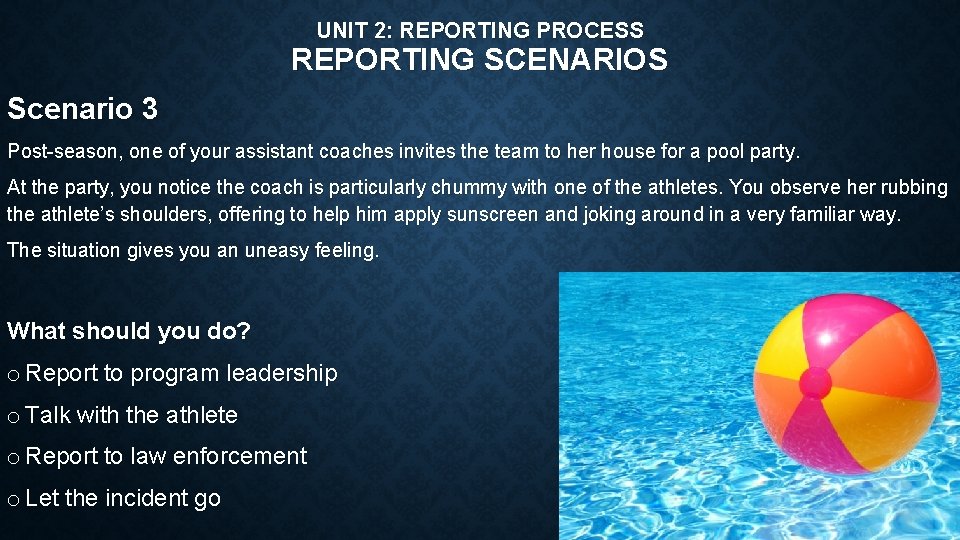
UNIT 2: REPORTING PROCESS REPORTING SCENARIOS Scenario 3 Post-season, one of your assistant coaches invites the team to her house for a pool party. At the party, you notice the coach is particularly chummy with one of the athletes. You observe her rubbing the athlete’s shoulders, offering to help him apply sunscreen and joking around in a very familiar way. The situation gives you an uneasy feeling. What should you do? o Report to program leadership o Talk with the athlete o Report to law enforcement o Let the incident go
CONCLUSION SUMMARY Summary: In this course, you have learned: • When and how to report a concern about child sexual abuse—to legal authorities and your organization • The legal requirements for reporting child sexual abuse • What barriers prevent people from reporting abuse • How to respond if an athlete discloses abuse to you
CONCLUSION POST-TEST 1. Before reporting a concern about sexual abuse to law enforcement, you should be absolutely certain that the allegation is true. o A. True o B. False
CONCLUSION POST-TEST 2. Which of the following are situations in which sexual abuse should be reported to law enforcement? o A. A minor discloses that have been sexually abused. o B. A minor discloses that have been sexually abused, but it happened over a year ago. o C. A minor was asked to text an adult a sexually explicit photo of themselves. o D. Both A and C o E. All of the above
CONCLUSION POST-TEST 3. If a minor reports to you that one of their friends has told them in confidence that they were sexually abused, you cannot make a report to law enforcement because this information is second-hand. o A. True o B. False
CONCLUSION POST-TEST 4. Only mandatory reporters (as defined by local, state or federal laws) need to know the guidelines for reporting child sexual abuse. o A. True o B. False
CONCLUSION POST-TEST 5. Which of the following is good advice to follow when a child comes to you with a report of sexual abuse? o A. Reassure the child that everything is going to be absolutely fine. o B. Avoid looking shocked by what the child tells you. o C. Ask the child lots of specific follow-up questions so you can verify if their story is true. o D. All of the above
CONCLUSION POST-TEST 6. Studies show that young children often falsely report abuse, probably due to over-active imaginations. o A. True o B. False