
Safe Sleep for Babies SIDS SUID and Other
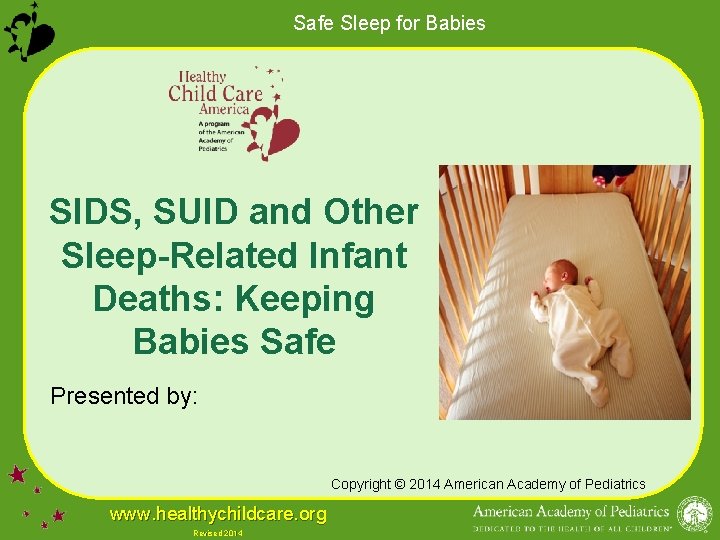
Safe Sleep for Babies SIDS, SUID and Other Sleep-Related Infant Deaths: Keeping Babies Safe Presented by: Copyright © 2014 American Academy of Pediatrics www. healthychildcare. org Revised 2014
Safe Sleep for Babies Overview • • Definition of Sudden Infant Death Syndrome (SIDS), Sudden Unexpected Infant Death (SUID), and sleep-related deaths Recent research about why these babies die Statistics Why child care providers are important to the health and safety of babies AAP SIDS Task Force recommendations and why they are important Putting policies into place in child care Available resources www. healthychildcare. org Revised 2014
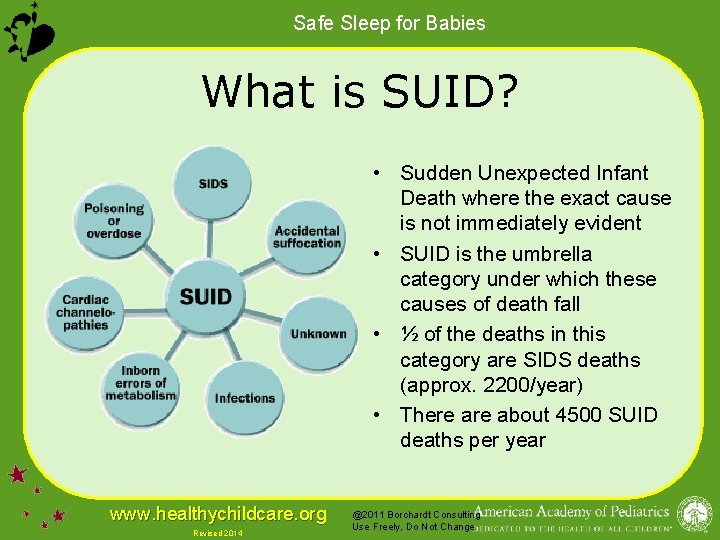
Safe Sleep for Babies What is SUID? • Sudden Unexpected Infant Death where the exact cause is not immediately evident • SUID is the umbrella category under which these causes of death fall • ½ of the deaths in this category are SIDS deaths (approx. 2200/year) • There about 4500 SUID deaths per year www. healthychildcare. org Revised 2014 @2011 Borchardt Consulting Use Freely, Do Not Change
Safe Sleep for Babies Definition of SIDS • • Sudden death which occurs before 1 year of age, usually in a previously healthy infant Cause of death unexplained after thorough investigation; including complete autopsy, death scene investigation, and review of child’s health history A diagnosis of exclusion SIDS is not predictable www. healthychildcare. org Revised 2014
Safe Sleep for Babies Sleep-related Infant Deaths • • • Most occur during infant sleep ASSB – Accidental Suffocation or Strangulation in Bed Suffocation Unknown/ undetermined SIDS www. healthychildcare. org Revised 2014
Safe Sleep for Babies Why Do We Talk About SIDS, SUID, and Sleep-related Deaths? While we don’t know the exact mechanism that causes SIDS, we have identified factors that put an infant at increased risk. Eliminating these risk factors will ELIMINATE suffocation deaths. www. healthychildcare. org Revised 2014
Safe Sleep for Babies SIDS Facts • In 2010, there were about 2, 063 SIDS cases (US) • It is the leading cause of death for babies from 1 to 12 months of age • Highest risk is at 2 to 4 months; 91% occur between 1 and 6 months of age • Seasonal trend: there are more SIDS deaths in winter months • More male babies die of SIDS • Unaccustomed tummy sleeping increases risk as much as 18 times www. healthychildcare. org Revised 2014

Safe Sleep for Babies Triple Risk Model www. healthychildcare. org Revised 2014
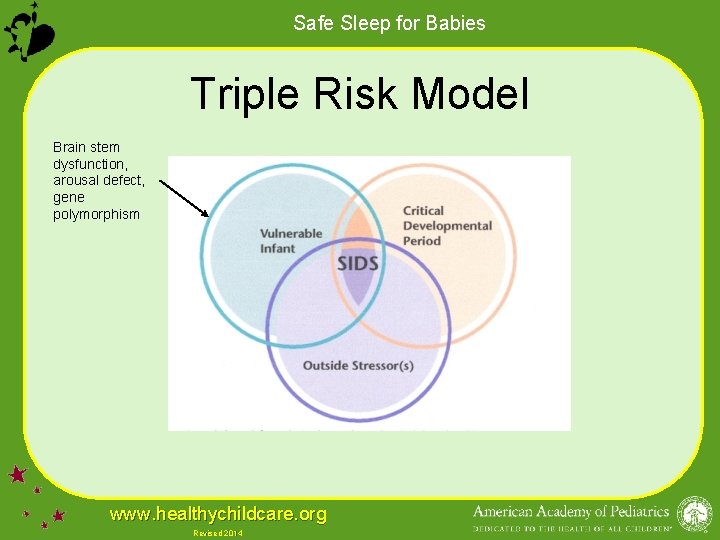
Safe Sleep for Babies Triple Risk Model Brain stem dysfunction, arousal defect, gene polymorphism www. healthychildcare. org Revised 2014
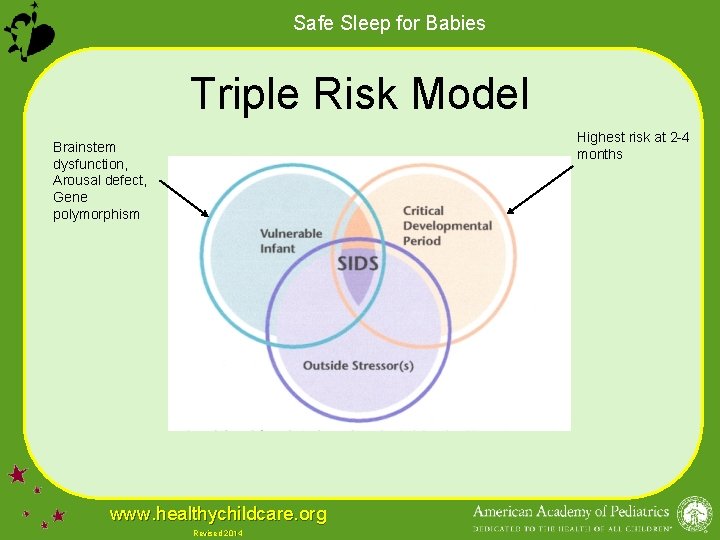
Safe Sleep for Babies Triple Risk Model Highest risk at 2 -4 months Brainstem dysfunction, Arousal defect, Gene polymorphism www. healthychildcare. org Revised 2014
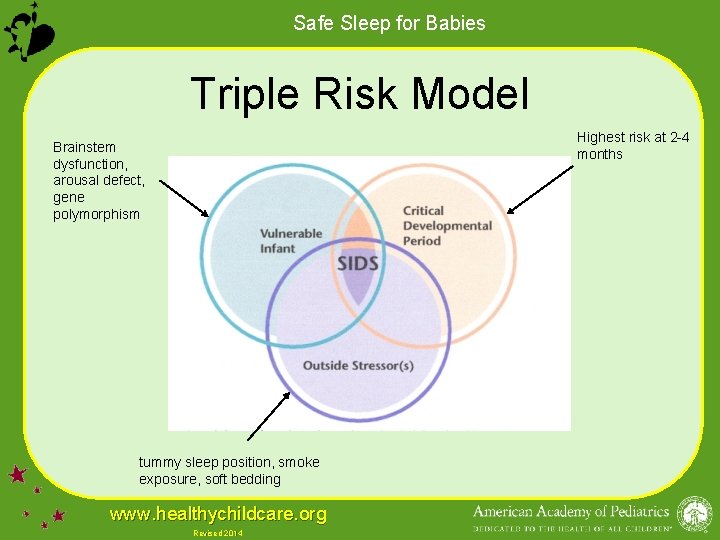
Safe Sleep for Babies Triple Risk Model Highest risk at 2 -4 months Brainstem dysfunction, arousal defect, gene polymorphism tummy sleep position, smoke exposure, soft bedding www. healthychildcare. org Revised 2014
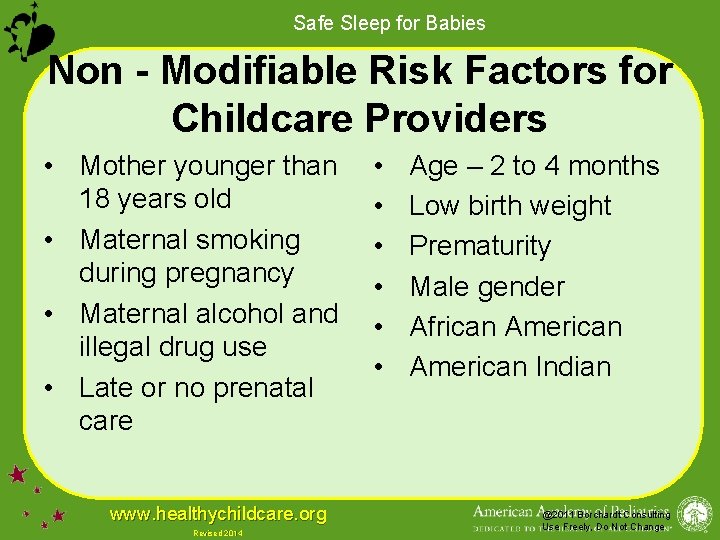
Safe Sleep for Babies Non - Modifiable Risk Factors for Childcare Providers • Mother younger than 18 years old • Maternal smoking during pregnancy • Maternal alcohol and illegal drug use • Late or no prenatal care www. healthychildcare. org Revised 2014 • • • Age – 2 to 4 months Low birth weight Prematurity Male gender African American Indian @2011 Borchardt Consulting Use Freely, Do Not Change
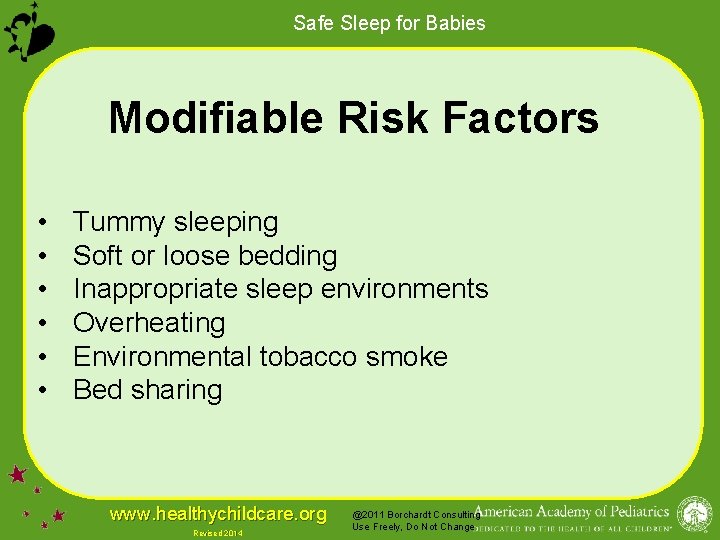
Safe Sleep for Babies Modifiable Risk Factors • • • Tummy sleeping Soft or loose bedding Inappropriate sleep environments Overheating Environmental tobacco smoke Bed sharing www. healthychildcare. org Revised 2014 @2011 Borchardt Consulting Use Freely, Do Not Change
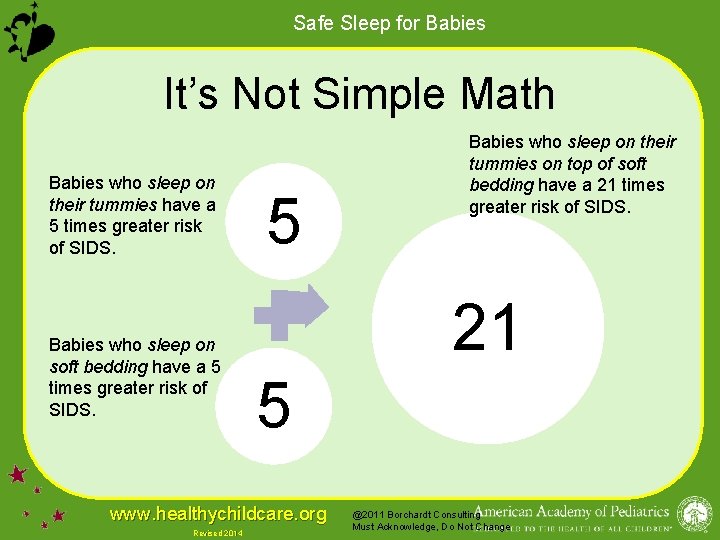
Safe Sleep for Babies It’s Not Simple Math Babies who sleep on their tummies have a 5 times greater risk of SIDS. Babies who sleep on soft bedding have a 5 times greater risk of SIDS. 5 21 5 www. healthychildcare. org Revised 2014 Babies who sleep on their tummies on top of soft bedding have a 21 times greater risk of SIDS. @2011 Borchardt Consulting Must Acknowledge, Do Not Change
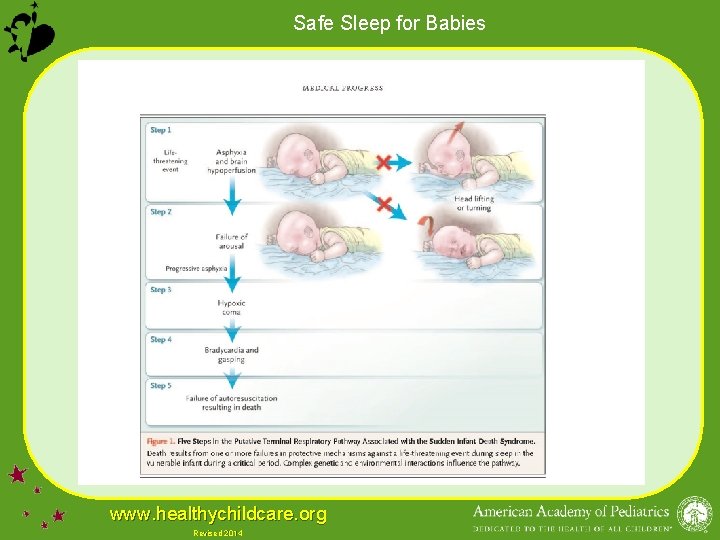
Safe Sleep for Babies Rebreathing Theory • Infants in certain sleep environments are more likely to trap exhaled CO 2 around the face – Tummy sleeping and near-face-down/ face-down – Soft bedding – Tobacco smoke exposure • Infants rebreathe exhaled CO 2 • Infants die if they cannot arouse/ respond appropriately www. healthychildcare. org Revised 2014
Safe Sleep for Babies www. healthychildcare. org Revised 2014
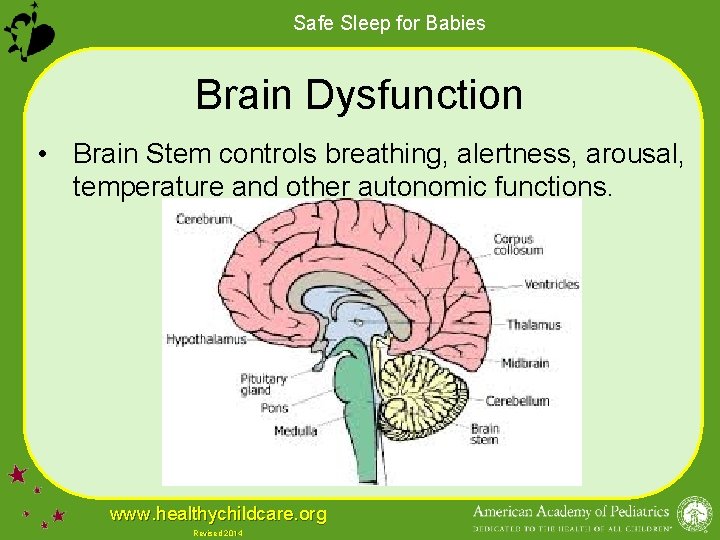
Safe Sleep for Babies Brain Dysfunction • Brain Stem controls breathing, alertness, arousal, temperature and other autonomic functions. www. healthychildcare. org Revised 2014
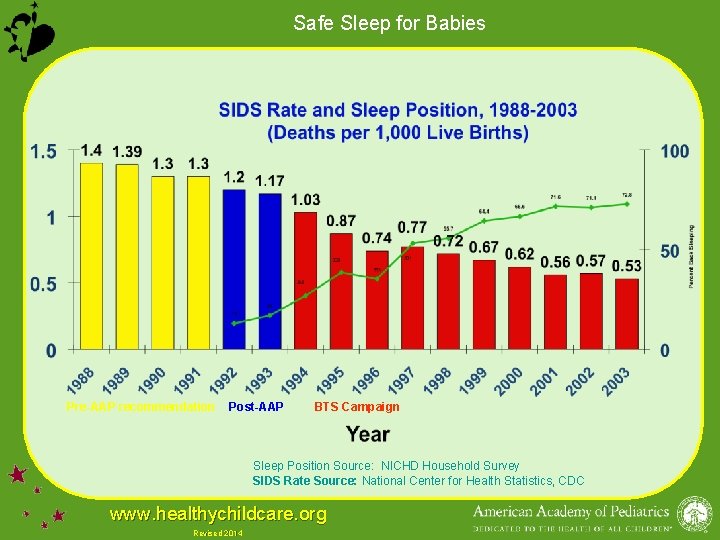
Safe Sleep for Babies Pre-AAP recommendation Post-AAP BTS Campaign Sleep Position Source: NICHD Household Survey SIDS Rate Source: National Center for Health Statistics, CDC www. healthychildcare. org Revised 2014
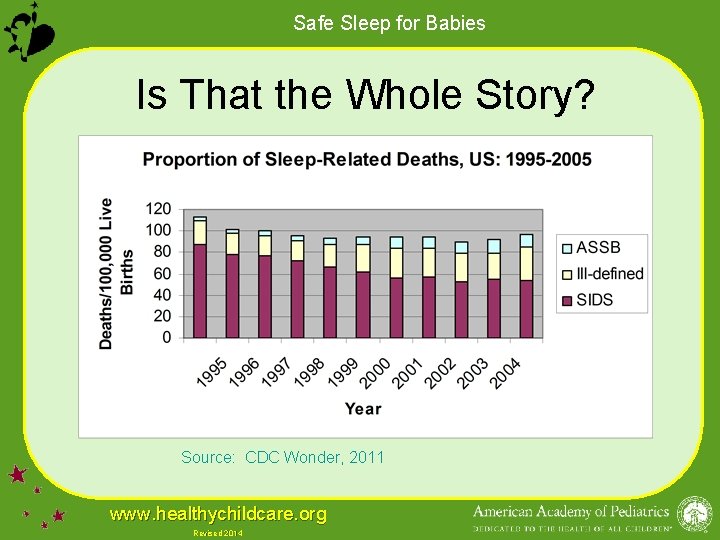
Safe Sleep for Babies Is That the Whole Story? Source: CDC Wonder, 2011 www. healthychildcare. org Revised 2014
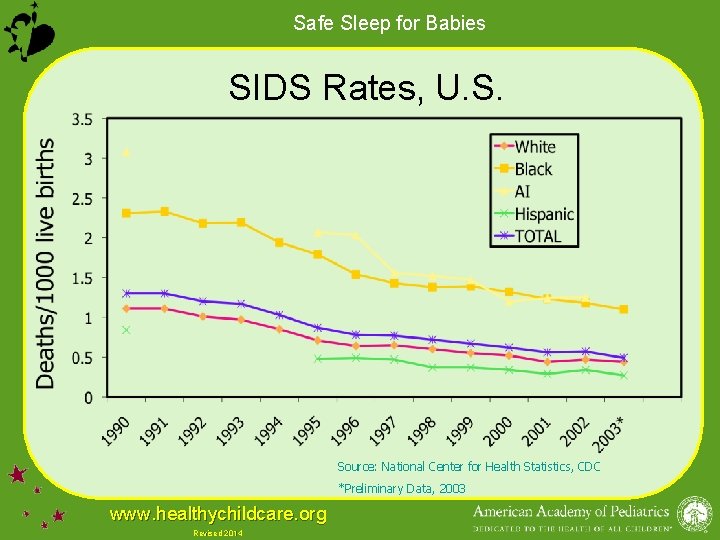
Safe Sleep for Babies SIDS Rates, U. S. Source: National Center for Health Statistics, CDC *Preliminary Data, 2003 www. healthychildcare. org Revised 2014
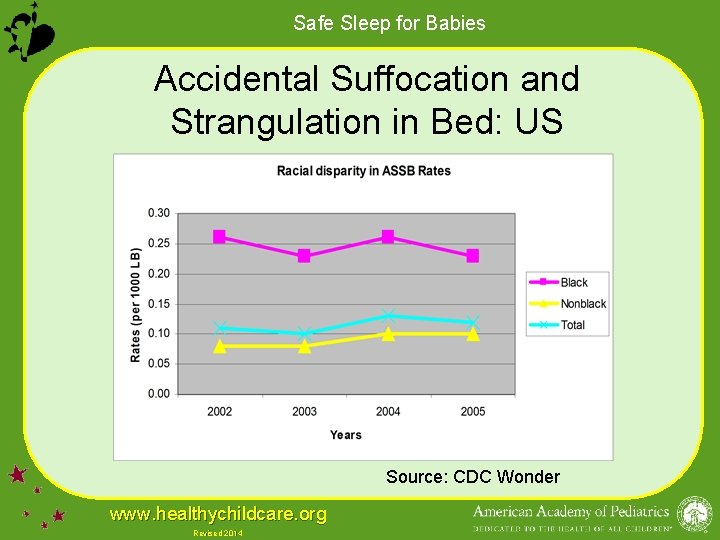
Safe Sleep for Babies Accidental Suffocation and Strangulation in Bed: US Source: CDC Wonder www. healthychildcare. org Revised 2014
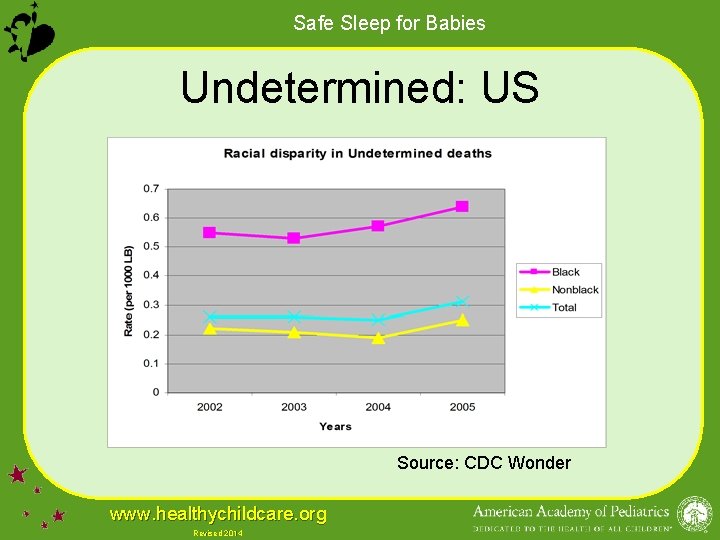
Safe Sleep for Babies Undetermined: US Source: CDC Wonder www. healthychildcare. org Revised 2014
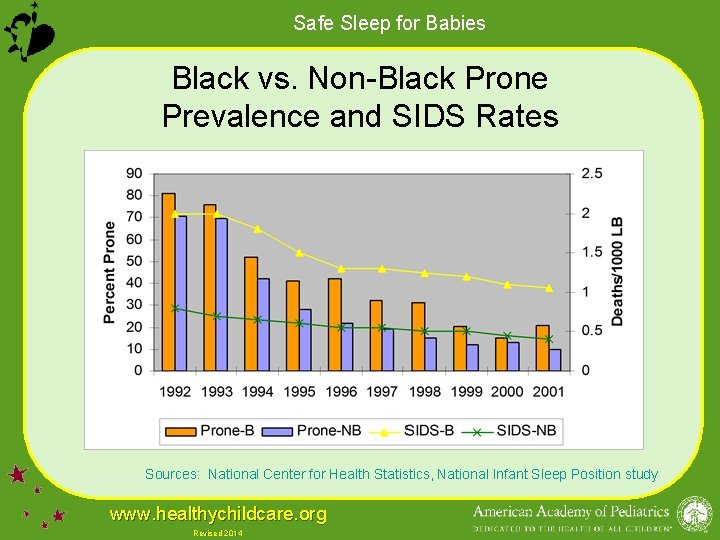
Safe Sleep for Babies Black vs. Non-Black Prone Prevalence and SIDS Rates Sources: National Center for Health Statistics, National Infant Sleep Position study www. healthychildcare. org Revised 2014
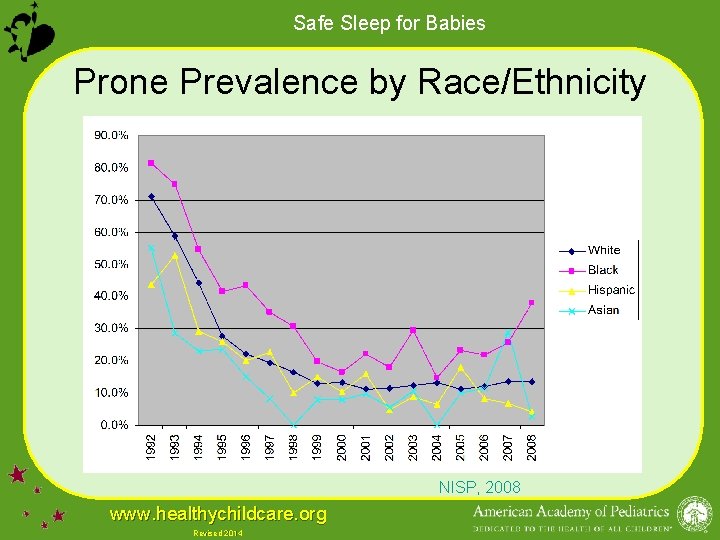
Safe Sleep for Babies Prone Prevalence by Race/Ethnicity NISP, 2008 www. healthychildcare. org Revised 2014
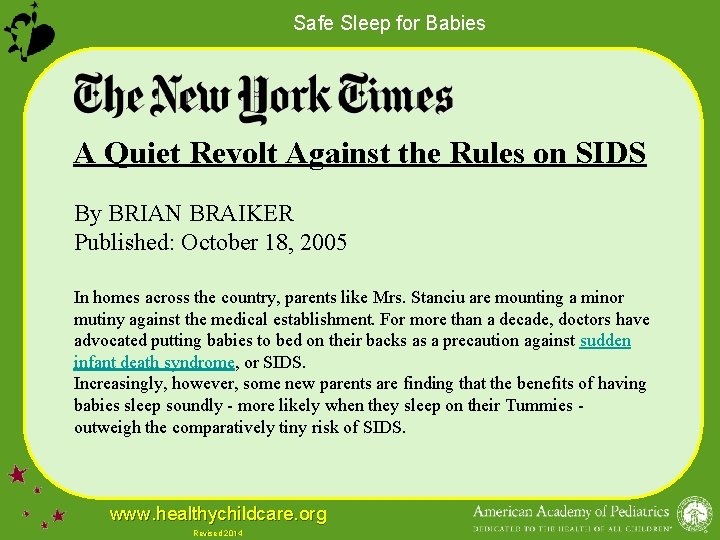
Safe Sleep for Babies A Quiet Revolt Against the Rules on SIDS By BRIAN BRAIKER Published: October 18, 2005 In homes across the country, parents like Mrs. Stanciu are mounting a minor mutiny against the medical establishment. For more than a decade, doctors have advocated putting babies to bed on their backs as a precaution against sudden infant death syndrome, or SIDS. Increasingly, however, some new parents are finding that the benefits of having babies sleep soundly - more likely when they sleep on their Tummies outweigh the comparatively tiny risk of SIDS. www. healthychildcare. org Revised 2014
Safe Sleep for Babies Child Care and SIDS • 2/3 of US infants are in non-parental child care (Ehrle et al, 2001) • Infants of employed mothers spend average of 22 hours/week in child care • 32% infants are in child care full-time • Of infants in child care: – 50% relative care – 10% in-home babysitter/nanny – 40% organized child care www. healthychildcare. org Revised 2014
Safe Sleep for Babies Child Care and SIDS - 1990 s • 15 -20% SIDS occurred in child care • In 1990 s, child care deaths associated with unaccustomed tummy position (Moon, 2000) – Child care providers were unaware of association of SIDS and sleep position – Misinformed about risks and benefits of various sleep positions www. healthychildcare. org Revised 2014
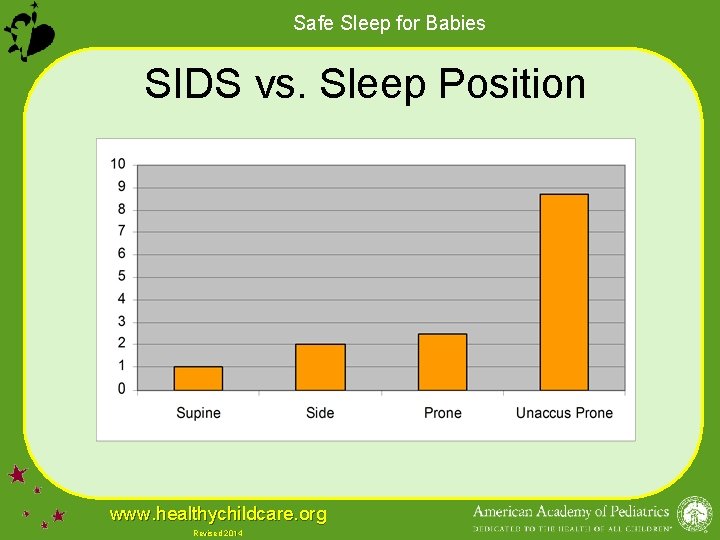
Safe Sleep for Babies SIDS vs. Sleep Position www. healthychildcare. org Revised 2014
Safe Sleep for Babies Unaccustomed Tummy Sleeping • Increases risk of SIDS (as much as 18 times) – Mitchell et al, 1999 • Non-parental caregivers may use tummy sleeping • Less ability to lift head in tummy position • Later development of upper body strength – Davis et al, 1998 www. healthychildcare. org Revised 2014
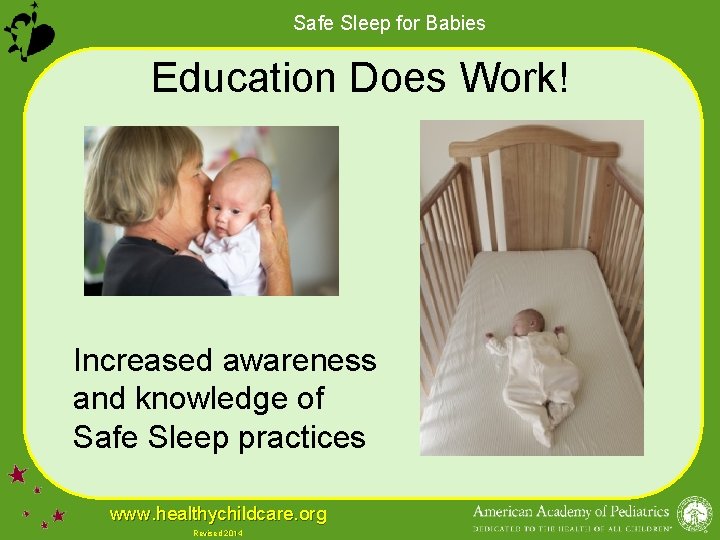
Safe Sleep for Babies Education Does Work! Increased awareness and knowledge of Safe Sleep practices www. healthychildcare. org Revised 2014
Safe Sleep for Babies Regulation and Legislation • Child care providers are more likely to place infants on their backs to sleep if there is a regulation or written policy in place • States with regulation or legislation regarding sleep position in child care has increased – In 2001, only 7 states had regulations for sleep position. – Now nearly all states have some safe sleep guidelines. www. healthychildcare. org Revised 2014
Safe Sleep for Babies Sleep Position Regulations (as of March 2012) • 39 states require back positioning for infants in CCCs and FCCHs – Some states allow a waiver from physician and/or parent • • Several states allow back or side positioning 1 state only requires back positioning in CCCs 3 states only require back positioning in FCCHs 7 states do not regulate sleep position in CCCs or FCCHs – NE requires bumpers in cribs of babies <6 months of age www. healthychildcare. org Revised 2014
Safe Sleep for Babies Child Care and Infant Deaths - 21 st Century • Still high proportion of infants die in child care, but decreasing (Moon, 2005) – 1/3 die in first week; of these, 1/2 die on the first day • Sleep position is less an issue – Relatives and non-licensed caregivers may still be unaware of importance of back • Infants in child care in safer sleep environment – More likely to be in a safe crib – Less likely to be in adult bed or sofa www. healthychildcare. org Revised 2014
Safe Sleep for Babies But it Still Happens… • In 2010, the parents of a 2 -month-old baby girl placed her at a neighborhood church day care • Religious organization – not subject to state regulations • Baby was placed on her Tummy • Found unresponsive • “We always put them on their tummies. . . ” www. healthychildcare. org Revised 2014
Safe Sleep for Babies Reasons That People Place Babies on Their Tummies • When the baby is on the back, s/he startles more easily and wakes up • The baby will get a flat head (plagiocephaly) if the baby sleeps on the back • The baby will get a bald spot from sleeping on the back • When babies sleep on their backs, they don’t develop normally www. healthychildcare. org Revised 2014
Safe Sleep for Babies Findings from National Study of Child Care Providers • Training child care providers improves knowledge and practices –Sleep position –Lessens use of loose and soft bedding • No change in provider attitudes about whether sleep position makes a difference –Policies and regulations are critical! • Barriers: perceived parental objections, provider skepticism, lack of policies and training opportunities (Moon, 2008) www. healthychildcare. org Revised 2014
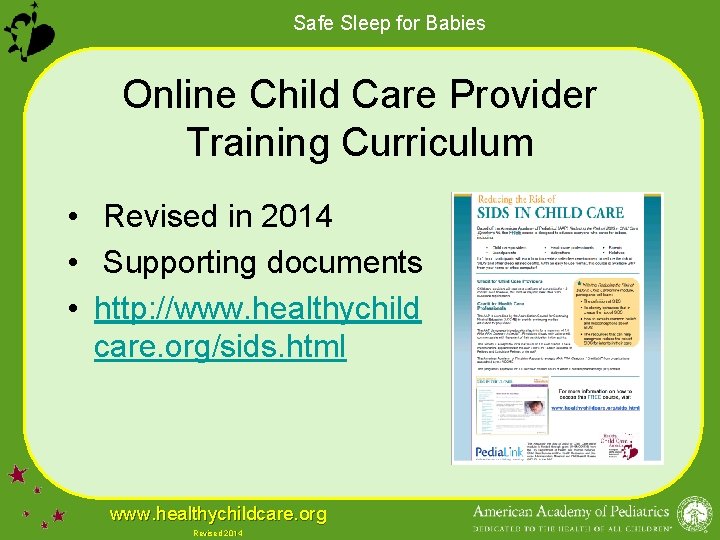
Safe Sleep for Babies Online Child Care Provider Training Curriculum • Revised in 2014 • Supporting documents • http: //www. healthychild care. org/sids. html www. healthychildcare. org Revised 2014
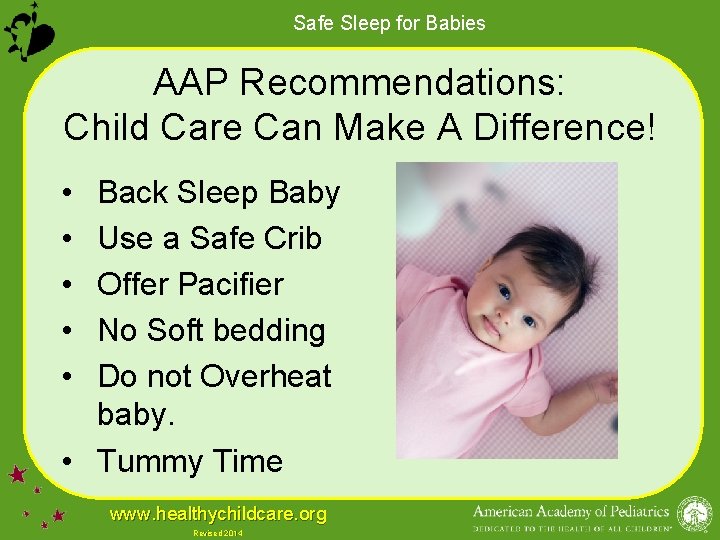
Safe Sleep for Babies AAP Recommendations: Child Care Can Make A Difference! • • • Back Sleep Baby Use a Safe Crib Offer Pacifier No Soft bedding Do not Overheat baby. • Tummy Time www. healthychildcare. org Revised 2014
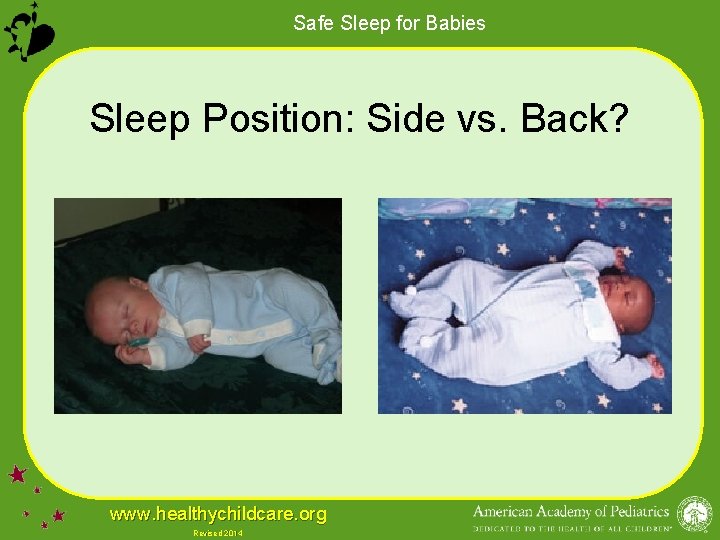
Safe Sleep for Babies Sleep Position: Side vs. Back? www. healthychildcare. org Revised 2014
Safe Sleep for Babies Risk of Side Position • Multiple studies have demonstrated that side position places infant at higher risk for SIDS than the back position • Recent studies show that risk with side (a. OR 2. 0) and tummy (a. OR 2. 6) are similar (Li, 2003; Hauck, 2002) • Side position is unstable – may lead to unaccustomed tummy positioning www. healthychildcare. org Revised 2014
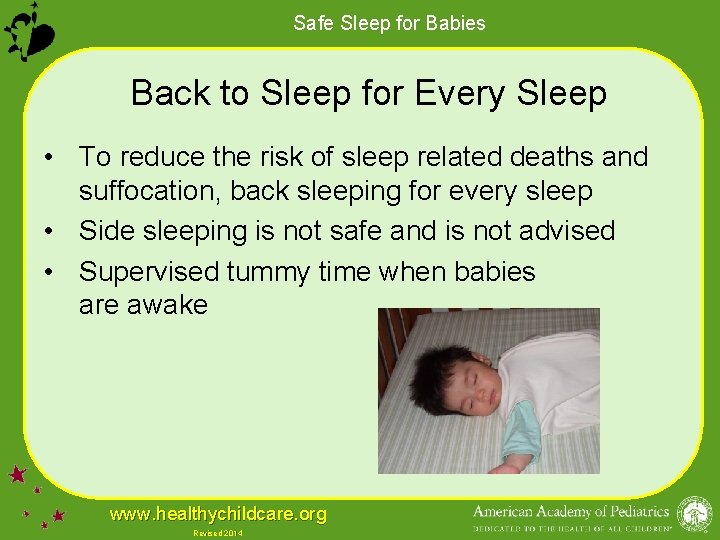
Safe Sleep for Babies Back to Sleep for Every Sleep • To reduce the risk of sleep related deaths and suffocation, back sleeping for every sleep • Side sleeping is not safe and is not advised • Supervised tummy time when babies are awake www. healthychildcare. org Revised 2014
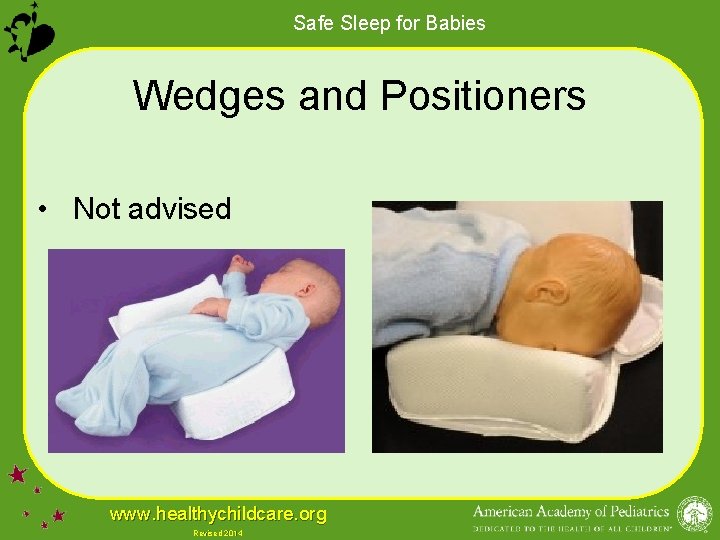
Safe Sleep for Babies Wedges and Positioners • Not advised www. healthychildcare. org Revised 2014
Safe Sleep for Babies But What About Choking? • Back sleeping does not increase the risk of choking and aspiration in infants, even those with GE reflux – • Infants with GE reflux should be placed back – – • Protective airway mechanisms RARE exception: infants for whom the risk of death from complications of GE reflux is greater than the risk of SIDS (i. e. , those with upper airway disorders, for whom airway protective mechanisms are impaired) Examples: infants with anatomic abnormalities (e. g. , type 3 or 4 laryngeal clefts, who have not undergone anti-reflux surgery) Elevating the head of the infant’s crib while the infant is back is not recommended – – Ineffective in reducing GE reflux Infant may slide to the foot of the crib - may compromise respiration. www. healthychildcare. org Revised 2014
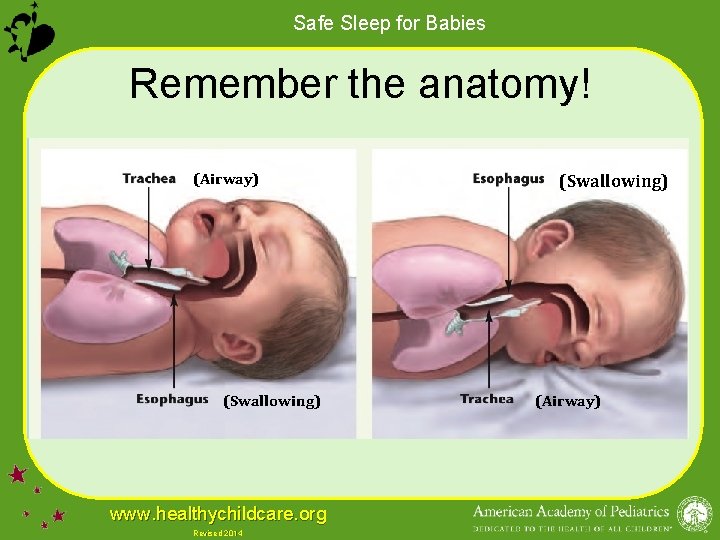
Safe Sleep for Babies Remember the anatomy! (Airway) (Swallowing) www. healthychildcare. org Revised 2014 (Swallowing) (Airway)
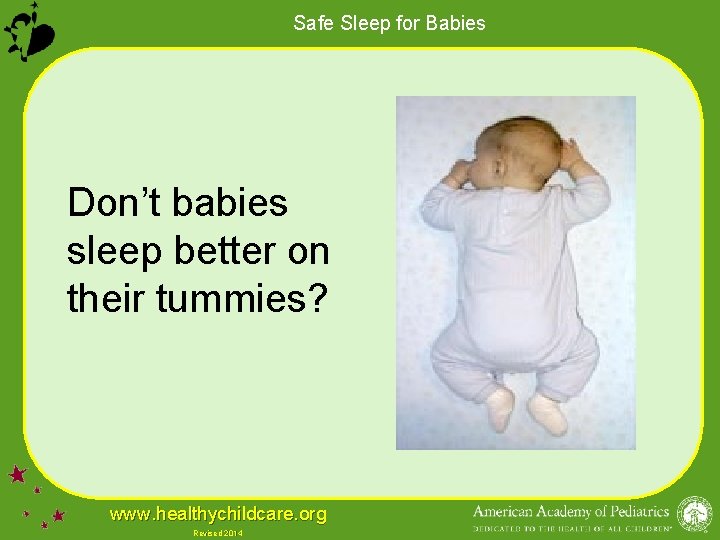
Safe Sleep for Babies Don’t babies sleep better on their tummies? www. healthychildcare. org Revised 2014
Safe Sleep for Babies DO Sleep Better on Tummy… • Babies sleeping on the tummy have higher arousal thresholds, sleep longer and deeper • This increased arousal threshold may be dangerous, as arousal may be the issue surrounding sleep related deaths… • Babies also startle more easily when on their back – this startle reflex is also protective • A baby who wakes up frequently is not a “bad” sleeper or a “bad” baby www. healthychildcare. org Revised 2014
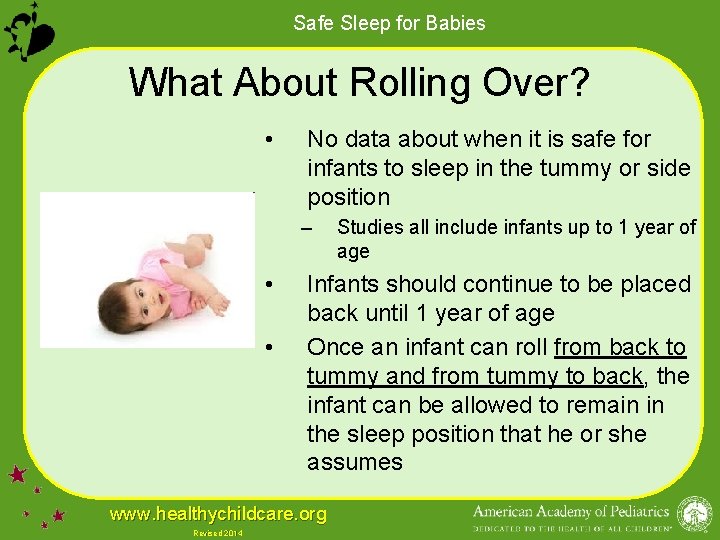
Safe Sleep for Babies What About Rolling Over? • No data about when it is safe for infants to sleep in the tummy or side position – • • Infants should continue to be placed back until 1 year of age Once an infant can roll from back to tummy and from tummy to back, the infant can be allowed to remain in the sleep position that he or she assumes www. healthychildcare. org Revised 2014 Studies all include infants up to 1 year of age
Safe Sleep for Babies *Break* www. healthychildcare. org Revised 2014
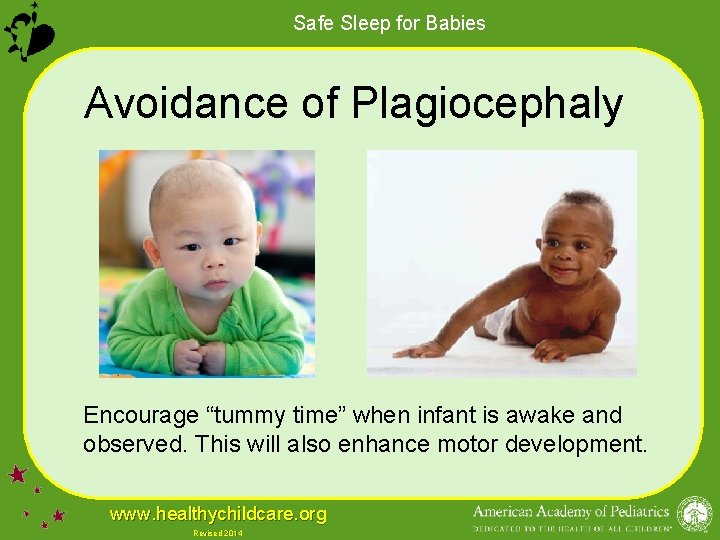
Safe Sleep for Babies Avoidance of Plagiocephaly Encourage “tummy time” when infant is awake and observed. This will also enhance motor development. www. healthychildcare. org Revised 2014
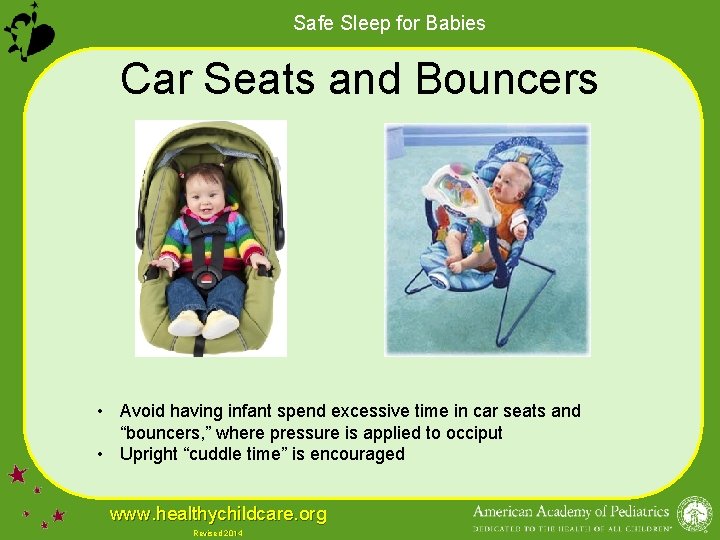
Safe Sleep for Babies Car Seats and Bouncers • Avoid having infant spend excessive time in car seats and “bouncers, ” where pressure is applied to occiput • Upright “cuddle time” is encouraged www. healthychildcare. org Revised 2014
Safe Sleep for Babies Expect the Unexpected www. healthychildcare. org Revised 2014
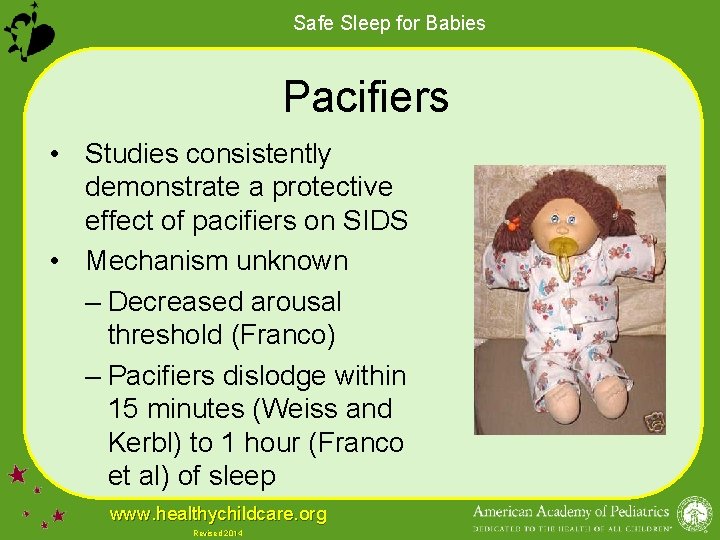
Safe Sleep for Babies Pacifiers • Studies consistently demonstrate a protective effect of pacifiers on SIDS • Mechanism unknown – Decreased arousal threshold (Franco) – Pacifiers dislodge within 15 minutes (Weiss and Kerbl) to 1 hour (Franco et al) of sleep www. healthychildcare. org Revised 2014
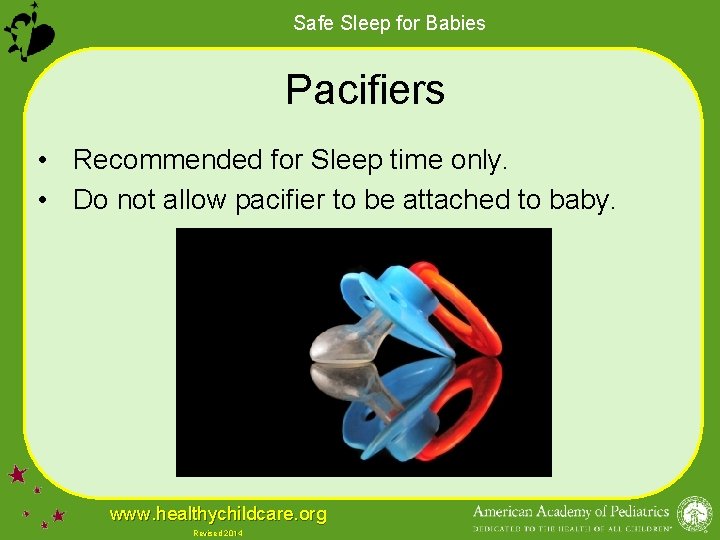
Safe Sleep for Babies Pacifiers • Recommended for Sleep time only. • Do not allow pacifier to be attached to baby. www. healthychildcare. org Revised 2014
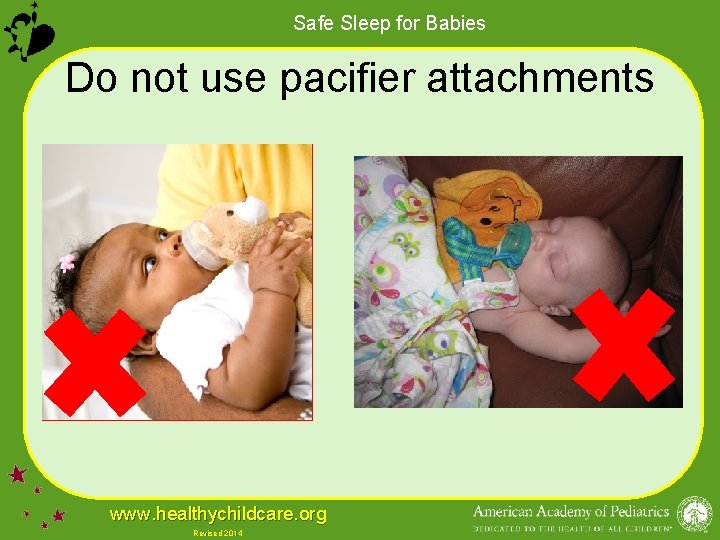
Safe Sleep for Babies Do not use pacifier attachments www. healthychildcare. org Revised 2014
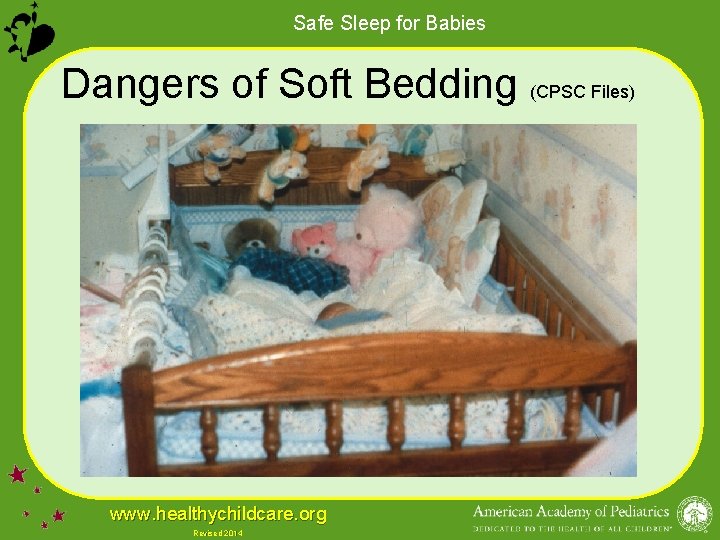
Safe Sleep for Babies Dangers of Soft Bedding (CPSC Files) www. healthychildcare. org Revised 2014
Safe Sleep for Babies Dangers of Soft Bedding • Infants dying from SIDS are more likely to have: – used a pillow or soft mattress – been found with nose and mouth completely covered by bedding – assumed face-down posture • Soft bedding increases risk of SIDS 5 x, independent of tummy position • Soft bedding + tummy = OR 21. 0 (Hauck, 2003) • Also increases risk of suffocation, strangulation, and entrapment www. healthychildcare. org Revised 2014
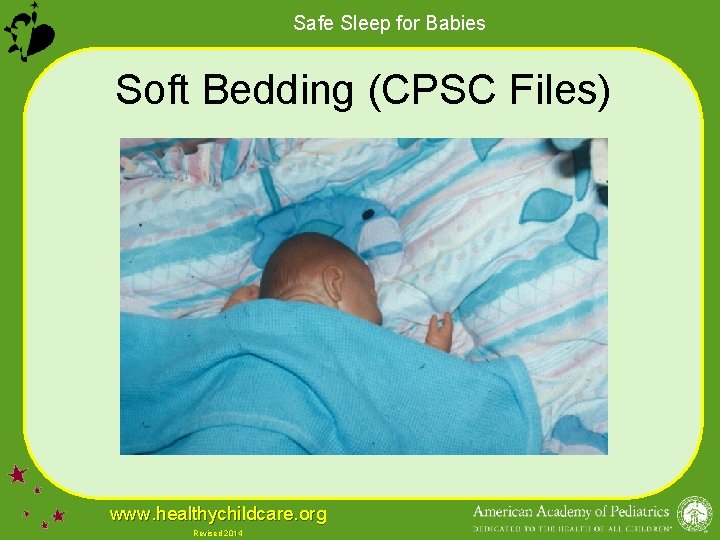
Safe Sleep for Babies Soft Bedding (CPSC Files) www. healthychildcare. org Revised 2014
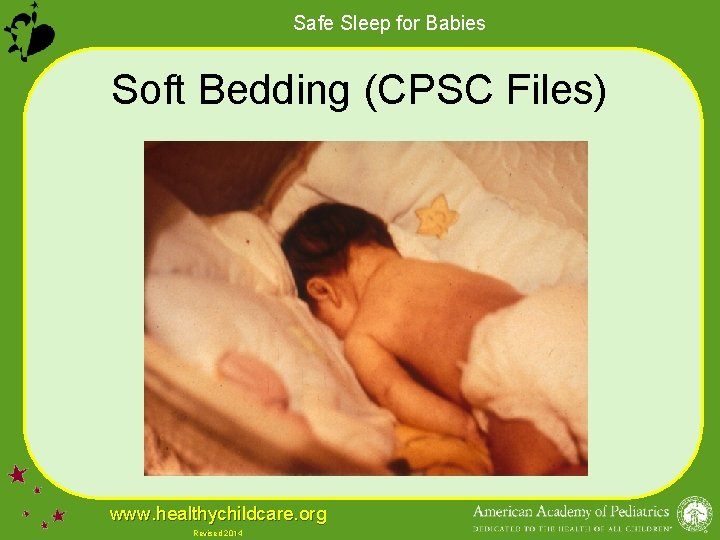
Safe Sleep for Babies Soft Bedding (CPSC Files) www. healthychildcare. org Revised 2014
Safe Sleep for Babies Use a Firm Sleep Surface • • To reduce SIDS and suffocation Firm crib mattress, covered by fitted sheet – – – • Use mattress designed for specific product – • • A crib, bassinet, portable crib, or play yard that conforms to CPSC safety standards Check for recalls Do not use cribs with missing hardware; don’t try to fix broken cribs Mattress should be firm and maintain shape even when fitted sheet is used No pillows or blankets in addition to or instead of mattress under the infant No adult beds – risk of entrapment and suffocation www. healthychildcare. org Revised 2014
Safe Sleep for Babies Avoid Overheating • Increased risk of Sleep Related Infant Deaths – – • • Definition of overheating varies Cannot provide specific room temperature guidelines – Licensing May Provide Dress infants appropriately for the environment, with no greater than 1 layer more than an adult would wear to be comfortable There is currently insufficient evidence to recommend use of a fan as a SIDS risk-reduction strategy www. healthychildcare. org Revised 2014
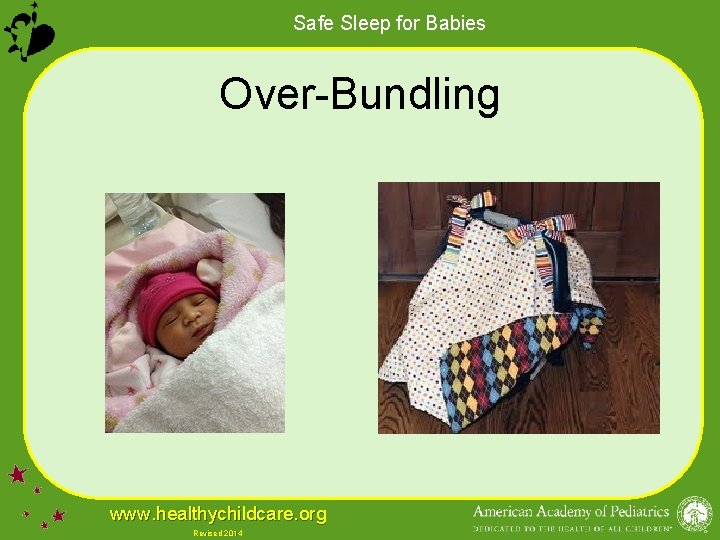
Safe Sleep for Babies Over-Bundling www. healthychildcare. org Revised 2014
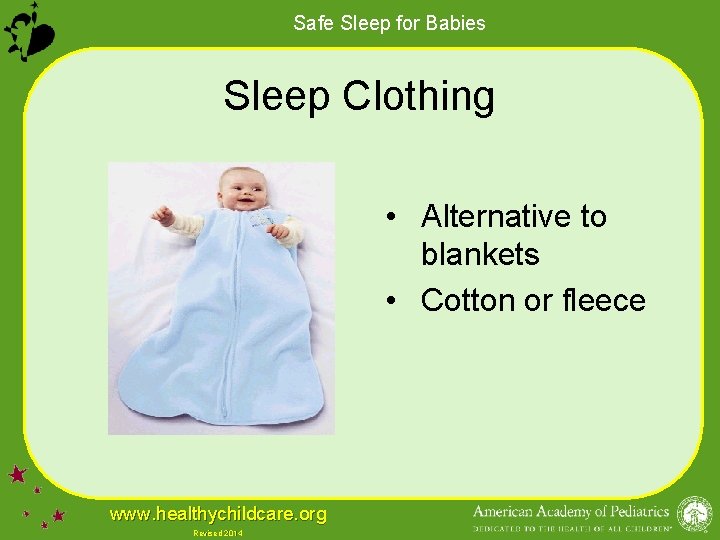
Safe Sleep for Babies Sleep Clothing • Alternative to blankets • Cotton or fleece www. healthychildcare. org Revised 2014
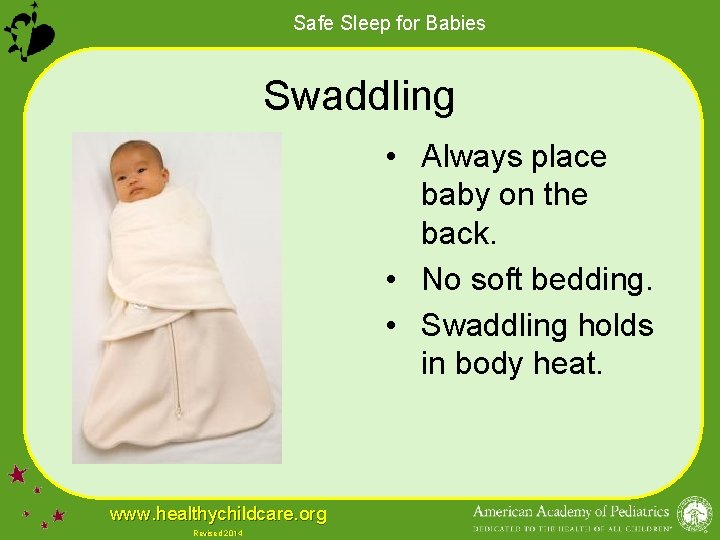
Safe Sleep for Babies Swaddling • Always place baby on the back. • No soft bedding. • Swaddling holds in body heat. www. healthychildcare. org Revised 2014
Safe Sleep for Babies Other Recommendations • Avoid second-hand & third-hand smoke exposure of the infant; maintain a smokefree environment. • Do not use apnea monitors as a strategy to prevent infant deaths www. healthychildcare. org Revised 2014
Safe Sleep for Babies Legal Considerations • Litigation – – Wrongful death Loss to society Neglect Breach of contract between parents and provider • Back to sleep = STANDARD OF CARE www. healthychildcare. org Revised 2014
Safe Sleep for Babies Benefits of a Safe Sleep Policy • May save babies’ lives • Shows parents baby’s health and safety is your #1 priority • Educates staff – Consistent care – Educate parents – Professional development • It empowers child care providers • If followed, helps reduce your risk of liability www. healthychildcare. org Revised 2014
Safe Sleep for Babies Elements of a Safe Sleep Policy • Healthy babies always sleep on their backs • Obtain physician’s note for non–back sleepers – The note should include prescribed sleep position and reason for not using the back position • Use safety-approved cribs and firm mattresses • Crib: free of toys, stuffed animals, and excess bedding – Alternative: sleep clothing • Sleep only one baby per crib www. healthychildcare. org Revised 2014
Safe Sleep for Babies Elements of a Safe Sleep Policy • Room temperature is comfortable for a lightly clothed adult • Monitor sleeping babies • Have supervised tummy time for awake babies • Teach staff about safe sleep policy and practices • Provide parents with safe sleep policy www. healthychildcare. org Revised 2014
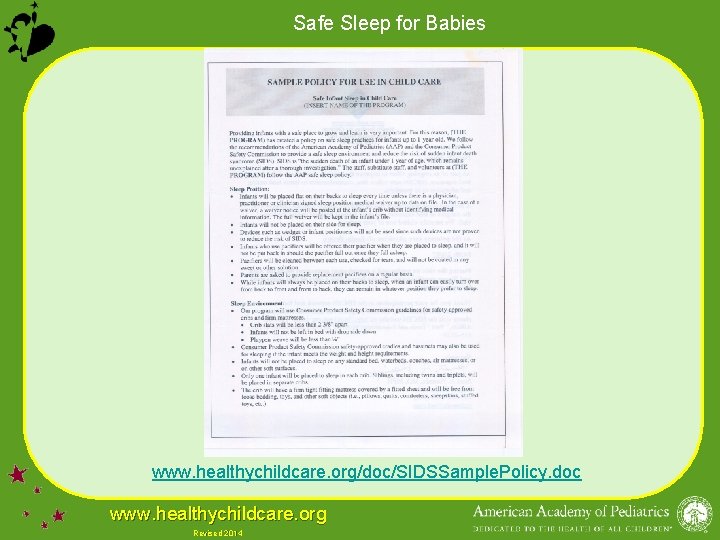
Safe Sleep for Babies www. healthychildcare. org/doc/SIDSSample. Policy. doc www. healthychildcare. org Revised 2014
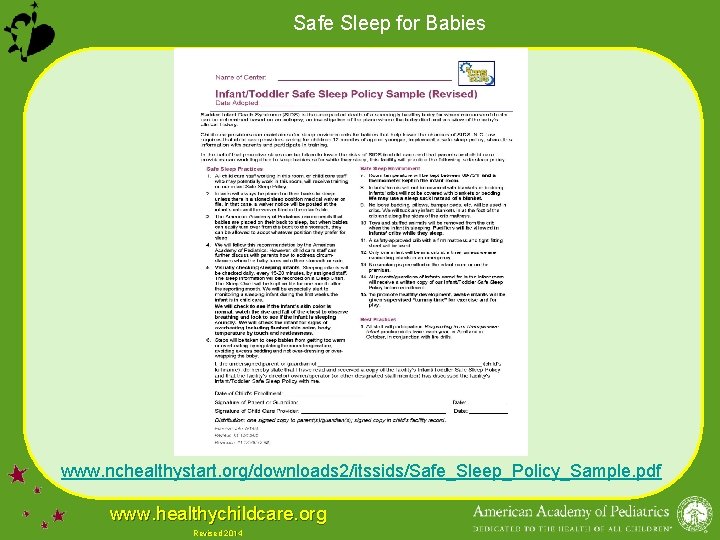
Safe Sleep for Babies www. nchealthystart. org/downloads 2/itssids/Safe_Sleep_Policy_Sample. pdf www. healthychildcare. org Revised 2014
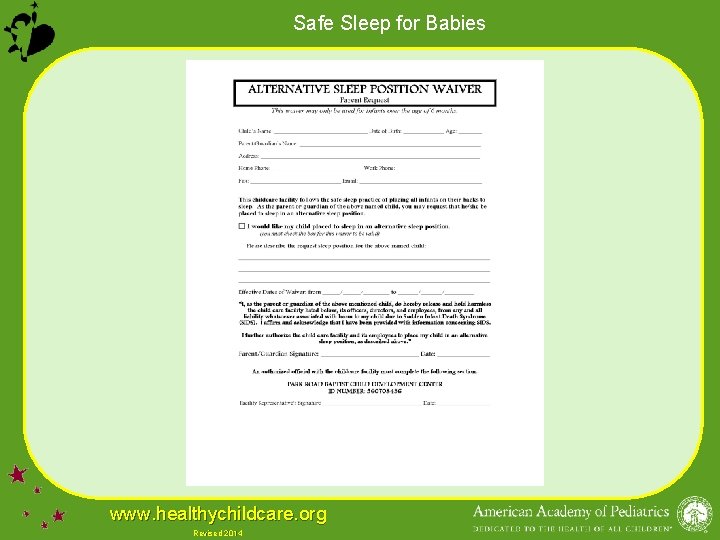
Safe Sleep for Babies Alternate Sleep Position • Require written and signed physician’s note – Stipulates that a medical condition requires an alternative sleep position and clearly states the needed position. • Inform all child care providers and substitutes • Keep physician’s note in baby’s medical file and post notice on crib www. healthychildcare. org Revised 2014
Safe Sleep for Babies www. healthychildcare. org Revised 2014
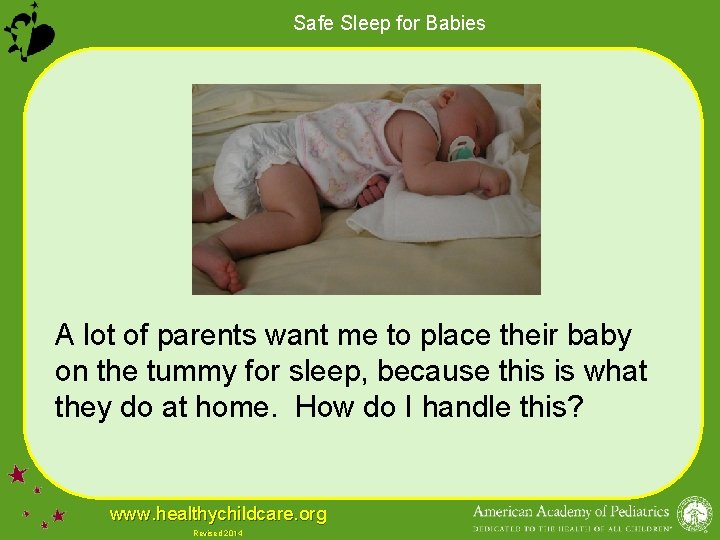
Safe Sleep for Babies A lot of parents want me to place their baby on the tummy for sleep, because this is what they do at home. How do I handle this? www. healthychildcare. org Revised 2014
Safe Sleep for Babies Caring for Our Children: National Health and Safety Performance Standards, 3 rd Ed. — 2011 STANDARD 3. 1. 4. 1: Safe Sleep Practices and SIDS/Suffocation Risk Reduction • Facilities should have written policies • Back sleep position for babies • Physician’s note if position other than back • Nothing in the crib except for baby and a pacifier • No monitors or positioning devices, unless specified by a physician www. healthychildcare. org Revised 2014
Safe Sleep for Babies Handling Parents’ Concerns • • Discuss Safe Sleep with parents Discuss sleep position policies Discuss medical waiver and implications Document your discussion! www. healthychildcare. org Revised 2014
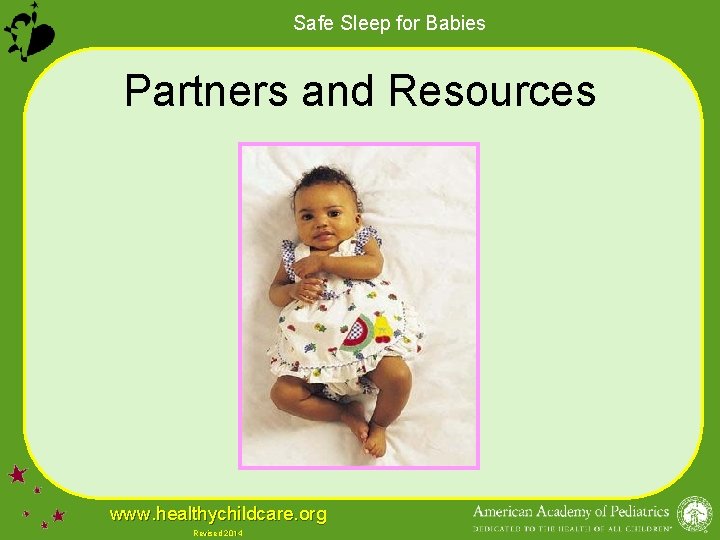
Safe Sleep for Babies Partners and Resources www. healthychildcare. org Revised 2014
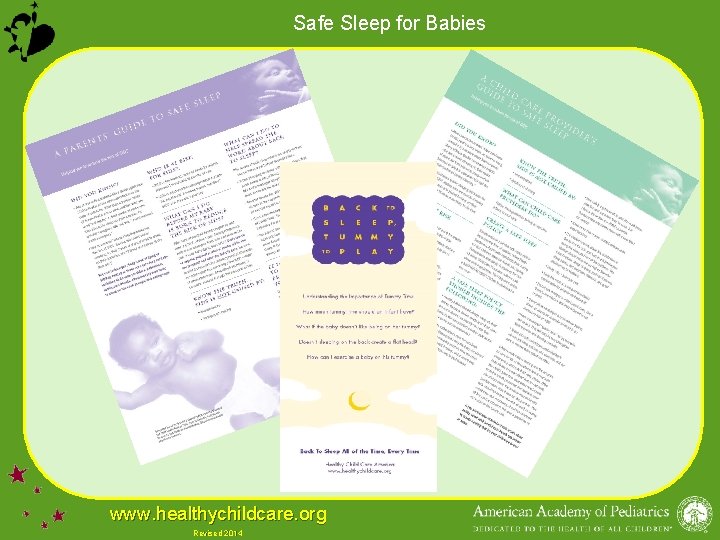
Safe Sleep for Babies Healthy Child Care America Safe Sleep Resources • American Academy of Pediatrics 141 Northwest Point Blvd Elk Grove Village, IL 60007 -1098 – Phone: 888/227 -5409 or 847/434 -7951 – Fax: 847/228 -7320 – E-mail: childcare@aap. org – Web site: www. healthychildcare. org Revised 2014
Safe Sleep for Babies www. healthychildcare. org Revised 2014
Safe Sleep for Babies Licensing Requirements • National Resource Center for Health and Safety in Child Care – http: //nrckids. org – 800/598 -KIDS (5437) – Caring for Our Children: National Health and Safety Performance Standards: Guidelines for Out-of-Home Child Care Programs, Third Edition (2011) – Individual state licensing information www. healthychildcare. org Revised 2014
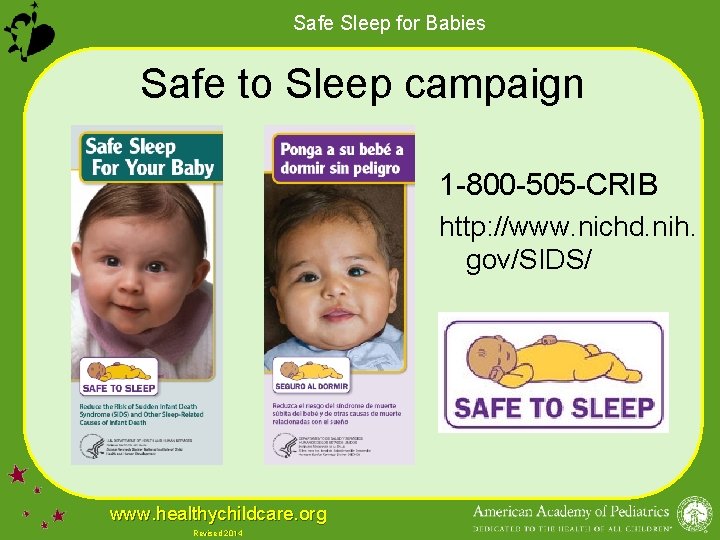
Safe Sleep for Babies Safe to Sleep campaign 1 -800 -505 -CRIB http: //www. nichd. nih. gov/SIDS/ www. healthychildcare. org Revised 2014
Safe Sleep for Babies First Candle • Provide grief/bereavement services, support services – 1314 Bedford Ave, Suite 210, Baltimore, MD 21208 – Phone: 800/221 -7437 or 410/653 -8226 – Fax: 410/653 -8709 – E-mail: info@firstcandle. org – Web site: www. firstcandle. org www. healthychildcare. org Revised 2014
Safe Sleep for Babies National SUID/SIDS Resource Center • Provides information about SIDS and other forms of infant death and stillbirth • Georgetown University • 1 -866 -7437 • www. sidscenter. org • info@sidscenter. org www. healthychildcare. org Revised 2014
Safe Sleep for Babies CJ Foundation for SIDS • 888/8 CJ-SIDS (825 -7437) • www. cjsids. com www. healthychildcare. org Revised 2014
Safe Sleep for Babies Summary • What SIDS, SUID and Safe Sleep is and is NOT • What are sleep-related deaths • Risk factors • Safe sleep practices to reduce the risk • Caring for Our Children: National Health and Safety Performance Standards, 3 rd Edition • Developing a safe sleep policy for your program • Resources for more information www. healthychildcare. org Revised 2014
Safe Sleep for Babies Questions? www. healthychildcare. org Revised 2014
Safe Sleep for Babies Practice Scenarios • 4 scenarios that child care providers may encounter in their workplace www. healthychildcare. org Revised 2014
Safe Sleep for Babies Scenario 1 You are the child care provider. A parent of a 2 month old baby requests that the child sleep on the side, propped by a pillow. This is how they do it at home. The mother says, “I don’t want to worry about my baby spitting up and it going down the wrong way. ” What do you do? www. healthychildcare. org Revised 2014
Safe Sleep for Babies Scenario 2 A parent has requested that his baby be placed on the tummy for naps. You showed him the policy that babies are to be placed on the back only unless there is a medical excuse. He takes the medical waiver form to the pediatrician. The pediatrician signs the waiver, but does not indicate a medical reason. In fact, the pediatrician has crossed through the section that asks for a medical reason. What do you do? www. healthychildcare. org Revised 2014
Safe Sleep for Babies Scenario 3 You have just started as a new child care provider in the infant room of a large child care center. On your first day, you notice that all of the other providers are placing babies on their tummies for naps. You know from your training that back is best. What do you do? www. healthychildcare. org Revised 2014
Safe Sleep for Babies Scenario 4 There is a new baby in the infant room. She is 2 months old. The mother tried to get the director to agree to put the baby on the tummy for sleep, since that is what they do at home. The director refused, and the mother finally said that was okay. You now place the baby on the back for a nap. The baby cries and refuses to go to sleep. What do you do? www. healthychildcare. org Revised 2014
- Slides: 90