
SAFE SLEEP Exploring Barriers to Caregiver Compliance Sally
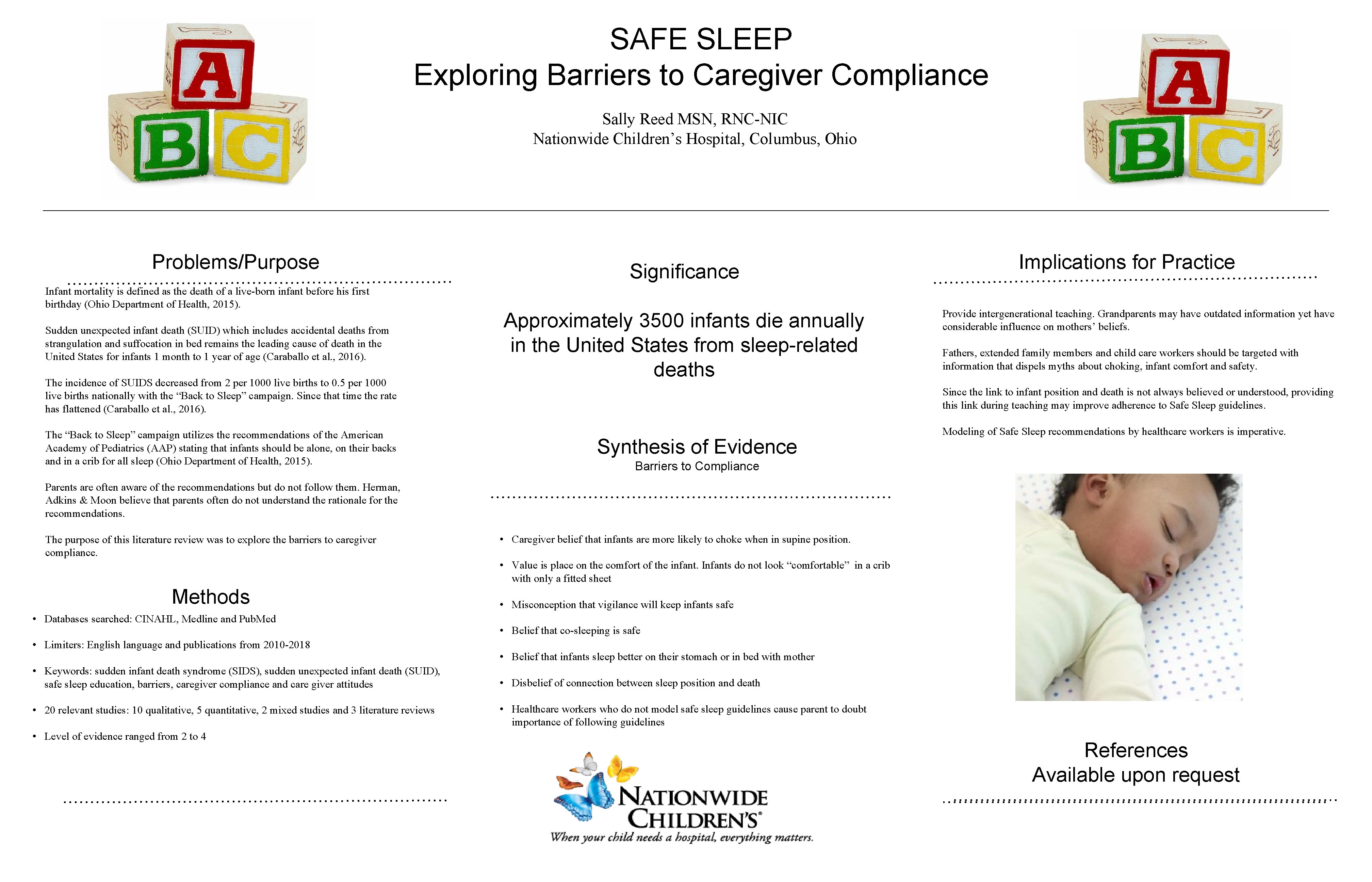
SAFE SLEEP Exploring Barriers to Caregiver Compliance Sally Reed MSN, RNC-NIC Nationwide Children’s Hospital, Columbus, Ohio Problems/Purpose Infant mortality is defined as the death of a live-born infant before his first birthday (Ohio Department of Health, 2015). Sudden unexpected infant death (SUID) which includes accidental deaths from strangulation and suffocation in bed remains the leading cause of death in the United States for infants 1 month to 1 year of age (Caraballo et al. , 2016). The incidence of SUIDS decreased from 2 per 1000 live births to 0. 5 per 1000 live births nationally with the “Back to Sleep” campaign. Since that time the rate has flattened (Caraballo et al. , 2016). The “Back to Sleep” campaign utilizes the recommendations of the American Academy of Pediatrics (AAP) stating that infants should be alone, on their backs and in a crib for all sleep (Ohio Department of Health, 2015). Significance Approximately 3500 infants die annually in the United States from sleep-related deaths Implications for Practice Provide intergenerational teaching. Grandparents may have outdated information yet have considerable influence on mothers’ beliefs. Fathers, extended family members and child care workers should be targeted with information that dispels myths about choking, infant comfort and safety. Since the link to infant position and death is not always believed or understood, providing this link during teaching may improve adherence to Safe Sleep guidelines. Synthesis of Evidence Modeling of Safe Sleep recommendations by healthcare workers is imperative. Barriers to Compliance Parents are often aware of the recommendations but do not follow them. Herman, Adkins & Moon believe that parents often do not understand the rationale for the recommendations. The purpose of this literature review was to explore the barriers to caregiver compliance. • Caregiver belief that infants are more likely to choke when in supine position. • Value is place on the comfort of the infant. Infants do not look “comfortable” in a crib with only a fitted sheet Methods • Databases searched: CINAHL, Medline and Pub. Med • Limiters: English language and publications from 2010 -2018 • Misconception that vigilance will keep infants safe • Belief that co-sleeping is safe • Belief that infants sleep better on their stomach or in bed with mother • Keywords: sudden infant death syndrome (SIDS), sudden unexpected infant death (SUID), safe sleep education, barriers, caregiver compliance and care giver attitudes • Disbelief of connection between sleep position and death • 20 relevant studies: 10 qualitative, 5 quantitative, 2 mixed studies and 3 literature reviews • Healthcare workers who do not model safe sleep guidelines cause parent to doubt importance of following guidelines • Level of evidence ranged from 2 to 4 Available upon request References Available upon request
- Slides: 1