
Safe Patient Handling Equipment Conner Bruns Introduction Healthcare
Safe Patient Handling Equipment Conner Bruns
Introduction ● Healthcare workers are #1 for on-the-job injuries ● Manual patient handling puts physical therapists and other health care workers at risk for musculoskeletal injuries ● Overexertion from lifting, moving, repositioning patients ● Some studies have suggested 90% of PT’s experience WMSD ● Safe patient handling equipment allows for earlier mobility without risk of injury
Benefits of Early Mobility ● Improved lung function ○ ● Improved transfers and bed mobility ○ ● Less risk of pressure ulcers Improved circulation ○ ● Less risk of pneumonia Less risk of DVT’s Strength and endurance ○ Less risk of falls
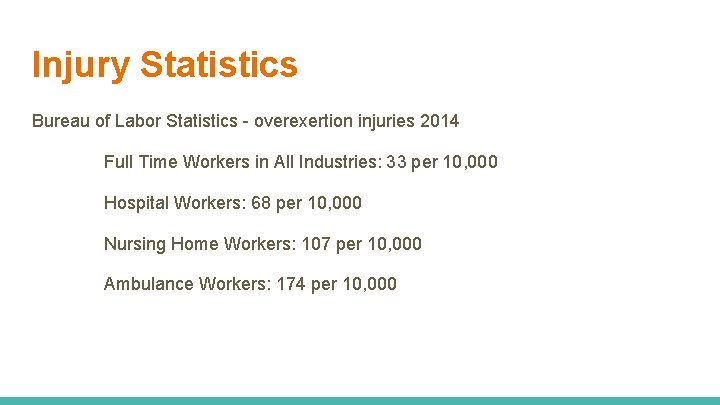
Injury Statistics Bureau of Labor Statistics - overexertion injuries 2014 Full Time Workers in All Industries: 33 per 10, 000 Hospital Workers: 68 per 10, 000 Nursing Home Workers: 107 per 10, 000 Ambulance Workers: 174 per 10, 000
Injury Statistics from Clinical Site (Mc. Laren Bay Region) 2006 - 90 pt handling injuries 308 lost days Cost of $31, 716 *Safe Patient Handling Program implemented in 2006 2016 - 2 pt handling injuries 39 lost days Cost of $3, 767
Basic Ergonomic Lifting Considerations Minimal bending and twisting of spine Elbows close to body <35 lbs per National Institute of Occupational Safety and Health Push rather than pull Smooth and steady movements Don’t lift above shoulders or below knees
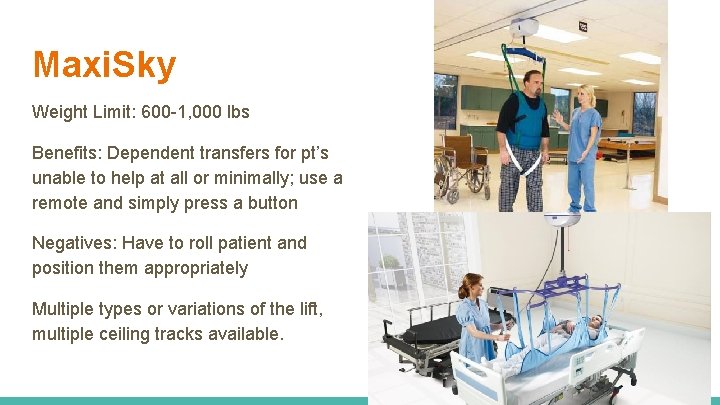
Maxi. Sky Weight Limit: 600 -1, 000 lbs Benefits: Dependent transfers for pt’s unable to help at all or minimally; use a remote and simply press a button Negatives: Have to roll patient and position them appropriately Multiple types or variations of the lift, multiple ceiling tracks available.
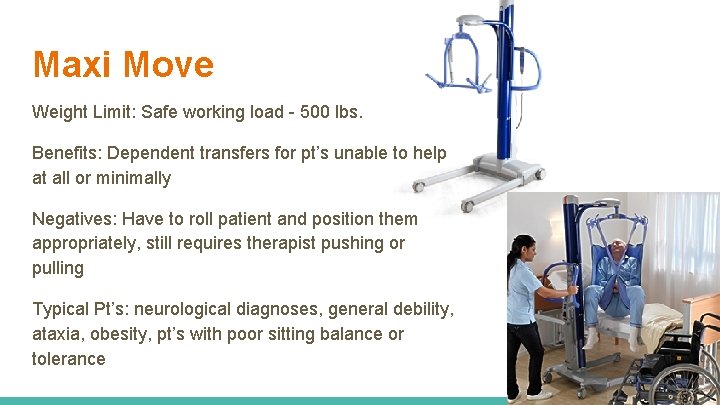
Maxi Move Weight Limit: Safe working load - 500 lbs. Benefits: Dependent transfers for pt’s unable to help at all or minimally Negatives: Have to roll patient and position them appropriately, still requires therapist pushing or pulling Typical Pt’s: neurological diagnoses, general debility, ataxia, obesity, pt’s with poor sitting balance or tolerance
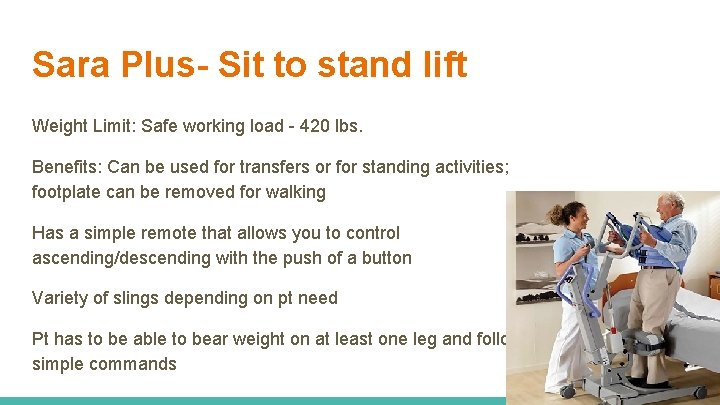
Sara Plus- Sit to stand lift Weight Limit: Safe working load - 420 lbs. Benefits: Can be used for transfers or for standing activities; footplate can be removed for walking Has a simple remote that allows you to control ascending/descending with the push of a button Variety of slings depending on pt need Pt has to be able to bear weight on at least one leg and follow simple commands
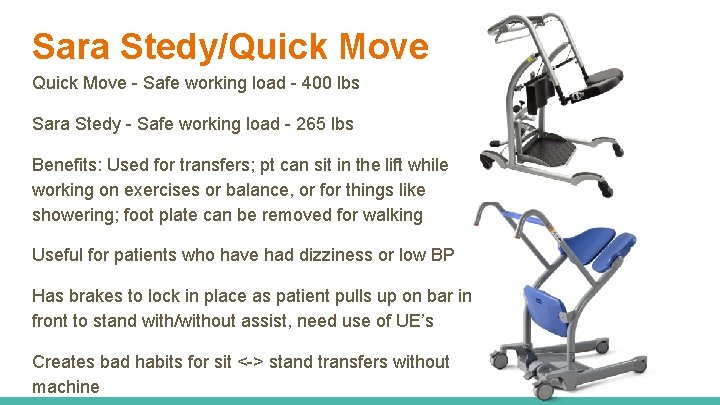
Sara Stedy/Quick Move - Safe working load - 400 lbs Sara Stedy - Safe working load - 265 lbs Benefits: Used for transfers; pt can sit in the lift while working on exercises or balance, or for things like showering; foot plate can be removed for walking Useful for patients who have had dizziness or low BP Has brakes to lock in place as patient pulls up on bar in front to stand with/without assist, need use of UE’s Creates bad habits for sit <-> stand transfers without machine
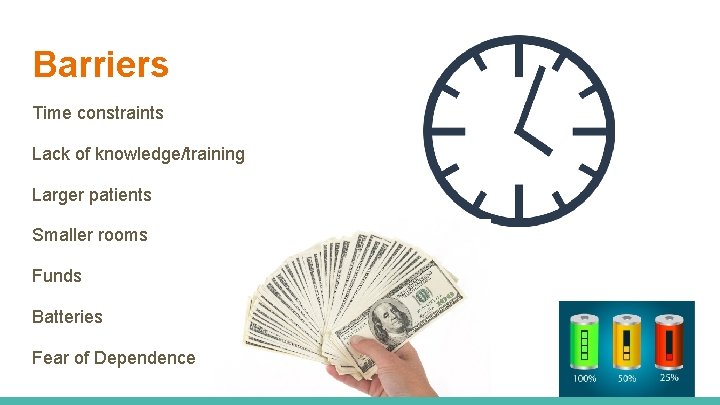
Barriers Time constraints Lack of knowledge/training Larger patients Smaller rooms Funds Batteries Fear of Dependence
References Safe patient handling perceptions and practices: a survey of acute care physical therapists. Olkowski BF, Stolfi AM. Phys Ther. May 2014; 9(5); 682 -695 Maxi Lift. Arjo. Huntleigh. http: //www. arjohuntleigh. com/products/patient-transfer-solutions/passive-floor-lifters/maxi-move/. Accessed October 21, 2017. Ceiling Lifts. Arjo. Huntleigh. http: //www. arjohuntleigh. com/products/patient-transfer-solutions/ceiling-lifts/. Accessed October 21, 2017 Sara Plus. Arjo. Huntleigh. http: //www. arjohuntleigh. com/products/patient-transfer-solutions/standing-raising-aids/sara-plus/. Accessed October 26, 2017 Sara Stedy. Arjo. Huntleigh. http: //www. arjohuntleigh. com/products/patient-transfer-solutions/standing-raising-aids/sara-stedy/. Accessed October 26, 2017 System. Ro. Medic™ – Quick. Move: Safe and secure sit-to-stand transfer. Handicare. https: //www. handicare. com/us/products/systemromedic-quickmove/p-296. Accessed October 23, 2017 Health Care Worker Injuries Due to Patient Handling Continue to Rise. PT in Motion. http: //www. apta. org/PTin. Motion/News/2015/6/24/Patient. Handling. Injuries/. June 25, 2015. Accessed October 25, 2017 Noble NL, Sweeney NL. Barriers to the use of assistive devices in patient handling. Workplace Health Saf. 2017 May Bureau of Labor Statistics. Incidence rates for nonfatal occupational injuries and illnesses involving days away from work per 10, 000 full-time workers by industry and selected events or exposures leading to injury or illness, private industry, 2014. https: //www. bls. gov/iif/oshwc/osh/ostb 4374. pdf
- Slides: 12