
Safe Medication Administration Effect of Root Cause Analysis
- Slides: 1
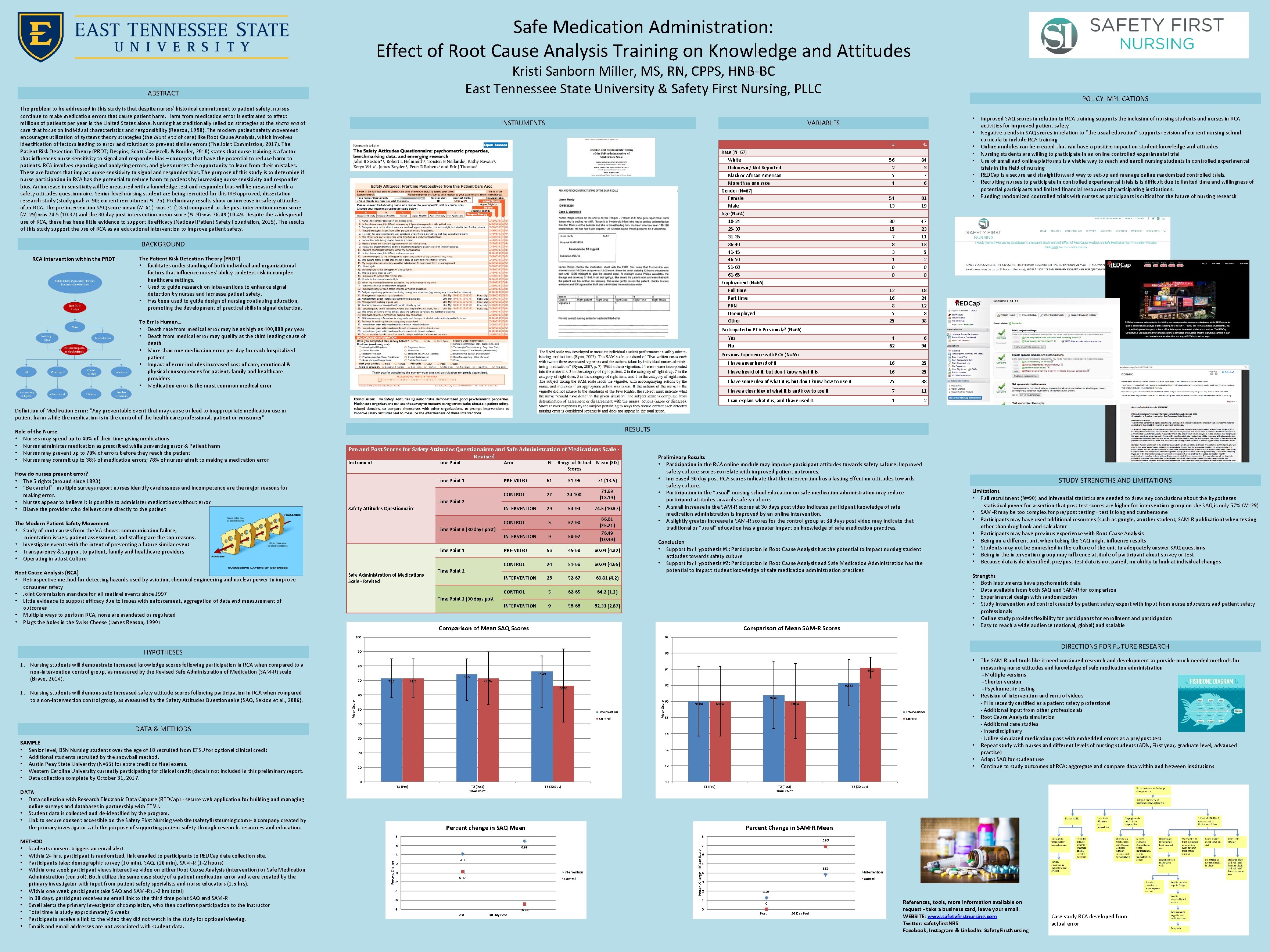
Safe Medication Administration: Effect of Root Cause Analysis Training on Knowledge and Attitudes Kristi Sanborn Miller, MS, RN, CPPS, HNB-BC East Tennessee State University & Safety First Nursing, PLLC ABSTRACT The problem to be addressed in this study is that despite nurses’ historical commitment to patient safety, nurses continue to make medication errors that cause patient harm. Harm from medication error is estimated to affect millions of patients per year in the United States alone. Nursing has traditionally relied on strategies at the sharp end of care that focus on individual characteristics and responsibility (Reason, 1990). The modern patient safety movement encourages utilization of systems theory strategies (the blunt end of care) like Root Cause Analysis, which involves identification of factors leading to error and solutions to prevent similar errors (The Joint Commission, 2017). The Patient Risk Detection Theory (PRDT; Despins, Scott-Cawiezell, & Rouder, 2010) states that nurse training is a factor that influences nurse sensitivity to signal and responder bias – concepts that have the potential to reduce harm to patients. RCA involves reporting and analyzing errors, and gives nurses the opportunity to learn from their mistakes. These are factors that impact nurse sensitivity to signal and responder bias. The purpose of this study is to determine if nurse participation in RCA has the potential to reduce harm to patients by increasing nurse sensitivity and responder bias. An increase in sensitivity will be measured with a knowledge test and responder bias will be measured with a safety attitudes questionnaire. Senior level nursing student are being recruited for this IRB approved, dissertation research study (study goal: n=90; current recruitment N=75). Preliminary results show an increase in safety attitudes after RCA. The pre-intervention SAQ score mean (N=61) was 71 (13. 5) compared to the post-intervention mean score (N=29) was 74. 5 (10. 37) and the 30 day post-intervention mean score (N=9) was 76. 49 (10. 49. Despite the widespread use of RCA, there has been little evidence to support its efficacy (National Patient Safety Foundation, 2015). The results of this study support the use of RCA as an educational intervention to improve patient safety. INSTRUMENTS • VARIABLES • # % 56 2 5 4 84 3 7 6 54 13 81 19 30 15 7 8 3 1 0 0 47 23 11 13 5 2 0 0 12 16 8 5 25 18 24 12 8 38 4 62 6 94 I have never heard of it 16 25 I have heard of it, but don't know what it is. 16 25 I have some idea of what it is, but don't know how to use it. 25 38 I have a clear idea of what it is and how to use it. 7 11 I can explain what it is, and I have used it. 1 2 Race (N=67) White Unknown / Not Reported Black or African American More than one race Gender (N=67) Female Male Age (N=64) 18 -24 25 -30 31 -35 36 -40 41 -45 46 -50 51 -60 61 -65 Employment (N=66) Full time Part time PRN Unemployed Other BACKGROUND RCA Intervention within the PRDT POLICY IMPLICATIONS The Patient Risk Detection Theory (PRDT) • facilitates understanding of both individual and organizational factors that influence nurses' ability to detect risk in complex healthcare settings. • Used to guide research on interventions to enhance signal detection by nurses and increase patient safety. • Has been used to guide design of nursing continuing education, promoting the development of practical skills in signal detection. To Err is Human… • Death rate from medical error may be as high as 400, 000 per year • Death from medical error may qualify as the third leading cause of death • More than one medication error per day for each hospitalized patient • Impact of error includes increased cost of care, emotional & physical consequences for patient, family and healthcare providers • Medication error is the most common medical error • • • Improved SAQ scores in relation to RCA training supports the inclusion of nursing students and nurses in RCA activities for improved patient safety Negative trends in SAQ scores in relation to “the usual education” supports revision of current nursing school curricula to include RCA training Online modules can be created that can have a positive impact on student knowledge and attitudes Nursing students are willing to participate in an online controlled experimental trial Use of email and online platforms is a viable way to reach and enroll nursing students in controlled experimental trials in the field of nursing REDCap is a secure and straightforward way to set-up and manage online randomized controlled trials. Recruiting nurses to participate in controlled experimental trials is is difficult due to limited time and willingness of potential participants and limited financial resources of participating institutions. Funding randomized controlled trials with nurses as participants is critical for the future of nursing research Participated in RCA Previously? (N=66) Yes No Previous Experience with RCA (N=65) Definition of Medication Error: “Any preventable event that may cause or lead to inappropriate medication use or patient harm while the medication is in the control of the health care professional, patient or consumer” How do nurses prevent error? • The 5 rights (around since 1893) • “Be careful” – multiple surveys report nurses identify carelessness and incompetence are the major reasons for making error. • Nurses appear to believe it is possible to administer medications without error • Blame the provider who delivers care directly to the patient RESULTS Pre and Post Scores for Safety Attitudes Questionairre and Safe Administration of Medications Scale Revised Instrument Arm N Range of Actual Mean (SD) Scores Time Point 1 PRE-VIDEO 61 31 -96 71 (13. 5) CONTROL 22 24 -100 71. 69 (18. 19) INTERVENTION 29 54 -94 74. 5 (10. 37) CONTROL 5 32 -90 66. 61 (25. 21) INTERVENTION 9 58 -92 76. 49 (10. 49) PRE-VIDEO 56 45 -68 60. 04 (4. 32) CONTROL 24 51 -66 60. 04 (4. 65) INTERVENTION 26 52 -67 60. 81 (4. 2) CONTROL 5 62 -65 64. 2 (1. 3) INTERVENTION 9 56 -66 62. 33 (2. 87) Time Point 2 Safety Attitudes Questionnaire The Modern Patient Safety Movement • Study of root causes from the VA shows: communication failure, orientation issues, patient assessment, and staffing are the top reasons. • Investigate events with the intent of preventing a future similar event • Transparency & support to patient, family and healthcare providers • Operating in a Just Culture Root Cause Analysis (RCA) • Retrospective method for detecting hazards used by aviation, chemical engineering and nuclear power to improve consumer safety • Joint Commission mandate for all sentinel events since 1997 • Little evidence to support efficacy due to issues with enforcement, aggregation of data and measurement of outcomes • Multiple ways to perform RCA, none are mandated or regulated • Plugs the holes in the Swiss Cheese (James Reason, 1990) Time Point 3 (30 days post) Time Point 1 Safe Administration of Medications Scale - Revised Time Point 2 Preliminary Results • Participation in the RCA online module may improve participant attitudes towards safety culture. Improved safety culture scores correlate with improved patient outcomes. • Increased 30 day post RCA scores indicate that the intervention has a lasting effect on attitudes towards safety culture. • Participation in the “usual” nursing school education on safe medication administration may reduce participant attitudes towards safety culture. • A small increase in the SAM-R scores at 30 days post video indicates participant knowledge of safe medication administration is improved by an online intervention. • A slightly greater increase in SAM-R scores for the control group at 30 days post video may indicate that traditional or “usual” education has a greater impact on knowledge of safe medication practices. Conclusion • Support for Hypothesis #1: Participation in Root Cause Analysis has the potential to impact nursing student attitudes towards safety culture • Support for Hypothesis #2: Participation in Root Cause Analysis and Safe Medication Administration has the potential to impact student knowledge of safe medication administration practices Time Point 3 (30 days post Comparison of Mean SAQ Scores Comparison of Mean SAM-R Scores 100 HYPOTHESES DATA & METHODS SAMPLE • Senior level, BSN Nursing students over the age of 18 recruited from ETSU for optional clinical credit • Additional students recruited by the snowball method. • Austin Peay State University (N=55) for extra credit on final exams. • Western Carolina University currently participating for clinical credit (data is not included in this preliminary report. • Data collection complete by October 31, 2017. Strengths • Both instruments have psychometric data • Data available from both SAQ and SAM-R for comparison • Experimental design with randomization • Study intervention and control created by patient safety expert with input from nurse educators and patient safety professionals • Online study provides flexibility for participants for enrollment and participation • Easy to reach a wide audience (national, global) and scalable 66 • 80 70 64 71. 5 74. 5 64. 2 76. 49 71. 69 62 66. 61 62. 33 50 Intervention Control Mean Score 60 60 • 60. 81 60. 04 Intervention 58 Control • 40 56 30 • 54 20 • • 52 10 0 The SAM-R and tools like it need continued research and development to provide much needed methods for measuring nurse attitudes and knowledge of safe medication administration - Multiple versions - Shorter version - Psychometric testing Revision of intervention and control videos - PI is recently certified as a patient safety professional - Additional input from other professionals Root Cause Analysis simulation - Additional case studies - Interdisciplinary - Utilize simulated medication pass with embedded errors as a pre/post test Repeat study with nurses and different levels of nursing students (ADN, First year, graduate level, advanced practice) Adapt SAQ for student use Continue to study outcomes of RCA: aggregate and compare data within and between institutions 50 T 1 (Pre) DATA • Data collection with Research Electronic Data Capture (REDCap) - secure web application for building and managing online surveys and databases in partnership with ETSU. • Student data is collected and de-identified by the program. • Link to secure consent accessible on the Safety First Nursing website (safetyfirstnursing. com)– a company created by the primary investigator with the purpose of supporting patient safety through research, resources and education. T 2 (Post) Time Point T 3 (30 day) T 1 (Pre) Percent change in SAQ Mean 8 6 4. 2 Intervention 0 -2 0. 27 Control -4 -6 -6. 84 Post 30 Day Post 6. 93 6 5 3. 81 4 2 0 Intervention Control 3 1 -8 T 3 (30 day) 7 6. 98 4 2 T 2 (Post) Time Point Percent Change in SAM-R Mean 8 Percent Change METHOD • Students consent triggers an email alert • Within 24 hrs, participant is randomized, link emailed to participants to REDCap data collection site. • Participants take: demographic survey (10 min), SAQ, (20 min), SAM-R (1 -2 hours) • Within one week participant views interactive video on either Root Cause Analysis (intervention) or Safe Medication Administration (control). Both utilize the same case study of a patient medication error and were created by the primary investigator with input from patient safety specialists and nurse educators (1. 5 hrs). • Within one week participants take SAQ and SAM-R (1 -2 hrs total) • In 30 days, participant receives an email link to the third time point SAQ and SAM-R • Email alerts the primary investigator of completion, who then confirms participation to the instructor • Total time in study approximately 6 weeks • Participants receive a link to the video they did not watch in the study for optional viewing. • Emails and email addresses are not associated with student data. Limitations • Full recruitment (N=90) and inferential statistics are needed to draw any conclusions about the hypotheses -statistical power for assertion that post test scores are higher for intervention group on the SAQ is only 57% (N=29) • SAM-R may be too complex for pre/post testing – test is long and cumbersome • Participants may have used additional resources (such as google, another student, SAM-R publication) when testing other than drug book and calculator • Participants may have previous experience with Root Cause Analysis • Being on a different unit when taking the SAQ might influence results • Students may not be enmeshed in the culture of the unit to adequately answer SAQ questions • Being in the intervention group may influence attitude of participant about survey or test • Because data is de-identified, pre/post test data is not paired, no ability to look at individual changes DIRECTIONS FOR FUTURE RESEARCH 90 1. Nursing students will demonstrate increased knowledge scores following participation in RCA when compared to a non-intervention control group, as measured by the Revised Safe Administration of Medication (SAM-R) scale (Bravo, 2014). 1. Nursing students will demonstrate increased safety attitude scores following participation in RCA when compared to a non-intervention control group, as measured by the Safety Attitudes Questionnaire (SAQ, Sexton et al. , 2006). STUDY STRENGTHS AND LIMITATIONS 68 Percent Change in Mean Score Role of the Nurse • Nurses may spend up to 40% of their time giving medications • Nurses administer medication as prescribed while preventing error & Patient harm • Nurses may prevent up to 70% of errors before they reach the patient • Nurses may commit up to 38% of medication errors; 78% of nurses admit to making a medication error 1. 28 0 Post 30 Day Post References, tools, more information available on request – take a business card, leave your email. WEBSITE: www. safetyfirstnursing. com Twitter: safetyfirst. NRS Facebook, Instagram & Linked. In: Safety. First. Nursing Case study RCA developed from actual error