
SAFE MAINTENANCE REPAIR ACTIVITIES Maintenance Work A Life
- Slides: 28
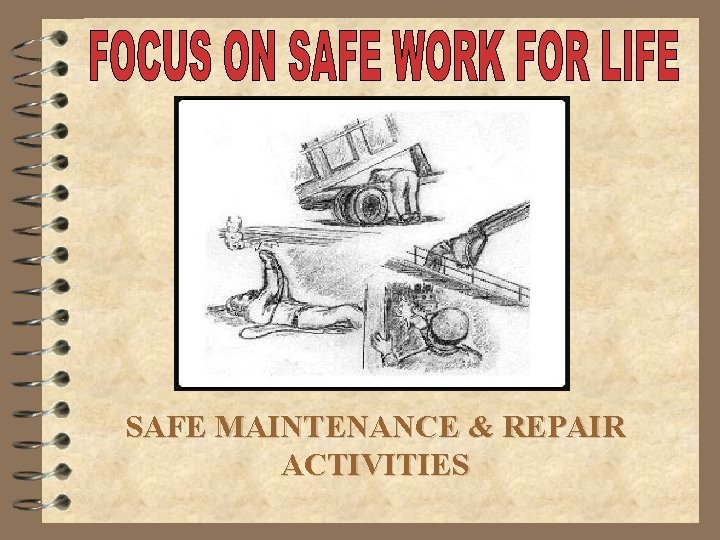
SAFE MAINTENANCE & REPAIR ACTIVITIES
Maintenance Work: A Life or Death Experience 4 EACH YEAR: MINERS DOING MAINTENANCE & REPAIR WORK are severely injured or killed from a wide variety of HAZARDS, including: 4 ELECTRICITY (Shock, Burns & Electrocution), 4 INADVERTENT MOVEMENT OF MACHINERY OR EQUIPMENT, AND 4 FALLING OFF PLATFORMS OR RAISED AREAS.
Life's too precious for anything less!!! ü All miners expect to return home after the end of their shift. And their families expect them too. ü Analyze all aspects of the job before beginning work. ü All hazards associated with the job should be properly communicated to the miners before starting work. ü Analyze every job… every day. N 45% of fatals in 2002 involved maintenance/repair activities. N 46% in 2003. 48% in 2004 56% in 2005 50% in 2006
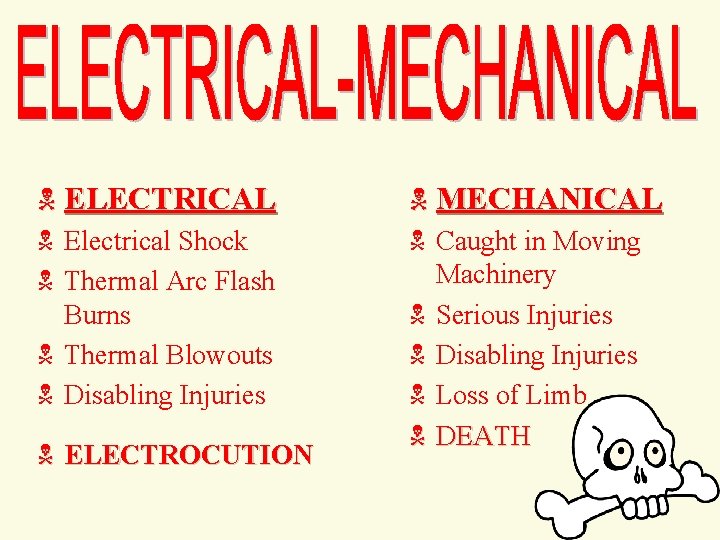
N ELECTRICAL N Electrical Shock N Thermal Arc Flash Burns N Thermal Blowouts N Disabling Injuries N ELECTROCUTION N MECHANICAL N Caught in Moving Machinery N Serious Injuries N Disabling Injuries N Loss of Limb N DEATH
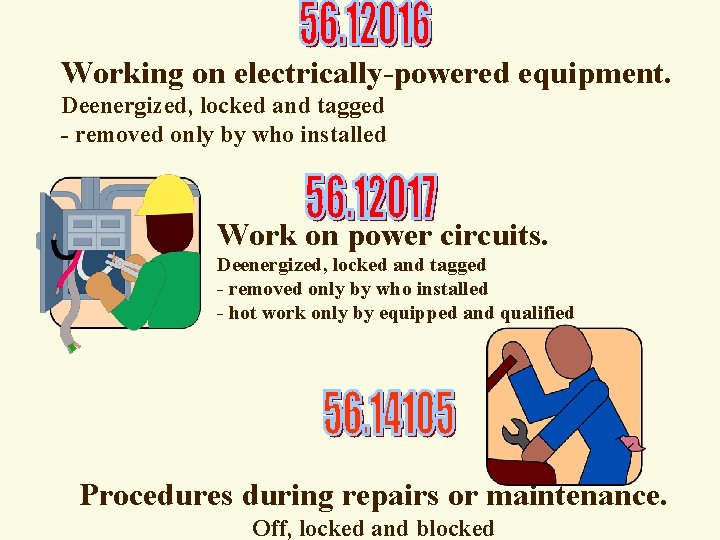
Working on electrically-powered equipment. Deenergized, locked and tagged - removed only by who installed Work on power circuits. Deenergized, locked and tagged - removed only by who installed - hot work only by equipped and qualified Procedures during repairs or maintenance. Off, locked and blocked
Ï Does Your Company have a “Lockout/Tag & Block” Policy? ÏIs it…. . . ÏIn writing, verbal? ÐPositive & effective? ÏIn miner’s training classes? ÏEnforced by mgmt. ? ÏIs it blocked against hazardous motion ? ÏDid YOU take the Keys?
Who does maintenance & repair work at your mine? Ø You Must Care About It! Take interest! Ø Mechanical/Electrical/Welding (Good/So-so/Poor) – Are they……. . – – Qualified? Certified? Formally Trained? OJT’d? “Jack-of-all-trades”- The “shade-tree” type? “Know it all”? – Who does it? …Equipment/Plant Operators? Laborers? – Utility workers? – Anyone? (that can hold a hammer/wrench)
What are things YOU can do? · Establish safe work procedures: · Incorporate manufacturer's recommendations · Assure workers are not exposed to hazards when performing maintenance or repair. · Identify ALL the hazards and correct them…… before starting the work.
More things YOU can do…. Ø Ensure that all workers are task trained. Ø Keep training up-to-date & current. Ø Ensure all workers follow established safe work procedures. Ø Analyze the job before starting work. Ø Prior to beginning work, clear the area of trip and fall hazards.
More things YOU can do… Ø Provide safe access to all work areas. Ø List the work steps. Ø De-energize, lockout and tag electrical equipment… and mechanical equip. Ø Solidly secure/block/chock all applicable equipment against movement - prior to maintenance & repair work.
More things YOU can do… Ø Use appropriate fall protection where there is a danger of falling. Ø Avoid pinch points. Ø Position your body/hands properly. Ø Stay focused for your own safety and for the safety of your fellow workers. Ø Double check everything yourself, if necessary.
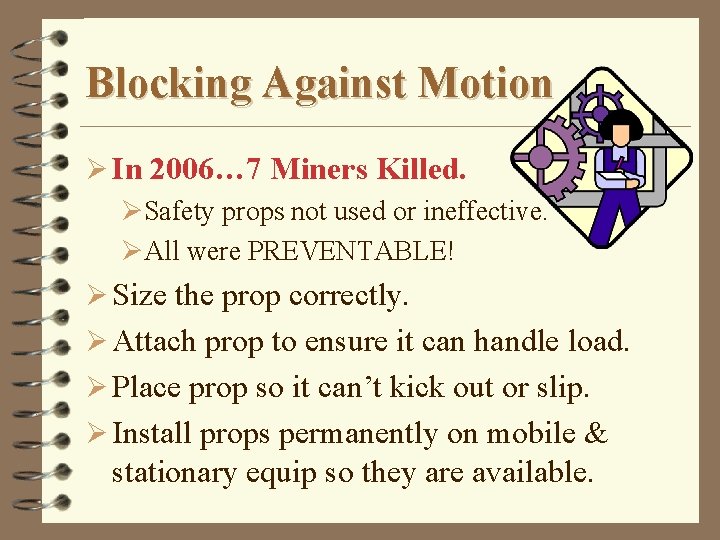
Blocking Against Motion Ø In 2006… 7 Miners Killed. ØSafety props not used or ineffective. ØAll were PREVENTABLE! Ø Size the prop correctly. Ø Attach prop to ensure it can handle load. Ø Place prop so it can’t kick out or slip. Ø Install props permanently on mobile & stationary equip so they are available.
WELDING HAZARDS N Electrical shock from welding can KILL! N ANY welder, AC or DC has the power to cause electrocution…. . How? N If the current travels through you while you are GROUNDED.
Some Safe Welding Tips ü Use dry, insulated gloves & protective clothing. (change them to keep dry) ü Insulate yourself from the workpiece. ü Use fully insulated stinger. In good repair. ü Don’t use damaged, poorly spliced, worn or undersized cables…. Includes both cables! ü Don’t wrap the cables around your body. ü Don’t touch the energized stinger with bare-hand. ü Turn off welder when not in use. ü Avoid wet conditions. Use appropriate safeguards.
What about Oxygen/Acetylene Safety? Ø Always your welding equipment before cutting or welding operations. Ø Always that valves at the torch are closed before turning on the gas regulator valves. Ø Always equip for wear/damage; leaks. Ø Always have good ventilation to work area. Ø Always wear correct clothing and PPE. Ø Always light the torch away from body. Ø Always keep grease/oil away from oxy lines.
Lubrication Systems Ø Automated lube systems (Octopus). Grease pump & distribution lines. Ø Centralized lube system. Lever gun supplies lube to single grease & on to others in system. Ø Extended grease fittings. Ø Single point auto lube - lube single point for weeks or months at a time. Replace single point lubricator when needed. Ø Provide catwalks or other safe access points.
Working on High Pressure Hoses Ø Before working on system……. Ø Always shut down the pump(s), lock out and tag. Ø Check hose(s) to be replaced by twisting and squeezing for pressure relief, or other preferred method. Ø If pressure still present…. . take action to relieve the pressure before loosening the fittings.
Working on Pressurized Fittings…. . Ø A miner injured…attempted to bleed pressure from a conveyor grease jack. ØJack had OEM relief type fitting broken. ØWas replaced with a standard grease fitting. Ø Using 1/4” socket/ratchet the grease fitting blew out of the jack as it was loosened. Like a gun. Ø Always use the proper valves/fittings to relieve grease pressure before maintenance.
Working on Pressurized Fittings…… Ø Don’t use a nail or wire to push in the ball on a standard grease fitting to relieve pressure. Ø Pressure can be more than 10, 000 PSI Ø Grease can shoot out in thin stream and inject itself into your skin. Ø Grease is extremely poisonous when injected into tissue and could require amputation. Ø(1 miner in Colorado knows this)
Large Wheel/Tire Assemblies N Many miners killed/seriously injured over the years. – Don’t work on them w/o safety cage or other restraining device. – Don’t stand too close during inflation/deflation. – Don’t hit inflated wheel/tire assembly with a hammer. – Don’t weld rims on wheel/tire assembly. – Don’t use mismatched rim parts – Always wear eye protection.
Whenever entering a bin or hopper Someone else must be outside A life line or tagline must connect the two The person outside must be healthy enough to be able to assist if the person inside gets into trouble
THINK THE JOB OUT…BEFORE YOU BEGIN WORK ! x What about the following miners?
MINER #1 N Fatally burned while air gouging a metal flange near a scrubber opening. – An ignition occurred after hot slag contacted a combustible membrane in the scrubber.
MINER #2 N A supervisor fell 9 feet from an elevated area at a cement plant. – A chain across a ladder opening unhooked when he contacted it.
ALERT - Use of Chains to Protect From Fall Hazards Ø Miners and managers should inspect anywhere chains are provided to protect persons from fall hazards. Ø Identify and promptly correct the connection between the chain and the permanent termination point. Ø A chain can easily slide out of the hook when a horizontal force estimated at less than 20 lbs. is applied: Ø Re: Miner #2 accident.
MINER #3 N A miner was fatally injured when he fell through a cover on a raised structure (transfer house). – He was repairing a water line and stepped on a metal covering that failed (rusted through).
4 MINERS N 4 miners have been electrocuted since 1999 performing welding operations. (wet clothing/ wet environments and current are a deadly combination)