
Safe Launch Wing Running Wing Running Safety Considerations
- Slides: 15
Safe Launch & Wing Running
Wing Running �Safety Considerations for Launching procedures
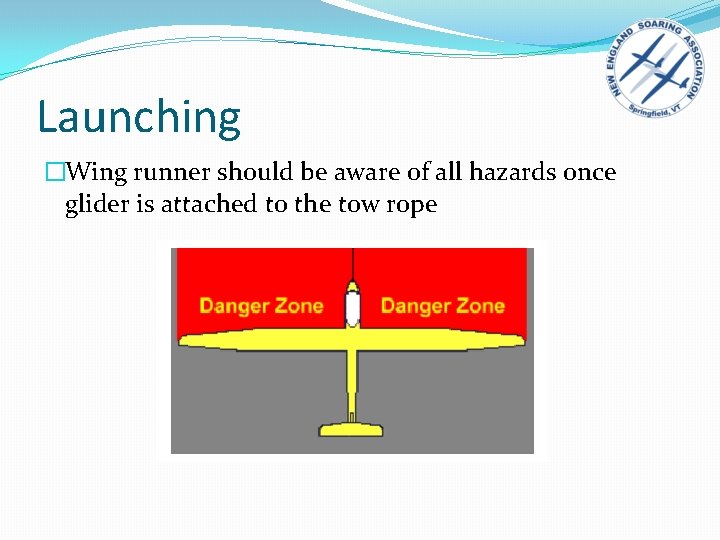
Launching �Wing runner should be aware of all hazards once glider is attached to the tow rope
A recent incident “Yesterday during a launch there was some miscommunication among the various parties: � The launch was proceeding, � The slack was out of the rope and the tug beginning to accelerate, � But, the wing runner was still in front of the glider. � I'm not sure whether he was trying to stop the launch, or he never thought it was happening, but he was concerned about a glider that was about to enter the pattern. � The pilot was focusing on the tug which was powering up, and became aware that the wing runner was in the way when he felt a bang and the glider swerved. � He pulled the release and looked over to see the runner in the midst of a lowlevel aerobatic maneuver over the top of the wing. � Luckily no one was hurt and nothing was damaged, but you can imagine it was an upsetting situation for those involved. � The tug continued the takeoff and proceeded around the pattern” (Taken from an email sent out by the president of another Northeast glider operation after a launch incident).
So, It can happen. . . �Miscommunication �Launch initiated �Wing runner not clear of wing �Glider pilot focused on tug �Low level aerobatics over the wing �Luckily, no damages or injuries
An Open Question �How often have you seen a wing-runner in front of the wing after the glider is hooked up?
Further thoughts. . . �Do not linger in front of the wing �Wing up/level can indicate "ready to go!" �Wing level vs. not might be discernable by the tug �If the launch needs to stop, lower the wing and signal to the glider pilot to RELEASE! �Glider pilots: wing down means something is wrong. Release and figure out the reason later.
Recommended Procedure at NESA �HOOK-UP �DO NOT HOOK UP A GLIDER BEFORE THE PILOT HAS COMPLETED HIS/HER CHECK-LIST AND THE CANOPY IS CLOSED*; �HOOKUP then immediately; �MOVE CLEAR OF THE WING; �DO NOT PICK UP THE WING; * Do not use check-lists where ‘Cable’ is listed before ‘Canopy’. If your checklist reads like this – revise it.
Recommended Procedure at NESA �CHECK PATTERN �PILOT asks: “IS THE PATTERN CLEAR”; �WING-RUNNER – LOOK AROUND AT FULL PATTERN FOR ALL RUWAYS. WHEN CONFIRMED CLEAR STATE LOUDLY “PATTERN IS CLEAR” �PILOT GIVES “THUMBS UP”
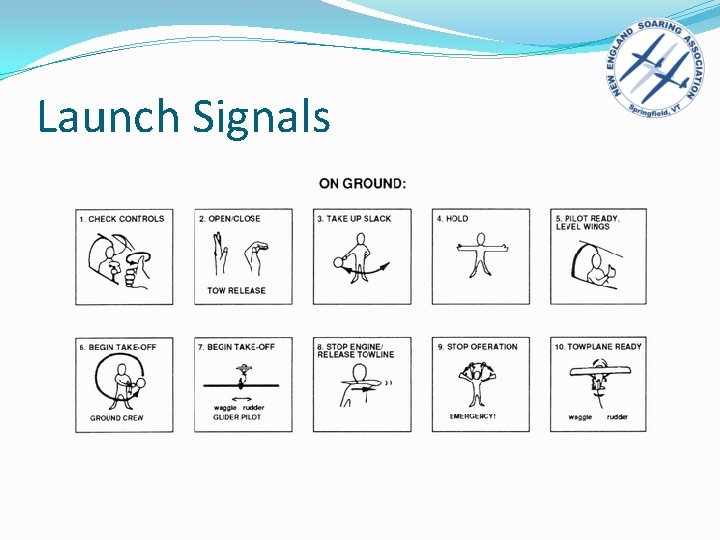
Recommended Procedure at NESA �TAKE UP SLACK �TOW PILOT WILL NOT BEGIN TAKING UP SLACK UNTIL WING IS LEVEL. �ONLY AFTER PILOT GIVES THUMBS UP �WING RUNNER: � HOLDS WING LEVEL & � GIVES TAKE UP SLACK SIGNAL
Recommended Procedure at NESA �LAUNCH �PILOT WAGGLES RUDDER � (no need to slam the rudder against the stops) �WING RUNNNER – GIVES LAUNCH SIGNAL
ABORT �ABORTS ON THE GROUND ARE THE SAME AS IN THE AIR, i. e. �TOW PLANE GOES LEFT (or straight ahead if left not possible) �GLIDER GOES RIGHT if necessary to avoid tow plane;
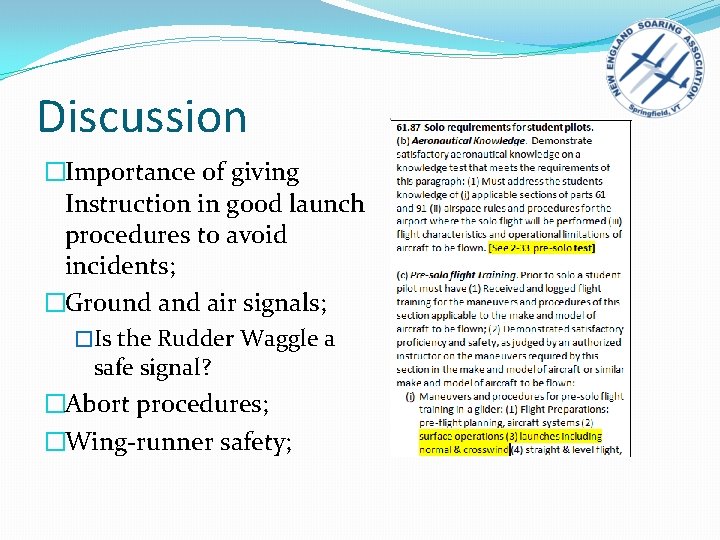
Discussion �Importance of giving Instruction in good launch procedures to avoid incidents; �Ground air signals; �Is the Rudder Waggle a safe signal? �Abort procedures; �Wing-runner safety;
Launch Signals
And Now for the rest of the story on the incident… � And it is a very important lesson for everyone to take away. � After the early termination, the glider pilot got out of the aircraft and immediately checked on the condition of the glider, and then the wing runner (joking – I'm sure it was the other way around. . . maybe. . . ) � then they repositioned the glider for relaunch as the tug came back around in the pattern. I'm sure there was some vigorous arm-waving from inside the tug, and then relaunch. � At about 200 feet the pilot noticed the canopy creeping open, and realized that in all of the excitement of the proceeding event, he hadn't thoroughly gone through the checklist. � This is exactly what happens when things go wrong, and is part of the chain of events we talk about preceding an accident. In this case the pilot handled the event with no more drama, the tow was completed and the canopy re-latched and he went on the a long (and boring) flight.