
Safe DrugFree Schools Communities Principles of Effectiveness Regional


- Slides: 89
Safe & Drug-Free Schools & Communities Principles of Effectiveness Regional Meeting Spring, 2003 10: 00 -3: 00 p. m. Linda Miller, IA Dept. of Education Pam Deichmann, IA Dept. of Public Health
AGENDA n n n n n Welcome Introduction to Principles of Effectiveness Principle 5: Parent & Community Involvement Principles 1 & 4: Needs Assessment Principle 2: Performance Indicators Principle 3: Science-Based Practice Evaluation Wrap-Up
Objective of the Session To apply the Principles of Effectiveness to the design of comprehensive prevention programs.
Purpose of SDFSC Provide comprehensive programs proven effective in preventing substance abuse and violence through implementation of the Principles of Effectiveness.
NCLB Principles “No Child Left Behind” Ø Ø Accountability Flexibility Science Based Parental Choice
NCLB Concepts n Principles of Effectiveness n Alignment n Comprehensive Approach n Science-Based Programming n Collaboration
Introduction Prevention is. . . “The active process of creating conditions and attributes that promote the well-being of people. ” - SAMSHA and OJJDP
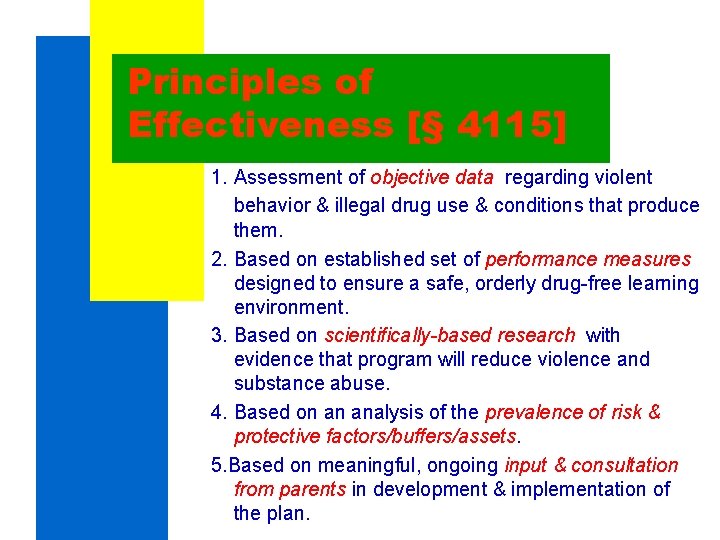
Principles of Effectiveness [§ 4115] 1. Assessment of objective data regarding violent behavior & illegal drug use & conditions that produce them. 2. Based on established set of performance measures designed to ensure a safe, orderly drug-free learning environment. 3. Based on scientifically-based research with evidence that program will reduce violence and substance abuse. 4. Based on an analysis of the prevalence of risk & protective factors/buffers/assets. 5. Based on meaningful, ongoing input & consultation from parents in development & implementation of the plan.
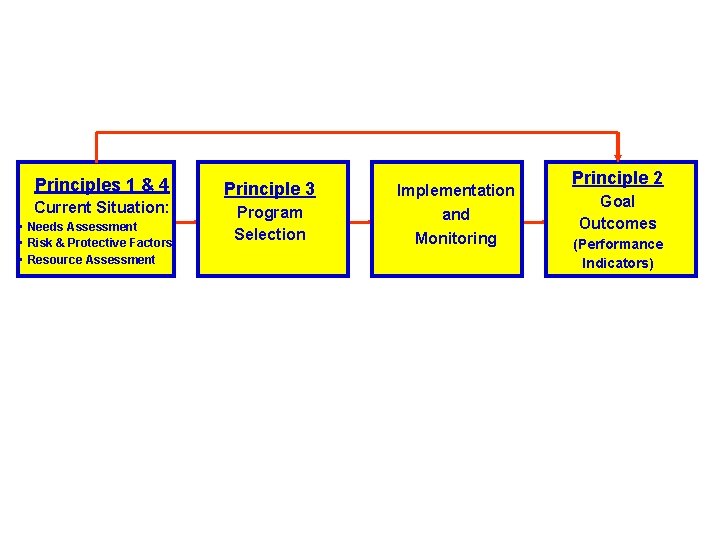
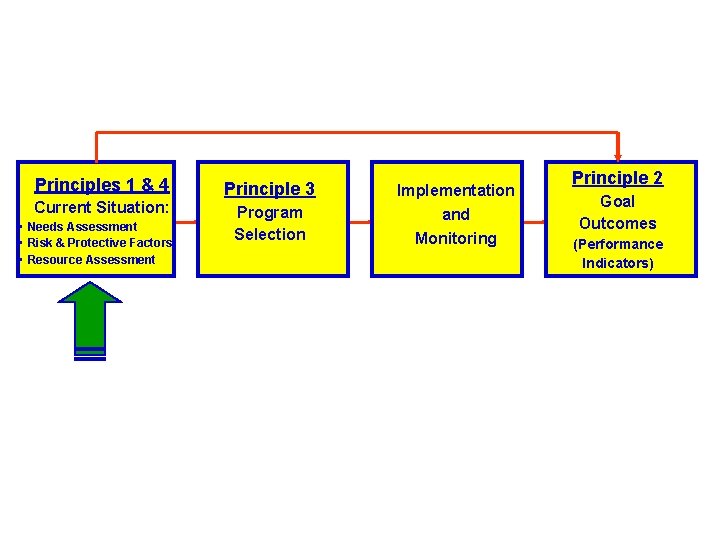
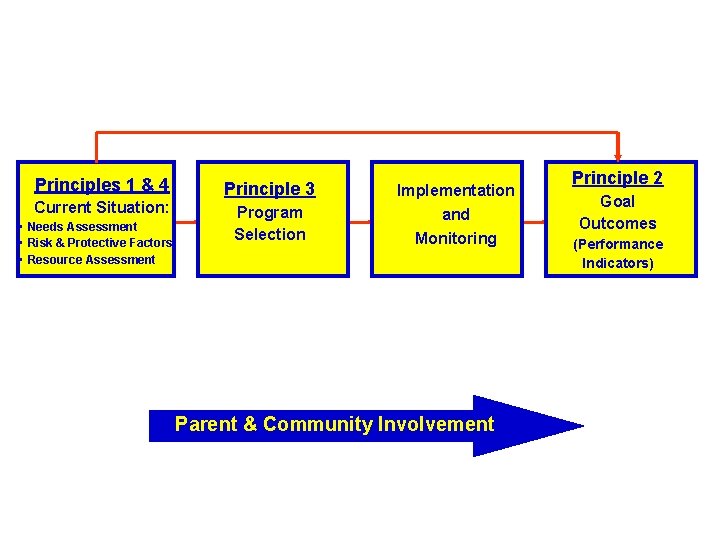
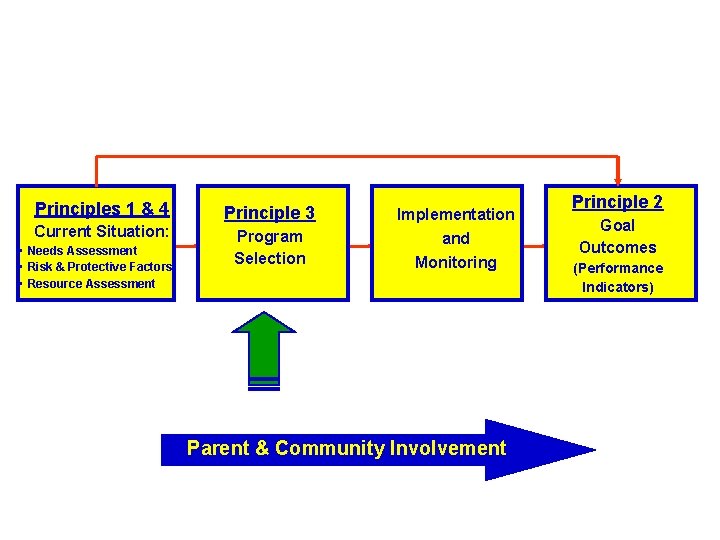
Principles 1 & 4 Current Situation: • Needs Assessment • Risk & Protective Factors • Resource Assessment Principle 3 Program Selection Implementation and Monitoring Principle 2 Goal Outcomes (Performance Indicators)
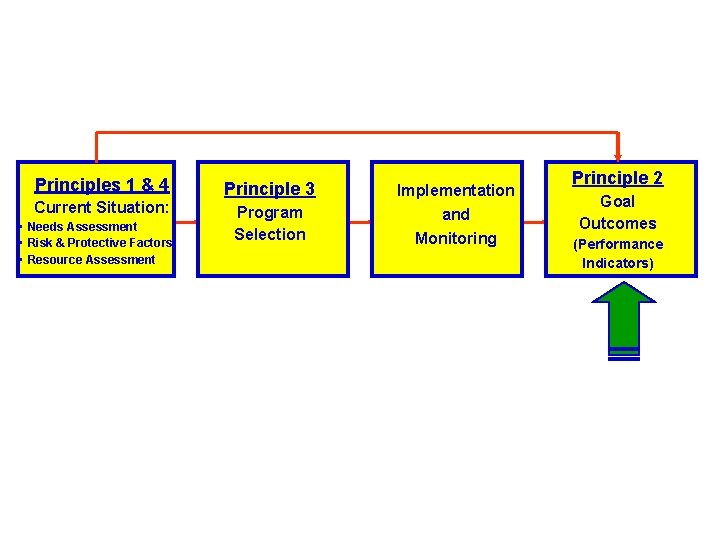
Principles 1 & 4 Current Situation: • Needs Assessment • Risk & Protective Factors • Resource Assessment Principle 3 Program Selection Implementation and Monitoring Principle 2 Goal Outcomes (Performance Indicators)
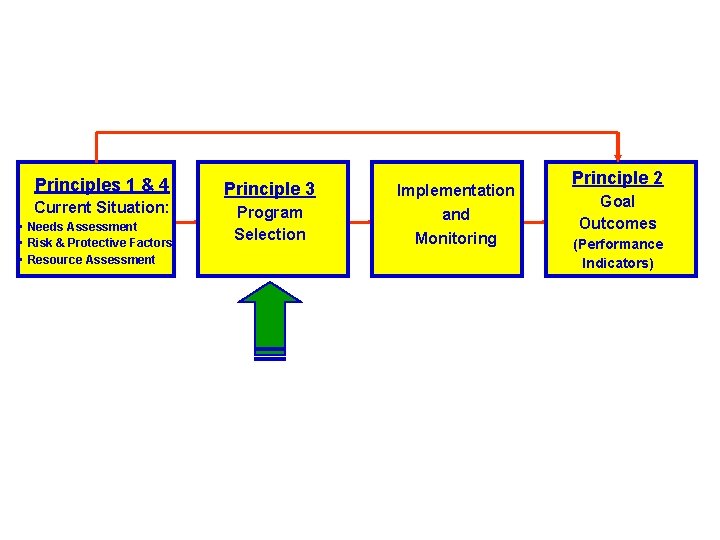
Principles 1 & 4 Current Situation: • Needs Assessment • Risk & Protective Factors • Resource Assessment Principle 3 Program Selection Implementation and Monitoring Principle 2 Goal Outcomes (Performance Indicators)
Principles 1 & 4 Current Situation: • Needs Assessment • Risk & Protective Factors • Resource Assessment Principle 3 Program Selection Implementation and Monitoring Principle 2 Goal Outcomes (Performance Indicators)
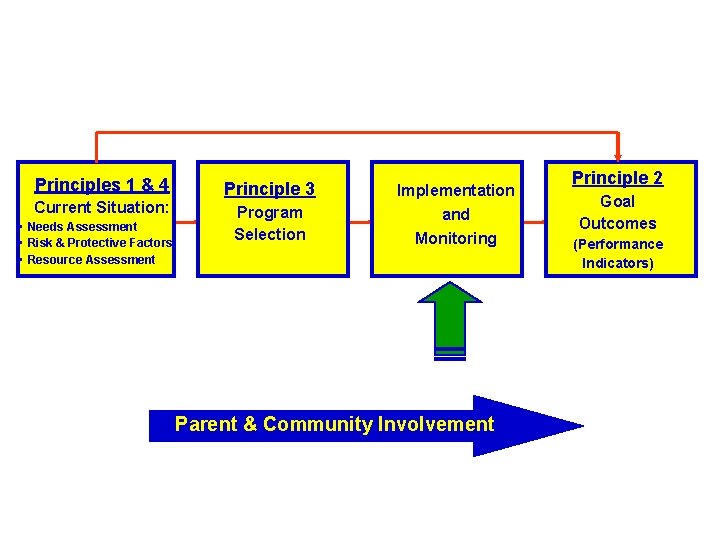
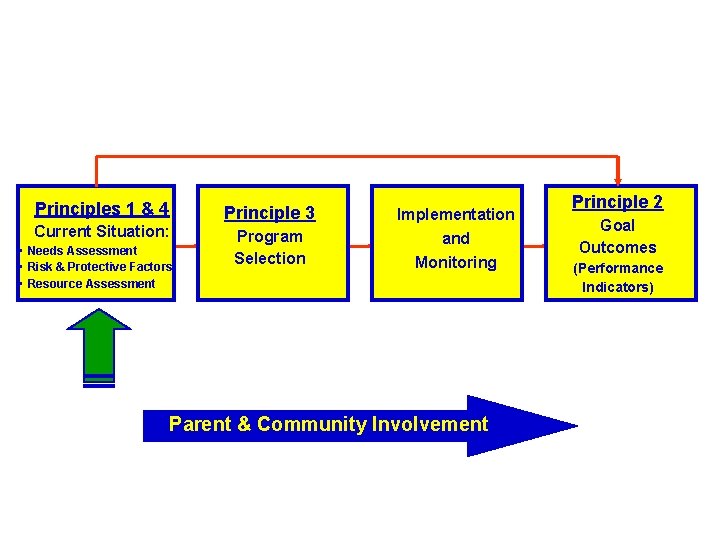
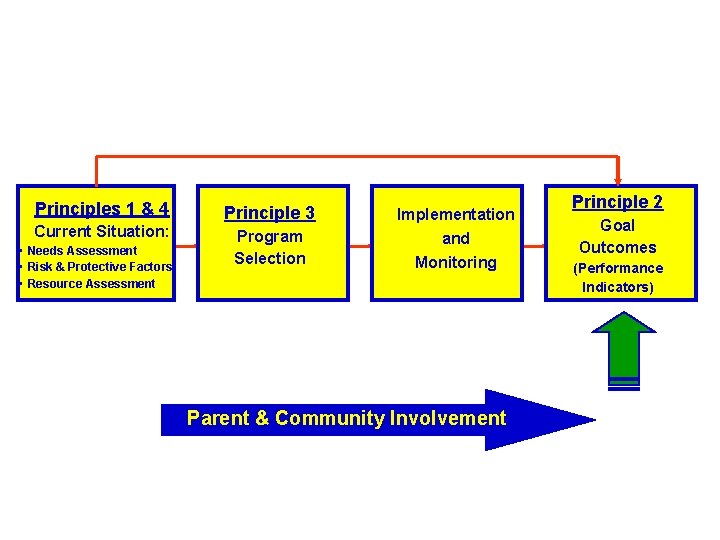
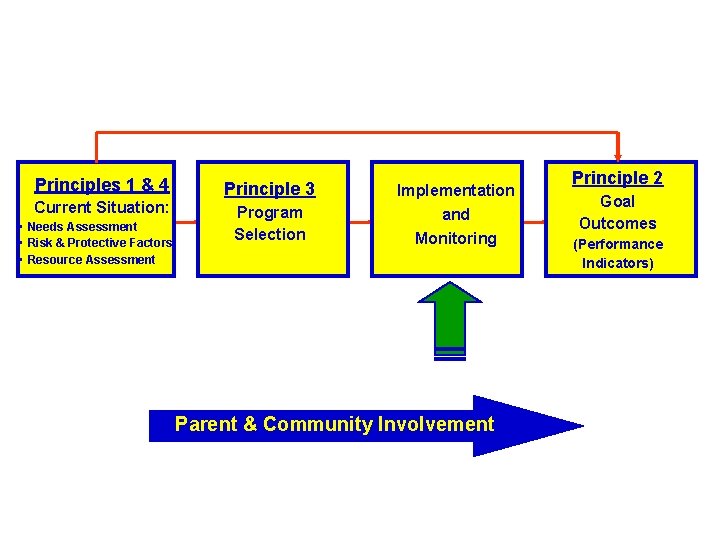
Principles 1 & 4 Current Situation: • Needs Assessment • Risk & Protective Factors • Resource Assessment Principle 3 Program Selection Implementation and Monitoring Parent & Community Involvement Principle 2 Goal Outcomes (Performance Indicators)
Introduction Assurances n Implement a weapons-free school policy consistent with Iowa law. n Drug & violence prevention activities convey a clear & consistent message that acts of violence & the illegal use of drugs are wrong & harmful. n Funds will not be used to supplant.
Assurances (cont. ) District has a safe school plan that includes: n appropriate & effective school discipline policies; n security procedures at & to & from school; n prevention activities designed to create & maintain a safe, drug-free, disciplined environment; n a crisis management plan; n a code of conduct policy that – allows a teacher to communicate effectively with all students – allows all students in the class to learn – has fair, developmentally appropriate consequences – considers the student & the circumstances; – is enforced accordingly
Introduction Districts are required to integrate other state and federal prevention programs into a comprehensive plan.
6 Strategies of Comprehensive Programs n n n Information Dissemination Environmental Approaches Prevention Education Problem Identification and Referral Processes Alternatives Parent and Community Involvement Activities
Comprehensive Programs Information dissemination increases knowledge and changes attitudes through activities such as classroom discussions, media campaigns, and special events. This strategy also includes the distribution of information to students and employees about community resources.
Comprehensive Programs Prevention education is developmentally-based instruction for all children and youth from early childhood through 12 th grade that: - teaches important skills, such as social skills, conflict management skills, problem solving skills; - promotes a sense of individual responsibility, and provide information and effective techniques for resisting peer pressure - addresses the legal, personal, and social consequences of violent and disruptive behavior, such as bullying and harassment, and or the legal, social, and health consequences of the use of illegal drugs,
Comprehensive Programs Alternatives offer opportunities for participation in constructive, developmentally appropriate activities that build assets or protective factors in environments that protect youth from situations that put them at risk.
Comprehensive Programs Problem identification and referral processes recognize individuals exhibiting problem behaviors and refer them for assessment and intervention.
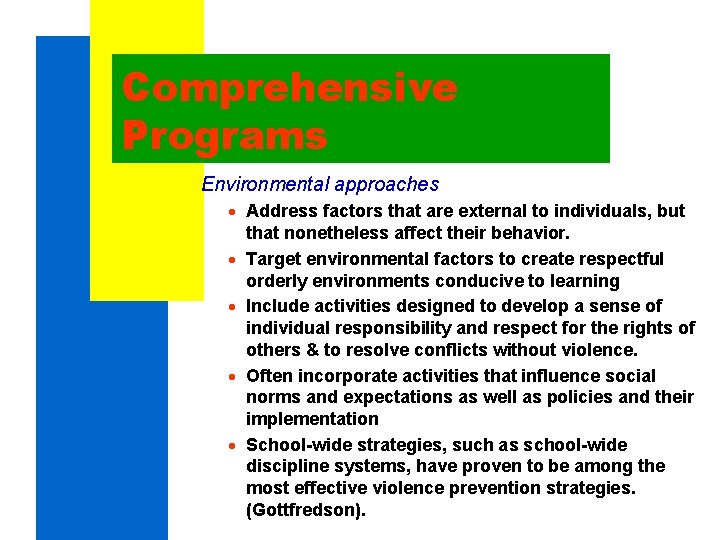
Comprehensive Programs Environmental approaches · Address factors that are external to individuals, but that nonetheless affect their behavior. · Target environmental factors to create respectful orderly environments conducive to learning · Include activities designed to develop a sense of individual responsibility and respect for the rights of others & to resolve conflicts without violence. · Often incorporate activities that influence social norms and expectations as well as policies and their implementation · School-wide strategies, such as school-wide discipline systems, have proven to be among the most effective violence prevention strategies. (Gottfredson).
Comprehensive Programs Parent and community involvement activities promote parent involvement and coordination with community groups and agencies, including the distribution of information about the LEA needs assessment, goals, and programs;
Programming
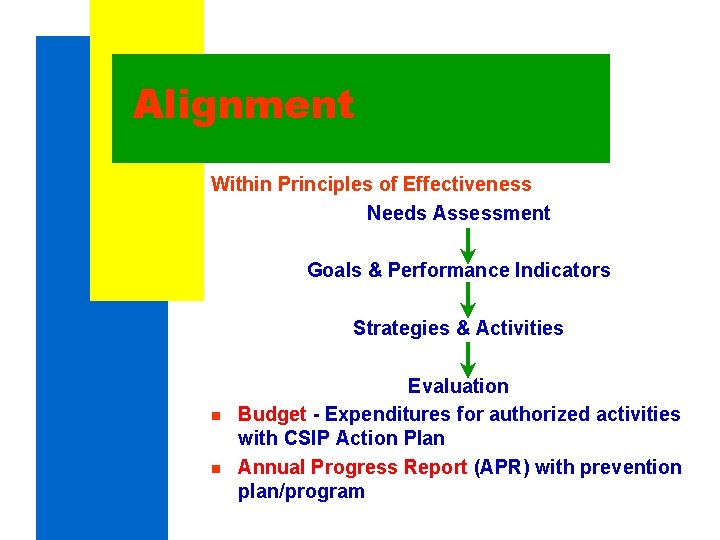
Alignment Within Principles of Effectiveness Needs Assessment Goals & Performance Indicators Strategies & Activities n n Evaluation Budget - Expenditures for authorized activities with CSIP Action Plan Annual Progress Report (APR) with prevention plan/program
Principles 1 & 4 Current Situation: • Needs Assessment • Risk & Protective Factors • Resource Assessment Principle 3 Program Selection Implementation and Monitoring Parent & Community Involvement Principle 2 Goal Outcomes (Performance Indicators)
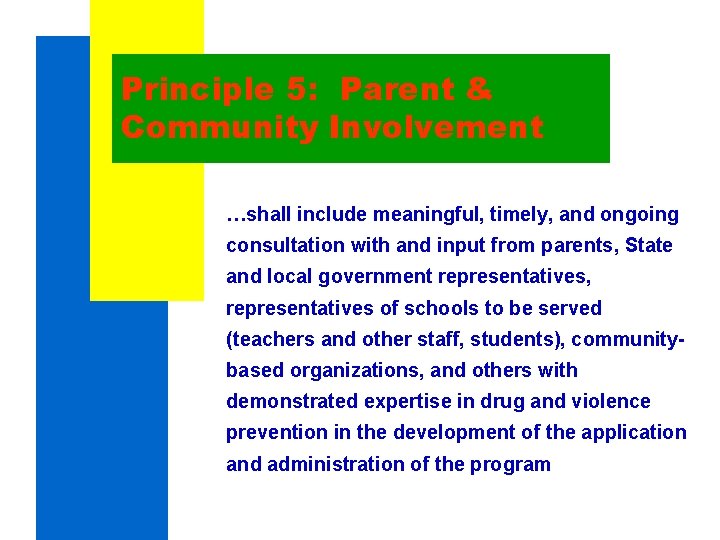
Principle 5: Parent & Community Involvement …shall include meaningful, timely, and ongoing consultation with and input from parents, State and local government representatives, representatives of schools to be served (teachers and other staff, students), communitybased organizations, and others with demonstrated expertise in drug and violence prevention in the development of the application and administration of the program
Principle 5: Parent & Community Involvement n n Practice Profile Page 15 Critical elements Ratings – Ideal – Principle based – Non-Principle-Based
Principle 5: Parent & Community Involvement Appendix B n “How can we invite participation? ” n “Who needs to be in the conversation? ”
Principle 5: Parent & Community Involvement In what ways can the school and community work together to prevent substance abuse and violence?
Principle 5: Parent & Community Involvement Directory of Prevention Specialists on pages 19 -20
Principles 1 & 4 Current Situation: • Needs Assessment • Risk & Protective Factors • Resource Assessment Principle 3 Program Selection Implementation and Monitoring Parent & Community Involvement Principle 2 Goal Outcomes (Performance Indicators)
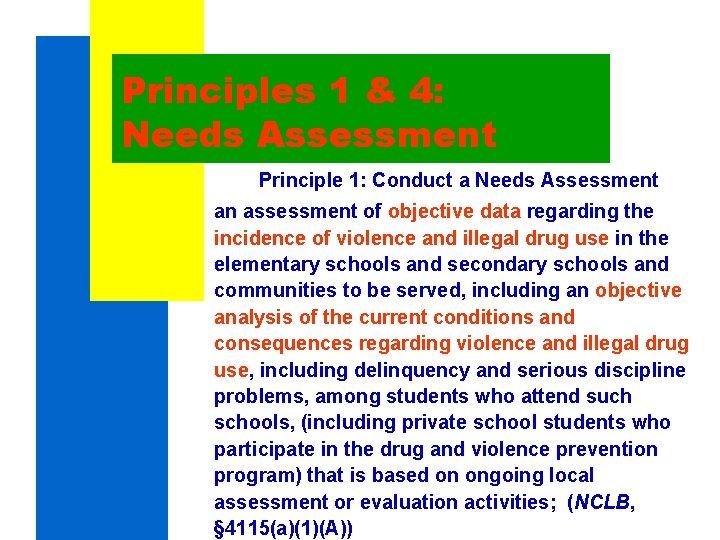
Principles 1 & 4: Needs Assessment Principle 1: Conduct a Needs Assessment an assessment of objective data regarding the incidence of violence and illegal drug use in the elementary schools and secondary schools and communities to be served, including an objective analysis of the current conditions and consequences regarding violence and illegal drug use, including delinquency and serious discipline problems, among students who attend such schools, (including private school students who participate in the drug and violence prevention program) that is based on ongoing local assessment or evaluation activities; (NCLB, § 4115(a)(1)(A))
Principles 1 & 4: Needs Assessment Principle 4: Based on Analysis of the Prevalence of Risk Factors and Protective Factors an analysis of the data reasonably available at the time, of the prevalence of risk factors, including high or increasing rates of reported cases of child abuse and domestic violence; protective factors, buffers, assets; or other variables in schools and communities in the State identified through scientifically based research; (NCLB, § 4115(a)(1)(D))
Principles 1 & 4 Needs Assessment Practice Profile Pages 22 to 29
Principles 1 & 4: Needs Assessment Appendix B n “Where can we find sources of internal data? ” n “Where can we find sources of external data? ”
Strategies for Parent Involvement ·Recruit parents to serve on planning committee or other group conducting needs assessment. ·Ensure opportunities for parents to review the needs assessment plan. ·Include parent views in data collected. ·Involve parents in some data collection tasks’ ·Involve parents in analysis of data. ·Share needs assessment results with parents ·Involve parents in goal setting begins with involving them in the needs assessment process;
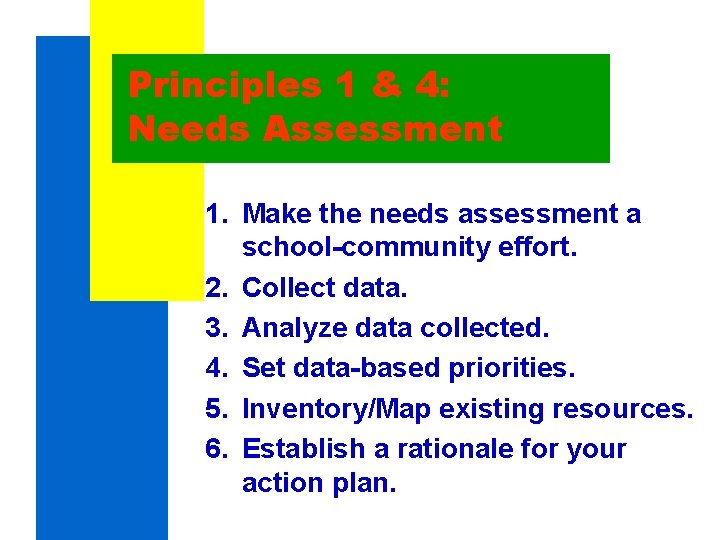
Principles 1 & 4: Needs Assessment 1. Make the needs assessment a school-community effort. 2. Collect data. 3. Analyze data collected. 4. Set data-based priorities. 5. Inventory/Map existing resources. 6. Establish a rationale for your action plan.
Principles 1 & 4: Needs Assessment 1. Make the needs assessment a school-community effort.
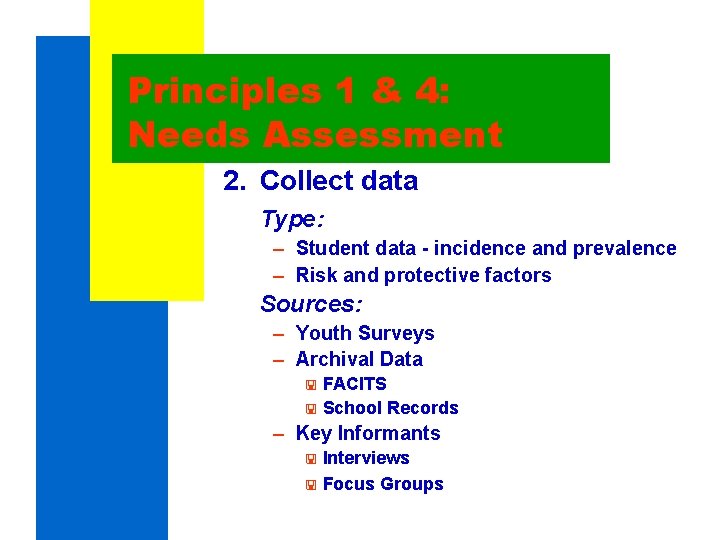
Principles 1 & 4: Needs Assessment 2. Collect data Type: – Student data - incidence and prevalence – Risk and protective factors Sources: – Youth Surveys – Archival Data < < FACITS School Records – Key Informants < < Interviews Focus Groups
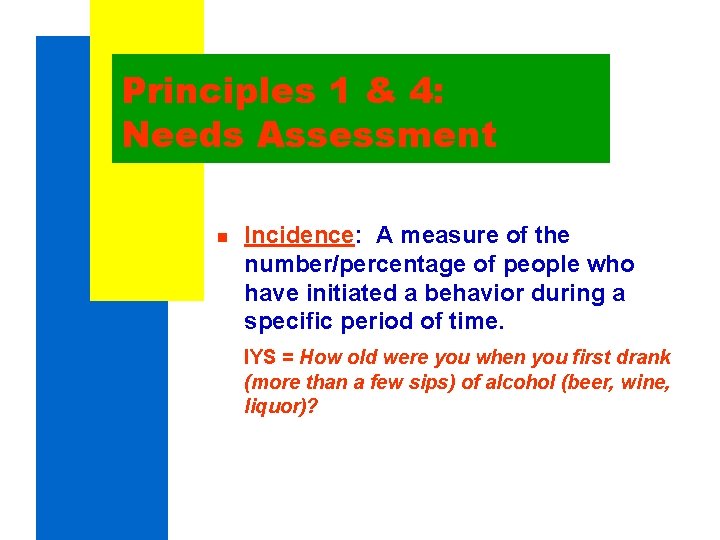
Principles 1 & 4: Needs Assessment n Incidence: A measure of the number/percentage of people who have initiated a behavior during a specific period of time. IYS = How old were you when you first drank (more than a few sips) of alcohol (beer, wine, liquor)?
Principles 1 & 4: Needs Assessment Prevalence: A measure of the number/percentage of people behaving in a certain way during a specified period of time. IYS = In the past 30 days on how many days have you had at least one drink of alcohol (glass, bottle, or can of beer, glass of wine, liquor or mixed drink)? IYS = In the last 12 months, how often have you been involved in a physical fight on school property?
Principles 1 & 4: Needs Assessment Risk Factors: Conditions for a group, individual, or defined geographic area that increases the likelihood of substance abuse or violence problem behavior. IYS: “How wrong would most adults in your neighborhood and/or community feel it would be for you to drink beer, wine, or hard liquor? ” Risk Factor: Community norms favorable toward drug use, firearms, and crime.
Principles 1 & 4: Needs Assessment Protective Factors or Assets: Individual skills, characteristics or strengths of school/community conditions that can protect against, or build resilience to, substance abuse or violence or buffer the negative effects of risks. IYS: “How wrong would most adults in your neighborhood and/or community feel it would be for you to drink beer, wine, or hard liquor? ” Risk Factor: Community norms favorable toward drug use, firearms, and crime.
Principles 1 & 4: Needs Assessment 3. Analyze data collected. Needs Data What is the incidence and prevalence of violence and substance abuse in your district? –Does the student data present a positive or negative picture of the current situation? –Are trends headed in the desired direction? –How are our students doing compared to students in other districts? the state? the nation? –How are out students doing compared to developmental expectations?
Principles 1 & 4: Needs Assessment n n n Risk & Protective Factor Data Are there risk factors contributing to the current situation of our students? What protective factors have potential to mitigate the risk factors present in our current situation? Are there sufficient protective factors in the lives of our children to offset the risk factors?
Principles 1 & 4: Needs Assessment Resource Assessment What are the resources our school district and community have available to address deficiencies uncovered in our risk and protective factor analysis? < Which risk factor does the program/service address? < How does the program increase protective factors? < What age group(s) are served by the program/practice? < Does the program address the needs of all students or a targeted group?
Principles 1 & 4: Needs Assessment < Is the program of sufficient duration and intensity to make a difference in the problem behavior of the targeted population? < Which cultural, socio-economic group, gender does the program address? < Does the program complement or conflict with other programs in the district? What content does it reinforce?
Principles 1 & 4: Needs Assessment n n n What are the areas of greatest student need? Of these areas of greatest need, which is the most deficient in protective factors and has the greatest number of associated risk factors? What is our greatest resource deficiency for addressing the need areas?
Principles 11 & & 4: 4: Needs Assessment Which set of circumstances in the current situation (student needs and environmental supports) should be addressed first? 1. Do you want to address this need? 2. Can we make necessary changes to address the need? 3. Are there certain factors, if addressed first, that will make positive changes in other factors? Is it doable? Likely to produce desired change? Able to leverage other change?
Principles 1 & 4: Needs Assessment MAKE THE CASE n. Select an area of focus. n. Indicators of need: EXAMPLE 1: Students at Anytown Middle School have difficulty resolving problems and interacting appropriately with each other. – 20% of 8 th graders reported that they had been disciplined at school for fighting in the last 30 days. (IYS) – 15% of Anytown middle schoolers received office referrals for fighting during the 2001 -2002 school year. – Faculty survey identifies fighting as number one safety concern for the middle school.
Principles 1 & 4: Needs Assessment n n Risk Factors Targeted for Reduction – reduce alienation and rebelliousness – reduce rewards for anti-social behavior Protective Factors Targeted for Enhancement – increase opportunities for rewards for positive behavior in school – increase social and self competency skills – enhance peer relationships – clarify social boundaries
Principles 1 & 4: Needs Assessment Assumption If students and staff develop better methods of managing behavior and resolving conflicts, then the school climate will improve and there will be fewer fights at school.
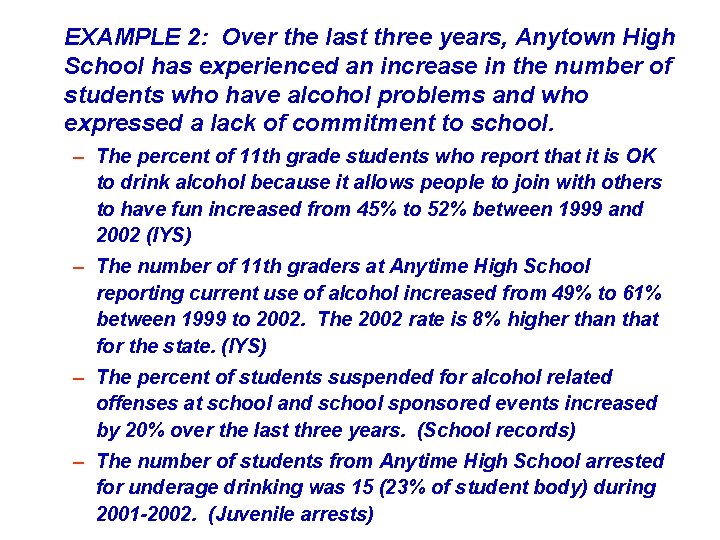
EXAMPLE 2: Over the last three years, Anytown High School has experienced an increase in the number of students who have alcohol problems and who expressed a lack of commitment to school. – The percent of 11 th grade students who report that it is OK to drink alcohol because it allows people to join with others to have fun increased from 45% to 52% between 1999 and 2002 (IYS) – The number of 11 th graders at Anytime High School reporting current use of alcohol increased from 49% to 61% between 1999 to 2002. The 2002 rate is 8% higher than that for the state. (IYS) – The percent of students suspended for alcohol related offenses at school and school sponsored events increased by 20% over the last three years. (School records) – The number of students from Anytime High School arrested for underage drinking was 15 (23% of student body) during 2001 -2002. (Juvenile arrests)
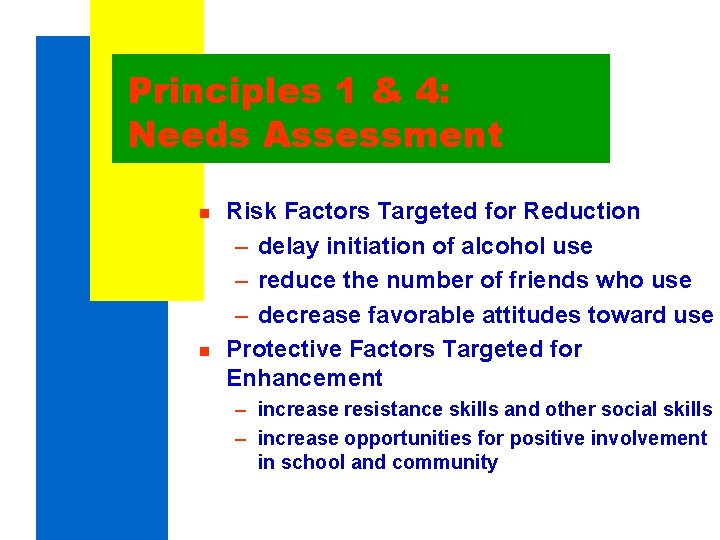
Principles 1 & 4: Needs Assessment n n Risk Factors Targeted for Reduction – delay initiation of alcohol use – reduce the number of friends who use – decrease favorable attitudes toward use Protective Factors Targeted for Enhancement – increase resistance skills and other social skills – increase opportunities for positive involvement in school and community
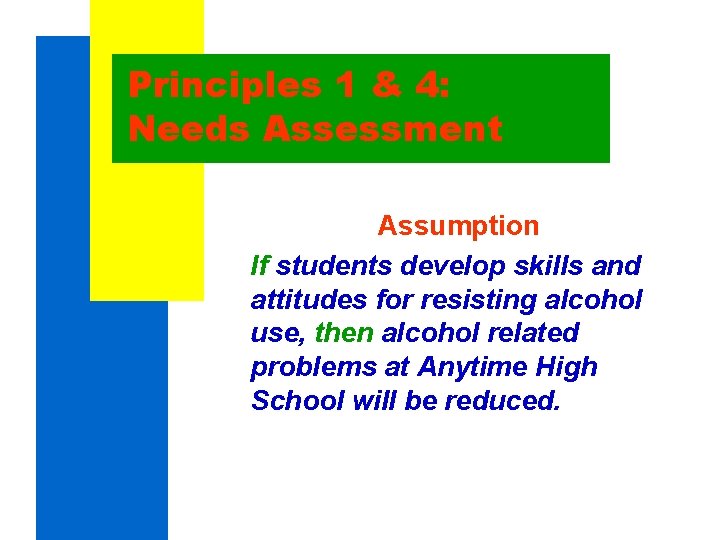
Principles 1 & 4: Needs Assessment Assumption If students develop skills and attitudes for resisting alcohol use, then alcohol related problems at Anytime High School will be reduced.
Principles 1 & 4 Current Situation: • Needs Assessment • Risk & Protective Factors • Resource Assessment Principle 3 Program Selection Implementation and Monitoring Parent & Community Involvement Principle 2 Goal Outcomes (Performance Indicators)
Principle 2: Performance Indicators An established set of performance measures aimed at ensuring that the elementary schools and secondary schools and communities to be served by the program have a safe, orderly, and drug-free learning environment; (NCLB, § 4115(a)(1)(b)
Principle 2: Performance Indicators Practice Profile Pages 45 -47
Strategies for Parent Involvement • Involving parents in goal setting begins with involving them in the needs assessment process; • Include parents on a planning committee that develops goals and objectives; • Involve parents in a facilitated process of goal development; • Provide parents with an opportunity to review and comment on goals set before they are adopted; • Inform parents of goals that have been adopted and progress toward achieving them.
Principle 2: Performance Indicators n n Determine area to be addressed by a program specific goal based on your needs assessment (e. g. , reduction of substance abuse or violence, decrease in specific risk factors, increase in specific protective factors). Write a long term (5 year) measurable goal for the area to be addressed. Identify the performance indicators. Establish expected levels of performance.
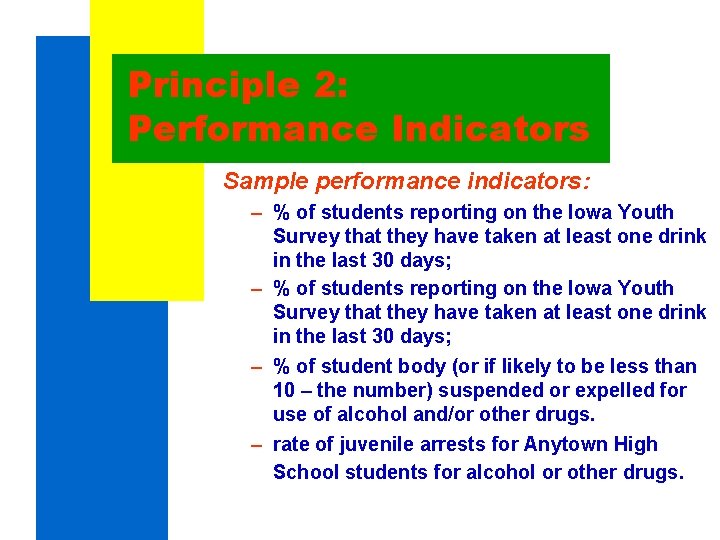
Principle 2: Performance Indicators Sample performance indicators: – % of students reporting on the Iowa Youth Survey that they have taken at least one drink in the last 30 days; – % of student body (or if likely to be less than 10 – the number) suspended or expelled for use of alcohol and/or other drugs. – rate of juvenile arrests for Anytown High School students for alcohol or other drugs.
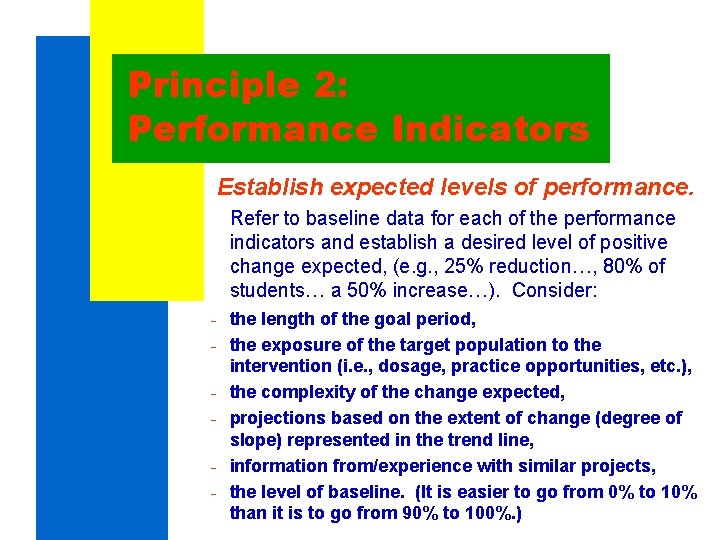
Principle 2: Performance Indicators Establish expected levels of performance. Refer to baseline data for each of the performance indicators and establish a desired level of positive change expected, (e. g. , 25% reduction…, 80% of students… a 50% increase…). Consider: - - - the length of the goal period, the exposure of the target population to the intervention (i. e. , dosage, practice opportunities, etc. ), the complexity of the change expected, projections based on the extent of change (degree of slope) represented in the trend line, information from/experience with similar projects, the level of baseline. (It is easier to go from 0% to 10% than it is to go from 90% to 100%. )
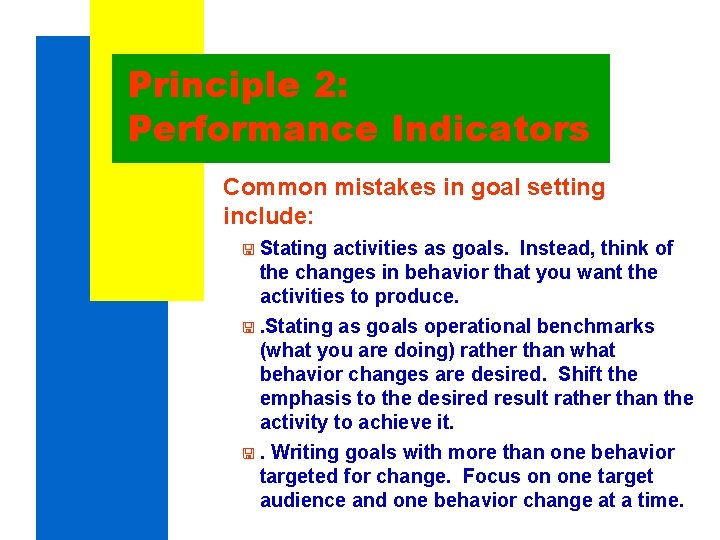
Principle 2: Performance Indicators Common mistakes in goal setting include: < Stating activities as goals. Instead, think of the changes in behavior that you want the activities to produce. <. Stating as goals operational benchmarks (what you are doing) rather than what behavior changes are desired. Shift the emphasis to the desired result rather than the activity to achieve it. <. Writing goals with more than one behavior targeted for change. Focus on one target audience and one behavior change at a time.
Principle 2: Performance Indicators Performance indicators serve as gauges for how well your program is working to achieve the outcomes you desire.
Principle 2: Performance Indicators n What program is being measured? (Draw a fence around what will be measured. ) n Who is the target audience customers/clients (i. e. , direct recipients/ beneficiaries of the service? )
Principle 2: Performance Indicators Client Population (Audience) n Those who receive a service or otherwise benefit from a program. n Almost always smaller than the whole population.
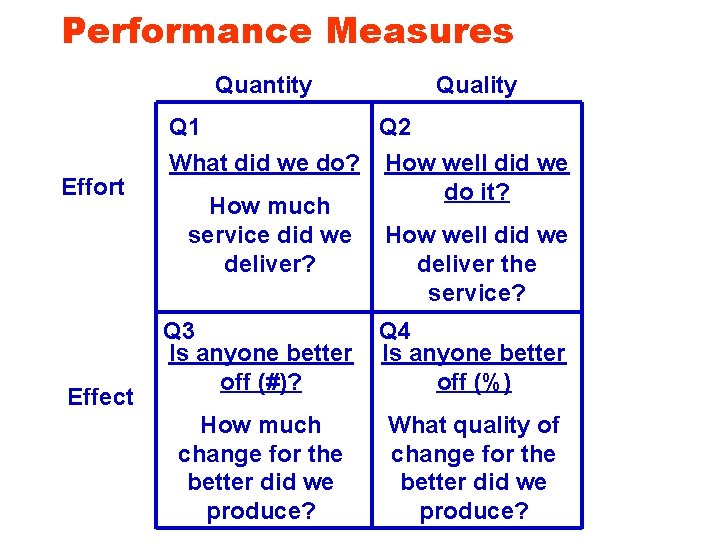
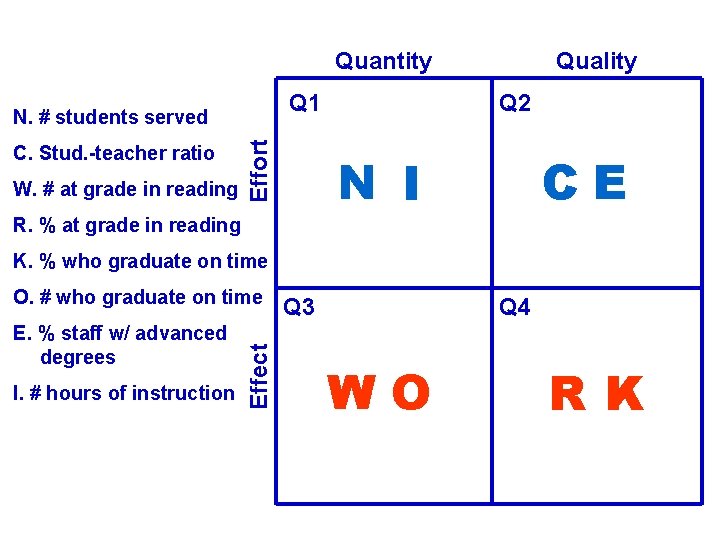
Performance Measures Quantity Effort Effect Quality Q 1 Q 2 What did we do? How well did we do it? How much service did we deliver? How well did we deliver the service? Q 3 Is anyone better off (#)? Q 4 Is anyone better off (%) How much change for the better did we produce? What quality of change for the better did we produce?
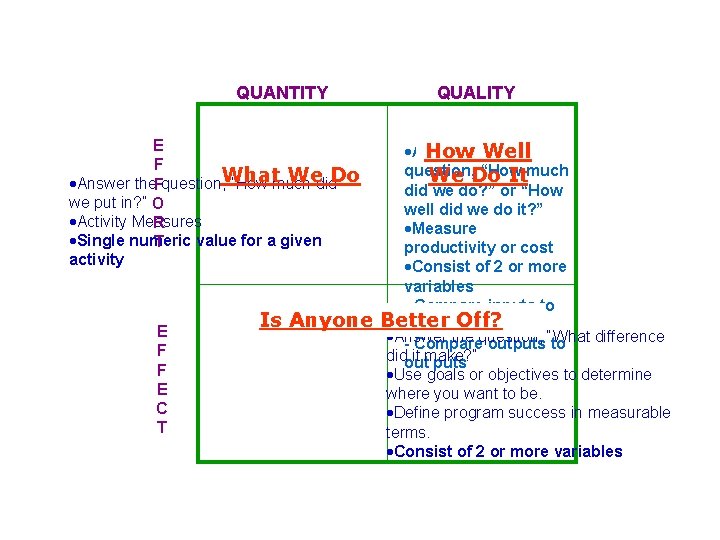
QUANTITY E F Wedid. Do ·Answer the. Fquestion, What “How much we put in? ” O ·Activity Measures R ·Single numeric value for a given T activity E F F E C T Is Anyone QUALITY ·Answer Howthe Well question, “How We Do Itmuch did we do? ” or “How well did we do it? ” ·Measure productivity or cost ·Consist of 2 or more variables - Compare inputs to Better Off? outputs, or ·Answer the difference - Comparequestion, outputs “What to didout it make? ” puts ·Use goals or objectives to determine where you want to be. ·Define program success in measurable terms. ·Consist of 2 or more variables
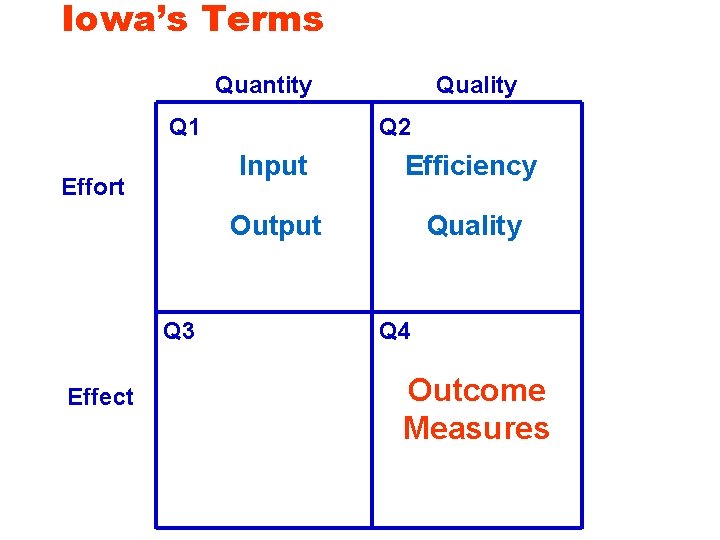
Iowa’s Terms Quantity Q 1 Effort Q 3 Effect Quality Q 2 Input Efficiency Output Quality Q 4 Outcome Measures
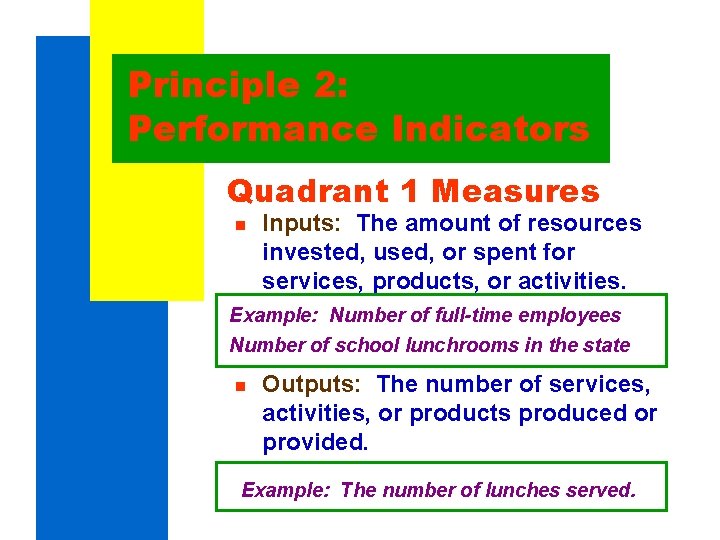
Principle 2: Performance Indicators Quadrant 1 Measures n Inputs: The amount of resources invested, used, or spent for services, products, or activities. Example: Number of full-time employees Number of school lunchrooms in the state n Outputs: The number of services, activities, or products produced or provided. Example: The number of lunches served.
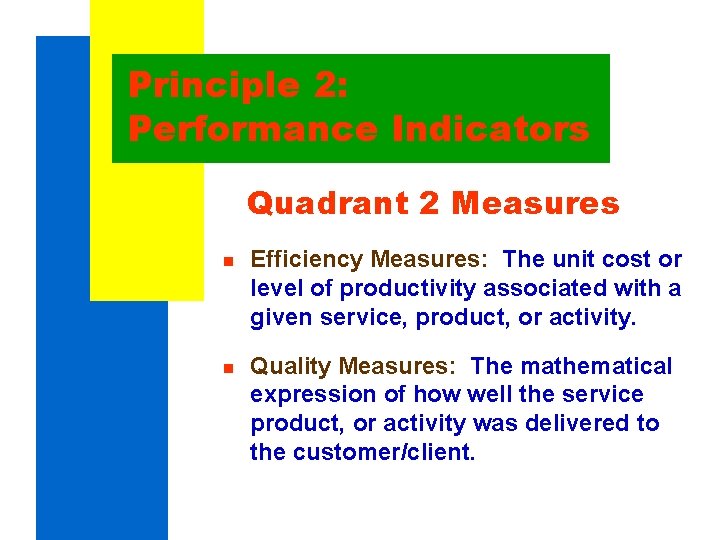
Principle 2: Performance Indicators Quadrant 2 Measures n Efficiency Measures: The unit cost or level of productivity associated with a given service, product, or activity. n Quality Measures: The mathematical expression of how well the service product, or activity was delivered to the customer/client.
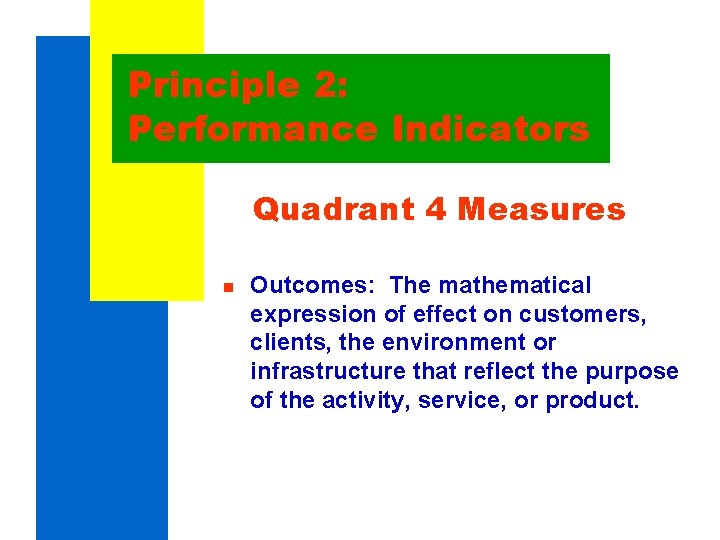
Principle 2: Performance Indicators Quadrant 4 Measures n Outcomes: The mathematical expression of effect on customers, clients, the environment or infrastructure that reflect the purpose of the activity, service, or product.
Quantity Q 1 C. Stud. -teacher ratio W. # at grade in reading Effort N. # students served Quality Q 2 N I R. % at grade in reading CE K. % who graduate on time E. % staff w/ advanced degrees I. # hours of instruction Effect O. # who graduate on time Q 3 Q 4 WO RK
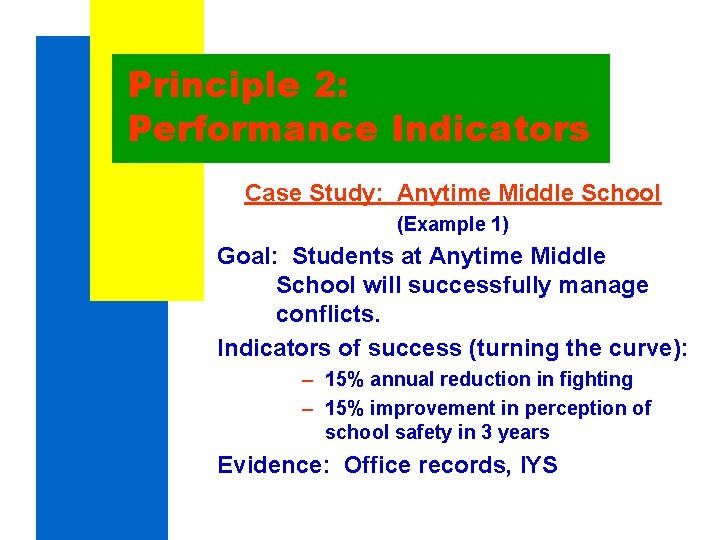
Principle 2: Performance Indicators Case Study: Anytime Middle School (Example 1) Goal: Students at Anytime Middle School will successfully manage conflicts. Indicators of success (turning the curve): – 15% annual reduction in fighting – 15% improvement in perception of school safety in 3 years Evidence: Office records, IYS
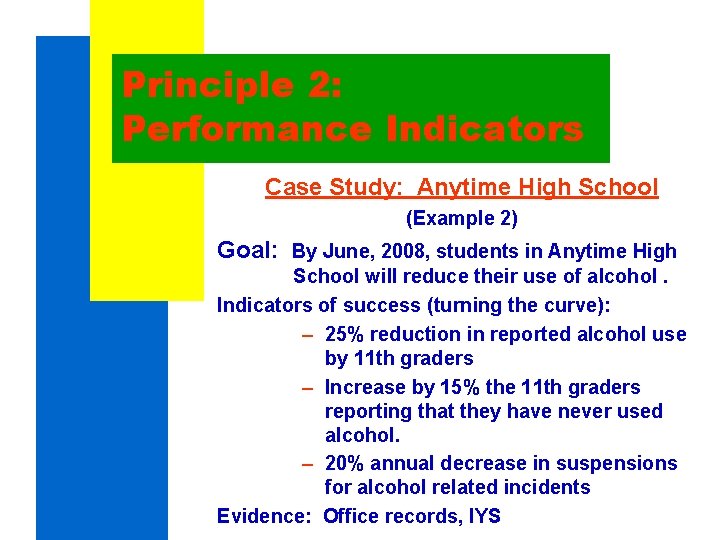
Principle 2: Performance Indicators Case Study: Anytime High School (Example 2) Goal: By June, 2008, students in Anytime High School will reduce their use of alcohol. Indicators of success (turning the curve): – 25% reduction in reported alcohol use by 11 th graders – Increase by 15% the 11 th graders reporting that they have never used alcohol. – 20% annual decrease in suspensions for alcohol related incidents Evidence: Office records, IYS
Principles 1 & 4 Current Situation: • Needs Assessment • Risk & Protective Factors • Resource Assessment Principle 3 Program Selection Implementation and Monitoring Parent & Community Involvement Principle 2 Goal Outcomes (Performance Indicators)
Principle 3: Science Based Programs Practice Profile Pages 61 -62
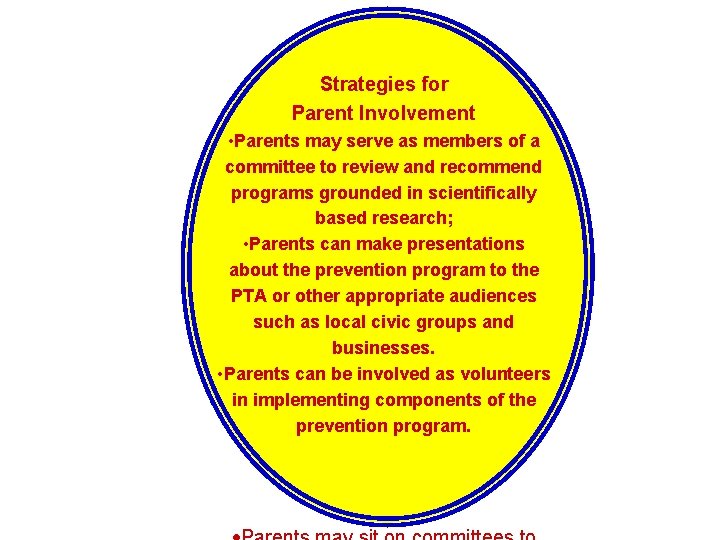
Strategies for Parent Involvement • Parents may serve as members of a committee to review and recommend programs grounded in scientifically based research; • Parents can make presentations about the prevention program to the PTA or other appropriate audiences such as local civic groups and businesses. • Parents can be involved as volunteers in implementing components of the prevention program.
“These changes [to science-based practices] can be difficult to make if current prevention programs are popular with staff, participants, or funding sources. ” - Tom Griffin, 1999
Principles 1 & 4 Current Situation: • Needs Assessment • Risk & Protective Factors • Resource Assessment Principle 3 Program Selection Implementation and Monitoring Parent & Community Involvement Principle 2 Goal Outcomes (Performance Indicators)
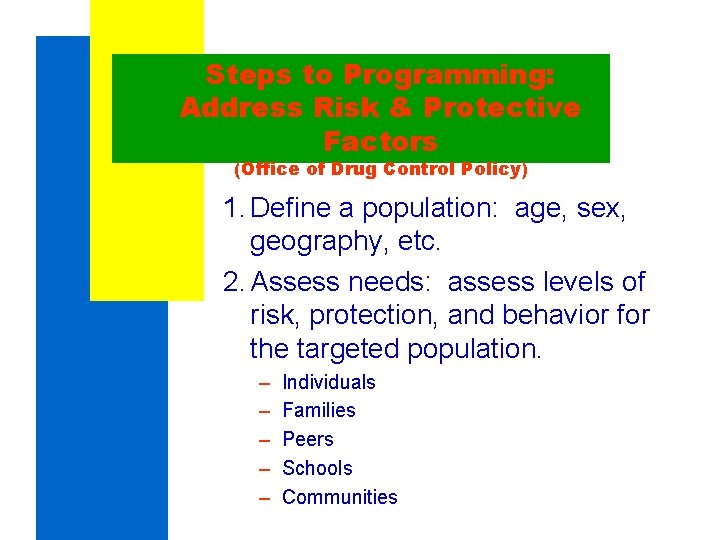
Steps to Programming: Address Risk & Protective Factors (Office of Drug Control Policy) 1. Define a population: age, sex, geography, etc. 2. Assess needs: assess levels of risk, protection, and behavior for the targeted population. – – – Individuals Families Peers Schools Communities
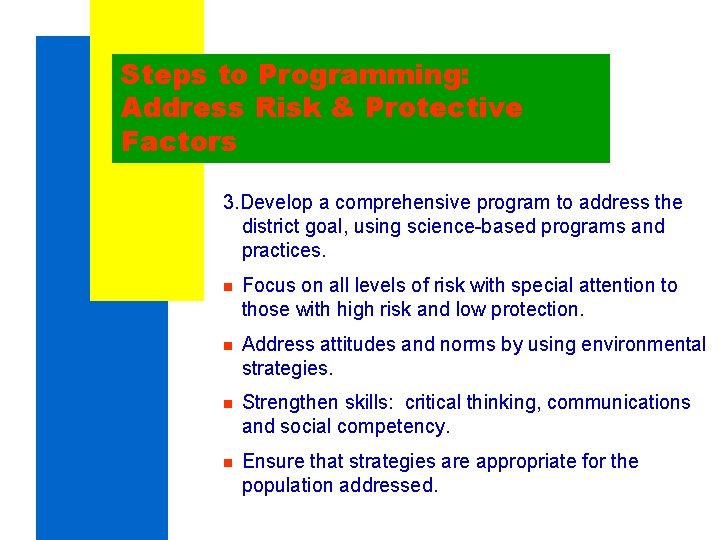
Steps to Programming: Address Risk & Protective Factors 3. Develop a comprehensive program to address the district goal, using science-based programs and practices. n Focus on all levels of risk with special attention to those with high risk and low protection. n Address attitudes and norms by using environmental strategies. n Strengthen skills: critical thinking, communications and social competency. n Ensure that strategies are appropriate for the population addressed.
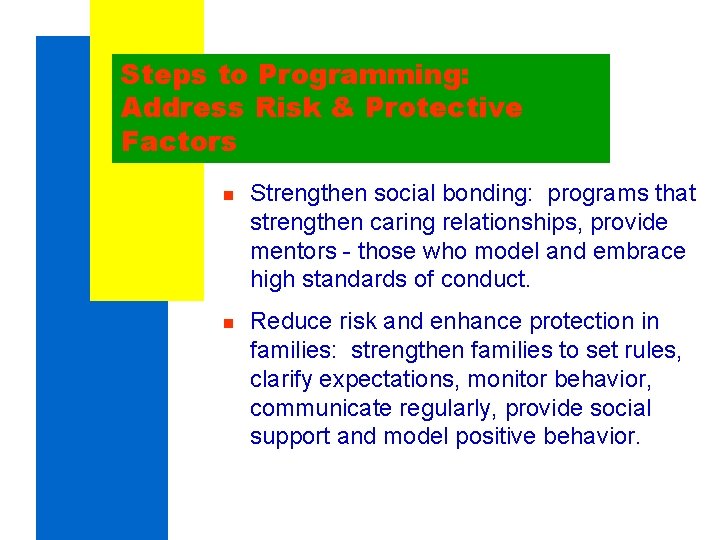
Steps to Programming: Address Risk & Protective Factors n Strengthen social bonding: programs that strengthen caring relationships, provide mentors - those who model and embrace high standards of conduct. n Reduce risk and enhance protection in families: strengthen families to set rules, clarify expectations, monitor behavior, communicate regularly, provide social support and model positive behavior.
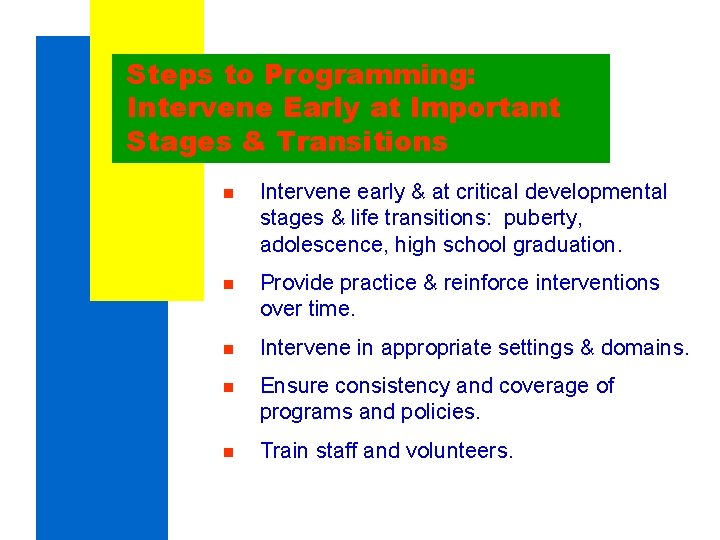
Steps to Programming: Intervene Early at Important Stages & Transitions n Intervene early & at critical developmental stages & life transitions: puberty, adolescence, high school graduation. n Provide practice & reinforce interventions over time. n Intervene in appropriate settings & domains. n Ensure consistency and coverage of programs and policies. n Train staff and volunteers.
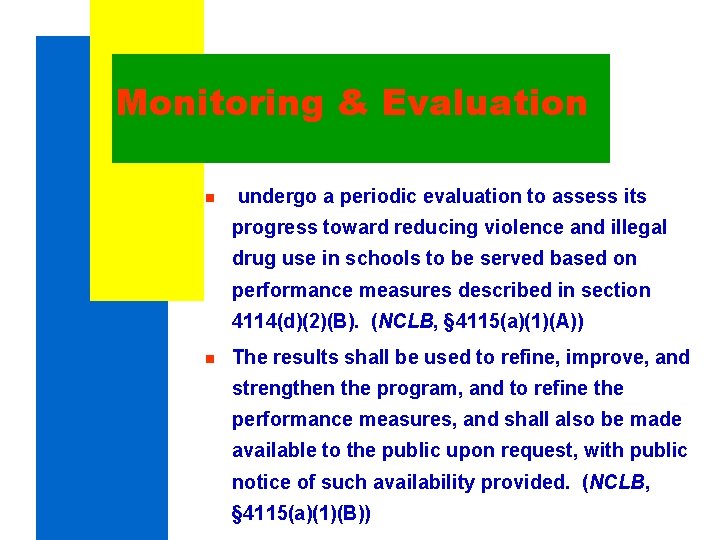
Monitoring & Evaluation n undergo a periodic evaluation to assess its progress toward reducing violence and illegal drug use in schools to be served based on performance measures described in section 4114(d)(2)(B). (NCLB, § 4115(a)(1)(A)) n The results shall be used to refine, improve, and strengthen the program, and to refine the performance measures, and shall also be made available to the public upon request, with public notice of such availability provided. (NCLB, § 4115(a)(1)(B))
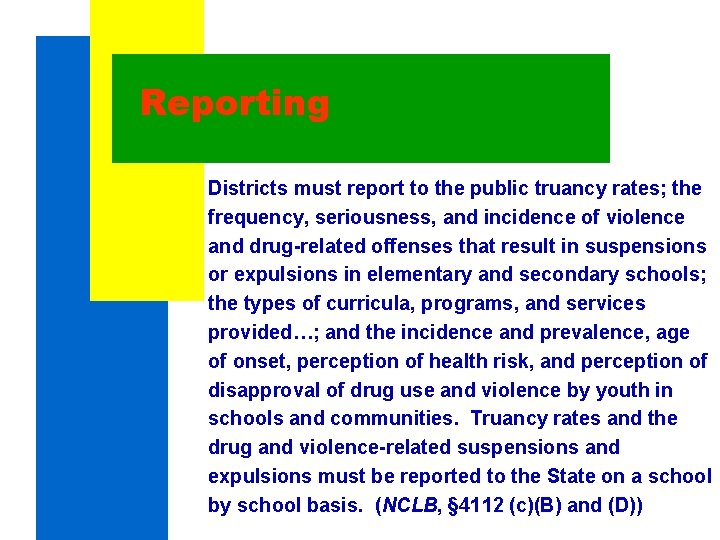
Reporting Districts must report to the public truancy rates; the frequency, seriousness, and incidence of violence and drug-related offenses that result in suspensions or expulsions in elementary and secondary schools; the types of curricula, programs, and services provided…; and the incidence and prevalence, age of onset, perception of health risk, and perception of disapproval of drug use and violence by youth in schools and communities. Truancy rates and the drug and violence-related suspensions and expulsions must be reported to the State on a school by school basis. (NCLB, § 4112 (c)(B) and (D))
Websites n n n SDFSC www. state. ia. us/educate/ecese/ cfcs/sdfsc/index. html Iowa Youth Survey www. state. ia. us/educate/ecese/ cfcs/iys/index. html FACITS