
SAE Programs Introduction to Agriculture What do we
- Slides: 32
SAE Programs Introduction to Agriculture
� What do we call people who start their own business? ? � What are the advantages and disadvantages of being your own boss? ?
Entrepreneurship �Entrepreneur: a person who organizes and manages a business undertaking, assuming the risk for the sake of profit �Any person who starts and operates a business is an entrepreneur �Agricultural students have been entrepreneurs since the beginning of agricultural education �Smith-Hughes Act of 1917
Early Entrepreneurship �Early programs were called different names: � Farming Program � Productive or Production Enterprises � Ownership �Early SAE entrepreneurship programs primarily involved: � Raising livestock � Growing crops
Entrepreneurship Today �Today, agricultural students are involved in many different types of entrepreneurial activities. �Can still be raising livestock and growing crops, but it can be much, much more than that.
Student Entrepreneurship � The student plans, implements, operates, and assumes financial risks in a farming activity or agricultural business. In entrepreneurship programs, the student owns that materials and other required inputs and keeps financial records to determine return to investments. � Examples: � Lawn maintenance service � Raise and sell fish bait � Fishing guide � Pet sitting service � Tractor and farm equipment detailing � Operating a roadside market selling produce � Making and selling Christmas wreathes
Three Aspects of Entrepreneurship The identification/recognition of market opportunity and the generation of a business idea to address the opportunity 2. The collection and commitment of resources in the face of risk to pursue the opportunity 3. The creation of an operating business organization to implement the opportunity (motivated business idea) 1.
Successful Entrepreneurs �According to the Small Business Administration, successful entrepreneurs have 5 characteristics: �Drive �Thinking ability �Aptitude for human relations �Communication skills �Technical ability
Advantages of Entrepreneurship �You are your own boss �Enjoy the profits from your efforts �Sense of pride in your business �Flexibility in your work schedule
Disadvantages of Entrepreneurship �Will need to put in long hours �Need money to start �Have to keep up with government rules and regulations �May have to make hard decisions �May lose money
FFA Agri-Entrepreneurship Program �Each state recognizes the agricultural student who has the best entrepreneurship program �There is a cash reward of $100 at the state level �All entries at the state level go on for national competition �At the national level, 10 outstanding entrepreneurship students are recognized �There is a cash reward of $1000 for each national winner �The FFA chapter of the national award winner each receive $500
�What is an internship? ? �What are the benefits of having an internship as part of your SAE program? ? �Are there any legal restrictions regarding internships? ?
What is an Internship? �Internship: programs that involve the employment of students on farms, ranches, agricultural businesses, school laboratories, or community facilities to provide a “learning by doing” environment �Done outside of normal classroom hours �May be paid or non-paid employment
Why do an Internship? �One of the best ways to learn something is to perform the task in a real world situation �Nothing beats the real thing �Earn money �Can lead to a real job in the future �Establishes a network of contacts �May be recognized in the FFA Proficiency Award Program
Internship Factors to Consider �Thinking, planning and effort is involved in a successful internship �Since an internship is a three-way partnership between the student, the school, and a business certain guidelines need to be followed
Internship Guidelines 1. 2. 3. 4. 5. 6. Should be agriculturally related Should be supervision and instruction on the job by the employer Students should have some previous knowledge Fill out job application form The person providing the internship should have the opportunity to interview 2 or more students and select the individual they want Written training agreement
What is a Training Agreement? �Written statement documenting the: �Hours �Pay �Student responsibilities �Teacher responsibilities �Employer responsibilities Regarding the placement of a student.
Internship Guidelines Con’t �Written training plan with copies �Should be involved in a variety of activities �Teacher will supervise at times �Employer will have a say in the evaluation of student �Student will maintain current, accurate records on the experience
What is a Training Plan? �A written document specifying: �Skills and tasks the student will learn to preform on the job �Who will teach skill or task �Safety instructions �Level of mastery and date accomplished �All parties involved sign the plan
Legal Considerations �Federal and state labor laws regulate employment of youth (restrictions on tasks and hours you can work) �Employment certificate �Work hours � Ages 14 & 15 can start work at 7 am and must stop at 7 pm � Ages 16 & 17 can start work at 5 am and must stop at 11 pm � Youth 14 & 15 can work until 9 pm in the summer when school is not in session
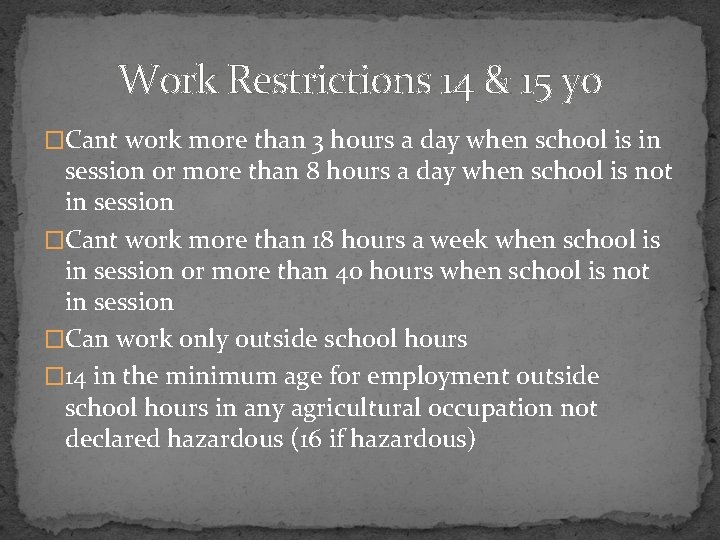
Work Restrictions 14 & 15 yo �Cant work more than 3 hours a day when school is in session or more than 8 hours a day when school is not in session �Cant work more than 18 hours a week when school is in session or more than 40 hours when school is not in session �Can work only outside school hours � 14 in the minimum age for employment outside school hours in any agricultural occupation not declared hazardous (16 if hazardous)
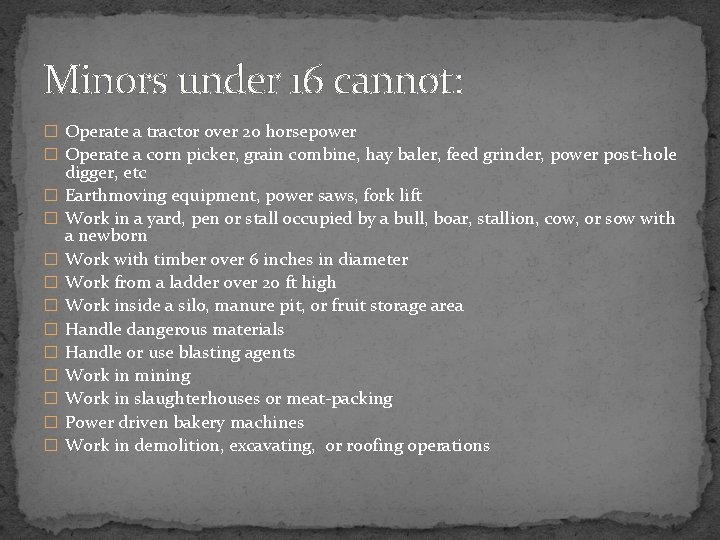
Minors under 16 cannot: � Operate a tractor over 20 horsepower � Operate a corn picker, grain combine, hay baler, feed grinder, power post-hole � � � digger, etc Earthmoving equipment, power saws, fork lift Work in a yard, pen or stall occupied by a bull, boar, stallion, cow, or sow with a newborn Work with timber over 6 inches in diameter Work from a ladder over 20 ft high Work inside a silo, manure pit, or fruit storage area Handle dangerous materials Handle or use blasting agents Work in mining Work in slaughterhouses or meat-packing Power driven bakery machines Work in demolition, excavating, or roofing operations
� How does one conduct a research based SAE program?
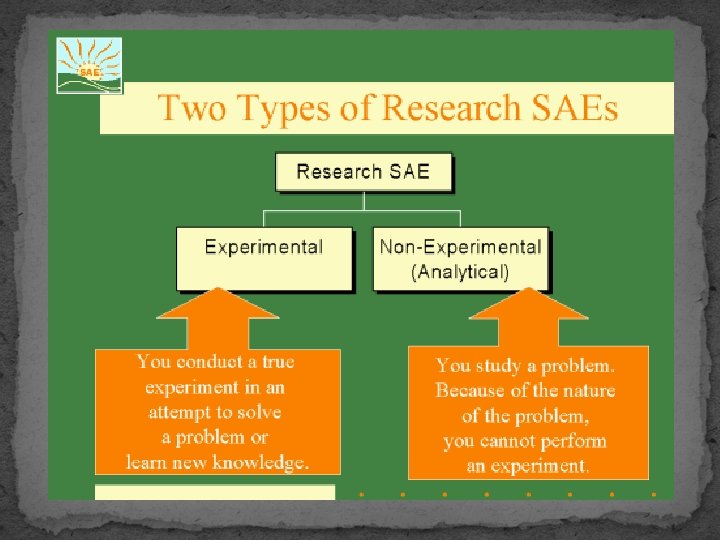
Experimental SAEs �An extensive activity where the student plans and conducts a major agricultural experiment using the scientific process. The purpose of the experiment is to provide “hands-on” experience in: � Verifying, learning, or demonstrating scientific principles � Discovering new knowledge � Using the scientific process
Experimental SAE Characteristics �There is a control group �There is one or more experimental groups �Randomization is used �Randomly pick control group and which would receive the experimental treatment
Steps in Conducting an Experiment 1. 2. 3. 4. 5. 6. 7. 8. Identify the problem to be investigated Conduct a thorough review of the literature Design the experiment Formulate a hypothesis Conduct the experiment Collect data Analyze the date and arrive at conclusions Prepare the final report
Examples of Experimental SAEs �Comparing the effect of various planting media on plant growth �Determining the impact of different levels of protein on fish growth �Comparing rooting hormones on root development �Analyzing the effectiveness of different display methods on plant sales in a garden center �Determining the strength of welds using different welding methods
Experimental SAE A quality experimental SAE should: �Have specific objectives �Follow the scientific process �Involve a number of steps �Focus on an important issue, question, or principle �Be of sufficient size and scope to assure a quality learning experience �Require a moderate to substantial time commitment on the part of the student �Be supervised
Non-Experimental SAE Programs �Sometimes it is not possible to conduct a true experiment with a control group. Yet, the problem still needs to be addressed. Research can still be done. �The student gathers and evaluates data from a variety of sources and then produces some type of finished product. �The approach taken may be that of: � An investigative reporter � A detective � And archeologist � A documentary producer
Non-Experimental SAE Examples � Developing a marketing plan for an agricultural commodity � Writing a series of newspaper articles � Preparing a land use plan for a farm � Designing a landscape plan for a community facility � Developing an advertising campaign for an agribusiness � Identifying the sources of pollution in a watershed � Researching resistance of organic fruits to common diseases � Examine techniques for controlling molds on bakery products
Non-Experimental SAE �A non-experimental SAE has all the steps of an experimental SAE except there is no control group �One will still: � Identify a problem � Review the literature � Develop a plan � Conduct the activity � Analyze the data � Prepare a final report