
SAE INTERNATIONAL SAE CV 2 X TECHNICAL COMMITTEE


- Slides: 8
SAE INTERNATIONAL SAE C-V 2 X TECHNICAL COMMITTEE CITS meeting, 9 March 2018, Geneva (Doc. 5) Jim Misener SAE C-V 2 X Technical Committee Chair Qualcomm
SAE C-V 2 X Technical Committee Motivation and Scope per LS submitted to ITU-T and ITU-R (SAE 103208 -1) • Motivation: Most V 2 X standards are not neutral with communication protocol, nor do they recognize the unique properties of C-V 2 X and impending 5 G technologies. • Scope: Adapting and developing standards, recommended practices and information reports that use cellular radio access technologies and specifically, evolving 4 G LTE and 5 G cellular technologies that require interoperability and performance standards for road vehicles and other road users in order to use the full capabilities of these technologies. SAE INTERNATIONAL V 2 I Direct communications for Active Safety V 2 V V 2 P Network communications for Informational Safety V 2 N
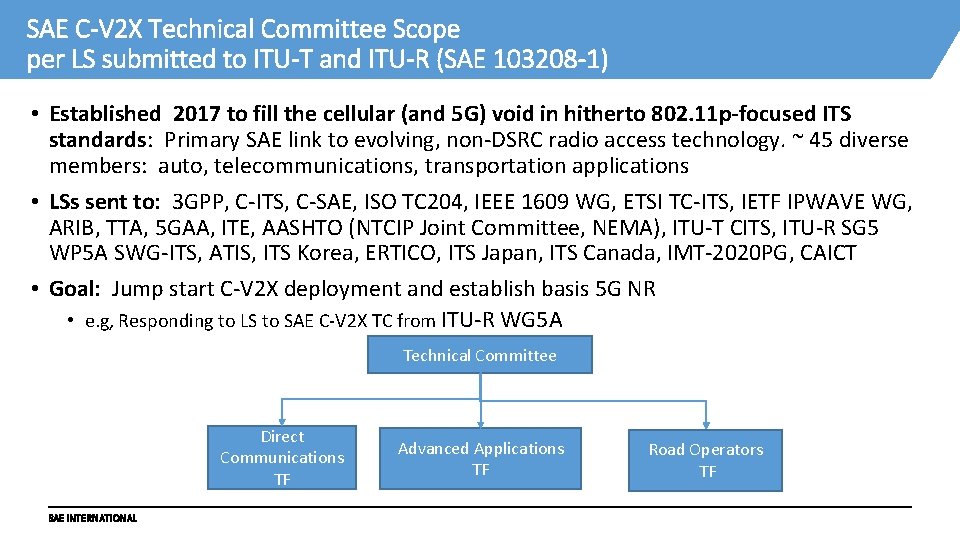
SAE C-V 2 X Technical Committee Scope per LS submitted to ITU-T and ITU-R (SAE 103208 -1) • Established 2017 to fill the cellular (and 5 G) void in hitherto 802. 11 p-focused ITS standards: Primary SAE link to evolving, non-DSRC radio access technology. ~ 45 diverse members: auto, telecommunications, transportation applications • LSs sent to: 3 GPP, C-ITS, C-SAE, ISO TC 204, IEEE 1609 WG, ETSI TC-ITS, IETF IPWAVE WG, ARIB, TTA, 5 GAA, ITE, AASHTO (NTCIP Joint Committee, NEMA), ITU-T CITS, ITU-R SG 5 WP 5 A SWG-ITS, ATIS, ITS Korea, ERTICO, ITS Japan, ITS Canada, IMT-2020 PG, CAICT • Goal: Jump start C-V 2 X deployment and establish basis 5 G NR • e. g, Responding to LS to SAE C-V 2 X TC from ITU-R WG 5 A Technical Committee Direct Communications TF SAE INTERNATIONAL Advanced Applications TF Road Operators TF
Direct Communications Task Force • Develop definitions of terms, use cases, recommended practices guidelines, test methods, specifications and performance standards for vehicles connected using C-V 2 X, focusing on safety applications that include cooperative awareness, warning notification, safe lane change, safe intersection and roundabout crossing, etc. • Current Effort: Developing SAE J 3161 On-Board System Requirements for LTE V 2 X V 2 V Safety Communications SAE INTERNATIONAL
SAE J 3161: On-Board System Requirements for LTE V 2 X V 2 V Safety Communications • Provides 3 GPP-based alternative to SAE J 2945/1 • SAE J 2945/1 pointed to in NHTSA V 2 V NPRM • Scope: This standard specifies the system requirements for an on-board vehicle-to-vehicle (V 2 V) safety communications system for light vehicles , including standards profiles, functional requirements, and performance requirements. The system is capable of transmitting and receiving the SAE J 2735 -defined Basic Safety Message (BSM) [1] over a PC 5 V 2 X wireless communications link as defined in 3 GPP Release 14. The system uses Institute of Electrical and Electronics Engineers (IEEE) 1609 standards for network and transport layer communications, and for security. SAE INTERNATIONAL
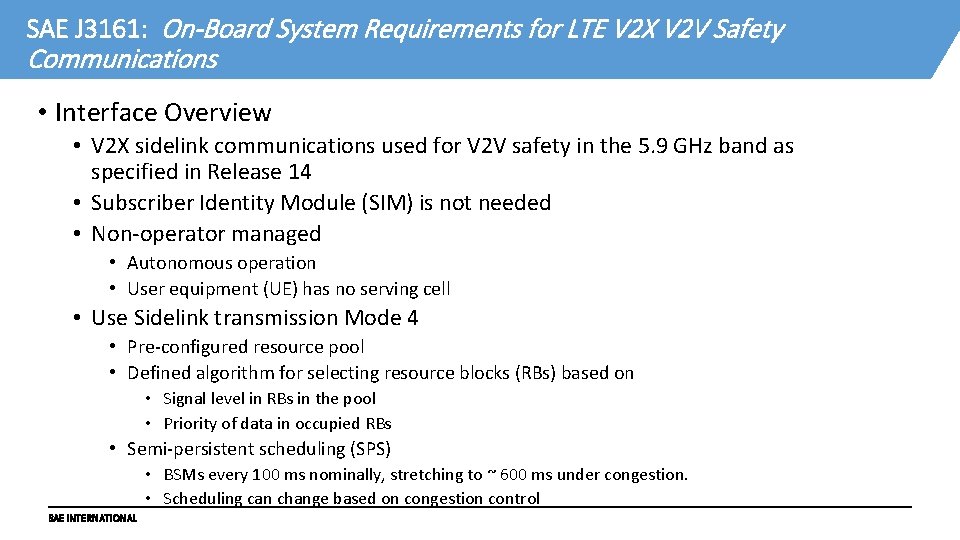
SAE J 3161: On-Board System Requirements for LTE V 2 X V 2 V Safety Communications • Interface Overview • V 2 X sidelink communications used for V 2 V safety in the 5. 9 GHz band as specified in Release 14 • Subscriber Identity Module (SIM) is not needed • Non-operator managed • Autonomous operation • User equipment (UE) has no serving cell • Use Sidelink transmission Mode 4 • Pre-configured resource pool • Defined algorithm for selecting resource blocks (RBs) based on • Signal level in RBs in the pool • Priority of data in occupied RBs • Semi-persistent scheduling (SPS) • BSMs every 100 ms nominally, stretching to ~ 600 ms under congestion. • Scheduling can change based on congestion control SAE INTERNATIONAL
Advanced Applications Task Force • Focuses on advanced V 2 X applications (i. e. , applications that cannot be supported by DSRC and Rel-14 LTE-V 2 X) that deal with 5 G (3 GPP NR and LTE evolution) to leverage enhanced mobile broadband, use of millimeter wave and other anticipated radio access technologies, and the next generation core network including enablers such as NFV/SDN, edge computing, and network slicing. Segue into advanced KPIs needed for Cooperative, Connected and Automated Mobility (CCAM) • Current Effort: Developing KPIs for automotive use cases pertinent to 5 G NR (Rel-16) • Targeting LS to RAN ~ June 2018 SAE INTERNATIONAL
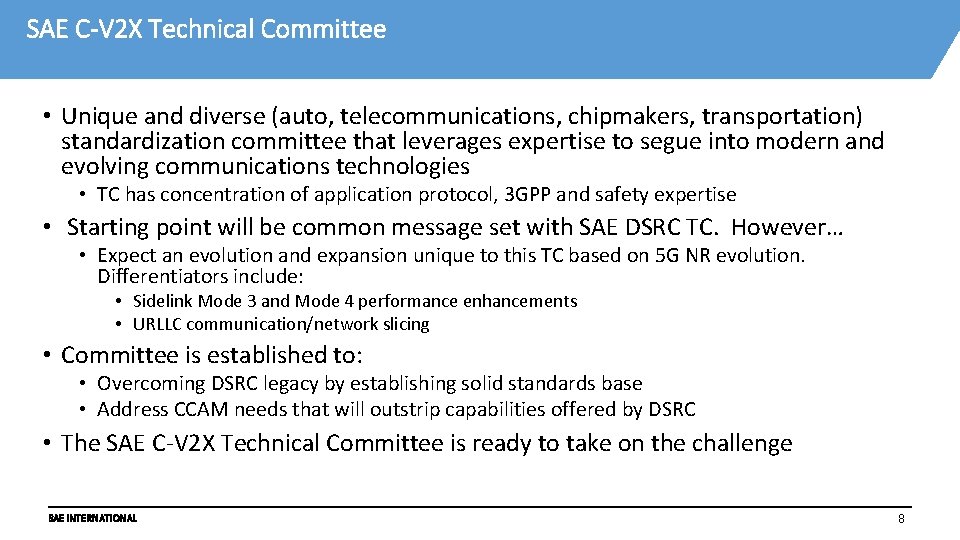
SAE C-V 2 X Technical Committee • Unique and diverse (auto, telecommunications, chipmakers, transportation) standardization committee that leverages expertise to segue into modern and evolving communications technologies • TC has concentration of application protocol, 3 GPP and safety expertise • Starting point will be common message set with SAE DSRC TC. However… • Expect an evolution and expansion unique to this TC based on 5 G NR evolution. Differentiators include: • Sidelink Mode 3 and Mode 4 performance enhancements • URLLC communication/network slicing • Committee is established to: • Overcoming DSRC legacy by establishing solid standards base • Address CCAM needs that will outstrip capabilities offered by DSRC • The SAE C-V 2 X Technical Committee is ready to take on the challenge SAE INTERNATIONAL 8