
SAE INTERNATIONAL FORMULA SAE ELECTRIC How to complete
- Slides: 8
SAE INTERNATIONAL FORMULA SAE ELECTRIC How to complete the Electrical Systems Form
Overview Electrical System Form is a design document for the tractive system of the vehicle. Purpose • Provide feedback to teams early in the design process when it is easier to fix the problem. • Enforce a design process for the tractive system. THE ESF is NOT… o A collection of all data sheets you can find for your parts o A complete collection of theoretical electrical engineering Reviewers are Engineers with significant experience in HV electrical systems for vehicles. SAE INTERNATIONAL
Format of the document • First Section • Provides a high level overview of the tractive system • Provide a simplified schematic of the TS to give the reviewer a reference of the architecture of your TS. • Subsequent Sections Go into detail for each component/subsystem in the vehicle. Description – Give an overview of the system, describe theory of operation. Wiring, cables, current calculations, connectors – Show important calculations about the circuit, include a detailed schematic of the circuit and detailed information about key components – Wire, fuses, connectors, relays, … Positions in car – Include a picture of the component in the car or CAD model showing its location. Be sure that the picture is a wide enough view to understand where in the car the component is located. • • SAE INTERNATIONAL
Keys to a Successful ESF • Start Early • Putting together 75 pages of documentation is not quick. • Learn to use Microsoft Word • Keep with next • References • Get support from both electrical and mechanical team members • CAD Tools • Provide CAD model images of components in car. • Provide readable accurate schematics The reviewer will be considering your design with respect to the rules for the competition. To the extent that your initial submission talks to all the required rules the faster the review process. SAE INTERNATIONAL
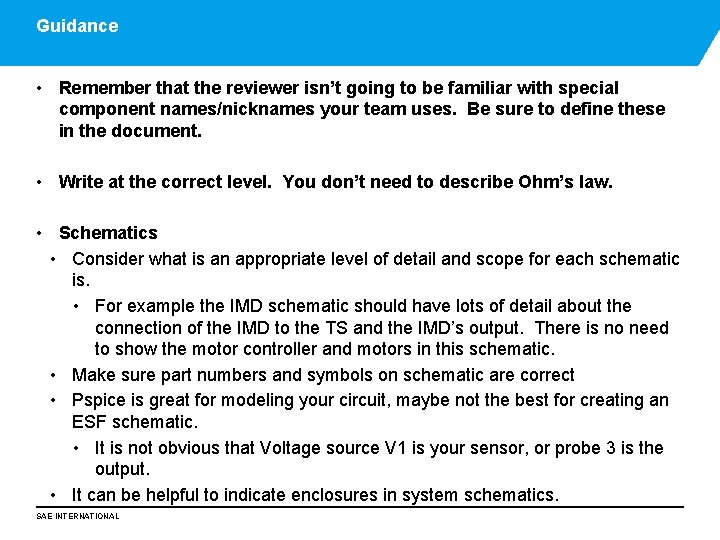
Guidance • Remember that the reviewer isn’t going to be familiar with special component names/nicknames your team uses. Be sure to define these in the document. • Write at the correct level. You don’t need to describe Ohm’s law. • Schematics • Consider what is an appropriate level of detail and scope for each schematic is. • For example the IMD schematic should have lots of detail about the connection of the IMD to the TS and the IMD’s output. There is no need to show the motor controller and motors in this schematic. • Make sure part numbers and symbols on schematic are correct • Pspice is great for modeling your circuit, maybe not the best for creating an ESF schematic. • It is not obvious that Voltage source V 1 is your sensor, or probe 3 is the output. • It can be helpful to indicate enclosures in system schematics. SAE INTERNATIONAL
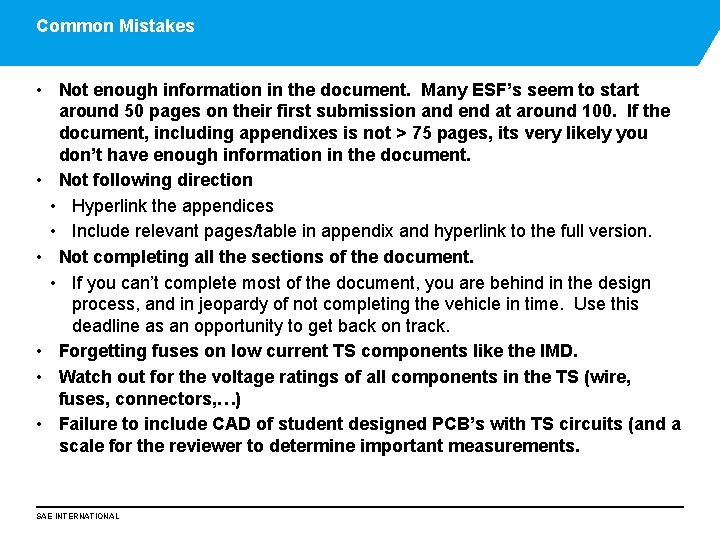
Common Mistakes • Not enough information in the document. Many ESF’s seem to start around 50 pages on their first submission and end at around 100. If the document, including appendixes is not > 75 pages, its very likely you don’t have enough information in the document. • Not following direction • Hyperlink the appendices • Include relevant pages/table in appendix and hyperlink to the full version. • Not completing all the sections of the document. • If you can’t complete most of the document, you are behind in the design process, and in jeopardy of not completing the vehicle in time. Use this deadline as an opportunity to get back on track. • Forgetting fuses on low current TS components like the IMD. • Watch out for the voltage ratings of all components in the TS (wire, fuses, connectors, …) • Failure to include CAD of student designed PCB’s with TS circuits (and a scale for the reviewer to determine important measurements. SAE INTERNATIONAL
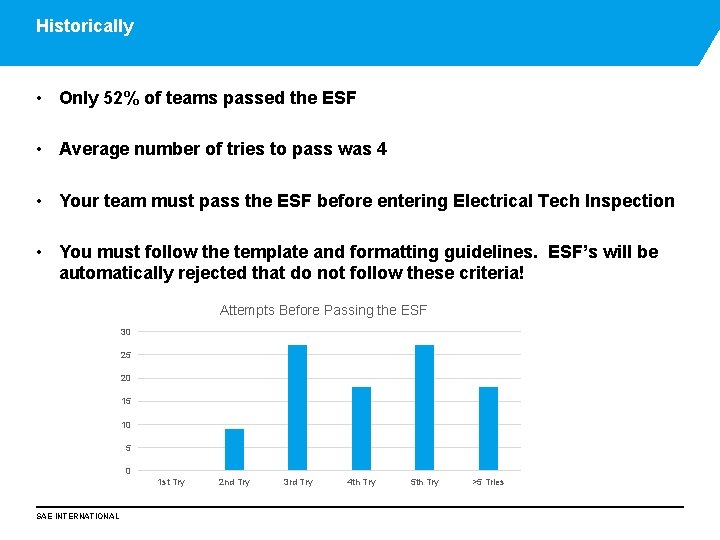
Historically • Only 52% of teams passed the ESF • Average number of tries to pass was 4 • Your team must pass the ESF before entering Electrical Tech Inspection • You must follow the template and formatting guidelines. ESF’s will be automatically rejected that do not follow these criteria! Attempts Before Passing the ESF 30 25 20 15 10 5 0 1 st Try SAE INTERNATIONAL 2 nd Try 3 rd Try 4 th Try 5 th Try >5 Tries
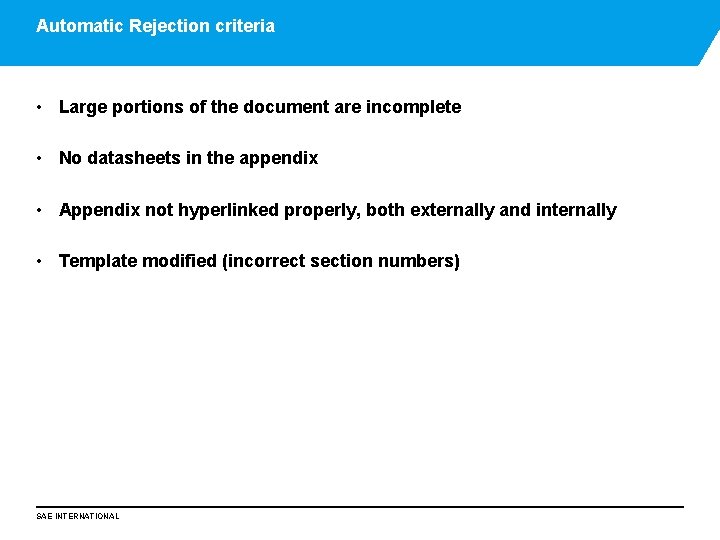
Automatic Rejection criteria • Large portions of the document are incomplete • No datasheets in the appendix • Appendix not hyperlinked properly, both externally and internally • Template modified (incorrect section numbers) SAE INTERNATIONAL