
SAE BATTERY SAFETY STANDARDS COMMITTEE UPDATE JANUARY 23

SAE BATTERY SAFETY STANDARDS COMMITTEE UPDATE JANUARY 23, 2019 Galen Ressler, GM Technical Fellow Committee Chair
Battery Safety Standards Committee Overview SAE Under SAE Vehicle Battery Standards Steering Committee Purpose: Create and maintain battery safety standards and test procedures for use in the assessment, development and qualification of battery cells, modules, packs and systems. Responsible for: • J 2464 - Electric and Hybrid Electric Vehicle Rechargeable Energy Storage System (RESS) Safety and Abuse Testing (Recommended Practice) • J 2929 - Safety Standard for Electric and Hybrid Vehicle Propulsion Battery Systems Utilizing Lithium-based Rechargeable Cells (Standard) SAE INTERNATIONAL 2
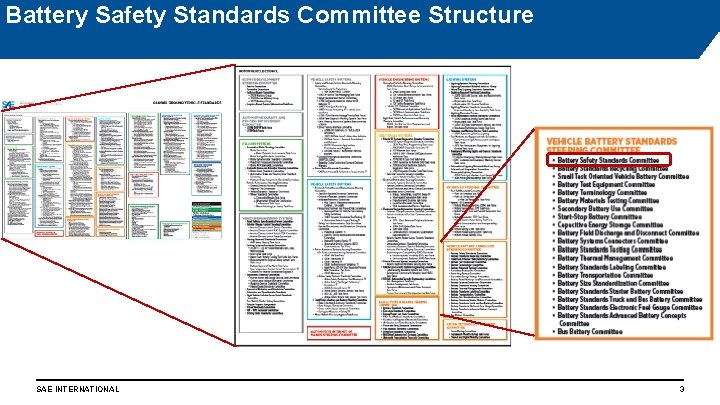
Battery Safety Standards Committee Structure SAE INTERNATIONAL 3
SAE Battery Standards Safety Committee Membership Currently have 24 voting members • 7 “users” – representing vehicle manufacturers • 7 “producers” – representing battery and component manufacturers • 10 “general interest” – testing facilities, consultants, etc. Additional 87 mailing list and liaison members SAE INTERNATIONAL 4
Comparison: J 2464 vs J 2929 J 2464: This SAE Recommended Practice is intended as a guide toward standard practice and is subject to change to keep pace with experience and technical advances. It describes a body of tests which may be used as needed for abuse testing of electric or hybrid electric vehicle batteries to determine the response of such batteries to conditions or events which are beyond their normal operating range. J 2929: This SAE Standard defines a minimum set of acceptable safety criteria for a lithium-based rechargeable battery system to be considered for use in a vehicle propulsion application as an energy storage system connected to a high voltage power train. While the objective is a safe battery system when installed into a vehicle application, this Standard is primarily focused, wherever possible, on conditions which can be evaluated utilizing the battery system alone. As this is a minimum set of criteria, it is recognized that battery system and vehicle manufacturers may have additional requirements for cells, modules, packs and systems in order to assure a safe battery system for a given application. SAE INTERNATIONAL 5

J 2464 Revision Status J 2464 originally published in 1999. This recommended practice describes Characterization Tests (NOT pass/fail tests). 1 st Revision published in Nov. 2009 (current release) 2 nd Revision started in April 2015 (expected release in 2019) Work group chaired by Daniel H. Doughty with participation from 30 -40 members (10 -15 very active) Reviewed every section, every page. Evaluated and compared to other standards on battery safety and sought to harmonize with existing published standards. SAE INTERNATIONAL 6
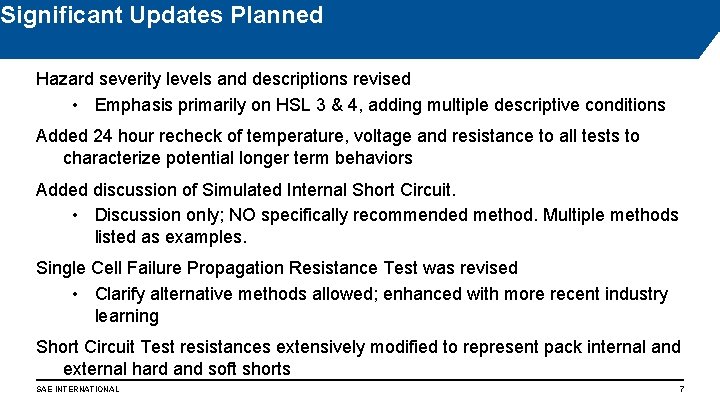
Significant Updates Planned Hazard severity levels and descriptions revised • Emphasis primarily on HSL 3 & 4, adding multiple descriptive conditions Added 24 hour recheck of temperature, voltage and resistance to all tests to characterize potential longer term behaviors Added discussion of Simulated Internal Short Circuit. • Discussion only; NO specifically recommended method. Multiple methods listed as examples. Single Cell Failure Propagation Resistance Test was revised • Clarify alternative methods allowed; enhanced with more recent industry learning Short Circuit Test resistances extensively modified to represent pack internal and external hard and soft shorts SAE INTERNATIONAL 7
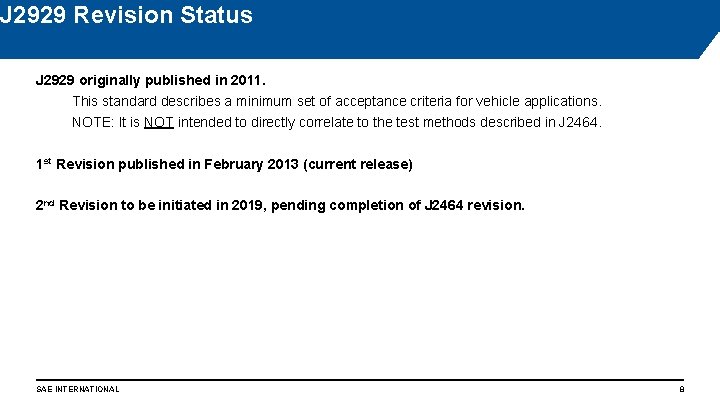
J 2929 Revision Status J 2929 originally published in 2011. This standard describes a minimum set of acceptance criteria for vehicle applications. NOTE: It is NOT intended to directly correlate to the test methods described in J 2464. 1 st Revision published in February 2013 (current release) 2 nd Revision to be initiated in 2019, pending completion of J 2464 revision. SAE INTERNATIONAL 8

THANK YOU! SAE INTERNATIONAL 9
- Slides: 9