
SAE Aerospace Regular Class High Lift Capacity Aircraft
- Slides: 1
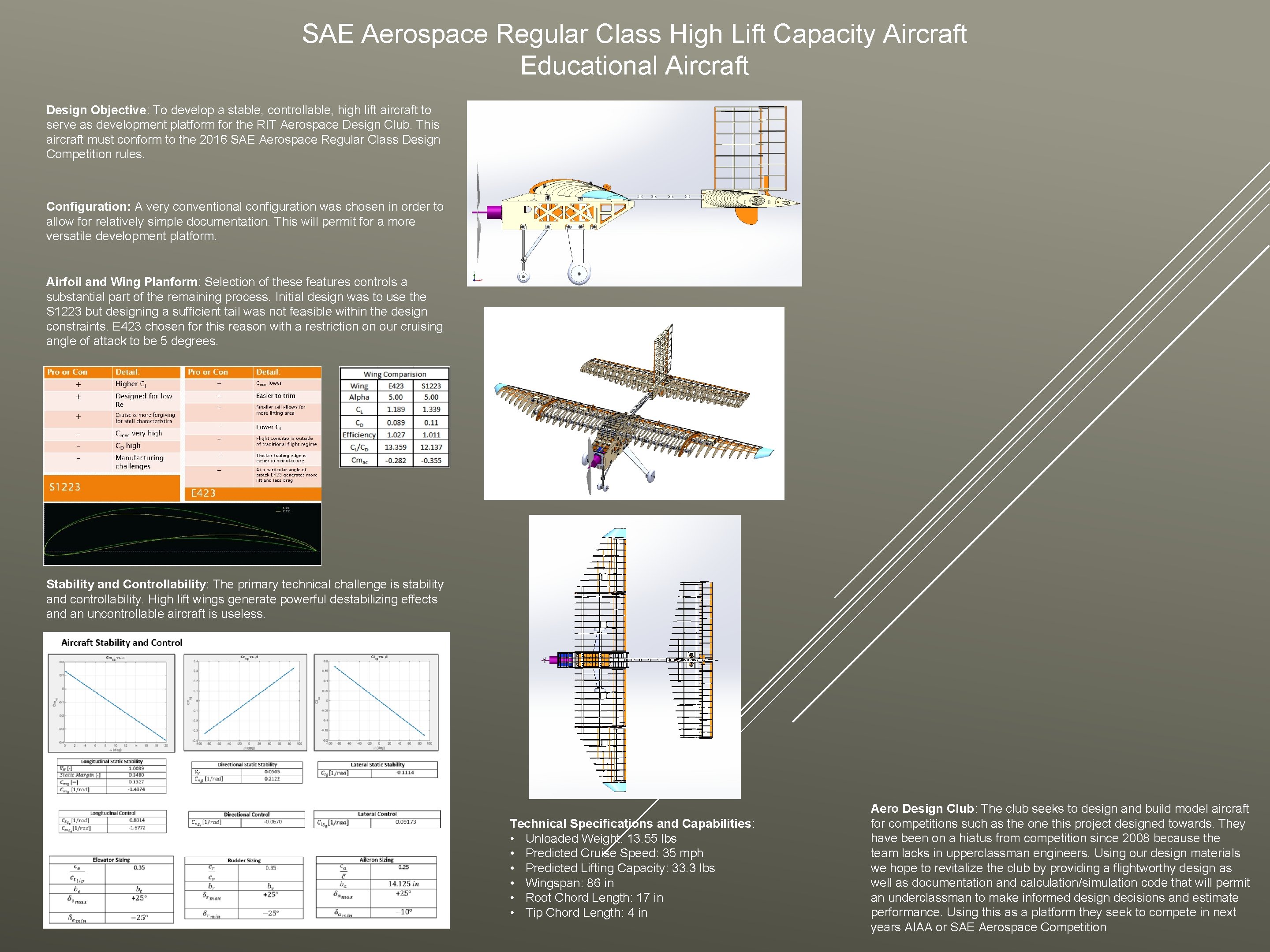
SAE Aerospace Regular Class High Lift Capacity Aircraft Educational Aircraft Design Objective: To develop a stable, controllable, high lift aircraft to serve as development platform for the RIT Aerospace Design Club. This aircraft must conform to the 2016 SAE Aerospace Regular Class Design Competition rules. Configuration: A very conventional configuration was chosen in order to allow for relatively simple documentation. This will permit for a more versatile development platform. Airfoil and Wing Planform: Selection of these features controls a substantial part of the remaining process. Initial design was to use the S 1223 but designing a sufficient tail was not feasible within the design constraints. E 423 chosen for this reason with a restriction on our cruising angle of attack to be 5 degrees. Stability and Controllability: The primary technical challenge is stability and controllability. High lift wings generate powerful destabilizing effects and an uncontrollable aircraft is useless. Technical Specifications and Capabilities: • Unloaded Weight: 13. 55 lbs • Predicted Cruise Speed: 35 mph • Predicted Lifting Capacity: 33. 3 lbs • Wingspan: 86 in • Root Chord Length: 17 in • Tip Chord Length: 4 in Aero Design Club: The club seeks to design and build model aircraft for competitions such as the one this project designed towards. They have been on a hiatus from competition since 2008 because the team lacks in upperclassman engineers. Using our design materials we hope to revitalize the club by providing a flightworthy design as well as documentation and calculation/simulation code that will permit an underclassman to make informed design decisions and estimate performance. Using this as a platform they seek to compete in next years AIAA or SAE Aerospace Competition