
Sacramento Soil Moisture Accounting Model SACSMA Tanya Hoogerwerf
- Slides: 13
Sacramento Soil Moisture Accounting Model (SAC-SMA) Tanya Hoogerwerf
Overview Spatially-lumped continuous soil moisture continuous accounting model Ideal model for the simulation of large-scale (>1000 km 2) basins Takes mean precipitation, evaporation and precipitation temperature as input
Input Calibrate by adjusting baseflow, tension Calibrate water capacities and runoff simulation parameters Point or areal estimates of historical precipitation, temperature, and potential evaporation
Input (2) Topography Soil characteristics Location of important features such as reservoirs and river junctions
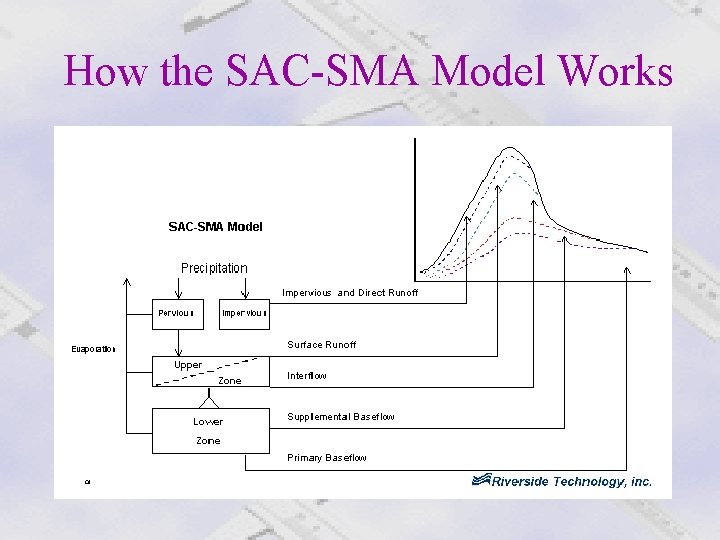
How the SAC-SMA Model Works
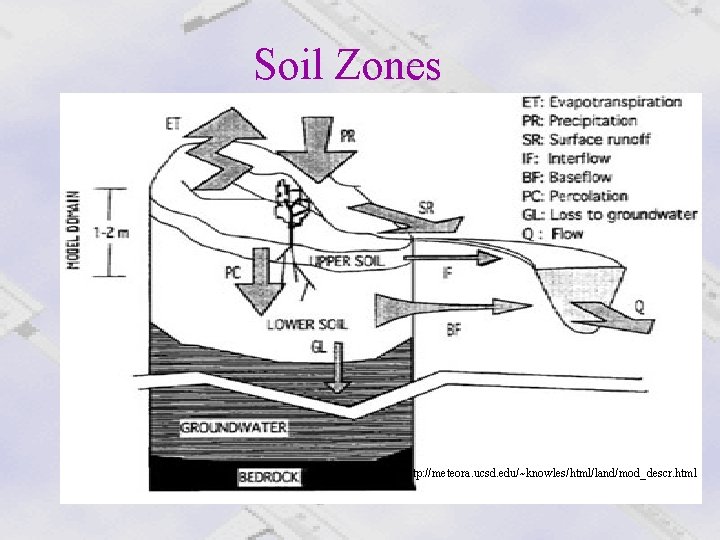
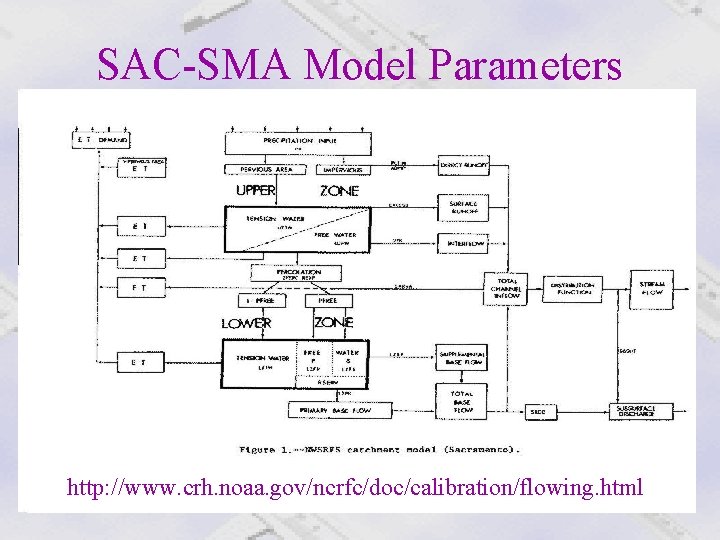
How the SAC-SMA Model Works (2) Each basin is represented vertically by two zones: An upper zone (short- term storage capacity) A lower zone (bulk of the soil moisture and longer groundwater storage)
Soil Zones http: //meteora. ucsd. edu/~knowles/html/land/mod_descr. html
How the SAC-SMA Model Works (3) Each layer models … Tension water elements (water bound by adhesion and cohesion, extracted only by evapotranspiration) Free water elements (free to move under gravitational forces, may be depleted by evapotranspiration, percolation, horizontal flow)
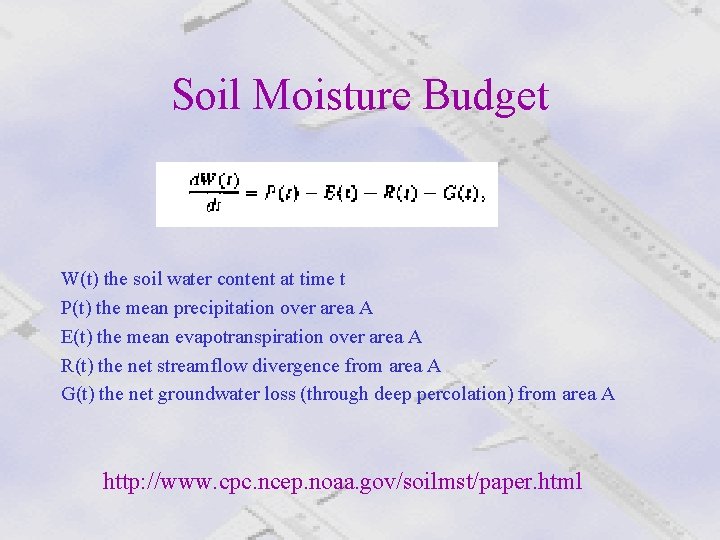
Soil Moisture Budget W(t) the soil water content at time t P(t) the mean precipitation over area A E(t) the mean evapotranspiration over area A R(t) the net streamflow divergence from area A G(t) the net groundwater loss (through deep percolation) from area A http: //www. cpc. ncep. noaa. gov/soilmst/paper. html
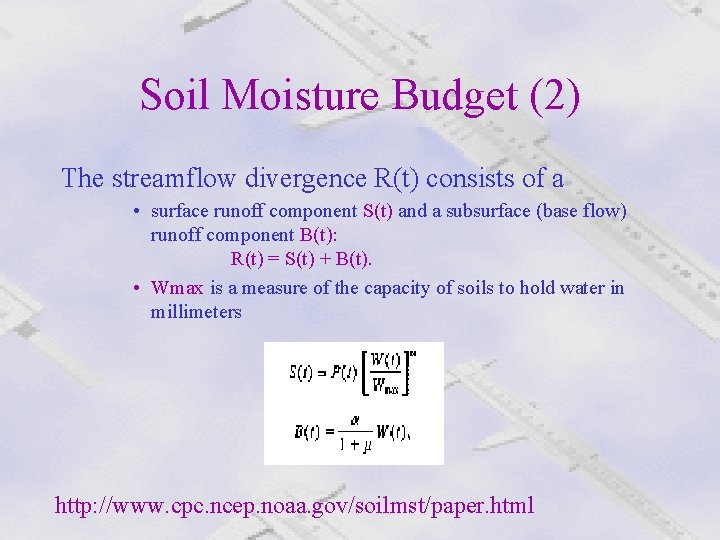
Soil Moisture Budget (2) The streamflow divergence R(t) consists of a • surface runoff component S(t) and a subsurface (base flow) runoff component B(t): R(t) = S(t) + B(t). • Wmax is a measure of the capacity of soils to hold water in millimeters http: //www. cpc. ncep. noaa. gov/soilmst/paper. html
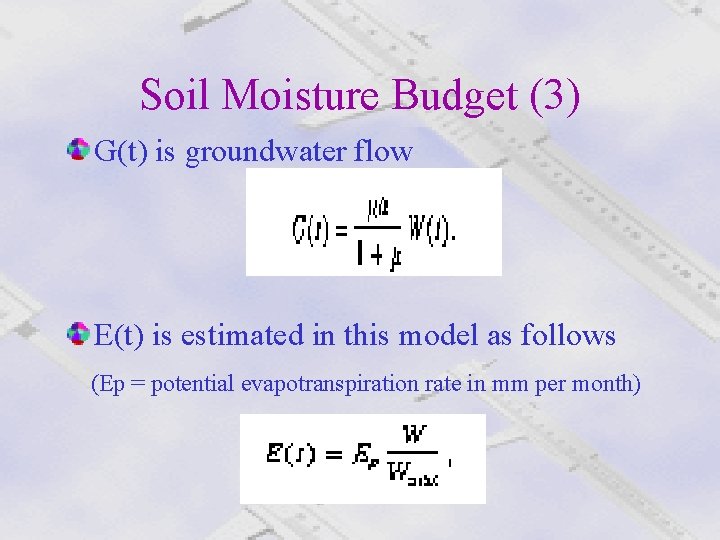
Soil Moisture Budget (3) G(t) is groundwater flow E(t) is estimated in this model as follows (Ep = potential evapotranspiration rate in mm per month)
Soil Moisture Budget (4) Ep (potential evaporation): Depends mainly on the net radiative heating on the surface Can be estimated from pan evaporation Thornthwaite's method (1948)…based on observed air temperature and duration of sunlight
SAC-SMA Model Parameters http: //www. crh. noaa. gov/ncrfc/doc/calibration/flowing. html