
Sabre Senior Design Project HUNTER ROSS RAMON TRESPALACIOS

Sabre Senior Design Project HUNTER ROSS, RAMON TRESPALACIOS, MARY LIZ TUTTLE M a y 1 s t , 2 0
The Problem ▪ Sabre Airline Solutions would like to provide traveler segmentation services for their customer reservation system to support various marketing programs.
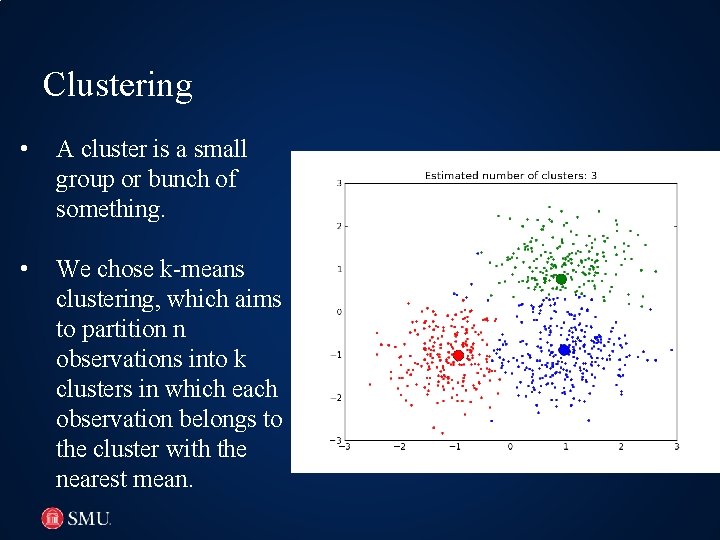
Clustering • A cluster is a small group or bunch of something. • We chose k-means clustering, which aims to partition n observations into k clusters in which each observation belongs to the cluster with the nearest mean.
Use Cases ▪If an airline creates a new ticket fare product, but our segmentation shows a wide variety in client demographics (30% leisure, 40% business, and 30% other) then perhaps the product is not well-defined or well-targeted. ▪A good segmentation can provide insights into the design of good fare products upfront. ▪Conduct break down analysis of various fare products by postbooking and pre-booking segmentation.
Information Given ▪Sabre provided ticketing data in an excel spreadsheet, with rows representing each ticket: - 14 days of ticketing - 2, 535, 955 tickets - Booking date, departure date, return date (and day-of-week) - Fare or fare ratio (ratio to lowest fare) - Travel time or ratio (ratio to non-stop time) OR number of stops (outbound and inbound), Market, Travel agency type (big global, small, online agency) ▪Sample R code referencing the data metrics above
Our Goal ▪ Create a set of rules that creates a unique category for any given ticket, along with a report showing validation efforts. Our report will also describe the techniques used, pros and cons, and rationale for the final recommended set of rules.
Methodology » Used k-means clustering in R » Found optimal number of clusters » Interpreted the output » Used subjective analysis to determine any conclusions
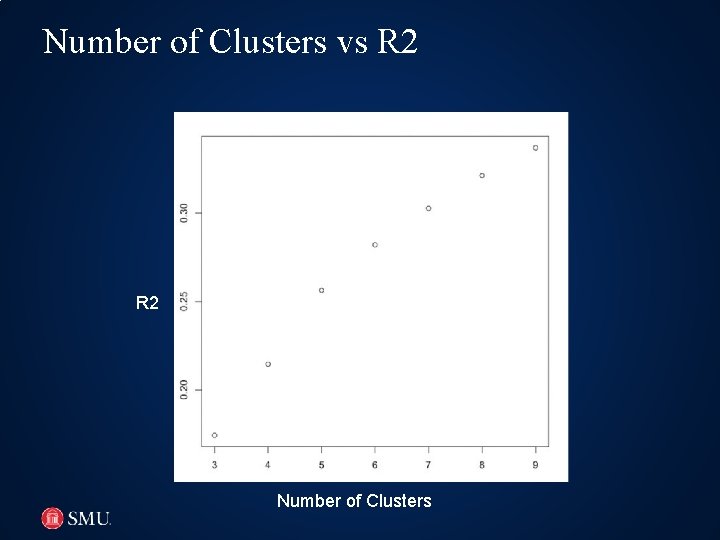
Number of Clusters vs R 2 Number of Clusters
Post-booking Classification Rules ▪ Set of Rules to classify clusters: 1. Determine if the value displayed in the table is above or below the mean for the following variables: Advanced Purchase, Length of Stay, Fare, Inbound Travel Time and Outbound Travel Time 2. Determine the most popular of the following variables: Departure Day of Week, Return Day of Week, Agency Type, and Number of Passengers 3. Check percentage of tickets in the cluster that stays on Saturdays (we need to determine if its high or low)
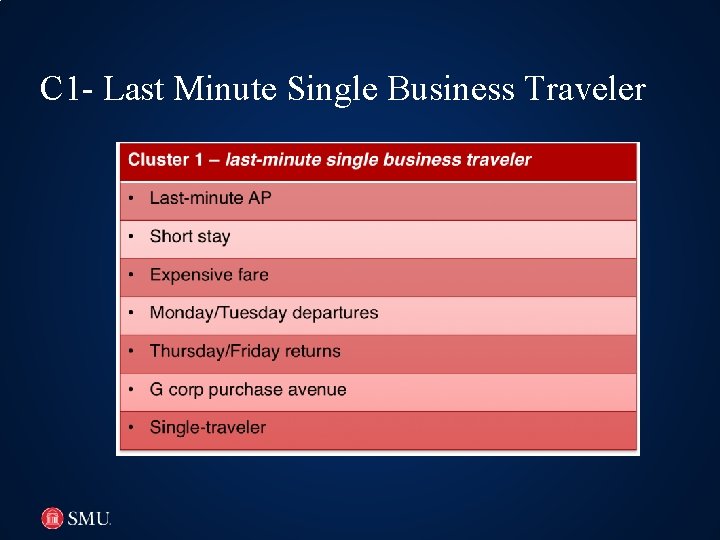
C 1 - Last Minute Single Business Traveler
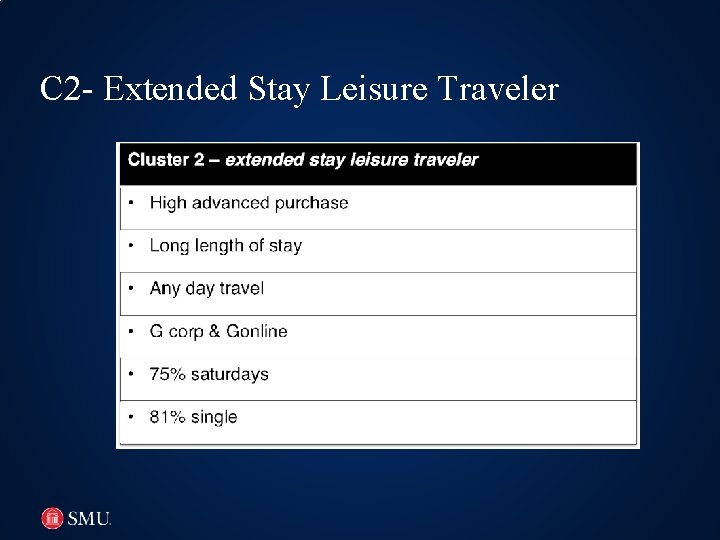
C 2 - Extended Stay Leisure Traveler
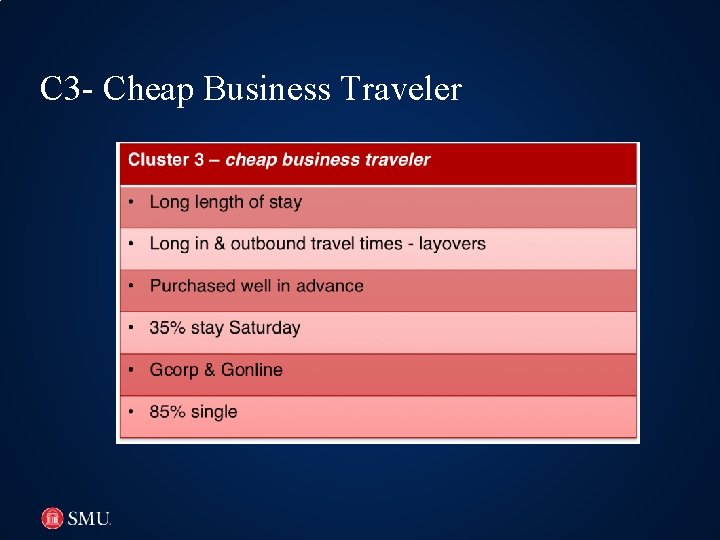
C 3 - Cheap Business Traveler
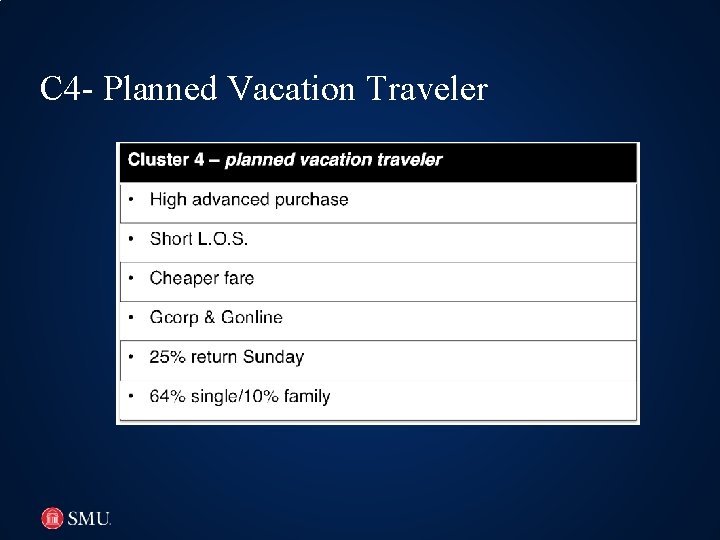
C 4 - Planned Vacation Traveler
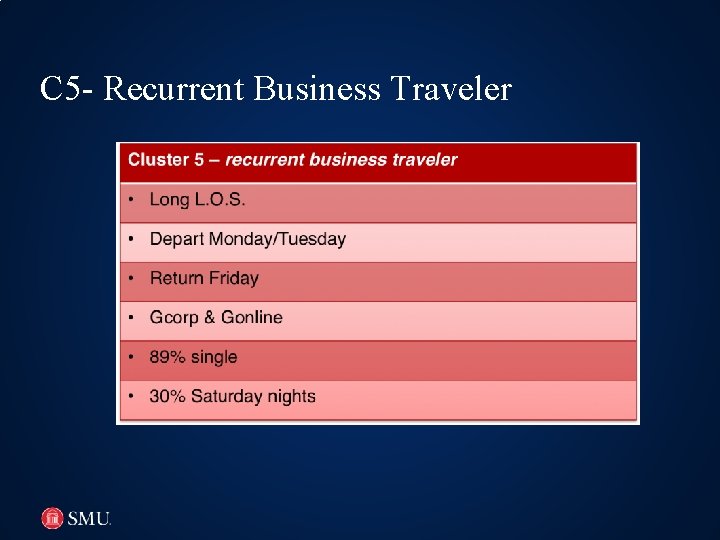
C 5 - Recurrent Business Traveler
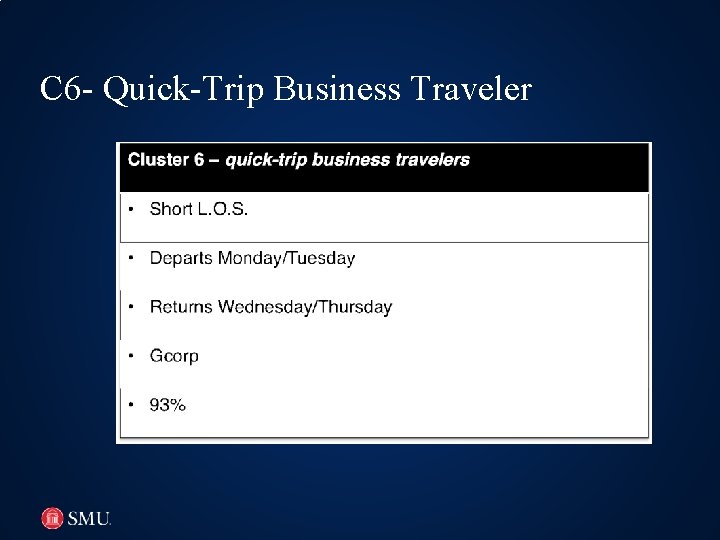
C 6 - Quick-Trip Business Traveler
Pre-booking Classification Rules ▪ Same rules as for Post-booking but with the removal of the following variables: o. Fare o. Outbound Travel Time o. Inbound Travel Time
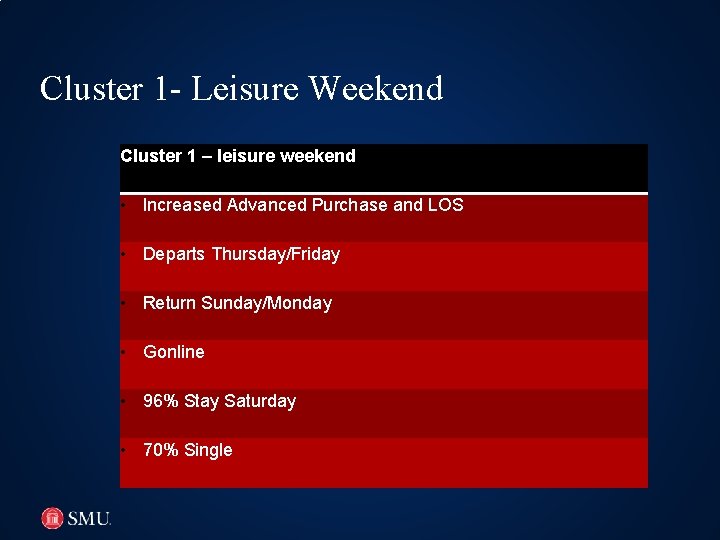
Cluster 1 - Leisure Weekend Cluster 1 – leisure weekend • Increased Advanced Purchase and LOS • Departs Thursday/Friday • Return Sunday/Monday • Gonline • 96% Stay Saturday • 70% Single
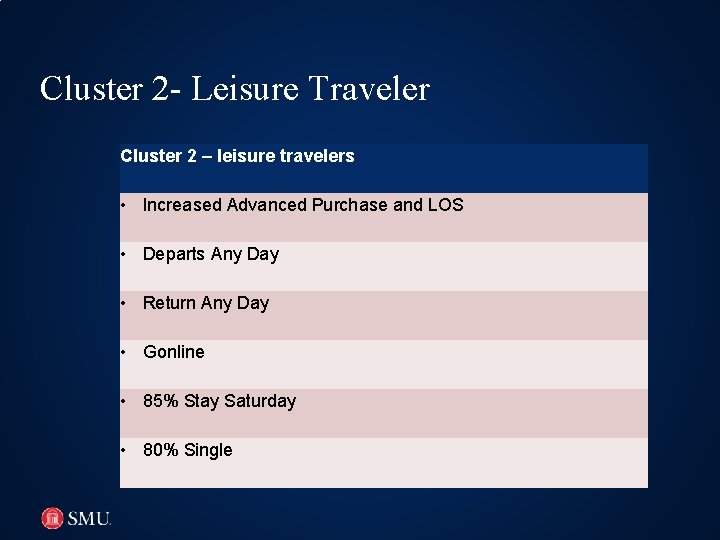
Cluster 2 - Leisure Traveler Cluster 2 – leisure travelers • Increased Advanced Purchase and LOS • Departs Any Day • Return Any Day • Gonline • 85% Stay Saturday • 80% Single
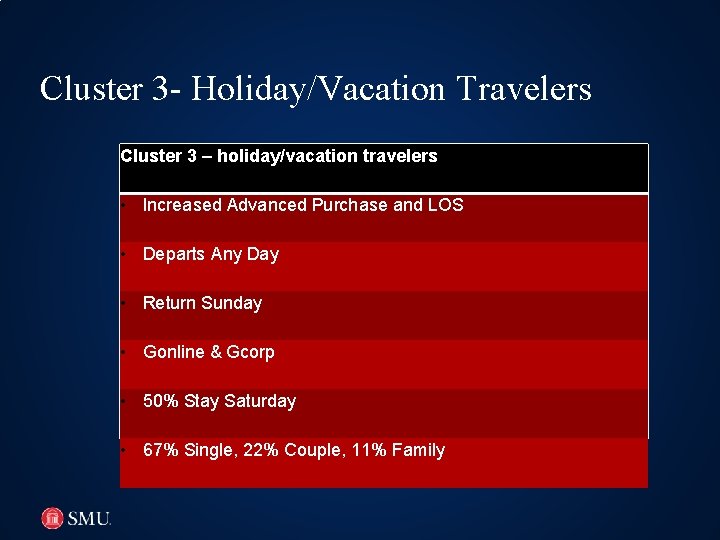
Cluster 3 - Holiday/Vacation Travelers Cluster 3 – quick-trip holiday/vacation business travelers • Increased Short L. O. S. Advanced Purchase and LOS • Departs Monday/Tuesday Any Day • Return Sunday • Gonline Gcorp & Gcorp • 50% 93% Stay Saturday • 67% Single, 22% Couple, 11% Family
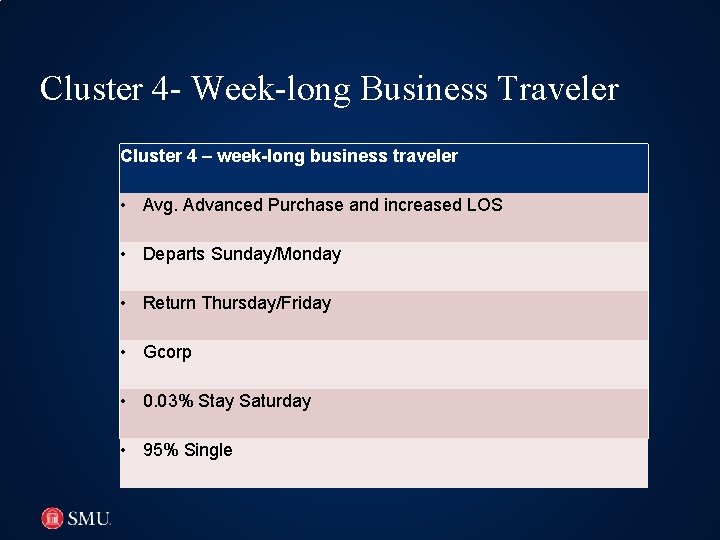
Cluster 4 - Week-long Business Traveler Cluster 4 – quick-trip week-longbusinesstravelers traveler • Avg. Short. Advanced L. O. S. Purchase and increased LOS • Departs Monday/Tuesday Sunday/Monday • Return Thursday/Friday • Gcorp • 0. 03% 93% Stay Saturday • 95% Single
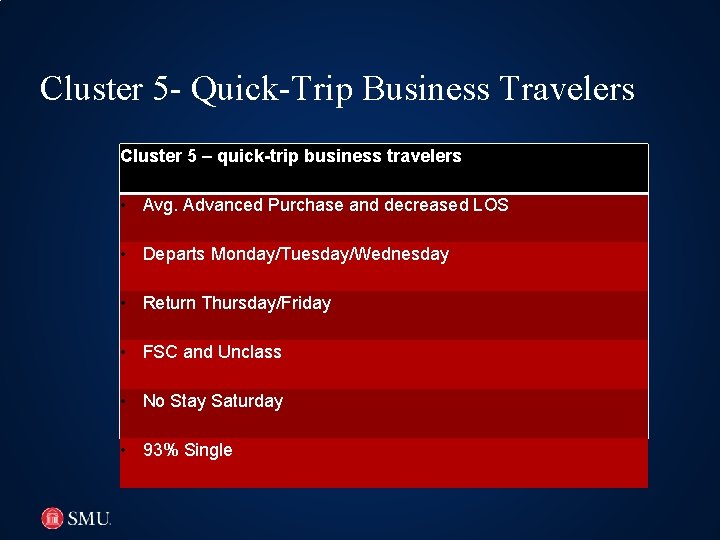
Cluster 5 - Quick-Trip Business Travelers Cluster 5 – quick-trip business travelers • Avg. Short. Advanced L. O. S. Purchase and decreased LOS • Departs Monday/Tuesday/Wednesday • Return Thursday/Friday • FSC Gcorpand Unclass • No 93%Stay Saturday • 93% Single
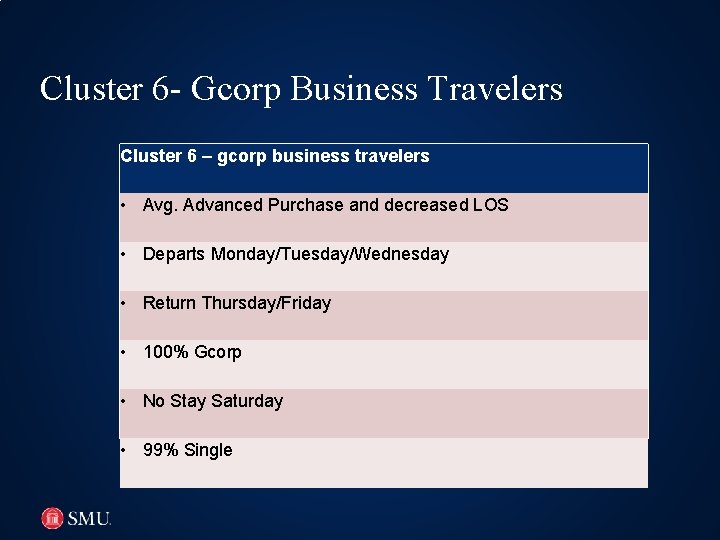
Cluster 6 - Gcorp Business Travelers Cluster 6 – quick-trip gcorp business travelers • Avg. Short. Advanced L. O. S. Purchase and decreased LOS • Departs Monday/Tuesday/Wednesday • Return Thursday/Friday • 100% Gcorp • No 93%Stay Saturday • 99% Single
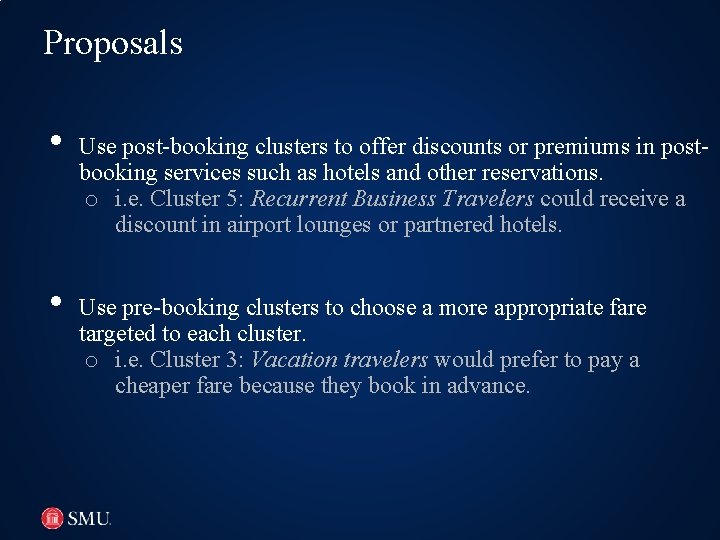
Proposals • • Use post-booking clusters to offer discounts or premiums in postbooking services such as hotels and other reservations. o i. e. Cluster 5: Recurrent Business Travelers could receive a discount in airport lounges or partnered hotels. Use pre-booking clusters to choose a more appropriate fare targeted to each cluster. o i. e. Cluster 3: Vacation travelers would prefer to pay a cheaper fare because they book in advance.

World Changers Shaped Here
- Slides: 24