
S72 227 Digital Communication Systems Overview into Fiber
S-72. 227 Digital Communication Systems Overview into Fiber Optic Communications
Overview into Fiber Optic Communications u u u u u Capacity of telecommunication networks Advantageous of optical systems Optical fibers – single mode – multimode Modules of fiber optic link Dispersion in fibers – inter-modal and intra-modal dispersion Fiber bandwidth and bitrate Optical sources: LEDs and lasers Optical sinks: PIN and APD photodiodes Factors in design of optical links Timo O. Korhonen, HUT Communication Laboratory
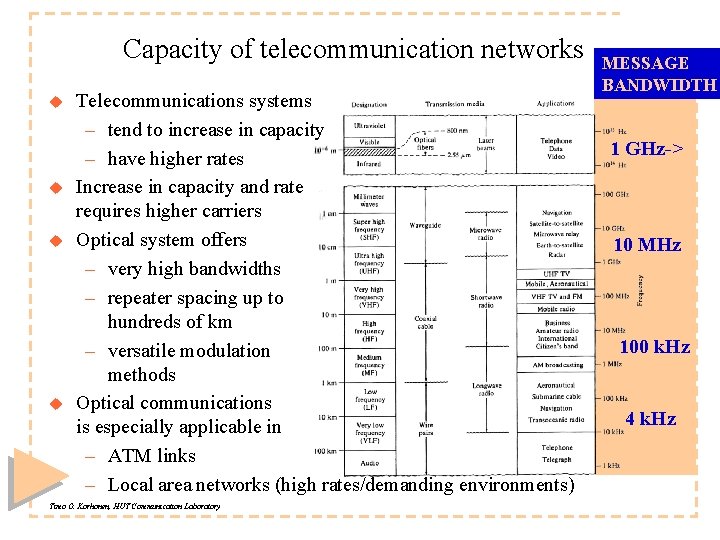
Capacity of telecommunication networks u u Telecommunications systems – tend to increase in capacity – have higher rates Increase in capacity and rate requires higher carriers Optical system offers – very high bandwidths – repeater spacing up to hundreds of km – versatile modulation methods Optical communications is especially applicable in – ATM links – Local area networks (high rates/demanding environments) Timo O. Korhonen, HUT Communication Laboratory MESSAGE BANDWIDTH 1 GHz-> 10 MHz 100 k. Hz 4 k. Hz
Summarizing advantages of optical systems u u u u Enormous capacity: 1. 3 mm. . . 1. 55 mm allocates bandwidth of 37 THz!! Low transmission loss – Optical fiber loss 0. 2 d. B/km, Coaxial cable loss 10 … 300 d. B/km ! Cables and equipment have small size and weight – aircrafts, satellites, ships Immunity to interference – nuclear power plants, hospitals, EMP (Electromagnetic pulse) resistive systems (installations for defense) Electrical isolation – electrical hazardous environments – negligible crosstalk Signal security – banking, computer networks, military systems Fibers have abundant raw material Timo O. Korhonen, HUT Communication Laboratory
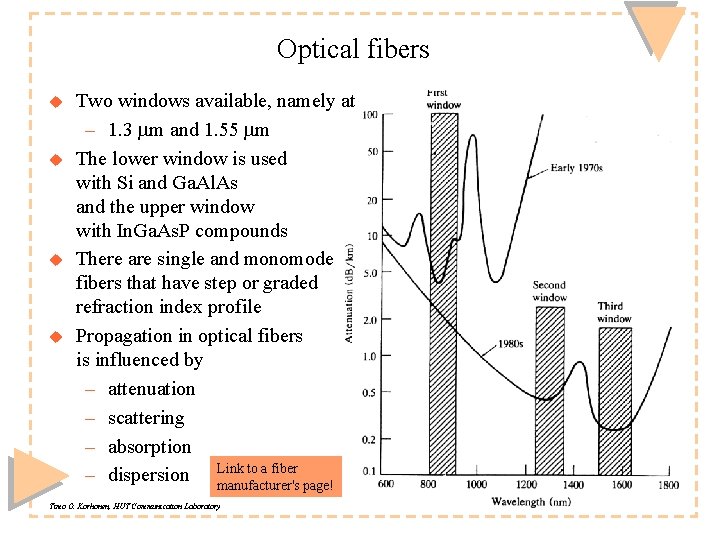
Optical fibers u u Two windows available, namely at – 1. 3 mm and 1. 55 mm The lower window is used with Si and Ga. Al. As and the upper window with In. Ga. As. P compounds There are single and monomode fibers that have step or graded refraction index profile Propagation in optical fibers is influenced by – attenuation – scattering – absorption to a fiber – dispersion Link manufacturer's page! Timo O. Korhonen, HUT Communication Laboratory
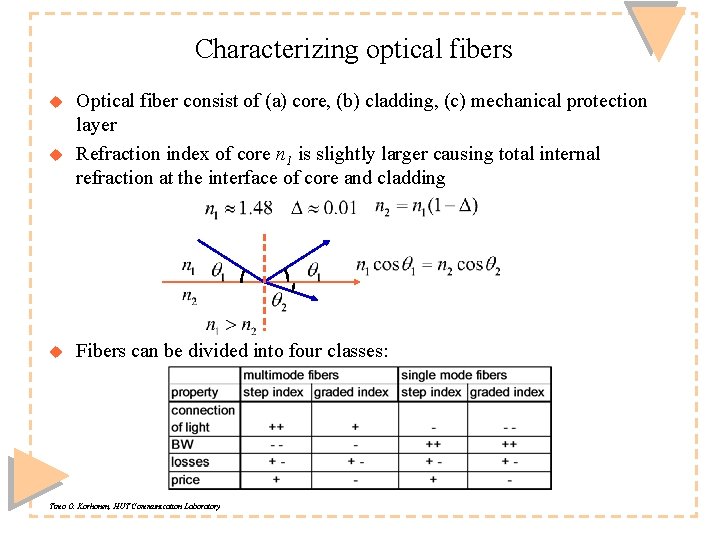
Characterizing optical fibers u u u Optical fiber consist of (a) core, (b) cladding, (c) mechanical protection layer Refraction index of core n 1 is slightly larger causing total internal refraction at the interface of core and cladding Fibers can be divided into four classes: Timo O. Korhonen, HUT Communication Laboratory
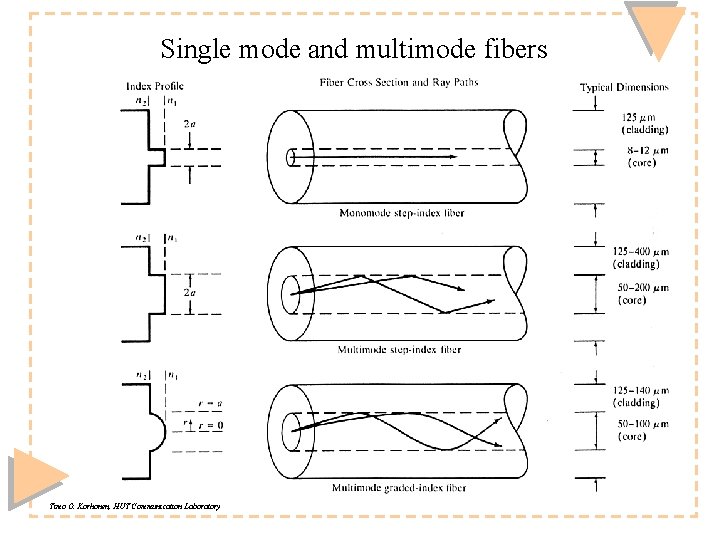
Single mode and multimode fibers Timo O. Korhonen, HUT Communication Laboratory
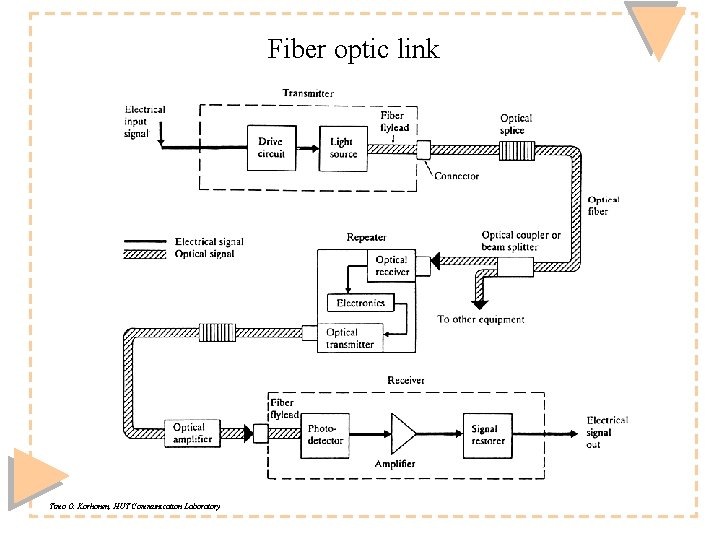
Fiber optic link Timo O. Korhonen, HUT Communication Laboratory
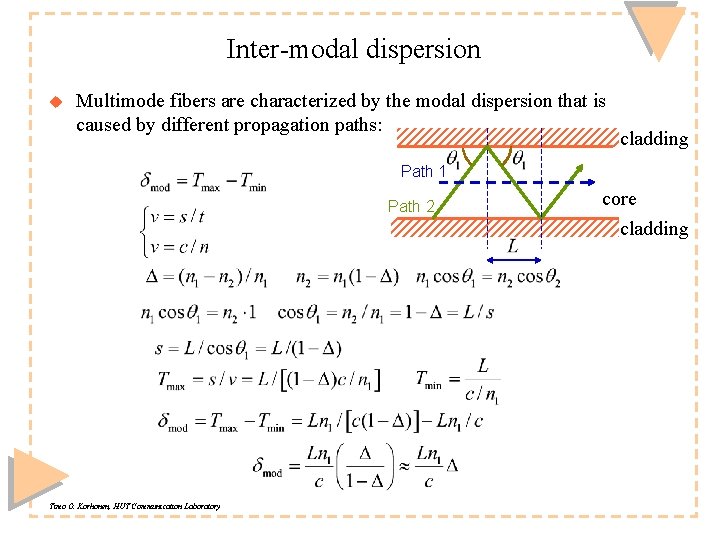
Inter-modal dispersion u Multimode fibers are characterized by the modal dispersion that is caused by different propagation paths: cladding Path 1 Path 2 Timo O. Korhonen, HUT Communication Laboratory core cladding
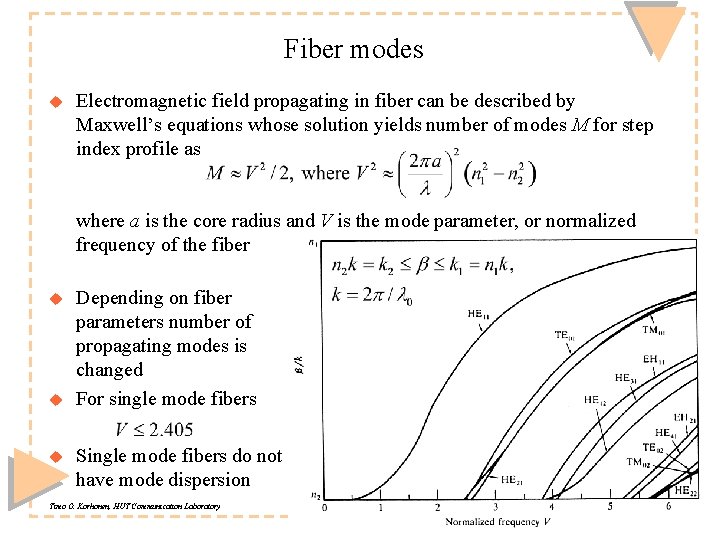
Fiber modes u Electromagnetic field propagating in fiber can be described by Maxwell’s equations whose solution yields number of modes M for step index profile as where a is the core radius and V is the mode parameter, or normalized frequency of the fiber u u u Depending on fiber parameters number of propagating modes is changed For single mode fibers Single mode fibers do not have mode dispersion Timo O. Korhonen, HUT Communication Laboratory
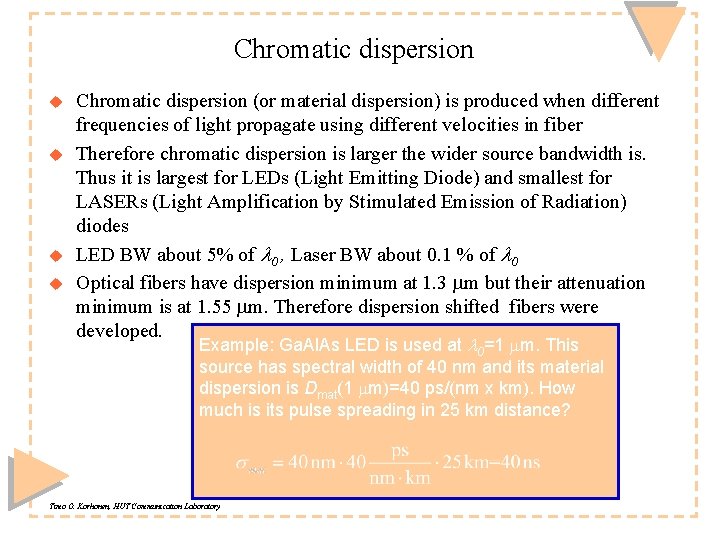
Chromatic dispersion u u Chromatic dispersion (or material dispersion) is produced when different frequencies of light propagate using different velocities in fiber Therefore chromatic dispersion is larger the wider source bandwidth is. Thus it is largest for LEDs (Light Emitting Diode) and smallest for LASERs (Light Amplification by Stimulated Emission of Radiation) diodes LED BW about 5% of l 0 , Laser BW about 0. 1 % of l 0 Optical fibers have dispersion minimum at 1. 3 mm but their attenuation minimum is at 1. 55 mm. Therefore dispersion shifted fibers were developed. Example: Ga. Al. As LED is used at l 0=1 mm. This source has spectral width of 40 nm and its material dispersion is Dmat(1 mm)=40 ps/(nm x km). How much is its pulse spreading in 25 km distance? Timo O. Korhonen, HUT Communication Laboratory
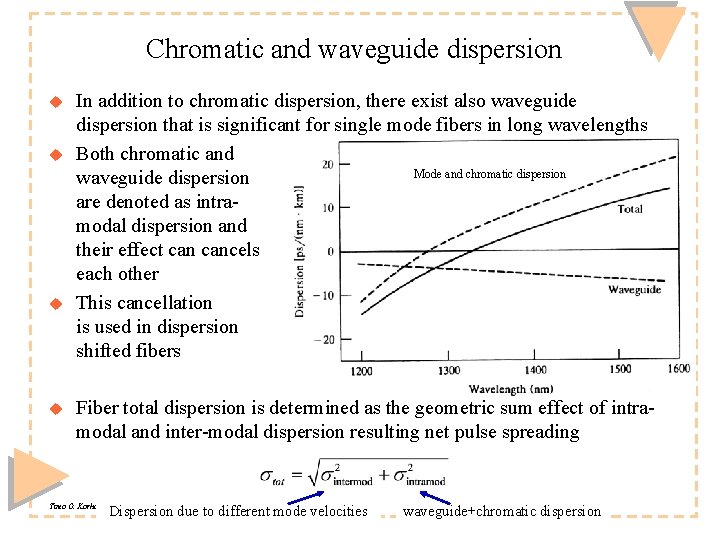
Chromatic and waveguide dispersion u u In addition to chromatic dispersion, there exist also waveguide dispersion that is significant for single mode fibers in long wavelengths Both chromatic and Mode and chromatic dispersion waveguide dispersion are denoted as intramodal dispersion and their effect cancels each other This cancellation is used in dispersion shifted fibers Fiber total dispersion is determined as the geometric sum effect of intramodal and inter-modal dispersion resulting net pulse spreading Timo O. Korhonen, HUT Communication Laboratory Dispersion due to different mode velocities waveguide+chromatic dispersion
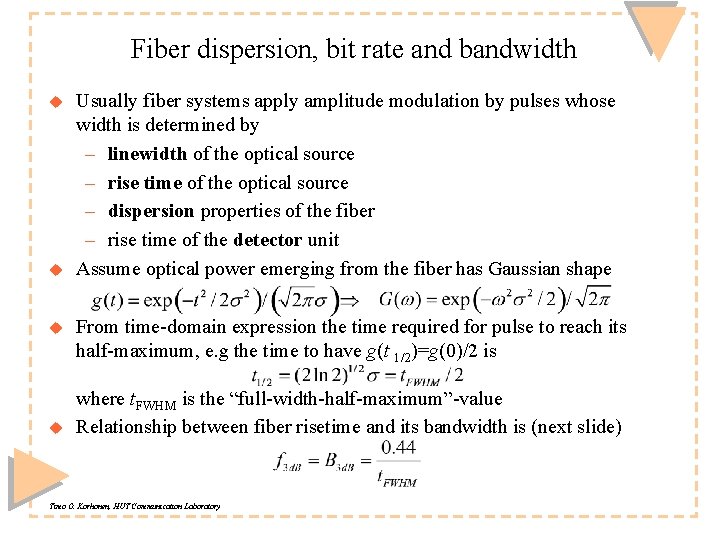
Fiber dispersion, bit rate and bandwidth u u Usually fiber systems apply amplitude modulation by pulses whose width is determined by – linewidth of the optical source – rise time of the optical source – dispersion properties of the fiber – rise time of the detector unit Assume optical power emerging from the fiber has Gaussian shape From time-domain expression the time required for pulse to reach its half-maximum, e. g the time to have g(t 1/2)=g(0)/2 is where t. FWHM is the “full-width-half-maximum”-value Relationship between fiber risetime and its bandwidth is (next slide) Timo O. Korhonen, HUT Communication Laboratory
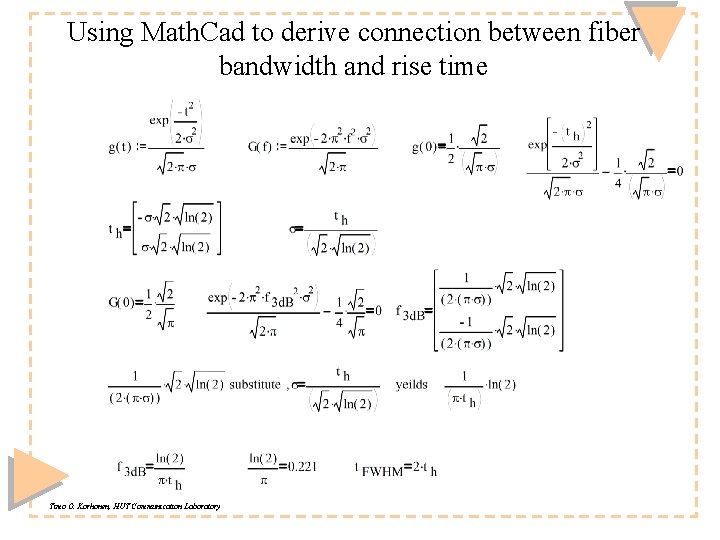
Using Math. Cad to derive connection between fiber bandwidth and rise time Timo O. Korhonen, HUT Communication Laboratory
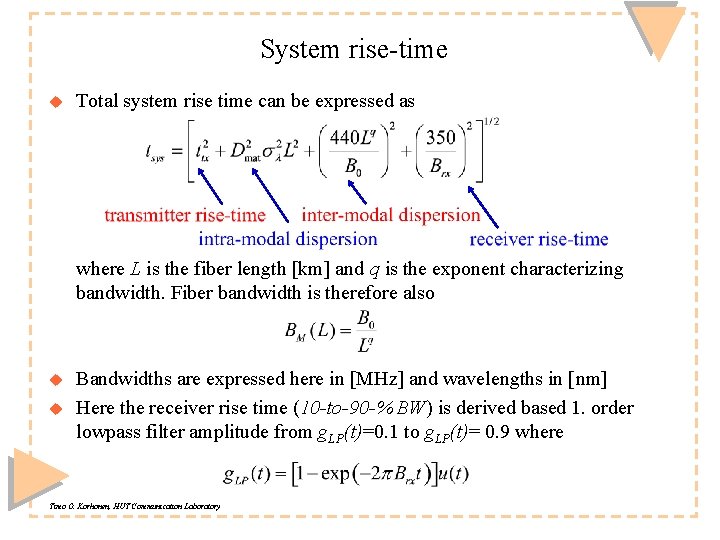
System rise-time u Total system rise time can be expressed as where L is the fiber length [km] and q is the exponent characterizing bandwidth. Fiber bandwidth is therefore also u u Bandwidths are expressed here in [MHz] and wavelengths in [nm] Here the receiver rise time (10 -to-90 -% BW) is derived based 1. order lowpass filter amplitude from g. LP(t)=0. 1 to g. LP(t)= 0. 9 where Timo O. Korhonen, HUT Communication Laboratory
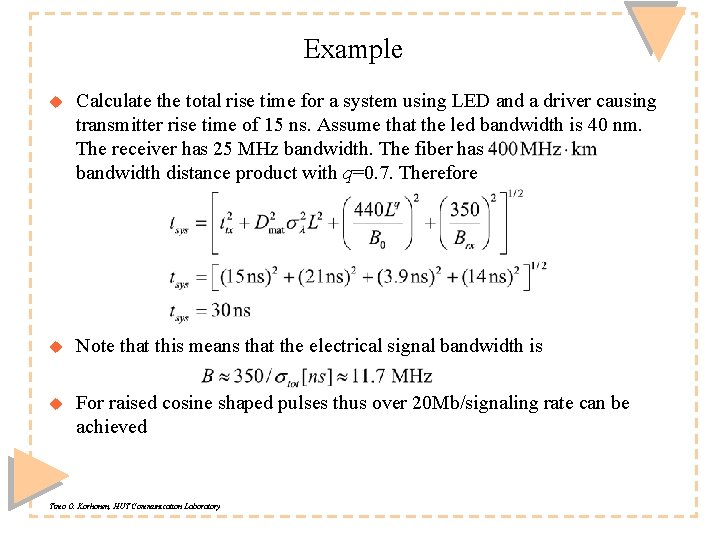
Example u Calculate the total rise time for a system using LED and a driver causing transmitter rise time of 15 ns. Assume that the led bandwidth is 40 nm. The receiver has 25 MHz bandwidth. The fiber has bandwidth distance product with q=0. 7. Therefore u Note that this means that the electrical signal bandwidth is u For raised cosine shaped pulses thus over 20 Mb/signaling rate can be achieved Timo O. Korhonen, HUT Communication Laboratory
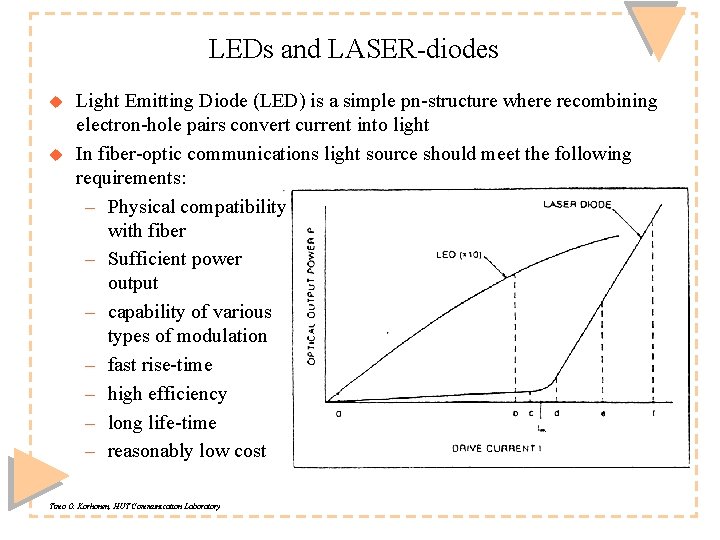
LEDs and LASER-diodes u u Light Emitting Diode (LED) is a simple pn-structure where recombining electron-hole pairs convert current into light In fiber-optic communications light source should meet the following requirements: – Physical compatibility with fiber – Sufficient power output – capability of various types of modulation – fast rise-time – high efficiency – long life-time – reasonably low cost Timo O. Korhonen, HUT Communication Laboratory
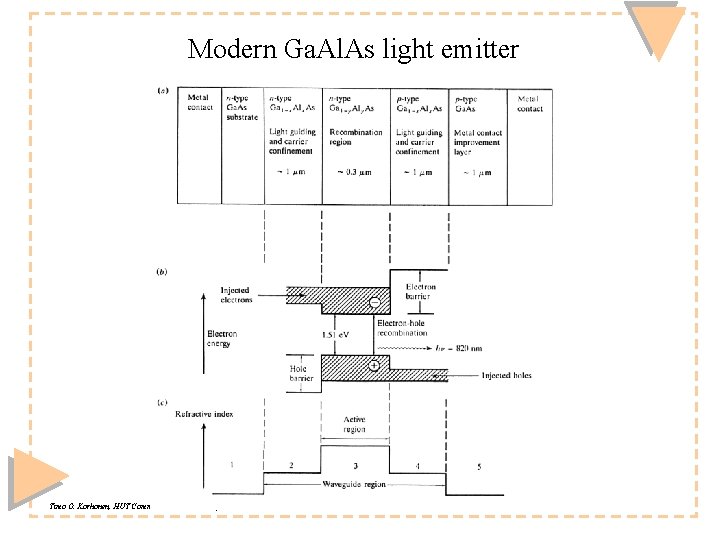
Modern Ga. Al. As light emitter Timo O. Korhonen, HUT Communication Laboratory
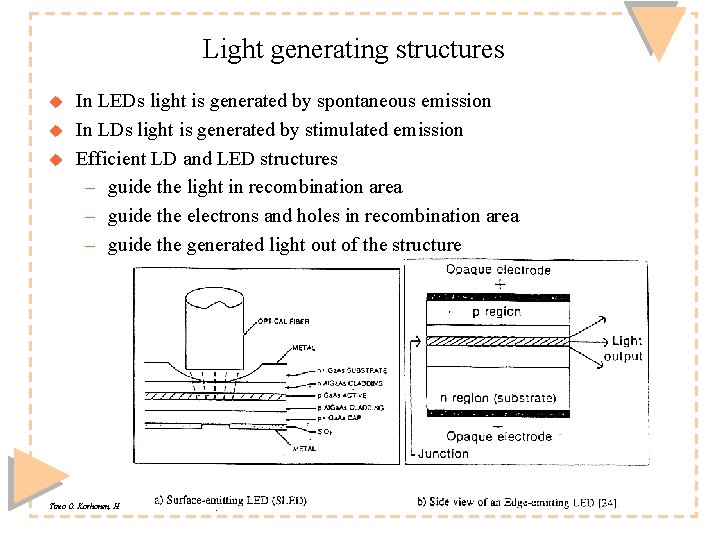
Light generating structures u u u In LEDs light is generated by spontaneous emission In LDs light is generated by stimulated emission Efficient LD and LED structures – guide the light in recombination area – guide the electrons and holes in recombination area – guide the generated light out of the structure Timo O. Korhonen, HUT Communication Laboratory
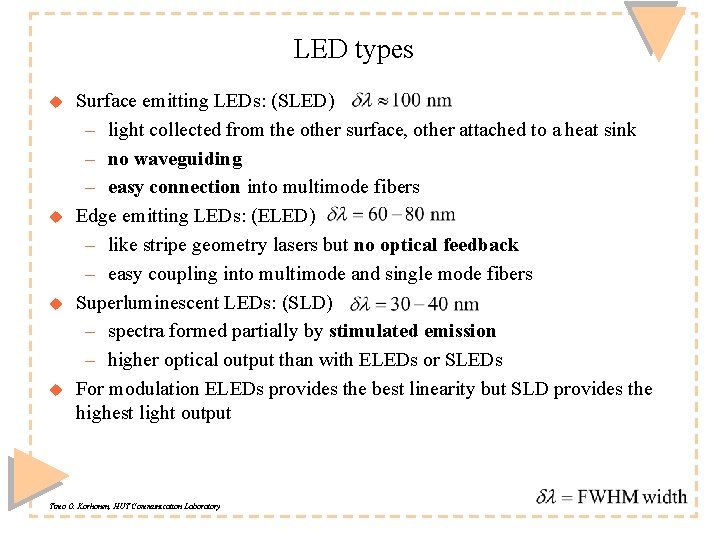
LED types u u Surface emitting LEDs: (SLED) – light collected from the other surface, other attached to a heat sink – no waveguiding – easy connection into multimode fibers Edge emitting LEDs: (ELED) – like stripe geometry lasers but no optical feedback – easy coupling into multimode and single mode fibers Superluminescent LEDs: (SLD) – spectra formed partially by stimulated emission – higher optical output than with ELEDs or SLEDs For modulation ELEDs provides the best linearity but SLD provides the highest light output Timo O. Korhonen, HUT Communication Laboratory
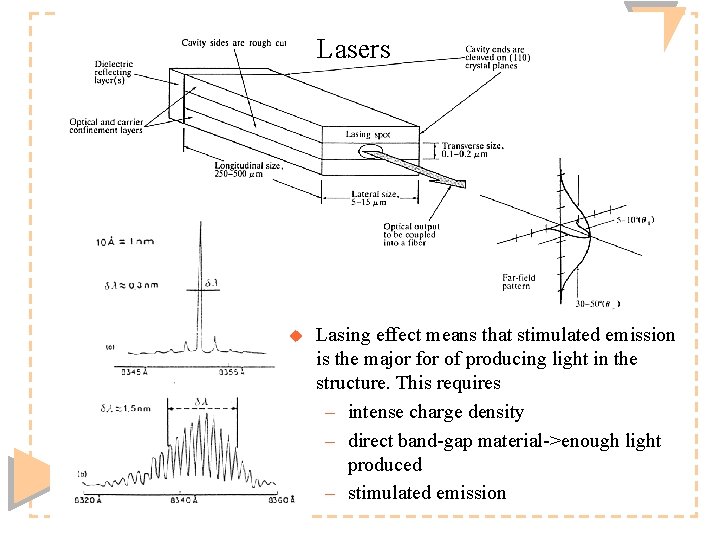
Lasers u Timo O. Korhonen, HUT Communication Laboratory Lasing effect means that stimulated emission is the major for of producing light in the structure. This requires – intense charge density – direct band-gap material->enough light produced – stimulated emission
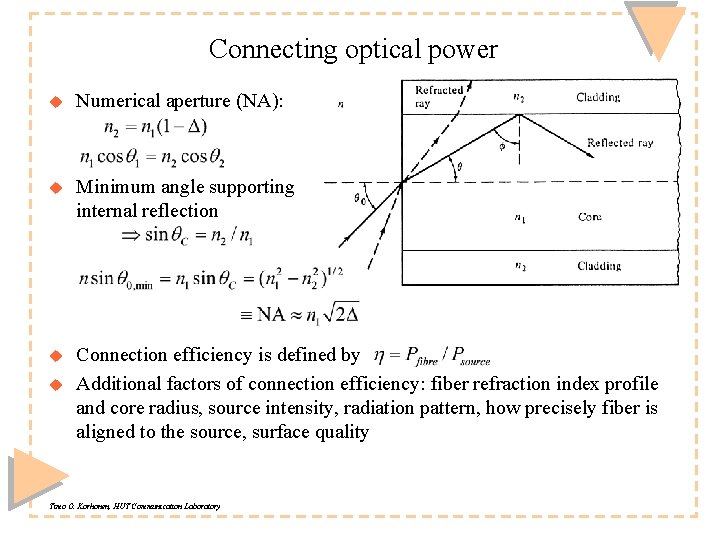
Connecting optical power u Numerical aperture (NA): u Minimum angle supporting internal reflection u Connection efficiency is defined by Additional factors of connection efficiency: fiber refraction index profile and core radius, source intensity, radiation pattern, how precisely fiber is aligned to the source, surface quality u Timo O. Korhonen, HUT Communication Laboratory
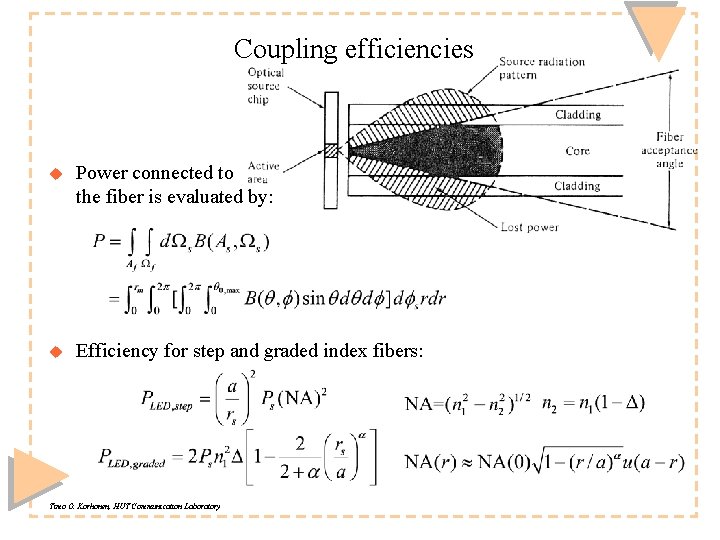
Coupling efficiencies u Power connected to the fiber is evaluated by: u Efficiency for step and graded index fibers: Timo O. Korhonen, HUT Communication Laboratory
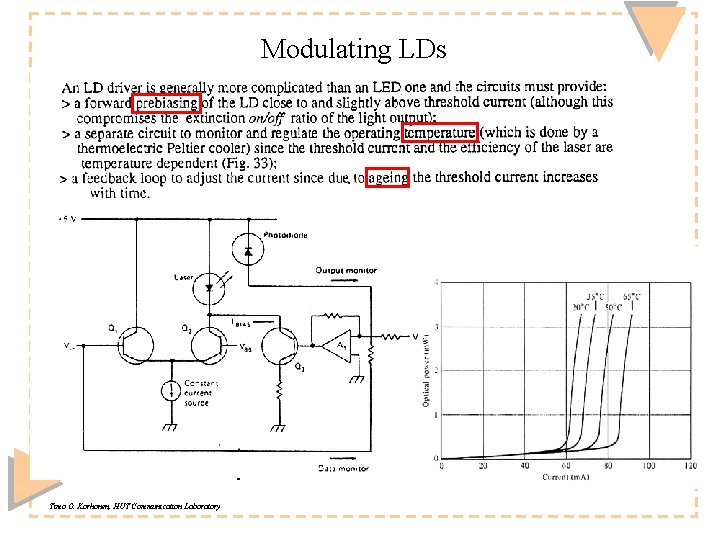
Modulating LDs Timo O. Korhonen, HUT Communication Laboratory
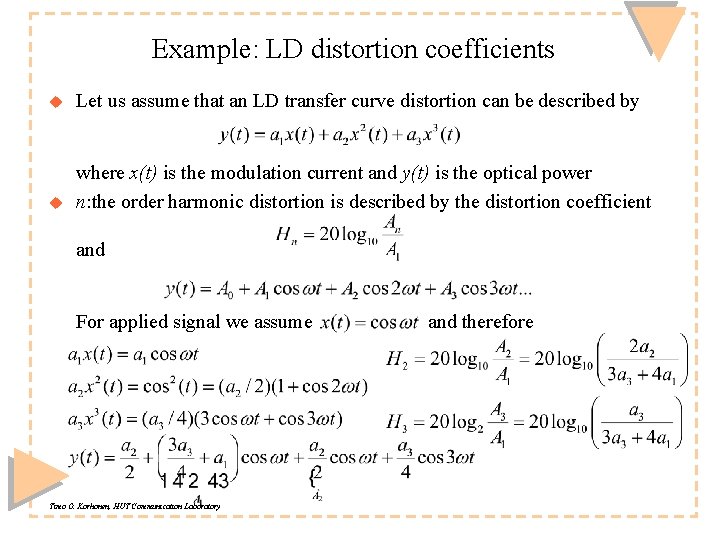
Example: LD distortion coefficients u Let us assume that an LD transfer curve distortion can be described by u where x(t) is the modulation current and y(t) is the optical power n: the order harmonic distortion is described by the distortion coefficient and For applied signal we assume Timo O. Korhonen, HUT Communication Laboratory and therefore
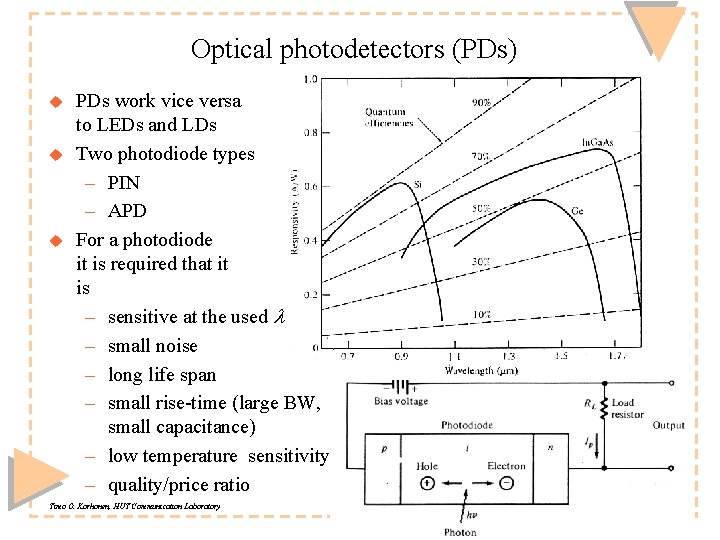
Optical photodetectors (PDs) u u u PDs work vice versa to LEDs and LDs Two photodiode types – PIN – APD For a photodiode it is required that it is – sensitive at the used l – small noise – long life span – small rise-time (large BW, small capacitance) – low temperature sensitivity – quality/price ratio Timo O. Korhonen, HUT Communication Laboratory
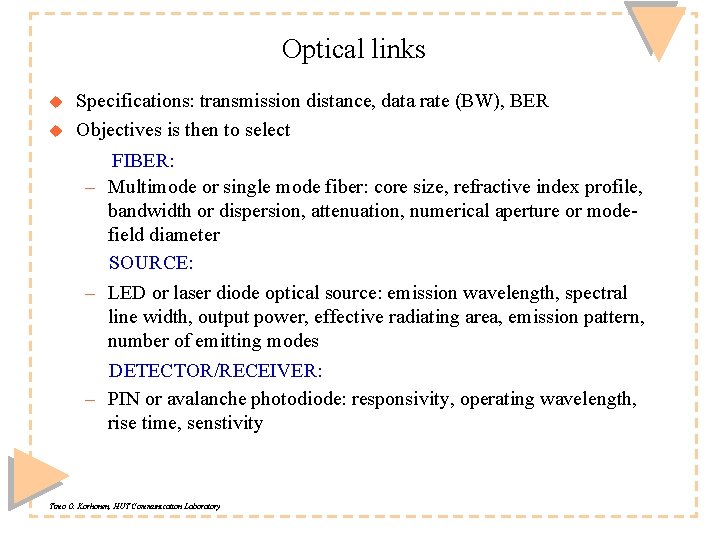
Optical links u u Specifications: transmission distance, data rate (BW), BER Objectives is then to select FIBER: – Multimode or single mode fiber: core size, refractive index profile, bandwidth or dispersion, attenuation, numerical aperture or modefield diameter SOURCE: – LED or laser diode optical source: emission wavelength, spectral line width, output power, effective radiating area, emission pattern, number of emitting modes DETECTOR/RECEIVER: – PIN or avalanche photodiode: responsivity, operating wavelength, rise time, senstivity Timo O. Korhonen, HUT Communication Laboratory
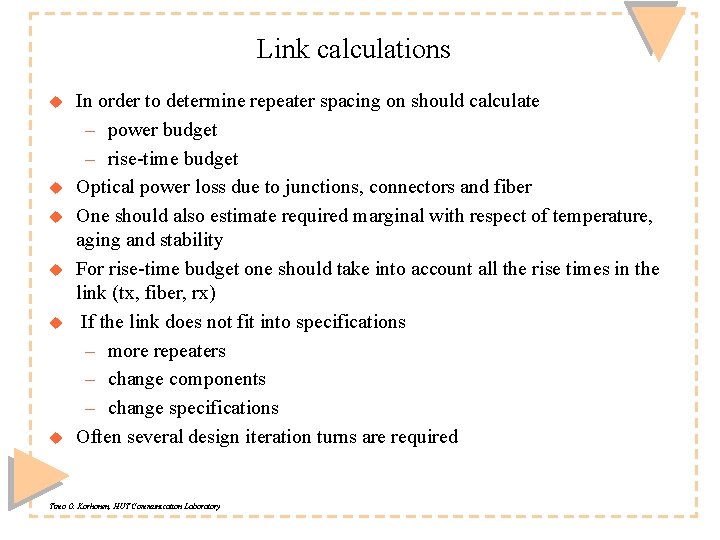
Link calculations u u u In order to determine repeater spacing on should calculate – power budget – rise-time budget Optical power loss due to junctions, connectors and fiber One should also estimate required marginal with respect of temperature, aging and stability For rise-time budget one should take into account all the rise times in the link (tx, fiber, rx) If the link does not fit into specifications – more repeaters – change components – change specifications Often several design iteration turns are required Timo O. Korhonen, HUT Communication Laboratory
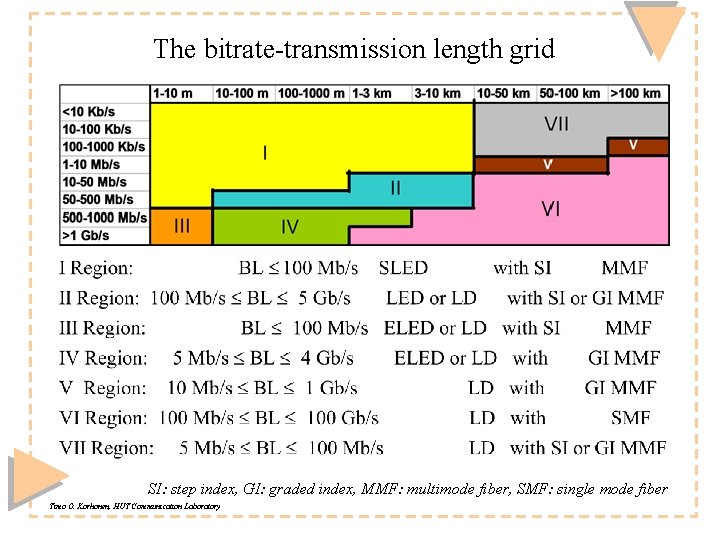
The bitrate-transmission length grid SI: step index, GI: graded index, MMF: multimode fiber, SMF: single mode fiber Timo O. Korhonen, HUT Communication Laboratory
- Slides: 29