
S330 Task ForceStrike Team Leader Responsibilities and Assessing
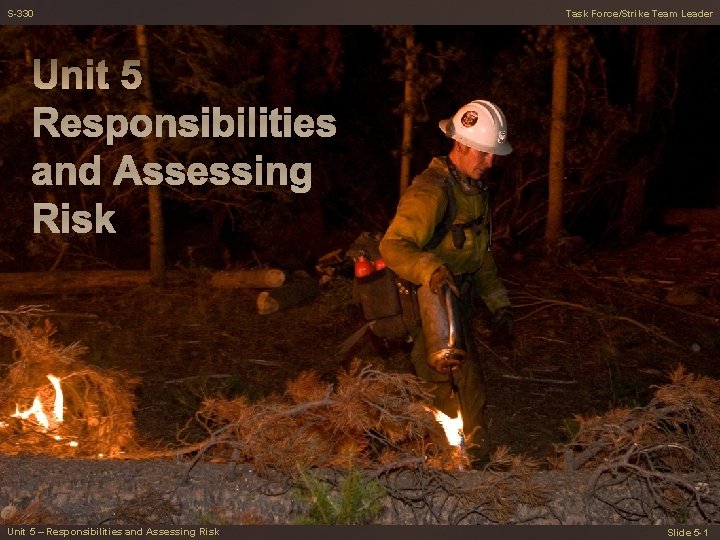
S-330 Task Force/Strike Team Leader Responsibilities and Assessing Risk Unit 5 – Responsibilities and Assessing Risk Slide 5 -1
S-330 Task Force/Strike Team Leader 1. Discuss duties and responsibilities of the TFLD/STL during initial attack assignments. 2. Identify duties and responsibilities of the TFLD/STL during an incident transition. 3. Discuss duties and responsibilities of the TFLD/STL in a Type 3 incident organization. Unit 5 – Responsibilities and Assessing Risk Slide 5 -2
S-330 Task Force/Strike Team Leader 4. Identify methods to ensure assigned resources follow appropriate safety procedures. 5. Describe appropriate actions to take on improved properties during a wildland/urban interface incident. 6. Explain the process for directing a firing operation. Unit 5 – Responsibilities and Assessing Risk Slide 5 -3
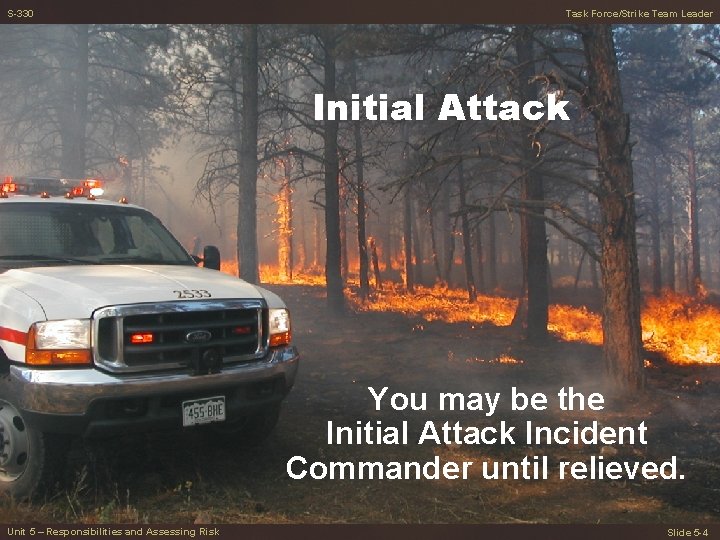
S-330 Task Force/Strike Team Leader Initial Attack You may be the Initial Attack Incident Commander until relieved. Unit 5 – Responsibilities and Assessing Risk Slide 5 -4
S-330 Task Force/Strike Team Leader • Collateral duties – Fire fatality reviews (30 Mile, South Canyon) identified collateral duties as contributing to the incident. • Risk and Complexity Assessment – Assists the Incident Commander in determining when they have exceeded their capabilities. Unit 5 – Responsibilities and Assessing Risk Slide 5 -5

S-330 Task Force/Strike Team Leader • Wildland Fire Incident Management Field Guide • IRPG • ICS-201 • Incident Organizer • Standard Firefighting Orders Unit 5 – Responsibilities and Assessing Risk Slide 5 -6
S-330 Task Force/Strike Team Leader Considerations: • Unclear objectives, strategies, and tactics • Chain of command • Delegation of authority • Communication • Increasing incident complexity • Unclear on number, type, and location of resources Unit 5 – Responsibilities and Assessing Risk Slide 5 -7
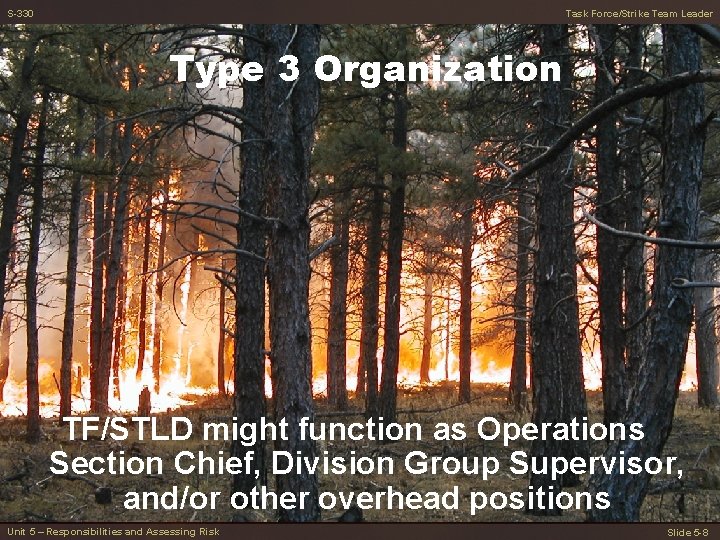
S-330 Task Force/Strike Team Leader Type 3 Organization TF/STLD might function as Operations Section Chief, Division Group Supervisor, and/or other overhead positions Unit 5 – Responsibilities and Assessing Risk Slide 5 -8
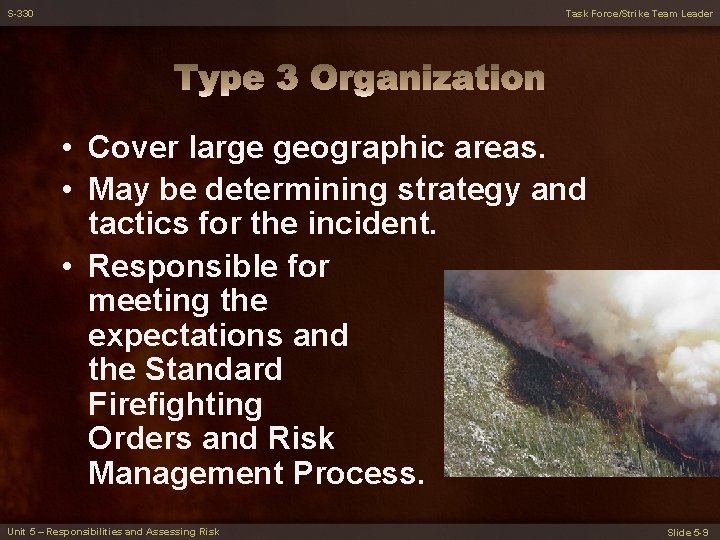
S-330 Task Force/Strike Team Leader • Cover large geographic areas. • May be determining strategy and tactics for the incident. • Responsible for meeting the expectations and the Standard Firefighting Orders and Risk Management Process. Unit 5 – Responsibilities and Assessing Risk Slide 5 -9
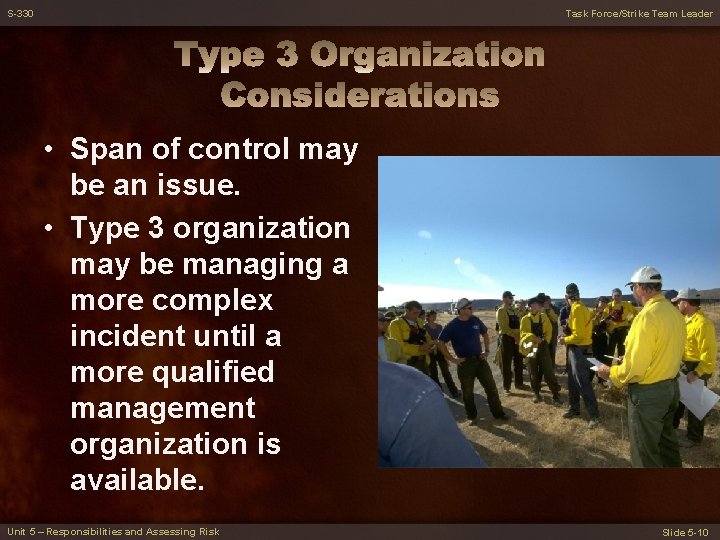
S-330 Task Force/Strike Team Leader • Span of control may be an issue. • Type 3 organization may be managing a more complex incident until a more qualified management organization is available. Unit 5 – Responsibilities and Assessing Risk Slide 5 -10

S-330 Task Force/Strike Team Leader • The TFLD/ STL is responsible for ensuring that team members and others are following safety procedures. Unit 5 – Responsibilities and Assessing Risk Slide 5 -11
S-330 Task Force/Strike Team Leader • Identify and communicate location of escape routes and safety zones. • Ensure hazards are communicated and mitigated. • Brief Task Force/Strike Team on safety expectations for the assignment. Unit 5 – Responsibilities and Assessing Risk Slide 5 -12

S-330 Task Force/Strike Team Leader • Follow or establish medical plan. Be aware of names and locations of medically trained people. • Order law enforcement if necessary. • Create or follow an evacuation plan if necessary. • Observe and correct unsafe procedures. Unit 5 – Responsibilities and Assessing Risk Slide 5 -13
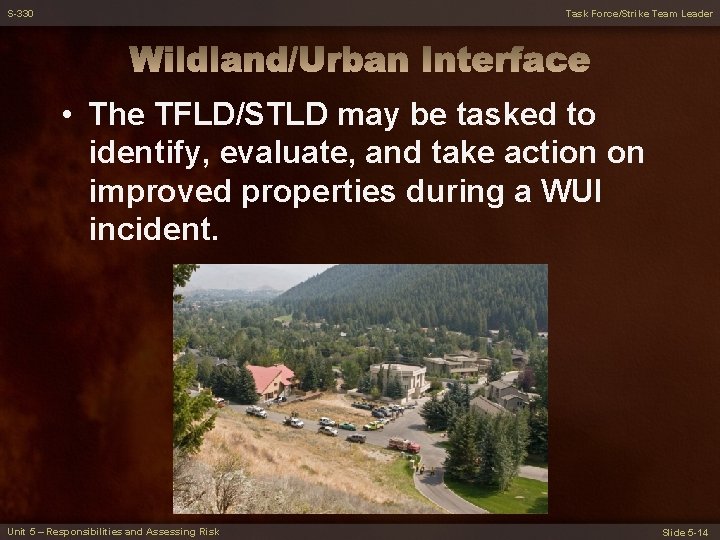
S-330 Task Force/Strike Team Leader • The TFLD/STLD may be tasked to identify, evaluate, and take action on improved properties during a WUI incident. Unit 5 – Responsibilities and Assessing Risk Slide 5 -14
S-330 Task Force/Strike Team Leader Considerations: • Ingress and egress • Review map if available. • Logistical needs • Resource requirements • Use appropriate tactics • Contact information Unit 5 – Responsibilities and Assessing Risk Slide 5 -15
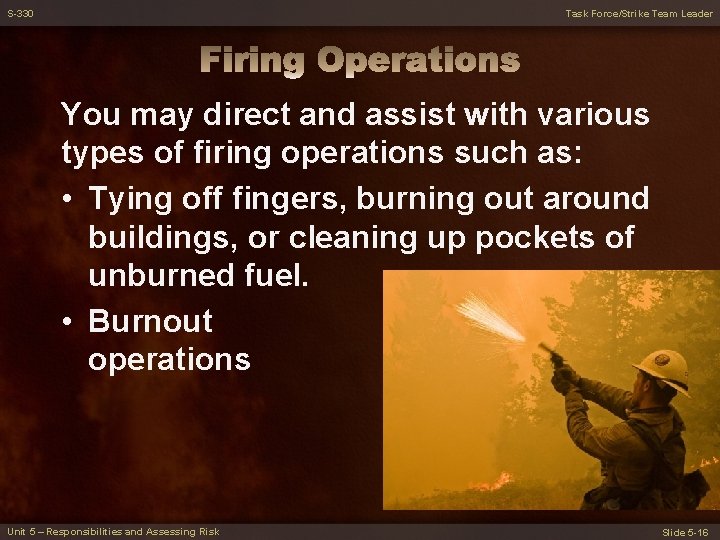
S-330 Task Force/Strike Team Leader You may direct and assist with various types of firing operations such as: • Tying off fingers, burning out around buildings, or cleaning up pockets of unburned fuel. • Burnout operations Unit 5 – Responsibilities and Assessing Risk Slide 5 -16
S-330 Task Force/Strike Team Leader Considerations: • Remember your level of engagement • Do you have a qualified Firing Boss? • Do you have ample resources? • Do you have enough time? • Do you have the delegation to take action on or around private property or structures? Who would you contact for this delegation? Unit 5 – Responsibilities and Assessing Risk Slide 5 -17
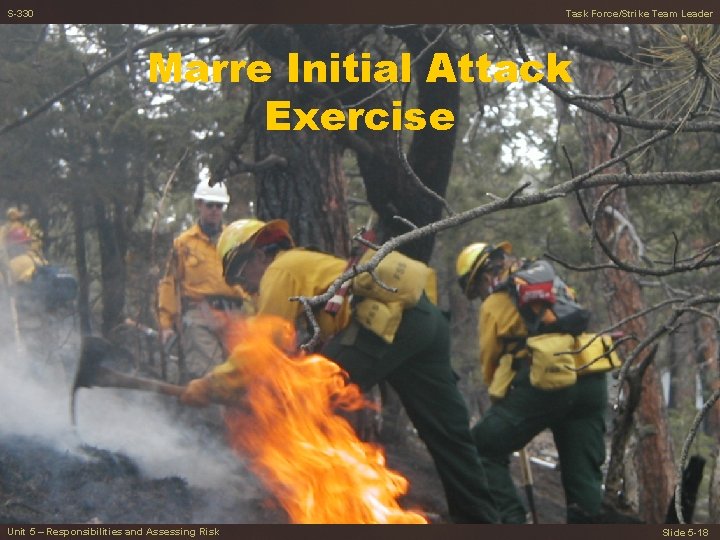
S-330 Task Force/Strike Team Leader Marre Initial Attack Exercise Unit 5 – Responsibilities and Assessing Risk Slide 5 -18
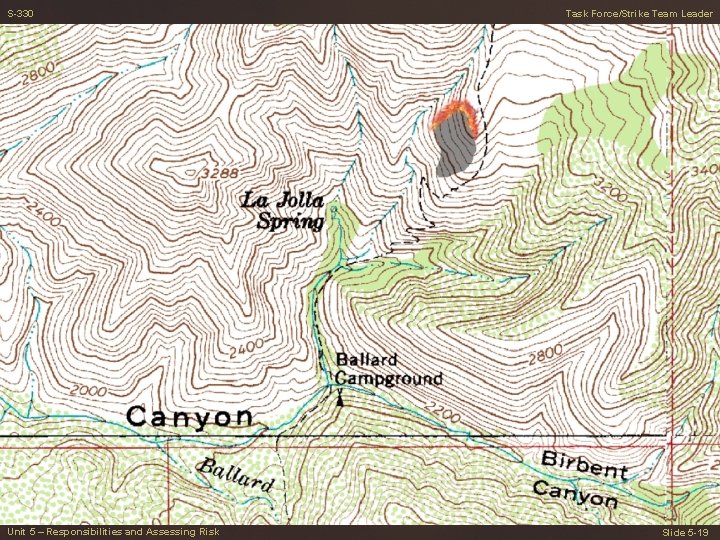
S-330 Unit 5 – Responsibilities and Assessing Risk Task Force/Strike Team Leader Slide 5 -19
S-330 Task Force/Strike Team Leader DEVELOP Tactical plan Order additional resources Incident objectives Briefing sketch map Unit 5 – Responsibilities and Assessing Risk Slide 5 -20
S-330 Task Force/Strike Team Leader 1. Discuss duties and responsibilities of the TFLD/STL during initial attack assignments. 2. Identify duties and responsibilities of the TFLD/STL during an incident transition. 3. Discuss duties and responsibilities of the TFLD/STL in a Type 3 incident organization. Unit 5 – Responsibilities and Assessing Risk Slide 5 -21
S-330 Task Force/Strike Team Leader 4. Identify methods to ensure assigned resources follow appropriate safety procedures. 5. Describe appropriate actions to take on improved properties during a wildland/urban interface incident. 6. Explain the process for directing a firing operation. Unit 5 – Responsibilities and Assessing Risk Slide 5 -22
- Slides: 22