
S271 Helicopter Crewmember Unit 8 Helispot Operations Unit
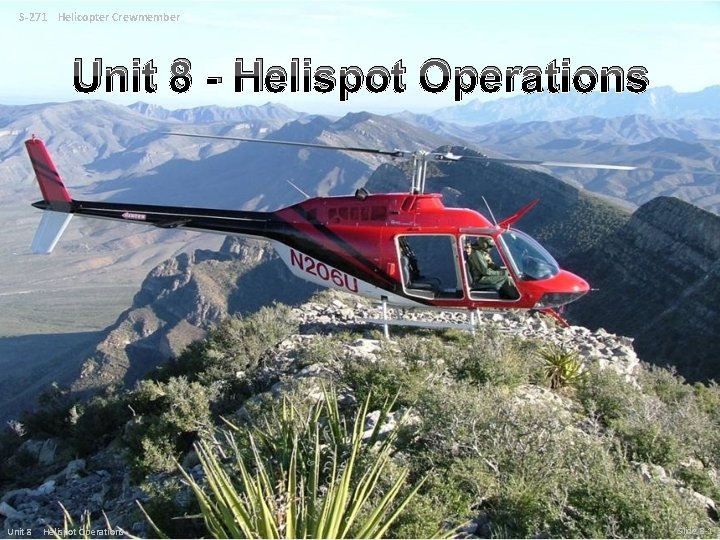
S-271 Helicopter Crewmember Unit 8 - Helispot Operations Unit 8 Helispot Operations Slide 8 -1
S-271 Helicopter Crewmember Unit 8 Objectives 1. Describe the process for staffing and preparing a landing area or helispot. 2. Define the methods for constructing landing areas or helispots. 3. Describe the duties performed in managing a helispot. Unit 8 Helispot Operations Slide 8 -2
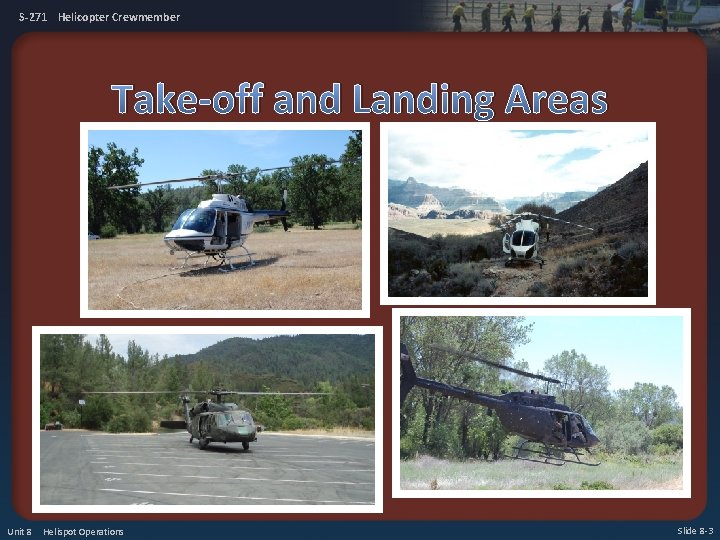
S-271 Helicopter Crewmember Take-off and Landing Areas Unit 8 Helispot Operations Slide 8 -3
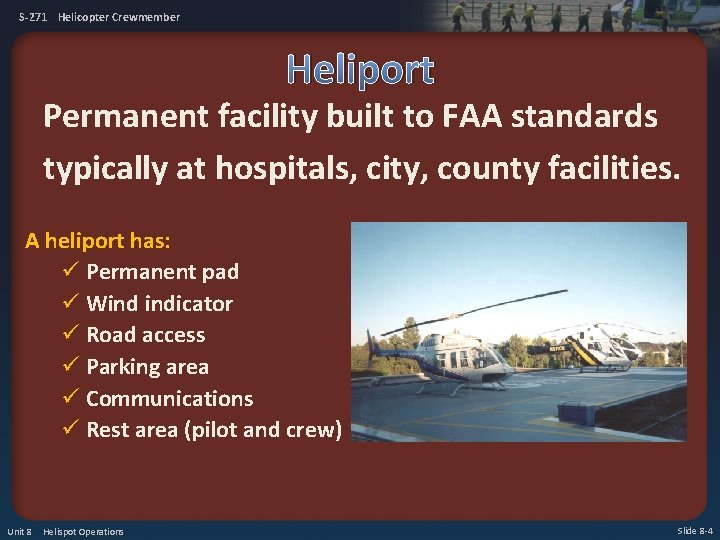
S-271 Helicopter Crewmember Heliport Permanent facility built to FAA standards typically at hospitals, city, county facilities. A heliport has: ü Permanent pad ü Wind indicator ü Road access ü Parking area ü Communications ü Rest area (pilot and crew) Unit 8 Helispot Operations Slide 8 -4
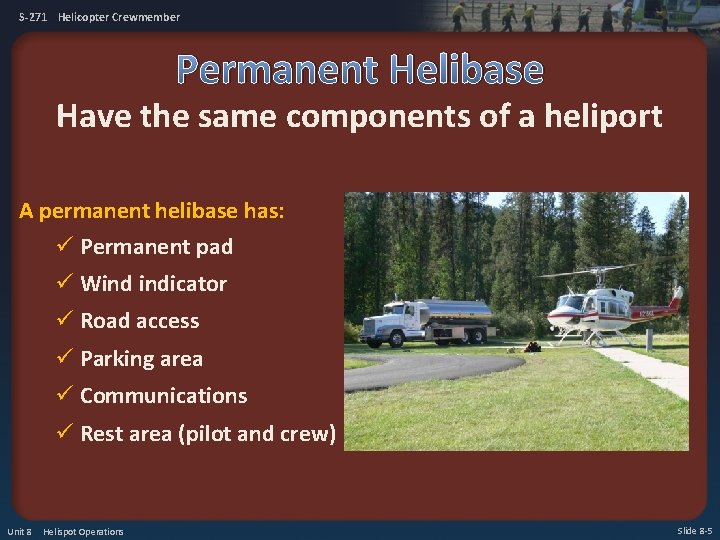
S-271 Helicopter Crewmember Permanent Helibase Have the same components of a heliport A permanent helibase has: ü Permanent pad ü Wind indicator ü Road access ü Parking area ü Communications ü Rest area (pilot and crew) Unit 8 Helispot Operations Slide 8 -5
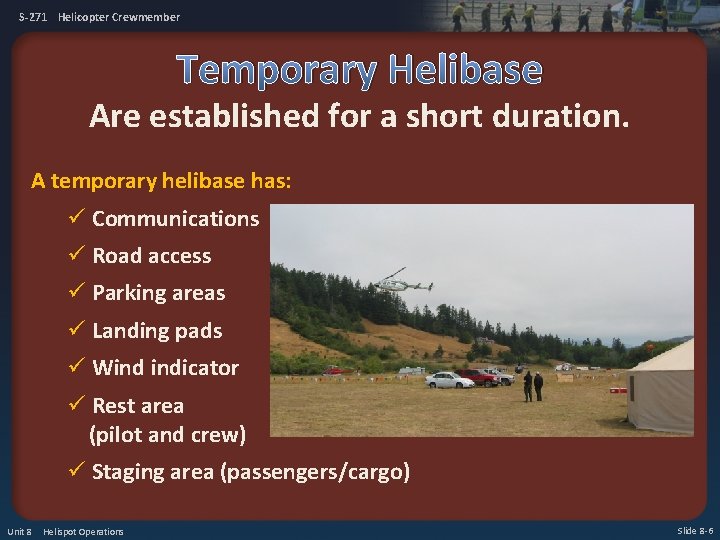
S-271 Helicopter Crewmember Temporary Helibase Are established for a short duration. A temporary helibase has: ü Communications ü Road access ü Parking areas ü Landing pads ü Wind indicator ü Rest area (pilot and crew) ü Staging area (passengers/cargo) Unit 8 Helispot Operations Slide 8 -6
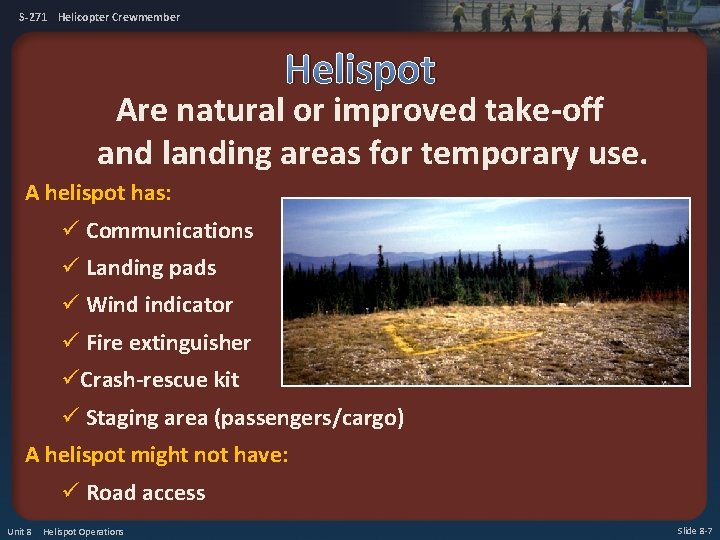
S-271 Helicopter Crewmember Helispot Are natural or improved take-off and landing areas for temporary use. A helispot has: ü Communications ü Landing pads ü Wind indicator ü Fire extinguisher üCrash-rescue kit ü Staging area (passengers/cargo) A helispot might not have: ü Road access Unit 8 Helispot Operations Slide 8 -7
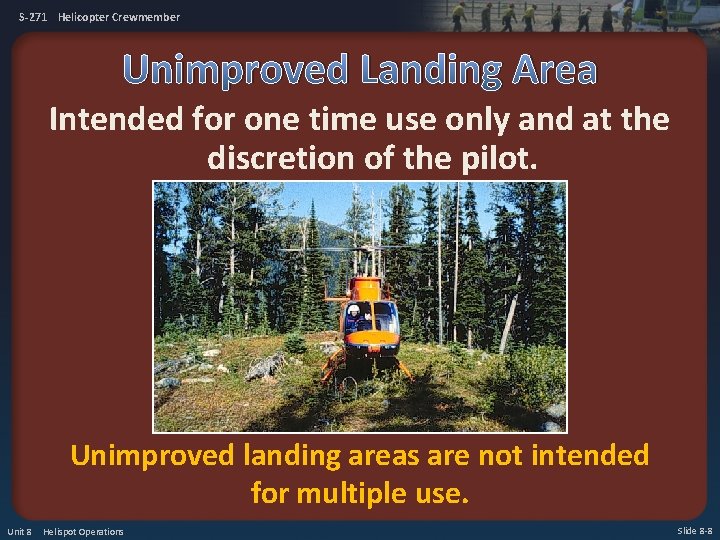
S-271 Helicopter Crewmember Unimproved Landing Area Intended for one time use only and at the discretion of the pilot. Unimproved landing areas are not intended for multiple use. Unit 8 Helispot Operations Slide 8 -8
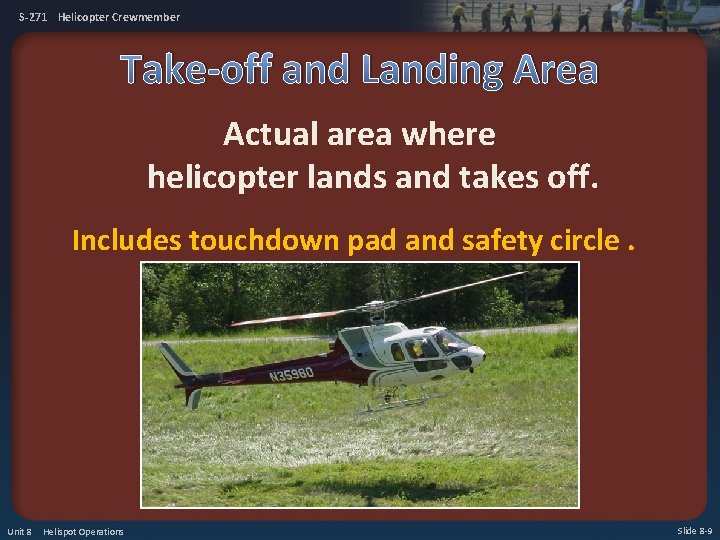
S-271 Helicopter Crewmember Take-off and Landing Area Actual area where helicopter lands and takes off. Includes touchdown pad and safety circle. Unit 8 Helispot Operations Slide 8 -9
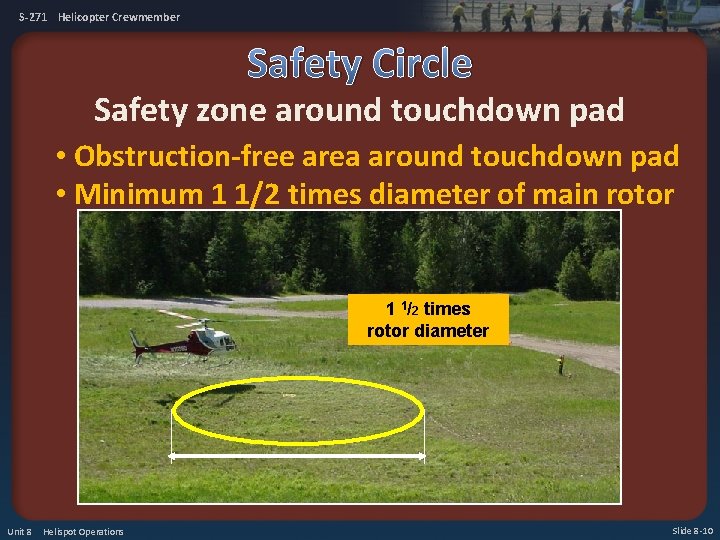
S-271 Helicopter Crewmember Safety Circle Safety zone around touchdown pad • Obstruction-free area around touchdown pad • Minimum 1 1/2 times diameter of main rotor 1 1/2 times rotor diameter Unit 8 Helispot Operations Slide 8 -10
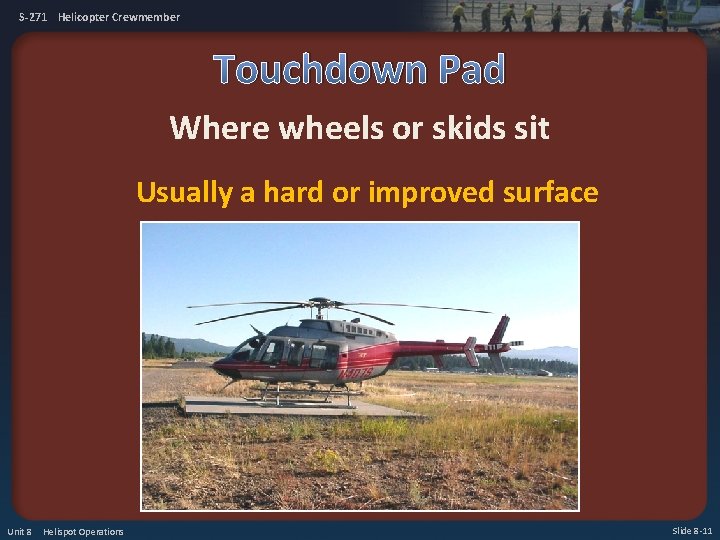
S-271 Helicopter Crewmember Touchdown Pad Where wheels or skids sit Usually a hard or improved surface Unit 8 Helispot Operations Slide 8 -11
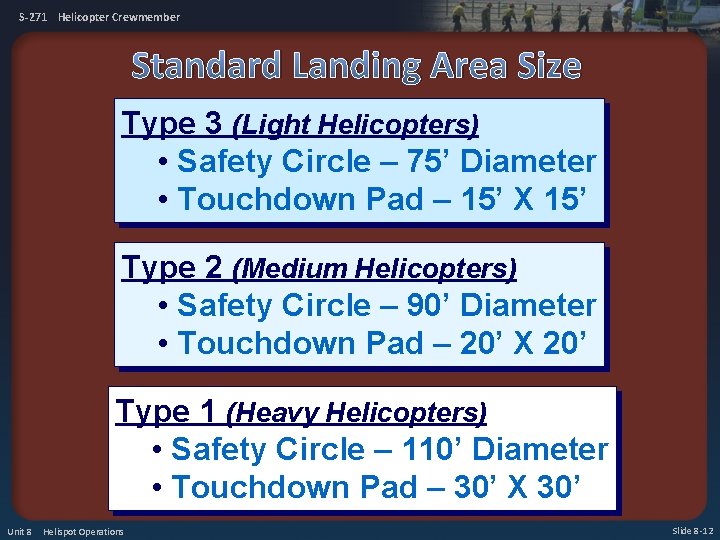
S-271 Helicopter Crewmember Standard Landing Area Size Type 3 (Light Helicopters) • Safety Circle – 75’ Diameter • Touchdown Pad – 15’ X 15’ Type 2 (Medium Helicopters) • Safety Circle – 90’ Diameter • Touchdown Pad – 20’ X 20’ Type 1 (Heavy Helicopters) • Safety Circle – 110’ Diameter • Touchdown Pad – 30’ X 30’ Unit 8 Helispot Operations Slide 8 -12
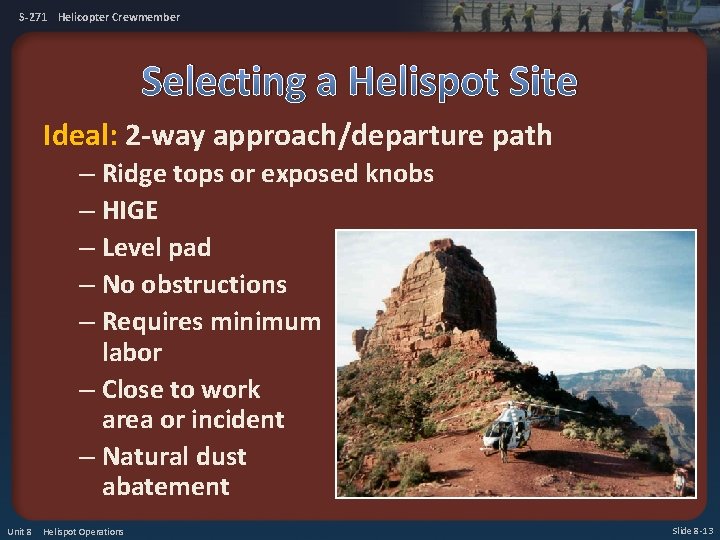
S-271 Helicopter Crewmember Selecting a Helispot Site Ideal: 2 -way approach/departure path – Ridge tops or exposed knobs – HIGE – Level pad – No obstructions – Requires minimum labor – Close to work area or incident – Natural dust abatement Unit 8 Helispot Operations Slide 8 -13
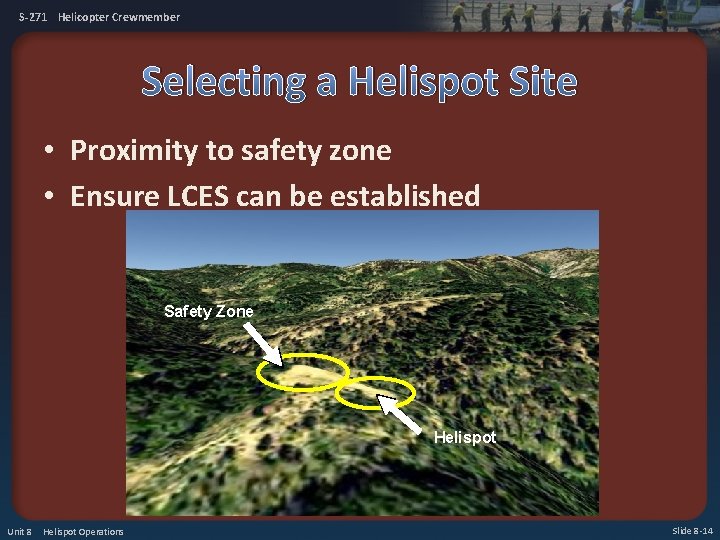
S-271 Helicopter Crewmember Selecting a Helispot Site • Proximity to safety zone • Ensure LCES can be established Safety Zone Helispot Unit 8 Helispot Operations Slide 8 -14
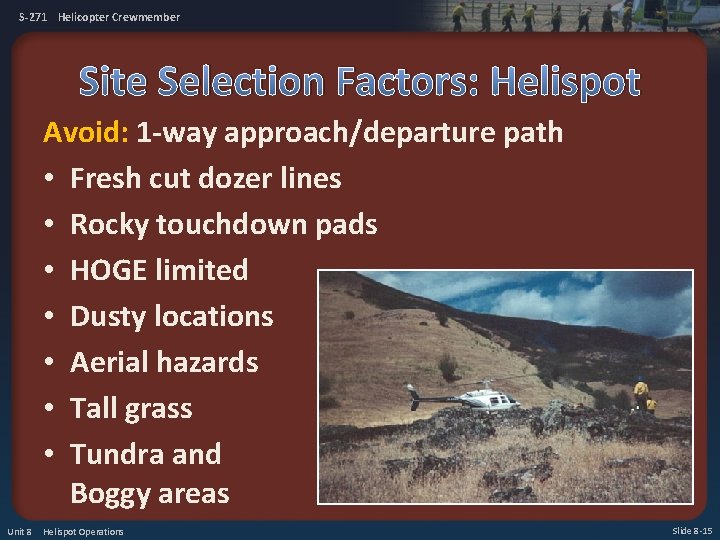
S-271 Helicopter Crewmember Site Selection Factors: Helispot Avoid: 1 -way approach/departure path • Fresh cut dozer lines • Rocky touchdown pads • HOGE limited • Dusty locations • Aerial hazards • Tall grass • Tundra and Boggy areas Unit 8 Helispot Operations Slide 8 -15
S-271 Helicopter Crewmember Site Selection Factors: Helispot Avoid: 1 -way approach/departure path • Sloping touchdown pads • Lee side turbulence (downdrafts, wind shear) • Trash and debris • Pinnacles requiring high power-on landings • Nearby commercial flight patterns • Nearby populated area Unit 8 Helispot Operations Slide 8 -16
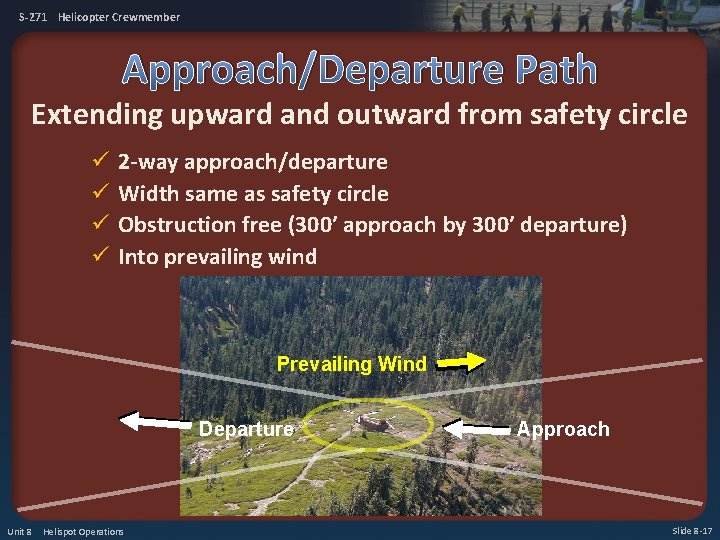
S-271 Helicopter Crewmember Approach/Departure Path Extending upward and outward from safety circle ü ü 2 -way approach/departure Width same as safety circle Obstruction free (300’ approach by 300’ departure) Into prevailing wind Prevailing Wind Departure Unit 8 Helispot Operations Approach Slide 8 -17
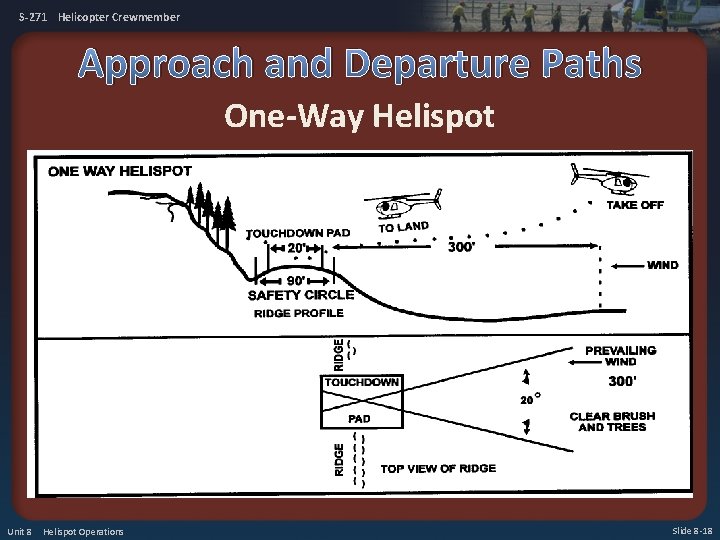
S-271 Helicopter Crewmember Approach and Departure Paths One-Way Helispot Unit 8 Helispot Operations Slide 8 -18
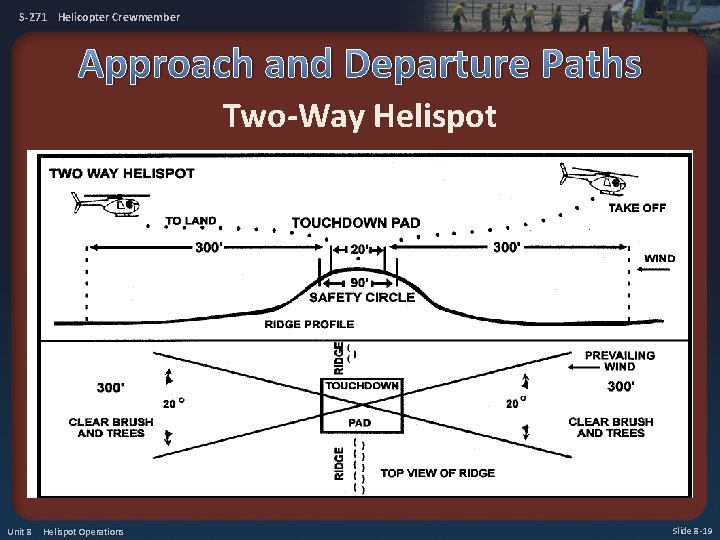
S-271 Helicopter Crewmember Approach and Departure Paths Two-Way Helispot Unit 8 Helispot Operations Slide 8 -19
S-271 Helicopter Crewmember Helispot Site Construction • Hand construction preferred, minimal impact. • Be aware of construction restraints follow local policy. • Construction in timber will take time to establish, take the extra time to find another location. Unit 8 Helispot Operations Slide 8 -20
S-271 Helicopter Crewmember Helispot Construction Remove all brush and trees with the following diameter safety circle around the touchdown pad according to the size of the helicopter. • 75 -feet for type 3 helicopters. • 90 -feet for type 2 helicopters. • 110 feet for type 1 helicopters (such as UH-60, S-61 N, and Boeing-Vertol 107) Unit 8 Helispot Operations Slide 8 -21
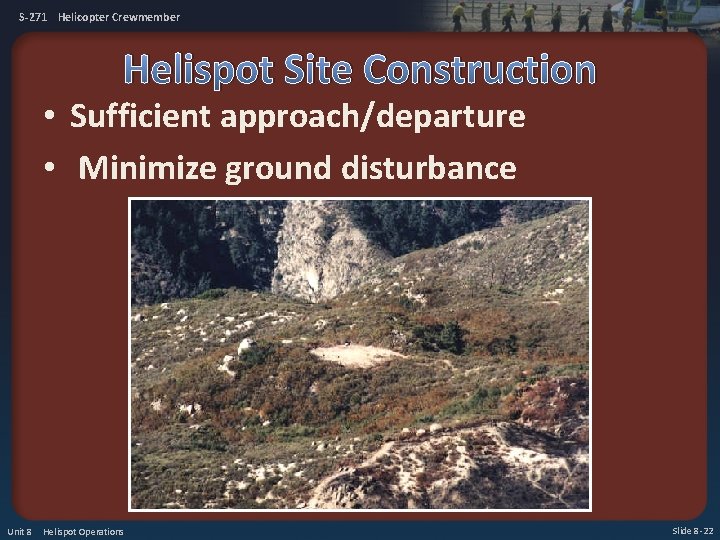
S-271 Helicopter Crewmember Helispot Site Construction • Sufficient approach/departure • Minimize ground disturbance Unit 8 Helispot Operations Slide 8 -22
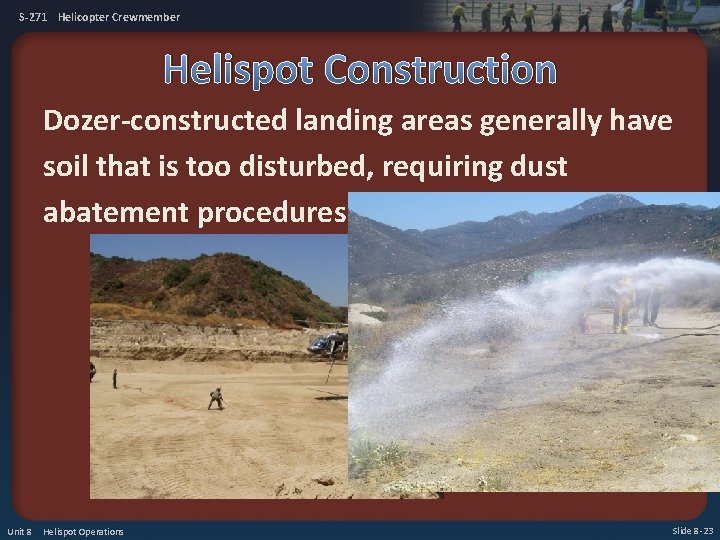
S-271 Helicopter Crewmember Helispot Construction Dozer-constructed landing areas generally have soil that is too disturbed, requiring dust abatement procedures. Unit 8 Helispot Operations Slide 8 -23
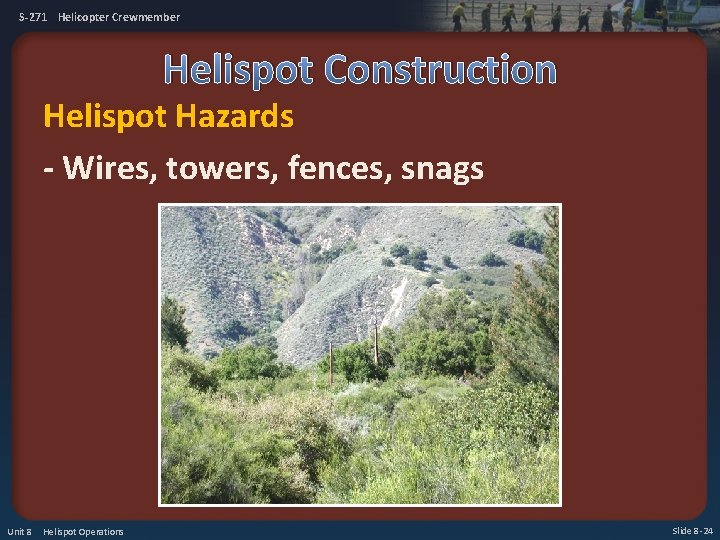
S-271 Helicopter Crewmember Helispot Construction Helispot Hazards - Wires, towers, fences, snags Unit 8 Helispot Operations Slide 8 -24
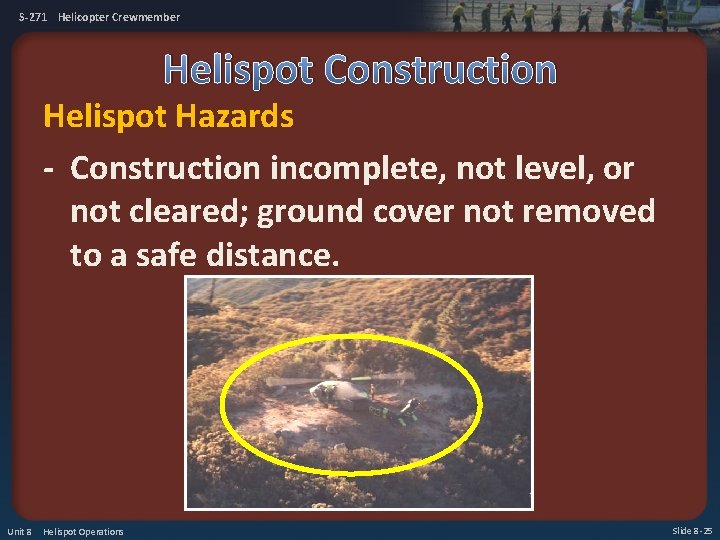
S-271 Helicopter Crewmember Helispot Construction Helispot Hazards - Construction incomplete, not level, or not cleared; ground cover not removed to a safe distance. Unit 8 Helispot Operations Slide 8 -25
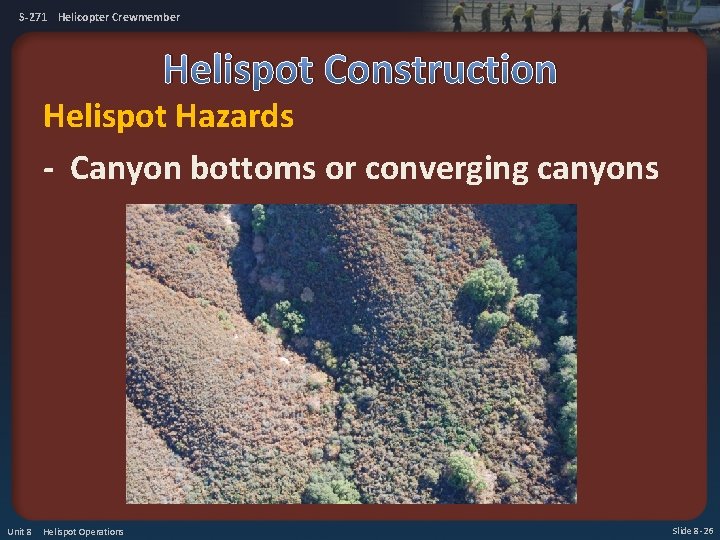
S-271 Helicopter Crewmember Helispot Construction Helispot Hazards - Canyon bottoms or converging canyons Unit 8 Helispot Operations Slide 8 -26
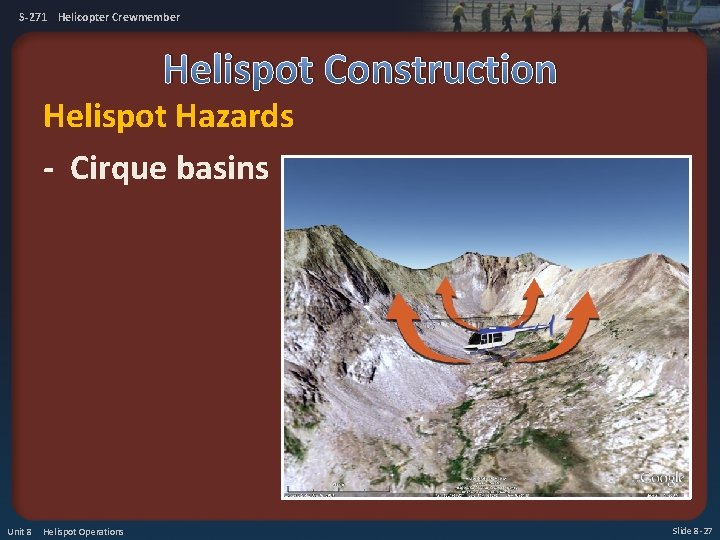
S-271 Helicopter Crewmember Helispot Construction Helispot Hazards - Cirque basins Unit 8 Helispot Operations Slide 8 -27
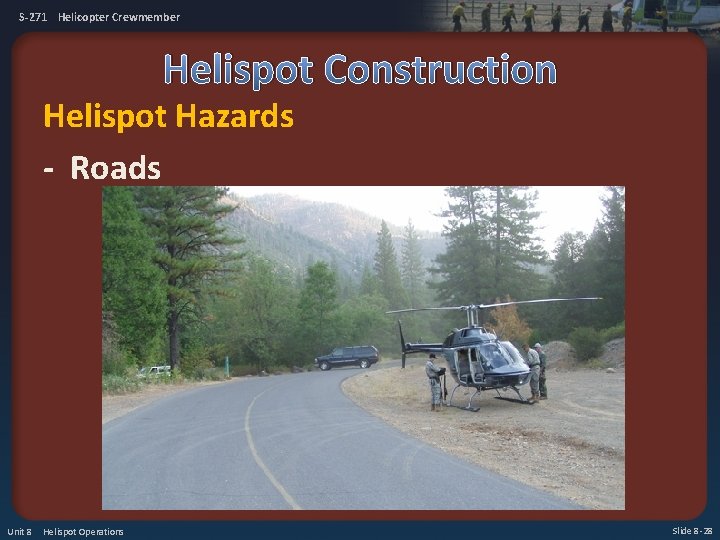
S-271 Helicopter Crewmember Helispot Construction Helispot Hazards - Roads Unit 8 Helispot Operations Slide 8 -28
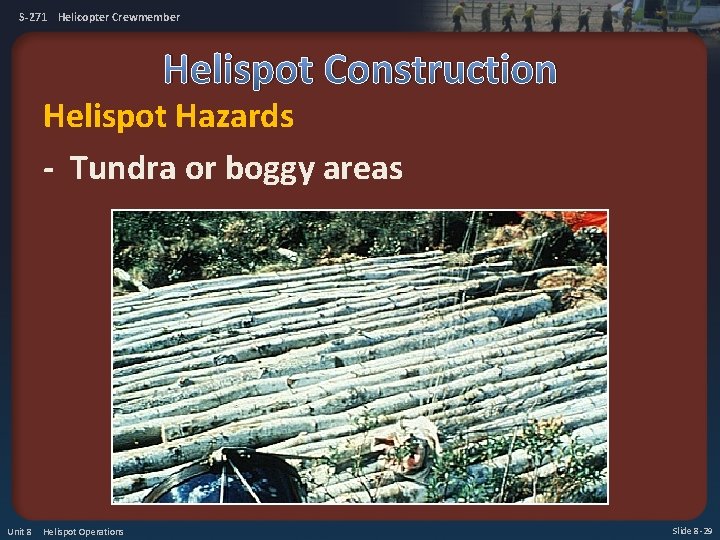
S-271 Helicopter Crewmember Helispot Construction Helispot Hazards - Tundra or boggy areas Unit 8 Helispot Operations Slide 8 -29
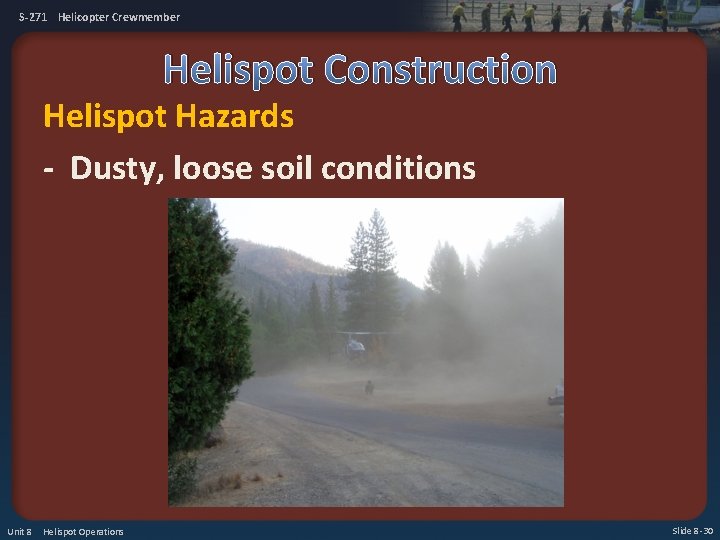
S-271 Helicopter Crewmember Helispot Construction Helispot Hazards - Dusty, loose soil conditions Unit 8 Helispot Operations Slide 8 -30
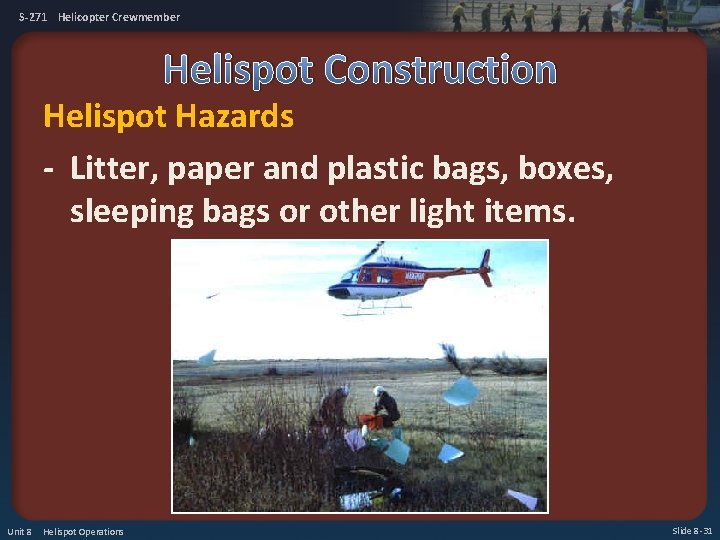
S-271 Helicopter Crewmember Helispot Construction Helispot Hazards - Litter, paper and plastic bags, boxes, sleeping bags or other light items. Unit 8 Helispot Operations Slide 8 -31
S-271 Helicopter Crewmember Helispot Construction Helispot Hazards - Personnel working around landing area should brace themselves when larger helicopters are landing or taking off due to the velocity of the rotor downwash. Unit 8 Helispot Operations Slide 8 -32
S-271 Helicopter Crewmember HELISPOT EXERCISE As a class, evaluate advantages and disadvantages of each of the following helispots. Unit 8 Helispot Operations Slide 8 -33
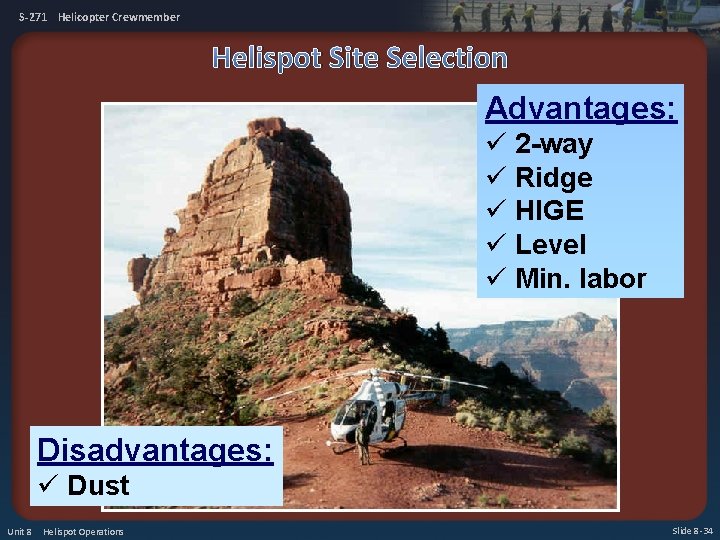
S-271 Helicopter Crewmember Helispot Site Selection Advantages: ü 2 -way ü Ridge ü HIGE ü Level ü Min. labor Disadvantages: ü Dust Unit 8 Helispot Operations Slide 8 -34
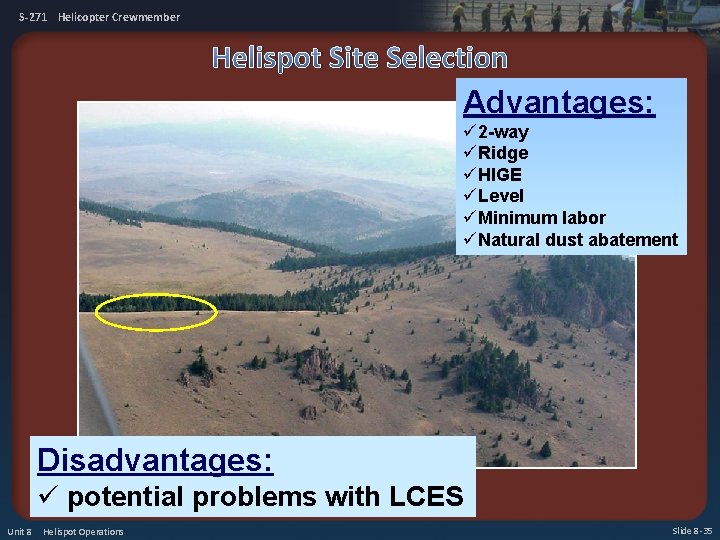
S-271 Helicopter Crewmember Helispot Site Selection Advantages: ü 2 -way üRidge üHIGE üLevel üMinimum labor üNatural dust abatement Disadvantages: ü potential problems with LCES Unit 8 Helispot Operations Slide 8 -35
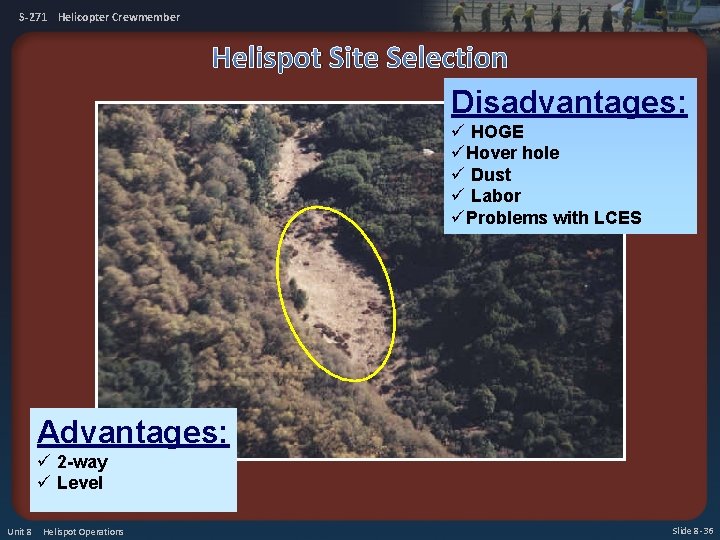
S-271 Helicopter Crewmember Helispot Site Selection Disadvantages: ü HOGE üHover hole ü Dust ü Labor üProblems with LCES Advantages: ü 2 -way ü Level Unit 8 Helispot Operations Slide 8 -36
S-271 Helicopter Crewmember Helispot Manager Duties and Responsibilities Helispot Equipment Needs Required supplies at helispot: • Wind indicator • 20 BC fire extinguisher (40 lbs. ) • Evacuation/crash rescue kit • Pad marker or other marker • Hanging scale Unit 8 Helispot Operations Slide 8 -37
S-271 Helicopter Crewmember Helispot Manager Duties and Responsibilities Helispot Equipment Needs Recommended supplies for personnel staffing helispot: • Allowable payloads (HIGE & HOGE) for all helicopters using helispot • Passenger/cargo manifest book • Fiber tape • Flagging Unit 8 Helispot Operations Slide 8 -38
S-271 Helicopter Crewmember Helispot Manager Duties and Responsibilities Unit 8 Helispot Equipment Needs Recommended supplies for personnel staffing helispot: • Pocket calculator • Line gear • Food and drinking water • Passenger briefing cards • Radio • Incident action plan (IAP) and/or Operations Plan Helispot Operations Slide 8 -39
S-271 Helicopter Crewmember Helispot Manager Duties and Responsibilities Personnel Assigned to a Helispot management assignments will normally be given out at the morning briefing at helibase. • Ensure that daily missions to helispot are understood. • Flight helmets must be worn when flying to staff a helispot unless LE waiver in effect. • The helispot should not be made operational until the helispot manager informs the helibase that they are ready to receive personnel and/or cargo. Unit 8 Helispot Operations Slide 8 -40
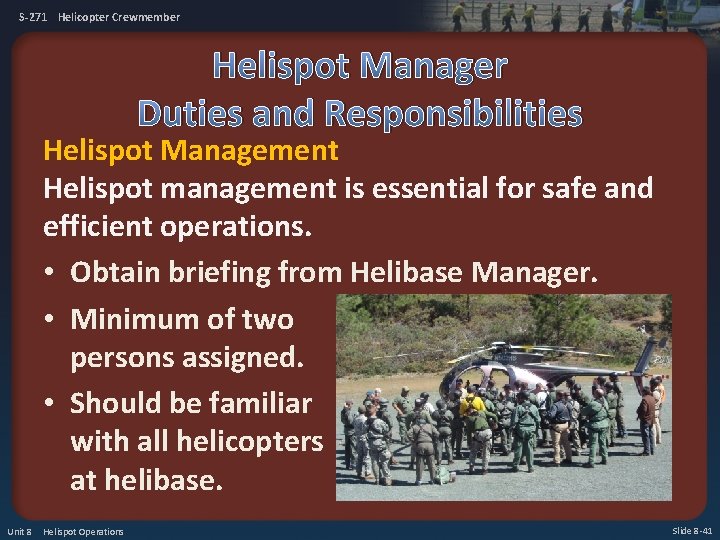
S-271 Helicopter Crewmember Helispot Manager Duties and Responsibilities Helispot Management Helispot management is essential for safe and efficient operations. • Obtain briefing from Helibase Manager. • Minimum of two persons assigned. • Should be familiar with all helicopters at helibase. Unit 8 Helispot Operations Slide 8 -41
S-271 Helicopter Crewmember Helispot Manager Duties and Responsibilities Helispot Management • As the helispot operation becomes more complex, additional people may be needed to provide support. • Ensure that qualified helicopter crew members are assigned to assist in helispot management • Provide on-the-job training as necessary. • Conduct regular briefings with helispot crew. Unit 8 Helispot Operations Slide 8 -42
S-271 Helicopter Crewmember Helispot Manager Duties and Responsibilities Helispot Management • Ensure all assigned personnel understand their responsibilities and authority. • Manage resources/supplies dispatched to the helispot. • Ensure that all helispot personnel are capable and prepared to perform law Enfocement duties in and around the helispot. • Ensure that helispot crew is equipped to remain overnight, even in adverse weather conditions. Unit 8 Helispot Operations Slide 8 -43
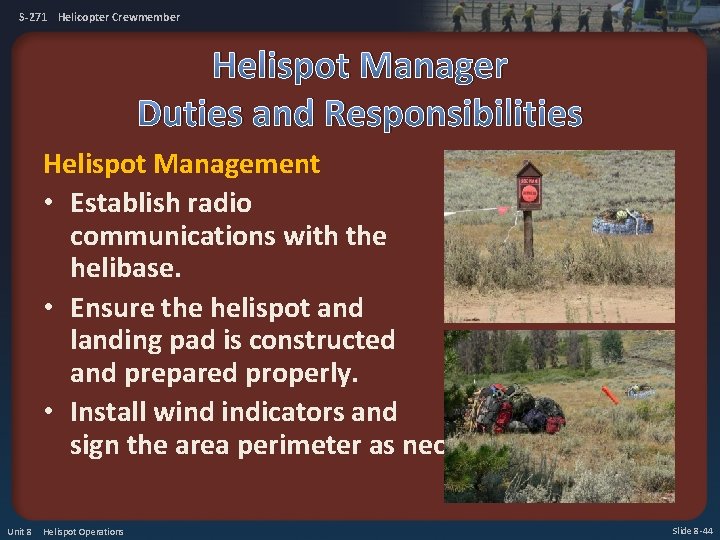
S-271 Helicopter Crewmember Helispot Manager Duties and Responsibilities Helispot Management • Establish radio communications with the helibase. • Ensure the helispot and landing pad is constructed and prepared properly. • Install wind indicators and sign the area perimeter as necessary. Unit 8 Helispot Operations Slide 8 -44
S-271 Helicopter Crewmember Helispot Manager Duties and Responsibilities Helispot Management • Perform any necessary aerial and ground hazard reduction and safety improvements. • Anticipate dust abatement needs and provide or request as necessary. • Ensure crash-rescue equipment is available. • Ensure that flight routes and aerial hazards are made known to all pilots. • Ensure manifests and briefings are timely and accurate. Unit 8 Helispot Operations Slide 8 -45
S-271 Helicopter Crewmember Helispot Manager Duties and Responsibilities Helispot Management • Return external load equipment (nets, leadlines, swivels) and excess equipment to the helibase promptly. • Inform Helibase Manager of helispot activities. • If returned to the helibase, attend the nightly debriefing and provide feedback on the day’s operations; otherwise, provide by radio. • Helispot crews should be continuously cleaning the helispots of garbage and loose debris. Unit 8 Helispot Operations Slide 8 -46
S-271 Helicopter Crewmember Apply Risk Management • Refer to IRPG and apply the Risk Management Process. • Follow the process to determine the helispot can function safely. • Inform helibase manager of changes. • Wait for instructions to cease or continue helispot operations. Unit 8 Helispot Operations Slide 8 -47
S-271 Helicopter Crewmember Risk Management Applied EXERCISE Refer to Risk Management Process in IRPG Unit 8 Helispot Operations Slide 8 -48

S-271 Helicopter Crewmember Questions and Review Unit 8 Helispot Operations Slide 8 -49
S-271 Helicopter Crewmember Unit 8 Objectives 1. Describe the process for staffing and preparing a landing area or helispot. 2. Define the methods for constructing landing areas or helispots. 3. Describe the duties performed in managing a helispot. Unit 8 Helispot Operations Slide 8 -50
- Slides: 50