
S190 Introduction to Wildland Fire Behavior S190 Course
S-190: Introduction to Wildland Fire Behavior S-190: Course Introduction 1

Course Objectives Student will be able to: • Describe the basic terminology used in wildland fire. • Identify and discuss the fire triangle. • Identify and discuss key characteristics of the primary wildland fire environment components fuels, weather, and topography. • Identify critical fire weather factors that, combined with receptive fuels, may result in extreme fire behavior. • Recognize how alignment of fuels, weather, and topography can increase the potential for extreme fire behavior. S-190: Course Introduction 2

Measurement of Objectives Achievement of course and unit objectives is measured using one or more of the following methods: • Class or group discussion • Instructor or coach observation and feedback • Knowledge checks • Knowledge assessment • Skill assessment • Course Evaluation Task Sheet S-190: Course Introduction 3
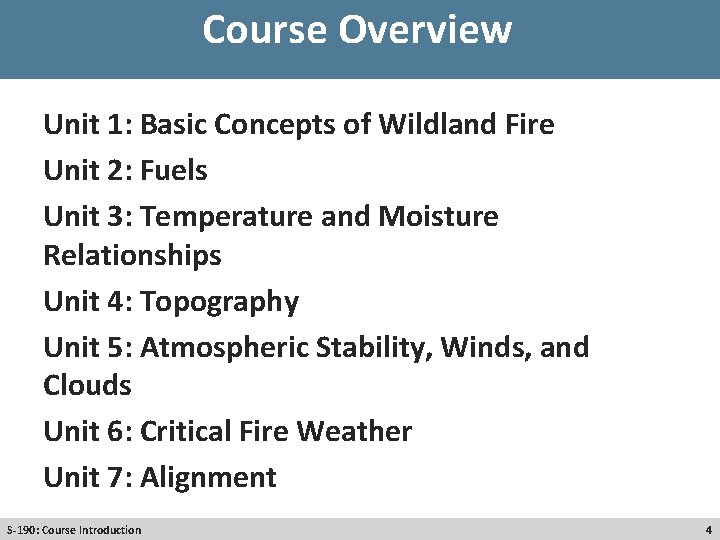
Course Overview Unit 1: Basic Concepts of Wildland Fire Unit 2: Fuels Unit 3: Temperature and Moisture Relationships Unit 4: Topography Unit 5: Atmospheric Stability, Winds, and Clouds Unit 6: Critical Fire Weather Unit 7: Alignment S-190: Course Introduction 4
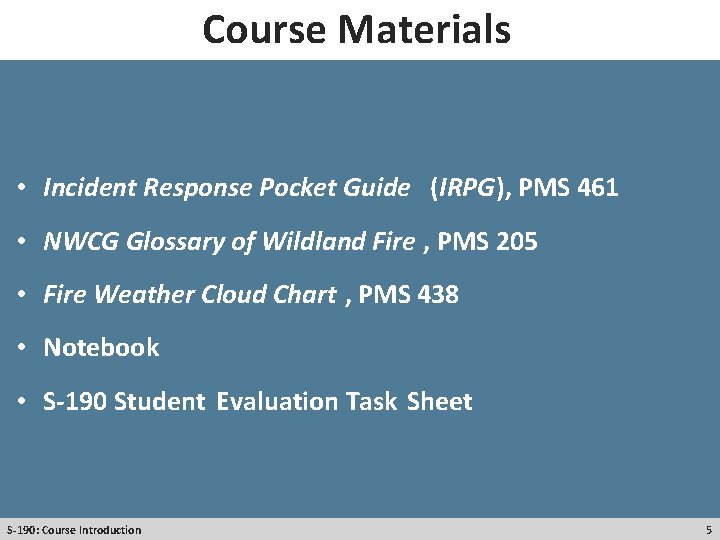
Course Materials • Incident Response Pocket Guide (IRPG), PMS 461 • NWCG Glossary of Wildland Fire , PMS 205 • Fire Weather Cloud Chart , PMS 438 • Notebook • S-190 Student Evaluation Task Sheet S-190: Course Introduction 5

Evaluating Student Performance S-190 Student Evaluation Task Sheet • Completed throughout the class. • Reviewed by instructors at end of class. • Modeled after NWCG Position Task Books. S-190: Course Introduction 6
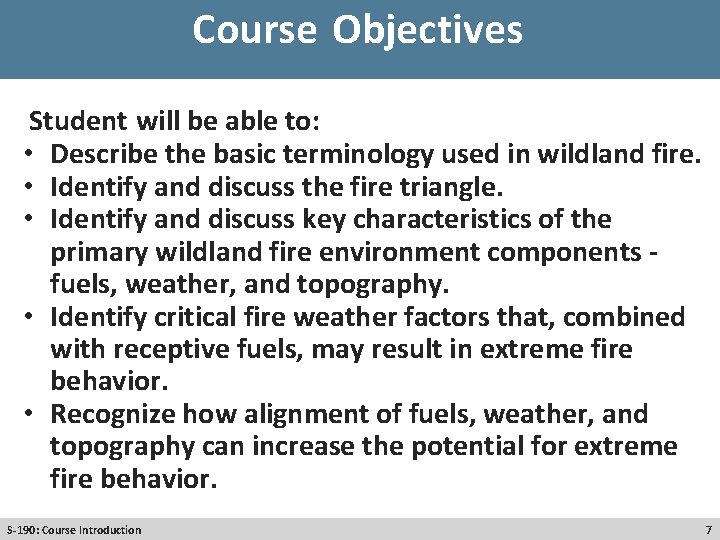
Course Objectives Student will be able to: • Describe the basic terminology used in wildland fire. • Identify and discuss the fire triangle. • Identify and discuss key characteristics of the primary wildland fire environment components fuels, weather, and topography. • Identify critical fire weather factors that, combined with receptive fuels, may result in extreme fire behavior. • Recognize how alignment of fuels, weather, and topography can increase the potential for extreme fire behavior. S-190: Course Introduction 7
- Slides: 7