
S USA 10m y Island arc assemblage USA
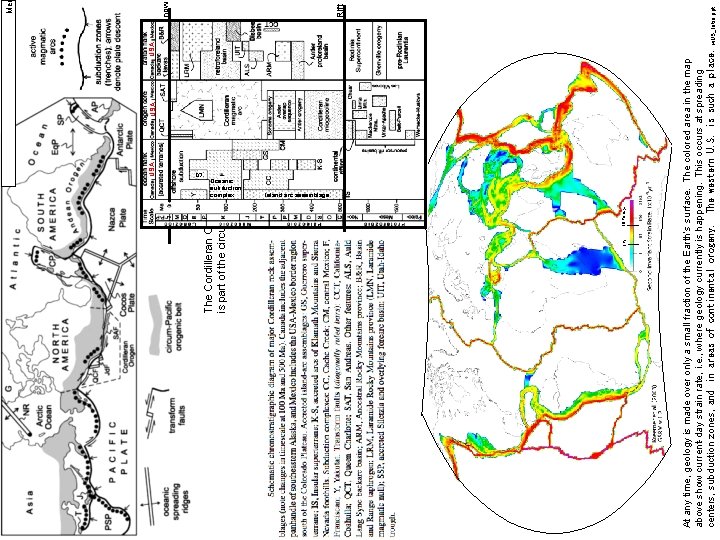
S USA 10%/m. y. Island arc assemblage USA Rift now Me At any time, geology is made over only a small fraction of the Earth’s surface. The colored area in the map above show current-day strain rate, i. e. , where geology currently is happening. This occurs at spreading centers, subduction zones, and in areas of continental orogeny. The western U. S. is such a place. w. US_Intro. ppt 1% The Cordilleran Orogen of western North America is part of the circum-Pacific orogenic belt. Oceanic subduction complex
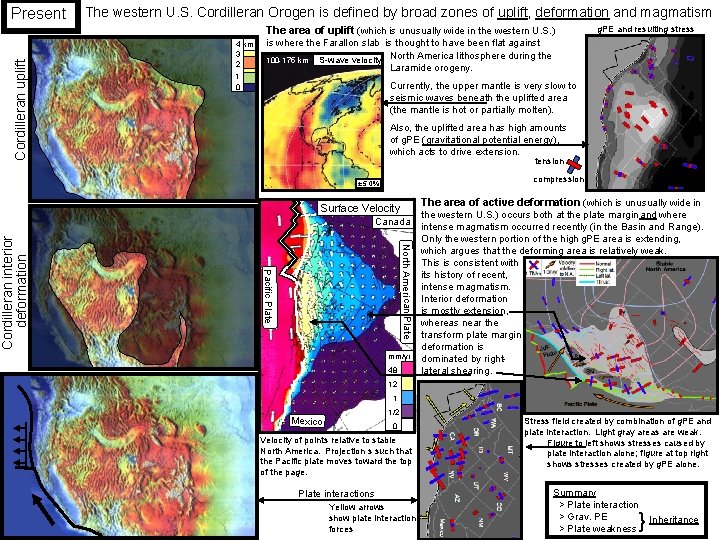
Present The western U. S. Cordilleran Orogen is defined by broad zones of uplift, deformation and magmatism 4 km 3 2 1 0 g. PE and resulting stress is where the Farallon slab is thought to have been flat against North America lithosphere during the 100 -175 km S-wave velocity Laramide orogeny. Currently, the upper mantle is very slow to seismic waves beneath the uplifted area (the mantle is hot or partially molten). Also, the uplifted area has high amounts of g. PE (gravitational potential energy), which acts to drive extension compression ± 5. 0% Surface Velocity Canada North American Plate Pacific Plate Cordilleran interior deformation Cordilleran uplift The area of uplift (which is unusually wide in the western U. S. ) mm/yr 48 The area of active deformation (which is unusually wide in the western U. S. ) occurs both at the plate margin and where intense magmatism occurred recently (in the Basin and Range). Only the western portion of the high g. PE area is extending, which argues that the deforming area is relatively weak. This is consistent with its history of recent, intense magmatism. Interior deformation is mostly extension, whereas near the transform plate margin deformation is dominated by rightlateral shearing. 12 1 1/2 Mexico 0 Velocity of points relative to stable North America. Projection s such that the Pacific plate moves toward the top of the page. Plate interactions Yellow arrows show plate interaction forces Stress field created by combination of g. PE and plate interaction. Light gray areas are weak. Figure to left shows stresses caused by plate interaction alone; figure at top right shows stresses created by g. PE alone. Summary > Plate interaction > Grav. PE > Plate weakness } Inheritance
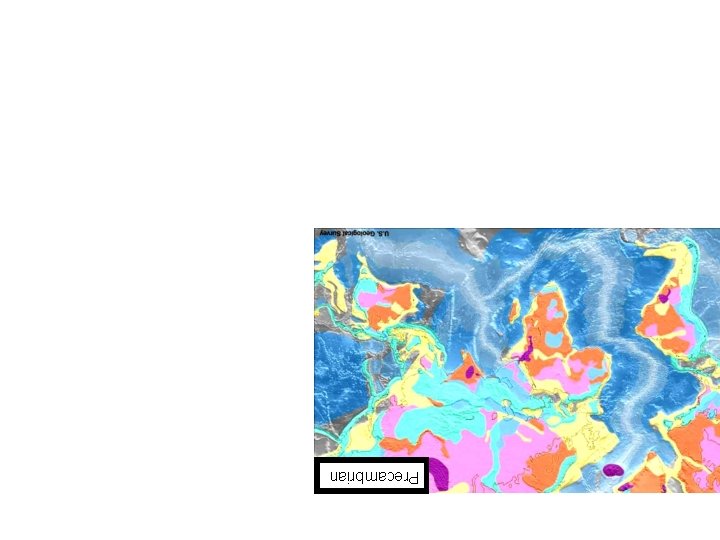
Precambrian
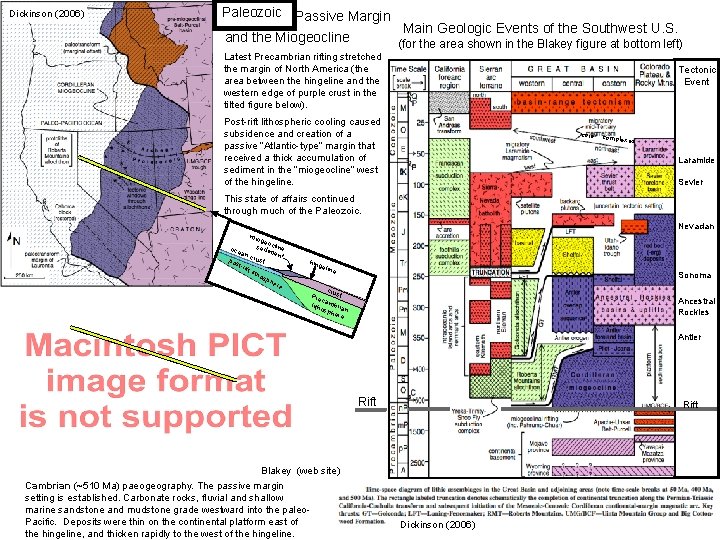
Dickinson (2006) Paleozoic Passive Margin and the Miogeocline Main Geologic Events of the Southwest U. S. (for the area shown in the Blakey figure at bottom left) Latest Precambrian rifting stretched the margin of North America (the area between the hingeline and the western edge of purple crust in the tilted figure below). Tectonic Event Post-rift lithospheric cooling caused subsidence and creation of a passive “Atlantic-type” margin that received a thick accumulation of sediment in the “miogeocline” west of the hingeline. core complexes Laramide Sevier This state of affairs continued through much of the Paleozoic. Nevadan mio ge sed ocline oce ime an c nt rust po strift lith osp he re hing elin e Sonoma crus t Pre ca litho mbria sph n ere Ancestral Rockies Antler Rift Blakey (web site) Cambrian (~510 Ma) paeogeography. The passive margin setting is established. Carbonate rocks, fluvial and shallow marine sandstone and mudstone grade westward into the paleo. Pacific. Deposits were thin on the continental platform east of the hingeline, and thicken rapidly to the west of the hingeline. Dickinson (2006)
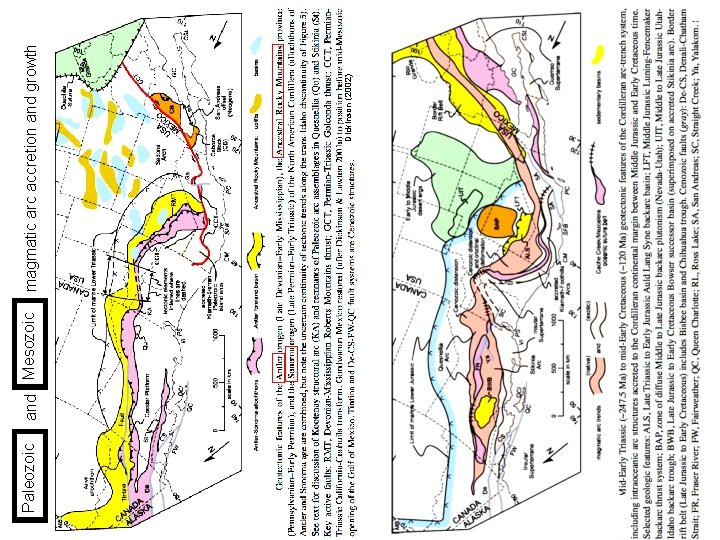
Paleozoic and Mesozoic Dickinson (2002) magmatic arc accretion and growth
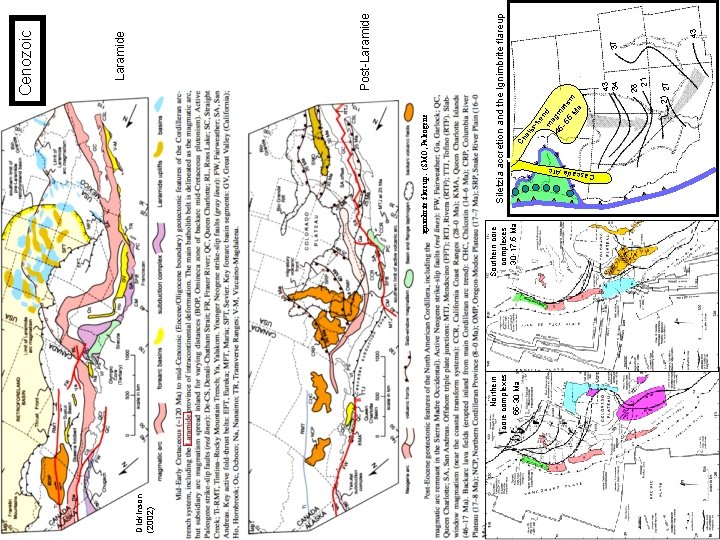
Dickinson (2002) 55 -30 Ma Northern core complexes Southern core complexes 30 -17. 5 Ma Post-Laramide Cenozoic 28 21 43 34 21 27 al lis -tr en m d ag 45 m - 5 atis 5 M m a Ch 37 43 Siletzia accretion and the Ignimbrite flareup ignimbrite flareup. (SMO, Paleogene Arc Cascade
- Slides: 6