
s u Basic Transmission Line Equations u Nine
s u Basic Transmission Line Equations u Nine Power Gains of Amplifiers u Linear and Nonlinear Synthesis/Analysis u Full-Wave Analysis for Microstrip 3/9/2021 1 t
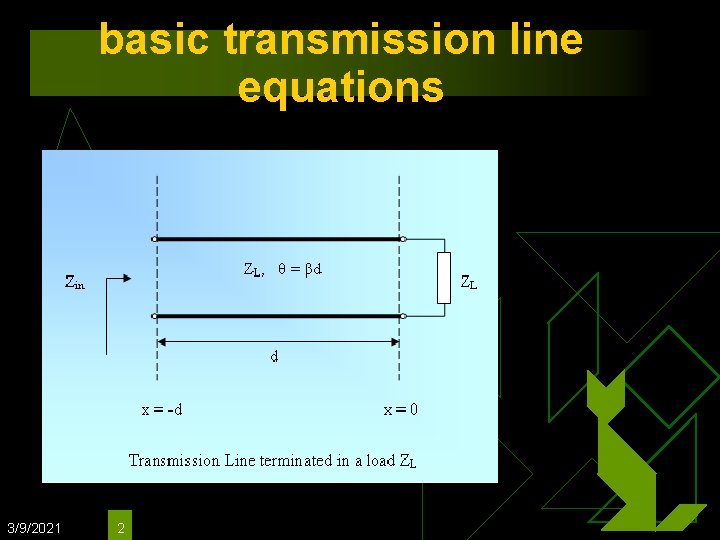
basic transmission line equations 3/9/2021 2
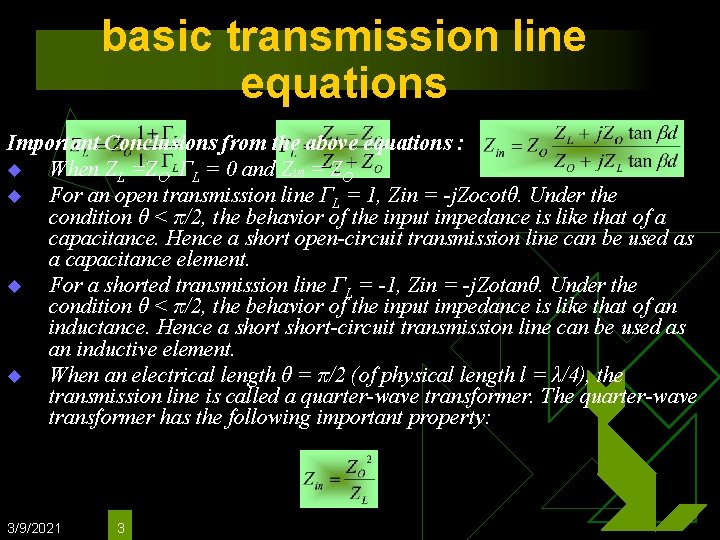
basic transmission line equations Important Conclusions from the above equations : u When ZL =ZO, ΓL = 0 and Zin = ZO u For an open transmission line ΓL = 1, Zin = -j. Zocotθ. Under the condition θ < π/2, the behavior of the input impedance is like that of a capacitance. Hence a short open-circuit transmission line can be used as a capacitance element. u For a shorted transmission line ΓL = -1, Zin = -j. Zotanθ. Under the condition θ < π/2, the behavior of the input impedance is like that of an inductance. Hence a short-circuit transmission line can be used as an inductive element. u When an electrical length θ = π/2 (of physical length l = λ/4), the transmission line is called a quarter-wave transformer. The quarter-wave transformer has the following important property: 3/9/2021 3

basic transmission line equations For a Matched Lossless two-port Transmission Line with electrical length θ: S ABCD matrix VSWR is the ratio of Vmax to Vmin. The relationship between VSWR and reflection coefficient is as follows: 3/9/2021 4
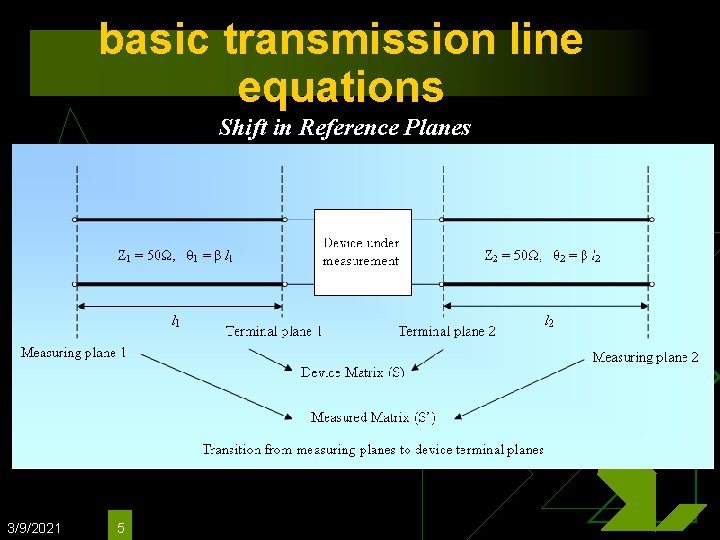
basic transmission line equations Shift in Reference Planes 3/9/2021 5
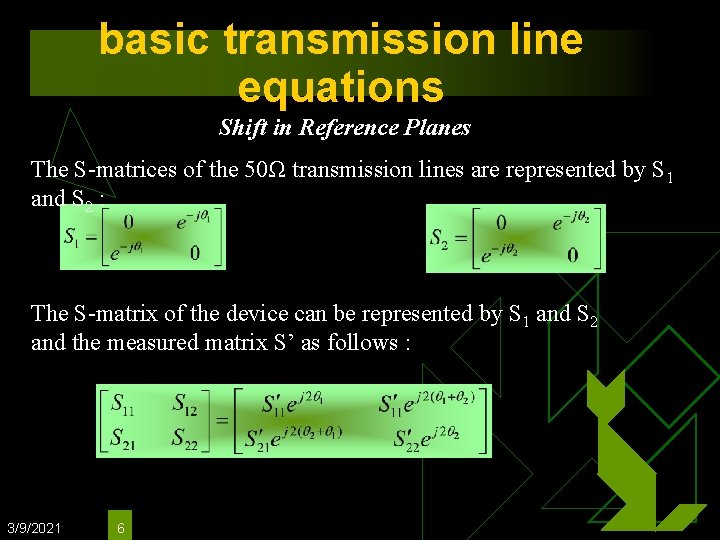
basic transmission line equations Shift in Reference Planes The S-matrices of the 50Ω transmission lines are represented by S 1 and S 2 : The S-matrix of the device can be represented by S 1 and S 2 and the measured matrix S’ as follows : 3/9/2021 6
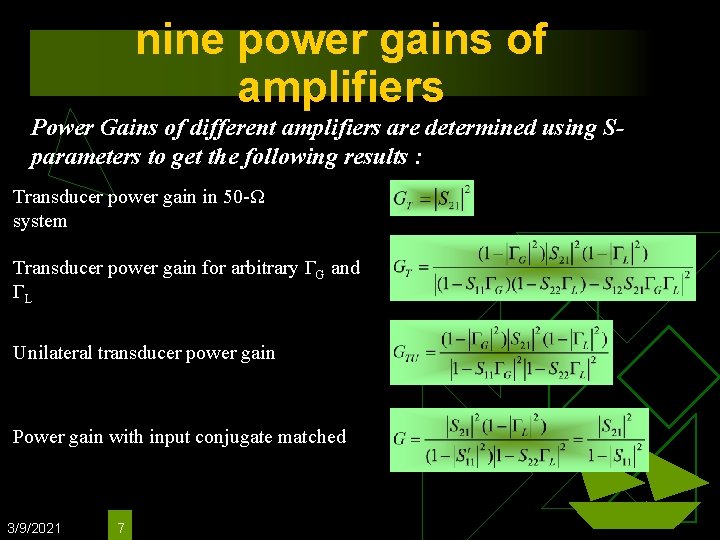
nine power gains of amplifiers Power Gains of different amplifiers are determined using Sparameters to get the following results : Transducer power gain in 50 -Ω system Transducer power gain for arbitrary ΓG and ΓL Unilateral transducer power gain Power gain with input conjugate matched 3/9/2021 7
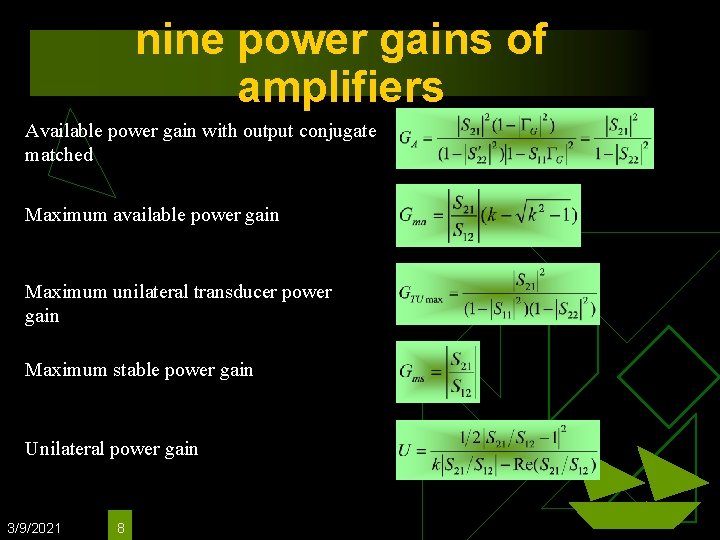
nine power gains of amplifiers Available power gain with output conjugate matched Maximum available power gain Maximum unilateral transducer power gain Maximum stable power gain Unilateral power gain 3/9/2021 8

full wave analysis for microstrip METHOD Spectral Domain Method FEATURES DISADVANTAGES § One of the most popular § Cannot handle thick conductor methods for infinitesimally thin structures conductors on multilayer § For tight coupling the number of structures basic functions becomes large; § Closed-form expressions for would involve convergent Fourier-transformed Green’s problems functions § Numerical efficiency Finite Difference Method § Mathematical preprocessing is § Numerically inefficient minimal § Precautions must be taken when § Can be applied to a wide the method is applied to an openrange of structures region problem § Need layer computer storage for accurate solution 3/9/2021 9

full wave analysis for microstrip METHOD FEATURES DISADVANTAGES Finite Element Method § Similar to the finite difference § Developed to solve very large method matrix equations Mode- Matching Method § Typically applied to the problem of scattering at the waveguide discontinuity § Has variational features in the § Numerically inefficient algorithm and is more flexible § Existence of so-called spurious in the application (unphysical) zeros § Often used to solve enclosed planar structures, including metal thickness effects 3/9/2021 10 § Several different formulations possible, all theoretically equivalent; however, they may be different numerically § Precautions must be taken on relative convergence for some problems

full wave analysis for microstrip METHOD Equivalent Waveguide Model 3/9/2021 11 FEATURES § Very useful method for analysis of microstrip discontinuity problem DISADVANTAGES
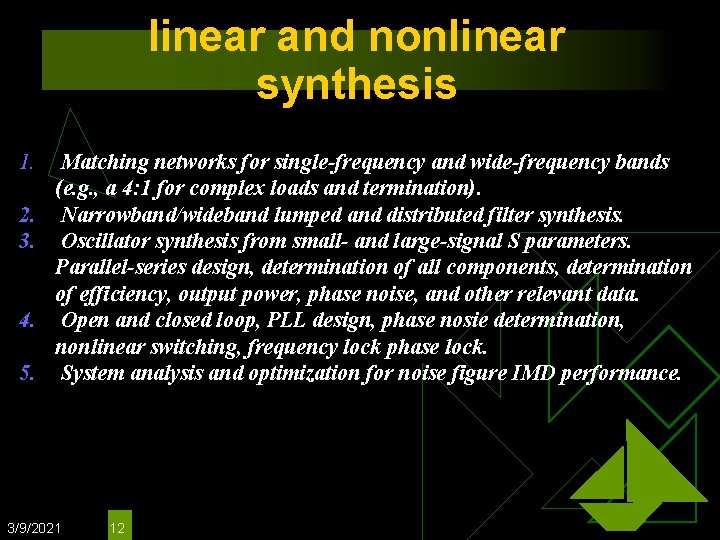
linear and nonlinear synthesis 1. 2. 3. 4. 5. Matching networks for single-frequency and wide-frequency bands (e. g. , a 4: 1 for complex loads and termination). Narrowband/wideband lumped and distributed filter synthesis. Oscillator synthesis from small- and large-signal S parameters. Parallel-series design, determination of all components, determination of efficiency, output power, phase noise, and other relevant data. Open and closed loop, PLL design, phase nosie determination, nonlinear switching, frequency lock phase lock. System analysis and optimization for noise figure IMD performance. 3/9/2021 12
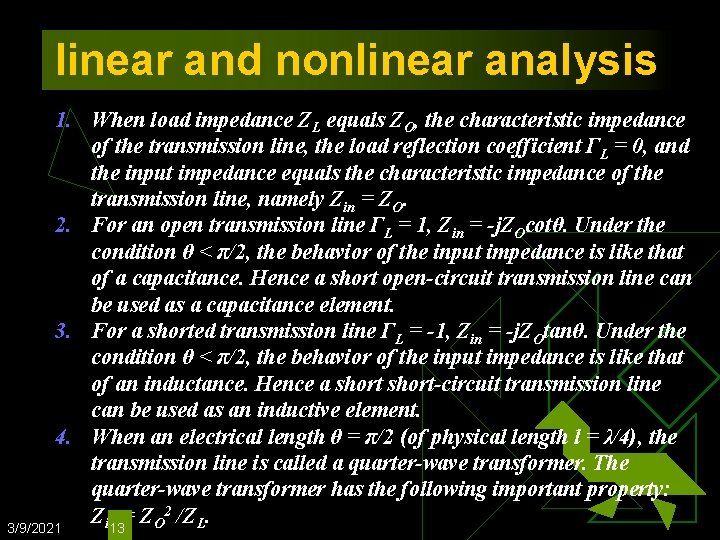
linear and nonlinear analysis 1. When load impedance ZL equals ZO, the characteristic impedance of the transmission line, the load reflection coefficient ΓL = 0, and the input impedance equals the characteristic impedance of the transmission line, namely Zin = ZO. 2. For an open transmission line ΓL = 1, Zin = -j. ZOcotθ. Under the condition θ < π/2, the behavior of the input impedance is like that of a capacitance. Hence a short open-circuit transmission line can be used as a capacitance element. 3. For a shorted transmission line ΓL = -1, Zin = -j. ZOtanθ. Under the condition θ < π/2, the behavior of the input impedance is like that of an inductance. Hence a short-circuit transmission line can be used as an inductive element. 4. When an electrical length θ = π/2 (of physical length l = λ/4), the transmission line is called a quarter-wave transformer. The quarter-wave transformer has the following important property: 2 /Z. Z = Z in O L 3/9/2021 13
- Slides: 13