
S L A R E T A L



- Slides: 49
S L A R E T A L I R QUAD CONCEPT 27
WHAT IS A QUADRILATERAL? • A quadrilateral is a 4 sided polygon (all straight sides and encloses space).
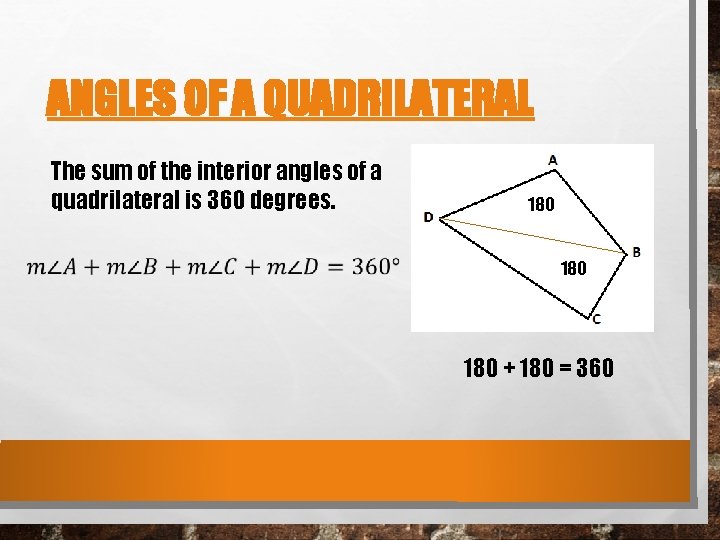
ANGLES OF A QUADRILATERAL The sum of the interior angles of a quadrilateral is 360 degrees. 180 180 + 180 = 360
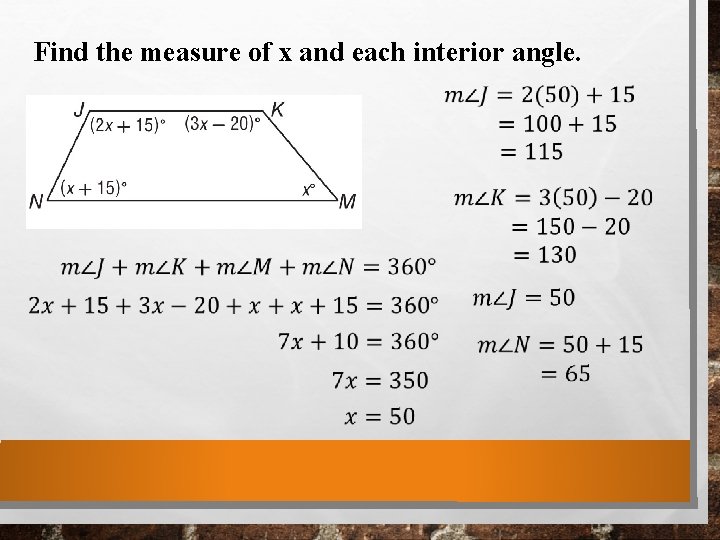
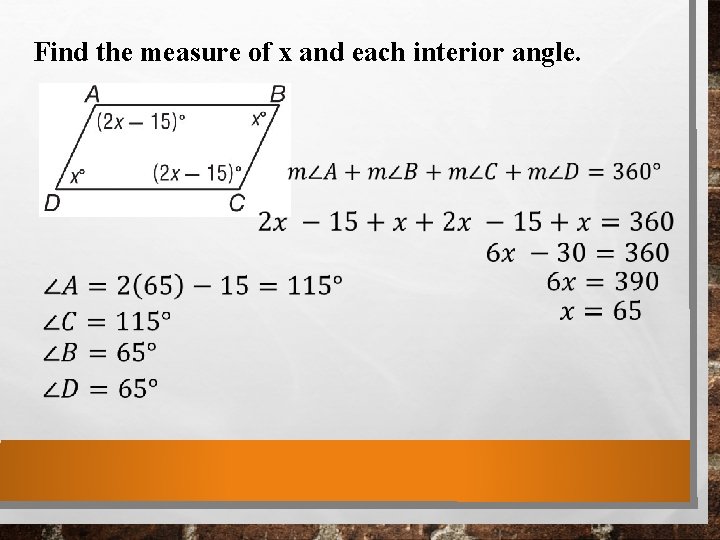
Find the measure of x and each interior angle.
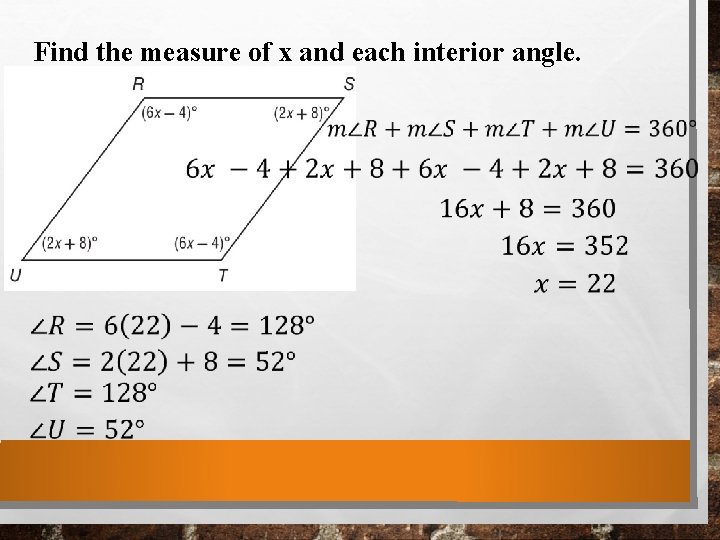
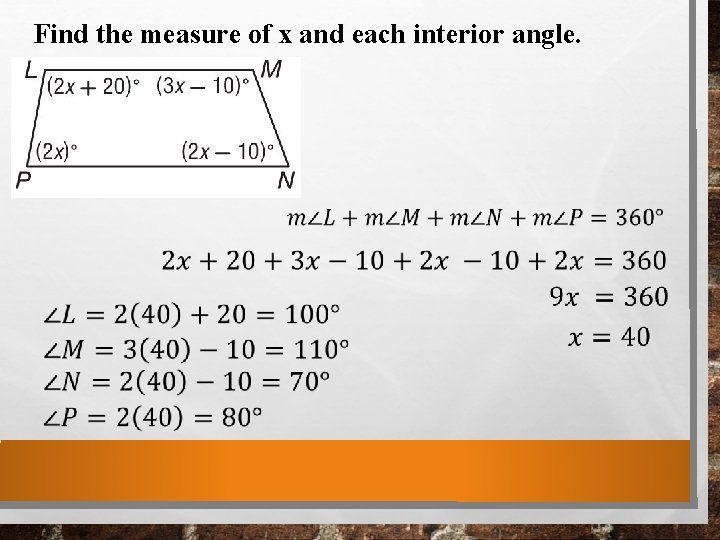
Find the measure of x and each interior angle.
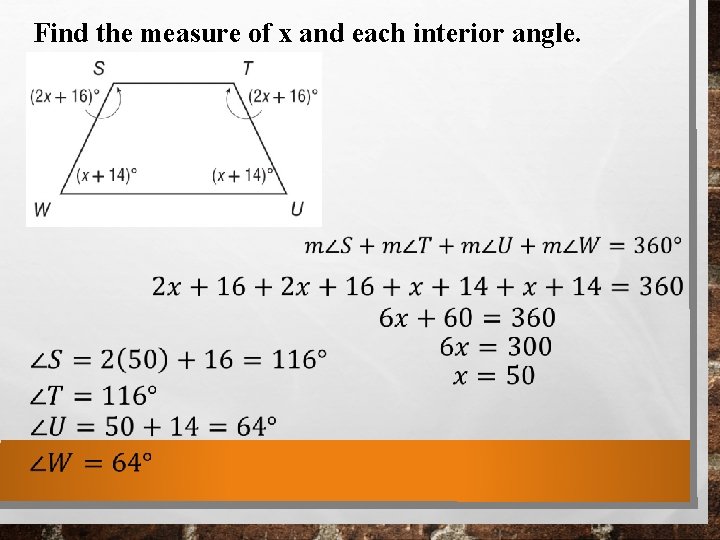
Find the measure of x and each interior angle.
Find the measure of x and each interior angle.
Find the measure of x and each interior angle.
S M A R G O L E L PARAL CONCEPT 29
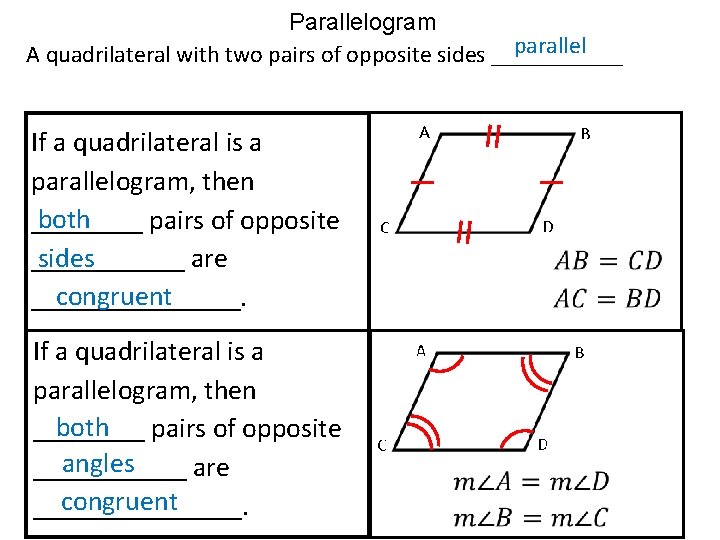
Parallelogram parallel A quadrilateral with two pairs of opposite sides ______ If a quadrilateral is a parallelogram, then both ____ pairs of opposite sides ______ are congruent ________. If a quadrilateral is a parallelogram, then both ____ pairs of opposite angles ______ are congruent ________.
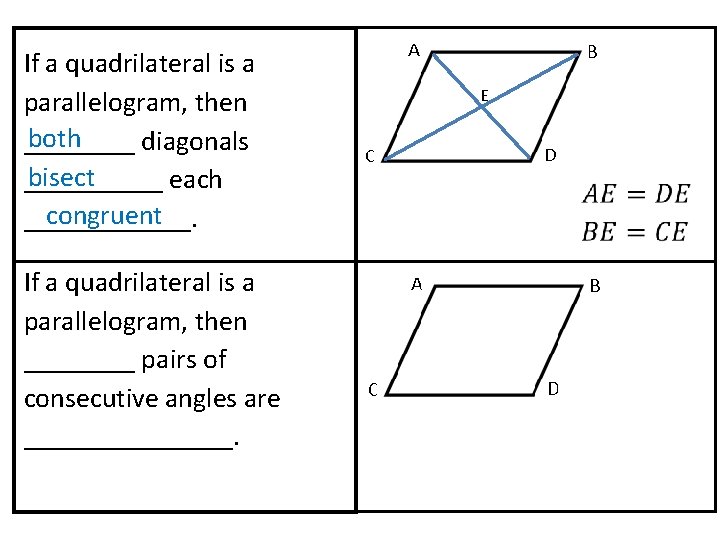
If a quadrilateral is a parallelogram, then both ____ diagonals bisect _____ each congruent ______. If a quadrilateral is a parallelogram, then ____ pairs of consecutive angles are ________. E
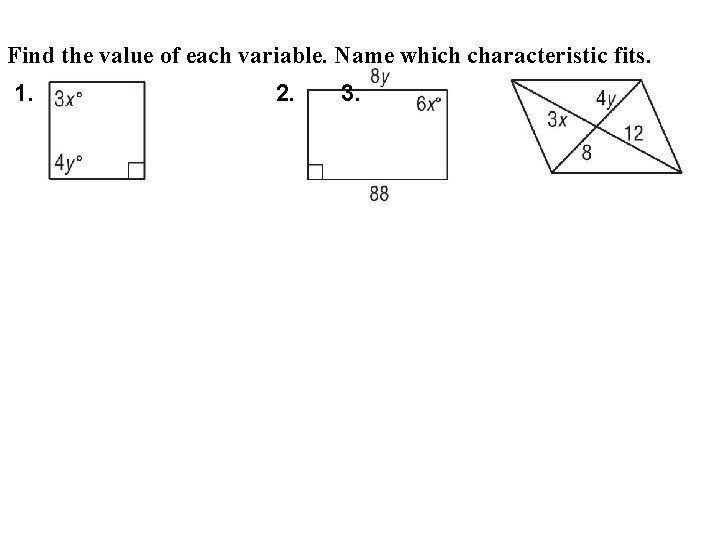
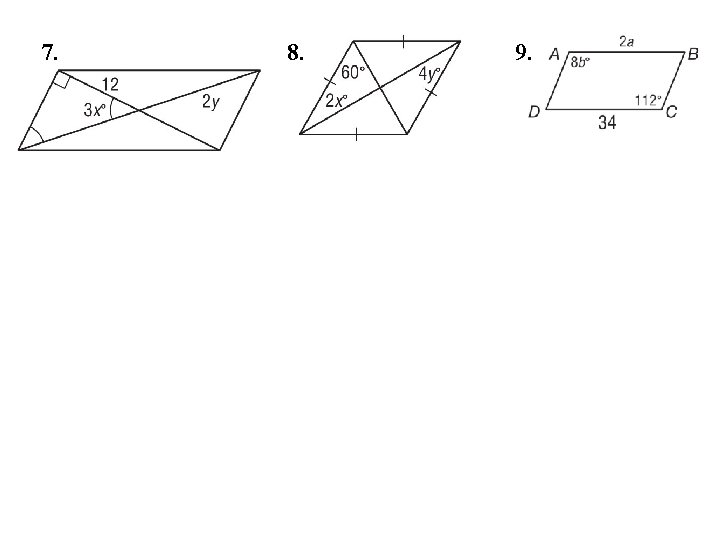
Find the value of each variable. Name which characteristic fits. 1. 2. 3.
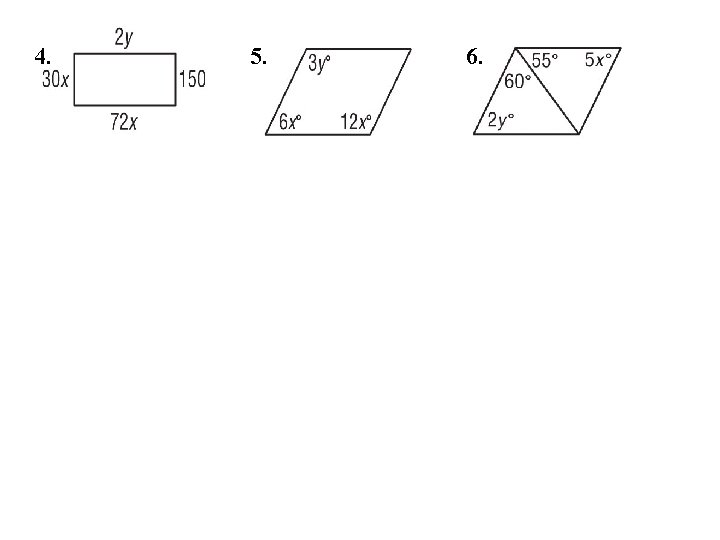
4. 5. 6.
7. 8. 9.
SPECIAL S M A R G O L E L PARAL CONCEPTS 29 - 31
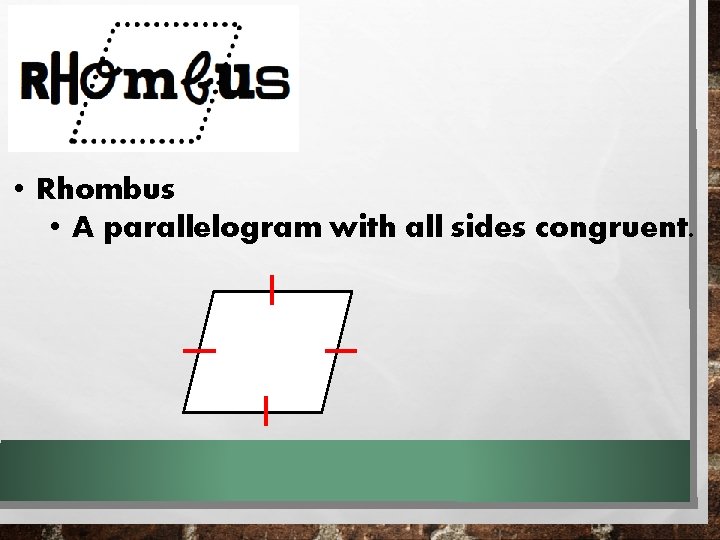
• Rhombus • A parallelogram with all sides congruent.
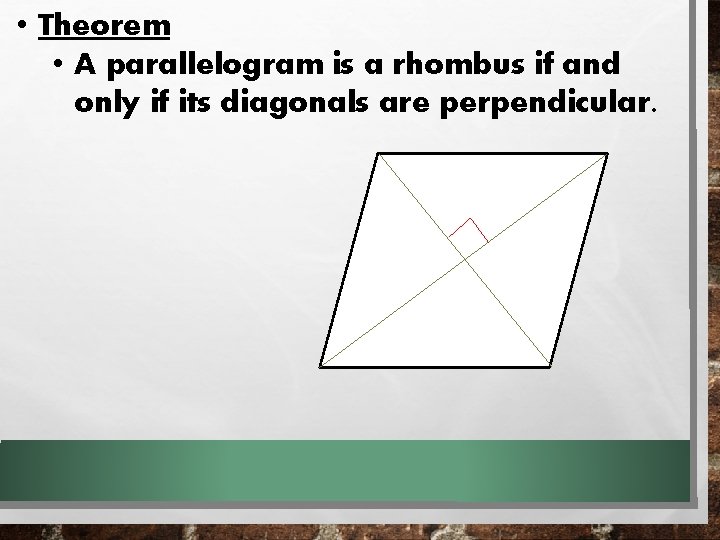
• Theorem • A parallelogram is a rhombus if and only if its diagonals are perpendicular.
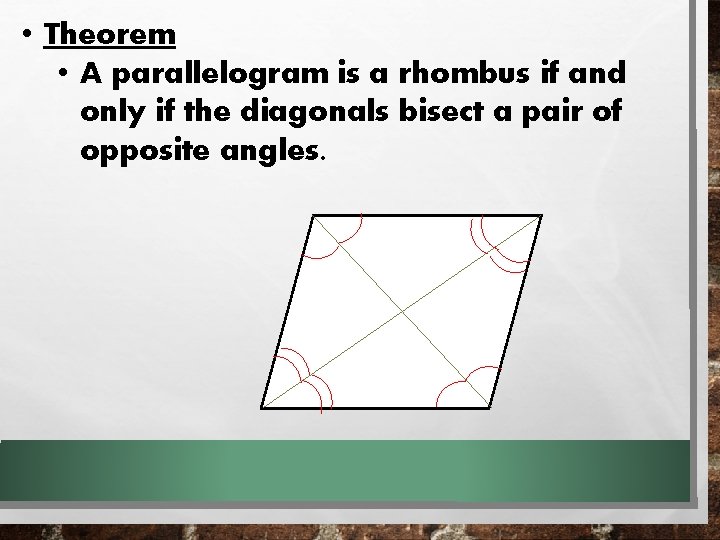
• Theorem • A parallelogram is a rhombus if and only if the diagonals bisect a pair of opposite angles.
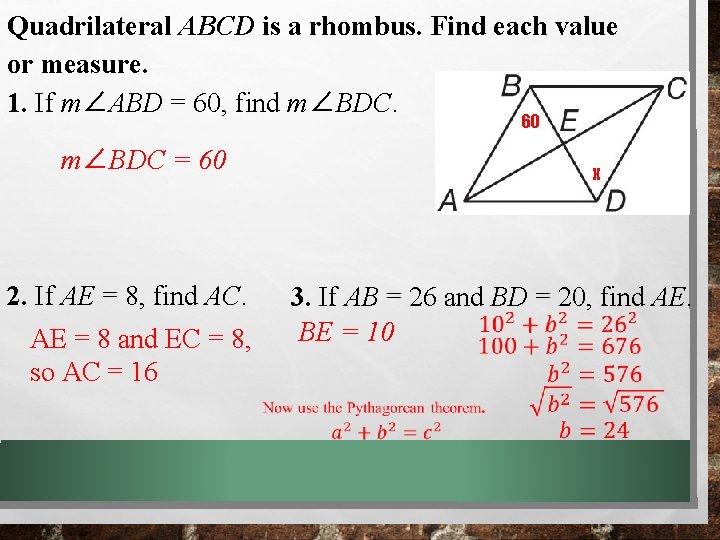
Quadrilateral ABCD is a rhombus. Find each value or measure. 1. If m∠ABD = 60, find m∠BDC. 60 m∠BDC = 60 x 2. If AE = 8, find AC. AE = 8 and EC = 8, so AC = 16 3. If AB = 26 and BD = 20, find AE. BE = 10
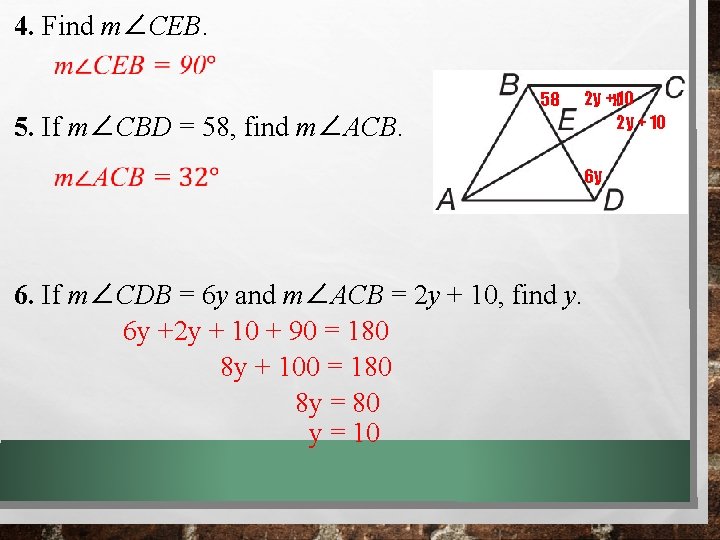
4. Find m∠CEB. 58 5. If m∠CBD = 58, find m∠ACB. 6. If m∠CDB = 6 y and m∠ACB = 2 y + 10, find y. 6 y +2 y + 10 + 90 = 180 8 y + 100 = 180 8 y = 80 y = 10 2 y +x 10 2 y + 10 6 y
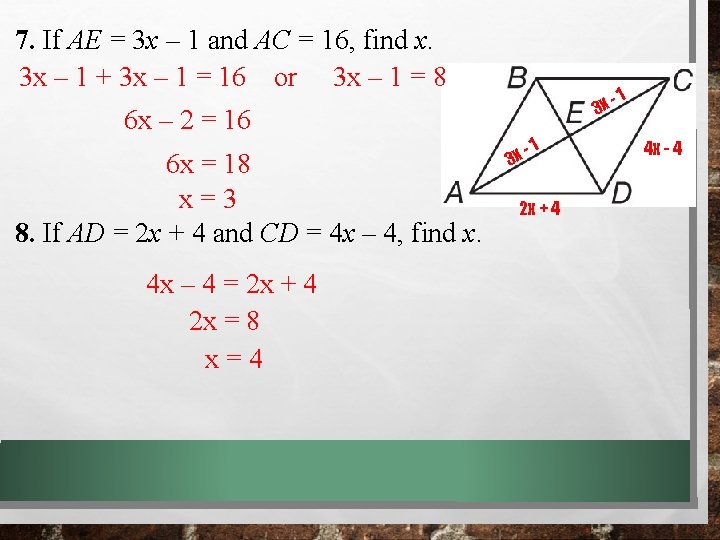
7. If AE = 3 x – 1 and AC = 16, find x. 3 x – 1 + 3 x – 1 = 16 or 3 x – 1 = 8 3 x 6 x – 2 = 16 6 x = 18 x = 3 8. If AD = 2 x + 4 and CD = 4 x – 4, find x. 4 x – 4 = 2 x + 4 2 x = 8 x = 4 3 x -1 2 x + 4 1 4 x - 4
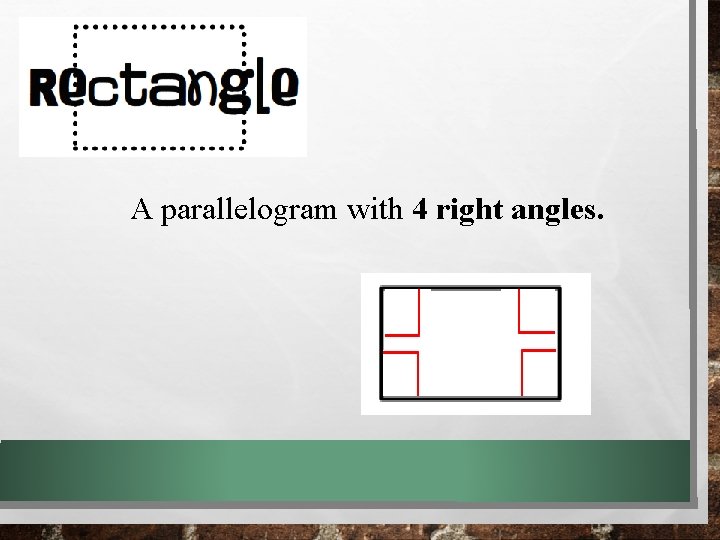
A parallelogram with 4 right angles.
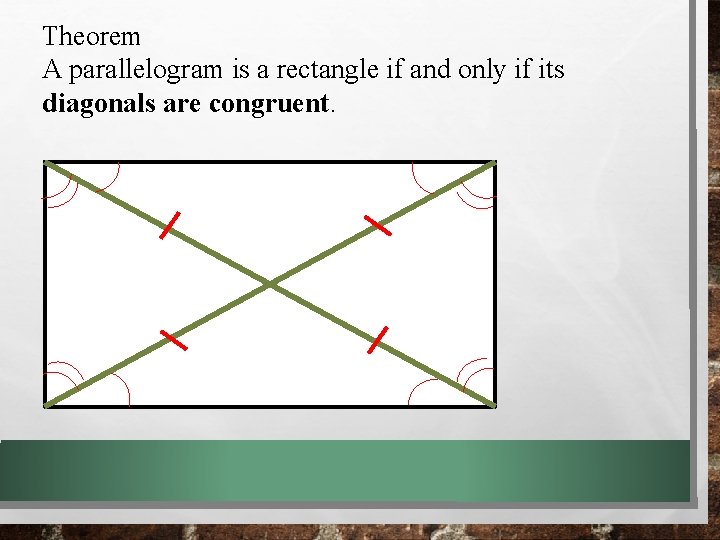
Theorem A parallelogram is a rectangle if and only if its diagonals are congruent.
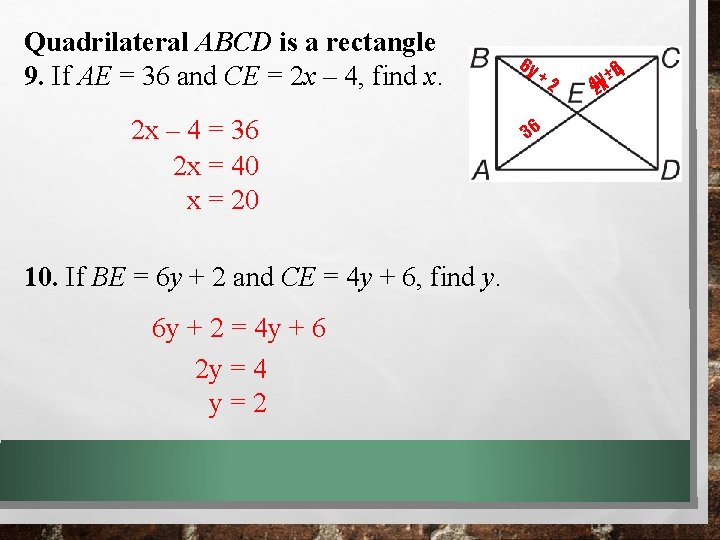
Quadrilateral ABCD is a rectangle 9. If AE = 36 and CE = 2 x – 4, find x. 2 x – 4 = 36 2 x = 40 x = 20 10. If BE = 6 y + 2 and CE = 4 y + 6, find y. 6 y + 2 = 4 y + 6 2 y = 4 y = 2 6 y +2 36 +-64 y 42 x
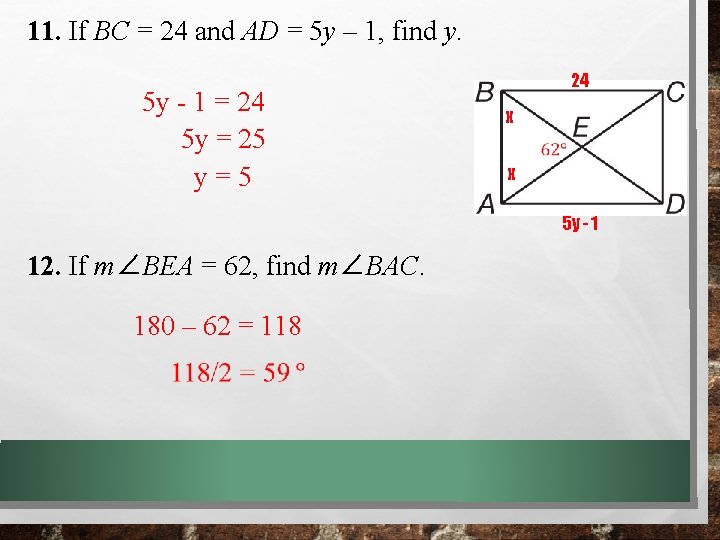
11. If BC = 24 and AD = 5 y – 1, find y. 5 y - 1 = 24 5 y = 25 y = 5 24 x x 5 y - 1 12. If m∠BEA = 62, find m∠BAC. 180 – 62 = 118
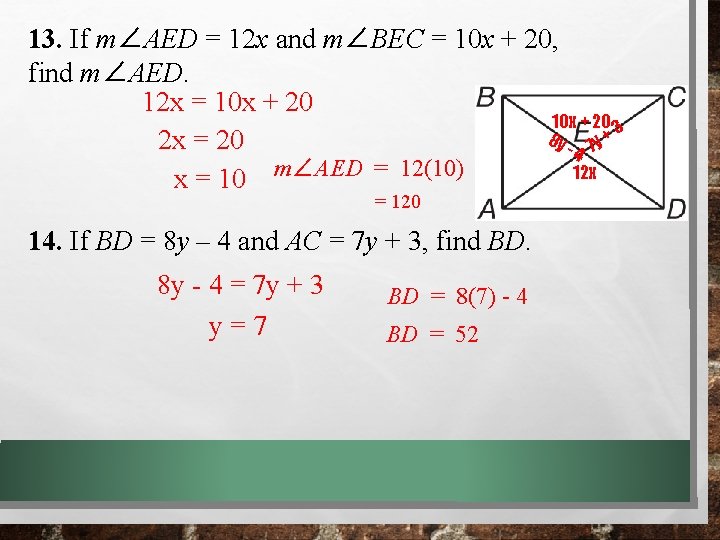
13. If m∠AED = 12 x and m∠BEC = 10 x + 20, find m∠AED. 12 x = 10 x + 20 3 + 8 y 2 x = 20 - 4 7 y m∠AED = 12(10) 12 x x = 10 = 120 14. If BD = 8 y – 4 and AC = 7 y + 3, find BD. 8 y - 4 = 7 y + 3 y = 7 BD = 8(7) - 4 BD = 52
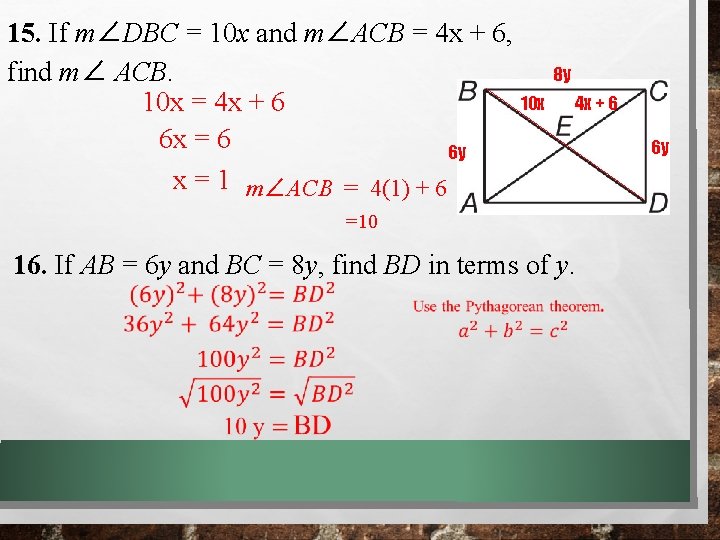
15. If m∠DBC = 10 x and m∠ACB = 4 x + 6, find m∠ ACB. 8 y 10 x 4 x + 6 10 x = 4 x + 6 6 x = 6 6 y x = 1 m∠ACB = 4(1) + 6 =10 16. If AB = 6 y and BC = 8 y, find BD in terms of y. 6 y
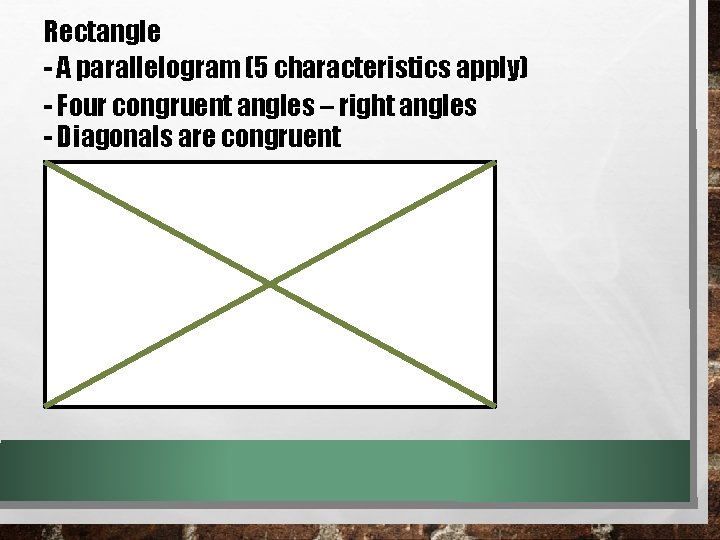
Rectangle - A parallelogram (5 characteristics apply) - Four congruent angles – right angles - Diagonals are congruent
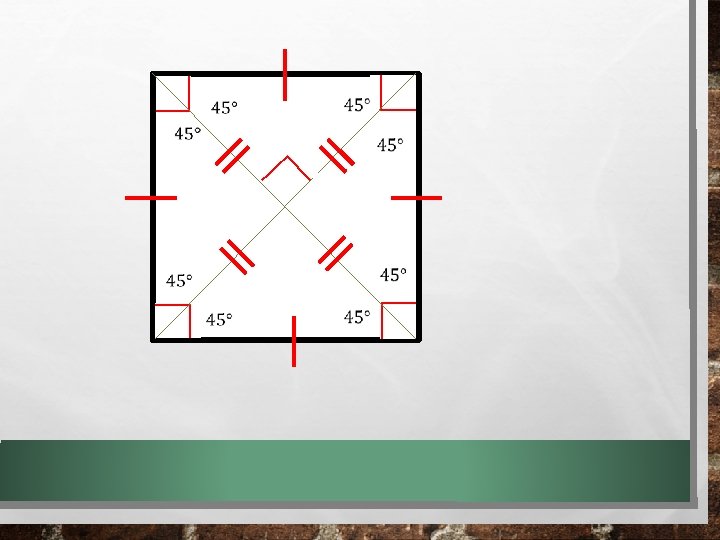
- a parallelogram with 4 congruent sides and 4 congruent angles.
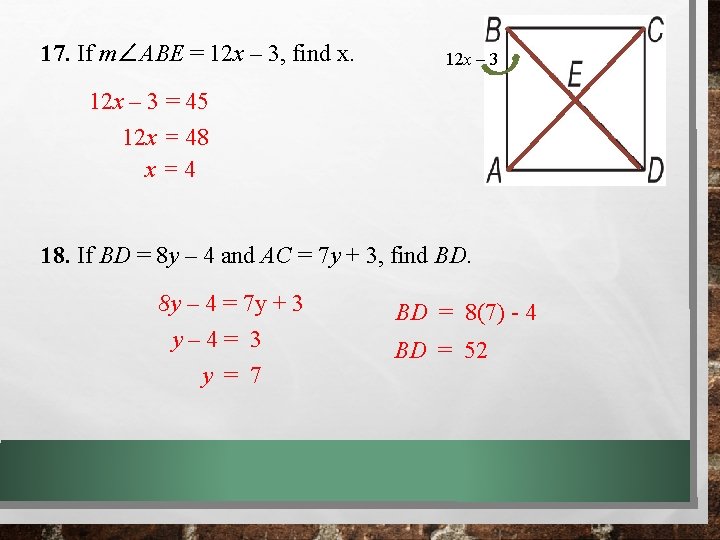
17. If m∠ABE = 12 x – 3, find x. 12 x – 3 = 45 12 x = 48 x=4 18. If BD = 8 y – 4 and AC = 7 y + 3, find BD. 8 y – 4 = 7 y + 3 y – 4 = 3 y = 7 BD = 8(7) - 4 BD = 52
D N A S D I O Z TRAPE KITES CONCEPTS 32 - 33
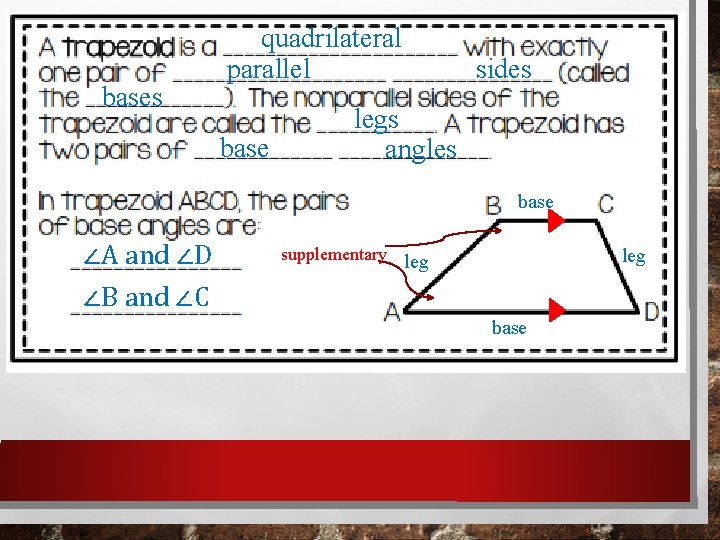
bases quadrilateral parallel base sides legs angles base ∠A and ∠D supplementary leg ∠B and ∠C base
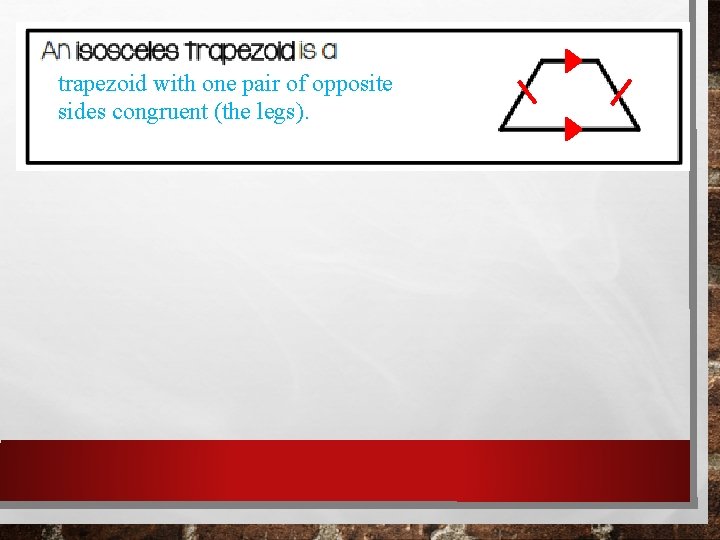
trapezoid with one pair of opposite sides congruent (the legs).
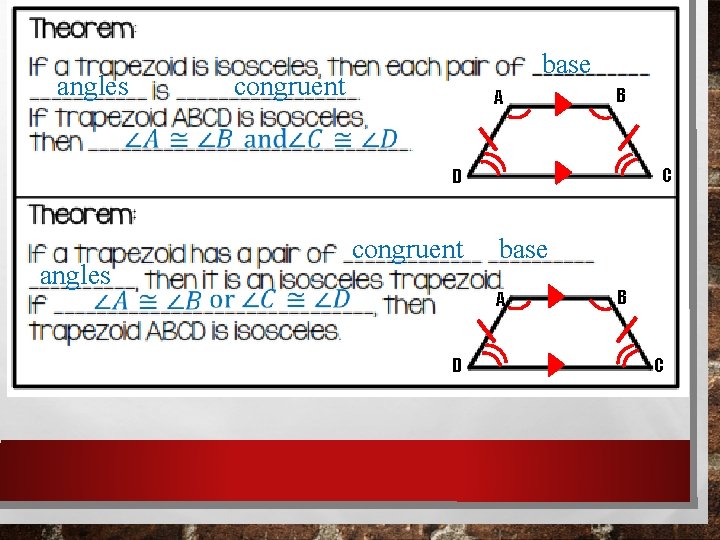
angles base congruent A B C D angles congruent base A D B C
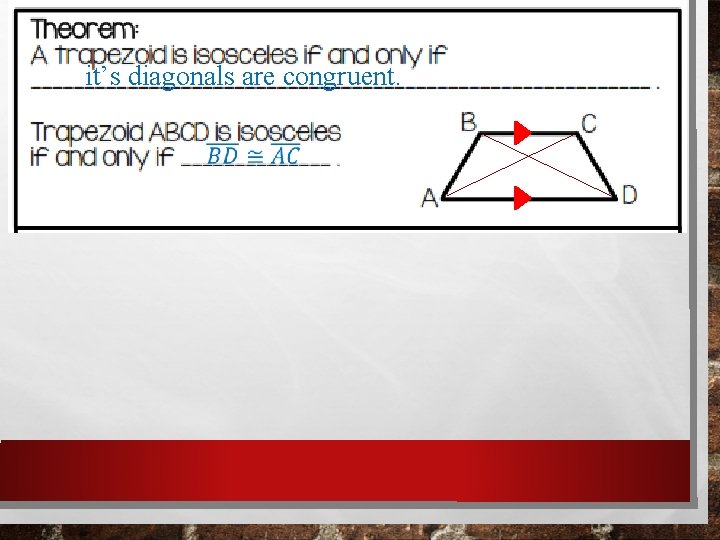
it’s diagonals are congruent.
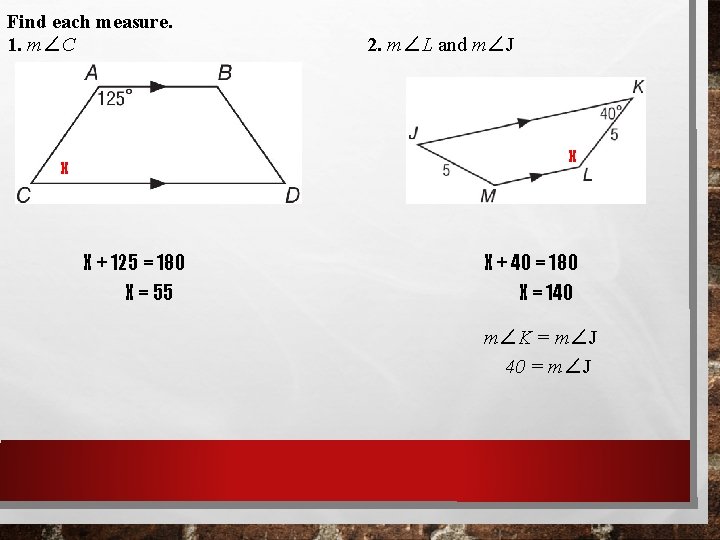
Find each measure. 1. m∠C 2. m∠L and m∠J x x X + 125 = 180 X = 55 X + 40 = 180 X = 140 m∠K = m∠J 40 = m∠J
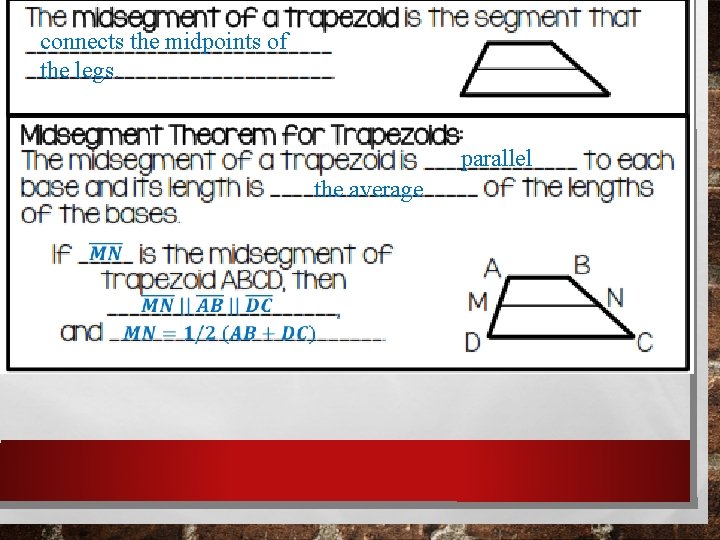
connects the midpoints of the legs. parallel the average
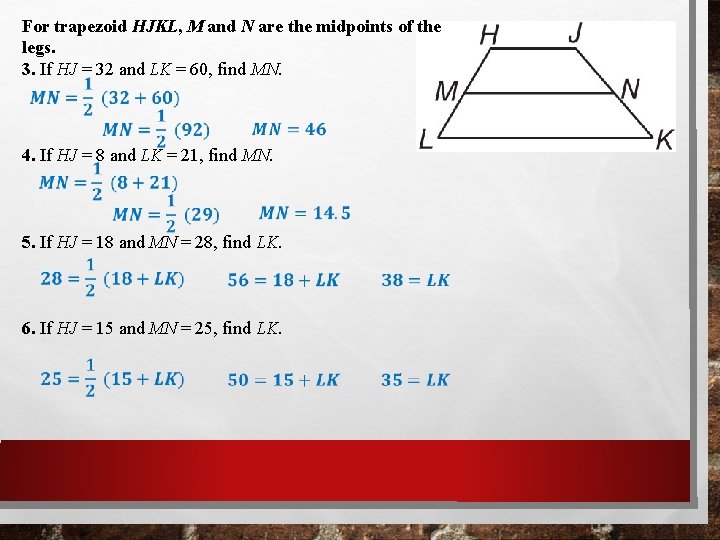
For trapezoid HJKL, M and N are the midpoints of the legs. 3. If HJ = 32 and LK = 60, find MN. 4. If HJ = 8 and LK = 21, find MN. 5. If HJ = 18 and MN = 28, find LK. 6. If HJ = 15 and MN = 25, find LK.
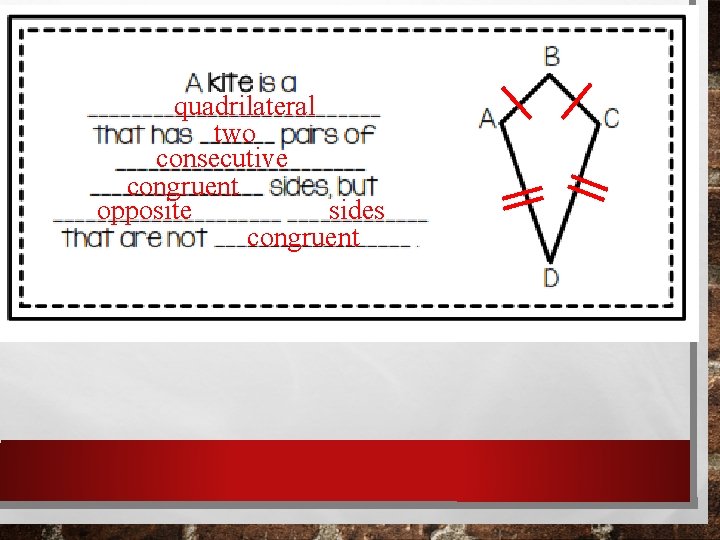
quadrilateral two consecutive congruent opposite sides congruent
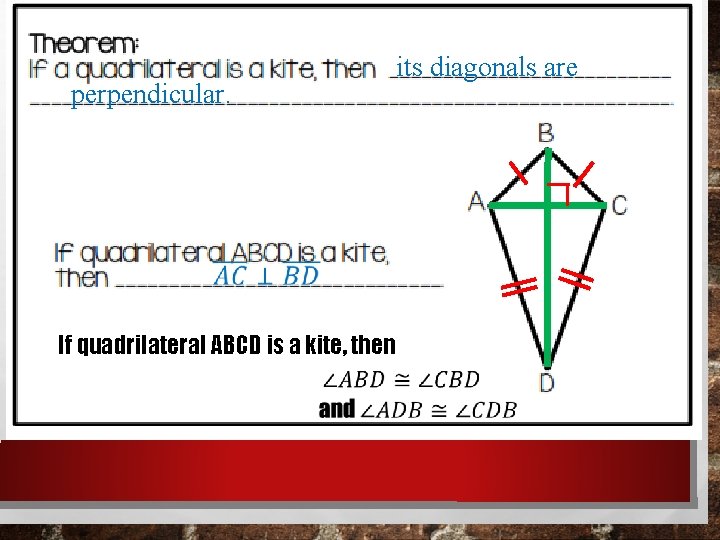
its diagonals are perpendicular. If quadrilateral ABCD is a kite, then
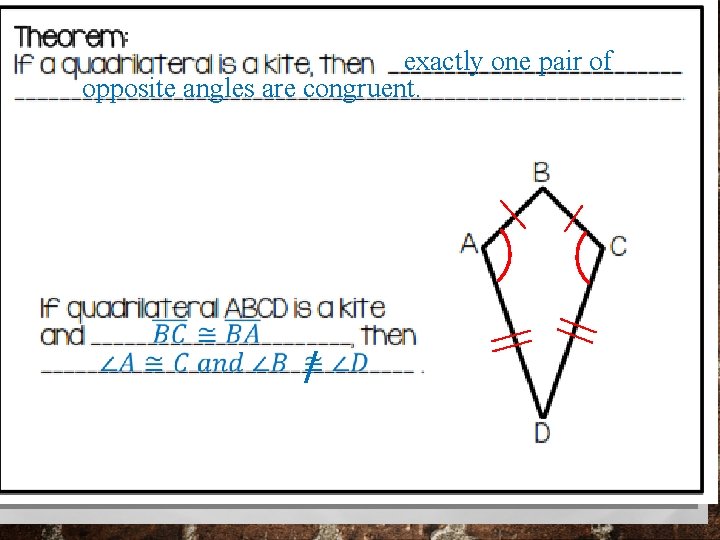
exactly one pair of opposite angles are congruent.
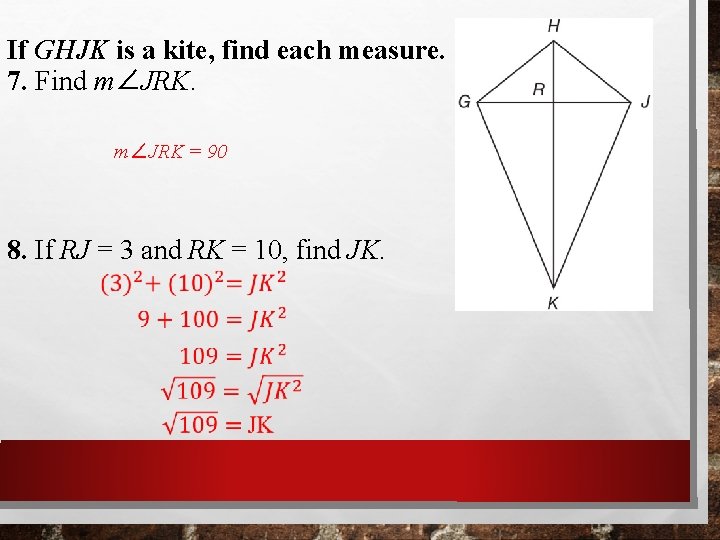
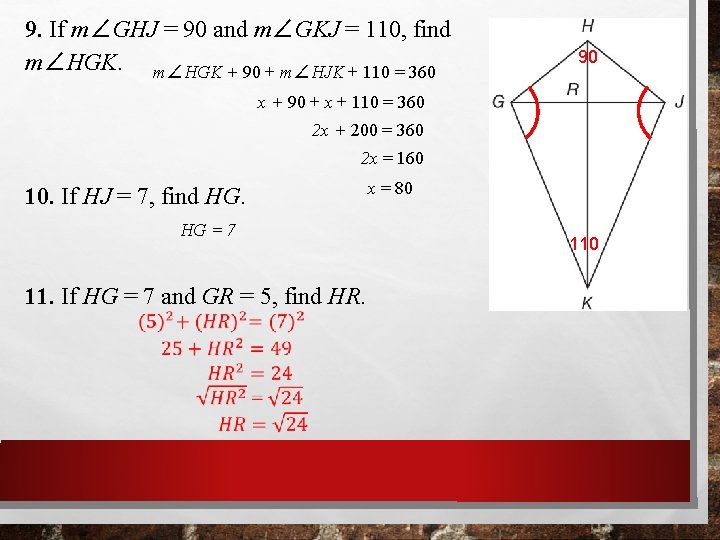
If GHJK is a kite, find each measure. 7. Find m∠JRK = 90 8. If RJ = 3 and RK = 10, find JK.
9. If m∠GHJ = 90 and m∠GKJ = 110, find m∠HGK + 90 + m∠HJK + 110 = 360 90 x + 90 + x + 110 = 360 2 x + 200 = 360 2 x = 160 x = 80 10. If HJ = 7, find HG. HG = 7 11. If HG = 7 and GR = 5, find HR. 110
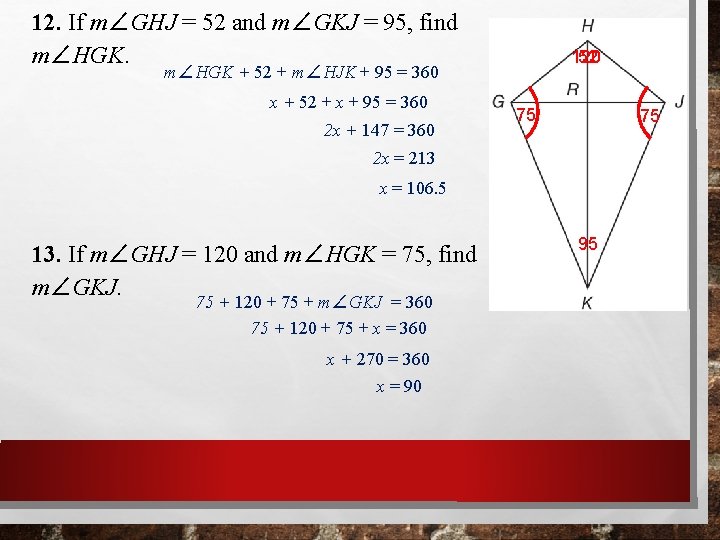
12. If m∠GHJ = 52 and m∠GKJ = 95, find m∠HGK. 120 52 m∠HGK + 52 + m∠HJK + 95 = 360 x + 52 + x + 95 = 360 2 x + 147 = 360 75 75 2 x = 213 x = 106. 5 13. If m∠GHJ = 120 and m∠HGK = 75, find m∠GKJ. 75 + 120 + 75 + m∠GKJ = 360 75 + 120 + 75 + x = 360 x + 270 = 360 x = 90 95
QUADRILATERA L PROPERTIES CONCEPT 34
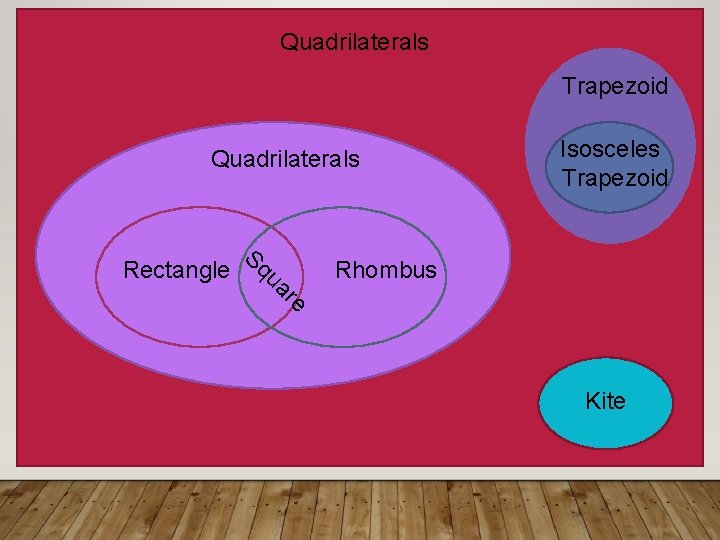
Quadrilaterals Trapezoid Quadrilaterals Sq Rectangle u a re Isosceles Trapezoid Rhombus Kite
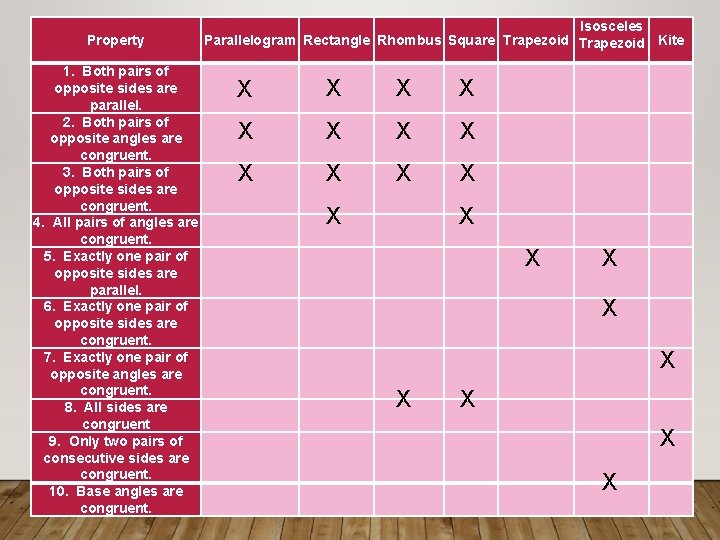
Property 1. Both pairs of opposite sides are parallel. 2. Both pairs of opposite angles are congruent. 3. Both pairs of opposite sides are congruent. 4. All pairs of angles are congruent. 5. Exactly one pair of opposite sides are parallel. 6. Exactly one pair of opposite sides are congruent. 7. Exactly one pair of opposite angles are congruent. 8. All sides are congruent 9. Only two pairs of consecutive sides are congruent. 10. Base angles are congruent. Isosceles Parallelogram Rectangle Rhombus Square Trapezoid Kite X X X X X X X X X
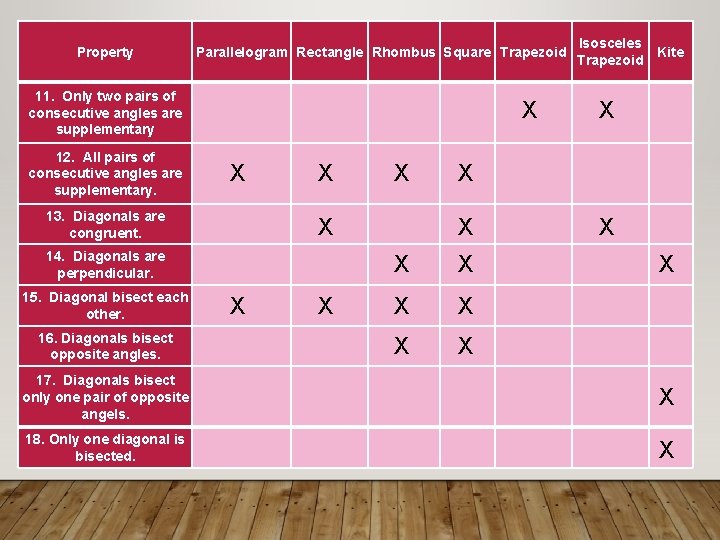
Property Parallelogram Rectangle Rhombus Square Trapezoid Isosceles Kite Trapezoid 11. Only two pairs of consecutive angles are supplementary X X 12. All pairs of consecutive angles are supplementary. X X 13. Diagonals are congruent. X X X 14. Diagonals are perpendicular. X X 15. Diagonal bisect each other. X X 16. Diagonals bisect opposite angles. X X 17. Diagonals bisect only one pair of opposite angels. X 18. Only one diagonal is bisected. X