
s FM Meta Data Content Proposal Nokia November
s FM Meta Data Content Proposal Nokia November 15, 2018
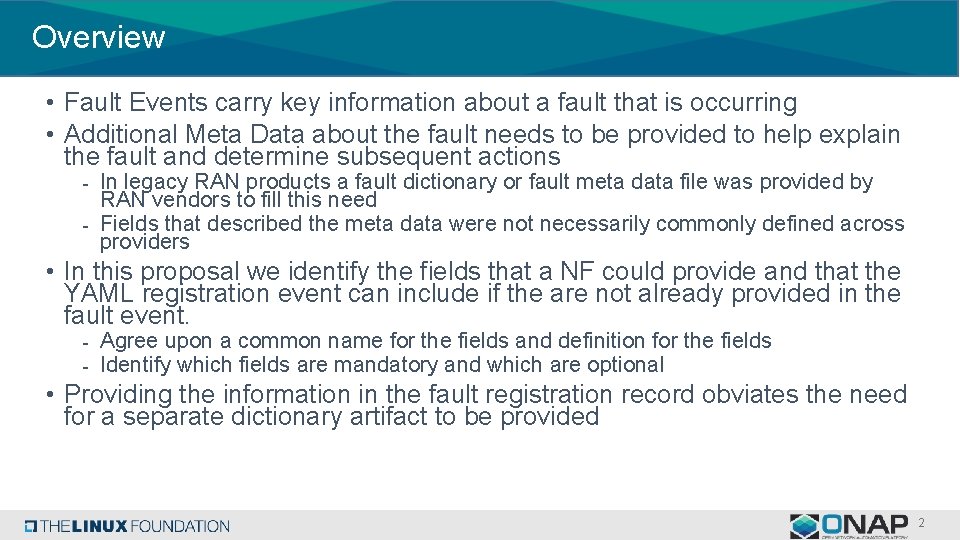
Overview • Fault Events carry key information about a fault that is occurring • Additional Meta Data about the fault needs to be provided to help explain the fault and determine subsequent actions - In legacy RAN products a fault dictionary or fault meta data file was provided by RAN vendors to fill this need - Fields that described the meta data were not necessarily commonly defined across providers • In this proposal we identify the fields that a NF could provide and that the YAML registration event can include if the are not already provided in the fault event. - Agree upon a common name for the fields and definition for the fields - Identify which fields are mandatory and which are optional • Providing the information in the fault registration record obviates the need for a separate dictionary artifact to be provided 2
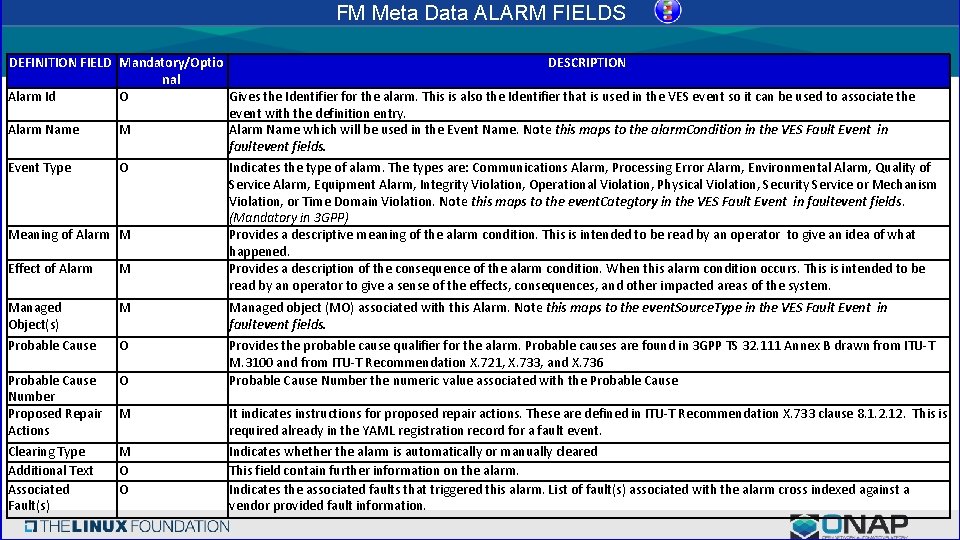
FM Meta Data ALARM FIELDS DEFINITION FIELD Mandatory/Optio DESCRIPTION nal Alarm Id O Gives the Identifier for the alarm. This is also the Identifier that is used in the VES event so it can be used to associate the event with the definition entry. Alarm Name M Alarm Name which will be used in the Event Name. Note this maps to the alarm. Condition in the VES Fault Event in faultevent fields. Event Type O Indicates the type of alarm. The types are: Communications Alarm, Processing Error Alarm, Environmental Alarm, Quality of Service Alarm, Equipment Alarm, Integrity Violation, Operational Violation, Physical Violation, Security Service or Mechanism Violation, or Time Domain Violation. Note this maps to the event. Categtory in the VES Fault Event in faultevent fields. (Mandatory in 3 GPP) Meaning of Alarm M Provides a descriptive meaning of the alarm condition. This is intended to be read by an operator to give an idea of what happened. Effect of Alarm M Provides a description of the consequence of the alarm condition. When this alarm condition occurs. This is intended to be read by an operator to give a sense of the effects, consequences, and other impacted areas of the system. Managed Object(s) Probable Cause M Probable Cause Number Proposed Repair Actions Clearing Type Additional Text Associated Fault(s) O O M M O O Managed object (MO) associated with this Alarm. Note this maps to the event. Source. Type in the VES Fault Event in faultevent fields. Provides the probable cause qualifier for the alarm. Probable causes are found in 3 GPP TS 32. 111 Annex B drawn from ITU-T M. 3100 and from ITU-T Recommendation X. 721, X. 733, and X. 736 Probable Cause Number the numeric value associated with the Probable Cause It indicates instructions for proposed repair actions. These are defined in ITU-T Recommendation X. 733 clause 8. 1. 2. 12. This is required already in the YAML registration record for a fault event. Indicates whether the alarm is automatically or manually cleared This field contain further information on the alarm. Indicates the associated faults that triggered this alarm. List of fault(s) associated with the alarm cross indexed against a vendor provided fault information.
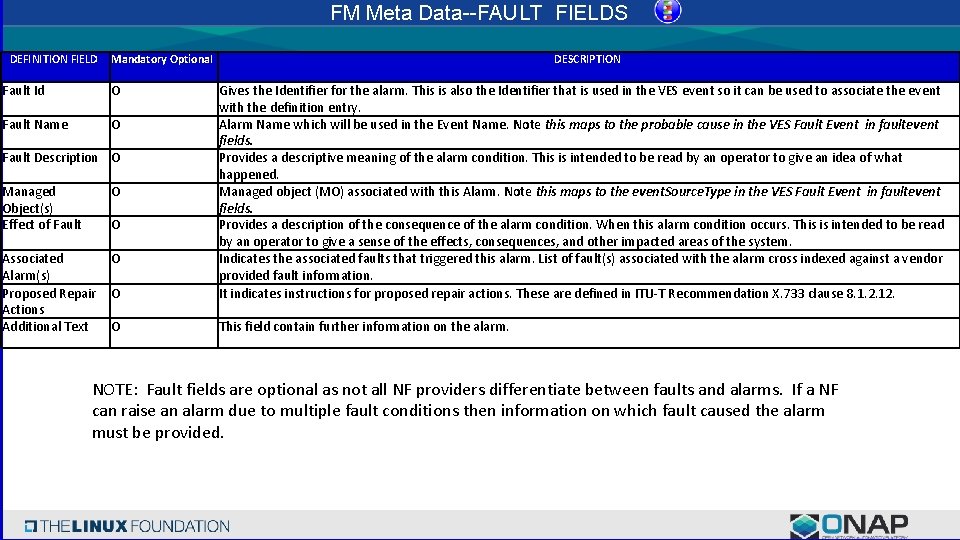
FM Meta Data--FAULT FIELDS DEFINITION FIELD Mandatory Optional Fault Id O Fault Name O Fault Description O Managed Object(s) Effect of Fault O O Associated O Alarm(s) Proposed Repair O Actions Additional Text O DESCRIPTION Gives the Identifier for the alarm. This is also the Identifier that is used in the VES event so it can be used to associate the event with the definition entry. Alarm Name which will be used in the Event Name. Note this maps to the probable cause in the VES Fault Event in faultevent fields. Provides a descriptive meaning of the alarm condition. This is intended to be read by an operator to give an idea of what happened. Managed object (MO) associated with this Alarm. Note this maps to the event. Source. Type in the VES Fault Event in faultevent fields. Provides a description of the consequence of the alarm condition. When this alarm condition occurs. This is intended to be read by an operator to give a sense of the effects, consequences, and other impacted areas of the system. Indicates the associated faults that triggered this alarm. List of fault(s) associated with the alarm cross indexed against a vendor provided fault information. It indicates instructions for proposed repair actions. These are defined in ITU-T Recommendation X. 733 clause 8. 1. 2. 12. This field contain further information on the alarm. NOTE: Fault fields are optional as not all NF providers differentiate between faults and alarms. If a NF can raise an alarm due to multiple fault conditions then information on which fault caused the alarm must be provided.
YAML Registration Proposal • NFs provide separate YAML registration records for each of the Fault Events they emit. • FM Meta Data particular to the specific event proposed to be included in the registration record - Provides all of the meta data for the fault so separate fault/alarm dictionaries do not have to be provided by the NF provider - YAML Registration provides a comment capability which the Registration processing can use to extract the meta data information for Policy creation. - Example file follows 5
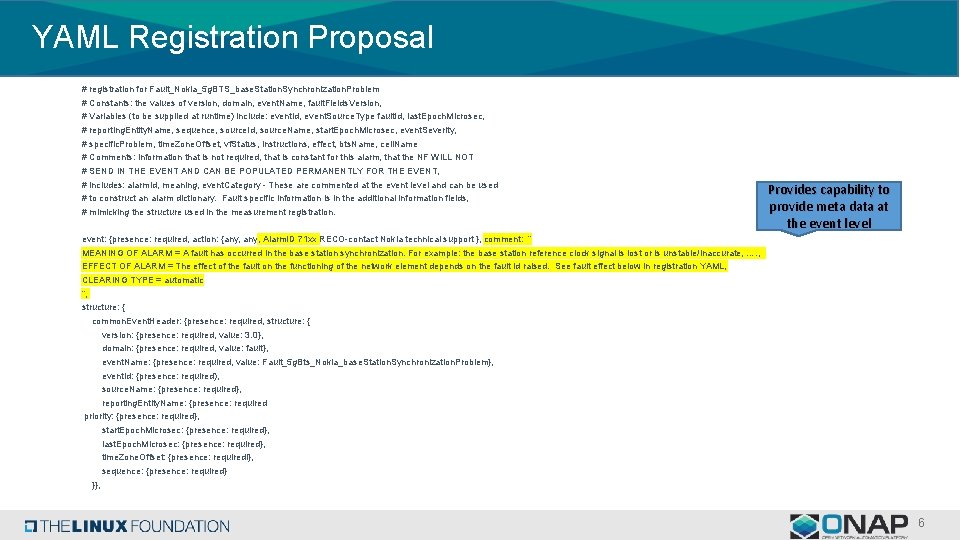
YAML Registration Proposal # registration for Fault_Nokia_5 g. BTS_base. Station. Synchronization. Problem # Constants: the values of version, domain, event. Name, fault. Fields. Version, # Variables (to be supplied at runtime) include: event. Id, event. Source. Type fault. Id, last. Epoch. Microsec, # reporting. Entity. Name, sequence, source. Id, source. Name, start. Epoch. Microsec, event. Severity, # specific. Problem, time. Zone. Offset, vf. Status, instructions, effect, bts. Name, cell. Name # Comments: information that is not required, that is constant for this alarm, that the NF WILL NOT # SEND IN THE EVENT AND CAN BE POPULATED PERMANENTLY FOR THE EVENT, # includes: alarm. Id, meaning, event. Category - These are commented at the event level and can be used # to construct an alarm dictionary. Fault specific information is in the additional information fields, # mimicking the structure used in the measurement registration. Provides capability to provide meta data at the event level event: {presence: required, action: {any, Alarm. ID 71 xx RECO-contact Nokia technical support }, comment: “ MEANING OF ALARM = A fault has occurred in the base station synchronization. For example: the base station reference clock signal is lost or is unstable/inaccurate, …. , EFFECT OF ALARM = The effect of the fault on the functioning of the network element depends on the fault id raised. See fault effect below in registration YAML, CLEARING TYPE = automatic ”, structure: { common. Event. Header: {presence: required, structure: { version: {presence: required, value: 3. 0}, domain: {presence: required, value: fault}, event. Name: {presence: required, value: Fault_5 g. Bts_Nokia_base. Station. Synchronization. Problem}, event. Id: {presence: required), source. Name: {presence: required}, reporting. Entity. Name: {presence: required priority: {presence: required}, start. Epoch. Microsec: {presence: required}, last. Epoch. Microsec: {presence: required}, time. Zone. Offset: {presence: requiredl}, sequence: {presence: required} }}, 6
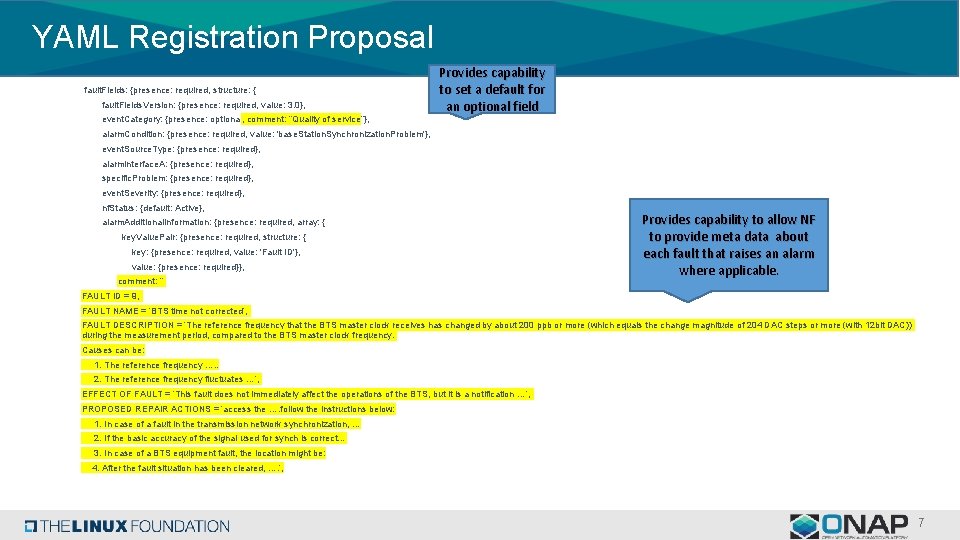
YAML Registration Proposal fault. Fields: {presence: required, structure: { fault. Fields. Version: {presence: required, value: 3. 0}, event. Category: {presence: optional, comment: “Quality of service”}, Provides capability to set a default for an optional field alarm. Condition: {presence: required, value: 'base. Station. Synchronization. Problem'}, event. Source. Type: {presence: required}, alarminterface. A: {presence: required}, specific. Problem: {presence: required}, event. Severity: {presence: required}, nf. Status: {default: Active}, Provides capability to allow NF to provide meta data about each fault that raises an alarm where applicable. alarm. Additional. Information: {presence: required, array: { key. Value. Pair: {presence: required, structure: { key: {presence: required, value: 'Fault ID'}, value: {presence: required}}, comment: “ FAULT ID = 9, FAULT NAME = ‘BTS time not corrected’, FAULT DESCRIPTION = ‘The reference frequency that the BTS master clock receives has changed by about 200 ppb or more (which equals the change magnitude of 204 DAC steps or more (with 12 bit DAC)) during the measurement period, compared to the BTS master clock frequency. Causes can be: 1. The reference frequency …. . 2. The reference frequency fluctuates …’, EFFECT OF FAULT = ‘This fault does not immediately affect the operations of the BTS, but it is a notification …’, PROPOSED REPAIR ACTIONS = ‘access the …. follow the instructions below: 1. In case of a fault in the transmission network synchronization, … 2. If the basic accuracy of the signal used for synch is correct… 3. In case of a BTS equipment fault, the location might be: 4. After the fault situation has been cleared, …. ’, 7
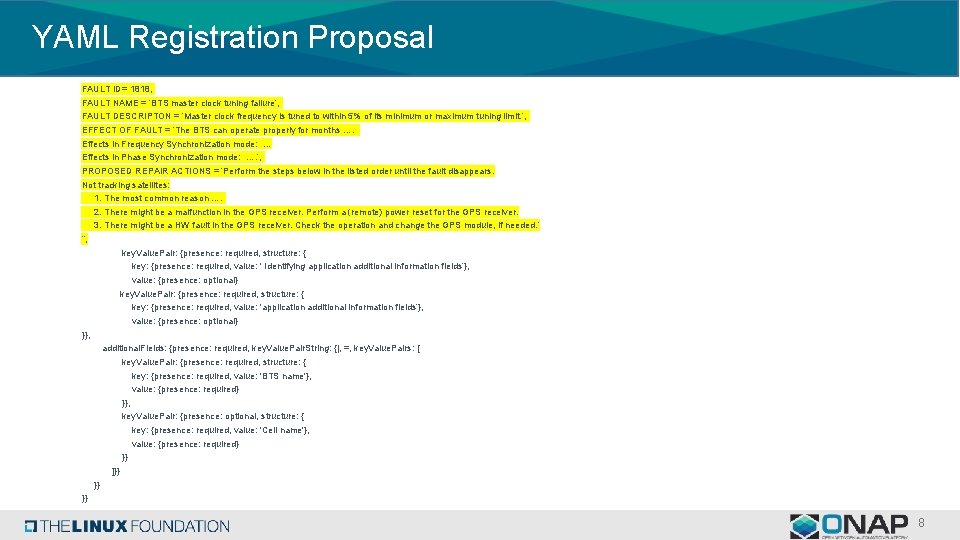
YAML Registration Proposal FAULT ID= 1818, FAULT NAME = ‘BTS master clock tuning failure’, FAULT DESCRIPTON = ‘Master clock frequency is tuned to within 5% of its minimum or maximum tuning limit. ’, EFFECT OF FAULT = ‘The BTS can operate properly for months …. Effects in Frequency Synchronization mode: … Effects in Phase Synchronization mode: …. ’, PROPOSED REPAIR ACTIONS = ‘Perform the steps below in the listed order until the fault disappears. Not tracking satellites: 1. The most common reason …. 2. There might be a malfunction in the GPS receiver. Perform a (remote) power reset for the GPS receiver. 3. There might be a HW fault in the GPS receiver. Check the operation and change the GPS module, if needed. ’ ”, key. Value. Pair: {presence: required, structure: { key: {presence: required, value: ' Identifying application additional information fields’}, value: {presence: optional} key. Value. Pair: {presence: required, structure: { key: {presence: required, value: 'application additional information fields’}, value: {presence: optional} }}, additional. Fields: {presence: required, key. Value. Pair. String: {|, =, key. Value. Pairs: [ key. Value. Pair: {presence: required, structure: { key: {presence: required, value: 'BTS name'}, value: {presence: required} }}, key. Value. Pair: {presence: optional, structure: { key: {presence: required, value: 'Cell name'}, value: {presence: required} }} ]}} }} }} 8
s Backup
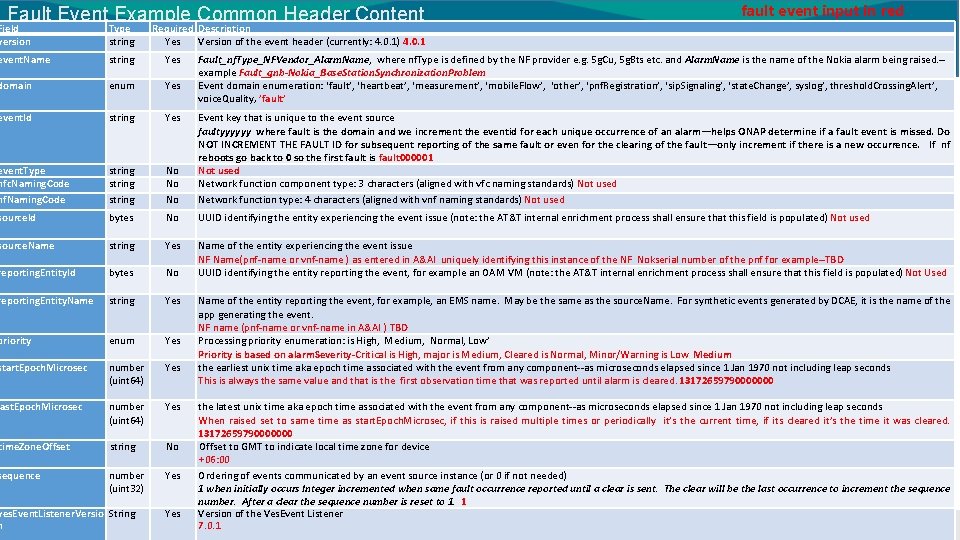
fault event input in red Fault Event Example Common Header Content Field version Type string event. Name string Yes domain enum Yes event. Id string Yes event. Type nfc. Naming. Code nf. Naming. Code string No No No Event key that is unique to the event source faultyyyyyy where fault is the domain and we increment the eventid for each unique occurrence of an alarm—helps ONAP determine if a fault event is missed. Do NOT INCREMENT THE FAULT ID for subsequent reporting of the same fault or even for the clearing of the fault—only increment if there is a new occurrence. If nf reboots go back to 0 so the first fault is fault 000001 Not used Network function component type: 3 characters (aligned with vfc naming standards) Not used Network function type: 4 characters (aligned with vnf naming standards) Not used source. Id bytes No UUID identifying the entity experiencing the event issue (note: the AT&T internal enrichment process shall ensure that this field is populated) Not used source. Name string Yes reporting. Entity. Id bytes No Name of the entity experiencing the event issue NF Name(pnf-name or vnf-name ) as entered in A&AI uniquely identifying this instance of the NF Nokserial number of the pnf for example--TBD UUID identifying the entity reporting the event, for example an OAM VM (note: the AT&T internal enrichment process shall ensure that this field is populated) Not Used reporting. Entity. Name string Yes priority enum Yes start. Epoch. Microsec number (uint 64) Yes last. Epoch. Microsec number (uint 64) Yes time. Zone. Offset string No sequence number (uint 32) Yes ves. Event. Listener. Versio String n Required Description Yes Version of the event header (currently: 4. 0. 1) 4. 0. 1 Yes Fault_nf. Type_NFVendor_Alarm. Name, where nf. Type is defined by the NF provider e. g. 5 g. Cu, 5 g. Bts etc. and Alarm. Name is the name of the Nokia alarm being raised. -example Fault_gnb-Nokia_Base. Station. Synchronization. Problem Event domain enumeration: ‘fault’, ‘heartbeat’, ‘measurement’, ‘mobile. Flow’, ‘other’, ‘pnf. Registration’, ‘sip. Signaling’, ‘state. Change’, syslog’, threshold. Crossing. Alert’, voice. Quality, ’fault’ Name of the entity reporting the event, for example, an EMS name. May be the same as the source. Name. For synthetic events generated by DCAE, it is the name of the app generating the event. NF name (pnf-name or vnf-name in A&AI ) TBD Processing priority enumeration: is High, Medium, Normal, Low’ Priority is based on alarm. Severity-Critical is High, major is Medium, Cleared is Normal, Minor/Warning is Low Medium the earliest unix time aka epoch time associated with the event from any component--as microseconds elapsed since 1 Jan 1970 not including leap seconds This is always the same value and that is the first observation time that was reported until alarm is cleared. 13172659790000000 the latest unix time aka epoch time associated with the event from any component--as microseconds elapsed since 1 Jan 1970 not including leap seconds When raised set to same time as start. Epoch. Microsec, if this is raised multiple times or periodically it’s the current time, if its cleared it’s the time it was cleared. 13172659790000000 Offset to GMT to indicate local time zone for device +06: 00 Ordering of events communicated by an event source instance (or 0 if not needed) 1 when initially occurs Integer incremented when same fault occurrence reported until a clear is sent. The clear will be the last occurrence to increment the sequence number. After a clear the sequence number is reset to 1. 1 Version of the Ves. Event Listener 7. 0. 1
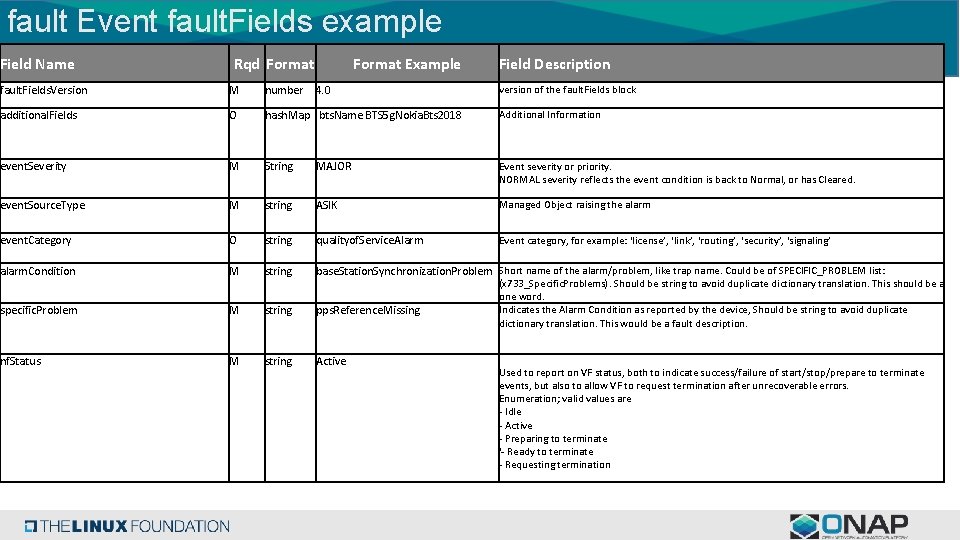
fault Event fault. Fields example Field Name Rqd Format Example Field Description fault. Fields. Version M number 4. 0 additional. Fields O hash. Map bts. Name BTS 5 g. Nokia. Bts 2018 Additional Information event. Severity M String MAJOR Event severity or priority. NORMAL severity reflects the event condition is back to Normal, or has Cleared. event. Source. Type M string ASIK Managed Object raising the alarm event. Category O string qualityof. Service. Alarm Event category, for example: ‘license’, ‘link’, ‘routing’, ‘security’, ‘signaling’ alarm. Condition M string base. Station. Synchronization. Problem Short name of the alarm/problem, like trap name. Could be of SPECIFIC_PROBLEM list: specific. Problem M string pps. Reference. Missing nf. Status M string Active version of the fault. Fields block (x 733_Specific. Problems). Should be string to avoid duplicate dictionary translation. This should be a one word. Indicates the Alarm Condition as reported by the device, Should be string to avoid duplicate dictionary translation. This would be a fault description. Used to report on VF status, both to indicate success/failure of start/stop/prepare to terminate events, but also to allow VF to request termination after unrecoverable errors. Enumeration; valid values are - Idle - Active - Preparing to terminate '- Ready to terminate - Requesting termination
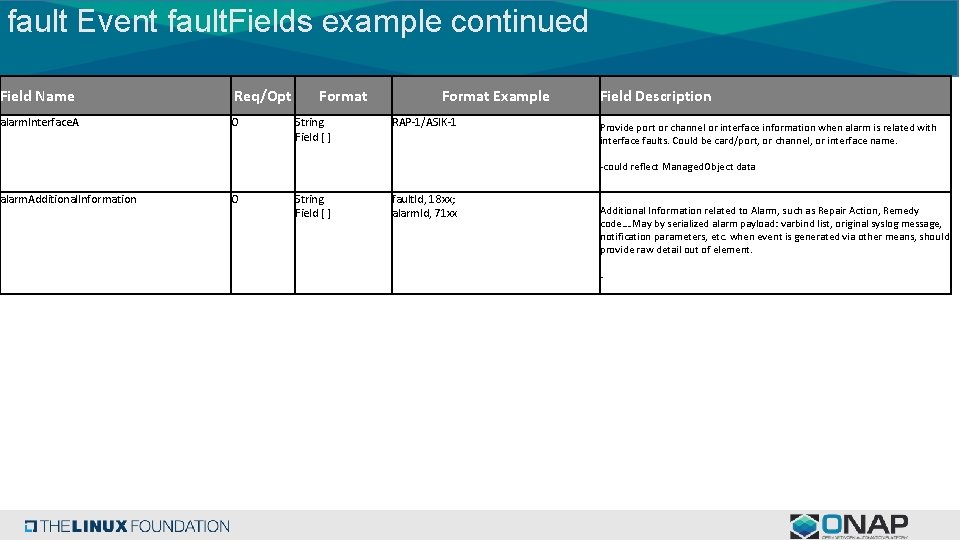
fault Event fault. Fields example continued Field Name Req/Opt alarm. Interface. A O alarm. Additional. Information Format String Field [ ] Format Example RAP-1/ASIK-1 Field Description Provide port or channel or interface information when alarm is related with interface faults. Could be card/port, or channel, or interface name. -could reflect Managed. Object data O String Field [ ] fault. Id, 18 xx; alarm. Id, 71 xx Additional Information related to Alarm, such as Repair Action, Remedy code…. May by serialized alarm payload: varbind list, original syslog message, notification parameters, etc. when event is generated via other means, should provide raw detail out of element. -

s
- Slides: 13