
s at h orse Introduction to Phonological Awareness
- Slides: 40
s at h orse Introduction to Phonological Awareness, Sight Words, and Structural Analysis the he and I to you a
Sort �verb: sort; �arrange systematically in groups; separate according to type, class, etc. �"she sorted out the clothes, some to be kept, some to be thrown away" �synonyms: �Classify, class, categorize, catalog, grade, group
Word Recognition �What is word recognition? ◦ Strategies we use to identify the oral equivalent of a word. �What areas included in word recognition? ◦ ◦ Sight Words Phonological Awareness Structural Analysis Phonics
Key Words � Phonological Awareness—the ability to detect rhyme and separate the sounds in words. This is a broad area that includes phonemic awareness. � Phoneme—individual speech sounds ◦ How many sounds are in the word cake? � Phonemic Awareness—an awareness of sounds in the speech stream. � Coarticulation—the process of articulating a sound while still articulating the previous sound.
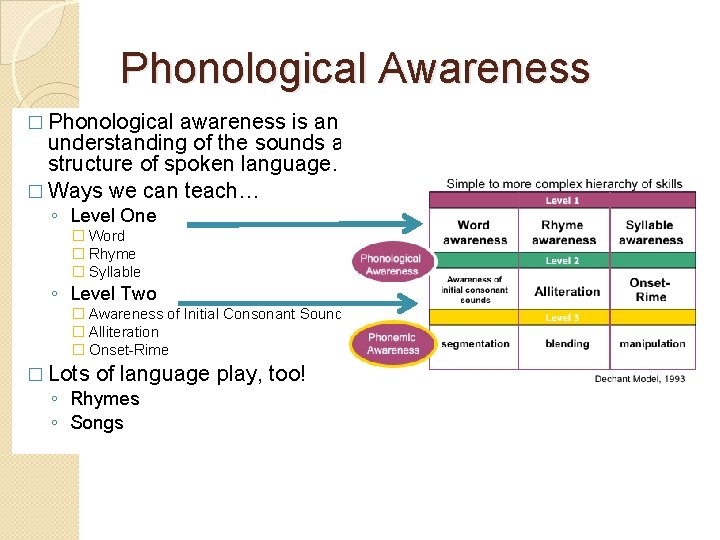
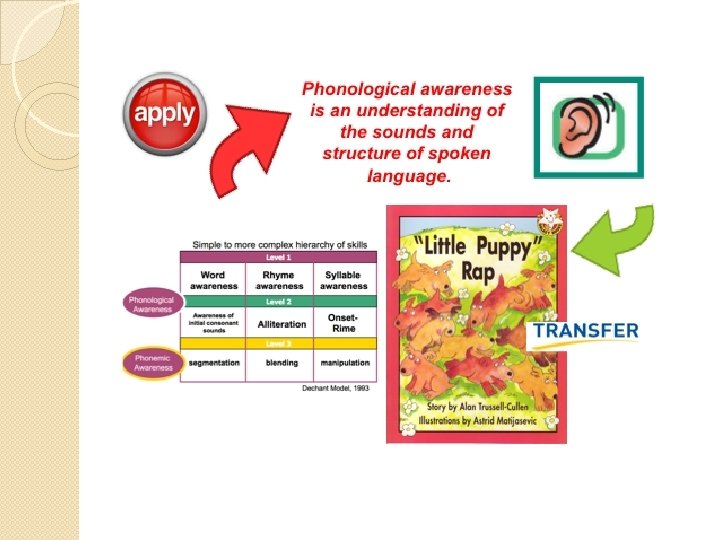
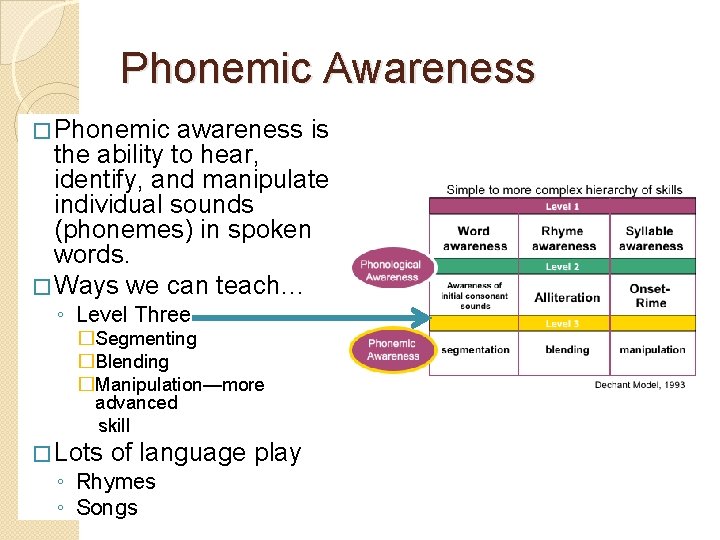
Phonological Awareness � Phonological awareness is an understanding of the sounds and structure of spoken language. � Ways we can teach… ◦ Level One � Word � Rhyme � Syllable ◦ Level Two � Awareness of Initial Consonant Sound � Alliteration � Onset-Rime � Lots of language play, too! ◦ Rhymes ◦ Songs
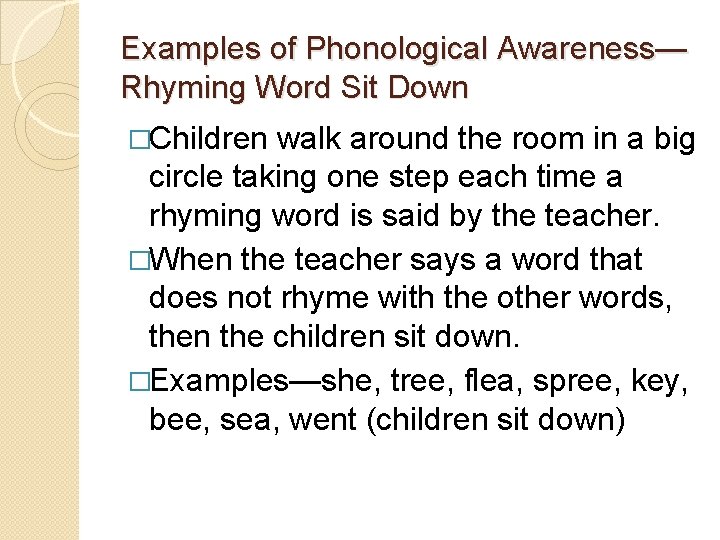
Examples of Phonological Awareness— Rhyming Word Sit Down �Children walk around the room in a big circle taking one step each time a rhyming word is said by the teacher. �When the teacher says a word that does not rhyme with the other words, then the children sit down. �Examples—she, tree, flea, spree, key, bee, sea, went (children sit down)
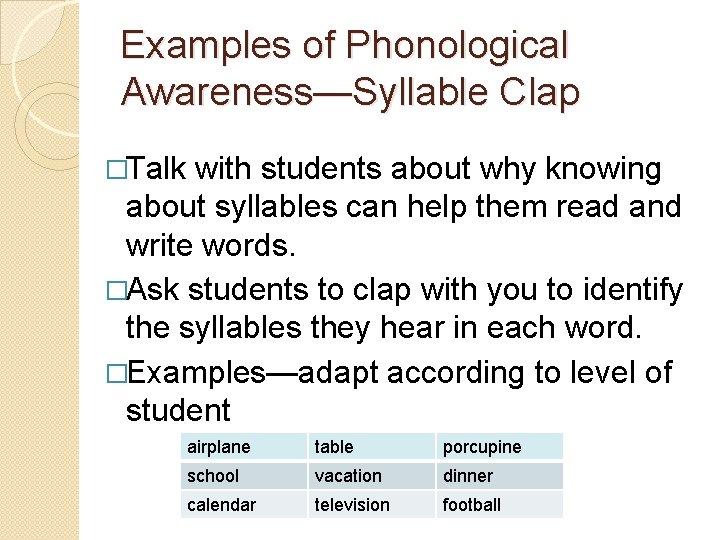
Examples of Phonological Awareness—Syllable Clap �Talk with students about why knowing about syllables can help them read and write words. �Ask students to clap with you to identify the syllables they hear in each word. �Examples—adapt according to level of student airplane table porcupine school vacation dinner calendar television football
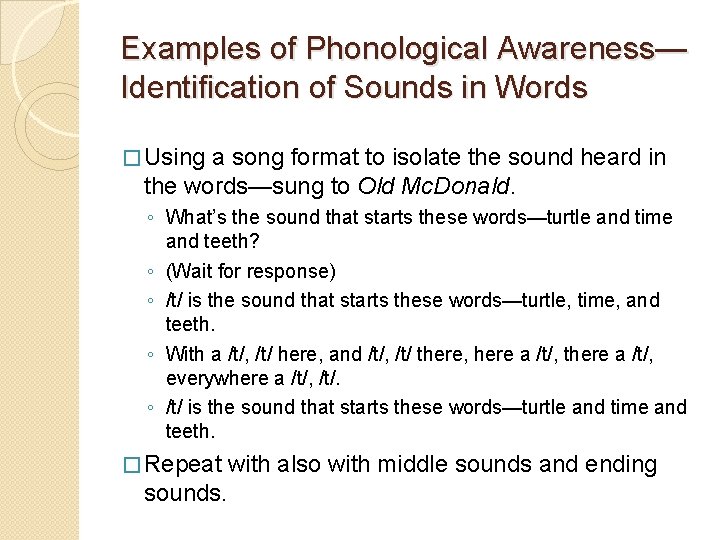
Examples of Phonological Awareness— Identification of Sounds in Words � Using a song format to isolate the sound heard in the words—sung to Old Mc. Donald. ◦ What’s the sound that starts these words—turtle and time and teeth? ◦ (Wait for response) ◦ /t/ is the sound that starts these words—turtle, time, and teeth. ◦ With a /t/, /t/ here, and /t/, /t/ there, here a /t/, there a /t/, everywhere a /t/, /t/. ◦ /t/ is the sound that starts these words—turtle and time and teeth. � Repeat with also with middle sounds and ending sounds.
Phonemic Awareness � Phonemic awareness is the ability to hear, identify, and manipulate individual sounds (phonemes) in spoken words. � Ways we can teach… ◦ Level Three �Segmenting �Blending �Manipulation—more advanced skill � Lots of language play ◦ Rhymes ◦ Songs
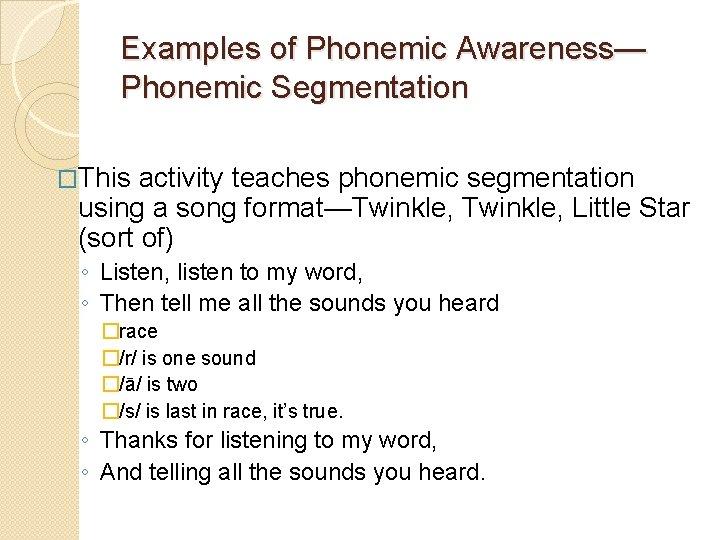
Examples of Phonemic Awareness— Phonemic Segmentation �This activity teaches phonemic segmentation using a song format—Twinkle, Little Star (sort of) ◦ Listen, listen to my word, ◦ Then tell me all the sounds you heard �race �/r/ is one sound �/ā/ is two �/s/ is last in race, it’s true. ◦ Thanks for listening to my word, ◦ And telling all the sounds you heard.
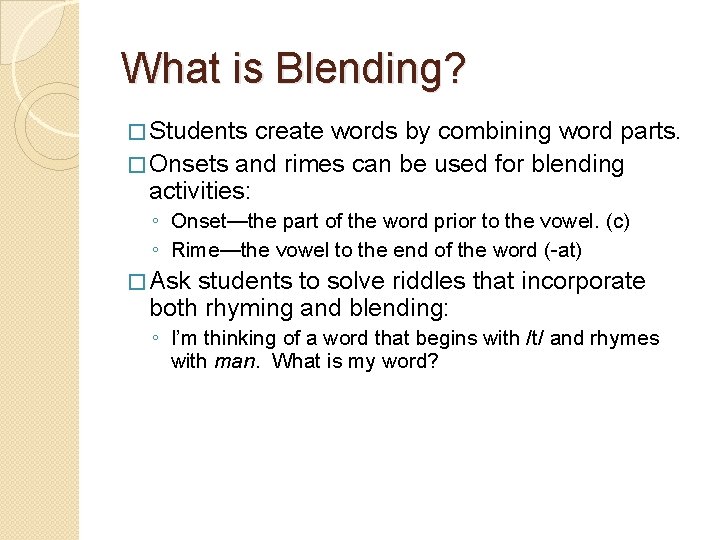
What is Blending? � Students create words by combining word parts. � Onsets and rimes can be used for blending activities: ◦ Onset—the part of the word prior to the vowel. (c) ◦ Rime—the vowel to the end of the word (-at) � Ask students to solve riddles that incorporate both rhyming and blending: ◦ I’m thinking of a word that begins with /t/ and rhymes with man. What is my word?
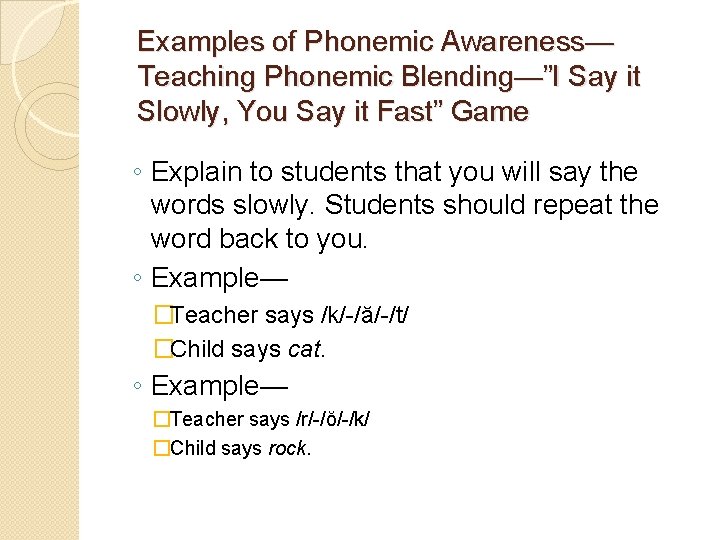
Examples of Phonemic Awareness— Teaching Phonemic Blending—”I Say it Slowly, You Say it Fast” Game ◦ Explain to students that you will say the words slowly. Students should repeat the word back to you. ◦ Example— �Teacher says /k/-/ă/-/t/ �Child says cat. ◦ Example— �Teacher says /r/-/ŏ/-/k/ �Child says rock.
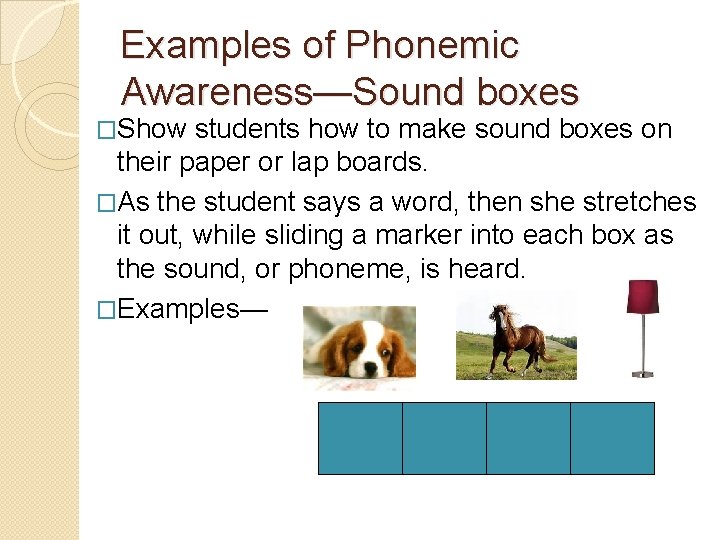
Examples of Phonemic Awareness—Sound boxes �Show students how to make sound boxes on their paper or lap boards. �As the student says a word, then she stretches it out, while sliding a marker into each box as the sound, or phoneme, is heard. �Examples—
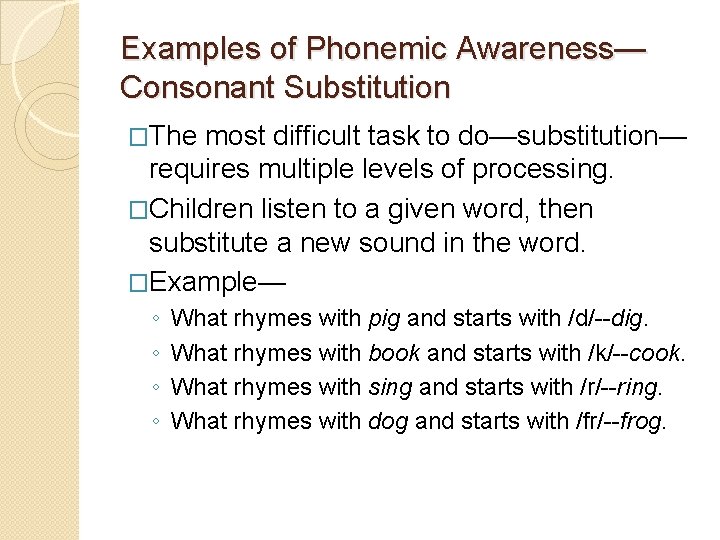
Examples of Phonemic Awareness— Consonant Substitution �The most difficult task to do—substitution— requires multiple levels of processing. �Children listen to a given word, then substitute a new sound in the word. �Example— ◦ ◦ What rhymes with pig and starts with /d/--dig. What rhymes with book and starts with /k/--cook. What rhymes with sing and starts with /r/--ring. What rhymes with dog and starts with /fr/--frog.
Resort �prefix: re ◦ To do again �verb: sort; ◦ arrange systematically in groups; separate according to type, class, etc.
Sight Words �High Frequency Words ◦ Dolch ◦ Fry �Colors �Numbers �How can we teach this type of word recognition area? �Examples of centers—BINGO, Concentration, PIG, Cloze, Roll-Say-Keep, and Gameboards.
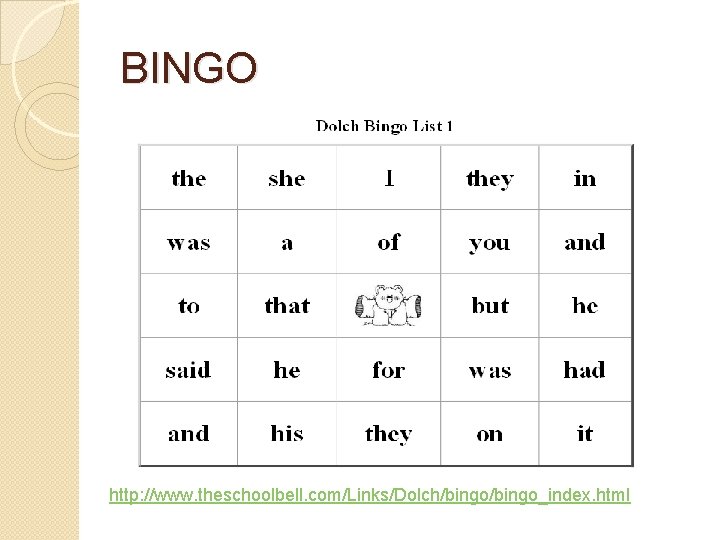
BINGO http: //www. theschoolbell. com/Links/Dolch/bingo_index. html
Important BINGO Notes �Be sure to print one of Card One, one of Card Two, one of Card Three, etc. If you do 5 copies of Card One, then everyone has a BINGO at the same time. �Include markers for BINGO Card. �Include a call list, which can be a printout of the corresponding DOLCH list. �You must do at least 5 BINGO cards.
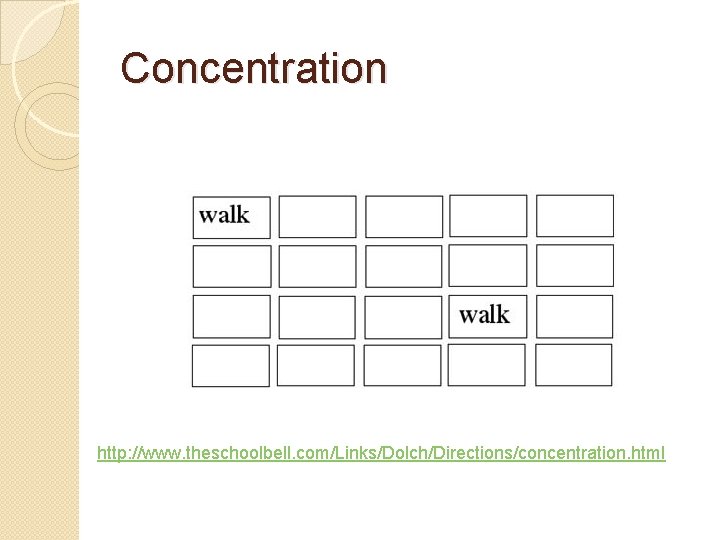
Concentration http: //www. theschoolbell. com/Links/Dolch/Directions/concentration. html
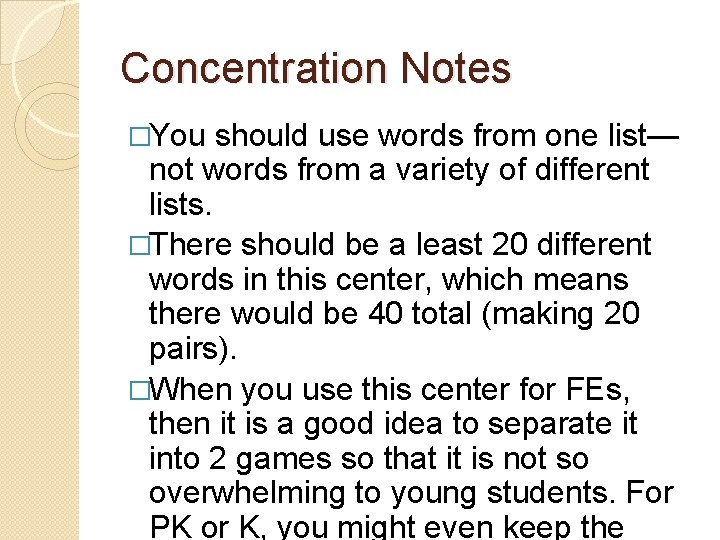
Concentration Notes �You should use words from one list— not words from a variety of different lists. �There should be a least 20 different words in this center, which means there would be 40 total (making 20 pairs). �When you use this center for FEs, then it is a good idea to separate it into 2 games so that it is not so overwhelming to young students. For PK or K, you might even keep the
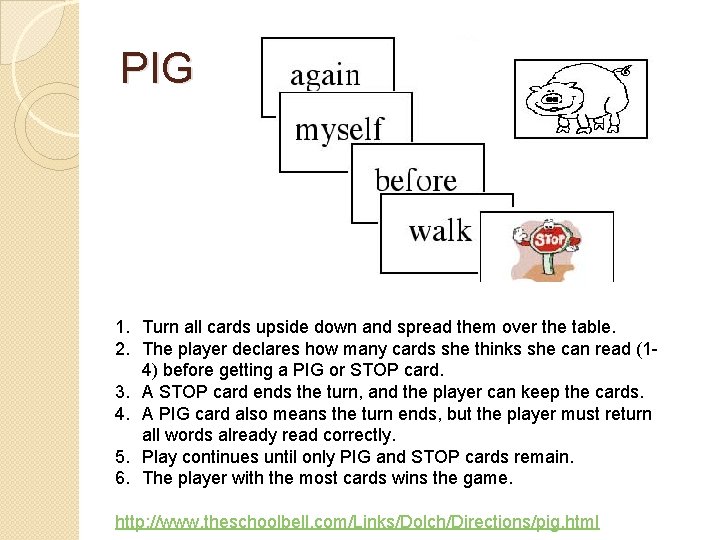
PIG 1. Turn all cards upside down and spread them over the table. 2. The player declares how many cards she thinks she can read (14) before getting a PIG or STOP card. 3. A STOP card ends the turn, and the player can keep the cards. 4. A PIG card also means the turn ends, but the player must return all words already read correctly. 5. Play continues until only PIG and STOP cards remain. 6. The player with the most cards wins the game. http: //www. theschoolbell. com/Links/Dolch/Directions/pig. html
PIG Notes �Remember to include all parts in the game: ◦ ◦ Word cards Pig cards Stop cards Directions �Use the corresponding mini-word cards that are included at the web site (don’t use words from different lists).
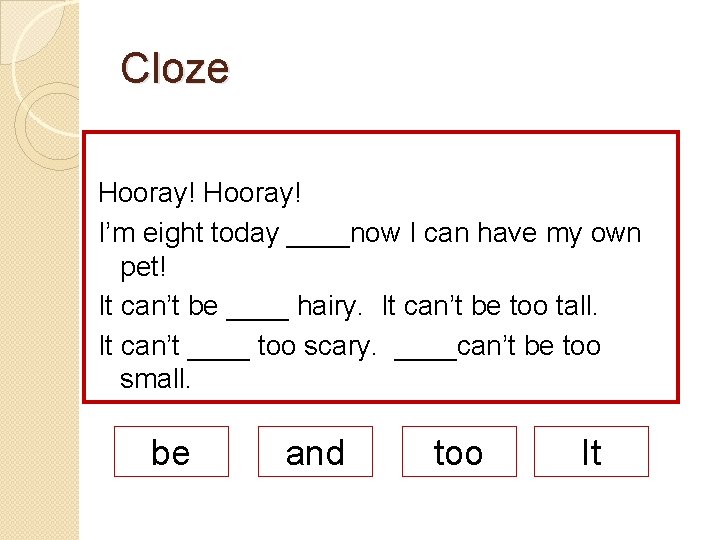
What is a Cloze Activity? �Students determine the word that goes in the missing blank. • It can be used to activate a reader’s background knowledge… • The reader draws upon his knowledge of the world to figure out the missing word. It’s a good activity to help build comprehension. • It encourages the reader to draw upon semantic, syntactic, and graphophonic cueing systems. •
Cloze Hooray! I’m eight today ____now I can have my own pet! It can’t be ____ hairy. It can’t be too tall. It can’t ____ too scary. ____can’t be too small. be and too It
Cloze Activity as a Center �If you do the cloze activity, then you need to use words from one list. �You should only do one missing word per sentence. �There would need to be 20 words/20 sentences. �Remember to include directions and self-check.
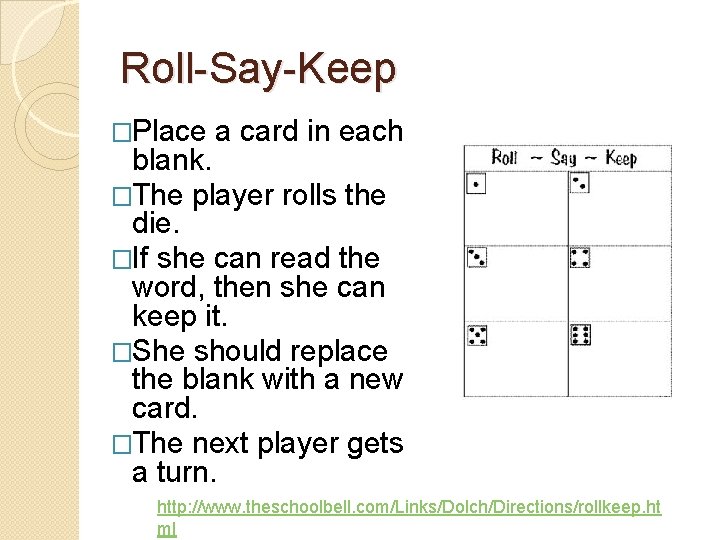
Roll-Say-Keep �Place a card in each blank. �The player rolls the die. �If she can read the word, then she can keep it. �She should replace the blank with a new card. �The next player gets a turn. http: //www. theschoolbell. com/Links/Dolch/Directions/rollkeep. ht ml
Roll-Say-Keep Notes �Remember-20 words per center. �Same rules as previously noted-don’t mix lists within a game. �Remember to include all parts.
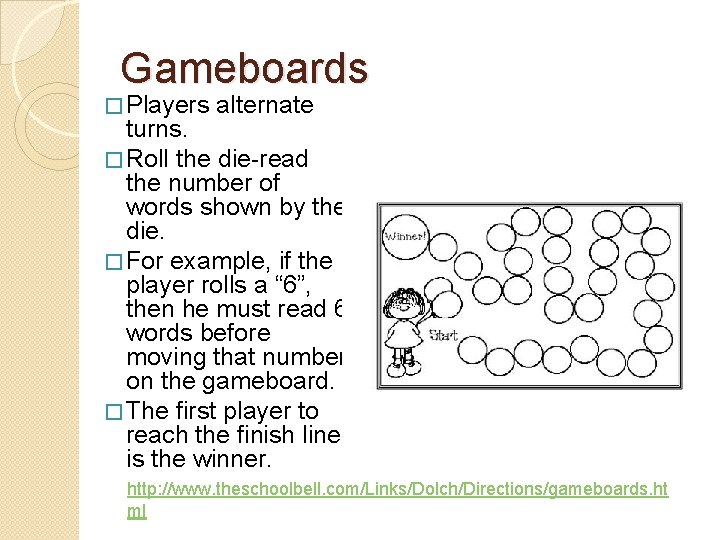
Gameboards � Players alternate turns. � Roll the die-read the number of words shown by the die. � For example, if the player rolls a “ 6”, then he must read 6 words before moving that number on the gameboard. � The first player to reach the finish line is the winner. http: //www. theschoolbell. com/Links/Dolch/Directions/gameboards. ht ml
Gameboard Notes �One gameboard and one set of minicards equals one center. �There a variety of gameboards at the School. Bell web site.
Other Notes about the Sight Word Center �Do not use word searches for the sight word center. �Do not use crossword puzzles. �You can mix and match elements to complete this center. For example, you could use 10 words in a BINGO game, then use another 10 words as the PIG game.
Resort �prefix: re ◦ To do again �verb: sort; ◦ arrange systematically in groups; separate according to type, class, etc.
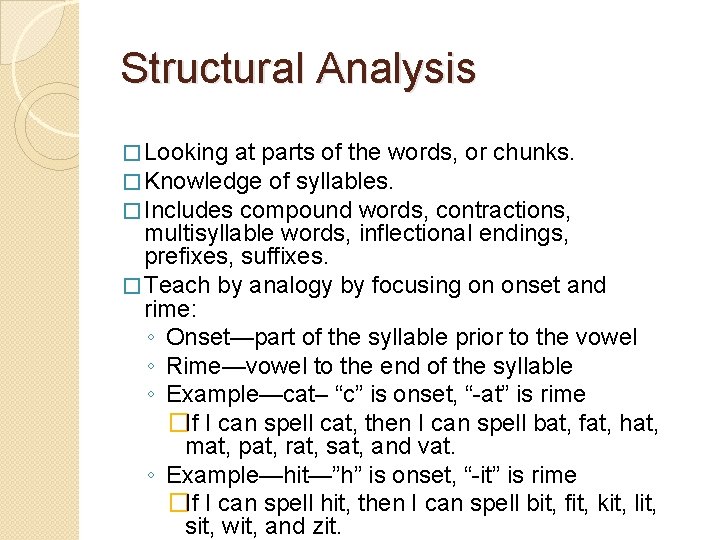
Structural Analysis � Looking at parts of the words, or chunks. � Knowledge of syllables. � Includes compound words, contractions, multisyllable words, inflectional endings, prefixes, suffixes. � Teach by analogy by focusing on onset and rime: ◦ Onset—part of the syllable prior to the vowel ◦ Rime—vowel to the end of the syllable ◦ Example—cat– “c” is onset, “-at” is rime �If I can spell cat, then I can spell bat, fat, hat, mat, pat, rat, sat, and vat. ◦ Example—hit—”h” is onset, “-it” is rime �If I can spell hit, then I can spell bit, fit, kit, lit, sit, wit, and zit.
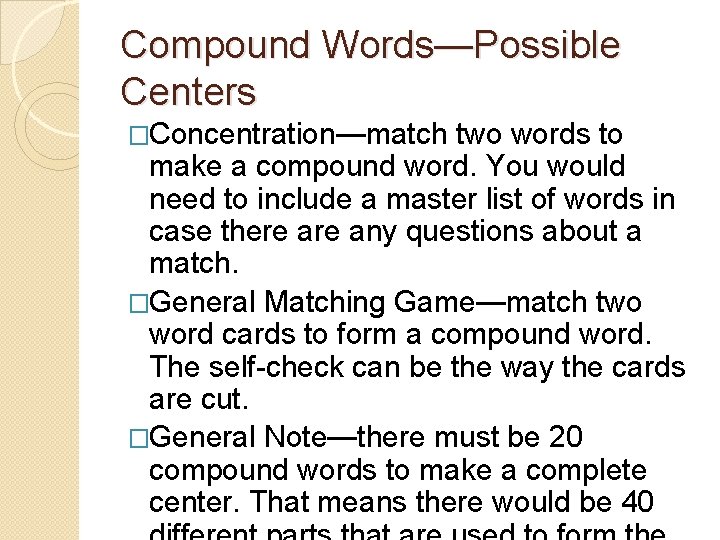
Compound Words—Possible Centers �Concentration—match two words to make a compound word. You would need to include a master list of words in case there any questions about a match. �General Matching Game—match two word cards to form a compound word. The self-check can be the way the cards are cut. �General Note—there must be 20 compound words to make a complete center. That means there would be 40
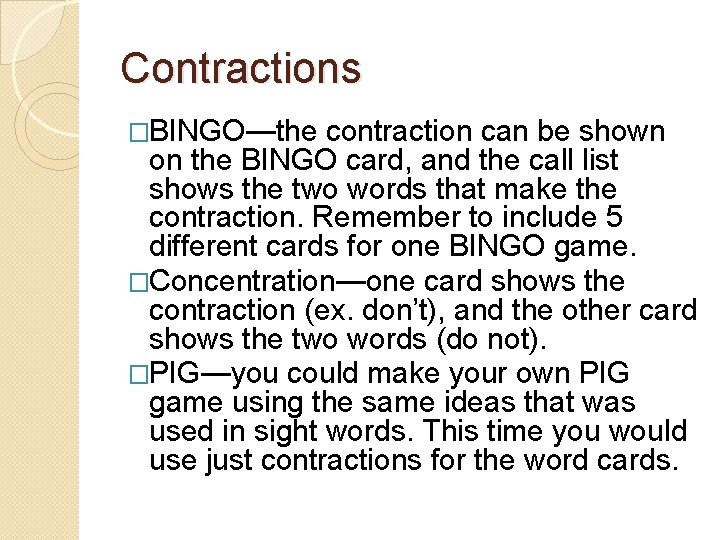
Contractions �BINGO—the contraction can be shown on the BINGO card, and the call list shows the two words that make the contraction. Remember to include 5 different cards for one BINGO game. �Concentration—one card shows the contraction (ex. don’t), and the other card shows the two words (do not). �PIG—you could make your own PIG game using the same ideas that was used in sight words. This time you would use just contractions for the word cards.
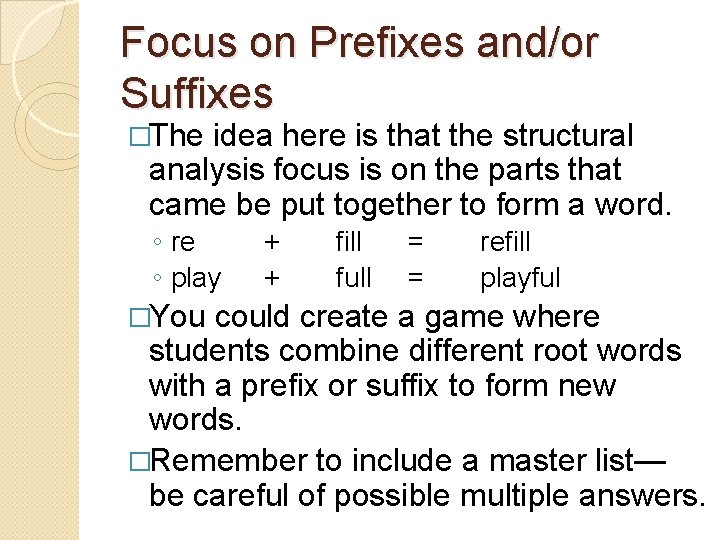
Focus on Prefixes and/or Suffixes �The idea here is that the structural analysis focus is on the parts that came be put together to form a word. ◦ re ◦ play + + fill full = refill = playful �You could create a game where students combine different root words with a prefix or suffix to form new words. �Remember to include a master list— be careful of possible multiple answers.
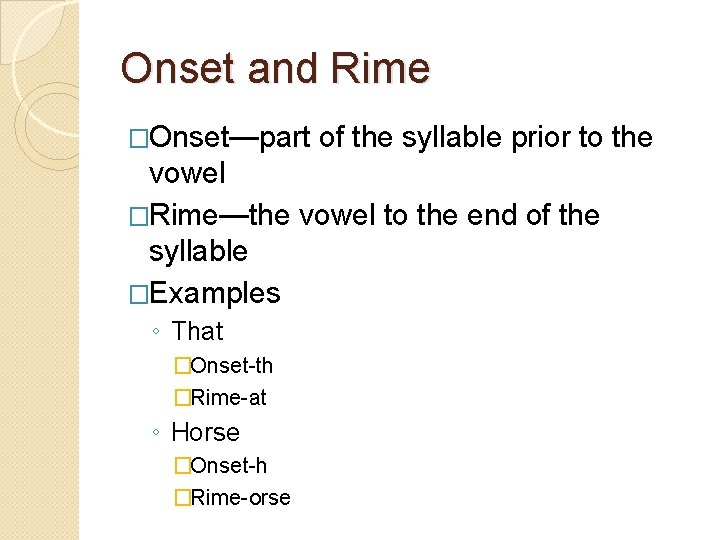
Onset and Rime �Onset—part of the syllable prior to the vowel �Rime—the vowel to the end of the syllable �Examples ◦ That �Onset-th �Rime-at ◦ Horse �Onset-h �Rime-orse
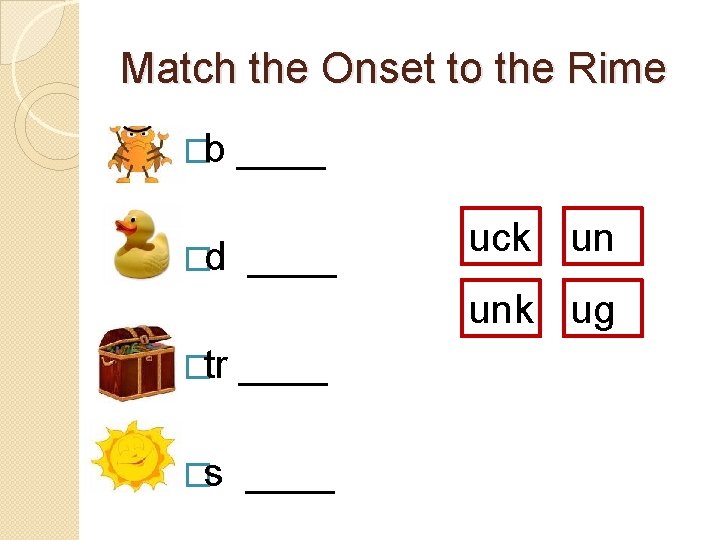
Match the Onset to the Rime �b ____ �d ____ uck un unk ug �tr ____ �s ____
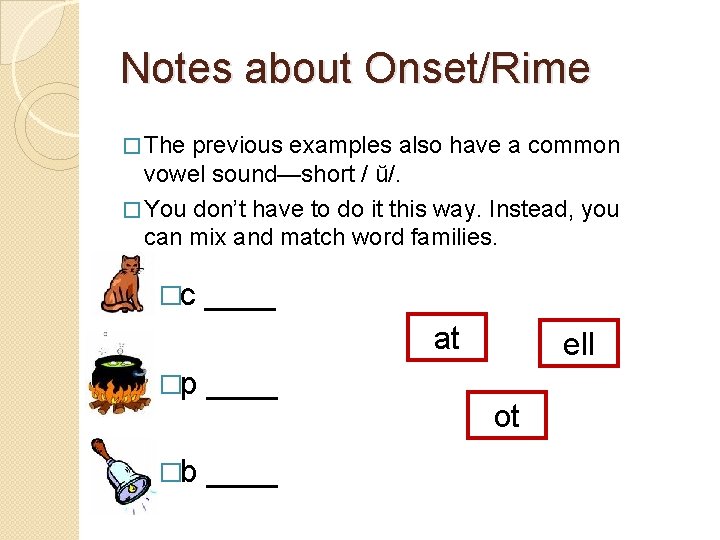
Notes about Onset/Rime � The previous examples also have a common vowel sound—short / ŭ/. � You don’t have to do it this way. Instead, you can mix and match word families. �c ____ at �p ____ �b ____ ell ot
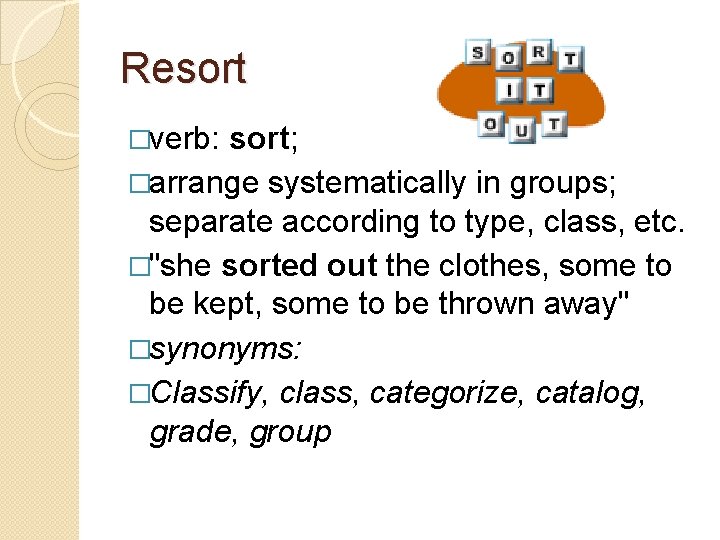
Resort �verb: sort; �arrange systematically in groups; separate according to type, class, etc. �"she sorted out the clothes, some to be kept, some to be thrown away" �synonyms: �Classify, class, categorize, catalog, grade, group