
S 802 16 m08319 New Preamble Sequence Design
S 802. 16 m-08/319 New Preamble Sequence Design Using Quasi Complete Complementary Codes for IEEE 802. 16 m Document Number: S 802. 16 m-08/319 Date Submitted: May 05, 2008 Source: Pei-Kai Liao (pk. liao@mediatek. com) and Paul Cheng (paul. cheng@mediatek. com) Media. Tek Inc. No. 1 Dusing Rd. 1 Hsinchu Science Park Hsinchu City 300 Taiwan; Chao-Yu Chen (d 919609@oz. nthu. edu. tw), Kuei-Ying Lu and Chi-Chao (ccc@ee. nthu. edu. tw) Institute of Communications Engineering, National Tsing Hua University, Hsinchu 30013, Taiwan; Yih-Guang Jan (yihjan@ee. tku. edu) and Yang-Han Lee (yhlee@ee. tku. edu. tw) Tamkang University; Shiann-Tsong Sheu (stsheu@ce. ncu. edu. tw) National Central Univeristy Venue: Macao, China Base Contribution: IEEE C 802. 16 m-08/319 r 1 Purpose: Propose to be discussed and adopted by TGm for the use in Project 802. 16 m SDD. Notice: This document does not represent the agreed views of the IEEE 802. 16 Working Group or any of its subgroups. It represents only the views of the participants listed in the “Source(s)” field above. It is offered as a basis for discussion. It is not binding on the contributor(s), who reserve(s) the right to add, amend or withdraw material contained herein. Release: The contributor grants a free, irrevocable license to the IEEE to incorporate material contained in this contribution, and any modifications thereof, in the creation of an IEEE Standards publication; to copyright in the IEEE’s name any IEEE Standards publication even though it may include portions of this contribution; and at the IEEE’s sole discretion to permit others to reproduce in whole or in part the resulting IEEE Standards publication. The contributor also acknowledges and accepts that this contribution may be made public by IEEE 802. 16. Patent Policy: The contributor is familiar with the IEEE-SA Patent Policy and Procedures: <http: //standards. ieee. org/guides/bylaws/sect 6 -7. html#6> and <http: //standards. ieee. org/guides/opman/sect 6. html#6. 3>. Further information is located at <http: //standards. ieee. org/board/pat-material. html> and <http: //standards. ieee. org/board/pat >.
Introduction • Motivation – Non-structural code sequence for 802. 16 e preamble • Memory for the storage of code sequence • Longer searching time of code matching – Structural code sequence with low PAPR, low crorsscorrelation and similar performance is desired • Purpose and Summary – A new code sequence using QCCC is proposed for 802. 16 m preamble – Propose to be discussed and included in 802. 16 m SDD
Design Considerations • Mathematical structure – Structural code sequences reduce hardware complexity of transceiver design • Low PAPR – To maximize transmission power efficiency, code sequences with low PAPR is desirable • Large peak to cross-correlation ratio – Large peak to cross-correlation ratio reduces the possibility of misjudgment of code matching • More code sequences – More Cell_ID is desired
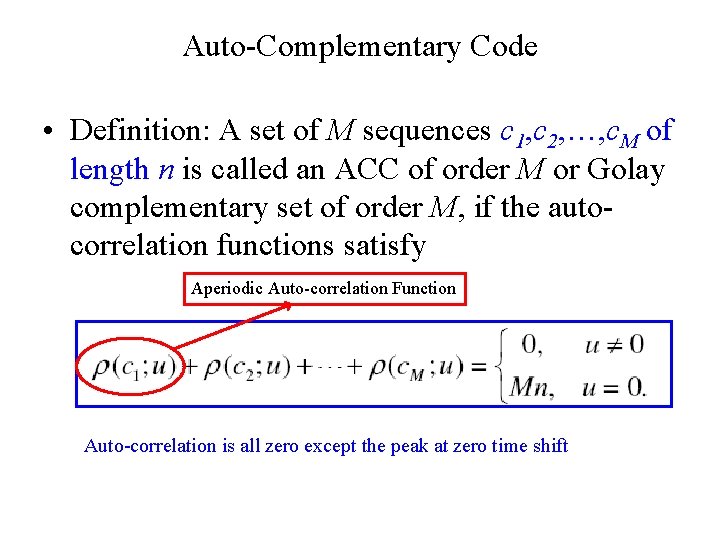
Auto-Complementary Code • Definition: A set of M sequences c 1, c 2, …, c. M of length n is called an ACC of order M or Golay complementary set of order M, if the autocorrelation functions satisfy Aperiodic Auto-correlation Function Auto-correlation is all zero except the peak at zero time shift
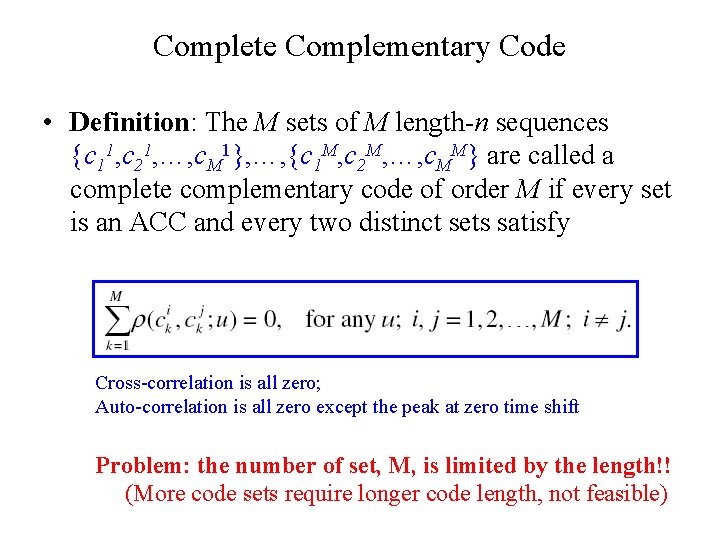
Complete Complementary Code • Definition: The M sets of M length-n sequences {c 11, c 21, …, c. M 1}, …, {c 1 M, c 2 M, …, c. MM} are called a complete complementary code of order M if every set is an ACC and every two distinct sets satisfy Cross-correlation is all zero; Auto-correlation is all zero except the peak at zero time shift Problem: the number of set, M, is limited by the length!! (More code sets require longer code length, not feasible)
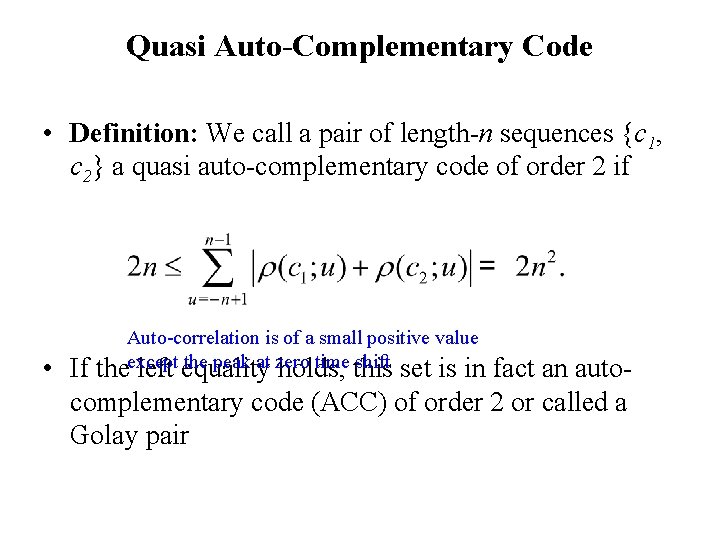
Quasi Auto-Complementary Code • Definition: We call a pair of length-n sequences {c 1, c 2} a quasi auto-complementary code of order 2 if Auto-correlation is of a small positive value the peak at zero time this shift set is in theexcept left equality holds, • If fact an autocomplementary code (ACC) of order 2 or called a Golay pair
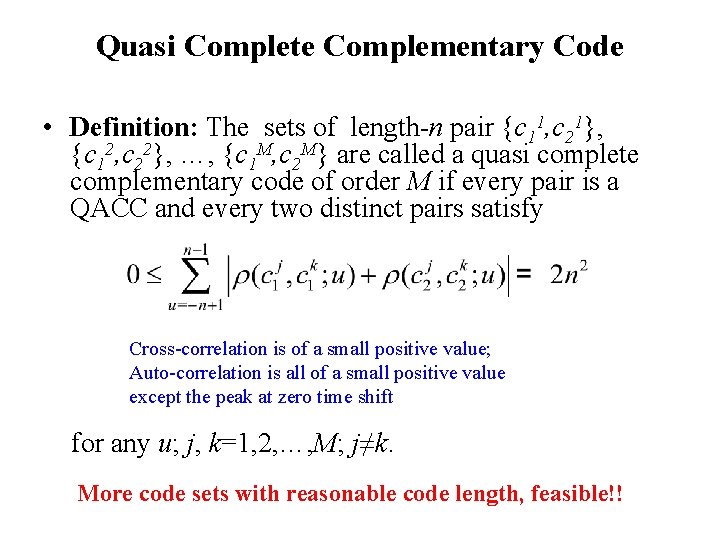
Quasi Complete Complementary Code • Definition: The sets of length-n pair {c 11, c 21}, {c 12, c 22}, …, {c 1 M, c 2 M} are called a quasi complete complementary code of order M if every pair is a QACC and every two distinct pairs satisfy Cross-correlation is of a small positive value; Auto-correlation is all of a small positive value except the peak at zero time shift for any u; j, k=1, 2, …, M; j≠k. More code sets with reasonable code length, feasible!!
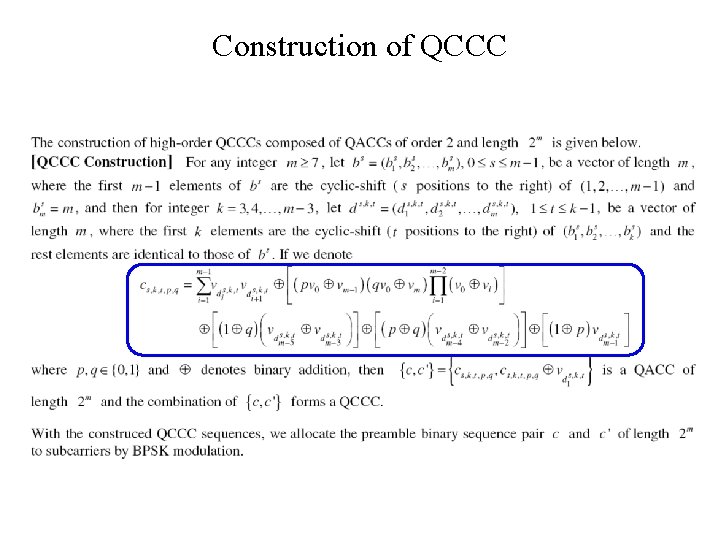
Construction of QCCC
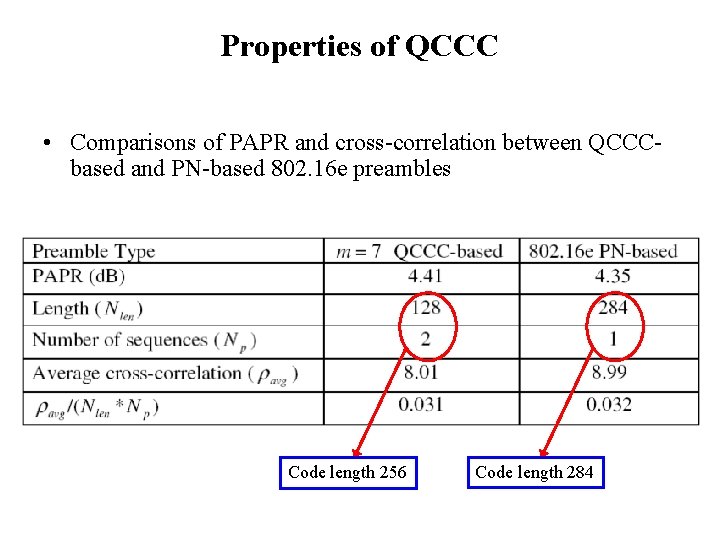
Properties of QCCC • Comparisons of PAPR and cross-correlation between QCCCbased and PN-based 802. 16 e preambles Code length 256 Code length 284
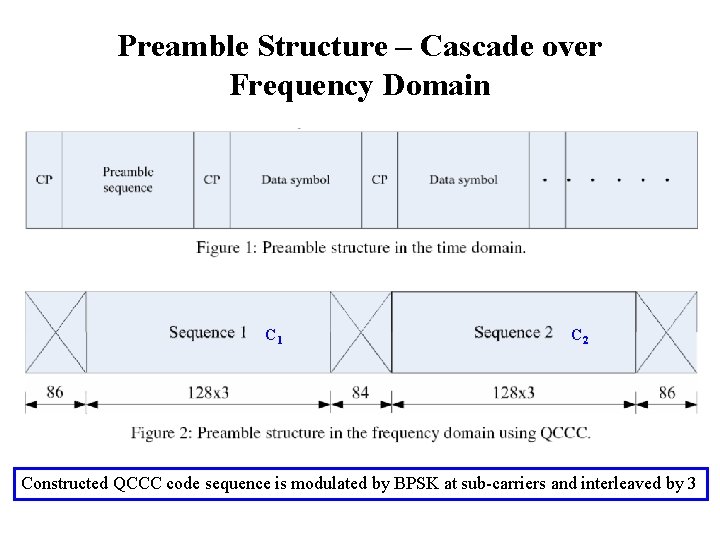
Preamble Structure – Cascade over Frequency Domain C 1 C 2 Constructed QCCC code sequence is modulated by BPSK at sub-carriers and interleaved by 3
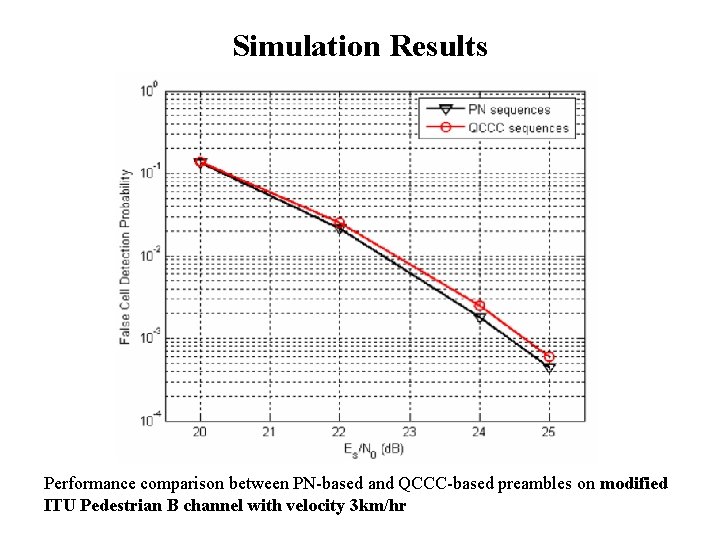
Simulation Results Performance comparison between PN-based and QCCC-based preambles on modified ITU Pedestrian B channel with velocity 3 km/hr
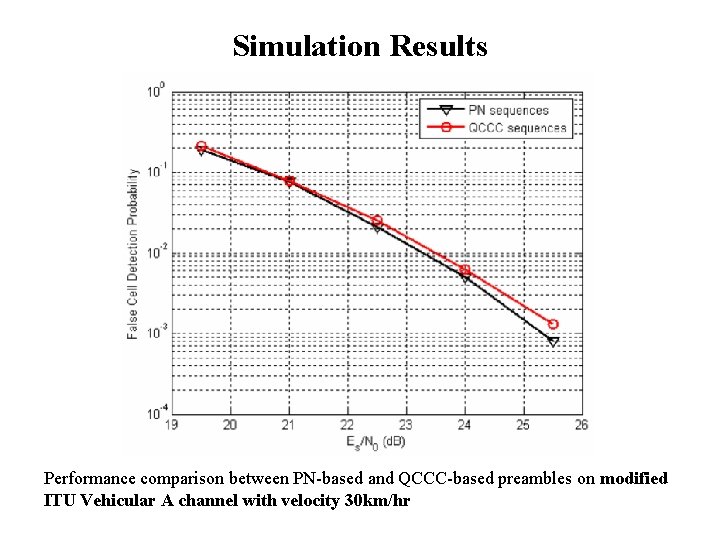
Simulation Results Performance comparison between PN-based and QCCC-based preambles on modified ITU Vehicular A channel with velocity 30 km/hr
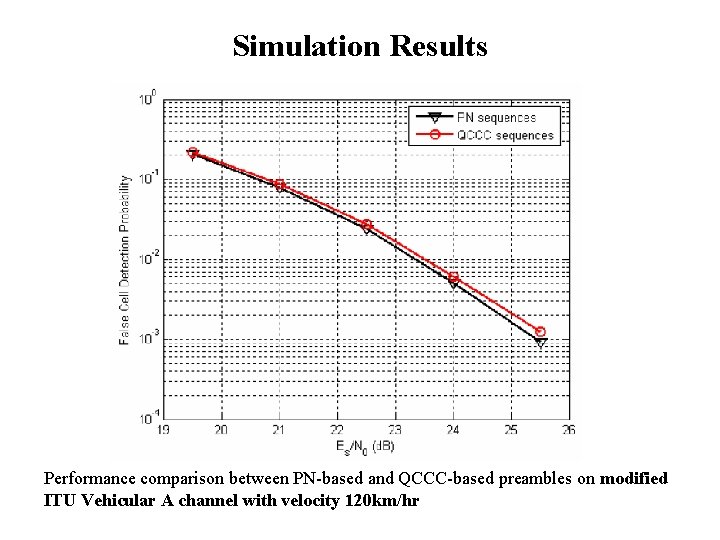
Simulation Results Performance comparison between PN-based and QCCC-based preambles on modified ITU Vehicular A channel with velocity 120 km/hr
Conclusion • A code sequence with mathematical structure for 16 m preamble is proposed – It waives the memory storage of all code sequences – It enables the possibility of more efficient code matching algorithm instead of full search • Performance of the proposed code sequence, QCCC, is close to that of 16 e PRBS
- Slides: 14