
S 5 Higher Textual Analysis Tips and Types


- Slides: 7
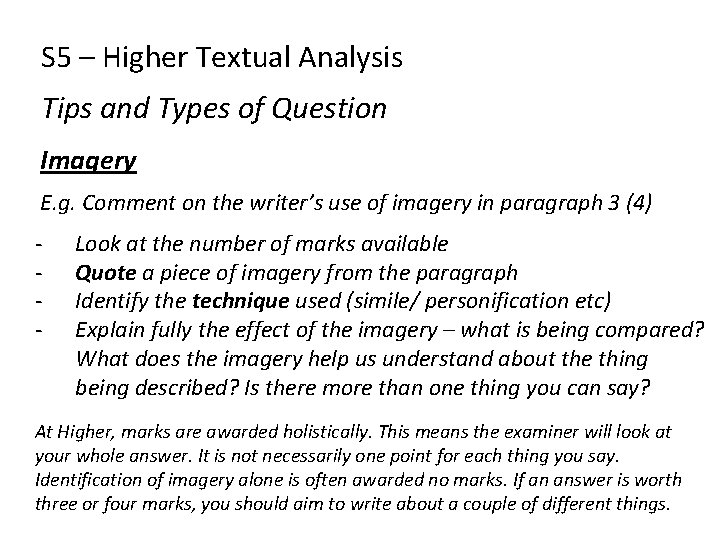
S 5 – Higher Textual Analysis Tips and Types of Question Imagery E. g. Comment on the writer’s use of imagery in paragraph 3 (4) - Look at the number of marks available Quote a piece of imagery from the paragraph Identify the technique used (simile/ personification etc) Explain fully the effect of the imagery – what is being compared? What does the imagery help us understand about the thing being described? Is there more than one thing you can say? At Higher, marks are awarded holistically. This means the examiner will look at your whole answer. It is not necessarily one point for each thing you say. Identification of imagery alone is often awarded no marks. If an answer is worth three or four marks, you should aim to write about a couple of different things.
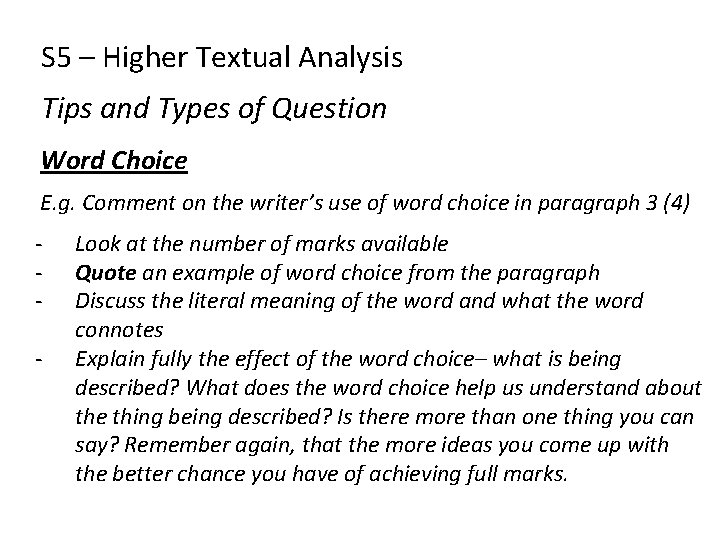
S 5 – Higher Textual Analysis Tips and Types of Question Word Choice E. g. Comment on the writer’s use of word choice in paragraph 3 (4) - Look at the number of marks available Quote an example of word choice from the paragraph Discuss the literal meaning of the word and what the word connotes Explain fully the effect of the word choice– what is being described? What does the word choice help us understand about the thing being described? Is there more than one thing you can say? Remember again, that the more ideas you come up with the better chance you have of achieving full marks.
S 5 – Higher Textual Analysis Tips and Types of Question Sentence Structure E. g. How does the writer use sentence structure to show the character’s frustration? (2) - Look at the number of marks available - Quote or describe the example of sentence structure - Explain the function of the structure and its effect on the reader. For the example above you would need to clearly explain how the example of sentence structure revealed the character’s frustration.
S 5 – Higher Textual Analysis Tips and Types of Question Description and Tone E. g. Comment on the writer’s description of the party in paragraph 5. In your answer you should refer to the writer’s tone. (3) - Look at the number of marks available - Quote and example of descriptive language. This could be word choice or imagery - Explain the effect of the language. You may discuss the denotation and connotations of a word and what it helps us understand about what is being described. - You must be specific about what the writer’s tone is and how the description helps you arrive at your understanding.
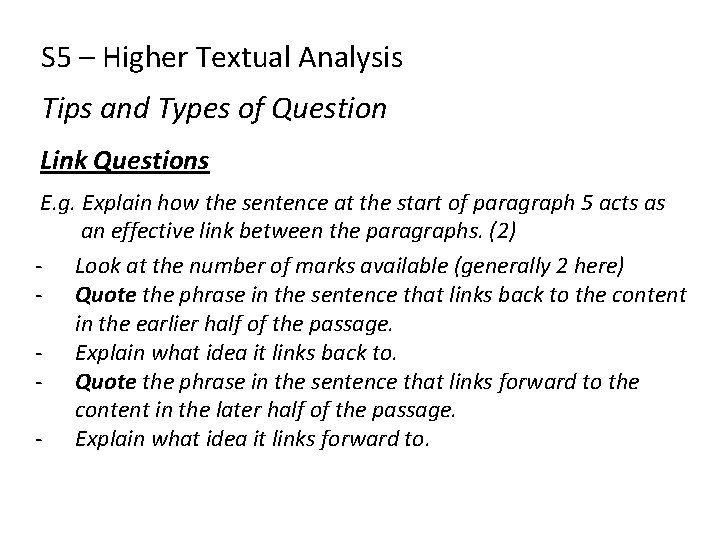
S 5 – Higher Textual Analysis Tips and Types of Question Link Questions E. g. Explain how the sentence at the start of paragraph 5 acts as an effective link between the paragraphs. (2) - Look at the number of marks available (generally 2 here) - Quote the phrase in the sentence that links back to the content in the earlier half of the passage. - Explain what idea it links back to. - Quote the phrase in the sentence that links forward to the content in the later half of the passage. - Explain what idea it links forward to.
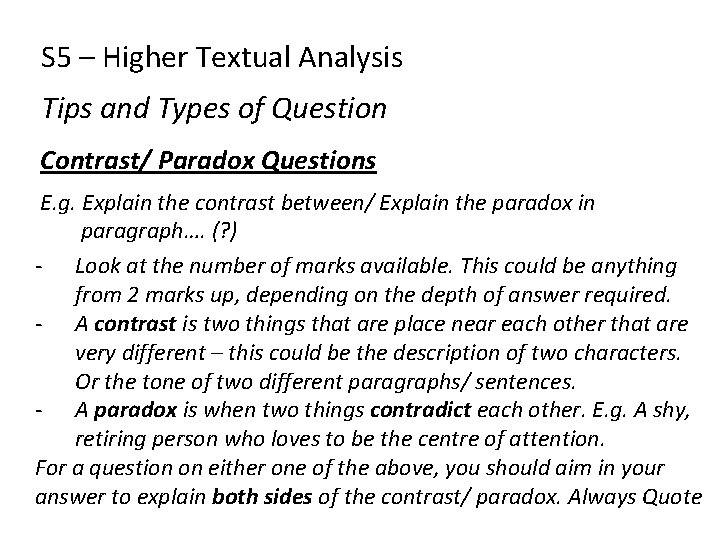
S 5 – Higher Textual Analysis Tips and Types of Question Contrast/ Paradox Questions E. g. Explain the contrast between/ Explain the paradox in paragraph…. (? ) - Look at the number of marks available. This could be anything from 2 marks up, depending on the depth of answer required. - A contrast is two things that are place near each other that are very different – this could be the description of two characters. Or the tone of two different paragraphs/ sentences. - A paradox is when two things contradict each other. E. g. A shy, retiring person who loves to be the centre of attention. For a question on either one of the above, you should aim in your answer to explain both sides of the contrast/ paradox. Always Quote
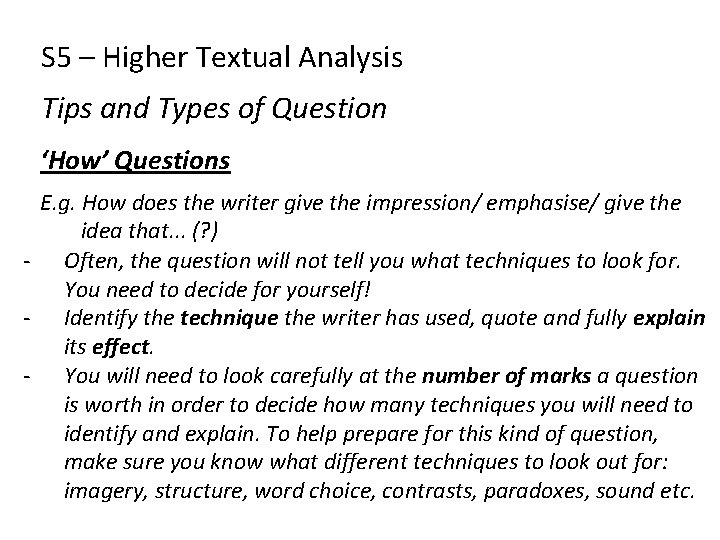
S 5 – Higher Textual Analysis Tips and Types of Question ‘How’ Questions E. g. How does the writer give the impression/ emphasise/ give the idea that. . . (? ) - Often, the question will not tell you what techniques to look for. You need to decide for yourself! - Identify the technique the writer has used, quote and fully explain its effect. - You will need to look carefully at the number of marks a question is worth in order to decide how many techniques you will need to identify and explain. To help prepare for this kind of question, make sure you know what different techniques to look out for: imagery, structure, word choice, contrasts, paradoxes, sound etc.