
S 131 Unit 3 LCES Lookouts Communications Escape

- Slides: 23
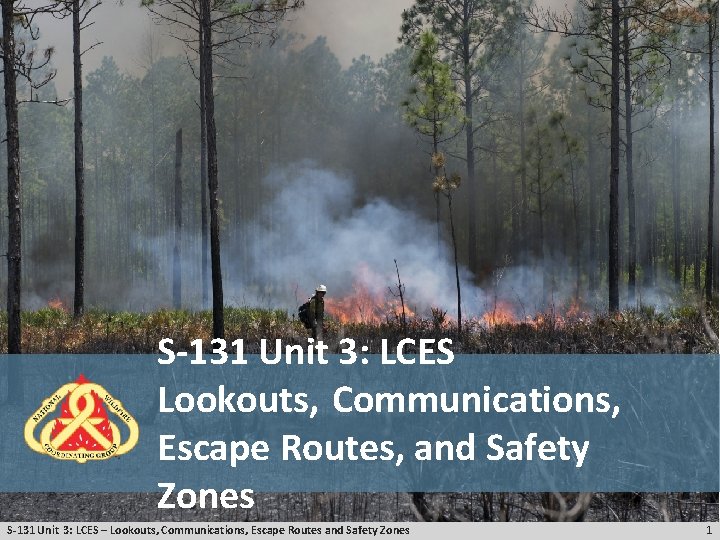
S 131 Unit 3: LCES Lookouts, Communications, Escape Routes, and Safety Zones S 131 Unit 3: LCES – Lookouts, Communications, Escape Routes and Safety Zones 1
Objective Students will be able to: • Demonstrate the ability to apply the principles of Lookouts, Communications, Escape Routes, and Safety Zones (LCES). S 131 Unit 3: LCES – Lookouts, Communications, Escape Routes and Safety Zones 2
Introduction A Brief History "LCES" Original Document By Paul Gleason Former Zig Zag Hotshot Superintendent June 1991 S 131 Unit 3: LCES – Lookouts, Communications, Escape Routes and Safety Zones 3
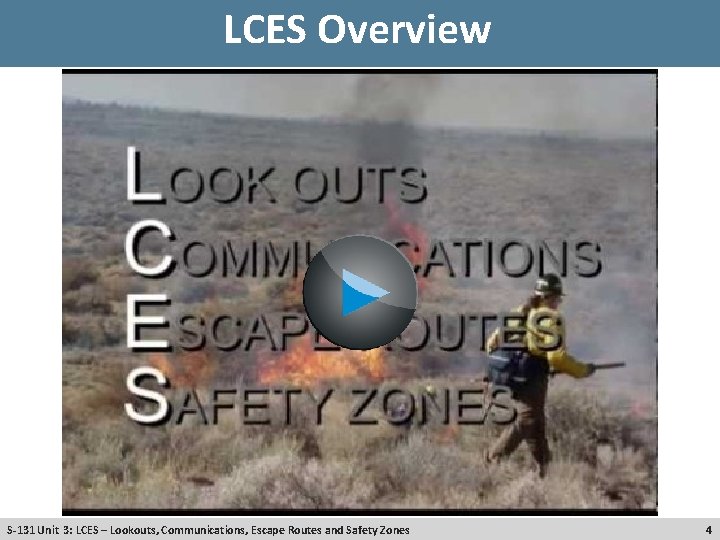
LCES Overview S 131 Unit 3: LCES – Lookouts, Communications, Escape Routes and Safety Zones 4
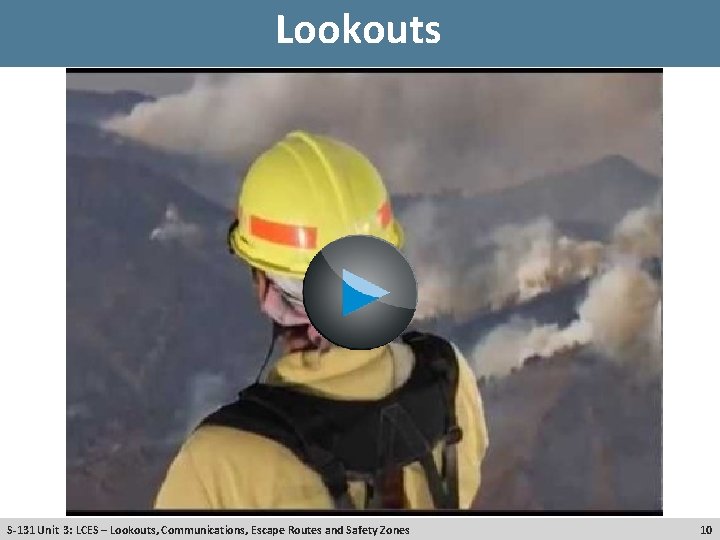
Lookouts Qualities of a Good Lookout • • • Experienced, competent, and trusted. Understands objectives and leader’s intent. Achieves a view of the fire scene. Keeps in mind the limits of their view. Accounts for everyone’s location, including small groups and individuals. S 131 Unit 3: LCES – Lookouts, Communications, Escape Routes and Safety Zones 5
Lookouts Qualities of a Good Lookout • Actively maintains communications with everyone in their area. • Monitors the fire, fire behavior, and weather and tracks weather trends. • Stays in position until replaced with another lookout, the hazard is otherwise mitigated, you (the lookout) are ordered out by the supervisor, or if your safety is compromised. S 131 Unit 3: LCES – Lookouts, Communications, Escape Routes and Safety Zones 6
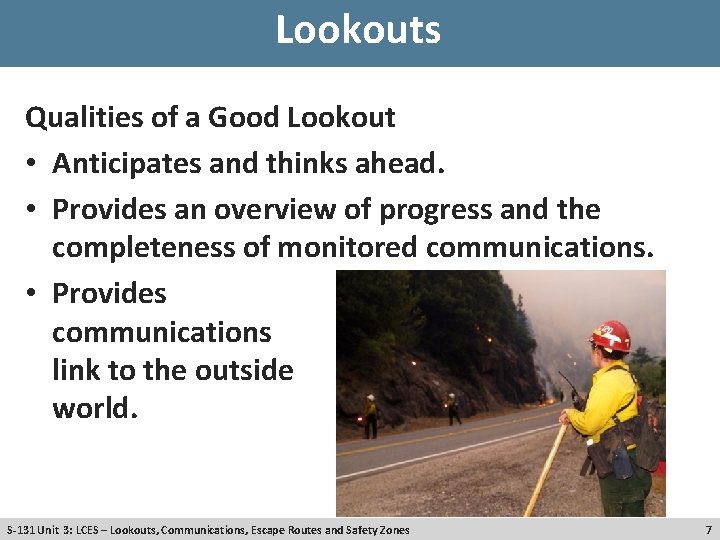
Lookouts Qualities of a Good Lookout • Anticipates and thinks ahead. • Provides an overview of progress and the completeness of monitored communications. • Provides communications link to the outside world. S 131 Unit 3: LCES – Lookouts, Communications, Escape Routes and Safety Zones 7
Lookouts Qualities of a Good Lookout • Handle logistics for the crew for remote operations. Makes logistical preparations for self for extended shifts that have the possibility for no support. • Establishes their own LCES plan and fit into the chain of command (e. g. , where their communications link is). • The lookout is not always an individual perched on an adjacent ridge, nor will the person looking out be able to see the entire scene. S 131 Unit 3: LCES – Lookouts, Communications, Escape Routes and Safety Zones 8
Lookouts Lookout Tools • • Notebook Binoculars Weather kit Compass and GPS Flashlight or head lamp Flagging (various colors) Extra batteries Wristwatch • Maps • Signal mirror or strobe • Radio • Cell or satellite phone • PPE • Incident Action Plan S 131 Unit 3: LCES – Lookouts, Communications, Escape Routes and Safety Zones 9
Lookouts S 131 Unit 3: LCES – Lookouts, Communications, Escape Routes and Safety Zones 10
Communications Guidelines for Effective Communications • Eliminate assumptions. • Ask questions. • Find out everything you need to know to stay aware of your situation. • Relay updated information as soon as possible. • Be available to communicate at all times. S 131 Unit 3: LCES – Lookouts, Communications, Escape Routes and Safety Zones 11
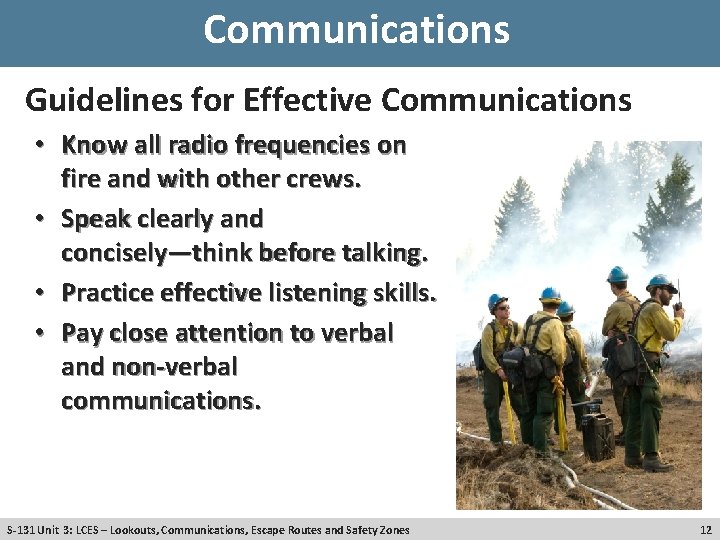
Communications Guidelines for Effective Communications • Know all radio frequencies on fire and with other crews. • Speak clearly and concisely—think before talking. • Practice effective listening skills. • Pay close attention to verbal and non verbal communications. S 131 Unit 3: LCES – Lookouts, Communications, Escape Routes and Safety Zones 12
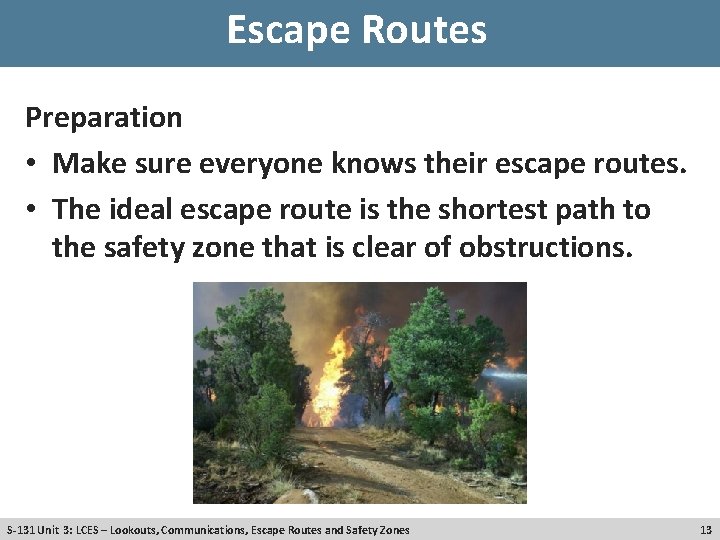
Escape Routes Preparation • Make sure everyone knows their escape routes. • The ideal escape route is the shortest path to the safety zone that is clear of obstructions. S 131 Unit 3: LCES – Lookouts, Communications, Escape Routes and Safety Zones 13
Escape Routes Preparation • Consider the time required to travel the escape route based on the slowest person, fatigue, and environmental factors. Avoid uphill escape routes. • Establish alternative escape routes. • Scout the area. Consider fuels, weather, topography, fire behavior, and spotting potential when evaluat ing an escape route. S 131 Unit 3: LCES – Lookouts, Communications, Escape Routes and Safety Zones 14
Escape Routes Preparation • Make routes known to adjoining forces and lookouts. Ensure they are marked for day or night use. • Park vehicles to allow for ease of escape. • Communicate, reevaluate, and reiterate. • You may need to change escape routes as weather, fire location, or crew location changes. S 131 Unit 3: LCES – Lookouts, Communications, Escape Routes and Safety Zones 15
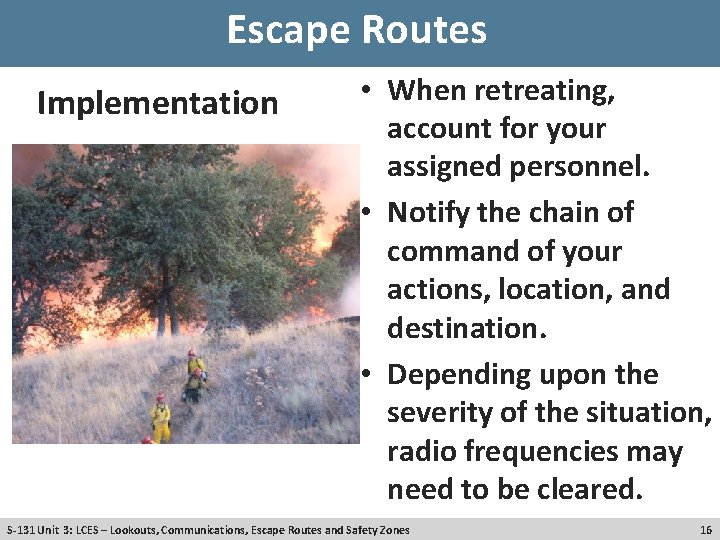
Escape Routes Implementation • When retreating, account for your assigned personnel. • Notify the chain of command of your actions, location, and destination. • Depending upon the severity of the situation, radio frequencies may need to be cleared. S 131 Unit 3: LCES – Lookouts, Communications, Escape Routes and Safety Zones 16
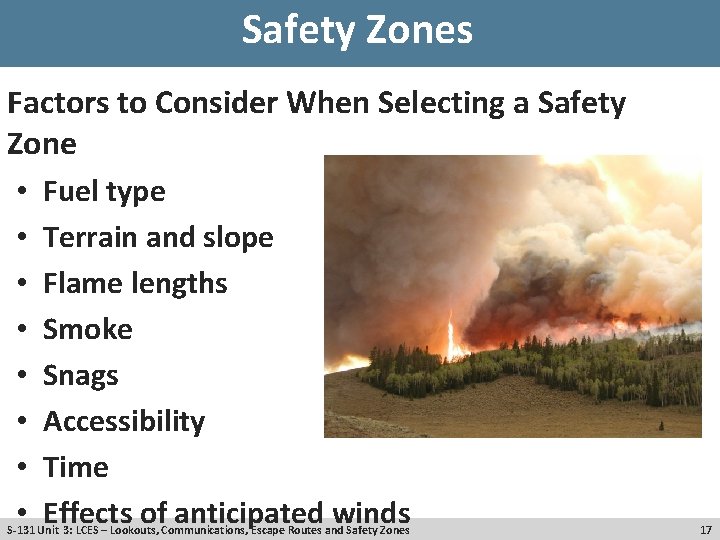
Safety Zones Factors to Consider When Selecting a Safety Zone • Fuel type • Terrain and slope • Flame lengths • Smoke • Snags • Accessibility • Time • Effects of anticipated winds S 131 Unit 3: LCES – Lookouts, Communications, Escape Routes and Safety Zones 17
Safety Zone Guidelines • Safety zones are not intended to be deployment zones. • Safety zones will be identified and discussed before work begins. • “Keep one foot in the black” or “Bring the black with you” is the first and most common safety practice. S 131 Unit 3: LCES – Lookouts, Communications, Escape Routes and Safety Zones 18
Safety Zone Guidelines • When a blackened area is used as a safety zone, the crown must also be absent. • Safety zones can be created by burning out light fuels, or irrigation; however, the time these actions require must be factored into the LCES formula. S 131 Unit 3: LCES – Lookouts, Communications, Escape Routes and Safety Zones 19
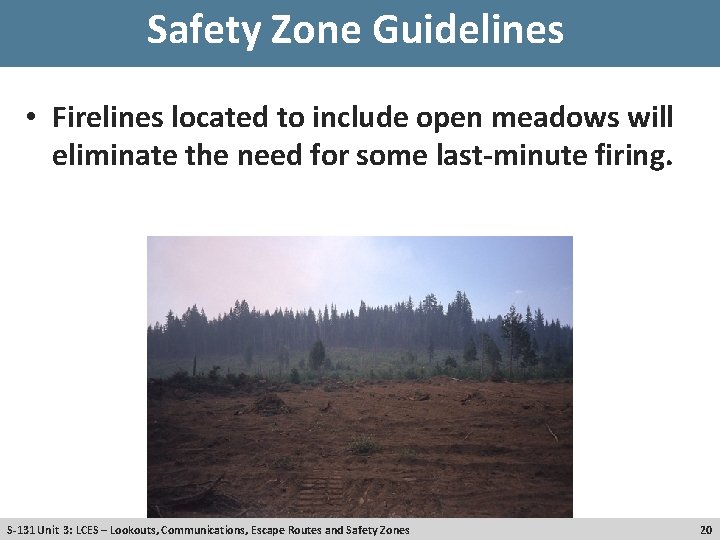
Safety Zone Guidelines • Firelines located to include open meadows will eliminate the need for some last minute firing. S 131 Unit 3: LCES – Lookouts, Communications, Escape Routes and Safety Zones 20
Safety Zone Guidelines • Take advantage of the aerial overview whenever possible. • Help less experienced people scrutinize safety zones. Give examples of good and poor safety zones. • Each individual must be constantly engaged in the LCES process, evaluating and reevaluating as locations and situations change. S 131 Unit 3: LCES – Lookouts, Communications, Escape Routes and Safety Zones 21
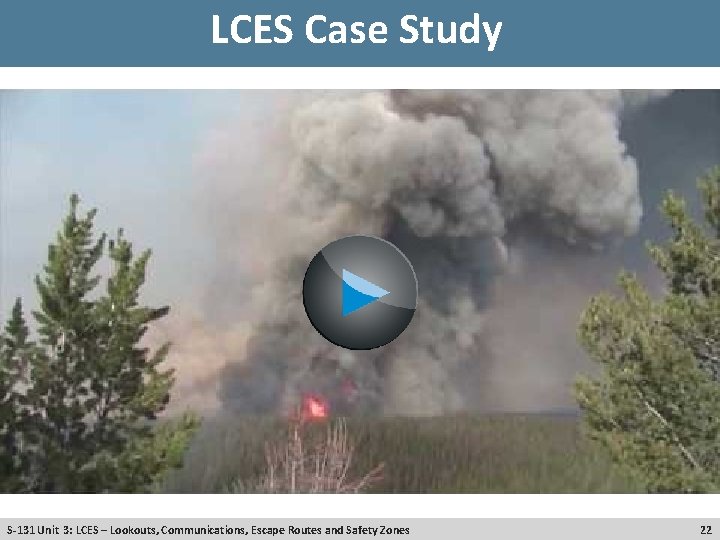
LCES Case Study S 131 Unit 3: LCES – Lookouts, Communications, Escape Routes and Safety Zones 22
Review Objective Students will be able to: • Demonstrate the ability to apply the principles of Lookouts, Communications, Escape Routes, and Safety Zones (LCES). S 131 Unit 3: LCES – Lookouts, Communications, Escape Routes and Safety Zones 23