
Rx Actuarial Equivalence Under MMA John Bertko F
Rx Actuarial Equivalence Under MMA John Bertko, F. S. A. , MAAA VP and Chief Actuary, Humana Inc. Margaret Wear, F. S. A. , MAAA Rx Actuary, Pacificare February 27, 2003
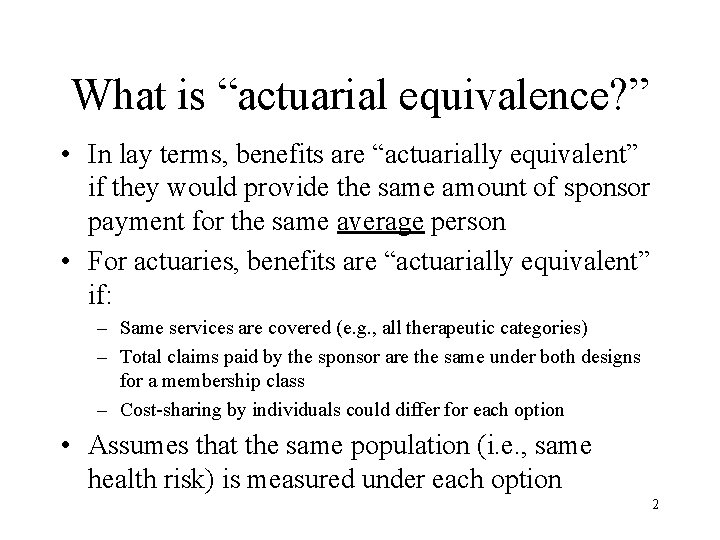
What is “actuarial equivalence? ” • In lay terms, benefits are “actuarially equivalent” if they would provide the same amount of sponsor payment for the same average person • For actuaries, benefits are “actuarially equivalent” if: – Same services are covered (e. g. , all therapeutic categories) – Total claims paid by the sponsor are the same under both designs for a membership class – Cost-sharing by individuals could differ for each option • Assumes that the same population (i. e. , same health risk) is measured under each option 2
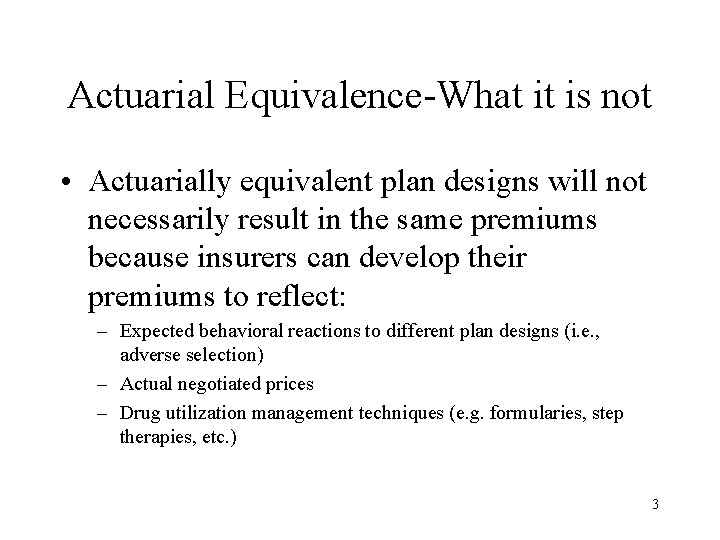
Actuarial Equivalence-What it is not • Actuarially equivalent plan designs will not necessarily result in the same premiums because insurers can develop their premiums to reflect: – Expected behavioral reactions to different plan designs (i. e. , adverse selection) – Actual negotiated prices – Drug utilization management techniques (e. g. formularies, step therapies, etc. ) 3
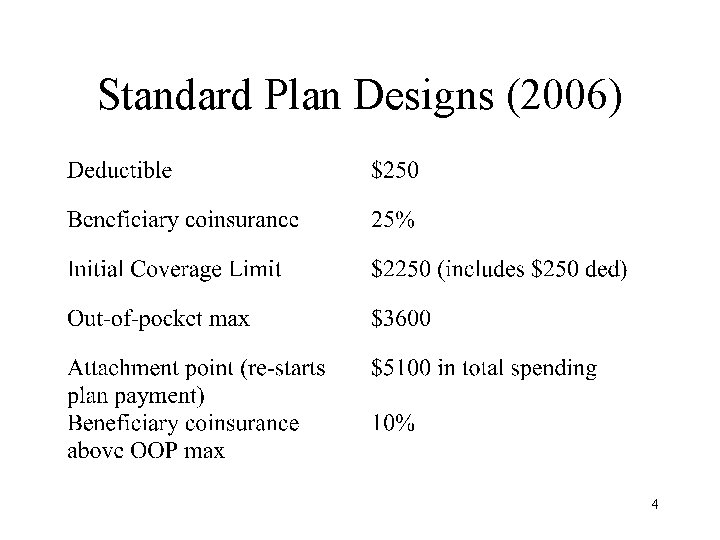
Standard Plan Designs (2006) 4
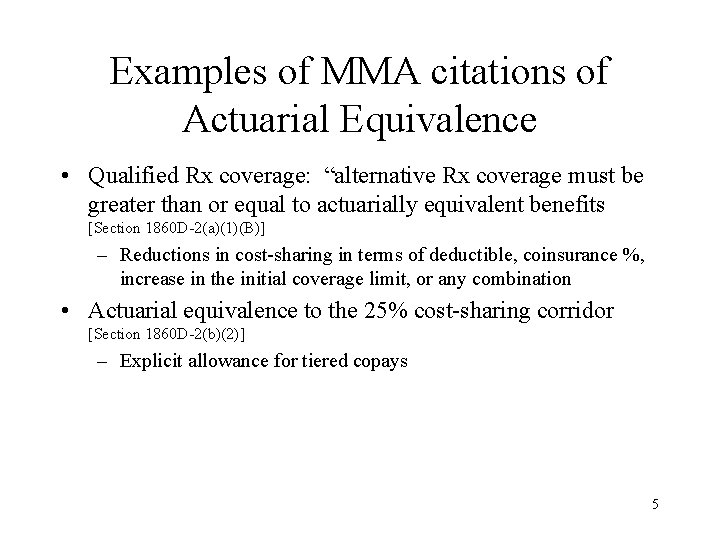
Examples of MMA citations of Actuarial Equivalence • Qualified Rx coverage: “alternative Rx coverage must be greater than or equal to actuarially equivalent benefits [Section 1860 D-2(a)(1)(B)] – Reductions in cost-sharing in terms of deductible, coinsurance %, increase in the initial coverage limit, or any combination • Actuarial equivalence to the 25% cost-sharing corridor [Section 1860 D-2(b)(2)] – Explicit allowance for tiered copays 5
![More Examples • Determining the actuarial valuation of Rx coverage [Section 1860 D-11(c)(1)] –](http://slidetodoc.com/presentation_image_h2/abeb97824b0db0c951dfafa3478a7aca/image-6.jpg "More Examples • Determining the actuarial valuation of Rx coverage [Section 1860 D-11(c)(1)] –")
More Examples • Determining the actuarial valuation of Rx coverage [Section 1860 D-11(c)(1)] – The Secretary shall establish processes and methods for. . . • • • Actuarial valuation of standard Rx coverage Actuarial valuations of alternative Rx coverage Actuarial valuation of reinsurance subsidies Use of generally accepted actuarial principles Applying the same methods for both standard and alternative Rx coverage • Allowable Medicare. Advantage-PD plan [Section 1860 D-13(b)(5)] – MA-PD coverage meets requirements if actuarial value equals or exceeds the actuarial value of standard Rx coverage 6
![One More Example • Special Rules for Employer-Sponsored Programs [Section 1860 D-22(a)(2)(A)] – The](http://slidetodoc.com/presentation_image_h2/abeb97824b0db0c951dfafa3478a7aca/image-7.jpg "One More Example • Special Rules for Employer-Sponsored Programs [Section 1860 D-22(a)(2)(A)] – The")
One More Example • Special Rules for Employer-Sponsored Programs [Section 1860 D-22(a)(2)(A)] – The sponsor. . . provides the Secretary. . . with an attestation that the actuarial value of Rx coverage under the plan is at least equal to the actuarial value of standard Rx coverage • Much variation in employer-sponsored programs today • Questions about how the required retiree contributions will be evaluated, or do only benefits count? 7
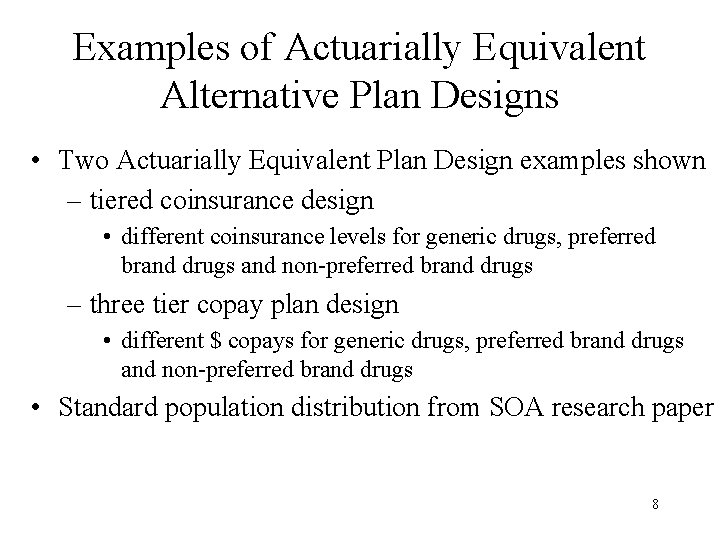
Examples of Actuarially Equivalent Alternative Plan Designs • Two Actuarially Equivalent Plan Design examples shown – tiered coinsurance design • different coinsurance levels for generic drugs, preferred brand drugs and non-preferred brand drugs – three tier copay plan design • different $ copays for generic drugs, preferred brand drugs and non-preferred brand drugs • Standard population distribution from SOA research paper 8
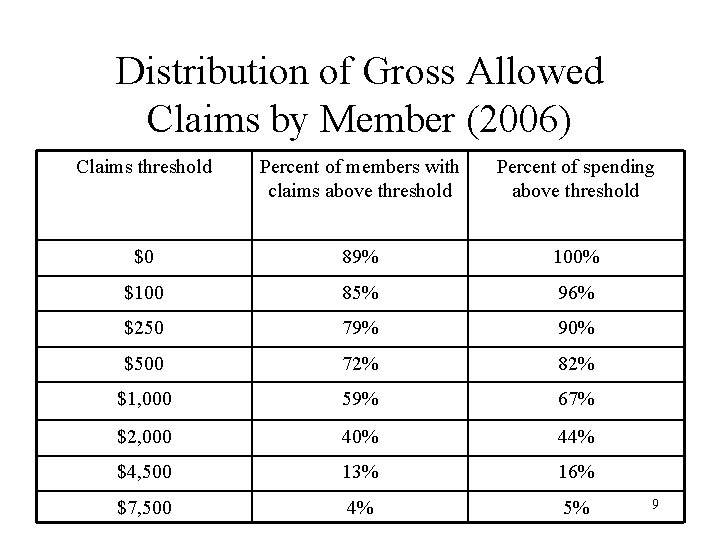
Distribution of Gross Allowed Claims by Member (2006) Claims threshold Percent of members with claims above threshold Percent of spending above threshold $0 89% 100% $100 85% 96% $250 79% 90% $500 72% 82% $1, 000 59% 67% $2, 000 40% 44% $4, 500 13% 16% $7, 500 4% 5% 9
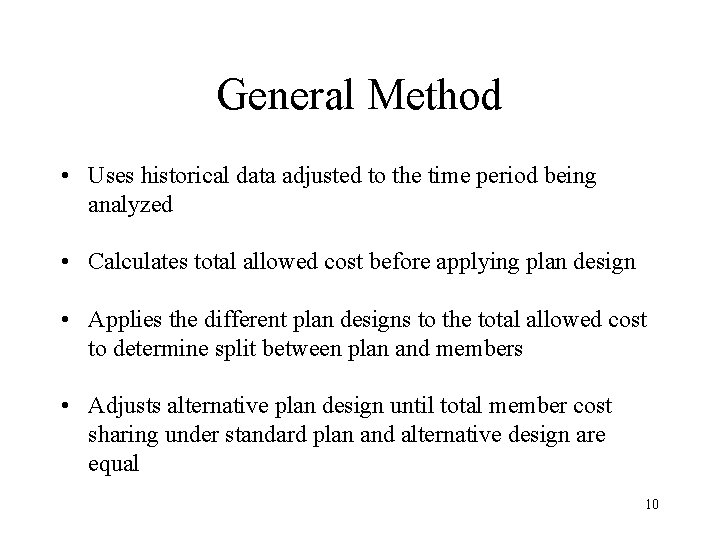
General Method • Uses historical data adjusted to the time period being analyzed • Calculates total allowed cost before applying plan design • Applies the different plan designs to the total allowed cost to determine split between plan and members • Adjusts alternative plan design until total member cost sharing under standard plan and alternative design are equal 10
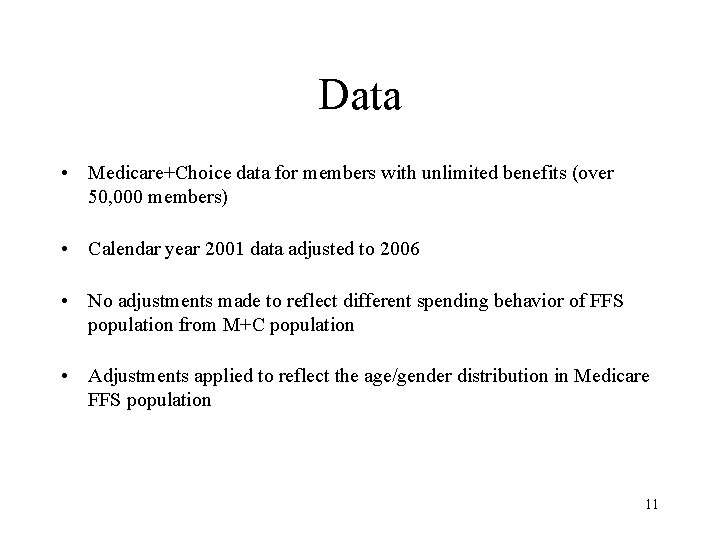
Data • Medicare+Choice data for members with unlimited benefits (over 50, 000 members) • Calendar year 2001 data adjusted to 2006 • No adjustments made to reflect different spending behavior of FFS population from M+C population • Adjustments applied to reflect the age/gender distribution in Medicare FFS population 11
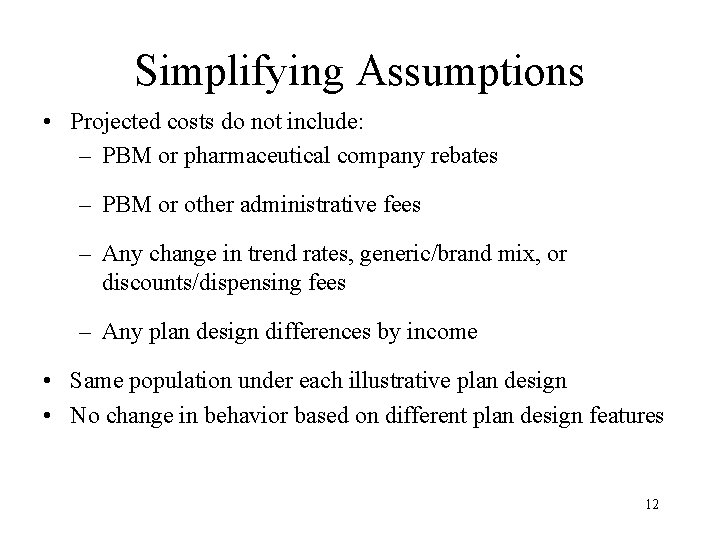
Simplifying Assumptions • Projected costs do not include: – PBM or pharmaceutical company rebates – PBM or other administrative fees – Any change in trend rates, generic/brand mix, or discounts/dispensing fees – Any plan design differences by income • Same population under each illustrative plan design • No change in behavior based on different plan design features 12
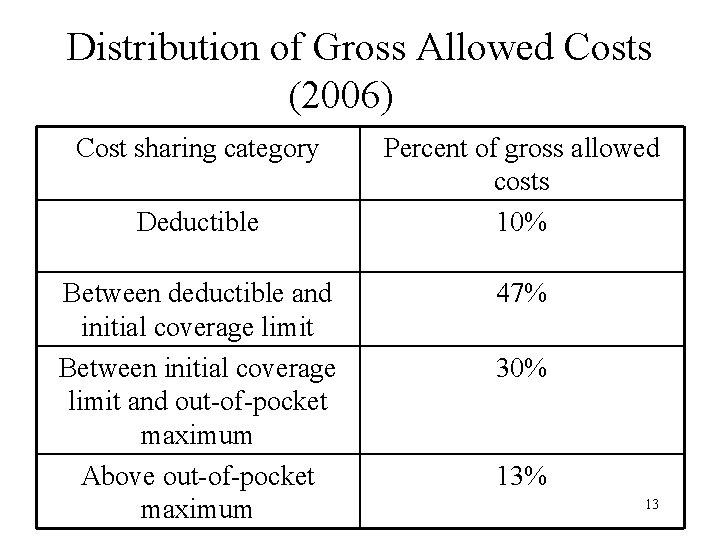
Distribution of Gross Allowed Costs (2006) Cost sharing category Deductible Between deductible and initial coverage limit Between initial coverage limit and out-of-pocket maximum Above out-of-pocket maximum Percent of gross allowed costs 10% 47% 30% 13
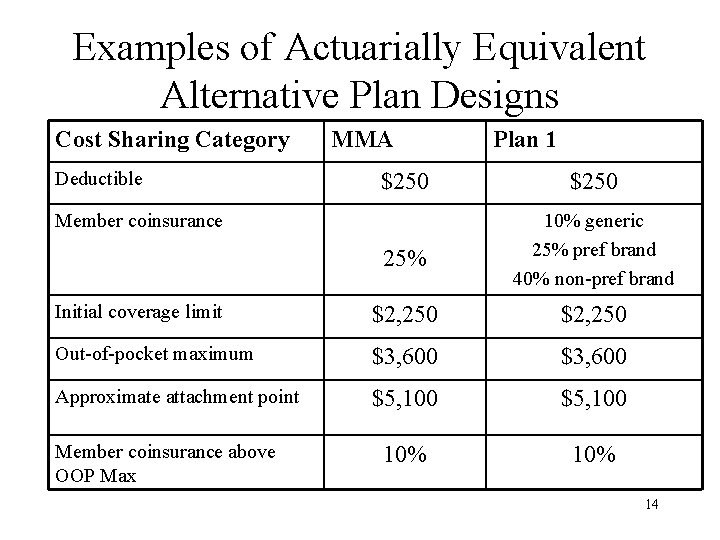
Examples of Actuarially Equivalent Alternative Plan Designs Cost Sharing Category Deductible MMA Plan 1 $250 25% 10% generic 25% pref brand 40% non-pref brand Initial coverage limit $2, 250 Out-of-pocket maximum $3, 600 Approximate attachment point $5, 100 10% Member coinsurance above OOP Max 14
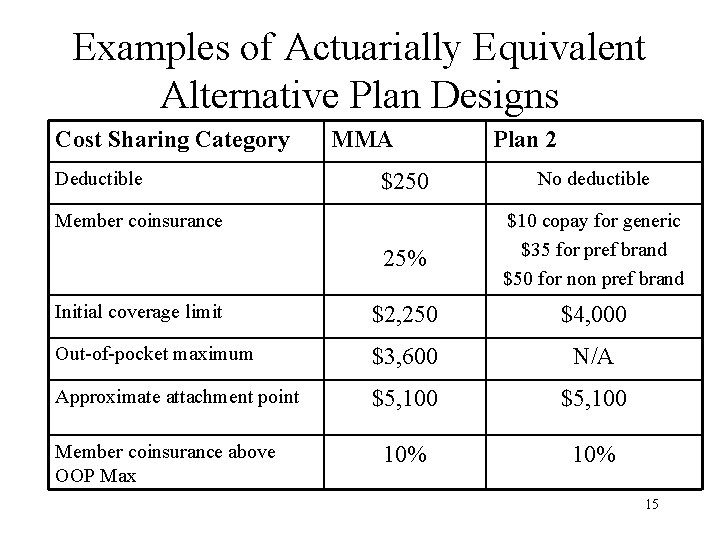
Examples of Actuarially Equivalent Alternative Plan Designs Cost Sharing Category Deductible MMA Plan 2 $250 No deductible 25% $10 copay for generic $35 for pref brand $50 for non pref brand Initial coverage limit $2, 250 $4, 000 Out-of-pocket maximum $3, 600 N/A Approximate attachment point $5, 100 10% Member coinsurance above OOP Max 15
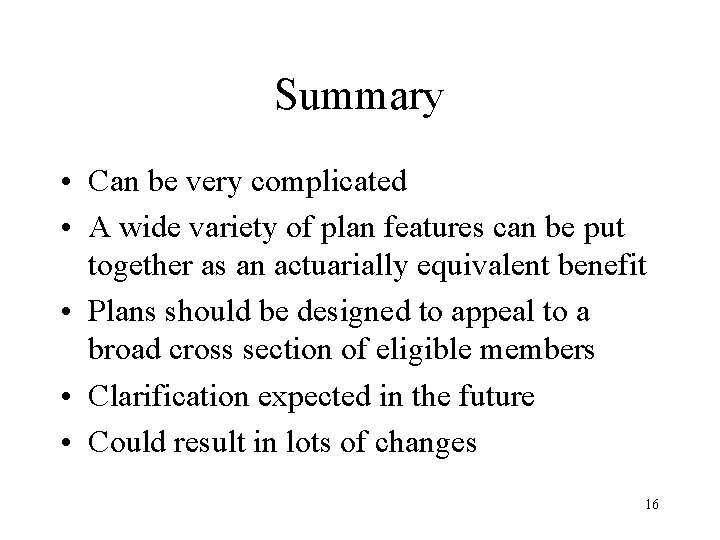
Summary • Can be very complicated • A wide variety of plan features can be put together as an actuarially equivalent benefit • Plans should be designed to appeal to a broad cross section of eligible members • Clarification expected in the future • Could result in lots of changes 16
- Slides: 16