
Rwanda Investing in Early Years and Human Capital
- Slides: 3
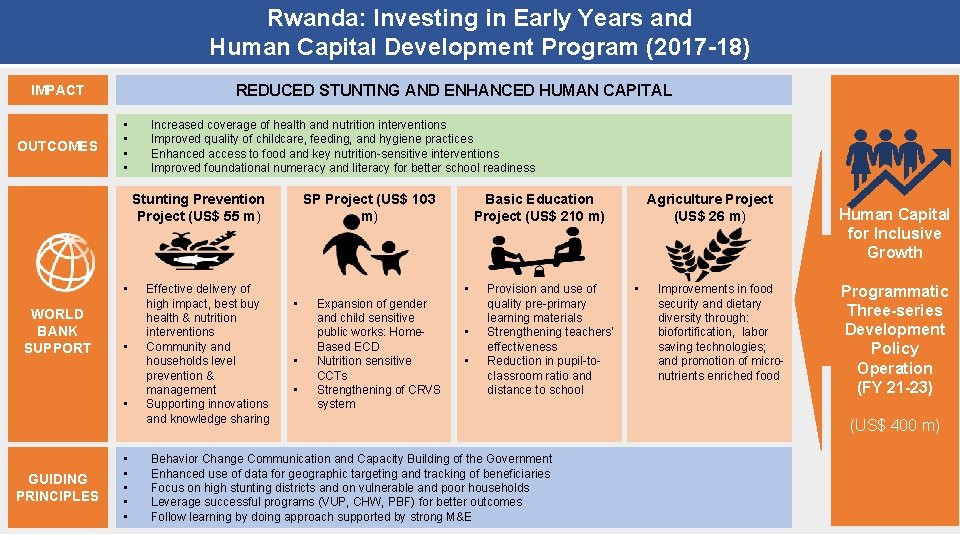
Rwanda: Investing in Early Years and Human Capital Development Program (2017 -18) REDUCED STUNTING AND ENHANCED HUMAN CAPITAL IMPACT OUTCOMES • • Increased coverage of health and nutrition interventions Improved quality of childcare, feeding, and hygiene practices Enhanced access to food and key nutrition sensitive interventions Improved foundational numeracy and literacy for better school readiness Stunting Prevention Project (US$ 55 m) • WORLD BANK SUPPORT • • GUIDING PRINCIPLES • • • Effective delivery of high impact, best buy health & nutrition interventions Community and households level prevention & management Supporting innovations and knowledge sharing SP Project (US$ 103 m) Basic Education Project (US$ 210 m) • • Expansion of gender and child sensitive public works: Home Based ECD Nutrition sensitive CCTs Strengthening of CRVS system • • Provision and use of quality pre primary learning materials Strengthening teachers’ effectiveness Reduction in pupil to classroom ratio and distance to school Behavior Change Communication and Capacity Building of the Government Enhanced use of data for geographic targeting and tracking of beneficiaries Focus on high stunting districts and on vulnerable and poor households Leverage successful programs (VUP, CHW, PBF) for better outcomes Follow learning by doing approach supported by strong M&E Agriculture Project (US$ 26 m) • Improvements in food security and dietary diversity through: biofortification, labor saving technologies; and promotion of micro nutrients enriched food Human Capital for Inclusive Growth Programmatic Three-series Development Policy Operation (FY 21 -23) (US$ 400 m)
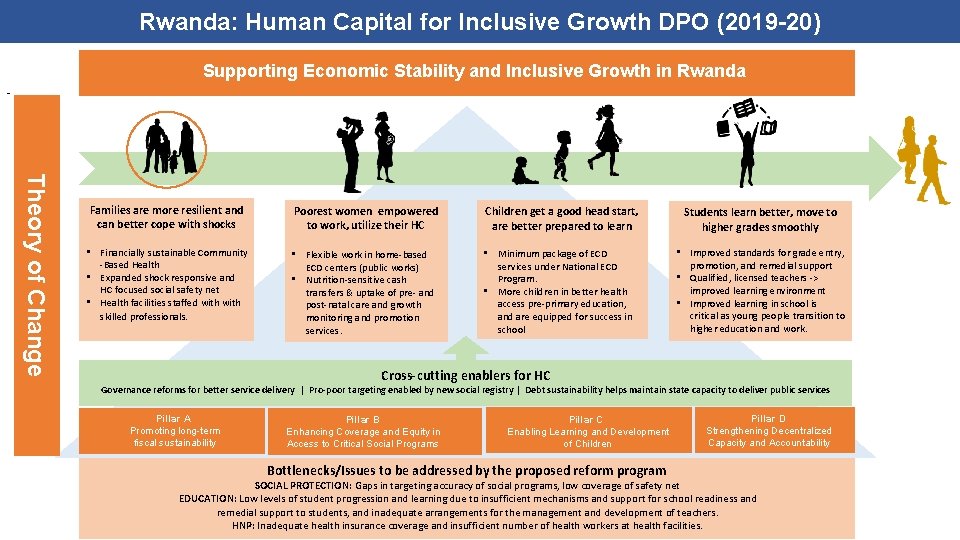
Rwanda: Human Capital for Inclusive Growth DPO (2019 -20) Supporting Economic Stability and Inclusive Growth in Rwanda Theory of Change Families are more resilient and can better cope with shocks Pillar A Promoting long term • fiscal sustainability Pillar B Poorest women empowered to work, utilize their HC Pillar C Children get a good head start, are better prepared to learn Students learn better, move to higher grades smoothly Pillar D Enhancing Coverage and Financially sustainable Community Enabling Learning • Flexible work. Strengthening in home-based Decentralized Capacity and Equity in Access to Critical and Development of -Based Health ECD centers (public works) Accountability Socialshock Programs Children • Expanded responsive and • Nutrition-sensitive cash HC focused social safety net transfers & uptake of pre- and • Health facilities staffed with post-natal care and growth skilled professionals. monitoring and promotion services. • Minimum package of ECD services under National ECD Program. • More children in better health access pre-primary education, and are equipped for success in school • Improved standards for grade entry, promotion, and remedial support • Qualified, licensed teachers -> improved learning environment • Improved learning in school is critical as young people transition to higher education and work. Cross-cutting enablers for HC Governance reforms for better service delivery | Pro-poor targeting enabled by new social registry | Debt sustainability helps maintain state capacity to deliver public services Pillar A Promoting long term fiscal sustainability Pillar B Enhancing Coverage and Equity in Access to Critical Social Programs Pillar C Enabling Learning and Development of Children Bottlenecks/Issues to be addressed by the proposed reform program Pillar D Strengthening Decentralized Capacity and Accountability SOCIAL PROTECTION: Gaps in targeting accuracy of social programs, low coverage of safety net EDUCATION: Low levels of student progression and learning due to insufficient mechanisms and support for school readiness and remedial support to students, and inadequate arrangements for the management and development of teachers. HNP: Inadequate health insurance coverage and insufficient number of health workers at health facilities.
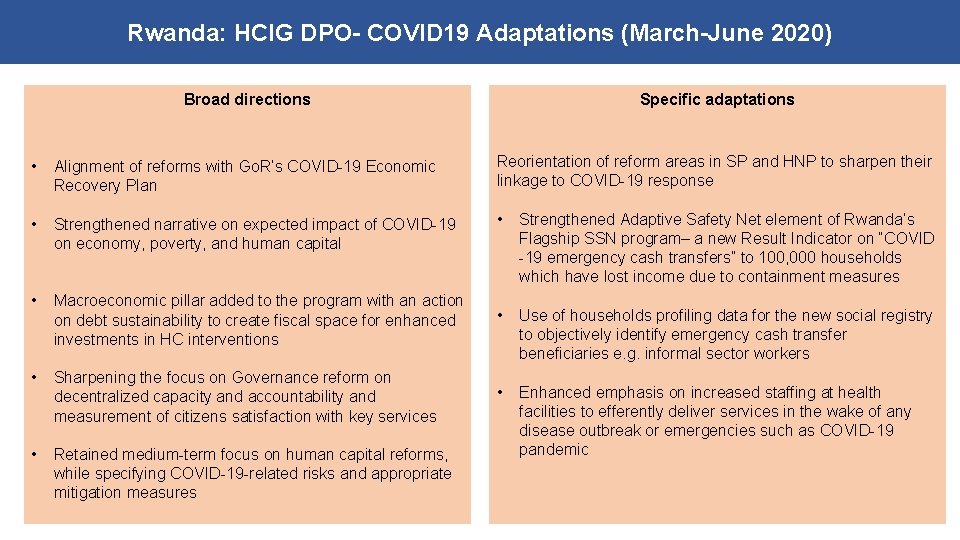
Rwanda: HCIG DPO- COVID 19 Adaptations (March-June 2020) Broad directions Specific adaptations • Alignment of reforms with Go. R’s COVID 19 Economic Recovery Plan Reorientation of reform areas in SP and HNP to sharpen their linkage to COVID 19 response • Strengthened narrative on expected impact of COVID 19 on economy, poverty, and human capital • Strengthened Adaptive Safety Net element of Rwanda’s Flagship SSN program– a new Result Indicator on “COVID 19 emergency cash transfers” to 100, 000 households which have lost income due to containment measures • Macroeconomic pillar added to the program with an action on debt sustainability to create fiscal space for enhanced investments in HC interventions • Use of households profiling data for the new social registry to objectively identify emergency cash transfer beneficiaries e. g. informal sector workers • Sharpening the focus on Governance reform on decentralized capacity and accountability and measurement of citizens satisfaction with key services • • Retained medium term focus on human capital reforms, while specifying COVID 19 related risks and appropriate mitigation measures Enhanced emphasis on increased staffing at health facilities to efferently deliver services in the wake of any disease outbreak or emergencies such as COVID 19 pandemic