
RW 1 1 Decoding and Word Recognition Recognize









- Slides: 122
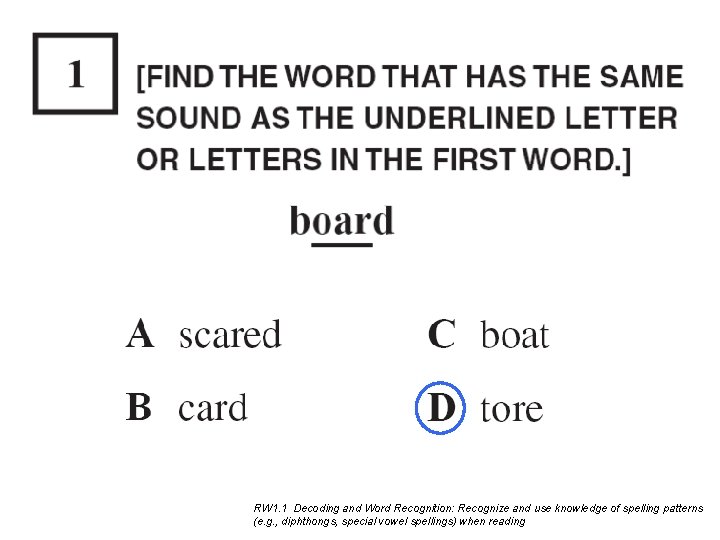
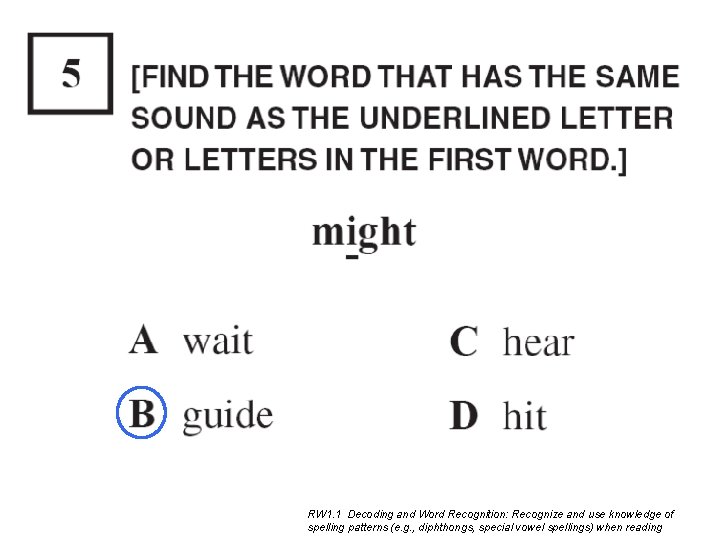
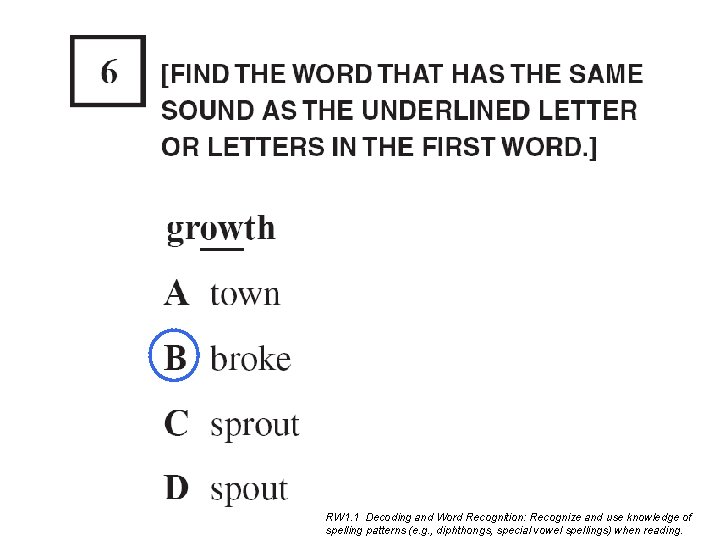
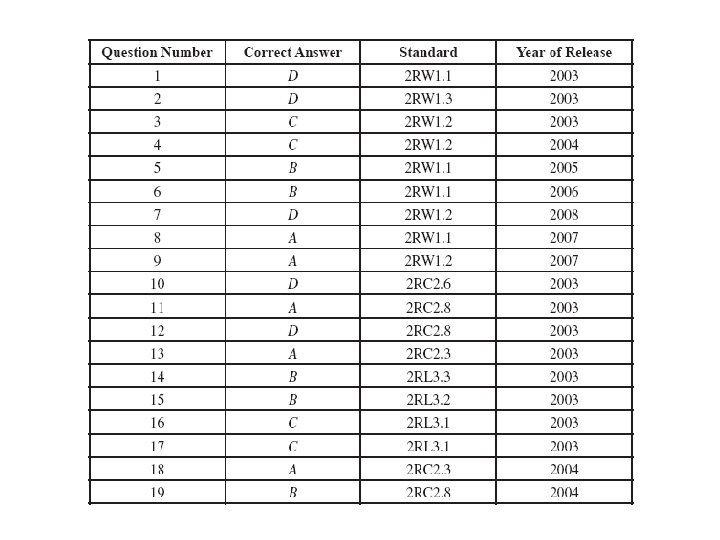
RW 1. 1 Decoding and Word Recognition: Recognize and use knowledge of spelling patterns (e. g. , diphthongs, special vowel spellings) when reading
RW 1. 3 Decoding and Word Recognition: Decode two-syllable nonsense words and regular multisyllable words
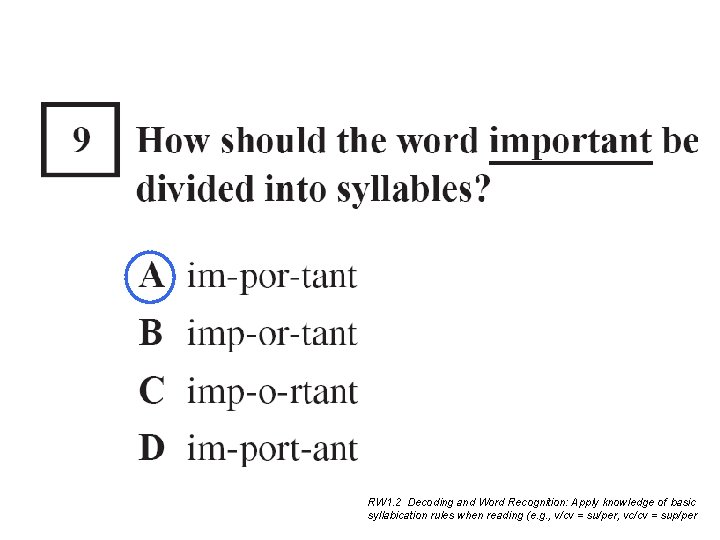
RW 1. 2 Decoding and Word Recognition: Apply knowledge of basic syllabication rules when reading (e. g. , v/cv = su/per, vc/cv = sup/per
RW 1. 2 Decoding and Word Recognition: Apply knowledge of basic syllabication rules when reading (e. g. , v/cv = su/per, vc/cv = sup/per
RW 1. 1 Decoding and Word Recognition: Recognize and use knowledge of spelling patterns (e. g. , diphthongs, special vowel spellings) when reading
RW 1. 1 Decoding and Word Recognition: Recognize and use knowledge of spelling patterns (e. g. , diphthongs, special vowel spellings) when reading.
RW 1. 2 Decoding and Word Recognition: Apply knowledge of basic syllabication rules when reading (e. g. , v/cv = su/per, vc/cv = sup/per
RW 1. 1 Decoding and Word Recognition: Recognize and use knowledge of spelling patterns (e. g. , diphthongs, special vowel spellings) when reading
RW 1. 2 Decoding and Word Recognition: Apply knowledge of basic syllabication rules when reading (e. g. , v/cv = su/per, vc/cv = sup/per
10 11 12 13
Cont.
Re-read RC 2. 6 Comprehension and Analysis of Grade-Level-Appropriate Text: Recognize cause-and effect relationships in a text.
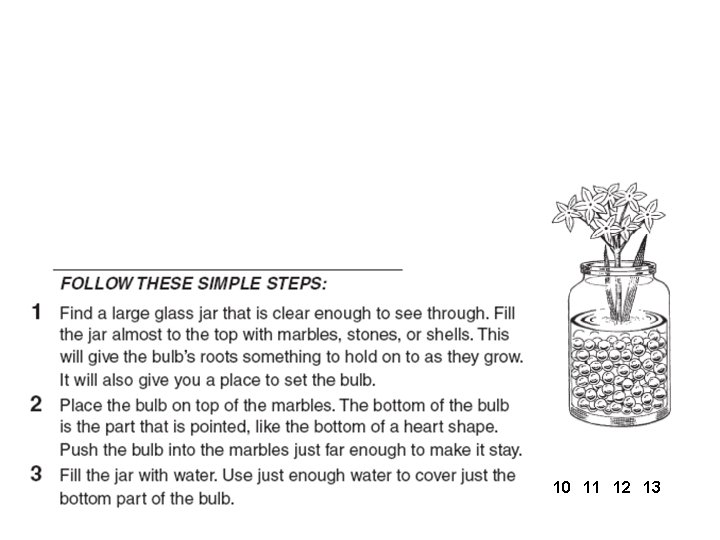
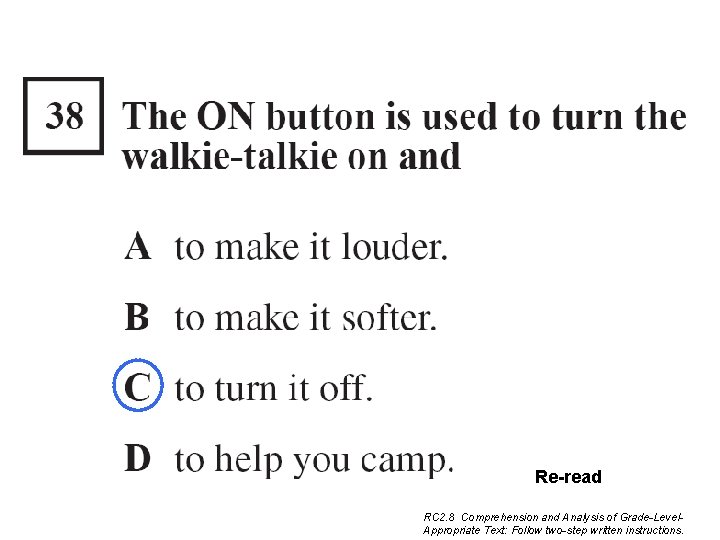
Re-read RC 2. 8 Comprehension and Analysis of Grade-Level. Appropriate Text: Follow two-step written instructions.
Re-read RC 2. 8 Comprehension and Analysis of Grade-Level-Appropriate Text: Follow two-step written instructions
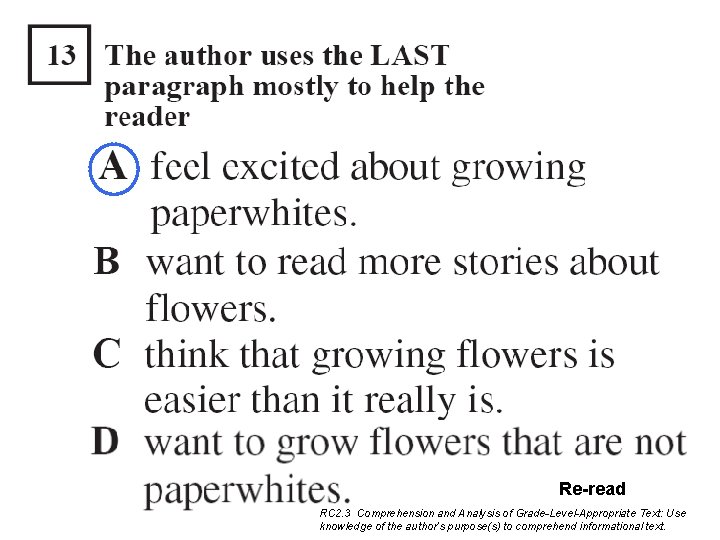
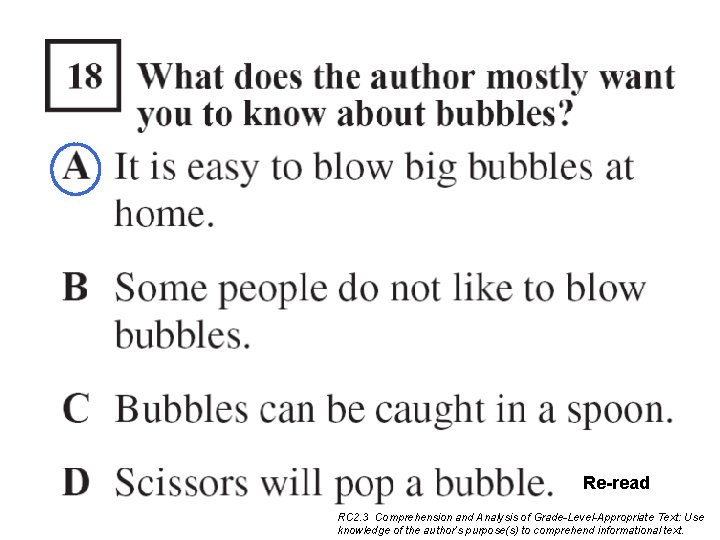
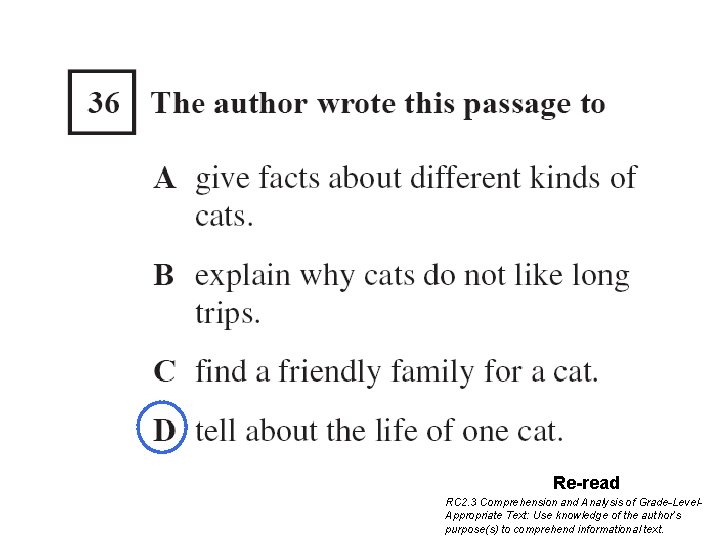
Re-read RC 2. 3 Comprehension and Analysis of Grade-Level-Appropriate Text: Use knowledge of the author’s purpose(s) to comprehend informational text.
14 15 16 17
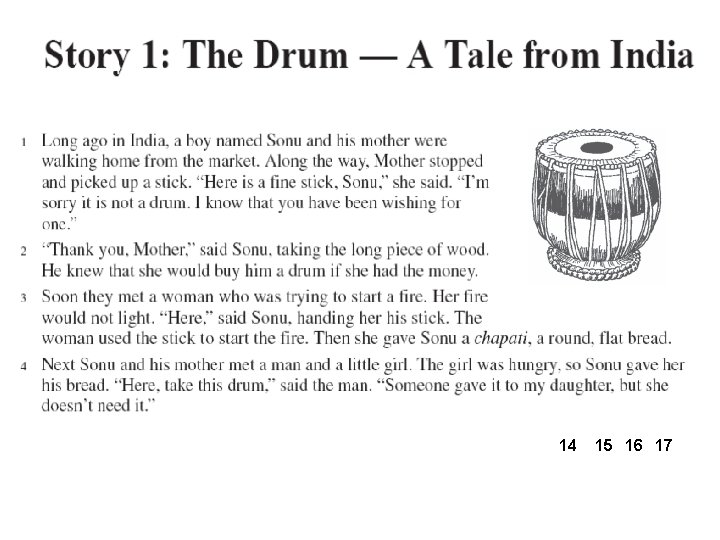
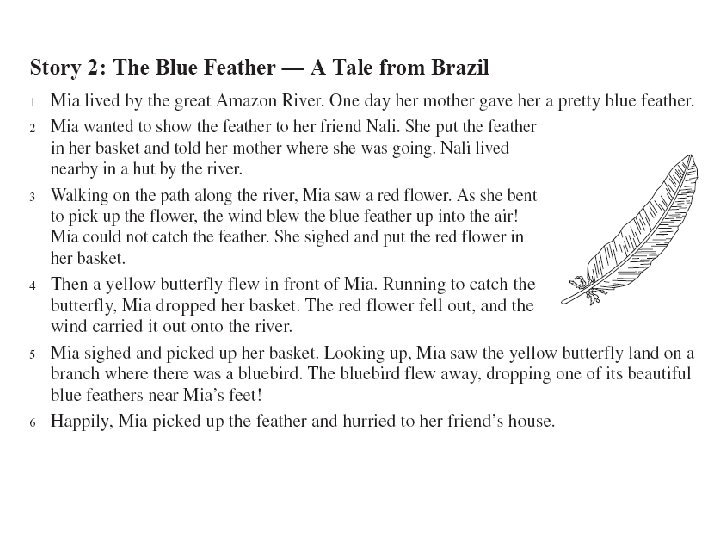
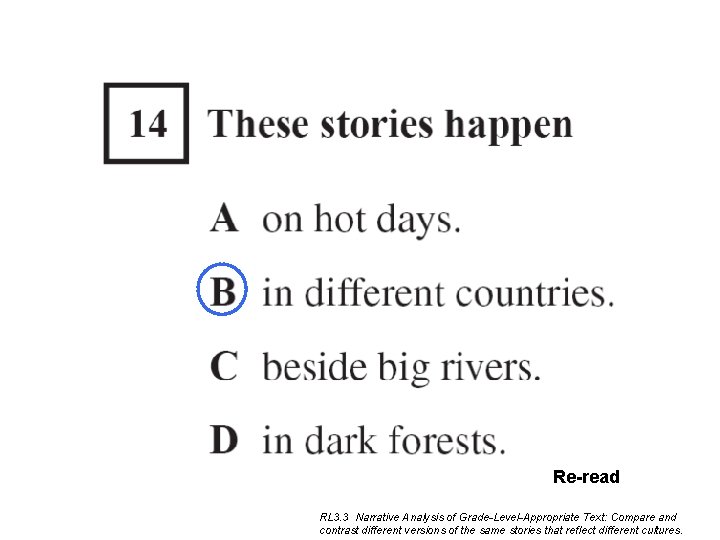
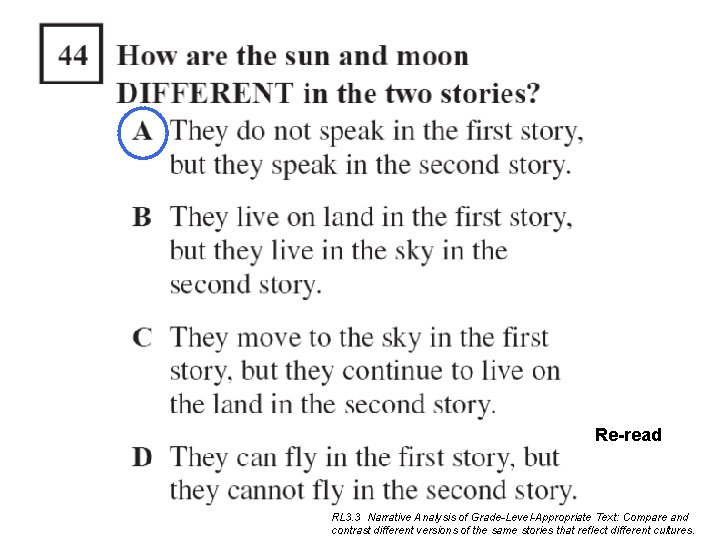
Re-read RL 3. 3 Narrative Analysis of Grade-Level-Appropriate Text: Compare and contrast different versions of the same stories that reflect different cultures.
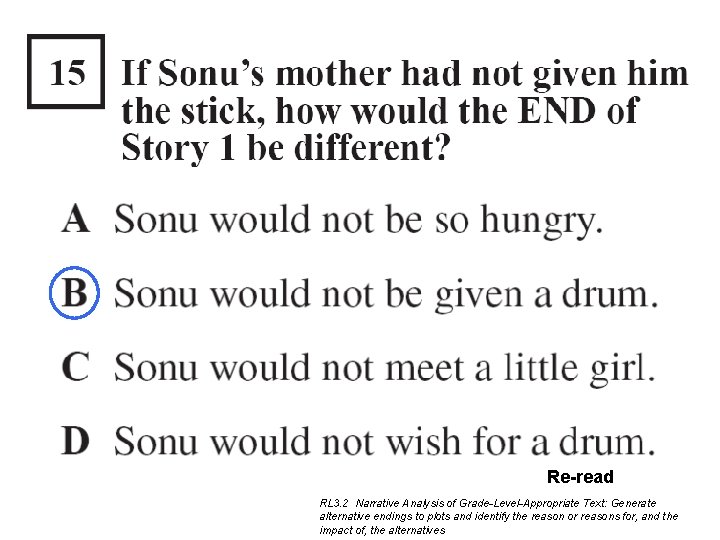
Re-read RL 3. 2 Narrative Analysis of Grade-Level-Appropriate Text: Generate alternative endings to plots and identify the reason or reasons for, and the impact of, the alternatives
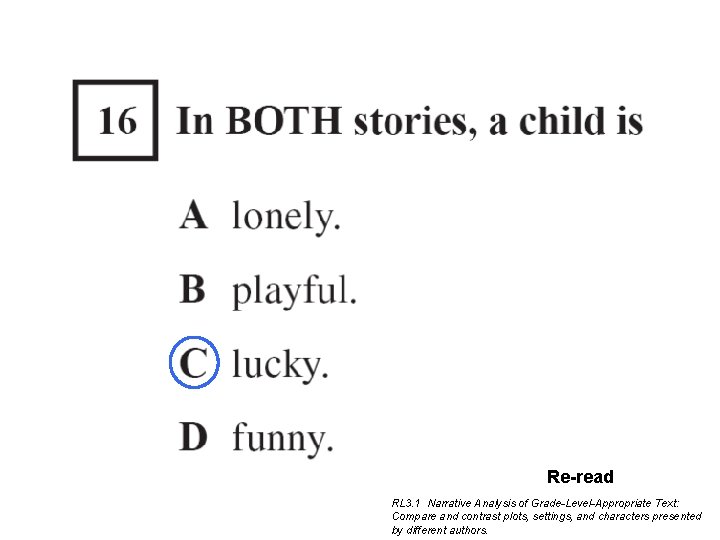
Re-read RL 3. 1 Narrative Analysis of Grade-Level-Appropriate Text: Compare and contrast plots, settings, and characters presented by different authors.
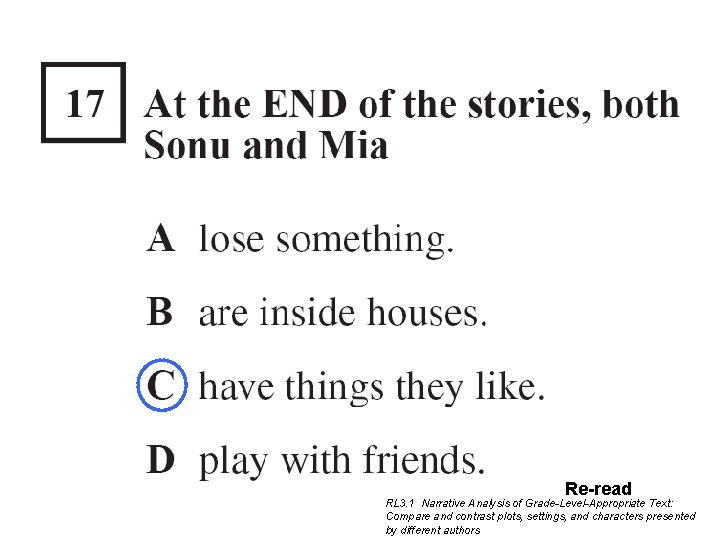
Re-read RL 3. 1 Narrative Analysis of Grade-Level-Appropriate Text: Compare and contrast plots, settings, and characters presented by different authors
18 20
19 21
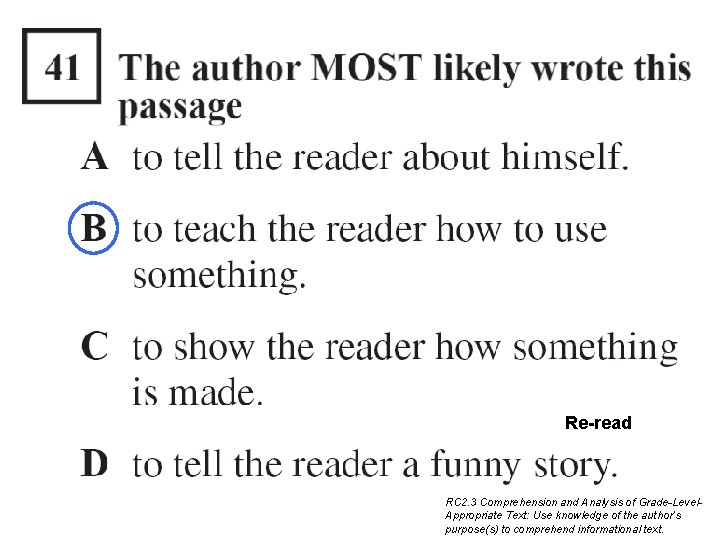
Re-read RC 2. 3 Comprehension and Analysis of Grade-Level-Appropriate Text: Use knowledge of the author’s purpose(s) to comprehend informational text.
Re-read RC 2. 8 Comprehension and Analysis of Grade-Level-Appropriate Text: Follow twostep written instructions.
Re-read RC 2. 5 Comprehension and Analysis of Grade-Level Appropriate Text: Restate facts and details in the text to clarify and organize ideas
Re-read RC 2. 8 Comprehension and Analysis of Grade-Level-Appropriate Text: Follow twostep written instructions.
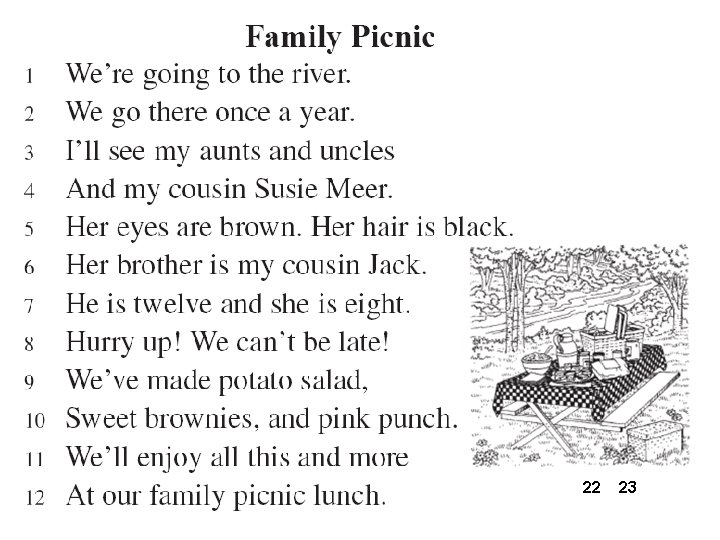
22 23
Re-read RL 3. 4 Narrative Analysis of Grade-Level-Appropriate Text: Identify the use of rhythm, rhyme, and alliteration in poetry
Re-read RL 3. 4 Narrative Analysis of Grade-Level-Appropriate Text: Identify the use of rhythm, rhyme, and alliteration in poetry.
24 25 26 27
Cont.
Re-read RC 2. 5 Comprehension and Analysis of Grade-Level-Appropriate Text: Restate facts and details in the text to clarify and organize ideas.
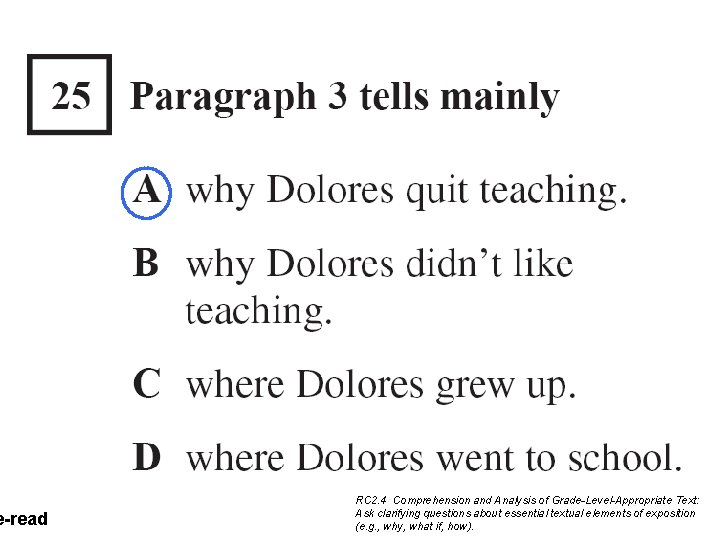
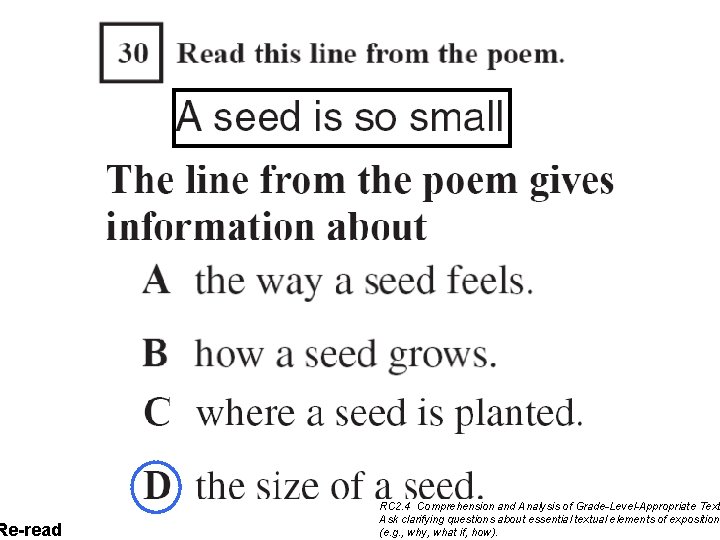
e-read RC 2. 4 Comprehension and Analysis of Grade-Level-Appropriate Text: Ask clarifying questions about essential textual elements of exposition (e. g. , why, what if, how).
Re-read RC 2. 6 Comprehension and Analysis of Grade-Level-Appropriate Text: Recognize cause-and effect relationships in a text
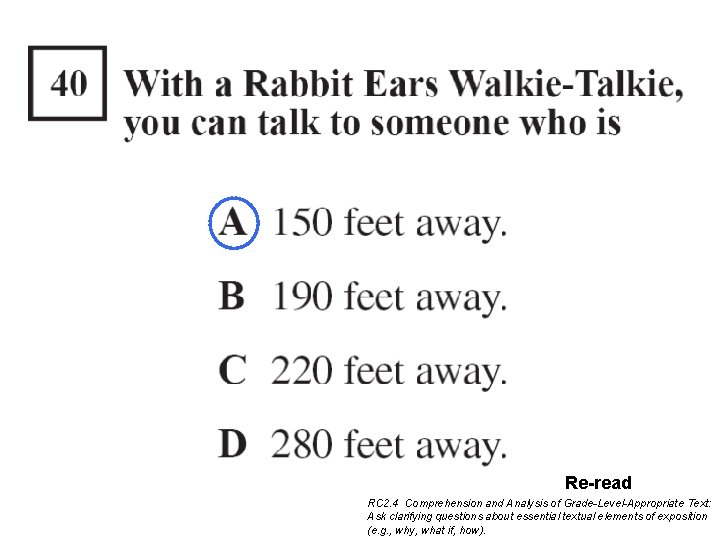
Re-read RC 2. 4 Comprehension and Analysis of Grade-Level-Appropriate Text: Ask clarifying questions about essential textual elements of exposition (e. g. , why, what if, how).
28 29 30 32
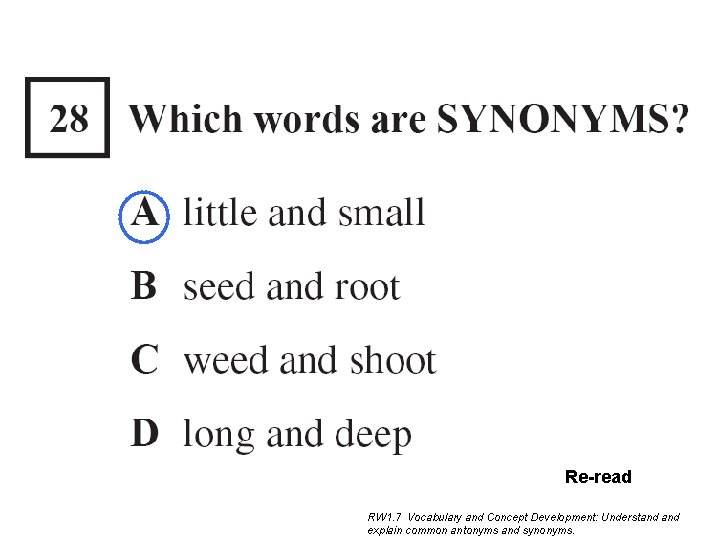
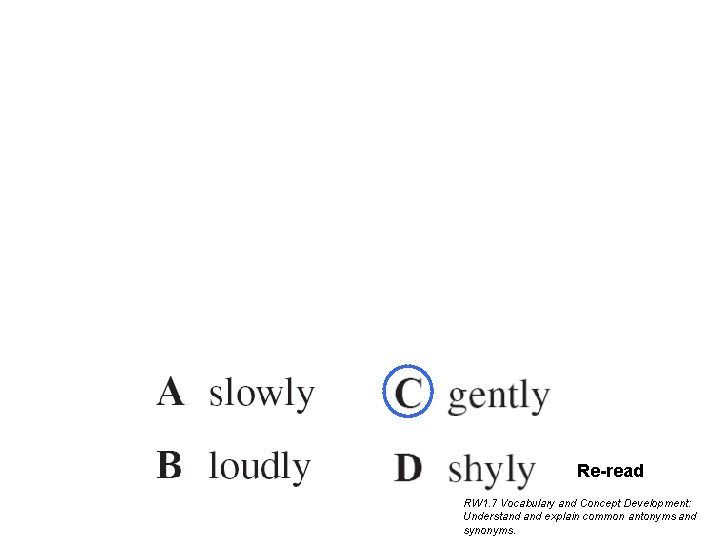
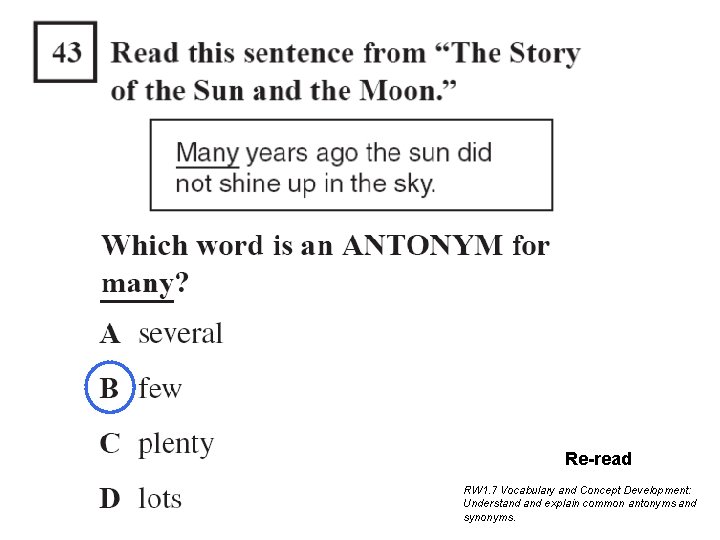
Re-read RW 1. 7 Vocabulary and Concept Development: Understand explain common antonyms and synonyms.
Re-read RL 3. 4 Narrative Analysis of Grade-Level-Appropriate Text: Identify the use of rhythm, rhyme, and alliteration in poetry.
Re-read RC 2. 4 Comprehension and Analysis of Grade-Level-Appropriate Text Ask clarifying questions about essential textual elements of exposition (e. g. , why, what if, how).
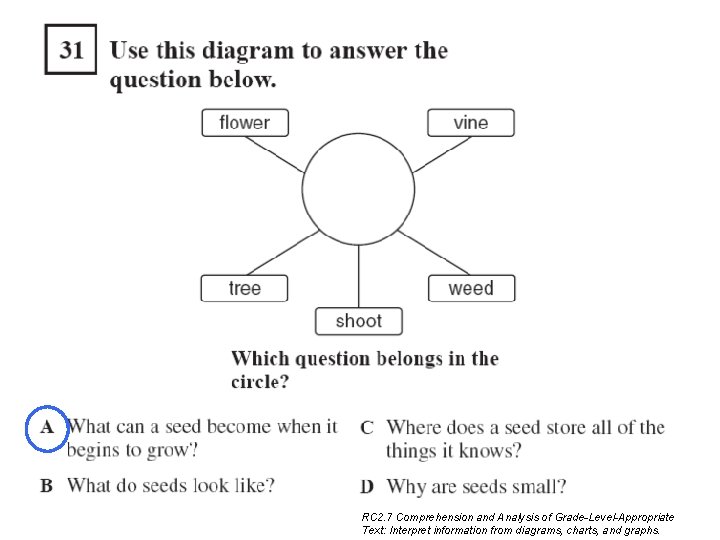
RC 2. 7 Comprehension and Analysis of Grade-Level-Appropriate Text: Interpret information from diagrams, charts, and graphs.
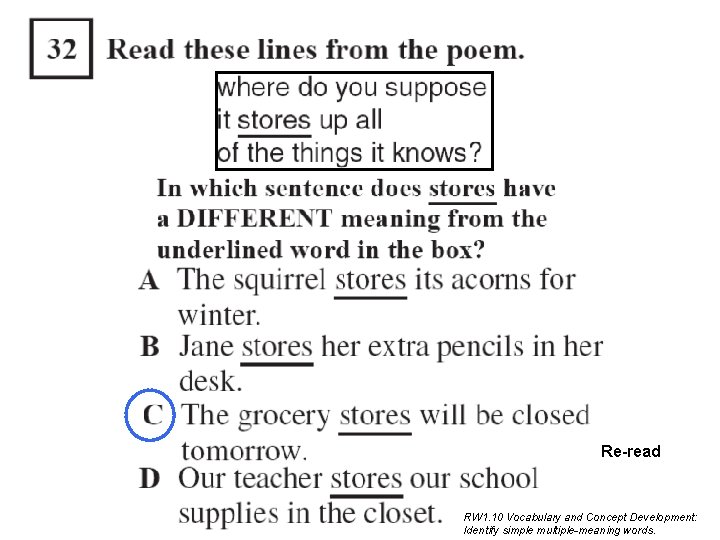
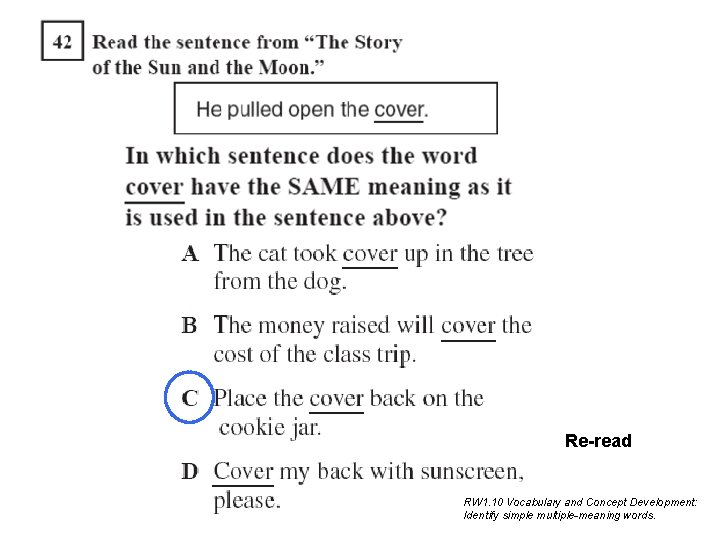
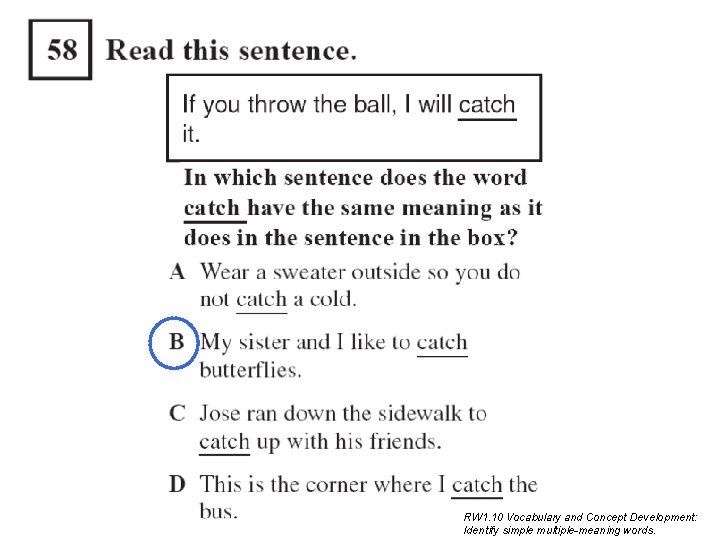
Re-read RW 1. 10 Vocabulary and Concept Development: Identify simple multiple-meaning words.
33 34 35 36 37
Cont.
Re-read RW 1. 7 Vocabulary and Concept Development: Understand explain common antonyms and synonyms.
Re-read RC 2. 5 Comprehension and Analysis of Grade-Level. Appropriate Text: Restate facts and details in the text to clarify and organize ideas.
Re-read RC 2. 5 Comprehension and Analysis of Grade-Level. Appropriate Text: Restate facts and details in the text to clarify and organize ideas.
Re-read RC 2. 3 Comprehension and Analysis of Grade-Level. Appropriate Text: Use knowledge of the author’s purpose(s) to comprehend informational text.
Re-read 2 RC 2. 6 Comprehension and Analysis of Grade-Level. Appropriate Text: Recognize cause-and effect relationships in a text
38 39 40 41
Re-read RC 2. 8 Comprehension and Analysis of Grade-Level. Appropriate Text: Follow two-step written instructions.
Re-read RC 2. 4 Comprehension and Analysis of Grade-Level-Appropriate Text: Ask clarifying questions about essential textual elements of exposition (e. g. , why, what if, how).
Re-read RC 2. 4 Comprehension and Analysis of Grade-Level-Appropriate Text: Ask clarifying questions about essential textual elements of exposition (e. g. , why, what if, how).
Re-read RC 2. 3 Comprehension and Analysis of Grade-Level. Appropriate Text: Use knowledge of the author’s purpose(s) to comprehend informational text.
43 44 45 46
Cont. 42
Cont.
Re-read RW 1. 10 Vocabulary and Concept Development: Identify simple multiple-meaning words.
Re-read RW 1. 7 Vocabulary and Concept Development: Understand explain common antonyms and synonyms.
Re-read RL 3. 3 Narrative Analysis of Grade-Level-Appropriate Text: Compare and contrast different versions of the same stories that reflect different cultures.
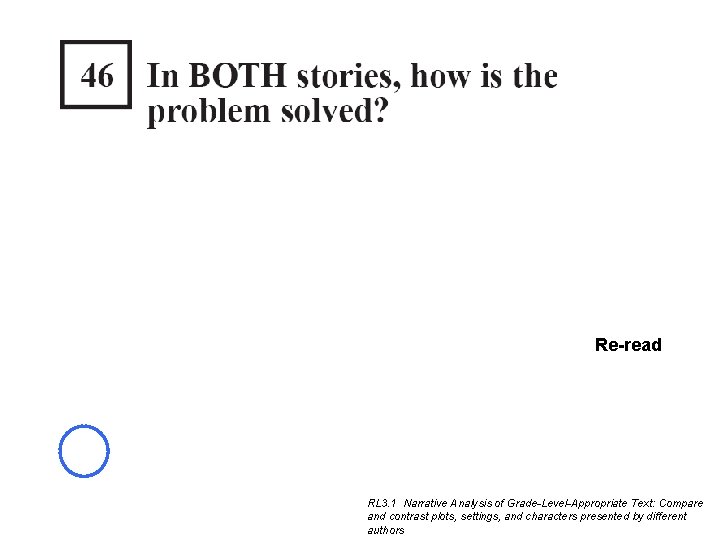
Re-read RL 3. 1 Narrative Analysis of Grade-Level-Appropriate Text: Compare and contrast plots, settings, and characters presented by different authors
Re-read RL 3. 1 Narrative Analysis of Grade-Level-Appropriate Text: Compare and contrast plots, settings, and characters presented by different authors
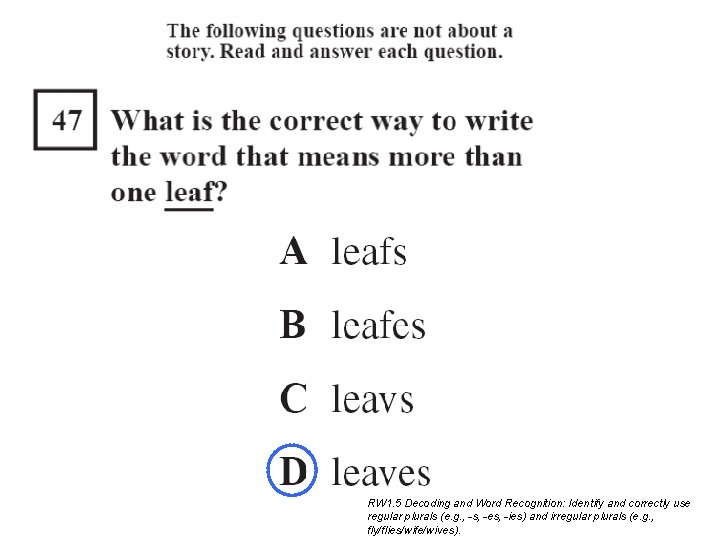
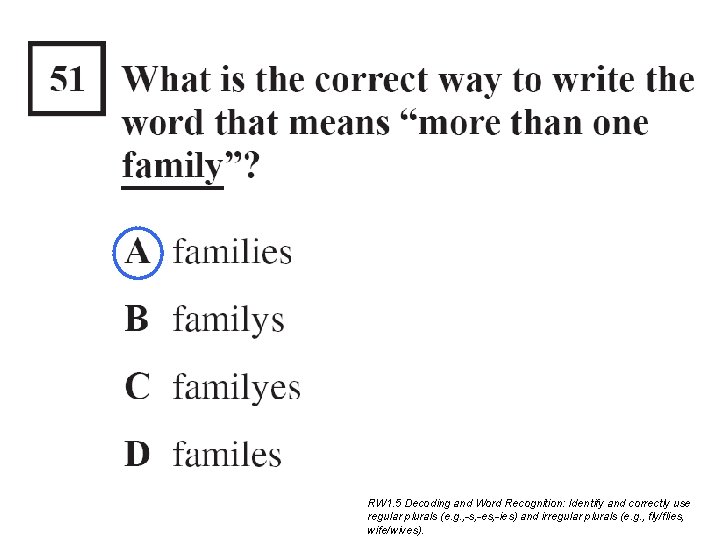
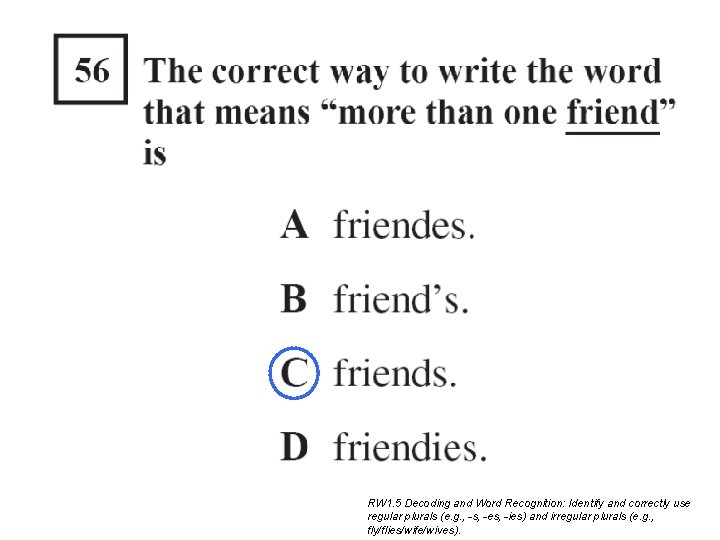
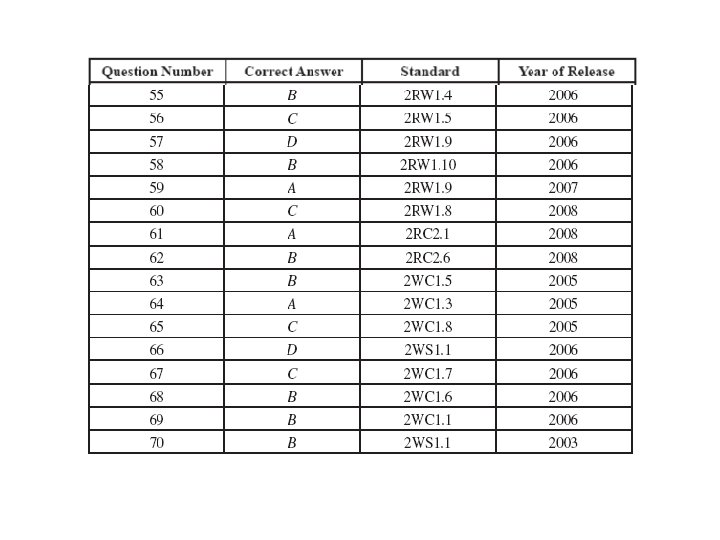
RW 1. 5 Decoding and Word Recognition: Identify and correctly use regular plurals (e. g. , -s, -es, -ies) and irregular plurals (e. g. , fly/flies/wife/wives).
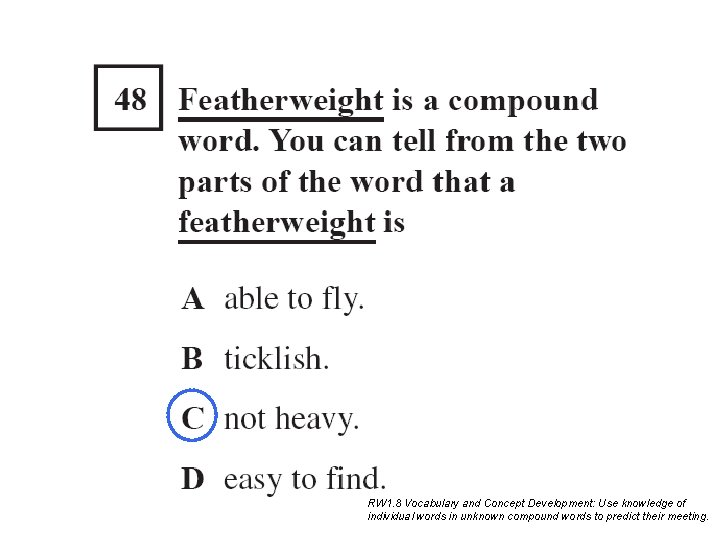
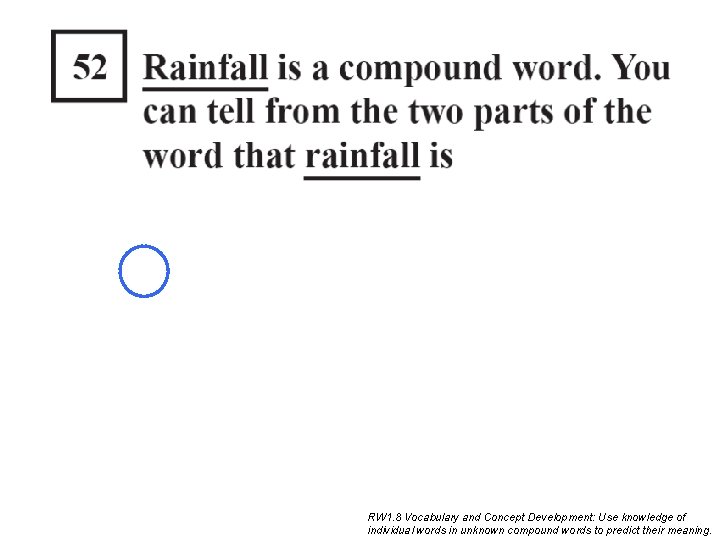
RW 1. 8 Vocabulary and Concept Development: Use knowledge of individual words in unknown compound words to predict their meeting.
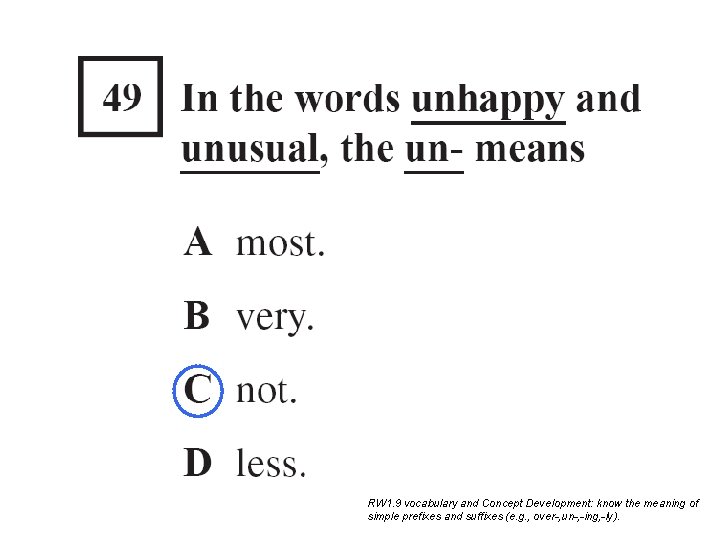
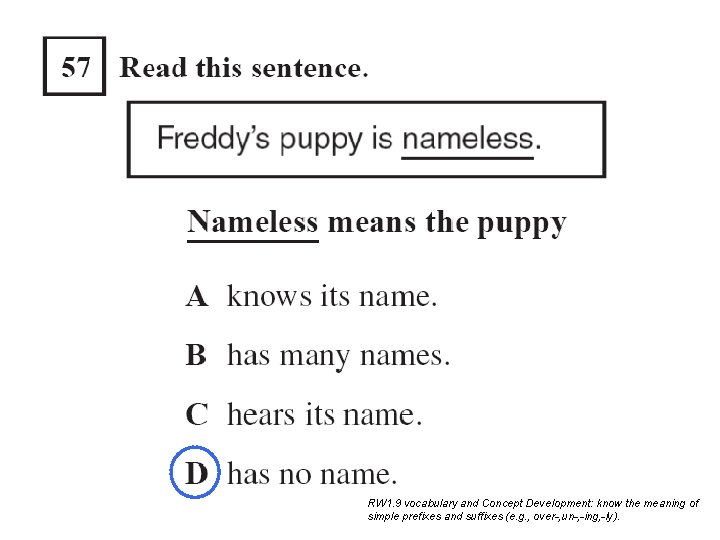
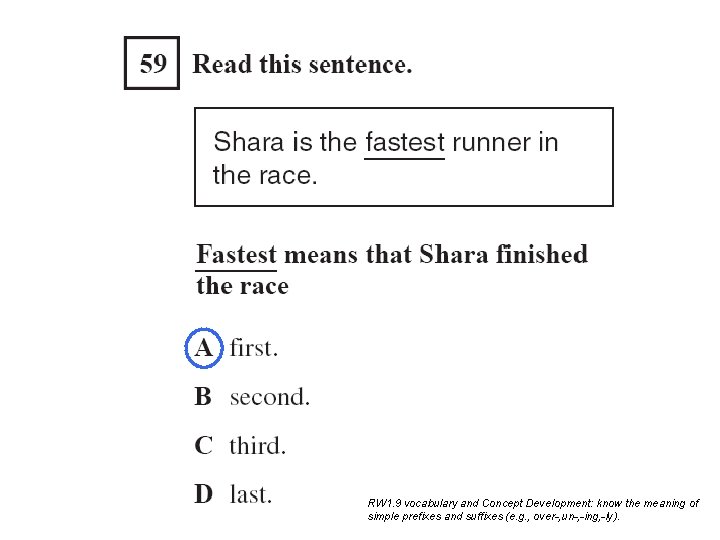
RW 1. 9 vocabulary and Concept Development: know the meaning of simple prefixes and suffixes (e. g. , over-, un-, -ing, -ly).
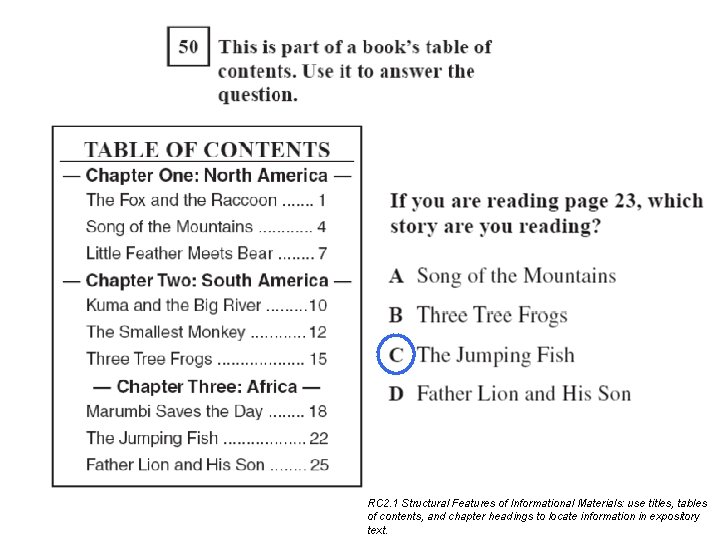
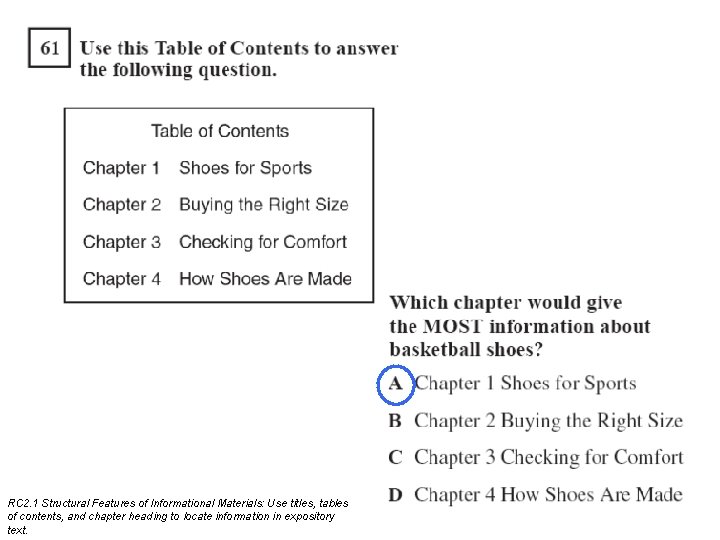
RC 2. 1 Structural Features of Informational Materials: use titles, tables of contents, and chapter headings to locate information in expository text.
RW 1. 5 Decoding and Word Recognition: Identify and correctly use regular plurals (e. g. , -s, -es, -ies) and irregular plurals (e. g. , fly/flies, wife/wives).
RW 1. 8 Vocabulary and Concept Development: Use knowledge of individual words in unknown compound words to predict their meaning.
RW 1. 9 vocabulary and Concept Development: know the meaning of simple prefixes and suffixes (e. g. , over-, un-, -ing, -ly).
RW 1. 3 Decoding and Word Recognition: Decode two-syllable nonsense words and regular multisyllable words
RW 1. 4 Decoding and Word Recognition: Recognize common abbreviations (e. g. , Jan. , Sun. , Mr. , St. ).
RW 1. 5 Decoding and Word Recognition: Identify and correctly use regular plurals (e. g. , -s, -es, -ies) and irregular plurals (e. g. , fly/flies/wife/wives).
RW 1. 9 vocabulary and Concept Development: know the meaning of simple prefixes and suffixes (e. g. , over-, un-, -ing, -ly).
RW 1. 10 Vocabulary and Concept Development: Identify simple multiple-meaning words.
RW 1. 9 vocabulary and Concept Development: know the meaning of simple prefixes and suffixes (e. g. , over-, un-, -ing, -ly).
RW 1. 8 Vocabulary and Concept Development: Use knowledge of individual words in unknown compound words to predict their meaning.
RC 2. 1 Structural Features of Informational Materials: Use titles, tables of contents, and chapter heading to locate information in expository text.
RC 2. 6 Comprehension and Analysis of Grade-Level. Appropriate Text: Recognize cause-and effect relationships in a text
63 64 65
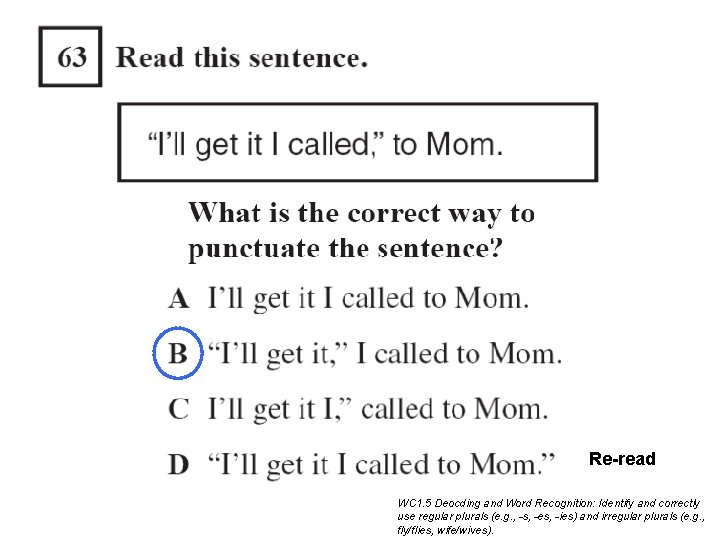
Re-read WC 1. 5 Deocding and Word Recognition: Identify and correctly use regular plurals (e. g. , -s, -es, -ies) and irregular plurals (e. g. , fly/flies, wife/wives).
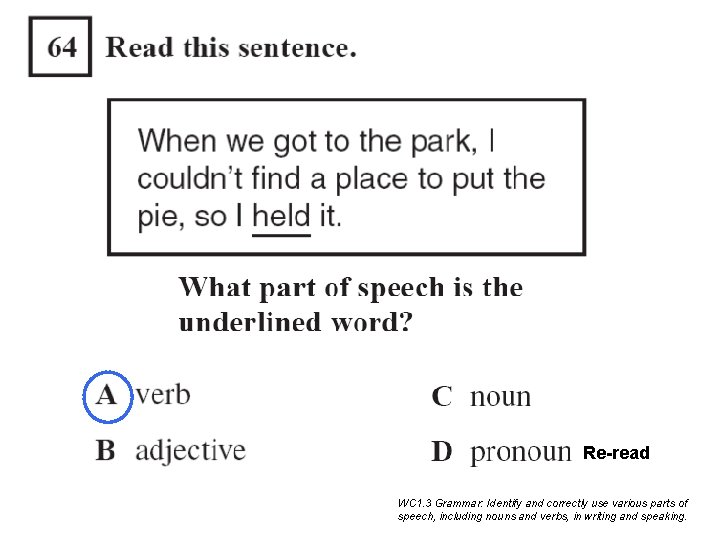
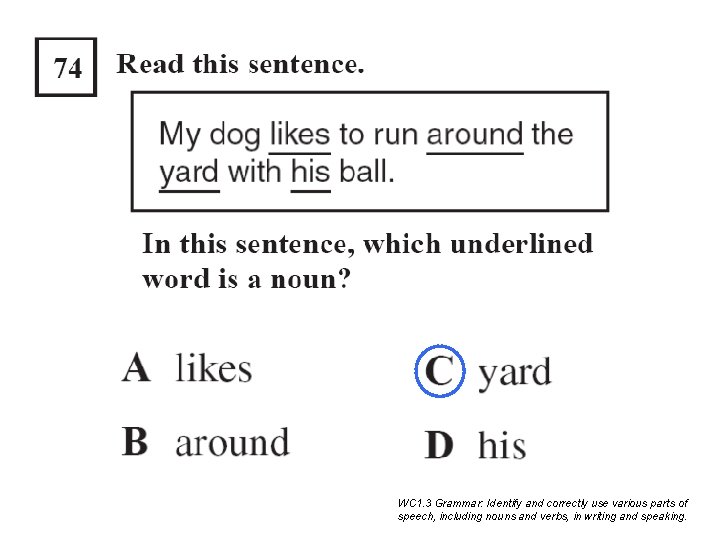
Re-read WC 1. 3 Grammar: Identify and correctly use various parts of speech, including nouns and verbs, in writing and speaking.
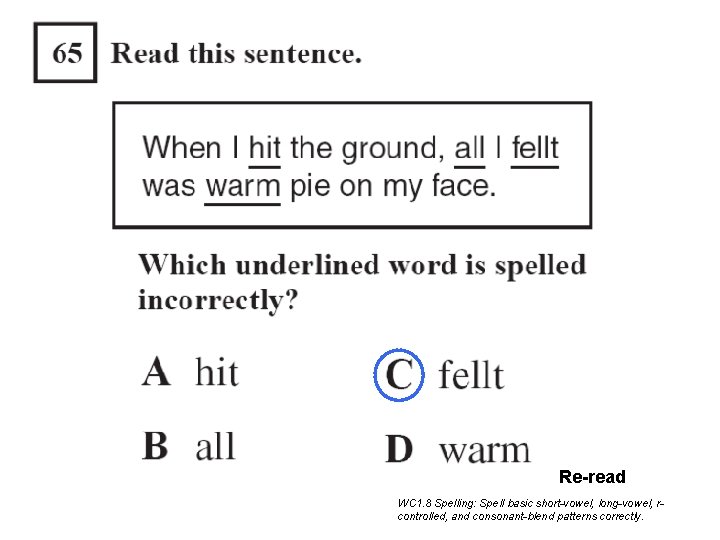
Re-read WC 1. 8 Spelling: Spell basic short-vowel, long-vowel, rcontrolled, and consonant-blend patterns correctly.
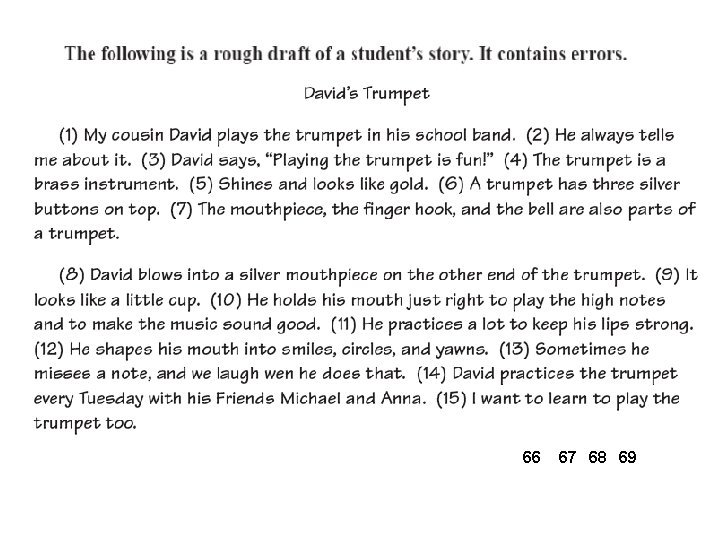
66 67 68 69
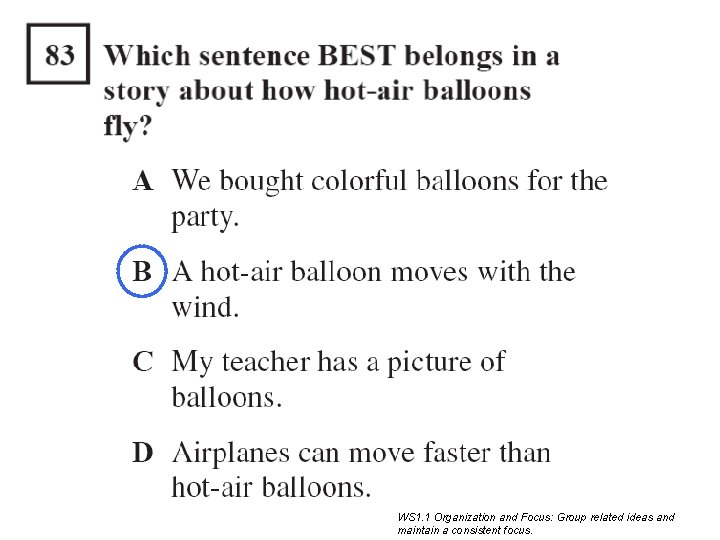
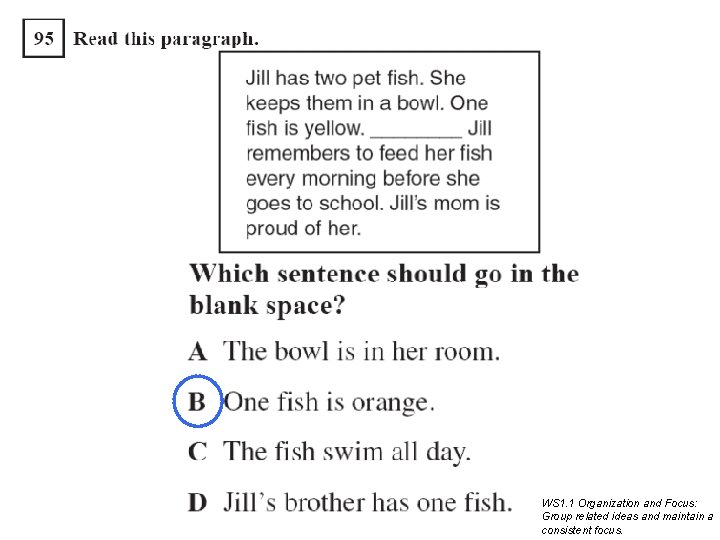
Re-read WS 1. 1 Organization and focus: Group related ideas and maintain a consistent focus.
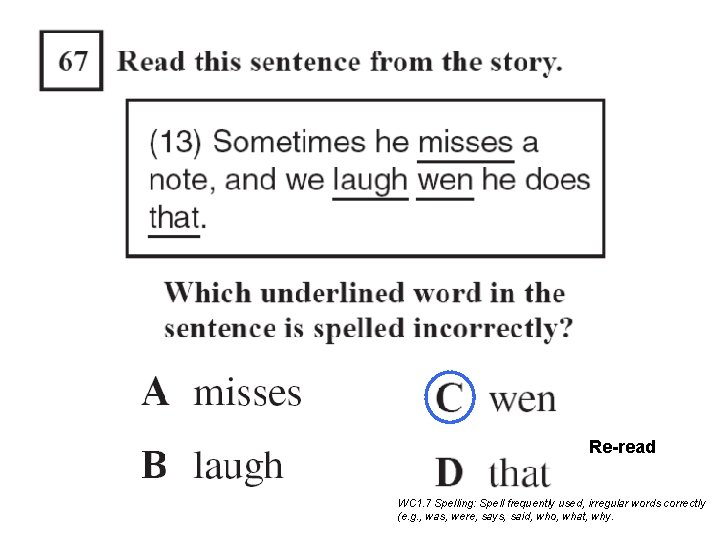
Re-read WC 1. 7 Spelling: Spell frequently used, irregular words correctly (e. g. , was, were, says, said, who, what, why.
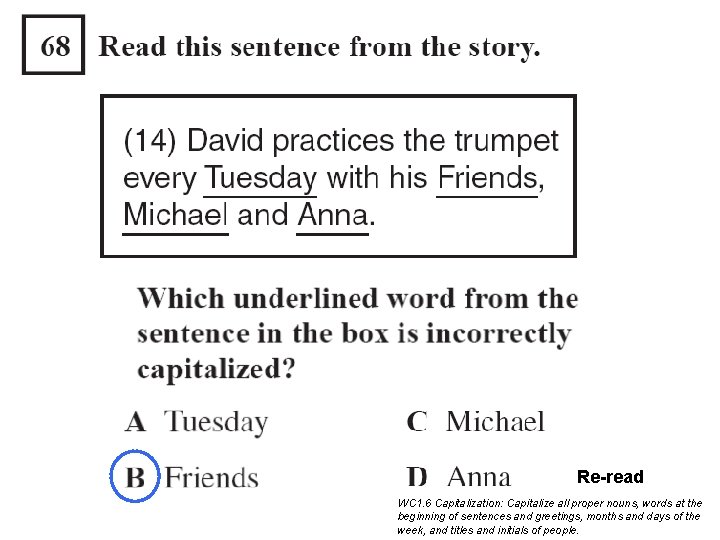
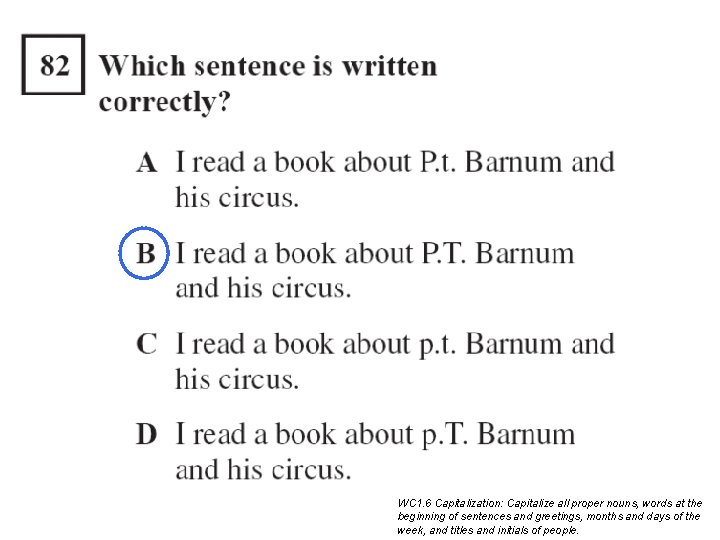
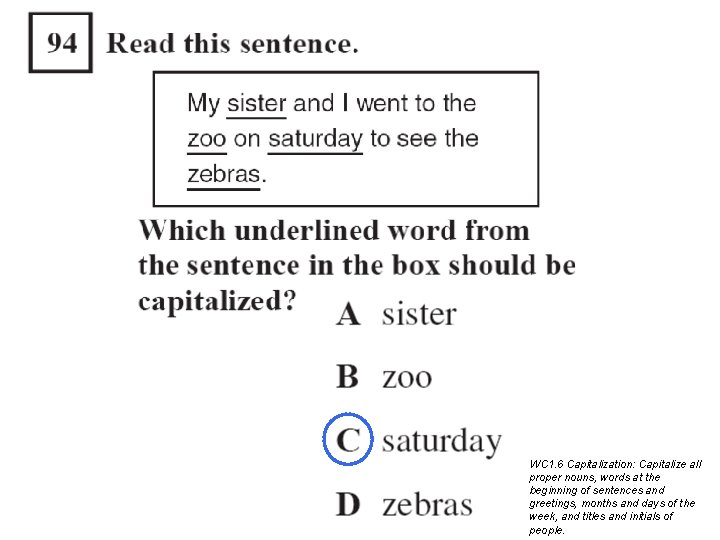
Re-read WC 1. 6 Capitalization: Capitalize all proper nouns, words at the beginning of sentences and greetings, months and days of the week, and titles and initials of people.
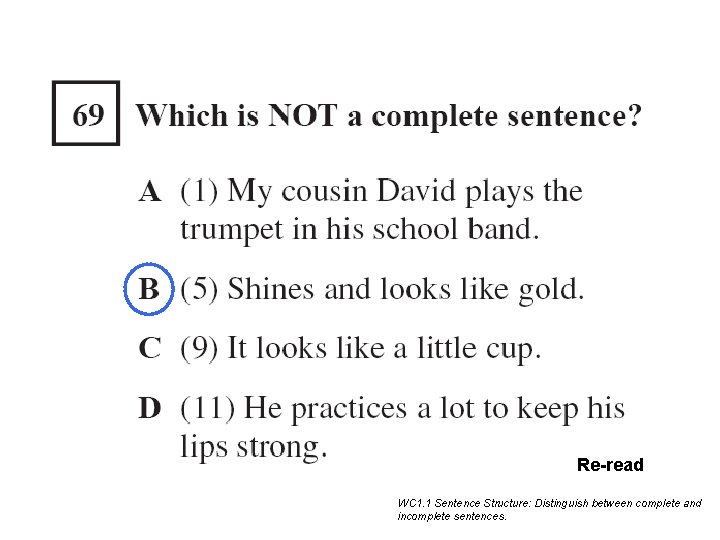
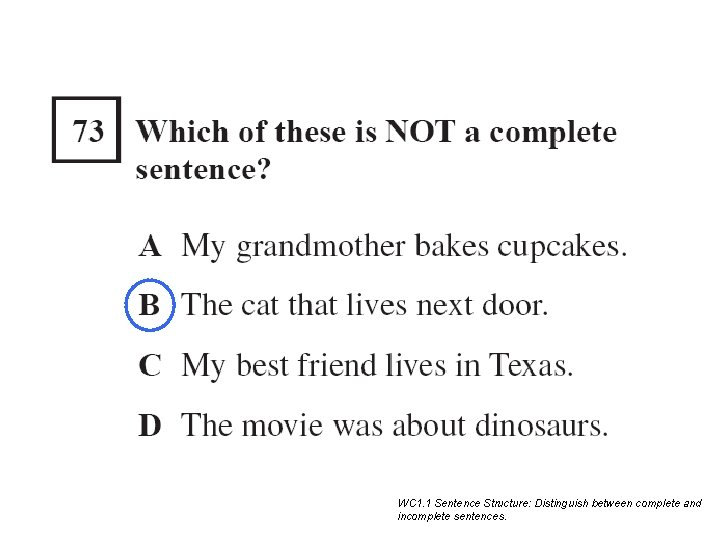
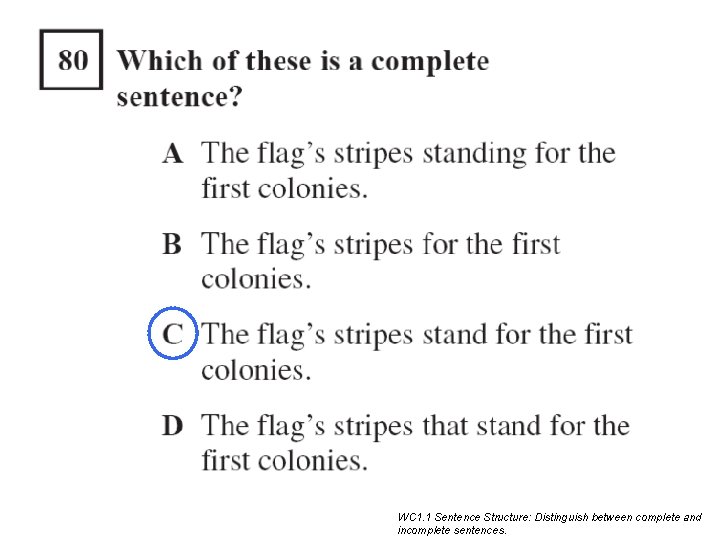
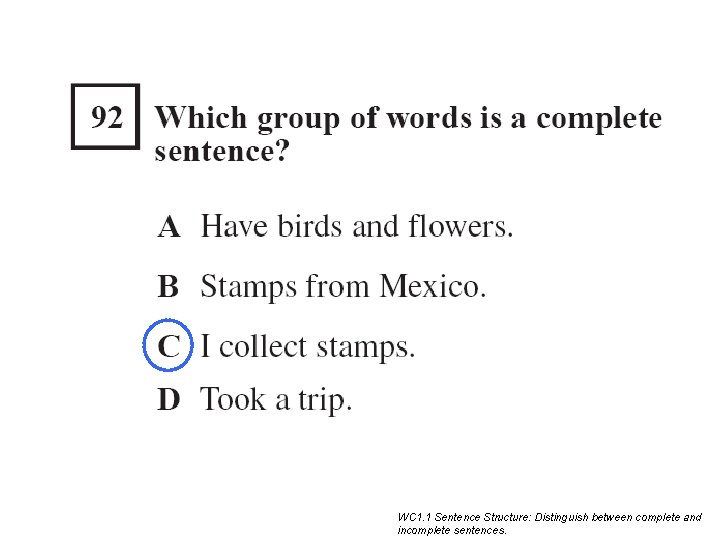
Re-read WC 1. 1 Sentence Structure: Distinguish between complete and incomplete sentences.
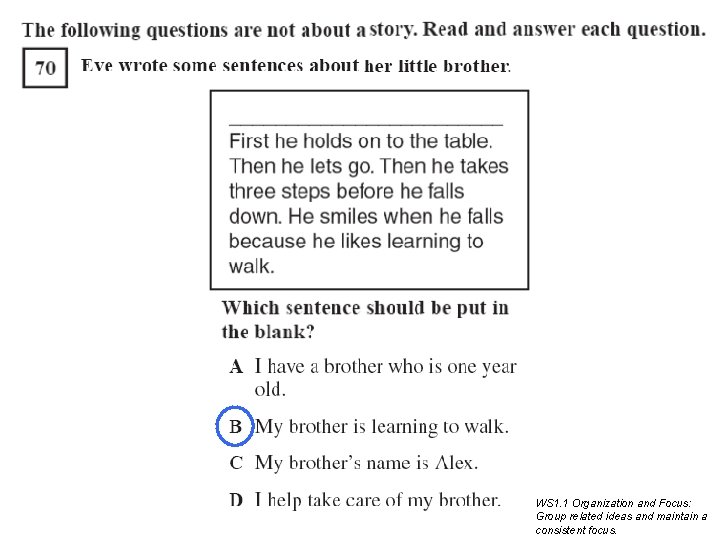
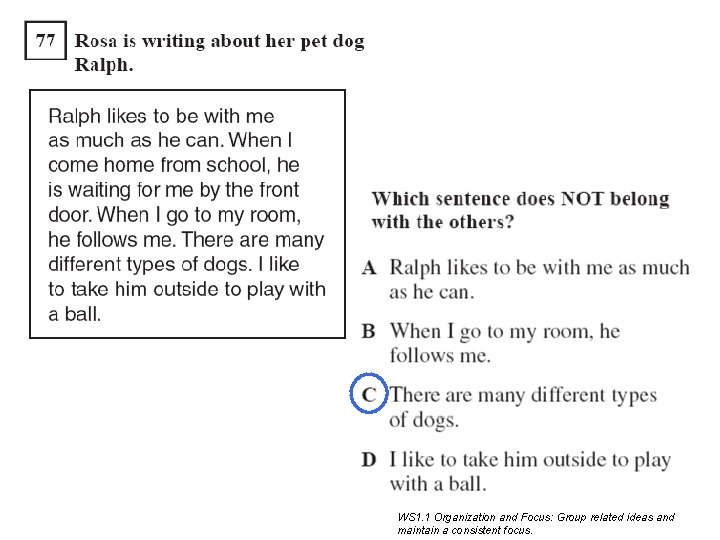
WS 1. 1 Organization and Focus: Group related ideas and maintain a consistent focus.
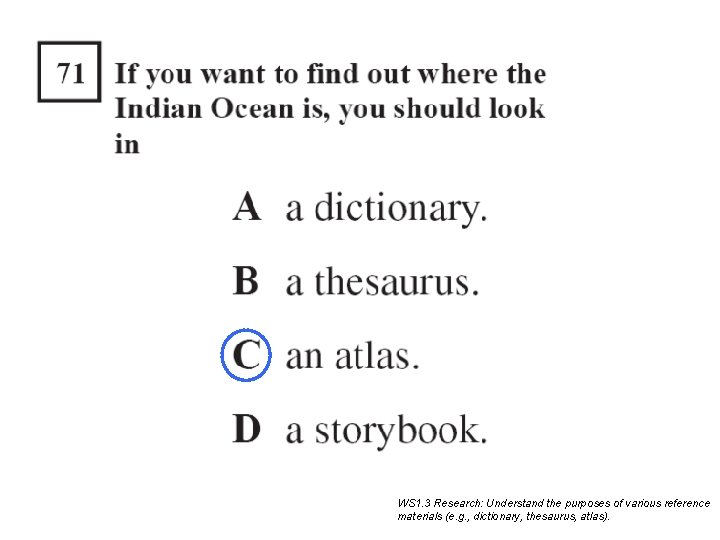
WS 1. 3 Research: Understand the purposes of various reference materials (e. g. , dictionary, thesaurus, atlas).
WC 1. 5 Decoding and Word Recognition: Identify and correctly use regular plurals (e. g. , -s, -es, -ies) and irregular plurals (e. g. , fly/flies, wife/wives).
WC 1. 1 Sentence Structure: Distinguish between complete and incomplete sentences.
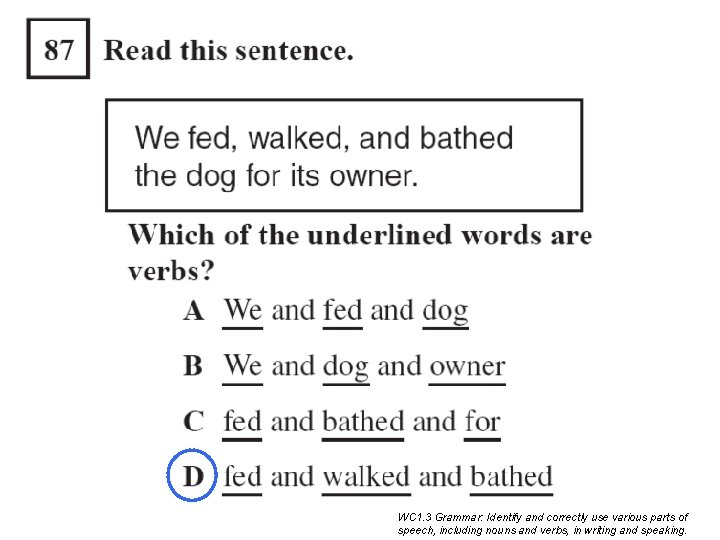
WC 1. 3 Grammar: Identify and correctly use various parts of speech, including nouns and verbs, in writing and speaking.
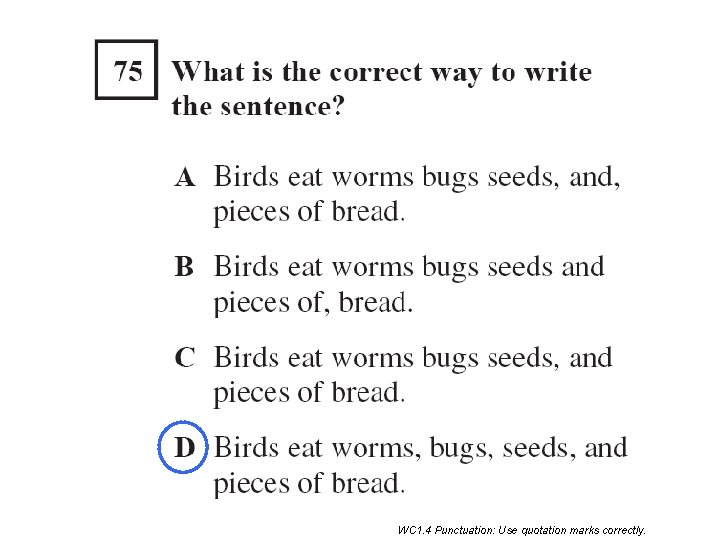
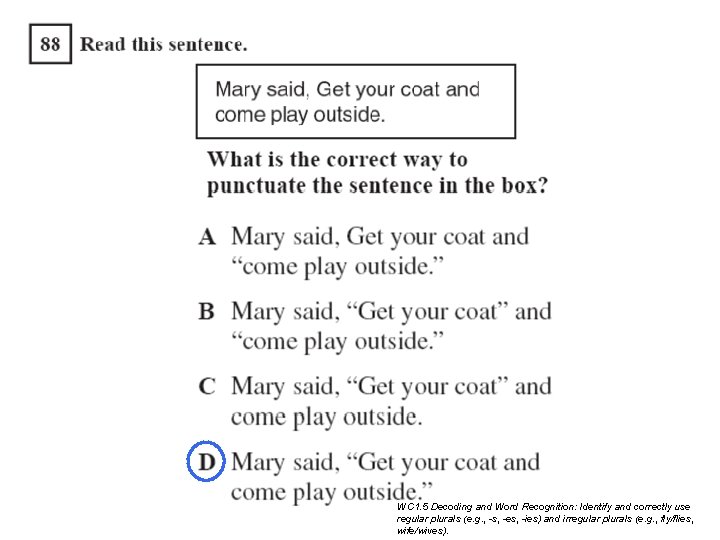
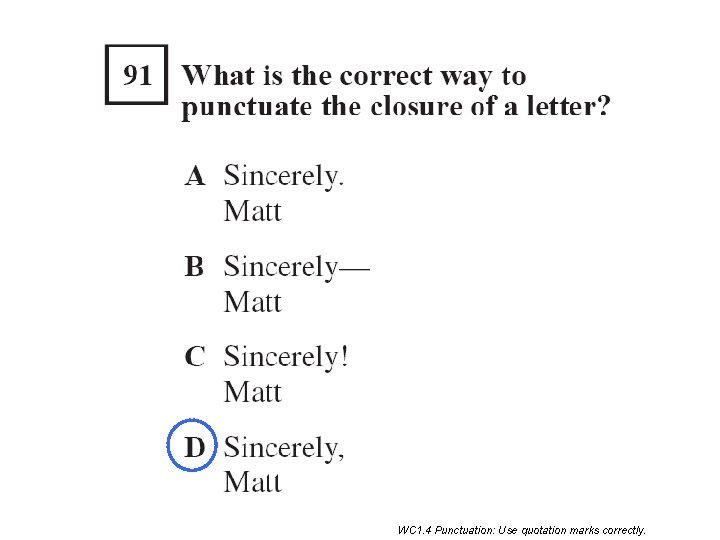
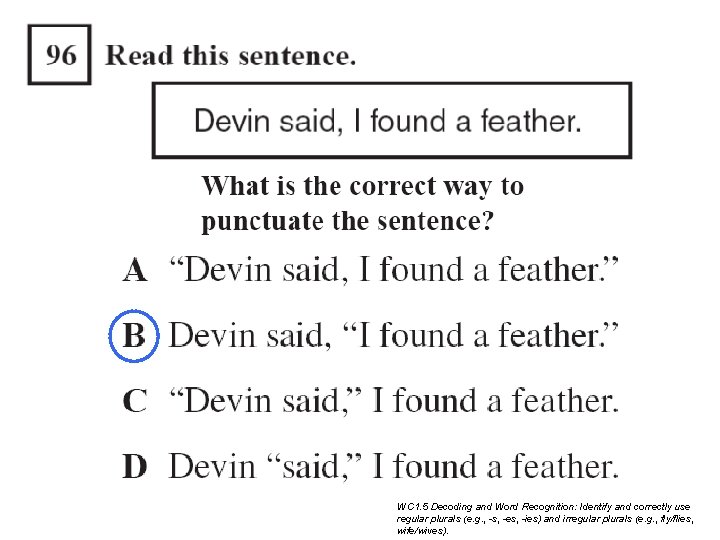
WC 1. 4 Punctuation: Use quotation marks correctly.
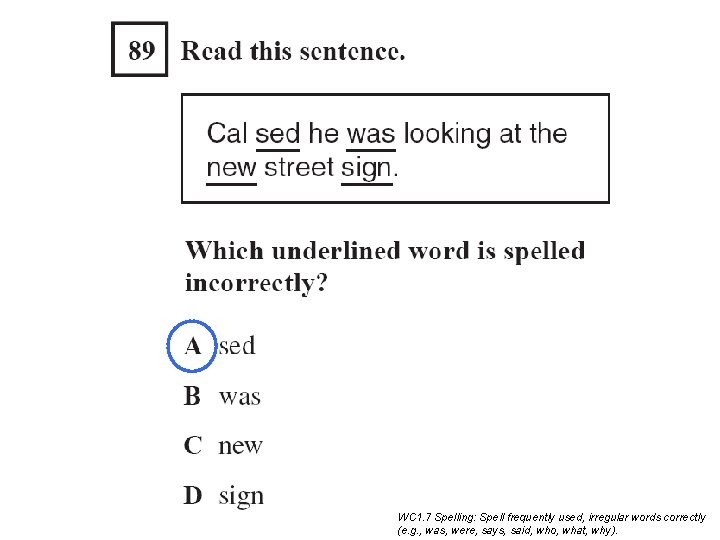
WC 1. 7 Spelling: Spell frequently used, irregular words correctly (e. g. , was, were, says, said, who, what, why).
WS 1. 1 Organization and Focus: Group related ideas and maintain a consistent focus.
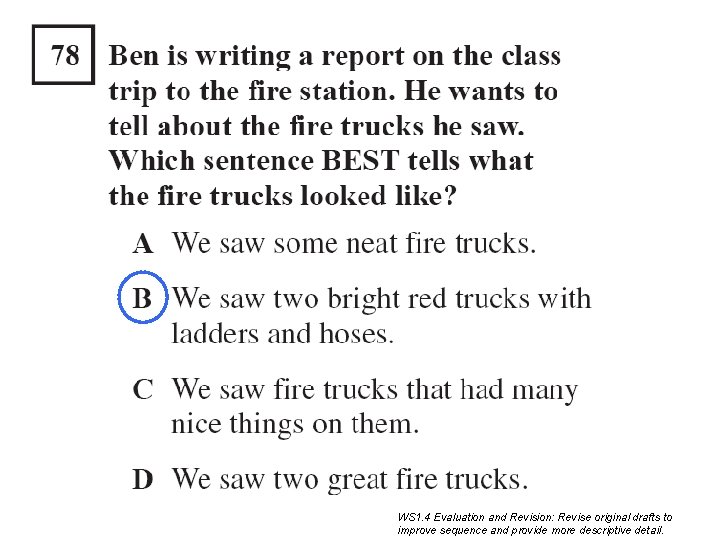
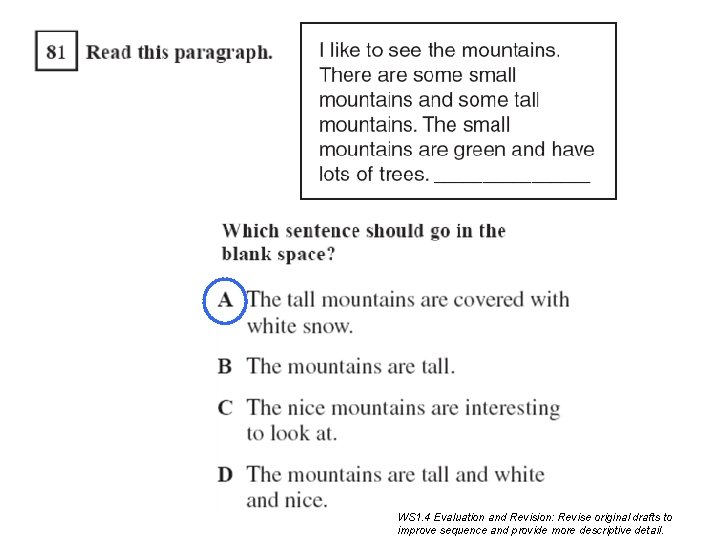
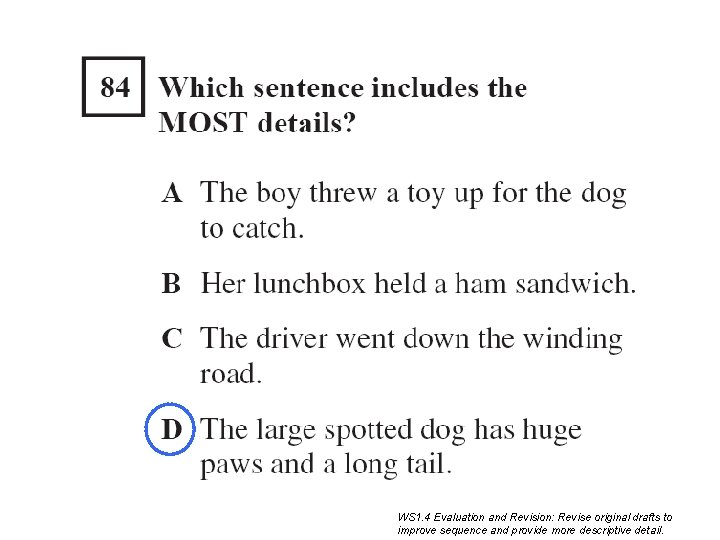
WS 1. 4 Evaluation and Revision: Revise original drafts to improve sequence and provide more descriptive detail.
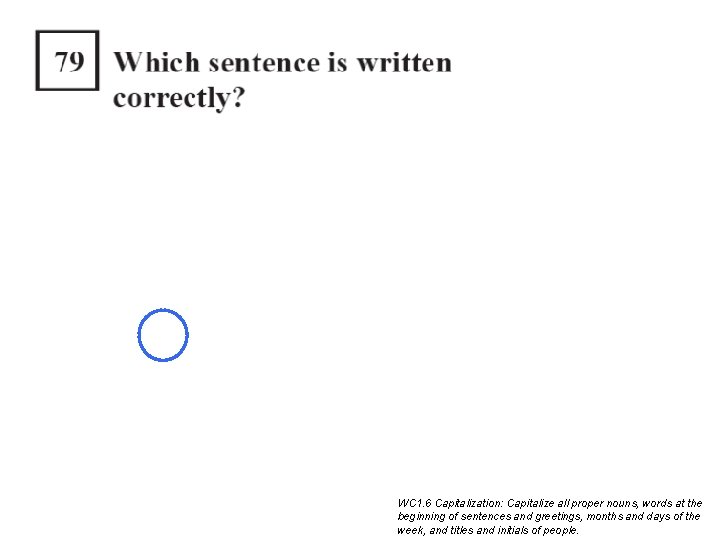
WC 1. 6 Capitalization: Capitalize all proper nouns, words at the beginning of sentences and greetings, months and days of the week, and titles and initials of people.
WC 1. 1 Sentence Structure: Distinguish between complete and incomplete sentences.
WS 1. 4 Evaluation and Revision: Revise original drafts to improve sequence and provide more descriptive detail.
WC 1. 6 Capitalization: Capitalize all proper nouns, words at the beginning of sentences and greetings, months and days of the week, and titles and initials of people.
WS 1. 1 Organization and Focus: Group related ideas and maintain a consistent focus.
WS 1. 4 Evaluation and Revision: Revise original drafts to improve sequence and provide more descriptive detail.
WC 1. 7 Spelling: Spell frequently used, irregular words correctly (e. g. , was, were, says, said, who, what, why).
WS 1. 3 Research: Understand the purposes of various reference materials (e. g. , dictionary, thesaurus, atlas).
WC 1. 3 Grammar: Identify and correctly use various parts of speech, including nouns and verbs, in writing and speaking.
WC 1. 5 Decoding and Word Recognition: Identify and correctly use regular plurals (e. g. , -s, -es, -ies) and irregular plurals (e. g. , fly/flies, wife/wives).
WC 1. 7 Spelling: Spell frequently used, irregular words correctly (e. g. , was, were, says, said, who, what, why).
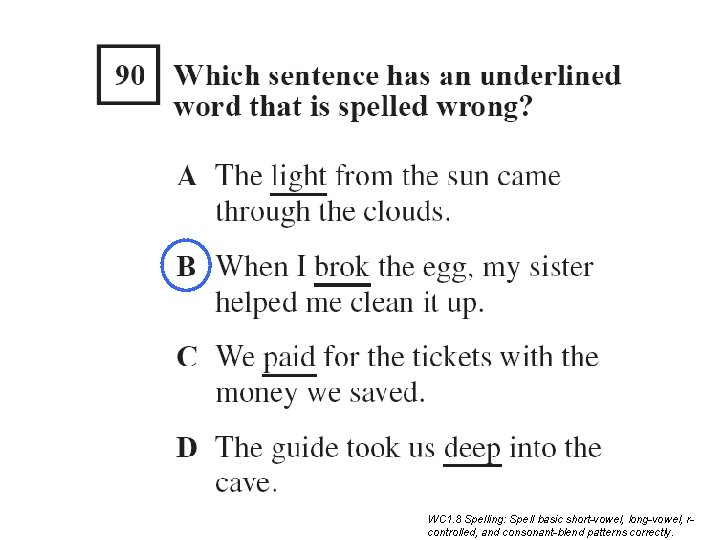
WC 1. 8 Spelling: Spell basic short-vowel, long-vowel, rcontrolled, and consonant-blend patterns correctly.
WC 1. 4 Punctuation: Use quotation marks correctly.
WC 1. 1 Sentence Structure: Distinguish between complete and incomplete sentences.
WC 1. 3 Grammar: Identify and correctly use various parts of speech, including nouns and verbs, in writing and speaking.
WC 1. 6 Capitalization: Capitalize all proper nouns, words at the beginning of sentences and greetings, months and days of the week, and titles and initials of people.
WS 1. 1 Organization and Focus: Group related ideas and maintain a consistent focus.
WC 1. 5 Decoding and Word Recognition: Identify and correctly use regular plurals (e. g. , -s, -es, -ies) and irregular plurals (e. g. , fly/flies, wife/wives).