
Rutherford Appleton Laboratory Particle Physics Department Knowledge Exchange
Rutherford Appleton Laboratory Particle Physics Department Knowledge Exchange Program in Particle Physics Department G. Villani 1 G. Villani Knowledge Exchange Activities
Rutherford Appleton Laboratory Particle Physics Department Selected Knowledge Exchange Strategic Areas Electronic system design (e. g. Power distribution in extreme environments) Detector and devices R&D (e. g. Nanopower radiation detector) Innovative solutions for scientific applications (e. g. Devices for QC) 2 G. Villani Knowledge Exchange Activities

Rutherford Appleton Laboratory Particle Physics Department Serial Powering of Electronic modules ed d e ne ly s le mb b e ca ss e a or nal m 0 e fi 0 20 n th y i l r a Ne Proposed solution of serial powering of Electronic modules tested with success q. Reduction in number of cables, material, co q. Higher power distribution efficiency q. Better noise performances Expertise in alternative powering options (DC/DC, switched capacitors) 3 G. Villani Knowledge Exchange Activities

Rutherford Appleton Laboratory Particle Physics Department Serial Powering of Electronic modules Layout of a General Purpose Serial Powering Chip designed at FNAL under PPD direction 4 G. Villani Knowledge Exchange Activities
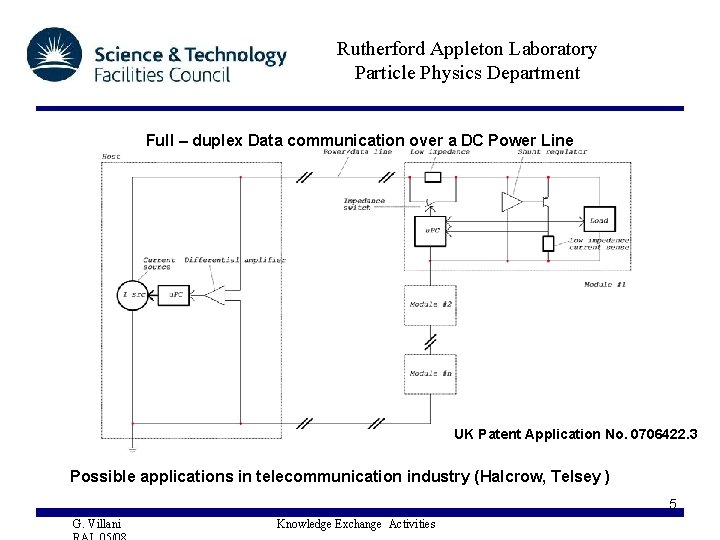
Rutherford Appleton Laboratory Particle Physics Department Full – duplex Data communication over a DC Power Line UK Patent Application No. 0706422. 3 Possible applications in telecommunication industry (Halcrow, Telsey ) 5 G. Villani Knowledge Exchange Activities
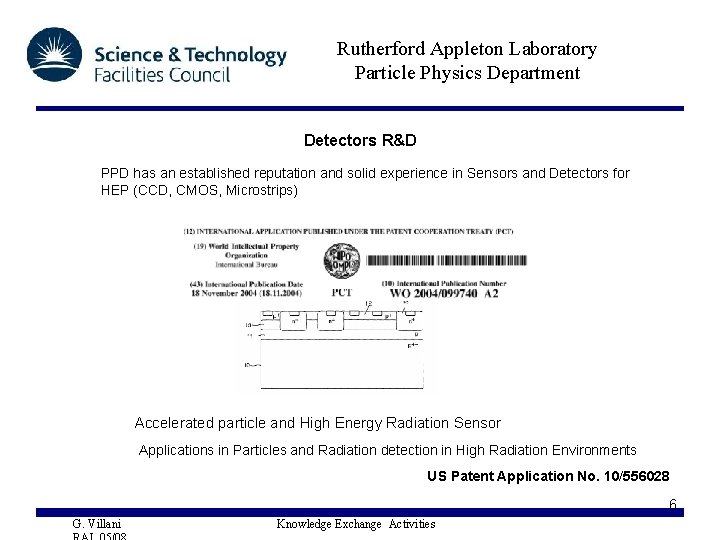
Rutherford Appleton Laboratory Particle Physics Department Detectors R&D PPD has an established reputation and solid experience in Sensors and Detectors for HEP (CCD, CMOS, Microstrips) Accelerated particle and High Energy Radiation Sensor Applications in Particles and Radiation detection in High Radiation Environments US Patent Application No. 10/556028 6 G. Villani Knowledge Exchange Activities
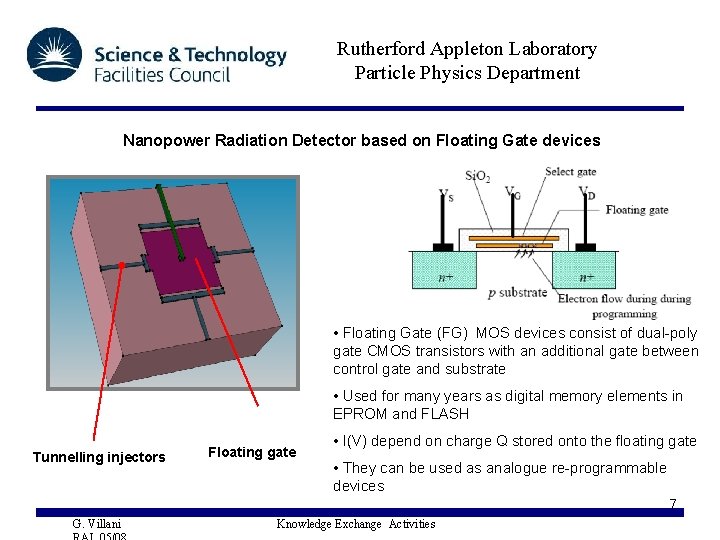
Rutherford Appleton Laboratory Particle Physics Department Nanopower Radiation Detector based on Floating Gate devices • Floating Gate (FG) MOS devices consist of dual-poly gate CMOS transistors with an additional gate between control gate and substrate • Used for many years as digital memory elements in EPROM and FLASH Tunnelling injectors Floating gate • I(V) depend on charge Q stored onto the floating gate • They can be used as analogue re-programmable devices 7 G. Villani Knowledge Exchange Activities
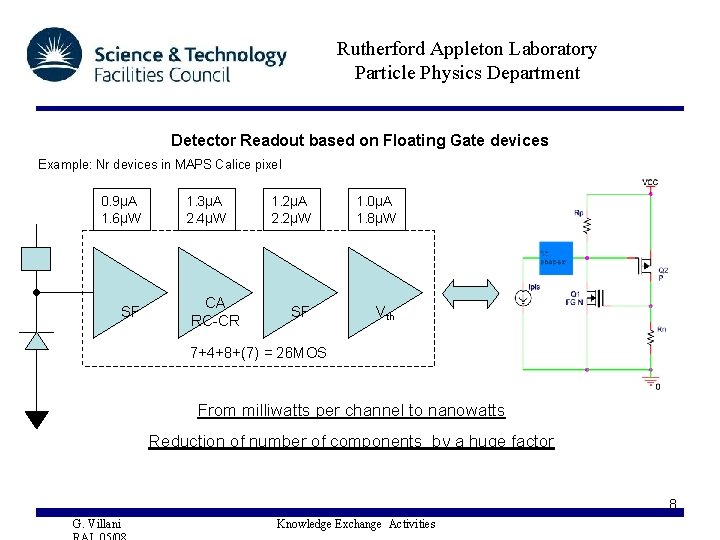
Rutherford Appleton Laboratory Particle Physics Department Detector Readout based on Floating Gate devices Example: Nr devices in MAPS Calice pixel 0. 9μA 1. 6μW SF 1. 3μA 2. 4μW CA RC-CR 1. 2μA 2. 2μW 1. 0μA 1. 8μW SF Vth 7+4+8+(7) = 26 MOS From milliwatts per channel to nanowatts Reduction of number of components by a huge factor 8 G. Villani Knowledge Exchange Activities
Rutherford Appleton Laboratory Particle Physics Department Detector Readout based on Floating Gate devices R&D efforts: Po. CFB 1012 fund from CLIK granted March 2008, 6 months International collaboration that includes: RAL PPD (Principal Investigator) Universita’ di Bologna, Italy Politecnico di Torino, Italy Brunel University Objectives: Low power readout for detectors (patent investigation) Applications in Biomedical Applications (Dosimetry) 9 G. Villani Knowledge Exchange Activities
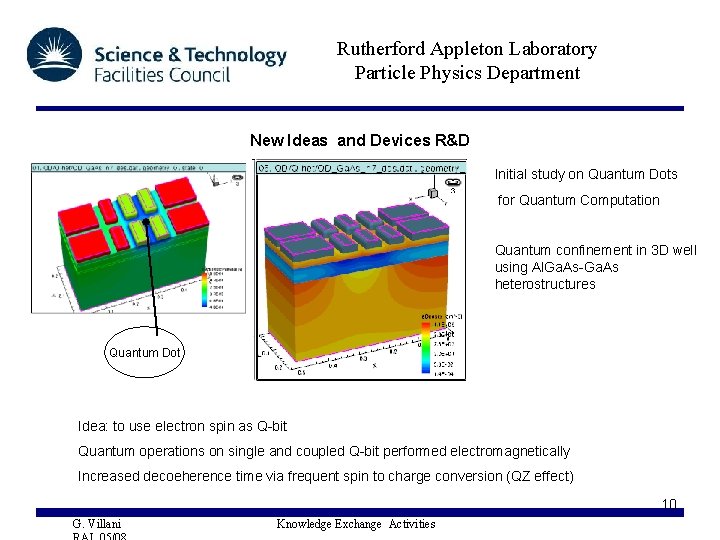
Rutherford Appleton Laboratory Particle Physics Department New Ideas and Devices R&D Initial study on Quantum Dots for Quantum Computation Quantum confinement in 3 D well using Al. Ga. As-Ga. As heterostructures Quantum Dot Idea: to use electron spin as Q-bit Quantum operations on single and coupled Q-bit performed electromagnetically Increased decoeherence time via frequent spin to charge conversion (QZ effect) 10 G. Villani Knowledge Exchange Activities
Rutherford Appleton Laboratory Particle Physics Department Conclusion Several active lines of research and development in PPD directly related to KE: • Electronic systems solutions suitable for a variety of scientific and industrial environments ü • Innovative Detectors for particles and radiation R&D ü • Power distribution efficiency optimisation through Serial powering FG applications in very low power and higher integration electronics, possible biomedical applications Devices studies for advanced scientific applications ü Initial studies on nanostructures for QC 11 G. Villani Knowledge Exchange Activities
- Slides: 11