
Ruth 1 1 5 ESV In the days
- Slides: 37
Ruth 1: 1 -5 (ESV) In the days when the judges ruled there was a famine in the land, and a man of Bethlehem in Judah went to sojourn in the country of Moab, he and his wife and his two sons.
The name of the man was Elimelech and the name of his wife Naomi, and the names of his two sons were Mahlon and Chilion. They were Ephrathites from Bethlehem in Judah. They went into the country of Moab and remained there.
But Elimelech, the husband of Naomi, died, and she was left with her two sons.
These took Moabite wives; the name of the one was Orpah and the name of the other Ruth. They lived there about ten years,
and both Mahlon and Chilion died, so that the woman was left without her two sons and her husband.
In the days when the judges ruled there was a famine in the land, and a man of Bethlehem in Judah went to sojourn in the country of Moab, he and his wife and his two sons. Ruth 1: 1, ESV
The Setting • The narrator informs us of the setting of the story • We are told it takes place during the time of the Judges • This could, technically, be anywhere from the conclusion of the conquest in Joshua to the coronation of Saul • Unfortunately we do not have a set date, though a later date makes most sense in context • We also learn that there is a famine in the land of the twelve tribes • This is telling during the time of the Judges • It could be meteorological, but it is just as likely judgment from God for their waywardness (See Deuteronomy 28 for blessings and curses)
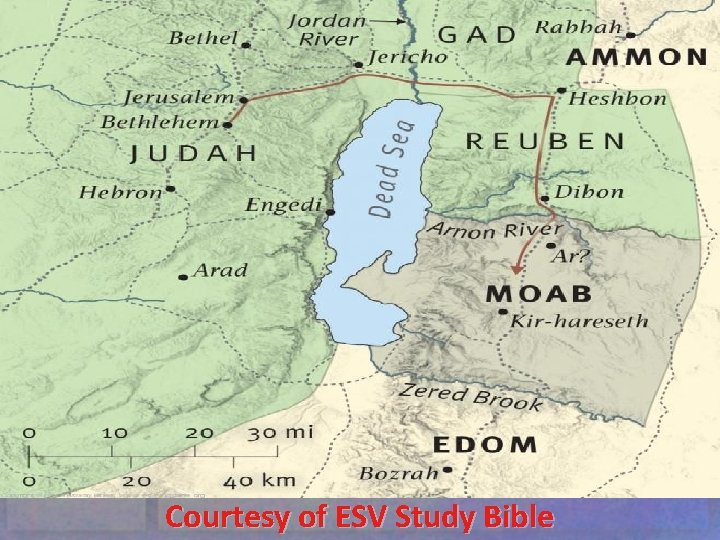
The Setting (2) • We learn of a man of Bethlehem in Judah • We learn of where specifically the story is taking place • The mention of “in Judah” may be to differentiate it from another Bethlehem • The man decided to take his family to Moab • Moab and the Tribes did not get along • We see this especially in Numbers with Balaam and elsewhere (See Numbers 22 -25) • Also, early in Judges the Moabites harassed the tribes (see Judges 3) • Still, the man takes his family to Moab • It is interesting to consider that Moab, which is fairly close to the tribal regions, seems to be unaffected by the famine (likely another hint at God’s judgment on the people)
Courtesy of ESV Study Bible
The name of the man was Elimelech and the name of his wife Naomi, and the names of his two sons were Mahlon and Chilion. They were Ephrathites from Bethlehem in Judah. They went into the country of Moab and remained there. Ruth 1: 2, ESV
Elimelech • We now learn of the man’s name which is Elimelech • His name means, “my God is King” • Is he turning to Moab instead of God? • We can’t be sure, but we can be sure his name has significance for the story • We also learn of his wife (Naomi) and their sons Mahlon and Chilion • We also learn their clan name • They were of the tribe of Judah, and the clan of Ephrathah • It is at this point that they remain there • Already there is a progression of a sojourn (verse 1) to remaining (verse 2)
But Elimelech, the husband of Naomi, died, and she was left with her two sons. Ruth 1: 3, ESV
The Death of Elimelech • Suddenly the story takes a drastic turn when we learn of the abrupt death of Elimelech • Did he die because of disobedience? We can only speculate • The story begins to focus on Naomi • She “Was left” implies the sorrow of losing a loved one • We also see how this focus takes shape • Elimelech now becomes “her husband” • And the sons become “her sons” (as opposed to verse 1)
These took Moabite wives; the name of the one was Orpah and the name of the other Ruth. They lived there about ten years, Ruth 1: 4, ESV
Marriage in Moab • We now learn that the sons marry Moabite women • The first being Orpah, and the second being Ruth • There is interesting speculation here • It is likely that they took the wives to carry on the family line • There may also be some joy from this in response to the passing of Elimelech • But why marry Moabite women? • We then learn that they lived there 10 years • The 10 years likely references how long they were married, not the overall stay of the family • Also, we now see the end of the progression, what started a sojourn ends with resettlement
and both Mahlon and Chilion died, so that the woman was left without her two sons and her husband. Ruth 1: 5, ESV
The Stage is Set • We are now informed that the sons die • This comes a shock to us as much as the death of Elimelech • They were to preserve the family line • We could of expected the story to turn to the sons, but this does not happen • Instead, the story turns fully to Naomi • She is left without her husband two sons • To be left, again, implies sorrow • She becomes the only survivor of the family
Main Point • The main point is that we now have a background for the rest of the story • Elimelech is dead, as are his two sons • This leaves the family line in a perilous situation • As well as Naomi, who has no heirs to support her
Application Points • Progression • It is interesting to see the progression for the family in Moab • Sojourn becomes remain, and remain becomes resettlement • This is kind of like sin • Sin begins like a snowflake, but little do we realize it will quickly cover everything
Application Points • Progression (2) • This makes me think of an encounter I had with Libby recently • She’s at that stage when she’s starting to lie (You all know that stage!) • Anyway, I asked her, “Libby did you do this? ” • Her response, “No it wasn’t me. ” • The evidence was not in her favor, so I asked her again, “Libby did you do this? ” • Her response, “No. I think it was Benny” • Eventually, she did tell me the truth
Application Points • Progression (3) • That’s like sin isn’t it? • When confronted we back ourselves into a corner and usually end up sinning more to cover up our sin • Or when we think, “Oh I’ll do this one time and that’ll be it!” • All it takes is one moment to begin a habit • It doesn’t take much more than one day, and then look back 30 years and wonder, “how did I get here? ”
Application Points • Progression (4) • Like the progression with Elimelech’s family, sin will all too often find a way to not become a once and done event • While it may be true that not every sin will become a lifestyle, all to often that can be the case • He did not bear his name well when he decided to move to Moab • Instead, he instilled in his family a desire to remain in their state rather than return to God • We need to be less like Elimelech in actions, and more like Elimelech in name
Application Points • Plan • God may not be mentioned in these verses directly • But we can be sure that His hand is on everything that is happening • God really is King • He is not in His throne room walking to and fro worrying whether His plans will come to fruition • No, He is on His throne and all of His plans will come to fruition • This makes us think of the famine • It is likely that the famine was brought by God with the goal to cause the people to return in repentance from their disobedience
Application Points • Plan (2) • In other words, the famine is part of God’s plan • Even bad things are part of God’s plan • We can be sure bad things occur and God will use them for His glory • As we go through Ruth it will be important for us to remember that God is King and He has a plan here • We have already seen the death of three male family members, and within the coming weeks we will see why this is significant • Through it all, God has a plan • Though there is likely disobedience from this family, God will turn even their disobedience into His good purposes
Application Points • Connections and Hope • We have noticed how the famine was likely brought by God for unfaithfulness • But we also want to consider the connection between Orpah, Ruth, the Famine, and other Old Testament texts • How do these things connect? • Well let’s consider where we started • Bethlehem means “House of Bread” • It is interesting they flee the house of bread because of a famine • In other words, the house is barren
Application Points • Connections and Hope (2) • This connects with Ruth and Orpah • Consider what we have learned • They’re from Moab, they marry, they remain married for 10 years • What’s missing? • The answer is children • Neither of the women bear children in the ten years of marriage • The Scriptures teach us that children are a blessing • It is possible to connect the wrath of God with the famine and their barrenness • Just as the tribes were disobedient causing the famine, the families disobedience may be causing their barrenness
Application Points • Connections and Hope (3) • God always leaves a door open to repentance • It will be interesting to see how this all plays out • Also, we want to be careful to consider that not all barrenness is necessarily God’s wrath • We know that there are brothers and sisters of the faith who struggle to have children • We should not assume not having children is God’s judgment on the marriage • God works in mysterious ways • There are many stories of marriages who are told they will never have children, and then God provides children • Likewise there are those who are perfectly healthy and have trouble conceiving
Application Points • Connections and Hope (4) • We should never be without hope • If there is anything we learn in the Old Testament is that God is faithful in His blessings, especially in regards to children • It is when we consider this we see a number of connections elsewhere in the Old Testament, especially with the patriarchs • Consider Abraham and Sarah • They flee the land because of a famine, and while there Abraham lies about Sarah (Genesis 12) • Because of a famine Isaac and Rebekah must also flee the land go to Philistia (Isaac also lies about Rebekah being his wife…Genesis 26)
Application Points • Connections and Hope (5) • The same happens with Jacob • There is a famine in Canaan and so he sends his sons to Egypt where they meet their brother Joseph (they all end up staying in Egypt see Genesis 41 -50) • So what is the connection with Ruth? • In all of these there is famine and relocation • Though it may have been alright for the Patriarchs to leave (it was not their land as it was promised to their offspring which was fulfilled after the Exodus) • It may not have been right for Elimelech to leave since the land belonged to the tribes at the time • So like the patriarchs, Elimelech ends up sinning while in his sojourn (The patriarchs sin was lying, Elimelech’s was remaining in Moab)
Application Points • Connections and Hope (6) • Another important connection is the matriarchs • Consider the following verses • “Now Sarai was barren; she had no child. ” (Genesis 11: 30 ESV) • “And Isaac prayed to the LORD for his wife, because she was barren. ” (Genesis 25: 21 A) • “When the LORD saw that Leah was hated, he opened her womb, but Rachel was barren. ” (Genesis 29: 31 ESV) • The connection? They are all barren • God will end up, however, opening all of their wombs (Sarah has Isaac, Rebekah has Jacob and Esau, Rachel had Joseph and Benjamin)
Application Points • Connections and Hope (7) • So we see certain connections with the Patriarchs/Matriarchs and the story in Ruth • They all have famines, sojourns, sins, and barren women • What do we end up remembering from the Genesis stories? • God provides for the Patriarchs • God opens the Matriarchs wombs • It’s with this we consider what we have learned in Ruth and where the story will likely lead us • Before we can get there, though, we need to take each step at a time • Right now in Ruth there is no happy ending, there is only sorrow
Application Points • Connections and Hope (8) • We can be sure that this sorrow will not last forever • There is hope, there is encouragement, for those who may be experiencing their own personal famines or barrenness now • God is not so distant • Keep your faith in the one who can heal all situations • Who brings the greatest of peace from above
Application Points • The Gospel • All of the Old Testament points to the time when Christ would arrive • We find it with Elimelech, “My God is King” • This King has a plan to undo death • This Gospel begins with Creation • It begins with God who is the Creator • We are created in God’s Image • Because God is a God who knows, can be known, loves, is moral, has reason, and personhood within the Trinity, we too have these attributes • It also means that humans have dignity, and there is sanctity to human life
Application Points • The Gospel (2) • Like God, however, we were able to choose • Instead of choosing God and life we chose sin and death • Because of this our relationships with God, within ourselves, each other, and the world are broken • We also accrue a greater moral guilt before God every day, making us worthy for judgment • God could have left us in this state forever • Instead He spoke into the darkness and gave us Light • The Voice we have heard and the Light we have seen is His Son Jesus Christ • Jesus lived, died, and was resurrected in space, time, history, and flesh • It is through Him we are redeemed, having peace with our God
Application Points • The Gospel (3) • All that is required of us is obedience in two things • The first is repentance from sin • We must turn from our sinful lifestyles and turn to God • We are to live according to His statutes, glorifying Him with our lives • The second is faith in Christ • It is not what we do, or what we have done, which makes us right with God • Instead it is what Jesus has done • Repentance is the evidence that we have been justified by grace through faith in Christ Jesus
Application Points • The Gospel (4) • For those who do not repent and do not place their faith in Jesus there is darkness • Our own works could never attain Christ’s righteousness, and because of this we will only find judgment if we go before God with only our own works in hand • For those who do repent and do place their faith in Jesus there is peace with God • Instead, there is eternal peace with our God • We become co-heirs of an eternal kingdom • This love, this peace, this kingdom will last forever because it is founded upon God Almighty