
Rust and Smut Diseases of Sorghum Rust Puccinia
- Slides: 7
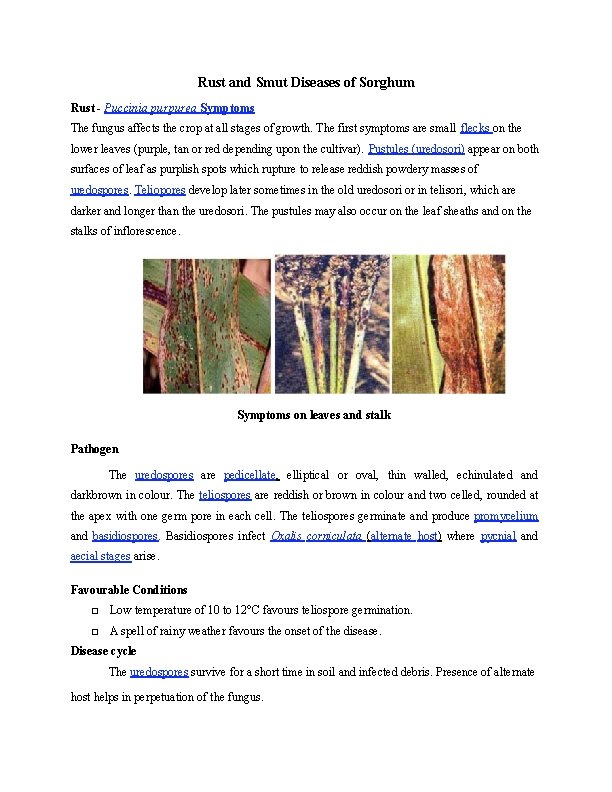
Rust and Smut Diseases of Sorghum Rust - Puccinia purpurea Symptoms The fungus affects the crop at all stages of growth. The first symptoms are small flecks on the lower leaves (purple, tan or red depending upon the cultivar). Pustules (uredosori) appear on both surfaces of leaf as purplish spots which rupture to release reddish powdery masses of uredospores. Teliopores develop later sometimes in the old uredosori or in telisori, which are darker and longer than the uredosori. The pustules may also occur on the leaf sheaths and on the stalks of inflorescence. Symptoms on leaves and stalk Pathogen The uredospores are pedicellate, elliptical or oval, thin walled, echinulated and darkbrown in colour. The teliospores are reddish or brown in colour and two celled, rounded at the apex with one germ pore in each cell. The teliospores germinate and produce promycelium and basidiospores. Basidiospores infect Oxalis corniculata (alternate host) where pycnial and aecial stages arise. Favourable Conditions □ Low temperature of 10 to 12°C favours teliospore germination. □ A spell of rainy weather favours the onset of the disease. Disease cycle The uredospores survive for a short time in soil and infected debris. Presence of alternate host helps in perpetuation of the fungus.
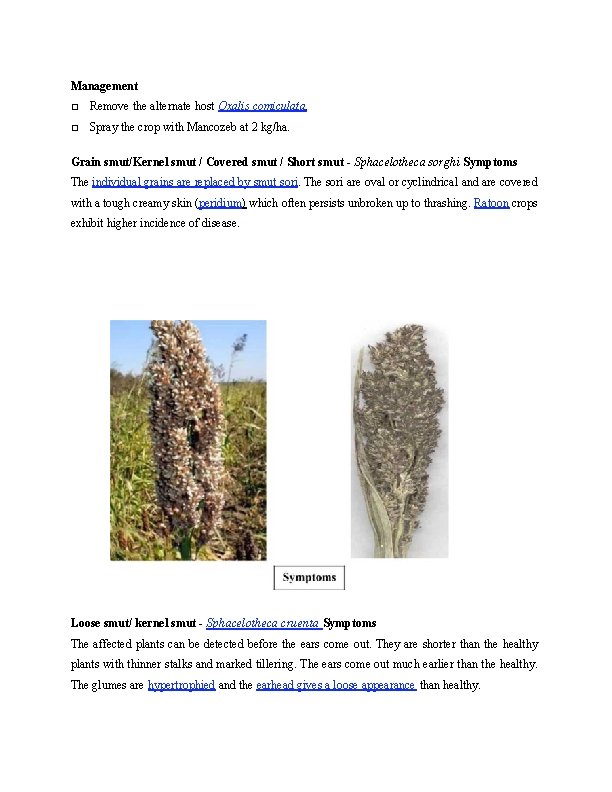
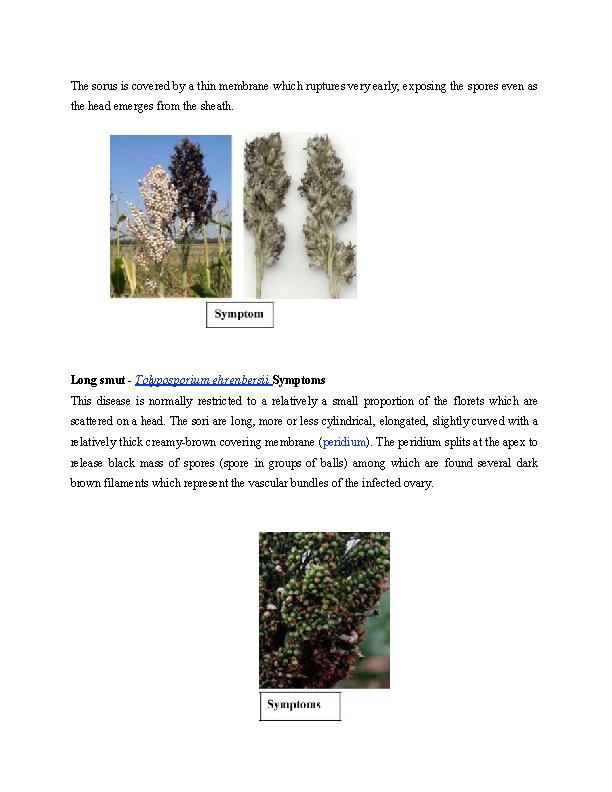
Management □ Remove the alternate host Oxalis comiculata. □ Spray the crop with Mancozeb at 2 kg/ha. Grain smut/Kernel smut / Covered smut / Short smut - Sphacelotheca sorghi Symptoms The individual grains are replaced by smut sori. The sori are oval or cyclindrical and are covered with a tough creamy skin (peridium) which often persists unbroken up to thrashing. Ratoon crops exhibit higher incidence of disease. Loose smut/ kernel smut - Sphacelotheca cruenta Symptoms The affected plants can be detected before the ears come out. They are shorter than the healthy plants with thinner stalks and marked tillering. The ears come out much earlier than the healthy. The glumes are hypertrophied and the earhead gives a loose appearance than healthy.
The sorus is covered by a thin membrane which ruptures very early, exposing the spores even as the head emerges from the sheath. Long smut - Tolyposporium ehrenbersii Symptoms This disease is normally restricted to a relatively a small proportion of the florets which are scattered on a head. The sori are long, more or less cylindrical, elongated, slightly curved with a relatively thick creamy-brown covering membrane (peridium). The peridium splits at the apex to release black mass of spores (spore in groups of balls) among which are found several dark brown filaments which represent the vascular bundles of the infected ovary.
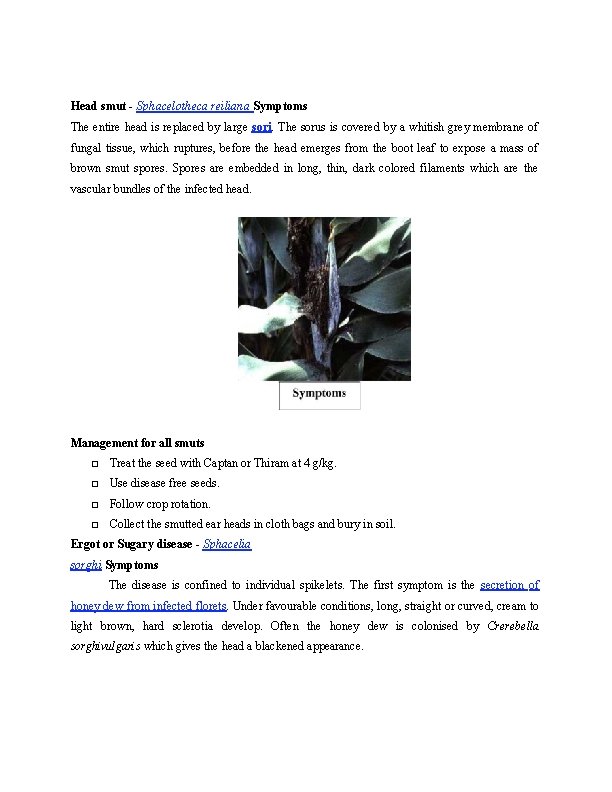
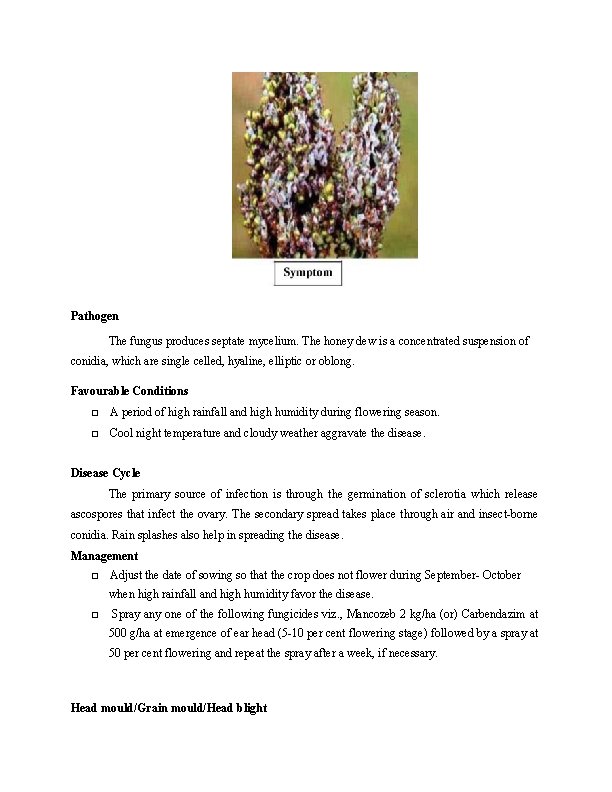
Head smut - Sphacelotheca reiliana Symptoms The entire head is replaced by large sori. The sorus is covered by a whitish grey membrane of fungal tissue, which ruptures, before the head emerges from the boot leaf to expose a mass of brown smut spores. Spores are embedded in long, thin, dark colored filaments which are the vascular bundles of the infected head. Management for all smuts □ Treat the seed with Captan or Thiram at 4 g/kg. □ Use disease free seeds. □ Follow crop rotation. □ Collect the smutted ear heads in cloth bags and bury in soil. Ergot or Sugary disease - Sphacelia sorghi Symptoms The disease is confined to individual spikelets. The first symptom is the secretion of honey dew from infected florets. Under favourable conditions, long, straight or curved, cream to light brown, hard sclerotia develop. Often the honey dew is colonised by Crerebella sorghivulgaris which gives the head a blackened appearance.
Pathogen The fungus produces septate mycelium. The honey dew is a concentrated suspension of conidia, which are single celled, hyaline, elliptic or oblong. Favourable Conditions □ A period of high rainfall and high humidity during flowering season. □ Cool night temperature and cloudy weather aggravate the disease. Disease Cycle The primary source of infection is through the germination of sclerotia which release ascospores that infect the ovary. The secondary spread takes place through air and insect-borne conidia. Rain splashes also help in spreading the disease. Management □ Adjust the date of sowing so that the crop does not flower during September- October when high rainfall and high humidity favor the disease. □ Spray any one of the following fungicides viz. , Mancozeb 2 kg/ha (or) Carbendazim at 500 g/ha at emergence of ear head (5 -10 per cent flowering stage) followed by a spray at 50 per cent flowering and repeat the spray after a week, if necessary. Head mould/Grain mould/Head blight
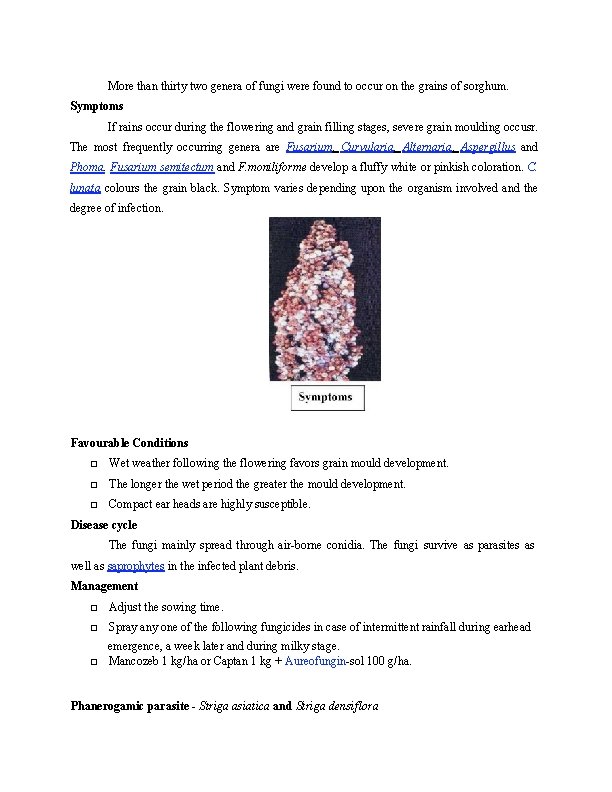
More than thirty two genera of fungi were found to occur on the grains of sorghum. Symptoms If rains occur during the flowering and grain filling stages, severe grain moulding occusr. The most frequently occurring genera are Fusarium, Curvularia, Alternaria, Aspergillus and Phoma. Fusarium semitectum and F. moniliforme develop a fluffy white or pinkish coloration. C. lunata colours the grain black. Symptom varies depending upon the organism involved and the degree of infection. Favourable Conditions □ Wet weather following the flowering favors grain mould development. □ The longer the wet period the greater the mould development. □ Compact ear heads are highly susceptible. Disease cycle The fungi mainly spread through air-borne conidia. The fungi survive as parasites as well as saprophytes in the infected plant debris. Management □ Adjust the sowing time. □ Spray any one of the following fungicides in case of intermittent rainfall during earhead emergence, a week later and during milky stage. □ Mancozeb 1 kg/ha or Captan 1 kg + Aureofungin-sol 100 g/ha. Phanerogamic parasite - Striga asiatica and Striga densiflora
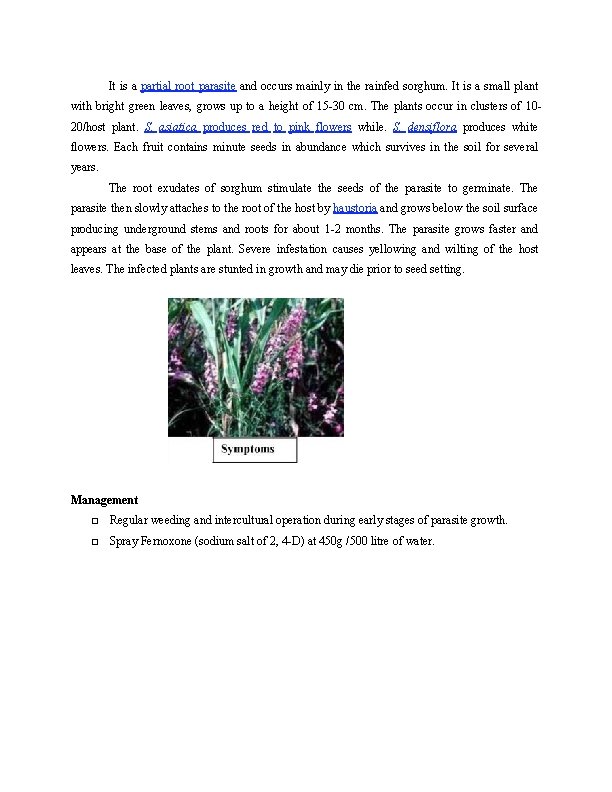
It is a partial root parasite and occurs mainly in the rainfed sorghum. It is a small plant with bright green leaves, grows up to a height of 15 -30 cm. The plants occur in clusters of 1020/host plant. S. asiatica produces red to pink flowers while. S. densiflora produces white flowers. Each fruit contains minute seeds in abundance which survives in the soil for several years. The root exudates of sorghum stimulate the seeds of the parasite to germinate. The parasite then slowly attaches to the root of the host by haustoria and grows below the soil surface producing underground stems and roots for about 1 -2 months. The parasite grows faster and appears at the base of the plant. Severe infestation causes yellowing and wilting of the host leaves. The infected plants are stunted in growth and may die prior to seed setting. Management □ Regular weeding and intercultural operation during early stages of parasite growth. □ Spray Fernoxone (sodium salt of 2, 4 -D) at 450 g /500 litre of water.