
Russias Soft Power Dr Vincent Charles Keating 08


- Slides: 28
Russia’s Soft Power Dr. Vincent Charles Keating 08 November 2017
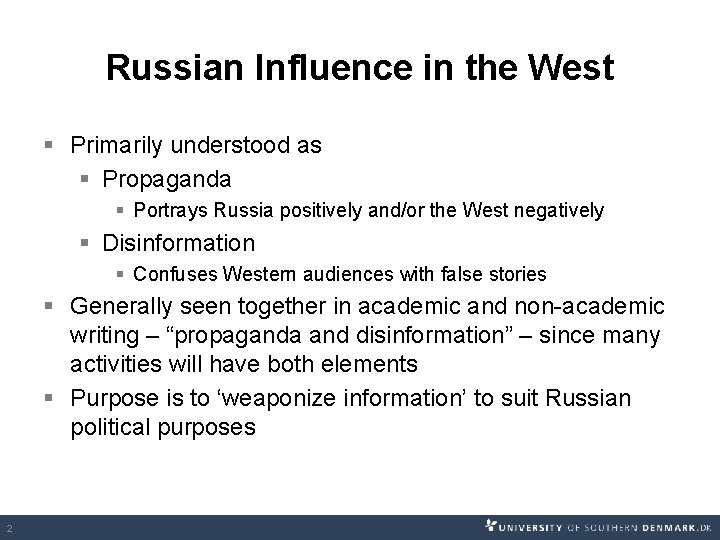
Russian Influence in the West § Primarily understood as § Propaganda § Portrays Russia positively and/or the West negatively § Disinformation § Confuses Western audiences with false stories § Generally seen together in academic and non-academic writing – “propaganda and disinformation” – since many activities will have both elements § Purpose is to ‘weaponize information’ to suit Russian political purposes 2
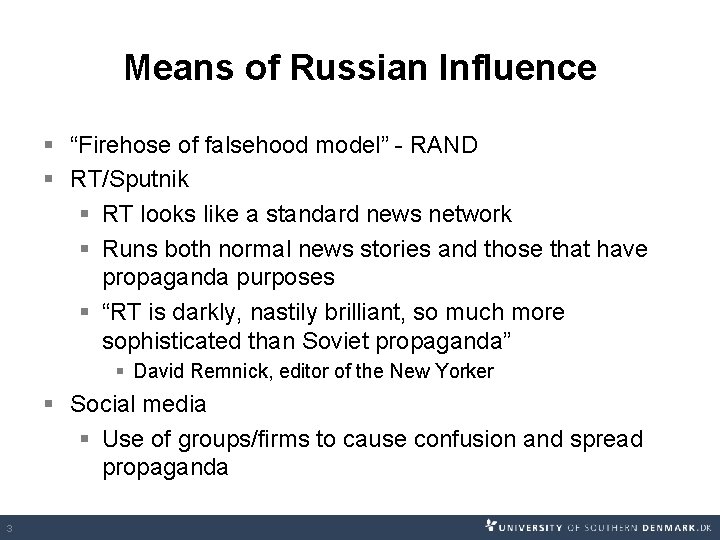
Means of Russian Influence § “Firehose of falsehood model” - RAND § RT/Sputnik § RT looks like a standard news network § Runs both normal news stories and those that have propaganda purposes § “RT is darkly, nastily brilliant, so much more sophisticated than Soviet propaganda” § David Remnick, editor of the New Yorker § Social media § Use of groups/firms to cause confusion and spread propaganda 3
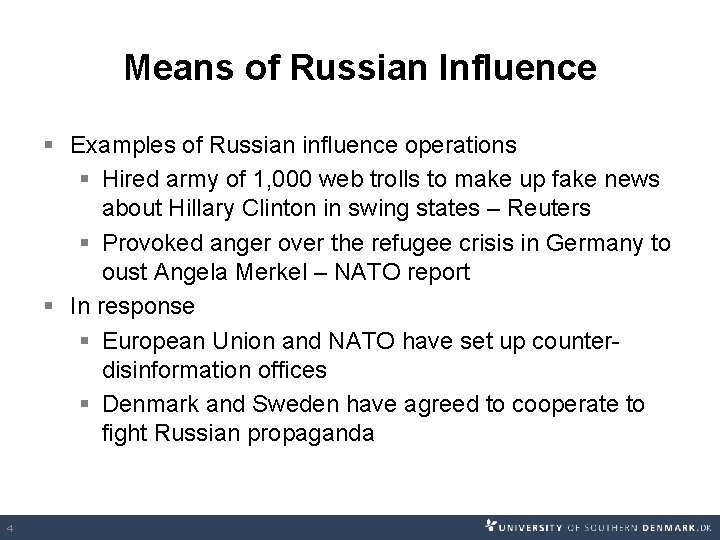
Means of Russian Influence § Examples of Russian influence operations § Hired army of 1, 000 web trolls to make up fake news about Hillary Clinton in swing states – Reuters § Provoked anger over the refugee crisis in Germany to oust Angela Merkel – NATO report § In response § European Union and NATO have set up counterdisinformation offices § Denmark and Sweden have agreed to cooperate to fight Russian propaganda 4
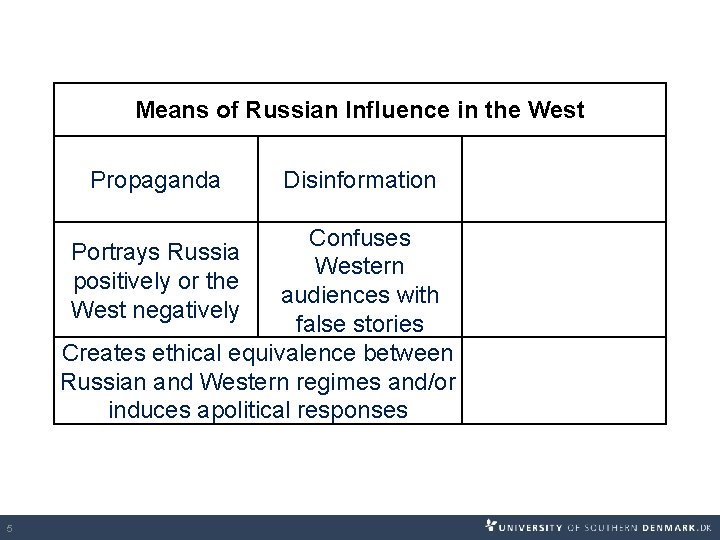
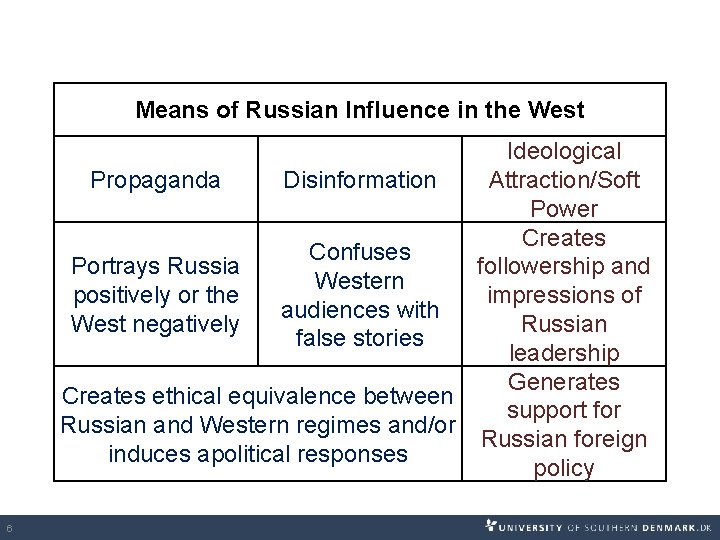
Means of Russian Influence in the West Propaganda Disinformation Confuses Western audiences with false stories Creates ethical equivalence between Russian and Western regimes and/or induces apolitical responses Portrays Russia positively or the West negatively 5
Means of Russian Influence in the West Ideological Propaganda Disinformation Attraction/Soft Power Creates Confuses followership and Portrays Russia Western impressions of positively or the audiences with West negatively Russian false stories leadership Generates Creates ethical equivalence between support for Russian and Western regimes and/or Russian foreign induces apolitical responses policy 6
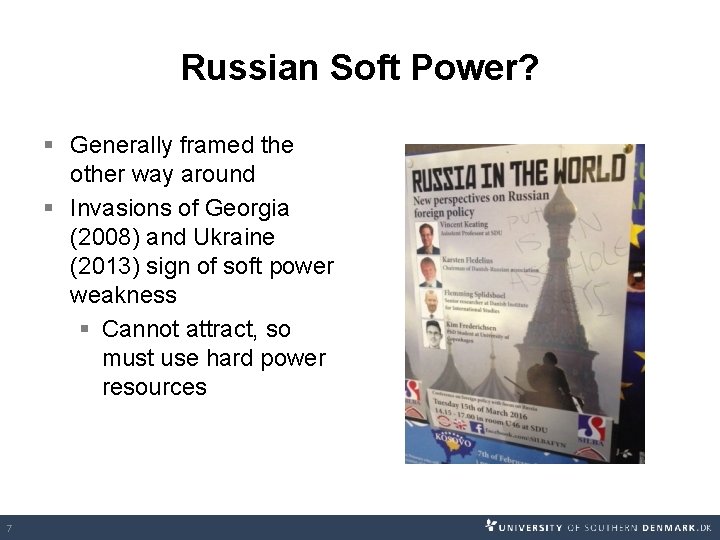
Russian Soft Power? § Generally framed the other way around § Invasions of Georgia (2008) and Ukraine (2013) sign of soft power weakness § Cannot attract, so must use hard power resources 7
Impossibility of Political Soft Power § “Russia’s influence does not display the emphasis on legitimacy and moral authority stipulated by Nye” (Grigas 2012) § “Freedom, democracy, rule of law, social stability and respect for human rights have become ‘a consumer basket’ of the modern world … Russia cannot export some model as an alternative. . . because it has not developed any such model yet” (Kosachev, 2012) § Russia “possesses almost no political ‘soft power’ for its neighbors or partners” (Leichtova 2014) § “Russia is unable to make its domestic socio-economic and political model attractive and sell it to other nations. ” (Sergunin, 2015) § “The main weakness of Russian strategy is the lack of soft 8
What is Soft Power? § Joseph Nye (1990) § The power of attraction to a state based on the appeal of its § Culture § Political Values § Foreign Policies § Grants states “the ability to influence the behavior of others to get the outcomes one wants” 9
Why Does Soft Power Work? § Nye gives several reasons explaining soft power’s effectiveness § Grants legitimacy and moral authority § Increases the possibility of persuasion § Lowers the cost of leadership by creating followership § Induces other states to see themselves as having a duty to ensure the success of the values § Induces other states to want to emulate the attractiveness, causing them to modify their preferences § Helps to manipulate the agenda by making opposing preferences seem too unrealistic 10
What Generates Political Attractiveness? § Nye suggests two factors § Having political values that reflect universal values § Conducting foreign policy based on these universal values § States that fulfil both of these criteria are likely to have large soft power resources 11
Universal Values § What are universal values? Nye argues that: § Soft power resources are contextual § Societies do not have uniform values § But all examples point to liberal democratic norms § “Many values like democracy, human rights, and individual opportunities are deeply seductive” § These are “powerful sources of attraction” § United States “advanced their values by creating a structure of international rules and institutions that were consistent with the liberal and democratic nature of the British and American economic systems. ” 12
Joseph Nye on Russia § China and Russia need to “be self-critical, and unleash the full talents of their civil societies” to increase soft power § Russian information warfare is a form of “negative soft power” § Attacks the values of others to reduce their attractiveness/soft power § For example, Russia’s attempts to delegitimize Western democratic processes § But too much propaganda is obvious, and reduces overall soft power 13
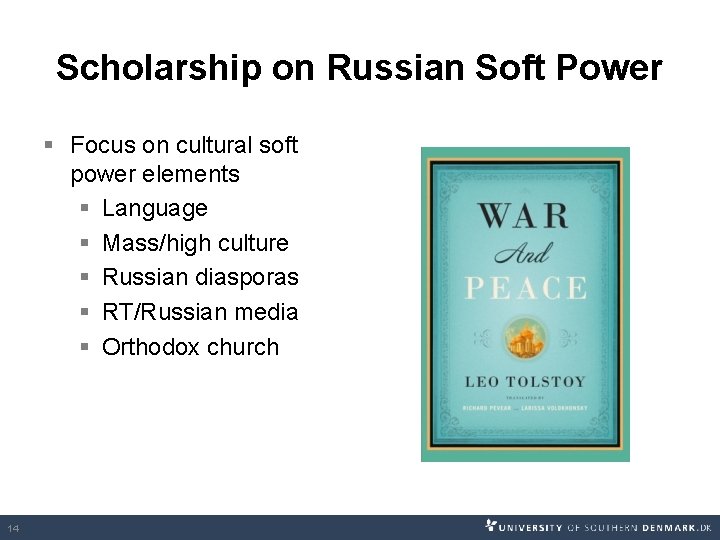
Scholarship on Russian Soft Power § Focus on cultural soft power elements § Language § Mass/high culture § Russian diasporas § RT/Russian media § Orthodox church 14
Scholarship on Russian Soft Power 15 § Focus on the instrumentalization of soft power § Soft power is only generated by Russian policy endorsed by the regime and financed from the state budget § Examines exclusively the production side of soft power § Use of Western techniques to promote political views, like GONGOs § Operate ‘with the aim of subverting authentic debate, either by spreading regime messages in a nontransparent way or by crowding out authentic voices’ (Walker 2016) § Use of ‘soft coercion’ not to attract, but to exploit
Effects of the Current Scholarship § Intellectually limits the scope of potential Russian soft power influence § Instrumentalization links capacities directly to the ability of the state to fund and promote them § So when the Russian government fell into recession, some argues that it left “Russian foreign policy in the near abroad with fewer ‘soft’ instruments” (Bratersky 2016). § Cultural focus leads to a focus primarily on post-Soviet space § Area most likely to be positively drawn to Russian cultural values 16
Our Argument § Soft power scholarship has a liberal democratic bias that § Is directly replicated in the Russian soft power literature § Automatically eliminates the possibility that Russian values can be attractive § Leaves scholars with only cultural values and instrumental programs § There is evidence that groups throughout the West are affected by Russian soft power because we can see a link between § Their open admiration of Russian values § Their open support for Russian foreign policy 17
Russia and Moral Conservatvism § Russia as inspiration to “traditional values activism” § Marie Le Pen: Putin shares “common values”, which are “the values of the European civilization”, in particular its “Christian heritage” § “courage, frankness, and the respect of identity and civilisation” § Jobbik: “Europe should get back to its own roots and rearrange its relationship with other traditional cultures that only exist in the East now” § Leader of Forza Nuova: “Moscow is the third Rome, and the role of Russia in history is to revive Christianity” 18
Russia and Moral Conservatvism § Patrick Buchanan: “In the culture war for the future of mankind, Putin is planting Russia’s flag firmly on the side of traditional Christianity” § Links with anti-LGBT activists § American Family Association spokesman declared that Russia’s gay propaganda ban matched exactly the type of ‘public policy that we’ve been advocating’ § Ongoing overtures between Russia evangelical and conservative religious organizations in the United States 19
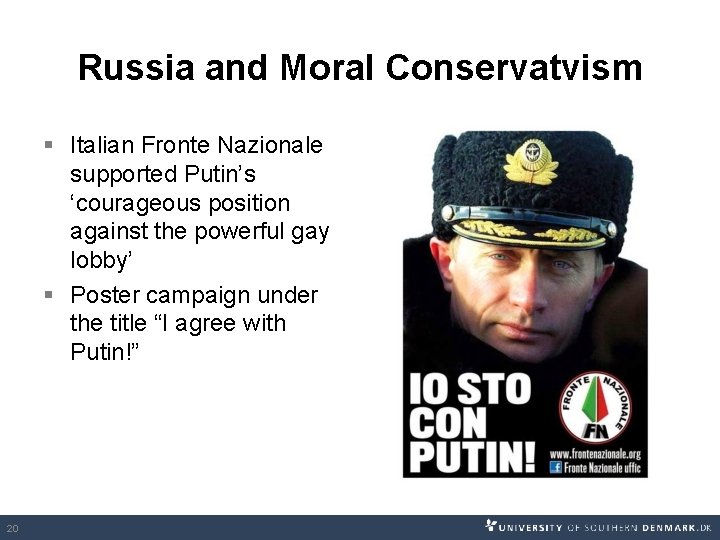
Russia and Moral Conservatvism § Italian Fronte Nazionale supported Putin’s ‘courageous position against the powerful gay lobby’ § Poster campaign under the title “I agree with Putin!” 20
Russia and Strong Leadership § Popularity in China – over 60 titles on Russian leader available, many on best seller lists § “Many Chinese think our country's diplomacy is too weak. So Putin's strong stance against Western countries has made him an idol among Chinese. ” – Zheng Yu, Russian researcher at Chinese Academy of Social Sciences § Chinese netizens cheering Russia’s Syria policy § “Russia is really, truly getting things done” § “Emperor Putin” 21
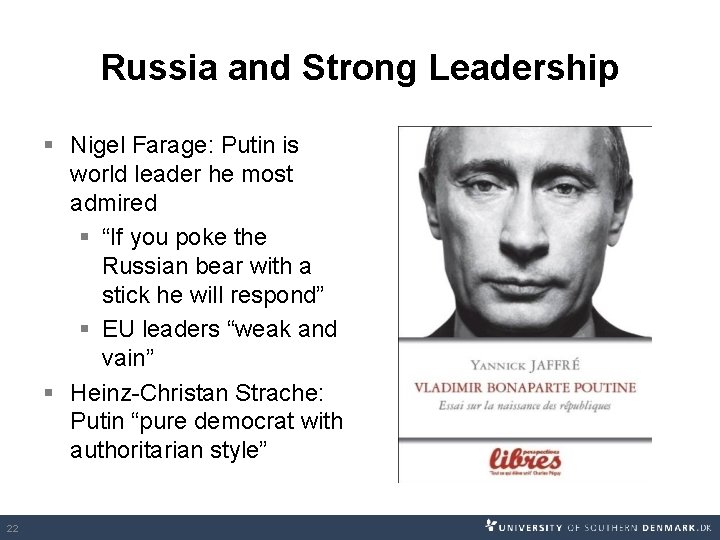
Russia and Strong Leadership § Nigel Farage: Putin is world leader he most admired § “If you poke the Russian bear with a stick he will respond” § EU leaders “weak and vain” § Heinz-Christan Strache: Putin “pure democrat with authoritarian style” 22
Russia and Strong Leadership § December 2016 poll of Republicans § Popularity of Putin – 37% § Popularity of Obama – 17% § Vice President Mike Pence: “I think it’s inarguable that Vladimir Putin has been a stronger leader in his country than Barack Obama has been in this country” § Rudy Guiliani: when Putin “makes a decision and he executes it, quickly. Then everybody reacts. That’s what you call a leader. President Obama, he’s got to think about it” 23
Support for Russian Foreign Policy § Russian soft power grants legitimacy and moral authority to its foreign policy § Crimea § Marine Le Pen: European Union had declared a Cold War on Russia with the sanctions § Position also openly shared by far-right leaders in Germany, Austria, Italy and the Netherlands § Trump: “the people of Crimea, from what I’ve heard, would rather be with Russia than where they were” § Carter Page (Trump foreign policy advisor): referred to the “so-called annexation” of Crimea 24
Support for Russian Foreign Policy § Syria § Marine Le Pen: “It’s a relief for us to see Islamic State retreat, and how Russia has succeeded where the EU has totally failed” § Donald Trump: “If Putin wants to go and knock the hell out of ISIS, I am all for it, 100 per cent, and I can’t understand how anybody would be against it” § Collected Chinese Internet users: Russia is getting things done and “simply trying to fight terrorists” 25
Undervalued Russian Soft Power § Russia has political soft power attractiveness not only in its sphere of influence, but also throughout the West and in China § 2016 survey of 41 representatives European antiestablishment parties on both right and left found all of them to by ‘sympathetic to Vladimir Putin’s Russia’ (Dennison and Paradijs 2016) § Increasing authoritarian populism and fatigue over liberal democracy a potential boon for Russian soft power § Already taken advantage of through foreign funding of political parties § Potentially increases support for Russian foreign policies, particularly in the Ukraine 26
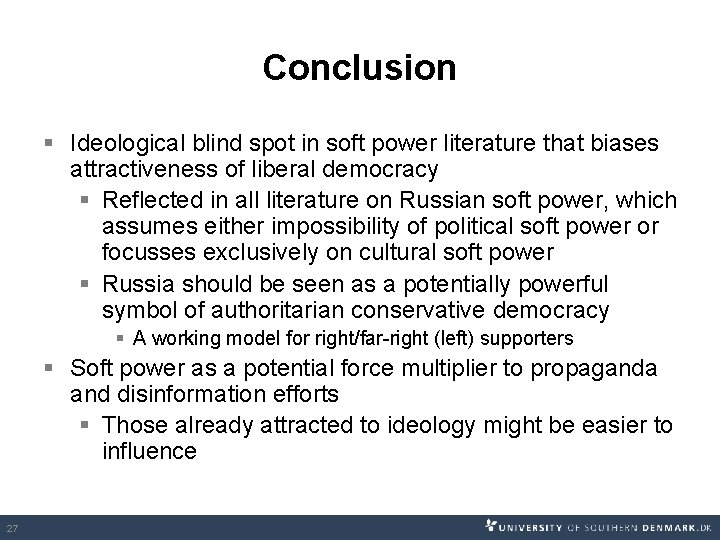
Conclusion § Ideological blind spot in soft power literature that biases attractiveness of liberal democracy § Reflected in all literature on Russian soft power, which assumes either impossibility of political soft power or focusses exclusively on cultural soft power § Russia should be seen as a potentially powerful symbol of authoritarian conservative democracy § A working model for right/far-right (left) supporters § Soft power as a potential force multiplier to propaganda and disinformation efforts § Those already attracted to ideology might be easier to influence 27
Questions? 28