
Russias Rise Growth of Muscovy 1300 1533 Russias

- Slides: 15
Russia’s Rise
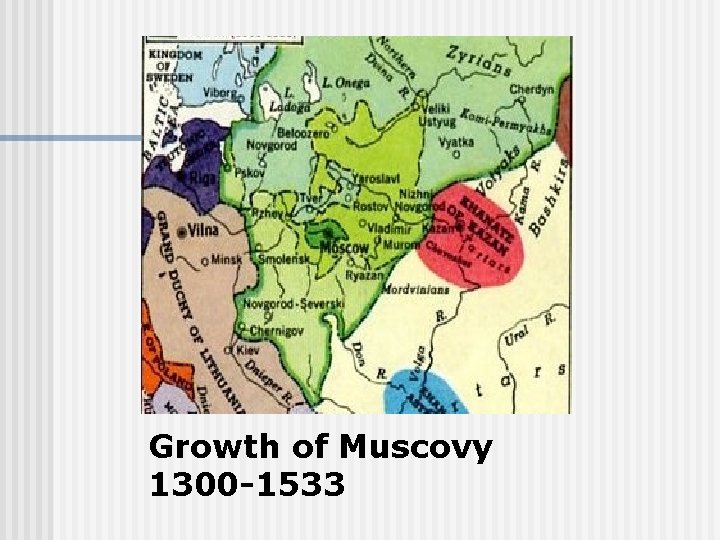
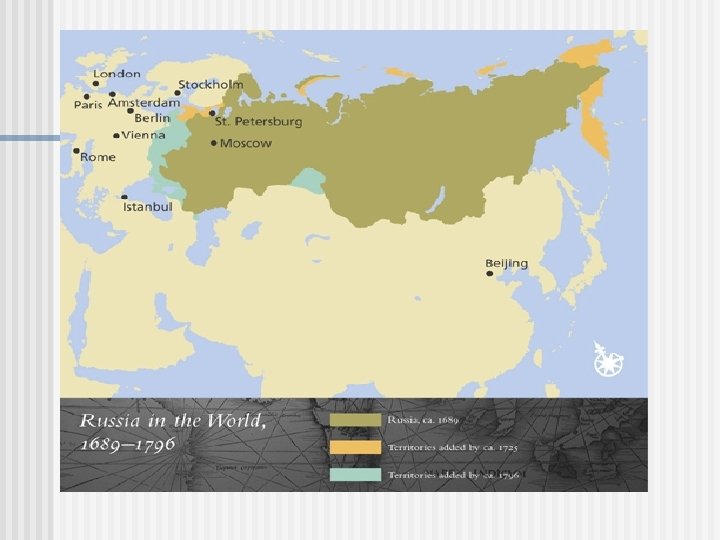
Growth of Muscovy 1300 -1533
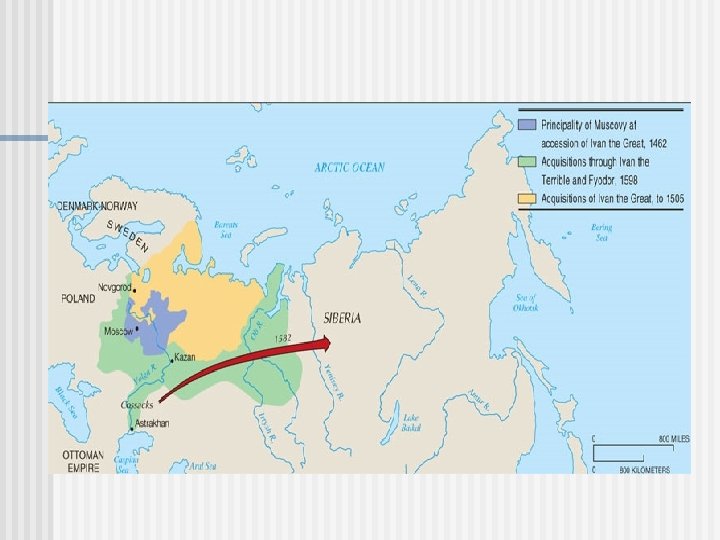
Russia’s Expansionist Politics Under the Tsars n n Ivan III- Ivan the Great- a large part of Russia freed from Mongol control after 1462 and by 1480 Moscow completely free of Mongol control Ivan organized strong army, giving government new military emphasis Ivan III called Russia a third Rome and assumed the title Czar and centralized authority Ivan IV- Ivan the Terrible- killed many boyars he suspected of conspiracy
Expansion and Contacts n n n Early expansion towards Central Asia Recruited Cossacks (peasant adventurers) to settle in new lands Incorporation of large Muslim minority- turning it into a multinational empire similar to Ottomans and Mughals Ivan IV established commercial contacts with Britain and western merchants established outposts in Moscow and other Russian centers Time of troubles- Ivan IV left no heir, so after his death there were power claims by the boyars and attacks from Poland Sweden 1613 member of the Romanov family chosen as tsar and the Romanov dynasty would rule until 1917
Russia’s First Westernization n n n n Peter I continued policies of building tsarist control and expanding territory between 1689 -1725 Great Embassy to westernize Russia Tsarist Autocracy of Peter the Great Crushed revolts No interest in parliamentary features of Holland Great Britain- more interested in absolutist trend Modernized the military Recruited bureaucrats from outside noble ranks Secret police St. Petersburg (Sweden reduced to second-rate military)
What Westernization Meant n n n n Russian navy Eliminated old noble councils Systematized law codes Training institutes Economics- built up the metallurgical and mining industries Culturally – got rid of whip at marriage ceremony, Western dress Imitation process- changes were selectivemostly affected elites Some elite opposed incorporation of the west arguing that Russian traditions were superior- tension still today
Consolidation under Catherine the Great n n n 1724 Peter died and period of weak rule ensued until 1761, when his nephew and wife, Catherine, a German princess came to the throne Catherine the Great ruled after husband’s death and continued earlier policies of expansion and consolidation Pugachev rebellion- peasant uprising that she put down and used as an excuse to extend the powers of the central government in regional affairs
1762 Catherine the Great became empress n n n n She was also a selective westernizer She gave new powers to the nobility over their serfs She patronized western art but closed the door to the French Revolution thinkers Resumed campaigns against the Ottomans and got Crimea, claimed Alaska Increased Russian interference with Polish affairs Partition of Poland- 1772, 1793, 1795 agreements with Austria and Prussia eliminated ind. Poland 1796 Catherine died
Serfdom: The Life of East Europe’s Masses n n n 17 th-18 th centuries power of the nobility over the serfs increased greatly. By 1800 half of population serfs 1649 – serfdom hereditary and close to slavery Agriculture and growing economic subordination to the west (dependent relationships of exporting raw materials and importing manufactured goods) 1785 law allowed landlords to punish harshly any serfs convicted of major crimes or rebellion
Trade and Economic Dependence 95% population rural and really only 2 classes: serfs and landlords n But it did produce enough revenue to support expansion and population growth n Agricultural and manufacturing methods behind n
Social Unrest By end of 18 th century recurring peasant rebellions and small number of western-oriented aristocrats calling for abolition of serfdom n Pugachev rebellion -1770 s by Emelian Pugachev (imprisoned and executed by Catherine) n
Russia and Eastern Europe n n Fluctuating borderland of influence, where Poland Bohemia (Czech rep. ) oriented towards west and Hungary part of Hapsburgs Poland- 1500 largest state in eastern Europe besides Russia ( Poland formed in 1386) By 1600 in decline. Lack of urban centers and merchant class, aristocratic parliament vetoed reforms