
Russian Revolution Soldiers sympathetic to the Bolshevik cause
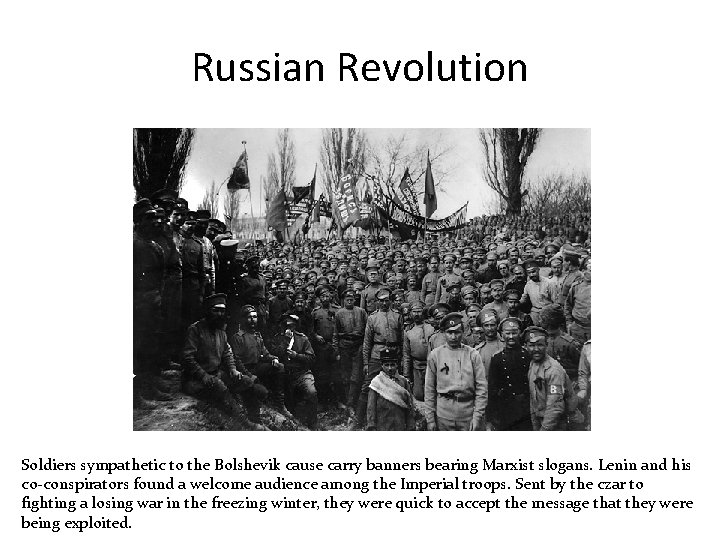
Russian Revolution Soldiers sympathetic to the Bolshevik cause carry banners bearing Marxist slogans. Lenin and his co-conspirators found a welcome audience among the Imperial troops. Sent by the czar to fighting a losing war in the freezing winter, they were quick to accept the message that they were being exploited.
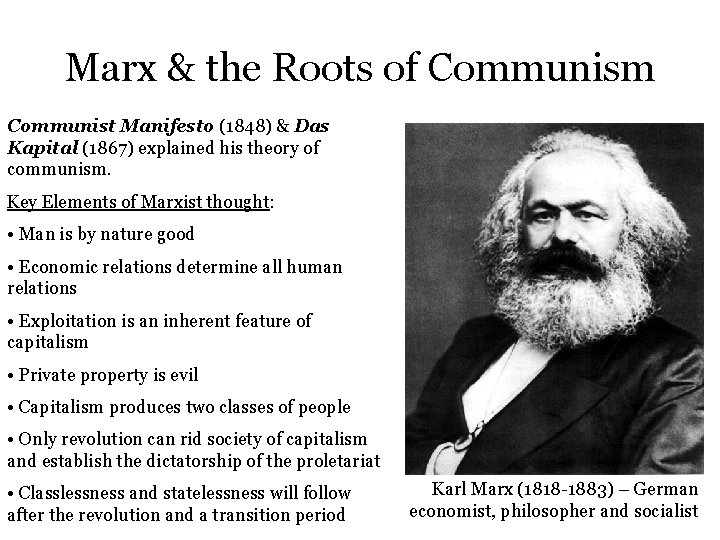
Marx & the Roots of Communism Communist Manifesto (1848) & Das Kapital (1867) explained his theory of communism. Key Elements of Marxist thought: • Man is by nature good • Economic relations determine all human relations • Exploitation is an inherent feature of capitalism • Private property is evil • Capitalism produces two classes of people • Only revolution can rid society of capitalism and establish the dictatorship of the proletariat • Classlessness and statelessness will follow after the revolution and a transition period Karl Marx (1818 -1883) – German economist, philosopher and socialist
Socialism vs. Communism Marxist theories pertaining to industry…. • raw materials; factory & machinery; factory manager & owner (bourgeosie); and the workman (proletariat); of all these elements, Marx said, the workman was most important. • Capitalists stole the value of the product from the worker for his own profit • Marx’s solution: Workers should take over all elements of production Socialism vs. Communism Socialism believes there are legal and constitutional approaches to take over industry; but, industrialists control the legal and political avenues of change. Communism states that only through violent revolution of the common man can he take over the means of production from the capitalists. Private property is an evil (according to Marx)
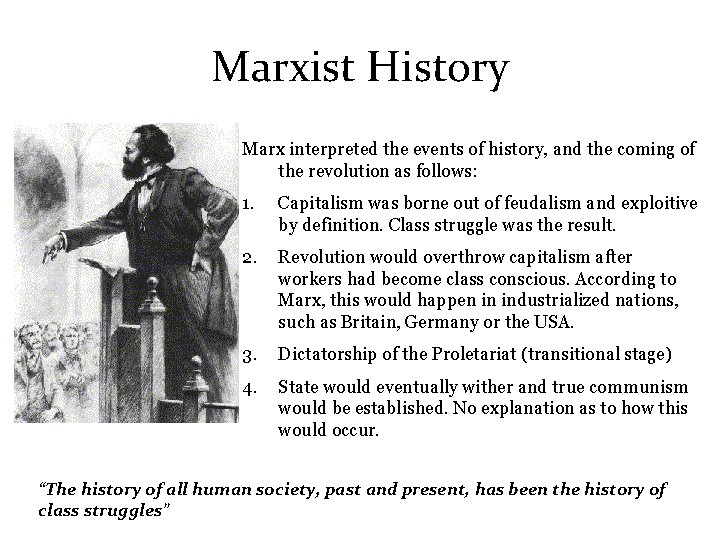
Marxist History Marx interpreted the events of history, and the coming of the revolution as follows: 1. Capitalism was borne out of feudalism and exploitive by definition. Class struggle was the result. 2. Revolution would overthrow capitalism after workers had become class conscious. According to Marx, this would happen in industrialized nations, such as Britain, Germany or the USA. 3. Dictatorship of the Proletariat (transitional stage) 4. State would eventually wither and true communism would be established. No explanation as to how this would occur. “The history of all human society, past and present, has been the history of class struggles”
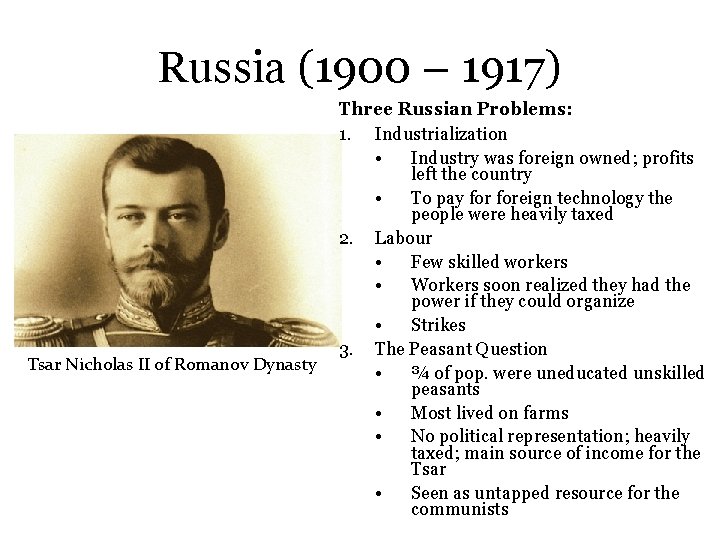
Russia (1900 – 1917) Tsar Nicholas II of Romanov Dynasty Three Russian Problems: 1. Industrialization • Industry was foreign owned; profits left the country • To pay foreign technology the people were heavily taxed 2. Labour • Few skilled workers • Workers soon realized they had the power if they could organize • Strikes 3. The Peasant Question • ¾ of pop. were uneducated unskilled peasants • Most lived on farms • No political representation; heavily taxed; main source of income for the Tsar • Seen as untapped resource for the communists
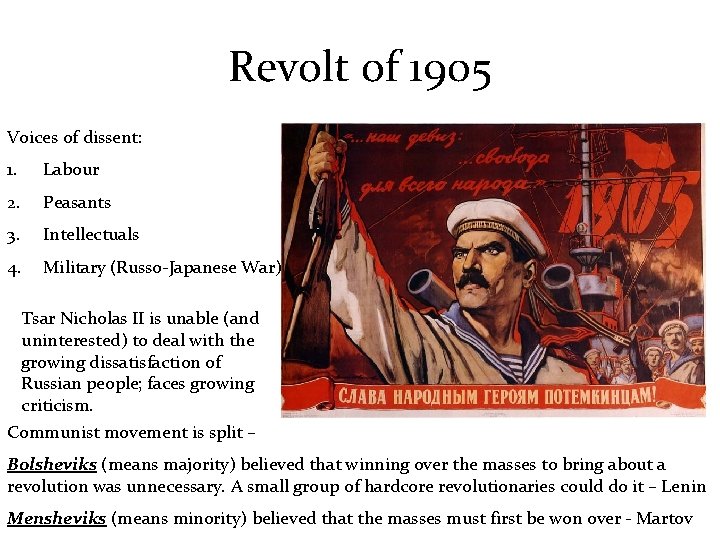
Revolt of 1905 Voices of dissent: 1. Labour 2. Peasants 3. Intellectuals 4. Military (Russo-Japanese War) Tsar Nicholas II is unable (and uninterested) to deal with the growing dissatisfaction of Russian people; faces growing criticism. Communist movement is split – Bolsheviks (means majority) believed that winning over the masses to bring about a revolution was unnecessary. A small group of hardcore revolutionaries could do it – Lenin Mensheviks (means minority) believed that the masses must first be won over - Martov
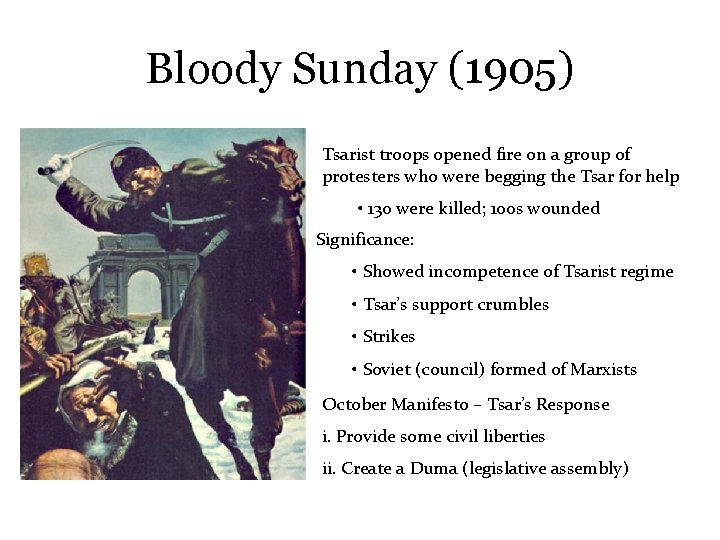
Bloody Sunday (1905) Tsarist troops opened fire on a group of protesters who were begging the Tsar for help • 130 were killed; 100 s wounded Significance: • Showed incompetence of Tsarist regime • Tsar’s support crumbles • Strikes • Soviet (council) formed of Marxists October Manifesto – Tsar’s Response i. Provide some civil liberties ii. Create a Duma (legislative assembly)
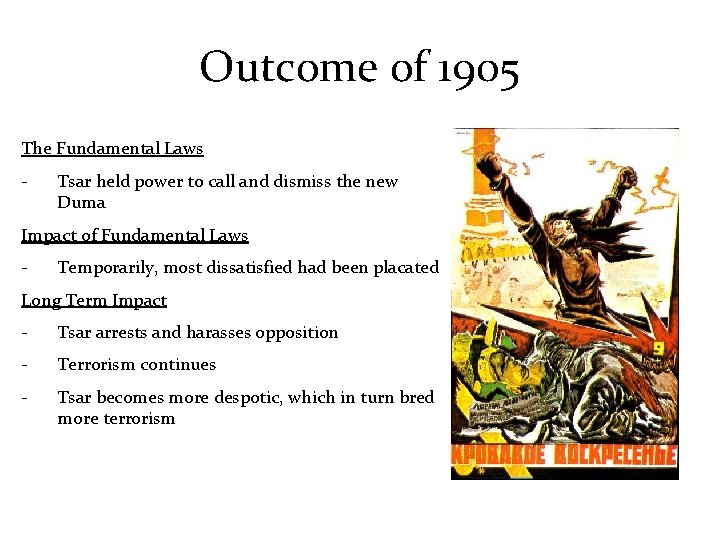
Outcome of 1905 The Fundamental Laws - Tsar held power to call and dismiss the new Duma Impact of Fundamental Laws - Temporarily, most dissatisfied had been placated Long Term Impact - Tsar arrests and harasses opposition - Terrorism continues - Tsar becomes more despotic, which in turn bred more terrorism
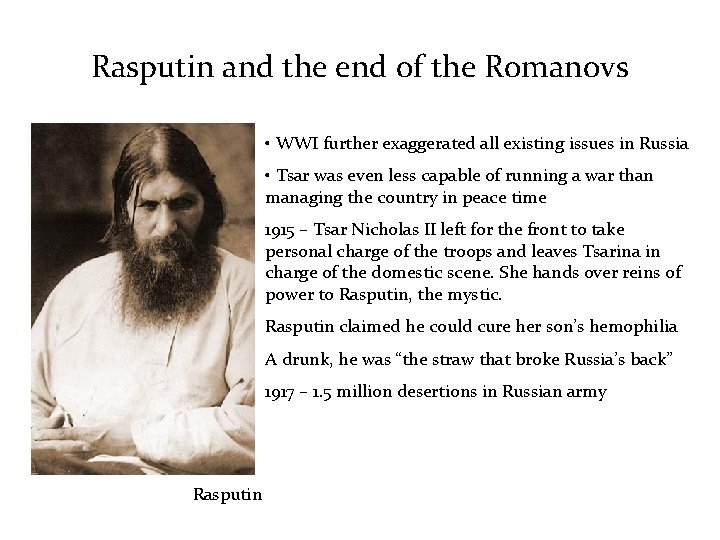
Rasputin and the end of the Romanovs • WWI further exaggerated all existing issues in Russia • Tsar was even less capable of running a war than managing the country in peace time 1915 – Tsar Nicholas II left for the front to take personal charge of the troops and leaves Tsarina in charge of the domestic scene. She hands over reins of power to Rasputin, the mystic. Rasputin claimed he could cure her son’s hemophilia A drunk, he was “the straw that broke Russia’s back” 1917 – 1. 5 million desertions in Russian army Rasputin
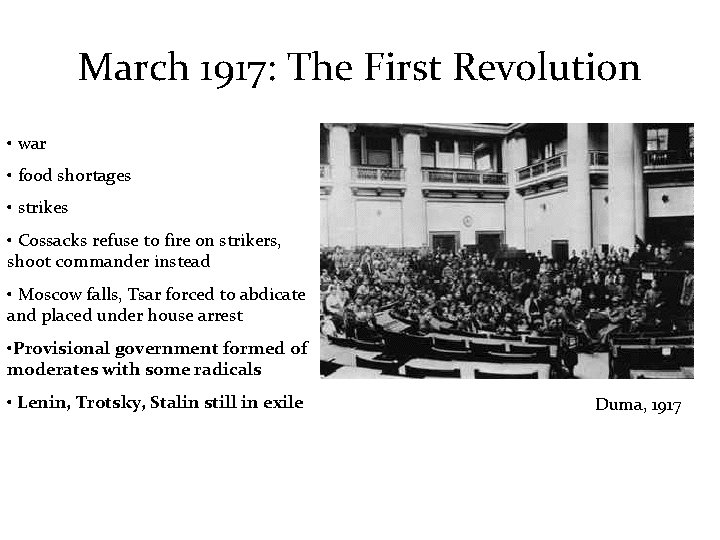
March 1917: The First Revolution • war • food shortages • strikes • Cossacks refuse to fire on strikers, shoot commander instead • Moscow falls, Tsar forced to abdicate and placed under house arrest • Provisional government formed of moderates with some radicals • Lenin, Trotsky, Stalin still in exile Duma, 1917
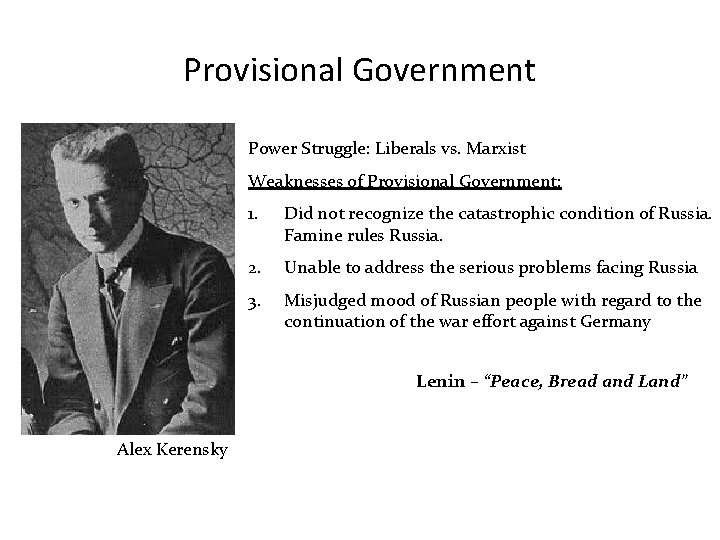
Provisional Government Power Struggle: Liberals vs. Marxist Weaknesses of Provisional Government: 1. Did not recognize the catastrophic condition of Russia. Famine rules Russia. 2. Unable to address the serious problems facing Russia 3. Misjudged mood of Russian people with regard to the continuation of the war effort against Germany Lenin – “Peace, Bread and Land” Alex Kerensky
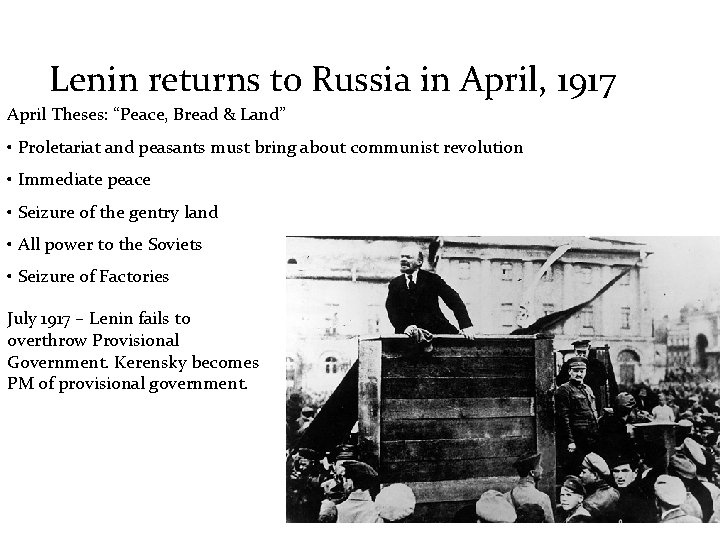
Lenin returns to Russia in April, 1917 April Theses: “Peace, Bread & Land” • Proletariat and peasants must bring about communist revolution • Immediate peace • Seizure of the gentry land • All power to the Soviets • Seizure of Factories July 1917 – Lenin fails to overthrow Provisional Government. Kerensky becomes PM of provisional government.
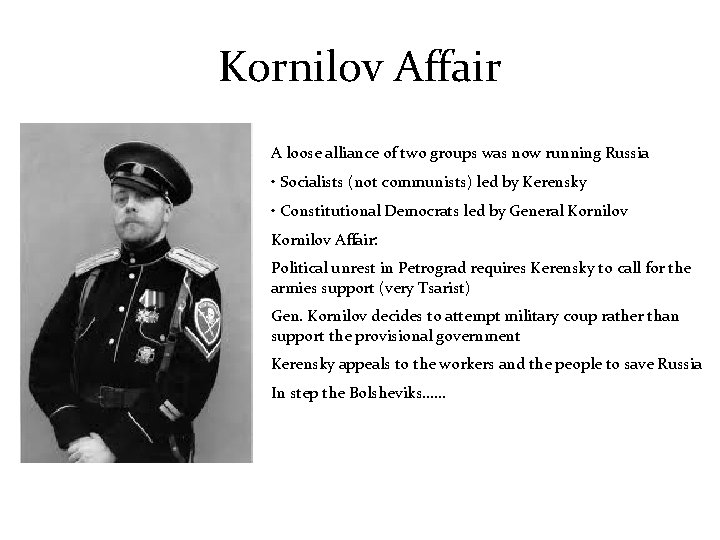
Kornilov Affair A loose alliance of two groups was now running Russia • Socialists (not communists) led by Kerensky • Constitutional Democrats led by General Kornilov Affair: Political unrest in Petrograd requires Kerensky to call for the armies support (very Tsarist) Gen. Kornilov decides to attempt military coup rather than support the provisional government Kerensky appeals to the workers and the people to save Russia In step the Bolsheviks……
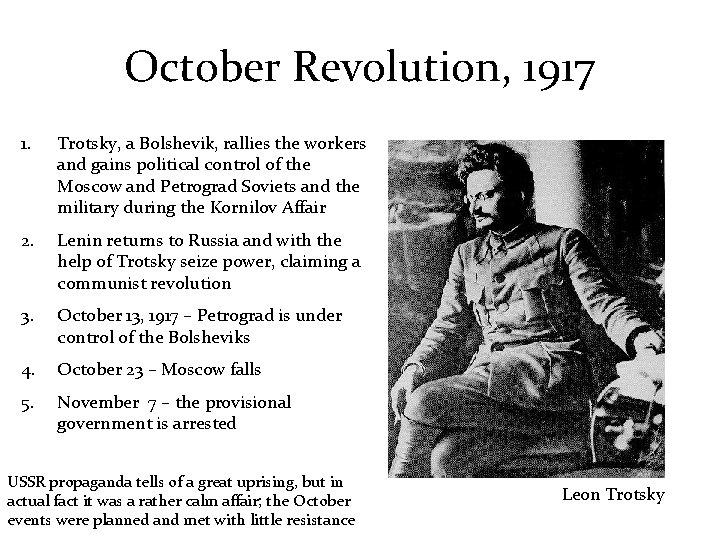
October Revolution, 1917 1. Trotsky, a Bolshevik, rallies the workers and gains political control of the Moscow and Petrograd Soviets and the military during the Kornilov Affair 2. Lenin returns to Russia and with the help of Trotsky seize power, claiming a communist revolution 3. October 13, 1917 – Petrograd is under control of the Bolsheviks 4. October 23 – Moscow falls 5. November 7 – the provisional government is arrested USSR propaganda tells of a great uprising, but in actual fact it was a rather calm affair; the October events were planned and met with little resistance Leon Trotsky
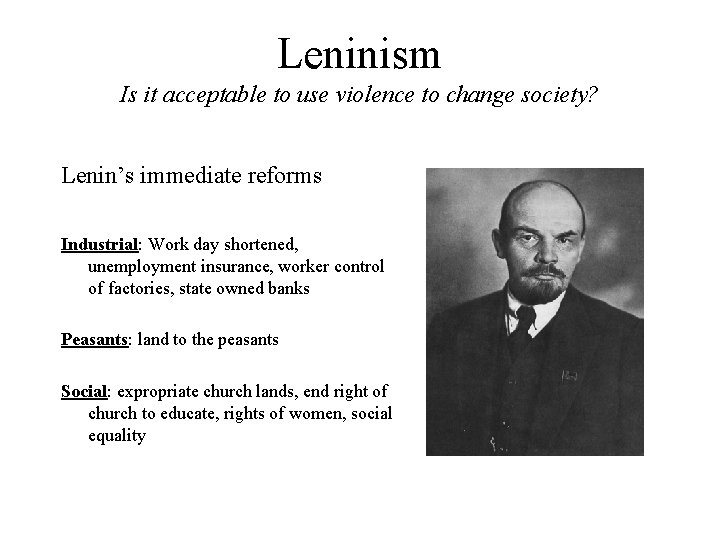
Leninism Is it acceptable to use violence to change society? Lenin’s immediate reforms Industrial: Work day shortened, unemployment insurance, worker control of factories, state owned banks Peasants: land to the peasants Social: expropriate church lands, end right of church to educate, rights of women, social equality
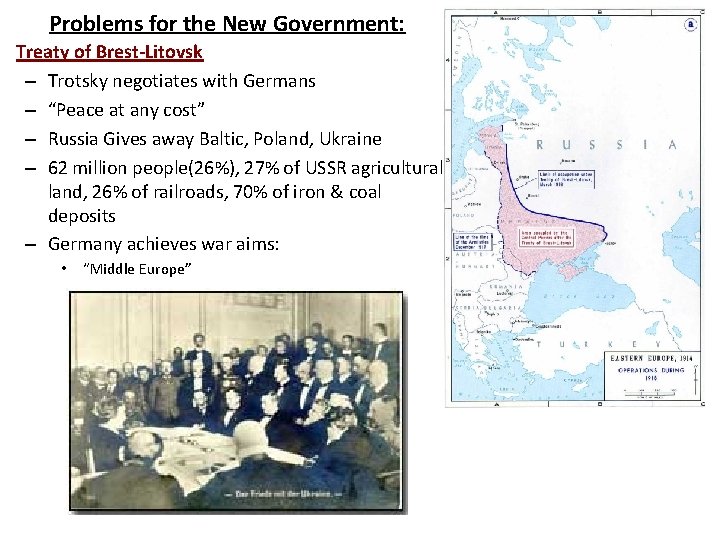
Problems for the New Government: Treaty of Brest-Litovsk – Trotsky negotiates with Germans – “Peace at any cost” – Russia Gives away Baltic, Poland, Ukraine – 62 million people(26%), 27% of USSR agricultural land, 26% of railroads, 70% of iron & coal deposits – Germany achieves war aims: • “Middle Europe”
Communism Steps taken to introduce communism: 1. 2. 3. 4. 5. 6. Bolsheviks allowed the peasants to seize land Factories come under the control of workers’ committees All banks are nationalized Private accounts were confiscated Foreign trade became a state monopoly All opposition groups were made illegal. • Including the Mensheviks
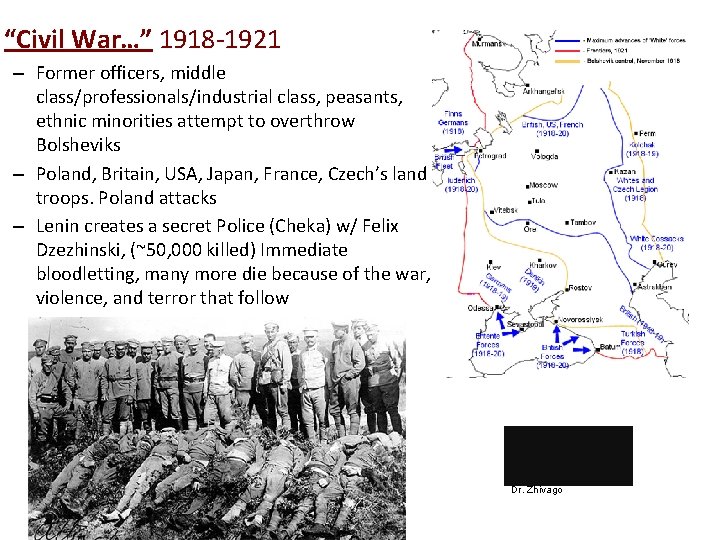
“Civil War…” 1918 -1921 – Former officers, middle class/professionals/industrial class, peasants, ethnic minorities attempt to overthrow Bolsheviks – Poland, Britain, USA, Japan, France, Czech’s land troops. Poland attacks – Lenin creates a secret Police (Cheka) w/ Felix Dzezhinski, (~50, 000 killed) Immediate bloodletting, many more die because of the war, violence, and terror that follow Dr. Zhivago
War Communism: Economic Policy • • • Radicalism establishing communism and fight civil war Organize agriculture under Bolshevik control Expropriate surplus for war Social equality (Housing, status of women, comrade) Nationalize all industry - end worker control Centralization of all aspects of Russian life 1918: Assassination attempt on Lenin Tsar: The Tsar and family are executed - including Anastasia? Famine: The turmoil that accompanies the civil war and land question leads to a famine in much of the Soviet Union
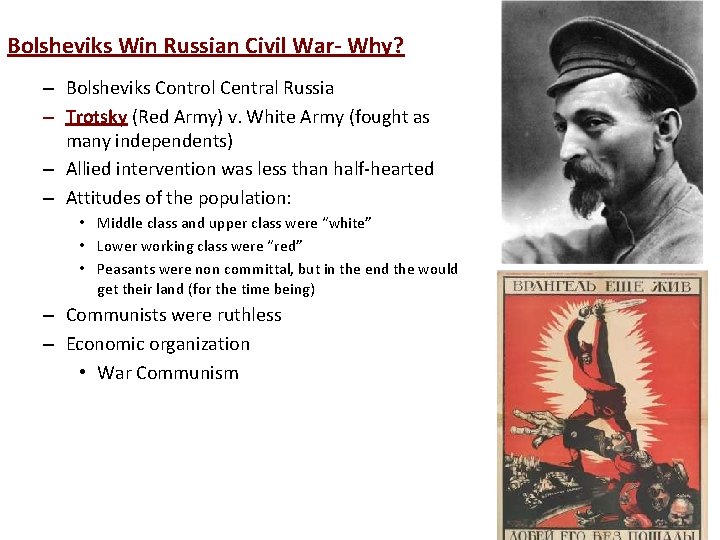
Bolsheviks Win Russian Civil War- Why? – Bolsheviks Control Central Russia – Trotsky (Red Army) v. White Army (fought as many independents) – Allied intervention was less than half-hearted – Attitudes of the population: • Middle class and upper class were “white” • Lower working class were “red” • Peasants were non committal, but in the end the would get their land (for the time being) – Communists were ruthless – Economic organization • War Communism
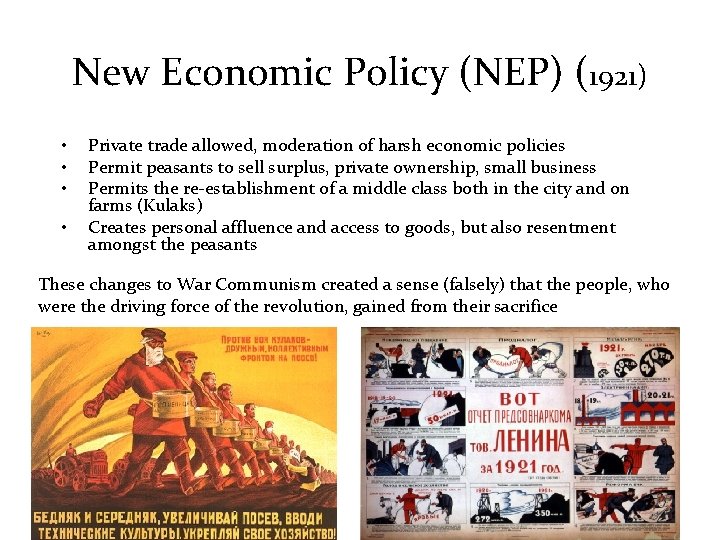
New Economic Policy (NEP) (1921) • • Private trade allowed, moderation of harsh economic policies Permit peasants to sell surplus, private ownership, small business Permits the re-establishment of a middle class both in the city and on farms (Kulaks) Creates personal affluence and access to goods, but also resentment amongst the peasants These changes to War Communism created a sense (falsely) that the people, who were the driving force of the revolution, gained from their sacrifice
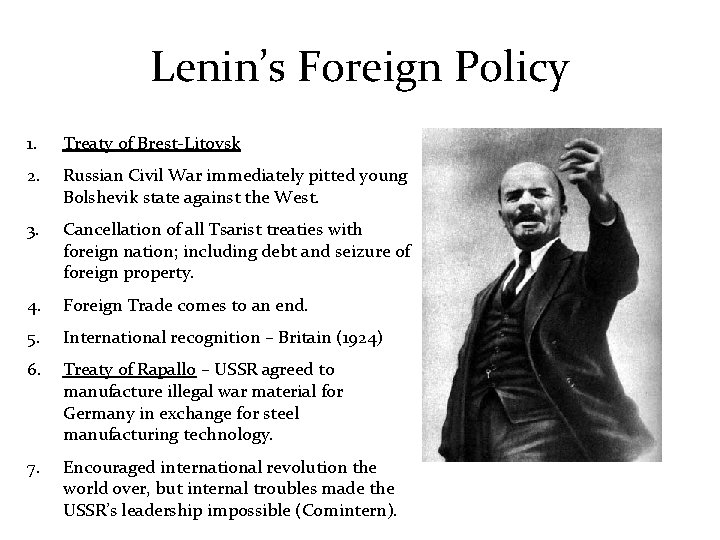
Lenin’s Foreign Policy 1. Treaty of Brest-Litovsk 2. Russian Civil War immediately pitted young Bolshevik state against the West. 3. Cancellation of all Tsarist treaties with foreign nation; including debt and seizure of foreign property. 4. Foreign Trade comes to an end. 5. International recognition – Britain (1924) 6. Treaty of Rapallo – USSR agreed to manufacture illegal war material for Germany in exchange for steel manufacturing technology. 7. Encouraged international revolution the world over, but internal troubles made the USSR’s leadership impossible (Comintern).
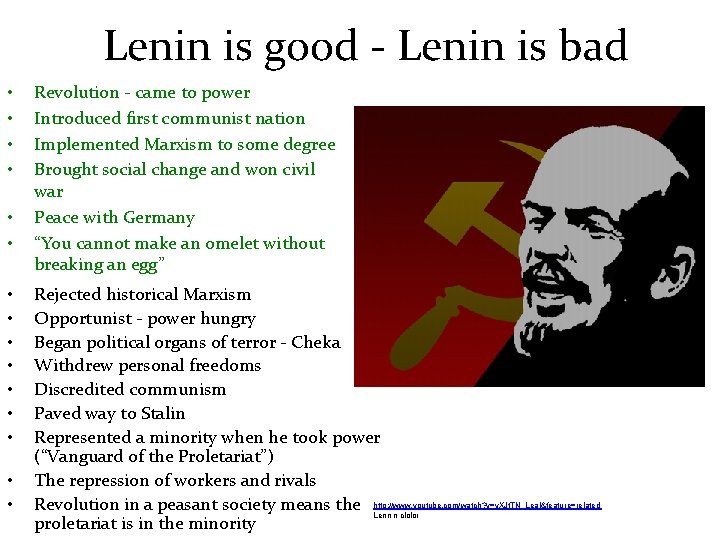
Lenin is good - Lenin is bad • • • • Revolution - came to power Introduced first communist nation Implemented Marxism to some degree Brought social change and won civil war Peace with Germany “You cannot make an omelet without breaking an egg” Rejected historical Marxism Opportunist - power hungry Began political organs of terror - Cheka Withdrew personal freedoms Discredited communism Paved way to Stalin Represented a minority when he took power (“Vanguard of the Proletariat”) The repression of workers and rivals Revolution in a peasant society means the http: //www. youtube. com/watch? v=y. XJf. TN_Lea. I&feature=related Lenn n clolor proletariat is in the minority
Is Lenin a Marxist? • The removal of private property • Social and economic reform • Violent overthrow of the Bourgeoise • Represented a minority when he took power (“Vanguard of the Proletariat”) • The repression of workers and rivals • Revolution in a peasant society means the proletariat is in the minority
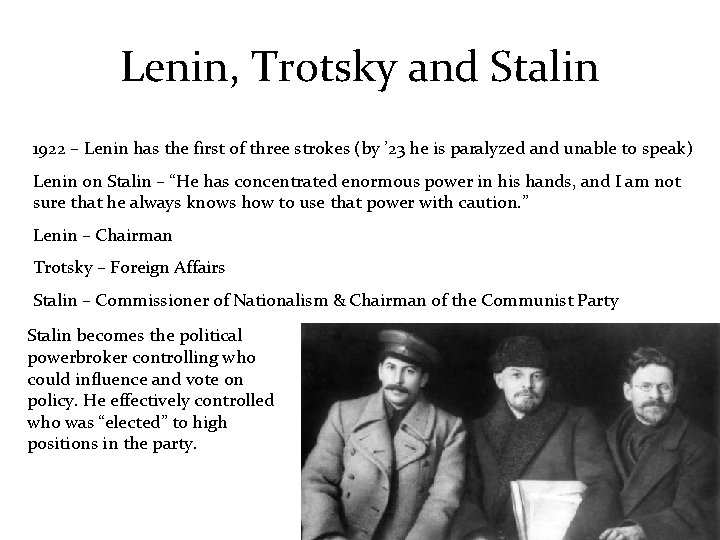
Lenin, Trotsky and Stalin 1922 – Lenin has the first of three strokes (by ’ 23 he is paralyzed and unable to speak) Lenin on Stalin – “He has concentrated enormous power in his hands, and I am not sure that he always knows how to use that power with caution. ” Lenin – Chairman Trotsky – Foreign Affairs Stalin – Commissioner of Nationalism & Chairman of the Communist Party Stalin becomes the political powerbroker controlling who could influence and vote on policy. He effectively controlled who was “elected” to high positions in the party.
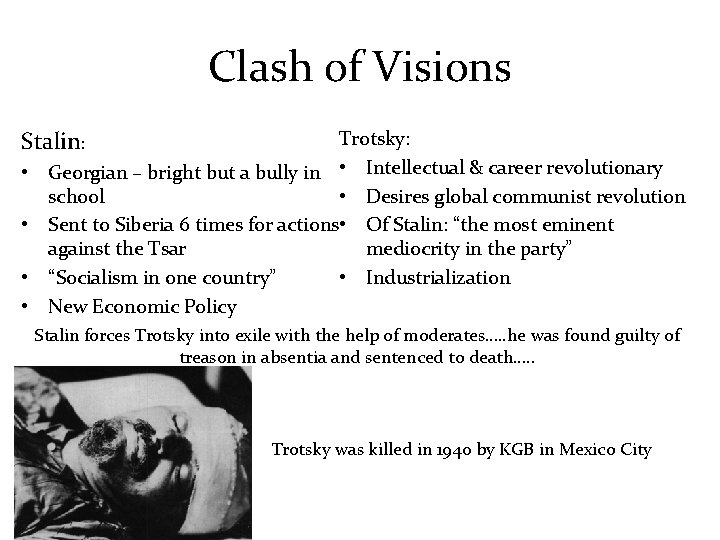
Clash of Visions Stalin: • • Trotsky: Georgian – bright but a bully in • Intellectual & career revolutionary school • Desires global communist revolution Sent to Siberia 6 times for actions • Of Stalin: “the most eminent against the Tsar mediocrity in the party” “Socialism in one country” • Industrialization New Economic Policy Stalin forces Trotsky into exile with the help of moderates…. . he was found guilty of treason in absentia and sentenced to death…. . Trotsky was killed in 1940 by KGB in Mexico City
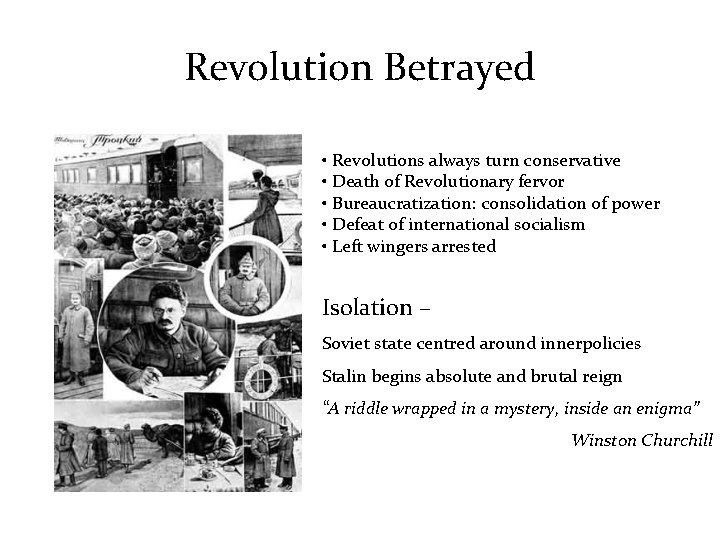
Revolution Betrayed • Revolutions always turn conservative • Death of Revolutionary fervor • Bureaucratization: consolidation of power • Defeat of international socialism • Left wingers arrested Isolation – Soviet state centred around innerpolicies Stalin begins absolute and brutal reign “A riddle wrapped in a mystery, inside an enigma” Winston Churchill
Lenin • Was Lenin a success or a failure? • Did Lenin betray communism or help to realize it? • Who did Lenin choose as his successor; why?
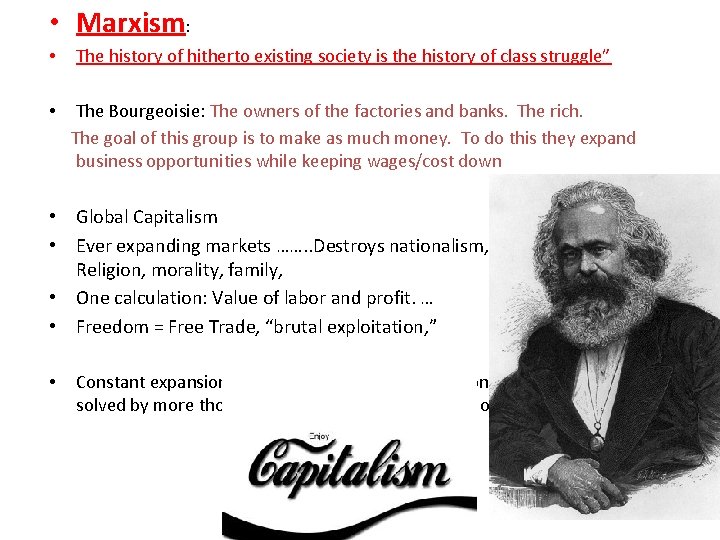
• Marxism: • The history of hitherto existing society is the history of class struggle” • The Bourgeoisie: The owners of the factories and banks. The rich. The goal of this group is to make as much money. To do this they expand business opportunities while keeping wages/cost down • Global Capitalism • Ever expanding markets ……. . Destroys nationalism, political power, Religion, morality, family, • One calculation: Value of labor and profit. … • Freedom = Free Trade, “brutal exploitation, ” • Constant expansion until the Crisis of Overproduction, which can only be solved by more thorough exploitation and conquest of new markets
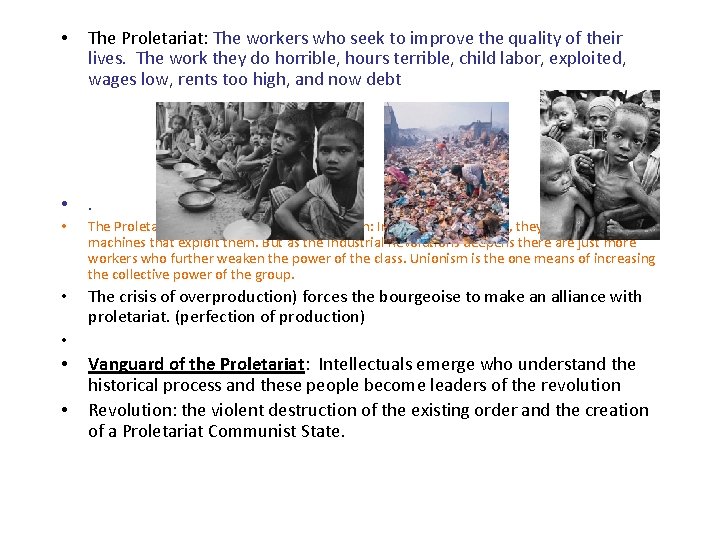
• The Proletariat: The workers who seek to improve the quality of their lives. The work they do horrible, hours terrible, child labor, exploited, wages low, rents too high, and now debt • The Proletariat seek to improve their situation: Individually, as trades, they destroy the machines that exploit them. But as the Industrial Revolutions deepens there are just more workers who further weaken the power of the class. Unionism is the one means of increasing the collective power of the group. • The crisis of overproduction) forces the bourgeoise to make an alliance with proletariat. (perfection of production) • • • Vanguard of the Proletariat: Intellectuals emerge who understand the historical process and these people become leaders of the revolution Revolution: the violent destruction of the existing order and the creation of a Proletariat Communist State.
Communists: Abolition of Private Property: Collective and common ownership of the means of production. “Dictatorship of the Proletariat: ” First time in history that the will of the majority will be the state. Hence the workers will have supreme control. Communist Party will have no interests that appose the welfare of the workers • • The Communists do not form a separate party opposed to the other working-class parties. They have no interests separate and apart from those of the proletariat as a whole. They do not set up any sectarian principles of their own, by which to shape and mould the proletarian movement. Communism is not nationalist (workers define humanity not ethnicity) Communism views “Religion as the opium of the masses” Communist state can be created in an Industrialized state, only. Industrialization creates the means to produce an excess of wealth and products, enough to distribute.
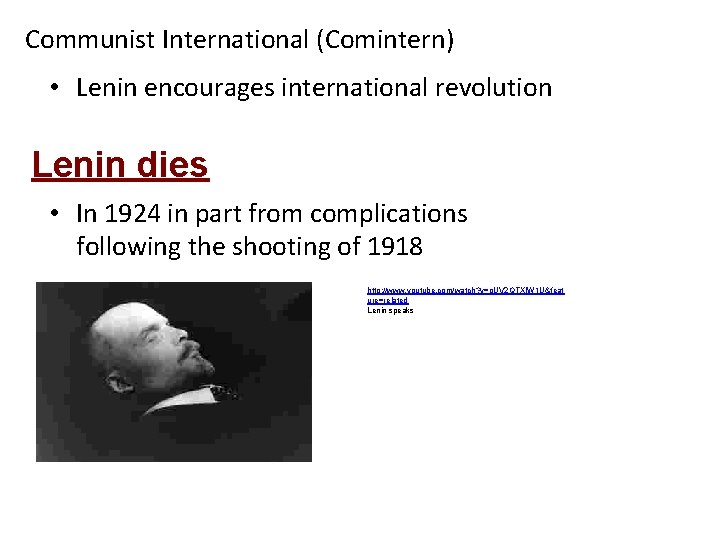
Communist International (Comintern) • Lenin encourages international revolution Lenin dies • In 1924 in part from complications following the shooting of 1918 http: //www. youtube. com/watch? v=o. UV 2 QTXIW 1 U&feat ure=related Lenin speaks
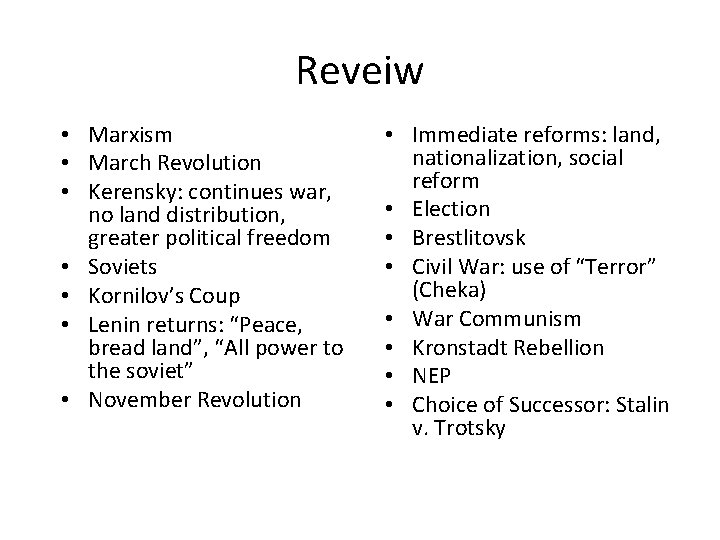
Reveiw • Marxism • March Revolution • Kerensky: continues war, no land distribution, greater political freedom • Soviets • Kornilov’s Coup • Lenin returns: “Peace, bread land”, “All power to the soviet” • November Revolution • Immediate reforms: land, nationalization, social reform • Election • Brestlitovsk • Civil War: use of “Terror” (Cheka) • War Communism • Kronstadt Rebellion • NEP • Choice of Successor: Stalin v. Trotsky
- Slides: 33