
Russian Revolution 1917 Causes Major Events Effects CAUSES
- Slides: 19
Russian Revolution, 1917 Causes, Major Events, Effects
CAUSES Long-term and short-term
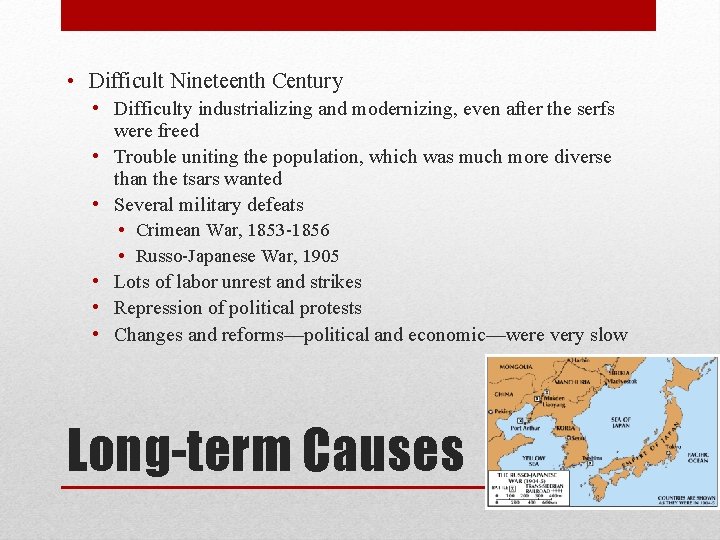
• Difficult Nineteenth Century • Difficulty industrializing and modernizing, even after the serfs were freed • Trouble uniting the population, which was much more diverse than the tsars wanted • Several military defeats • Crimean War, 1853 -1856 • Russo-Japanese War, 1905 • Lots of labor unrest and strikes • Repression of political protests • Changes and reforms—political and economic—were very slow Long-term Causes
• Assassination of Alexander II in 1881 • Led to the repressive rule of Nicholas II • Revolution of 1905 • Workers gathered at the tsar’s Winter Palace and protested the lack of freedoms AND asked for a legislature • Soldiers killed 130 of the protestors • People all over the empire were angry, and it started labor, student, and peasant protests AND instability in the military • Even though Nicholas II started the parliament (the Duma), he cracked down on all protests • Nicholas could veto any decision of the Duma Long-term causes continued
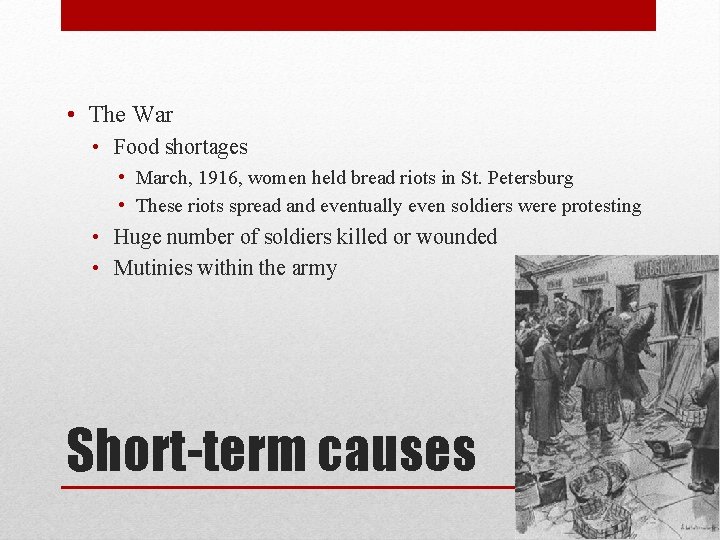
• The War • Food shortages • March, 1916, women held bread riots in St. Petersburg • These riots spread and eventually even soldiers were protesting • Huge number of soldiers killed or wounded • Mutinies within the army Short-term causes
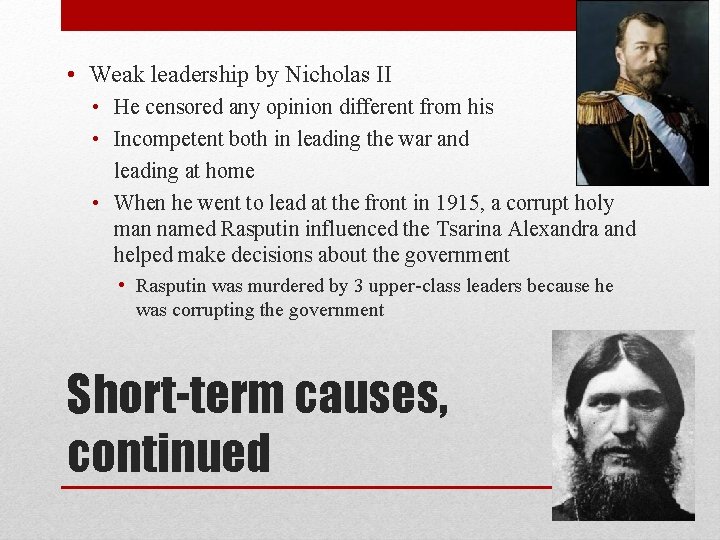
• Weak leadership by Nicholas II • He censored any opinion different from his • Incompetent both in leading the war and leading at home • When he went to lead at the front in 1915, a corrupt holy man named Rasputin influenced the Tsarina Alexandra and helped make decisions about the government • Rasputin was murdered by 3 upper-class leaders because he was corrupting the government Short-term causes, continued
MAJOR EVENTS OF THE REVOLUTION
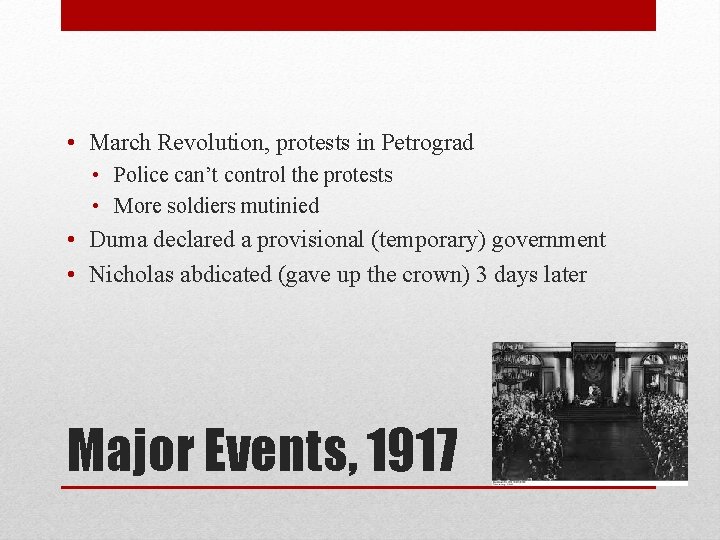
• March Revolution, protests in Petrograd • Police can’t control the protests • More soldiers mutinied • Duma declared a provisional (temporary) government • Nicholas abdicated (gave up the crown) 3 days later Major Events, 1917
• Provisional government takes over and shares power with the Petrograd Soviet of Workers’ and Soldiers’ Deputies • soviet=local council of workers • Tension between the Provisional Government and the Petrograd Soviet from March to November • Why? • The Soviet wanted to end the war and the government didn’t • The Soviet wanted land reform (giving more land to peasants) the government did not think it had the authority to do so Major Events, 1917
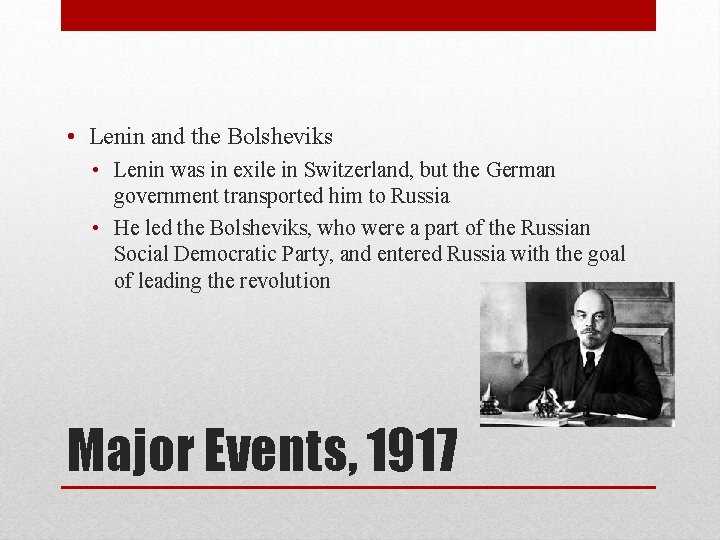
• Lenin and the Bolsheviks • Lenin was in exile in Switzerland, but the German government transported him to Russia • He led the Bolsheviks, who were a part of the Russian Social Democratic Party, and entered Russia with the goal of leading the revolution Major Events, 1917
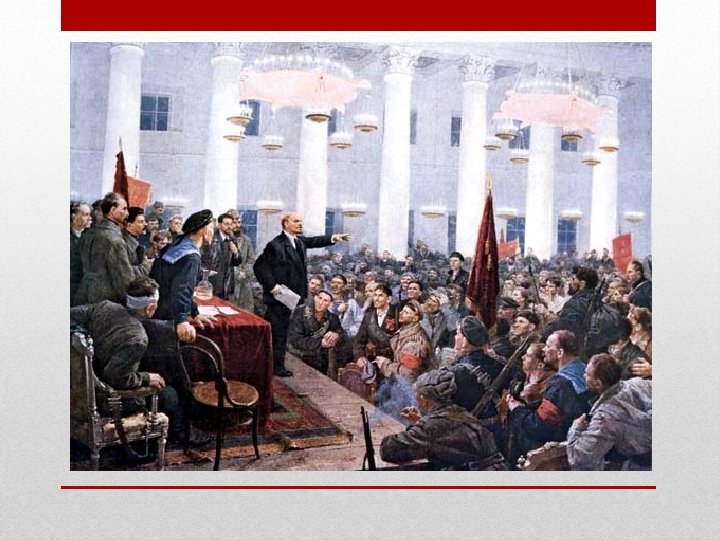
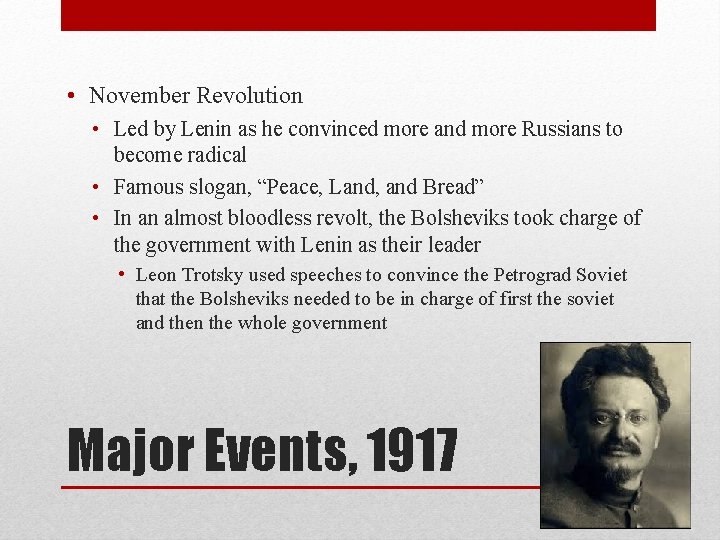
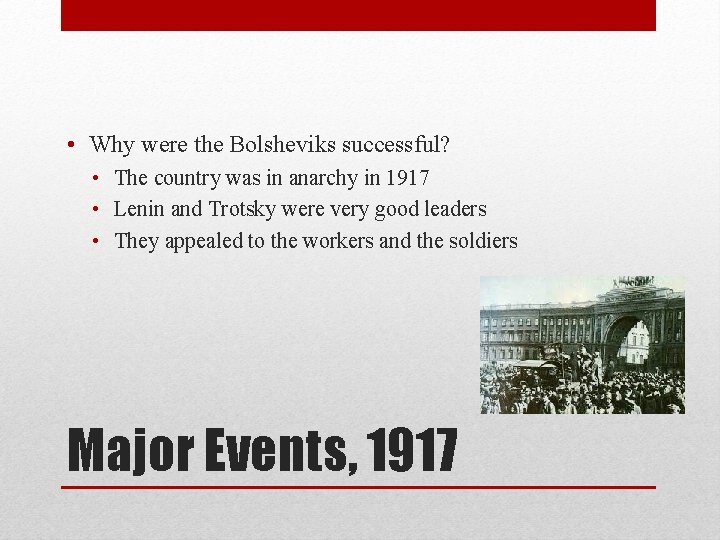
• November Revolution • Led by Lenin as he convinced more and more Russians to become radical • Famous slogan, “Peace, Land, and Bread” • In an almost bloodless revolt, the Bolsheviks took charge of the government with Lenin as their leader • Leon Trotsky used speeches to convince the Petrograd Soviet that the Bolsheviks needed to be in charge of first the soviet and then the whole government Major Events, 1917
• Why were the Bolsheviks successful? • The country was in anarchy in 1917 • Lenin and Trotsky were very good leaders • They appealed to the workers and the soldiers Major Events, 1917
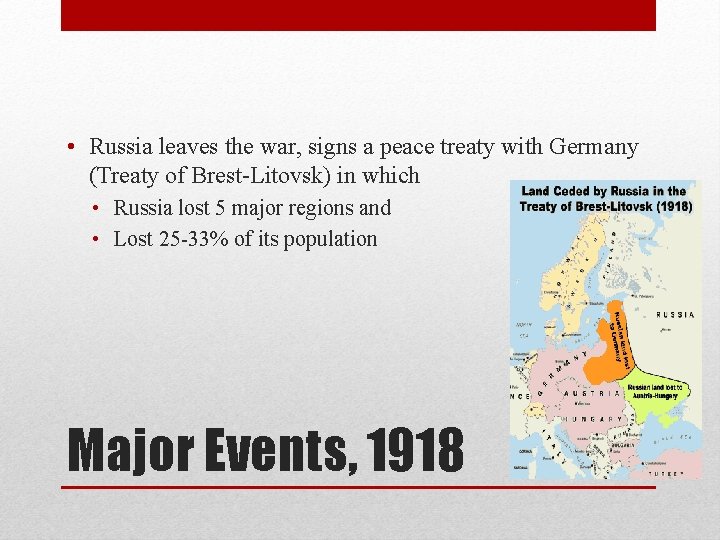
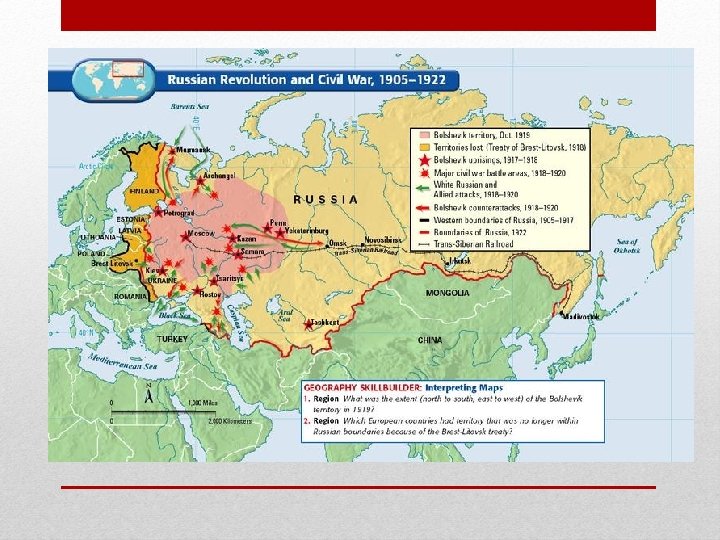
• Russia leaves the war, signs a peace treaty with Germany (Treaty of Brest-Litovsk) in which • Russia lost 5 major regions and • Lost 25 -33% of its population Major Events, 1918
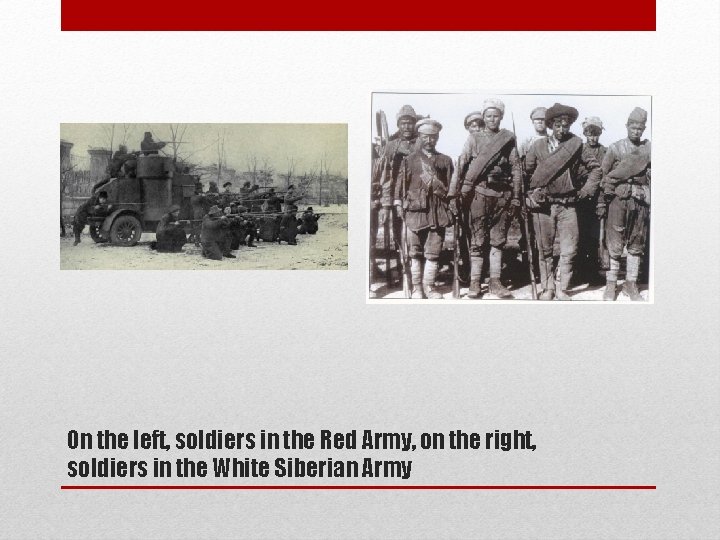
• Response to Lenin’s Takeover • Civil War, 1918 -1920 • Red Terror—the killing of the Whites (anticommunists) by the Bolsheviks after false trials • Secret Police (the Cheka)—killed 200, 000 enemies of the Bolsheviks • Executed the Romanov family in July, 1918 • Red Army won in 1920, despite the help that the Whites were getting from foreign countries • Effects: Lenin and the Bolsheviks in charge, approximately 10 million killed, and a culture of oppression firmly in place Major Events, 1918
On the left, soldiers in the Red Army, on the right, soldiers in the White Siberian Army
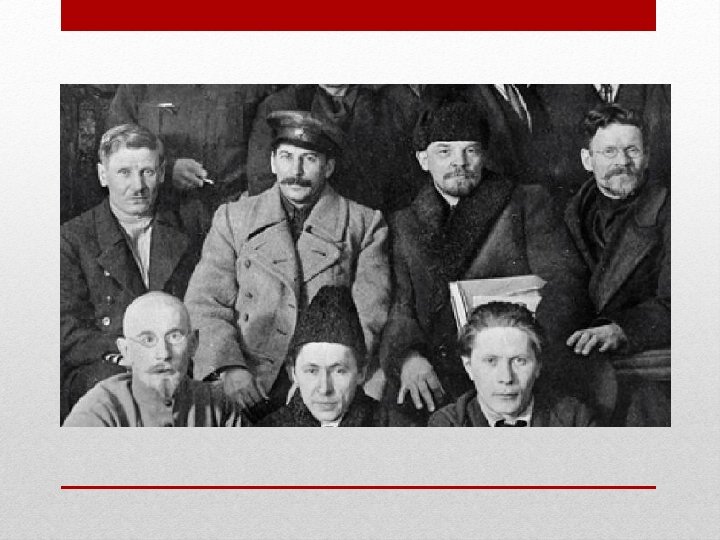
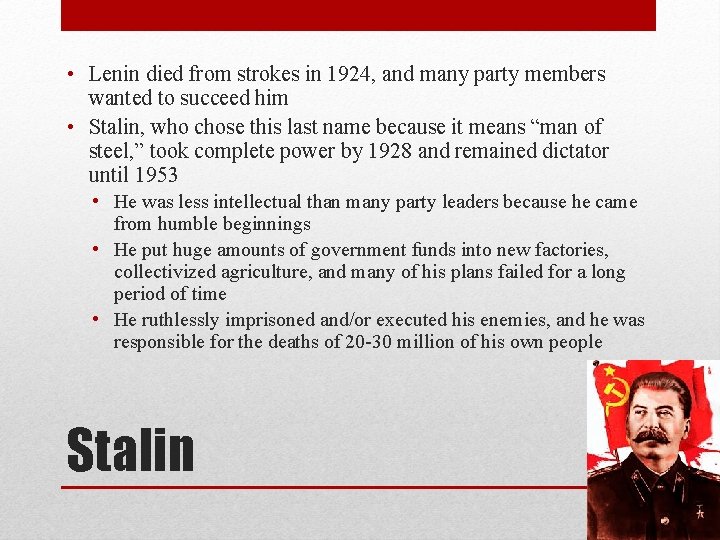
• Lenin died from strokes in 1924, and many party members wanted to succeed him • Stalin, who chose this last name because it means “man of steel, ” took complete power by 1928 and remained dictator until 1953 • He was less intellectual than many party leaders because he came from humble beginnings • He put huge amounts of government funds into new factories, collectivized agriculture, and many of his plans failed for a long period of time • He ruthlessly imprisoned and/or executed his enemies, and he was responsible for the deaths of 20 -30 million of his own people Stalin