
RUSSIAN REMOTE SENSING SYSTEM CURRENT STATUS AND PROSPECTS

- Slides: 20
RUSSIAN REMOTE SENSING SYSTEM: CURRENT STATUS AND PROSPECTS OF DEVELOPMENT
PRIORITIES OF REMOTE SENSING CONSTELLATION DEVELOPMENT v In Russia, the Earth remote sensing constitutes one of the priority lines of space activities which regulation is the responsibility of the ROSCOSMOS State Space Corporation v The Russian Federal Space Program for 2016– 2025 envisages more than double increase in data resource of the Russian satellite constellation group and productivity of remote sensing ground infrastructure. © JSC «RUSSIAN SPACE SYSTEMS» 2 2
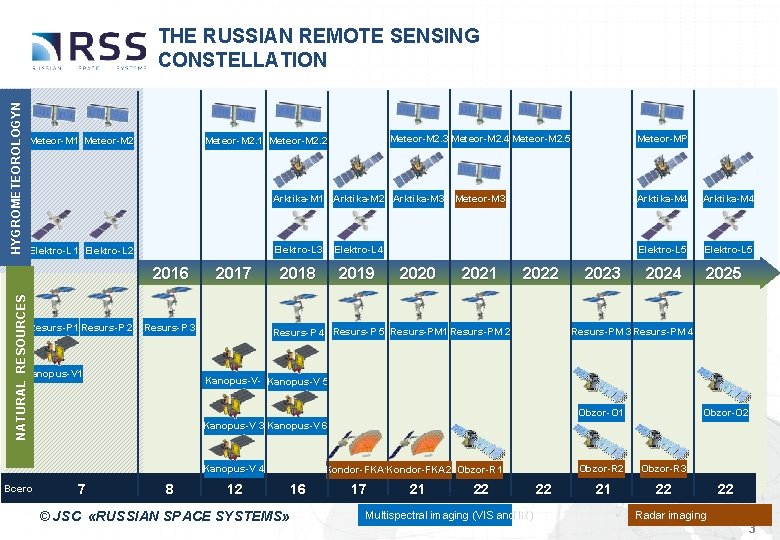
HYDROMETEOROLOGY HYGROMETEOROLOGYN THE RUSSIAN REMOTE SENSING CONSTELLATION Meteor-M 1 Meteor-M 2. 2 Meteor-M 2. 3 Meteor-M 2. 4 Meteor-M 2. 5 Meteor-MP Meteor-M 3 Arktika-M 4 Elektro-L 5 Arktika-M 1 Arktika-M 2 Arktika-M 3 Elektro-L 2 Elektro-L 1 Elektro- NATURAL RESOURCES 2016 Resurs-P 2 Resurs-P 1 Resurs- 2017 Resurs-P 3 Kanopus-V 1 Elektro-L 3 Elektro-L 4 2018 2019 2021 2022 Resurs-PM 1 Resurs-PM 2 Resurs-P 5 Resurs-P 4 Resurs- 2023 2024 2025 Resurs-PM 3 Resurs-PM 4 Kanopus-V- Kanopus-V 5 IK Obzor-O 1 Obzor-O 2 Kanopus-V 6 Kanopus-V 3 Kanopus-V 4 Всего 2020 7 8 12 Kondor-FKA 1 Obzor-R 1 Kondor-FKA 1 Kondor-FKA 2 Obzor-R 1 16 © JSC «RUSSIAN SPACE SYSTEMS» 17 21 22 Multispectral imaging (VIS and IR) 22 Obzor-R 3 21 22 Radar imaging 22 3 3
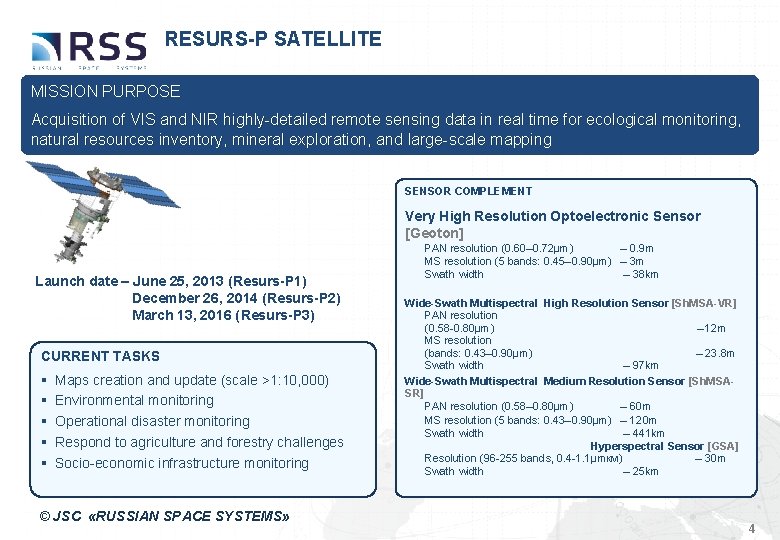
RESURS-P SATELLITE MISSION PURPOSE Acquisition of VIS and NIR highly-detailed remote sensing data in real time for ecological monitoring, natural resources inventory, mineral exploration, and large-scale mapping SENSOR COMPLEMENT Very High Resolution Optoelectronic Sensor [Geoton] Launch date – June 25, 2013 (Resurs-P 1) December 26, 2014 (Resurs-P 2) March 13, 2016 (Resurs-P 3) CURRENT TASKS § § § Maps creation and update (scale >1: 10, 000) Environmental monitoring Operational disaster monitoring Respond to agriculture and forestry challenges Socio-economic infrastructure monitoring © JSC «RUSSIAN SPACE SYSTEMS» PAN resolution (0. 60– 0. 72µm) – 0. 9 m MS resolution (5 bands: 0. 45– 0. 90µm) – 3 m Swath width – 38 km Wide-Swath Multispectral High Resolution Sensor [Sh. MSA-VR] PAN resolution (0. 58 -0. 80µm) – 12 m MS resolution (bands: 0. 43– 0. 90µm) – 23. 8 m Swath width – 97 km Wide-Swath Multispectral Medium Resolution Sensor [Sh. MSASR] PAN resolution (0. 58– 0. 80µm) – 60 m MS resolution (5 bands: 0. 43– 0. 90µm) – 120 m Swath width – 441 km Hyperspectral Sensor [GSA] Resolution (96 -255 bands, 0. 4 -1. 1µmкм) – 30 m Swath width – 25 km 4 4
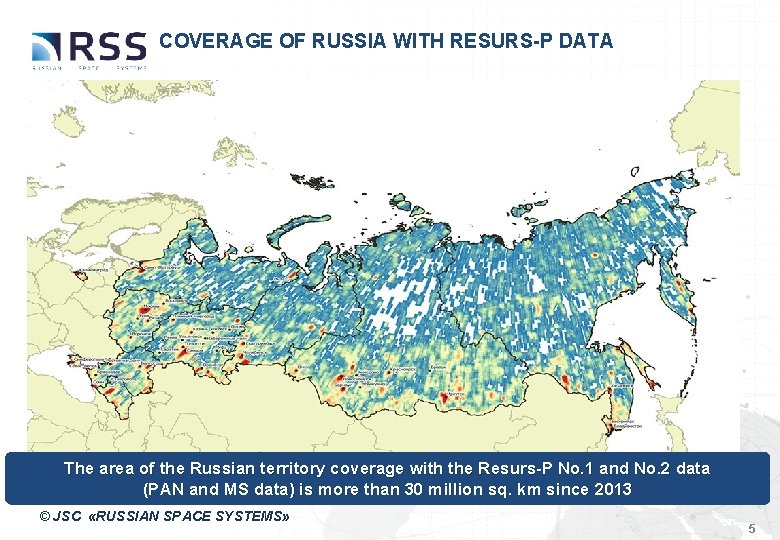
COVERAGE OF RUSSIA WITH RESURS-P DATA The area of the Russian territory coverage with the Resurs-P No. 1 and No. 2 data (PAN and MS data) is more than 30 million sq. km since 2013 © JSC «RUSSIAN SPACE SYSTEMS» 5 5
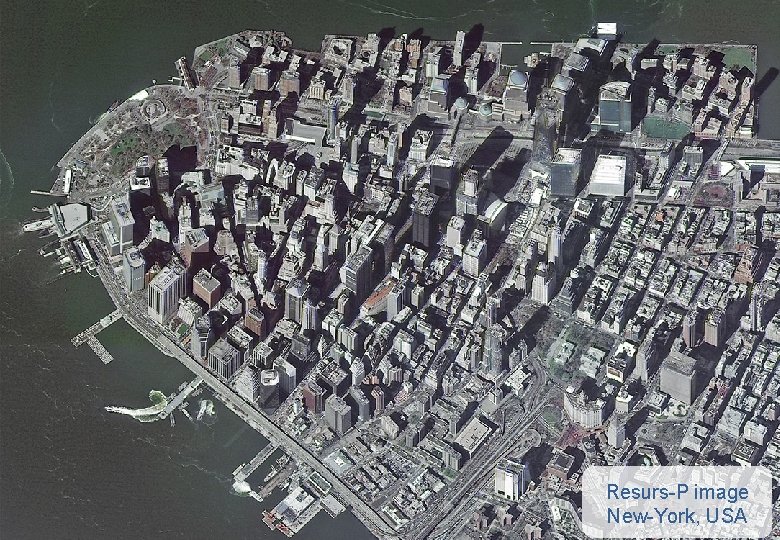
© JSC «RUSSIAN SPACE SYSTEMS» Resurs-P image New-York, USA 6 6
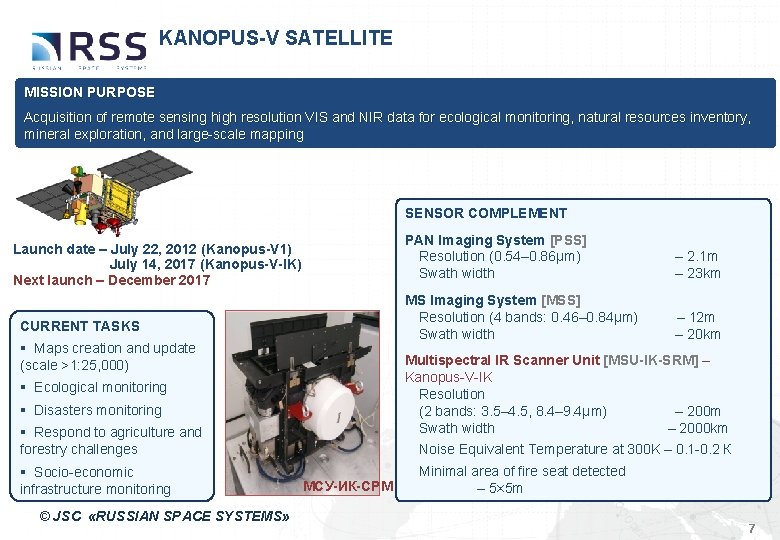
KANOPUS-V SATELLITE MISSION PURPOSE Acquisition of remote sensing high resolution VIS and NIR data for ecological monitoring, natural resources inventory, mineral exploration, and large-scale mapping SENSOR COMPLEMENT Launch date – July 22, 2012 (Kanopus-V 1) July 14, 2017 (Kanopus-V-IK) Next launch – December 2017 CURRENT TASKS § Maps creation and update (scale >1: 25, 000) § Disasters monitoring § Respond to agriculture and forestry challenges © JSC «RUSSIAN SPACE SYSTEMS» – 2. 1 m – 23 km MS Imaging System [MSS] Resolution (4 bands: 0. 46– 0. 84µm) Swath width – 12 m – 20 km Multispectral IR Scanner Unit [MSU-IK-SRM] – Kanopus-V-IK Resolution (2 bands: 3. 5– 4. 5, 8. 4– 9. 4µm) – 200 m Swath width – 2000 km § Ecological monitoring § Socio-economic infrastructure monitoring PAN Imaging System [PSS] Resolution (0. 54– 0. 86µm) Swath width Noise Equivalent Temperature at 300 K – 0. 1 -0. 2 К МСУ-ИК-СРМ Minimal area of fire seat detected – 5× 5 m 7 7
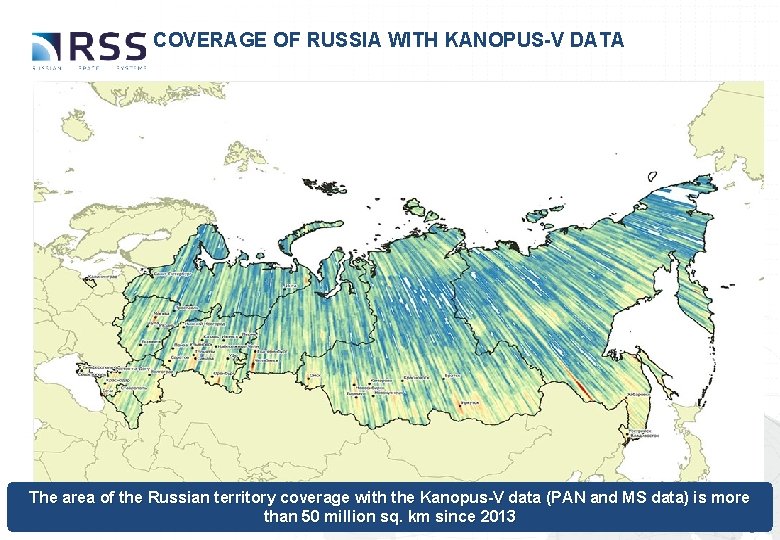
COVERAGE OF RUSSIA WITH KANOPUS-V DATA The area of the Russian territory coverage with the Kanopus-V data (PAN and MS data) is more © JSC «RUSSIAN SPACE SYSTEMS» than 50 million sq. km since 2013 8 8
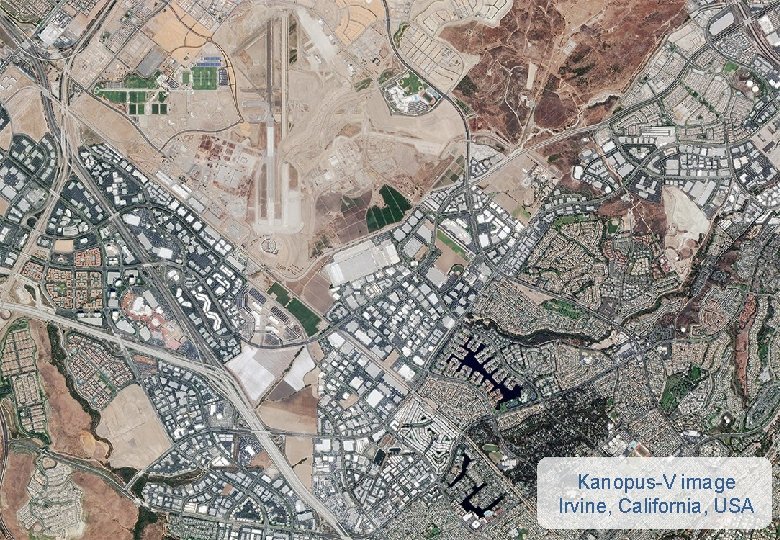
© JSC «RUSSIAN SPACE SYSTEMS» Kanopus-V image Irvine, California, USA 9 9
METEOR-M SATELLITE MISSION PURPOSE Operational acquisition of data on cloudiness and the Earth’s underlying surface, hydrometeorological data collection, heliogeophysical research, and ecological monitoring SENSOR COMPLEMENT Launch date – 17 September 2009 (Meteor-M 1) 8 July 2014 (Meteor-M 2) CURRENT TASKS § Environmental monitoring § Ice conditions monitoring § Operational emergency monitoring § Radiation and heliophysical condition monitoring in near space © JSC «RUSSIAN SPACE SYSTEMS» Multispectral Scanning Imaging System [KMSS] Multispectral scanning instrument [MSU-100] MS resolution (3 bands: 0. 53– 0. 57, 0. 63– 0. 68, 0. 76– 0. 90µm) 60 m Swath width – 900 km Multispectral scanning instrument [MSU-50] MS resolution (3 bands: 0. 37 -0. 45, 0. 45 -0. 51, 0. 58 -0. 69µm) – 120 m Swath width – 900 km – Low-resolution multispectral scanning instrument [MSU MR] MS resolution (6 bands: 0. 5– 0. 7, 0. 7– 1. 1, 1. 6– 1. 8, 3. 5– 4. 1, 10. 5– 11. 5, 11. 5– 12. 5µm) – 1000 m Swath width – 2800 km Heliogeophysical Instrument Complex [GGAK] 10 10
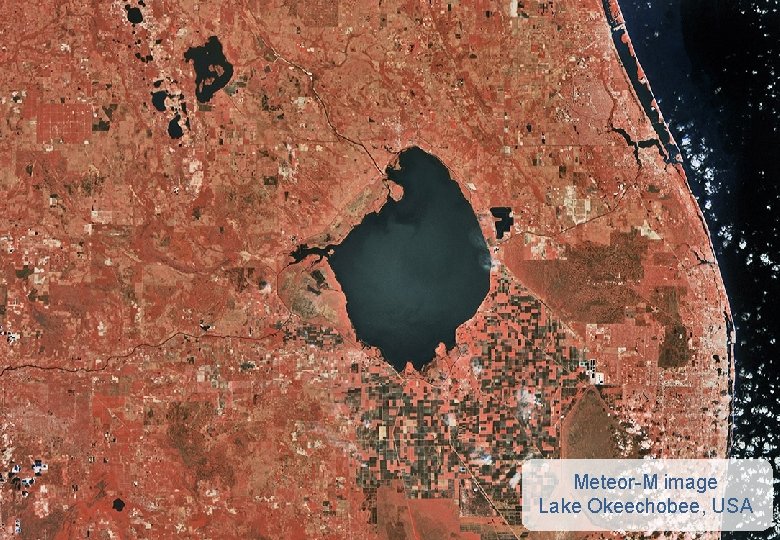
© JSC «RUSSIAN SPACE SYSTEMS» Meteor-M image Lake Okeechobee, USA 11 11
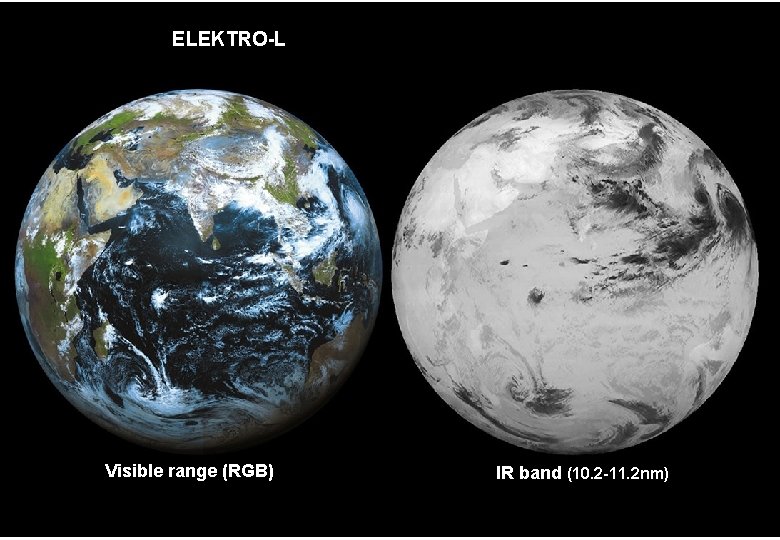
ELEKTRO-L SATTELITE MISSION PURPOSE Operational acquisition of data on cloudiness and the Earth’s underlying surface, hydrometeorological data collection, and heliogeophysical measurements SENSOR COMPLEMENT § Ocean monitoring Multispectral scanner [MSU-GS] Coverage area – visible disk of the Earth VIS resolution (3 bands: 0. 46– 0. 65, 0. 65– 0. 80, 0. 80– 0. 90µm) – 1000 m NIR resolution (7 bands: 3. 5– 4. 1, 5. 7– 7. 0, 7. 5– 8. 5, 8. 2– 9. 2, 9. 2– 10. 2, 10. 2– 11. 2, 11. 2– 12. 5µm) – 4000 m Swath width – 900 km Revisit period – 30 min (as scheduled) – 15 min (by request) § Global monitoring of emergencies Heliogeophysical instrument complex [GGAK] Launch date – January 20, 2011 (Elektro-L 1) currently located at 76°E 10 December 2015 (Elektro-L 2) currently located at 77. 8 E CURRENT TASKS § Operational imagery of the earth’s underlying surface © JSC «RUSSIAN SPACE SYSTEMS» 12 12
ELEKTRO-L Visible range (RGB) IR band (10. 2 -11. 2 nm)
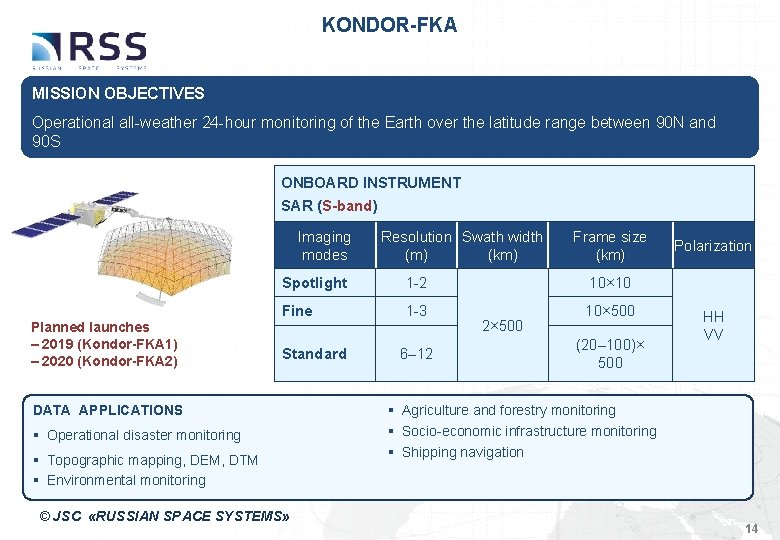
KONDOR-FKA MISSION OBJECTIVES Operational all-weather 24 -hour monitoring of the Earth over the latitude range between 90 N and 90 S ONBOARD INSTRUMENT SAR (S-band) Imaging modes Planned launches – 2019 (Kondor-FKA 1) – 2020 (Kondor-FKA 2) Resolution Swath width (m) (km) Spotlight 1 -2 Fine 1 -3 Standard DATA APPLICATIONS § Operational disaster monitoring § Topographic mapping, DEM, DTM § Environmental monitoring © JSC «RUSSIAN SPACE SYSTEMS» 6– 12 Frame size (km) Polarization 10× 10 2× 500 10× 500 (20– 100)× 500 HH VV § Agriculture and forestry monitoring § Socio-economic infrastructure monitoring § Shipping navigation 14 14
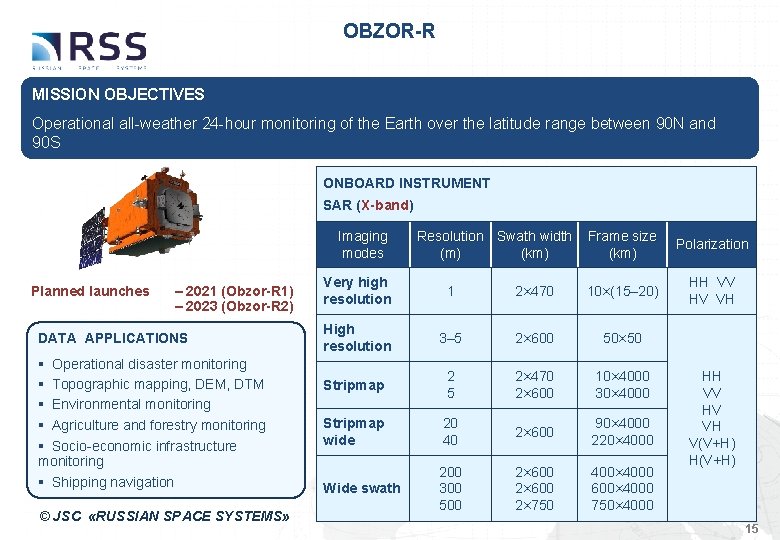
OBZOR-R MISSION OBJECTIVES Operational all-weather 24 -hour monitoring of the Earth over the latitude range between 90 N and 90 S ONBOARD INSTRUMENT SAR (X-band) Imaging modes Planned launches – 2021 (Obzor-R 1) – 2023 (Obzor-R 2) DATA APPLICATIONS § Operational disaster monitoring § Topographic mapping, DEM, DTM § Environmental monitoring § Agriculture and forestry monitoring § Socio-economic infrastructure monitoring § Shipping navigation © JSC «RUSSIAN SPACE SYSTEMS» Resolution Swath width (m) (km) Frame size (km) Polarization HH VV HV VH Very high resolution 1 2× 470 10×(15– 20) High resolution 3– 5 2× 600 50× 50 Stripmap 2 5 2× 470 2× 600 10× 4000 30× 4000 Stripmap wide 20 40 2× 600 90× 4000 220× 4000 Wide swath 200 300 500 2× 600 2× 750 400× 4000 600× 4000 750× 4000 HH VV HV VH V(V+H) H(V+H) 15 15
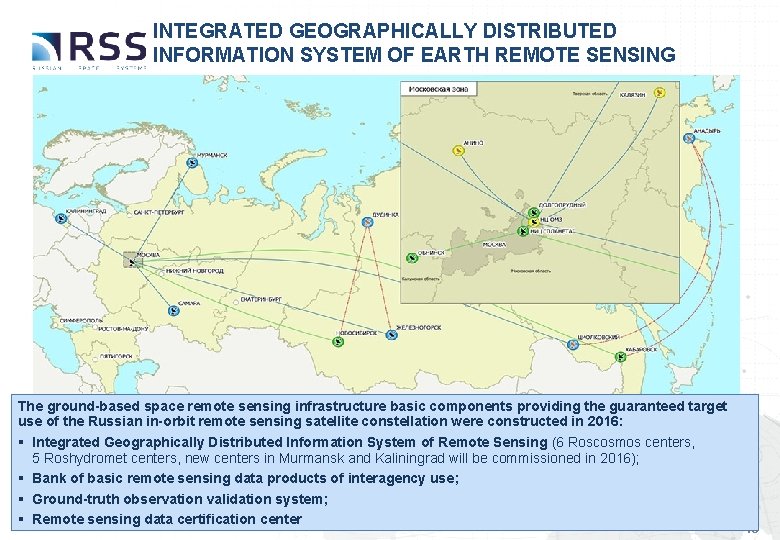
INTEGRATED GEOGRAPHICALLY DISTRIBUTED INFORMATION SYSTEM OF EARTH REMOTE SENSING The ground-based space remote sensing infrastructure basic components providing the guaranteed target use of the Russian in-orbit remote sensing satellite constellation were constructed in 2016: § Integrated Geographically Distributed Information System of Remote Sensing (6 Roscosmos centers, 5 Roshydromet centers, new centers in Murmansk and Kaliningrad will be commissioned in 2016); § Bank of basic remote sensing data products of interagency use; § Ground-truth observation validation system; © JSC sensing «RUSSIAN SPACE SYSTEMS» § Remote data certification center 16 16
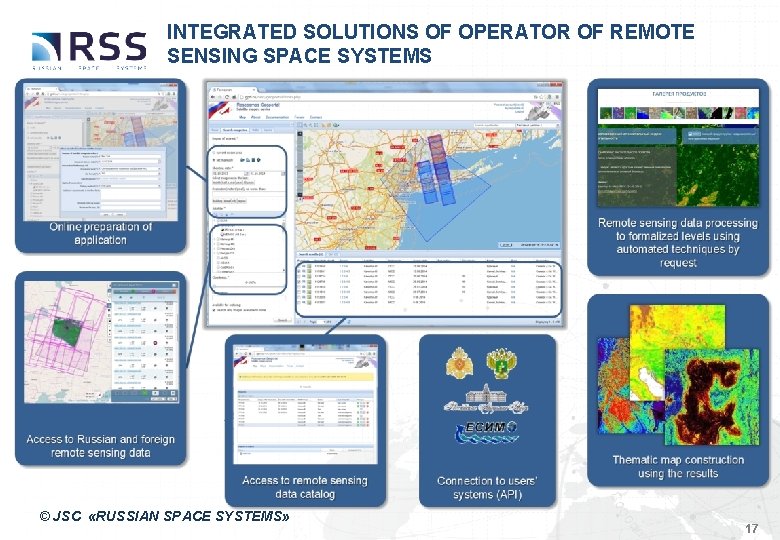
INTEGRATED SOLUTIONS OF OPERATOR OF REMOTE SENSING SPACE SYSTEMS © JSC «RUSSIAN SPACE SYSTEMS» 17 17
PRIORITIES OF THE RUSSIAN REMOTE SENSING SYSTEM DEVELOPMENT v Developing hydrometeorological facilities including practical use of modern target equipment and scientific instruments (microwave radiometers, Fourier spectrometers etc. ); v Constructing all-weather radar observing facilities, especially in S- and Х-band; v Establishing the National Remote Sensing Center in order to provide a one-man management of target use of in-orbit satellite constellation and ground-based space infrastructure of Earth remote sensing to secure an optimal distribution of data flows with extended functional of scientific research and experimental operation of prospective remote sensing facilities including with regard to solving thematic tasks by governmental and commercial customers; v Creating an end-to-end quality control of the target equipment at all stages of satellite lifetime, data and data products validation; v Creating a system of automatic (flow) generation of key socioeconomic products and geoservices in real time. © JSC «RUSSIAN SPACE SYSTEMS» 18 18
ROSCOSMOS PARTICIPATION IN CEOS v ROSCOSMOS is a member WGCV, WGISS and Working Group on Disasters v ROSCOSMOS provides the latest information on Russian satellites to update the CEOS MIM Database v ROSCOSMOS implements a set of activities aimed at opening up access to some Russian remote sensing data (Open Data Portal establishing and the ROSCOSMOS’s geoinformation services catalogs connection to the CWIC) v ROSCOSMOS organized and hosted the 13 th GEO Plenary in November 2016 and in October 2017, ROSCOSMOS holds the 8 th Asia/Oceania Meteorological Satellite Users’ Conference (Vladivostok city). © JSC «RUSSIAN SPACE SYSTEMS» 19 19
THANK YOU!