
Russian Federation Case Study 2 Russia Government Basics
Russian Federation Case Study 2
Russia Government Basics Government A presidential democracy on paper that functions in reality like an authoritarian regime Federal Govt Government centralized in Moscow There are 83 subnational governments with varying degrees of power.
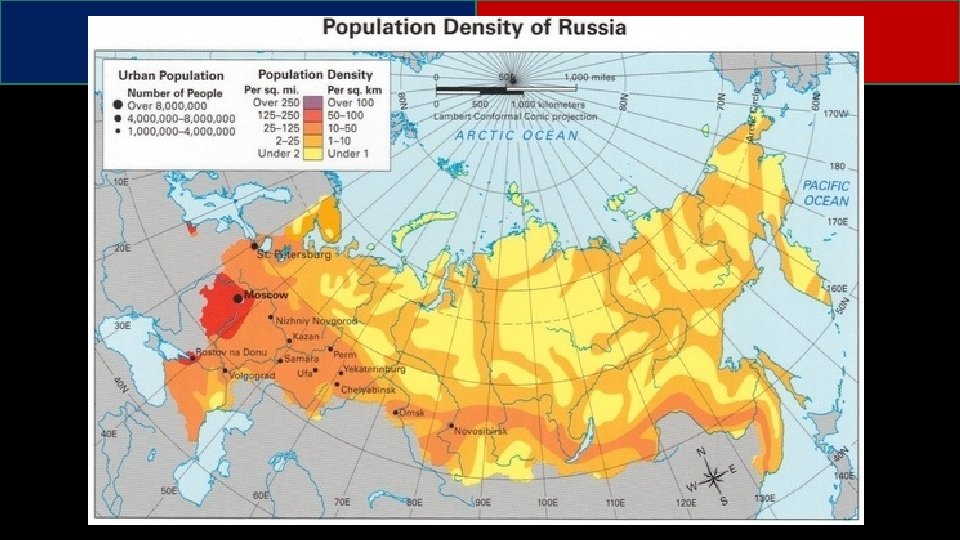
Russia Land Geography Largest European country in population and in land mass Largest country in the world Spans 11 different time zones Less than 8% of all land is arable. Rich in natural resources, but they are concentrated in the north & western Siberia 73% of Russians now live in urban areas
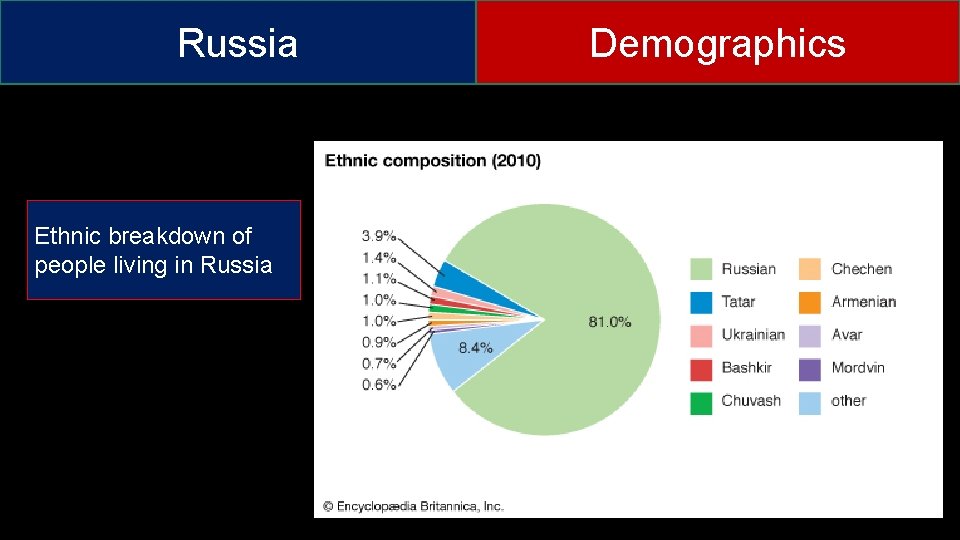
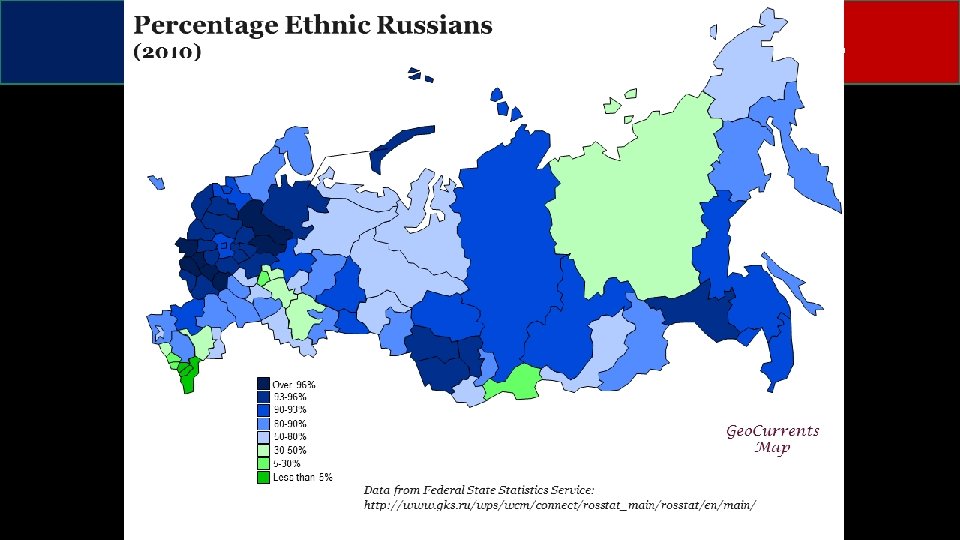
Russia Ethnic breakdown of people living in Russia Demographics
Russia Demographics
Russia Demographics
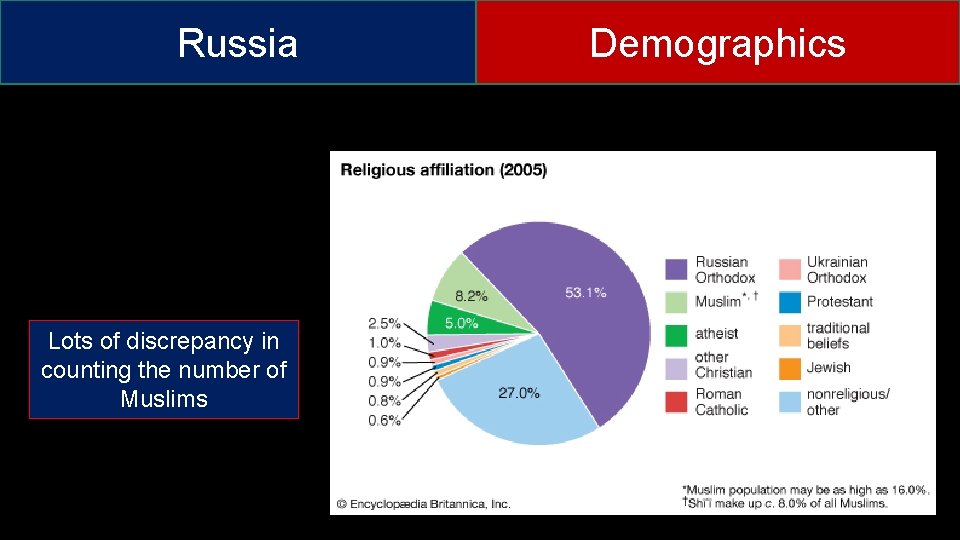
Russia Lots of discrepancy in counting the number of Muslims Demographics
Development of the State Russia
Russia Pre 1917 Critical Junctures Was an autocratic tsarist state until 1917. The state ruled the country and owned all the land Peasant population were tied to nobles, which were tied to the state. Serfs were emancipated in 1861. The state drove efforts to modernize and industrialize Revolution attempts in 1905 were suppressed & the tsar maintained power until World War 1 began
Russia 1917 Revolution Critical Junctures Vladimir Lenin was sent into Russia by Germans. He began a revolution based on interests of proletariat Bolsheviks formed the USSR in 1922 after a long civil war. As they built govt. centralization took precedence over democratic elements. Joseph Stalin came to power following the death of Lenin in 1924. This revolution also caused a period of international isolation
Russia Stalin Revolution Critical Junctures Stalin ruled from 1929 -1953, consolidating his power throughout State drove economic development and owned all economic assets. Collectivization led to famine. Political opposition was eliminated & state controlled media & the arts. Under Stalin, USSR involvement in WW 2 allowed empire to expand into Eastern Europe and emerged as a global superpower
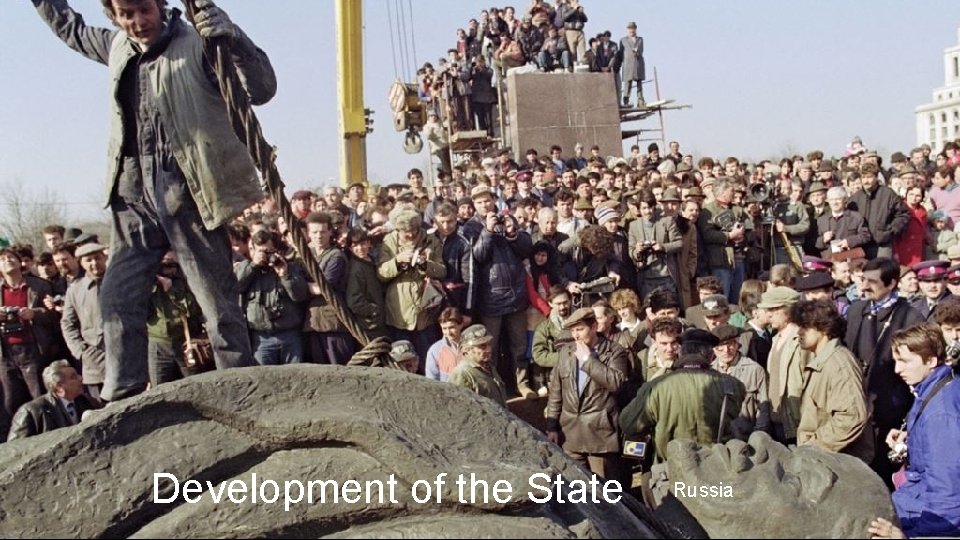
Russia Collapse of USSR Critical Junctures In 1991 Boris Yeltsin was elected president of the Russian Republic – a part of the USSR A conservative coup was attempted to halt Gorbachev’s reforms While Gorbachev was held captive, Yeltsin and other leaders declared an end to the USSR Yeltsin proclaimed his commitment to Western style democracy and market economy in an independent Russia
Russia Vladimir Putin Critical Junctures Yeltsin appointed Putin prime minister in 1999. He won the presidency the next year when Yeltsin resigned. A sustained period of economic growth began around the same time After serving two terms as president, Putin was unable to run again so endorsed Dmitry Medvedev who won easily in 2008. In 2012, Putin was able to run for president again and won easily.
Russia International influence Themes Russia has reasserted itself as an important player in international affairs under the leadership of Putin Has difficulty establishing itself as a respected world leader When they act, they are likely to face opposition from international coalitions. Russia struggles to find steady allies, is not a member of NATO

Russia Economic performance Themes The first decade after USSR collapse was marked by steady economic decline After 1998 growth returned, govt generated steady surpluses The 2008 financial crisis and dropping oil prices posed challenges for the government
Russia Democracy? Themes Reforms adopted after 2000 have undermined political competition There are widespread concerns about the future of Russian democracy United Russia, Putin’s party, is the dominant political party and faces little real competition Corruption is widespread
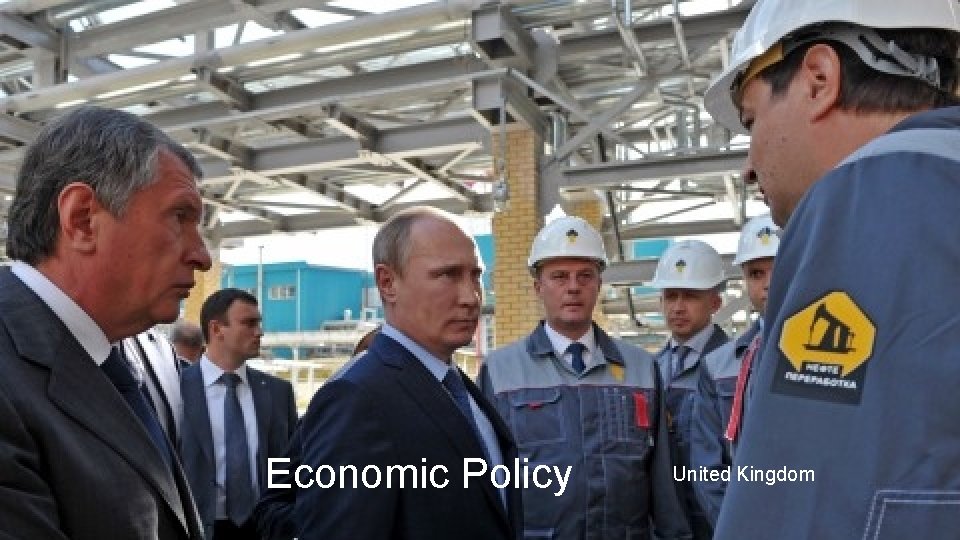
Economic Policy United Kingdom
Russia End of Communism State & Economy Collapse of USSR radically reduced the state’s role in economic development This brought an immediate dramatic decline in economic performance Unprecedented depression from 1991 1998 This went along with a decline in the prices of oil and natural gas, which drives a good bit of Russia’s economy
Russia Market Reforms State & Economy In the USSR, all assets belonged to the state. Prices were controlled. Yeltsin began market reforms in 1992. End price controls Encourage entrepreneurships Privatizing state owned industries Encouraging foreign investment
Russia Privatization State & Economy Privatization took place very quickly, compared to other post communist states State enterprises were privatized by turning them into joint stock companies Insider privatization allowed managers and workers to acquire ownership of where they worked at made up prices Each citizen was given a privatization voucher to buy shares in a company The people who ended up in control were not prepared to operate in a market economy
Russia Privatization State & Economy By 1995 firms were allowed to sell shares for cash or investment guarantees Successful companies were grabbed by successful financial firms This caused acceleration of more and more of the market being concentrated in the hands of few connected people These oligarchs, who were the few that benefitted from privatization, now have significant political influence
Russia Weak Institutions State & Economy State was unable to collect taxes efficiently, so it lacked revenue Without revenue, the state was unable to provide services to the population The state was unable to fight crime, so many businesses turned to the mafia for protection Lack of capacity of the govt encouraged corruption and crime
Russia Debt State & Economy Bad finances caused the government to begin taking out more loans New loans had progressively higher interest rates to pay the old debts This pyramid debt structure caused Russian stock market to collapse and the govt defaulted on its bonds They printed more rubles, devaluing the money
Russia Recovery State & Economy The devalued ruble actually made Russian products more competitive Firms improved and productivity began to increase This created more revenue which increased state capacity
Russia Putin’s Reforms State & Economy He imposed a 13% flat tax. Significant deficits turned into budget surpluses He said he would impose sanctions on oligarchs that used their positions to impact politics, but he only punished those who were critical of his govt.
Russia Soviet Govt Society & Economy USSR leadership did not get input from society to establish priorities The regime did accomplish many social goals. There was free universal health care Low cost essential goods & services Education for all led to universal literacy Guaranteed employment & job security
Russia Soviet problems Society & Economy Soviet system was plagued by shortages and low quality services There were housing shortages that prevented people from moving There was no economic incentive for innovation or outstanding achievements This led to Russians to expect the state to ensure a social welfare network, so they were unprepared for cutbacks in the 1990 s
Russia Market reforms Society & Economy Some benefitted from market reforms much more than others People who gained positions in banking, finance, oil, and gas tend to be among the super wealthy Those in natural resources or with Western language skills are better off Young people adapted to new work environments better than older people, who were stuck in Soviet mindsets.
Russia Under Putin Society & Economy Level of personal consumption are rising among Russians Putin has prioritized improvement in health care, education, housing, and agriculture He doubled the monthly child support payments to encourage more children in order to fight declining populations
Russia Foreign Assistance Global Economy Western countries made commitments of technical and humanitarian aid in the 1990 s Substantial assistance has come from the World, Bank, the IMF, and the EU Russia has had problems attracting foreign investment, but there has been significant FDI from Germany & USA Foreign investors are prevented from gaining a majority share in sectors of the economy identified as being strategically important.
Russia Trade Global Economy Trade priorities have shifted In the early 1990 s it’s most important trading partner was Ukraine. In 2008, Germany was the largest trading partner, followed by the Netherlands, and Italy Focus has shifted from Eastern Europe to Western Europe China is the largest source of Russian imports Russia exports a lot of energy resources to European Union countries
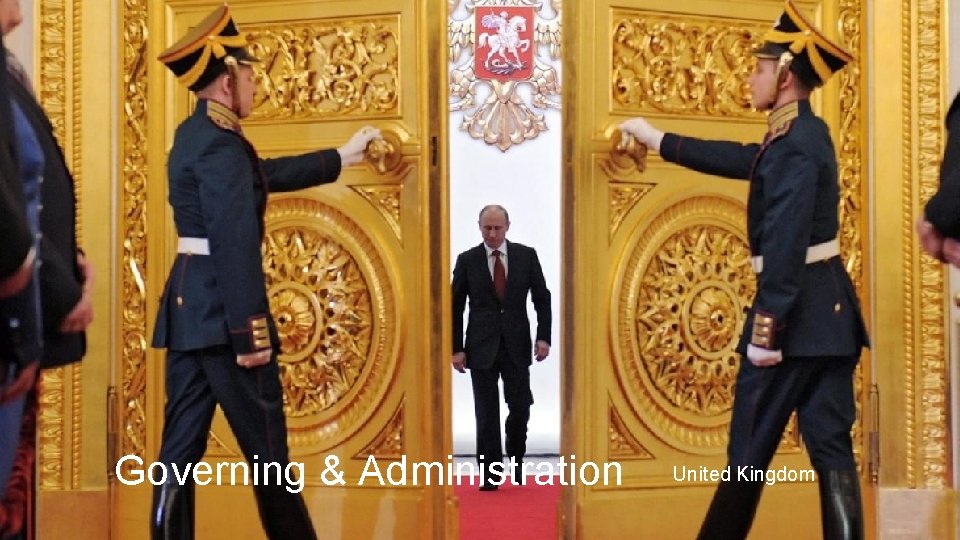
Governing & Administration United Kingdom
Russia Executive The constitution creates a semi presidential system There’s a president and a prime minister The prime minister is appointed by the president but is approved by the Duma The president is the head of state and the prime minister is the head of government. The president is in charge of foreign policy and the prime minister focuses on the economy.
Russia Presidency State Organization The position was created in 1991. It’s elected by direct popular vote The constitution makes the executive dominant, but still dependent on the legislative branch to realize policy goals Executive powers have expanded under Putin, who has undermined checks and balances and centralized authority
Russia President Executive The constitution prevents the same person from being president for three consecutive terms. The president can issue decrees, which cannot violate the constitution or legislation passed by the Duma This allows the president to ignore an uncooperative legislature The president is commander in chief of the military and handles diplomacy
Russia President Executive The president can call a state of emergency Can impose martial law Can temporarily suspend actions of other state organs These powers make it easy for the president to use emergencies to increase his powers
Russia Prime minister Executive The prime minister will fill in for the president if he dies, until new elections can be held. The president’s choice of prime minister must be approved by the Duma The prime minister can be removed by the Duma after two votes of no confidence within a 3 month period. The prime minister is not necessarily a member of the majority party When Putin was PM, the PM was the leader of the dominant party.
Russia Bureaucracy State administration structure includes ministries, state committees, and agencies. Ministries are mostly concerned with policy functions Agencies deal with monitoring functions and implementation Ministries like Foreign Affairs Ministry and Defense Ministry report directly to the president.
Russia Bureaucracy The president created advisory bodies to give input from political and economic actors in order to co-opt them into supporting govt policies The Security Council advises the president about foreign policy and includes heads of some ministries The State Council advises the president about regional issues The ministers do not have to be approved by parliament and are generally career bureaucrats instead of political figures
Russia Bureaucracy Some economic sectors are still either public or semi public Telecommunications, public transportation, electronic media, and energy are public or semi public Gazprom is the state monopoly on natural gas Other sectors like education and health care supported by taxes. There is a state run system to provide medical care, but also private hospitals are increasing
Russia Military Other Institutions Security establishment has become more powerful under Putin The military has shrunk to a quarter of its size at the end of the USSR Defense spending is increasing but is still far below Soviet levels. Political power and prestige of the military have decreased Private security firms are expanding becase of high crime rates
Russia Judiciary Other Institutions Judicial independence and rule of law were not important in Soviet Russia The implementation of these concepts has not been very successful Constitutional Court has power to settle disputes between the federal and regional laws, and between various political institutions The court does not really confront the executive branch There’s also lower and appellate courts that feed into a Supreme Court for regular civil and criminal cases
Russia Subnational Governments Subnational Putin has implemented a system called the power vertical This created 7 federal districts on top of the existing federal units. These oversee the work of federal offices in these regions The election of governors has been eliminated. They are now nominated by the president and approved by the regional legislation Governors and regional presidents are not dependent on having good relations with the president.
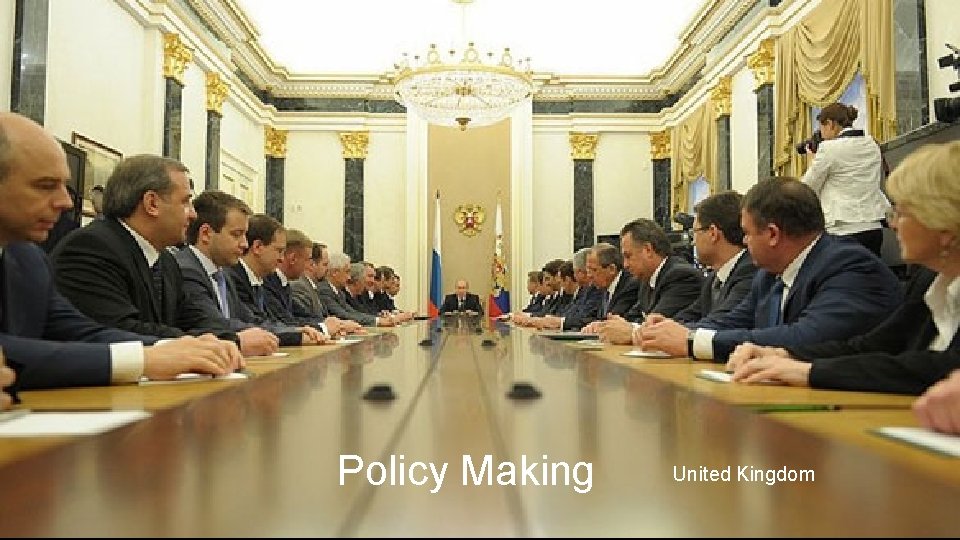
Policy Making United Kingdom
Russia Policy Making Process The constitution allows the president, regional legislatures, deputies, and judicial bodies can propose legislation Yeltsin had conflicts with the Duma, but under Putin, the Duma has generally gone along with the president Policy increasingly comes from the executive branch.
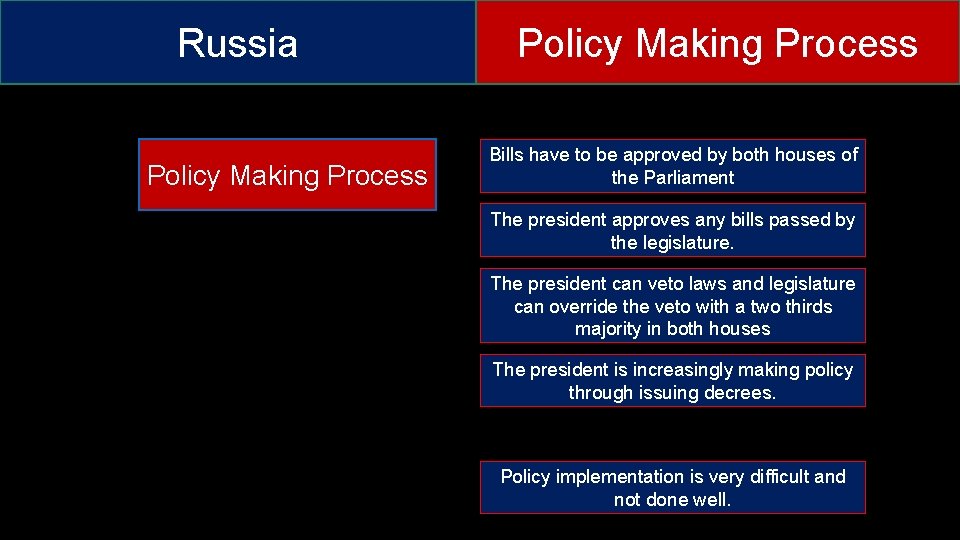
Russia Policy Making Process Bills have to be approved by both houses of the Parliament The president approves any bills passed by the legislature. The president can veto laws and legislature can override the veto with a two thirds majority in both houses The president is increasingly making policy through issuing decrees. Policy implementation is very difficult and not done well.
Representation United Kingdom
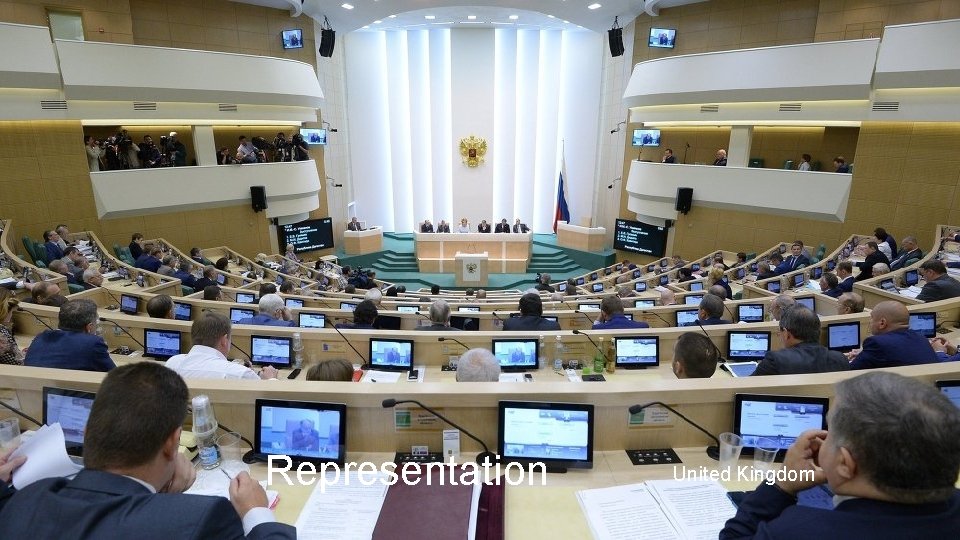
Russia Federal Assembly Legislature A bicameral legislature created in 1993 Upper house is the Federation Council which represents federal units Lower house is the State Duma which represents the people Both must agree on legislation in order for it to pass. Deputies from both houses are granted immunity from criminal prosecution
Russia Federal Assembly Legislature In the early 1990 s, parliament confronted Boris Yeltsin often Since 2003, parliament has mostly cooperated with the president About 2/3 of the members have ties to United Russia, Putin’s party. Parties in parliament are isolated from the public, suffer low levels of popular respect, and are dominated by the elite
Russia Duma Legislature 450 members that are directly elected based on proportional representation The Duma is controlled overwhelmingly by the dominant party, United Russia It elects its own leadership, the speaker is from majority party 32 committees are made from among the Duma to do the work of legislating
Russia Duma Legislature Women and workers are underrepresented in the Duma In 1984, 1/3 of members were women, that was less than 10% by 2005.
Russia Federation Council Legislature Has two members from each of Russia’s federal regions & republics Its members are appointed, and often in exchange for political loyalty Parties do not play a major role in the Federation Council
Participation United Kingdom
Russia Old Party System Political Parties Most important political change has been the shift from a one party system under Soviet rule to a multi party system The Communist Party dominated the state, but also the media, unions, education, and professional associations 10% of all adults were party members, but there was nothing to make the party accountable to the people National elections were held for the first time in 1989, but new parties did not participate until 1993.
Russia Political Parties Party Spectrum The traditional left, critical of market reforms, and mildly nationalistic Liberal/reform parties, support Western style market reform & political norms Parties do not fit neatly on a left-right political spectrum Centrist parties of power represent the political elite of Russia Nationalist/patriotic parties primarily focus on identity issues and nationalism
Russia United Russia Political Parties United Russia has dominated Russian politics since 2003. It rose to prominence with Putin in elections in 1999 and 2000. In 2008 they made the position of party chairman for Vladimir Putin United Russia is the main source of political support for Putin The party is essentially a political machine that controls regional elites
Russia United Russia Political Parties The party is focused on winning prominent people’s support. It is centrally controlled and gains control over the regions because Putin has the power to appoint the governors The party does not really present a platform or program of legislation
Russia Communist Party Political Parties The only party that could be considered an opposition force Its strength has steadily declined since the elections of the early 1990 s. Its goals are democracy, justice, equality, patriotism, internationalism, and socialist renewal, but not really advocating a return to communist govt Supported mostly by older Russians, the economically disadvantaged, and rural Russians – those who have adapted less successfully to changes. It has been unable to find a likeable political leader or support from the young
Russia Liberal Democratic Party Political Parties It’s not really liberal or democratic! Its populist and nationalist and it appeals to anti-western sentiments It gets its support from working class men and from some military personnel
Russia A Just Russia Political Parties Brought a few smaller parties together under one larger party May be kind of a fake party. People think it was formed just so that there could be proof of real competition in Russia’s election It shows competition exists while undermining the other opposition parties that could threaten United Russia
Russia Liberal reform parties Political Parties These parties have been marginalized since 2003. They’ve changed party names over and over. They are committed to liberal values, such as limited economic role for the state, support for free market, and protection of individual liberties People reject their ideas because of how these ideas worked out in the 90 s Since they haven’t run under a consistent party name, they haven’t been able to attract a real following
Russia Elections Turnout his usually between 60% & 70% Political leadership wants turnout to be high so elections appear legitimate. The Duma is elected by proportional representation for parties that get at least 7% of the votes Parties must also have affiliates in more than half of the regions of Russia Media coverage favors United Russia and there has been no real transfer of power so does not appear democratic
Russia Political Culture Tsarist period attitudes have tremendous influence on political culture There’s a tradition of personalistic authority Russians expect highly centralized leadership. The 1990 s brought Western political ideas, but people are skeptical of “imported culture” Putin has introduced the concept of sovereign democracy, emphasizing the importance of adapting democracy to Russian traditions and conditions instead of Western models.
Russia Ethnicity Political Culture Soviet Union was only 50% Russian, but many ethnic minority states broke away Russians make up 80% of the population now. Largest minority group is Tartars, a Muslim group. Other Muslims are concentrated in the northern Caucus region Russian nationalism is contributing to a rise in anti-Semitism and anti-Muslim attitudes.
Russia Religion Political Culture Russian Orthodox Christianity is the dominant religion A 1997 law made it harder for new religious groups to organize in Russia This impacted mostly Western religions that were beginning to organize in Russia after the dissolution of the USSR Russian Orthodox Church pushed for this law and it helps them maintain a privileged status in Russia
Russia Women Political Culture Gender roles tend to reflect traditional family values. Feminism is not popular or part of accepted social roles for women Women in media are likely to be portrayed as sex objects. Increasing numbers of young women are turning to prostitution
Russia Social Class Political Culture Social class was a dominant theme in Soviet Russia. In postcommunist Russia, people do not trust politicians who claim to represent the working class. Unions are not supported Even the Communist Party does not express itself as advocating for the working class
Russia NGOs Political Culture In 2006 Putin made laws that denied many new public organizations Existing ones have to report to the government, especially if they get money from foreign sources The government can monitor the actions of these groups This was justified as necessary to stop terrorist threats. Govt tries to channel public activism through official forums
Russia Public Chamber Political Culture In 2001 the Civic Forum was organized and in 2005 the Public Chamber was added These allow the public to consult and give input to the government about policies and political issues This allows the government to co-opt public activists from more disruption This does allow citizens to interact with the government and express their desires, but in a way that is controlled by the government
Russia Media Political Culture TV coverage is subject to direct influence from the government Newspapers & independent journalists, and some independent sources are critical of the govenrment 52 journalists have been murdered since 1992 (according to the text) More outlets are controlled by industrial groups close to Putin. Independent media sources have declined dramatically Russia ranks 140 th of 178 in ranking of press freedom.
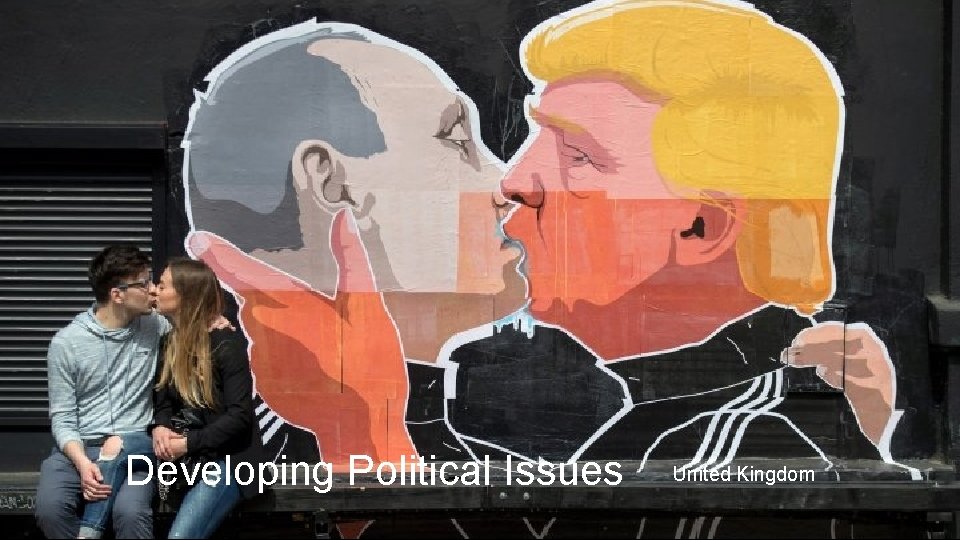
Developing Political Issues United Kingdom
Russia International Role Current Challenges Moscow resents Western dominance & is relatively powerless in affecting global developments (*text) Relations with the West got slightly better when they worked together to fight against terrorism They have been unable to reestablish themselves as a regional leader in neighboring countries, like Ukraine They are not seen as an equal partner with the United States and Europe
Russia Economy Current Challenges Cooperation with the West will be important economically, because they will need the West to reach potential Especially in natural gas extraction, Russia needs Western investment & technical knowledge to meet demands and export commitments Drops in gas prices after 2008 hurt the Russian govt which relies on income from natural gas exports Energy prices recovered quickly & they had a big reserve built up, so it did not cripple the economy this time, but prolonged decreases could.
Russia Democracy? Current Challenges Moving more toward authoritarianism hurts its relationship with the West Putin’s consolidation of control has severely limited political competition The lack of established civil society makes it easy for politicians to use emotional appeals & nationalism
Keep knowledge here. Russia
Main Ideas Russia Privatization Liberalism Europe or American oriented FP Putin’s Pointers! Devolution
- Slides: 76