
RUSSIAN ALASKA In this section you will find
- Slides: 26
RUSSIAN ALASKA In this section, you will find a brief history of Russia's possession of Alaska (17411867). For more information, Lydia Black is considered the foremost scholar on Russian Alaska. An Alaskan Anthology (eds. Haycox and Mangusso) has several interesting short papers as well.
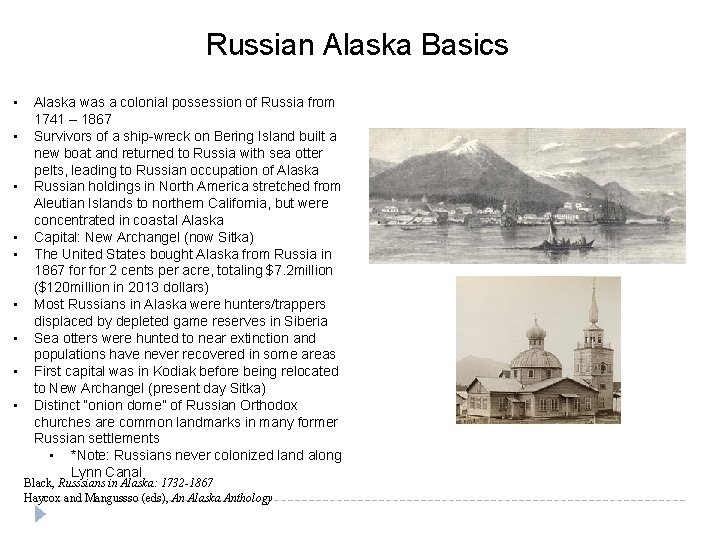
Russian Alaska Basics • • • Alaska was a colonial possession of Russia from 1741 – 1867 Survivors of a ship-wreck on Bering Island built a new boat and returned to Russia with sea otter pelts, leading to Russian occupation of Alaska Russian holdings in North America stretched from Aleutian Islands to northern California, but were concentrated in coastal Alaska Capital: New Archangel (now Sitka) The United States bought Alaska from Russia in 1867 for 2 cents per acre, totaling $7. 2 million ($120 million in 2013 dollars) Most Russians in Alaska were hunters/trappers displaced by depleted game reserves in Siberia Sea otters were hunted to near extinction and populations have never recovered in some areas First capital was in Kodiak before being relocated to New Archangel (present day Sitka) Distinct “onion dome” of Russian Orthodox churches are common landmarks in many former Russian settlements • *Note: Russians never colonized land along Lynn Canal Black, Russsians in Alaska: 1732 -1867 Haycox and Mangussso (eds), An Alaska Anthology
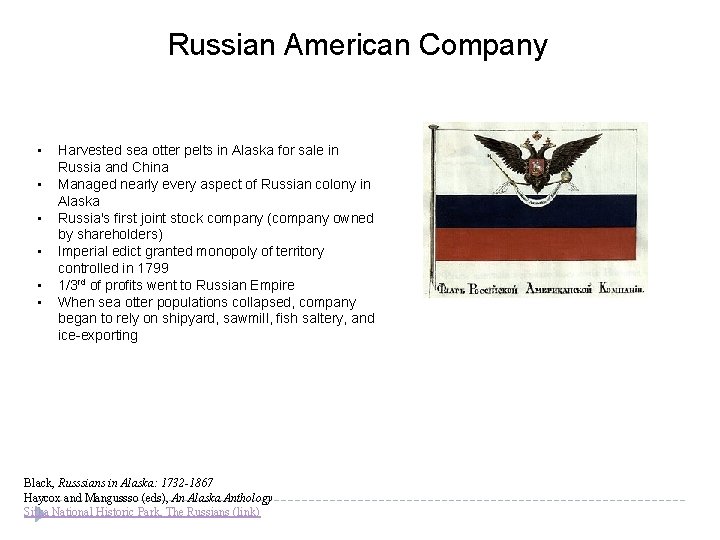
Russian American Company • • • Harvested sea otter pelts in Alaska for sale in Russia and China Managed nearly every aspect of Russian colony in Alaska Russia's first joint stock company (company owned by shareholders) Imperial edict granted monopoly of territory controlled in 1799 1/3 rd of profits went to Russian Empire When sea otter populations collapsed, company began to rely on shipyard, sawmill, fish saltery, and ice-exporting Black, Russsians in Alaska: 1732 -1867 Haycox and Mangussso (eds), An Alaska Anthology Sitka National Historic Park, The Russians (link)
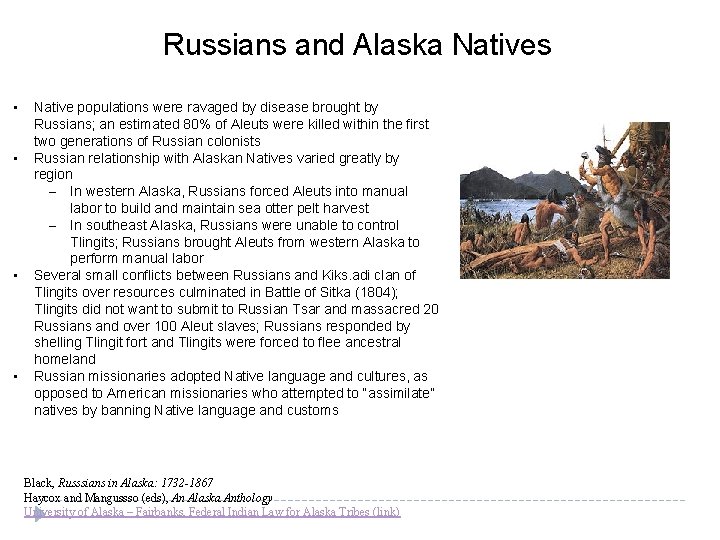
Russians and Alaska Natives • • Native populations were ravaged by disease brought by Russians; an estimated 80% of Aleuts were killed within the first two generations of Russian colonists Russian relationship with Alaskan Natives varied greatly by region – In western Alaska, Russians forced Aleuts into manual labor to build and maintain sea otter pelt harvest – In southeast Alaska, Russians were unable to control Tlingits; Russians brought Aleuts from western Alaska to perform manual labor Several small conflicts between Russians and Kiks. adi clan of Tlingits over resources culminated in Battle of Sitka (1804); Tlingits did not want to submit to Russian Tsar and massacred 20 Russians and over 100 Aleut slaves; Russians responded by shelling Tlingit fort and Tlingits were forced to flee ancestral homeland Russian missionaries adopted Native language and cultures, as opposed to American missionaries who attempted to “assimilate” natives by banning Native language and customs Black, Russsians in Alaska: 1732 -1867 Haycox and Mangussso (eds), An Alaska Anthology University of Alaska – Fairbanks, Federal Indian Law for Alaska Tribes (link)
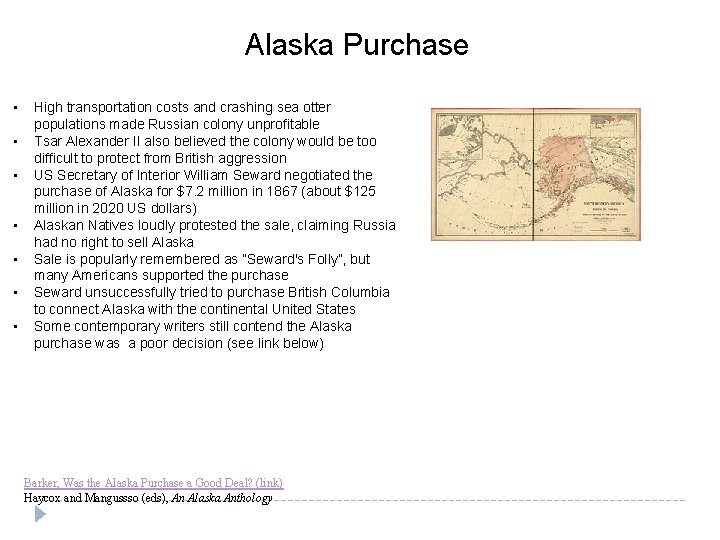
Alaska Purchase • • High transportation costs and crashing sea otter populations made Russian colony unprofitable Tsar Alexander II also believed the colony would be too difficult to protect from British aggression US Secretary of Interior William Seward negotiated the purchase of Alaska for $7. 2 million in 1867 (about $125 million in 2020 US dollars) Alaskan Natives loudly protested the sale, claiming Russia had no right to sell Alaska Sale is popularly remembered as “Seward's Folly”, but many Americans supported the purchase Seward unsuccessfully tried to purchase British Columbia to connect Alaska with the continental United States Some contemporary writers still contend the Alaska purchase was a poor decision (see link below) Barker, Was the Alaska Purchase a Good Deal? (link) Haycox and Mangussso (eds), An Alaska Anthology
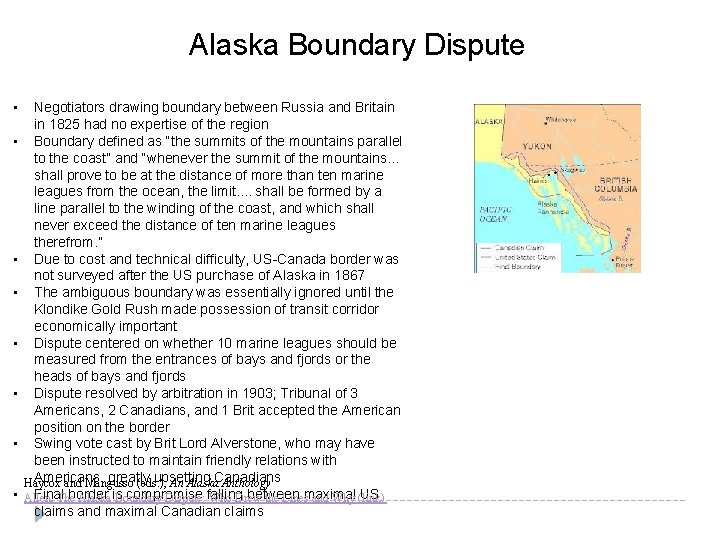
Alaska Boundary Dispute • • Negotiators drawing boundary between Russia and Britain in 1825 had no expertise of the region Boundary defined as “the summits of the mountains parallel to the coast” and “whenever the summit of the mountains. . . shall prove to be at the distance of more than ten marine leagues from the ocean, the limit. . shall be formed by a line parallel to the winding of the coast, and which shall never exceed the distance of ten marine leagues therefrom. ” Due to cost and technical difficulty, US-Canada border was not surveyed after the US purchase of Alaska in 1867 The ambiguous boundary was essentially ignored until the Klondike Gold Rush made possession of transit corridor economically important Dispute centered on whether 10 marine leagues should be measured from the entrances of bays and fjords or the heads of bays and fjords Dispute resolved by arbitration in 1903; Tribunal of 3 Americans, 2 Canadians, and 1 Brit accepted the American position on the border Swing vote cast by Brit Lord Alverstone, who may have been instructed to maintain friendly relations with Americans, greatly upsetting Haycox and Mangusso (eds. ), An Alaska. Canadians Anthology Final border is compromise falling between US Allen, The Alaska Boundary Dispute: Who Drew the Linesmaximal and Why (link) claims and maximal Canadian claims
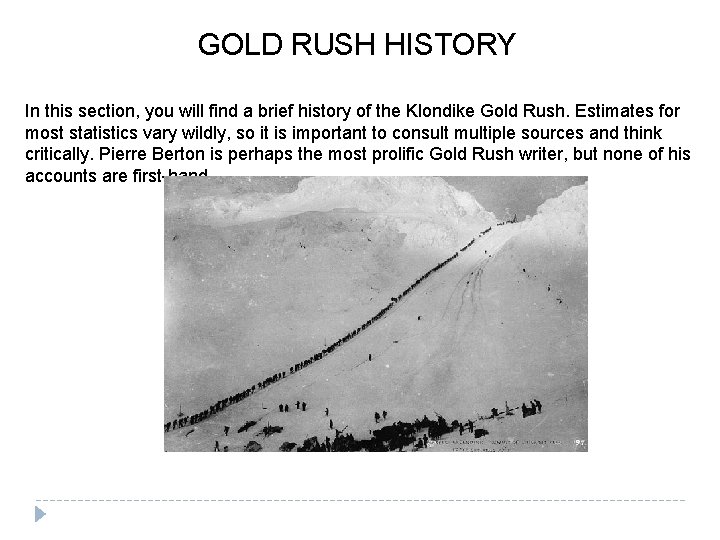
GOLD RUSH HISTORY In this section, you will find a brief history of the Klondike Gold Rush. Estimates for most statistics vary wildly, so it is important to consult multiple sources and think critically. Pierre Berton is perhaps the most prolific Gold Rush writer, but none of his accounts are first-hand.
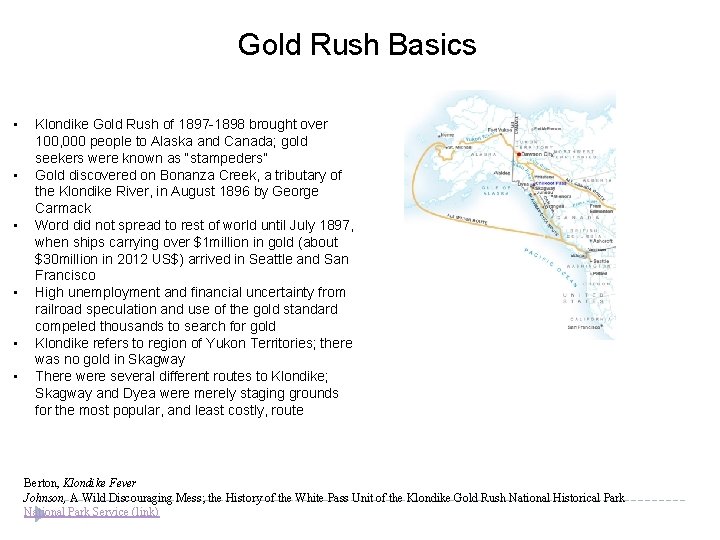
Gold Rush Basics • • • Klondike Gold Rush of 1897 -1898 brought over 100, 000 people to Alaska and Canada; gold seekers were known as “stampeders” Gold discovered on Bonanza Creek, a tributary of the Klondike River, in August 1896 by George Carmack Word did not spread to rest of world until July 1897, when ships carrying over $1 million in gold (about $30 million in 2012 US$) arrived in Seattle and San Francisco High unemployment and financial uncertainty from railroad speculation and use of the gold standard compeled thousands to search for gold Klondike refers to region of Yukon Territories; there was no gold in Skagway There were several different routes to Klondike; Skagway and Dyea were merely staging grounds for the most popular, and least costly, route Berton, Klondike Fever Johnson, A Wild Discouraging Mess; the History of the White Pass Unit of the Klondike Gold Rush National Historical Park National Park Service (link)
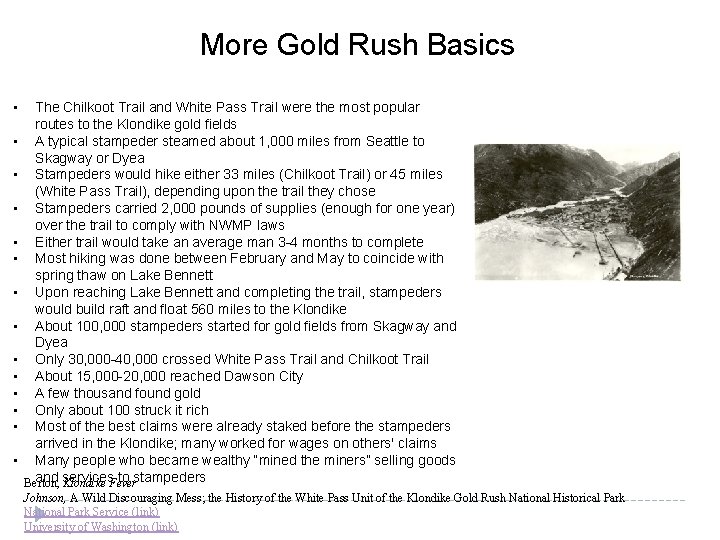
More Gold Rush Basics • • • • The Chilkoot Trail and White Pass Trail were the most popular routes to the Klondike gold fields A typical stampeder steamed about 1, 000 miles from Seattle to Skagway or Dyea Stampeders would hike either 33 miles (Chilkoot Trail) or 45 miles (White Pass Trail), depending upon the trail they chose Stampeders carried 2, 000 pounds of supplies (enough for one year) over the trail to comply with NWMP laws Either trail would take an average man 3 -4 months to complete Most hiking was done between February and May to coincide with spring thaw on Lake Bennett Upon reaching Lake Bennett and completing the trail, stampeders would build raft and float 560 miles to the Klondike About 100, 000 stampeders started for gold fields from Skagway and Dyea Only 30, 000 -40, 000 crossed White Pass Trail and Chilkoot Trail About 15, 000 -20, 000 reached Dawson City A few thousand found gold Only about 100 struck it rich Most of the best claims were already staked before the stampeders arrived in the Klondike; many worked for wages on others' claims Many people who became wealthy “mined the miners” selling goods and services to stampeders Berton, Klondike Fever Johnson, A Wild Discouraging Mess; the History of the White Pass Unit of the Klondike Gold Rush National Historical Park National Park Service (link) University of Washington (link)
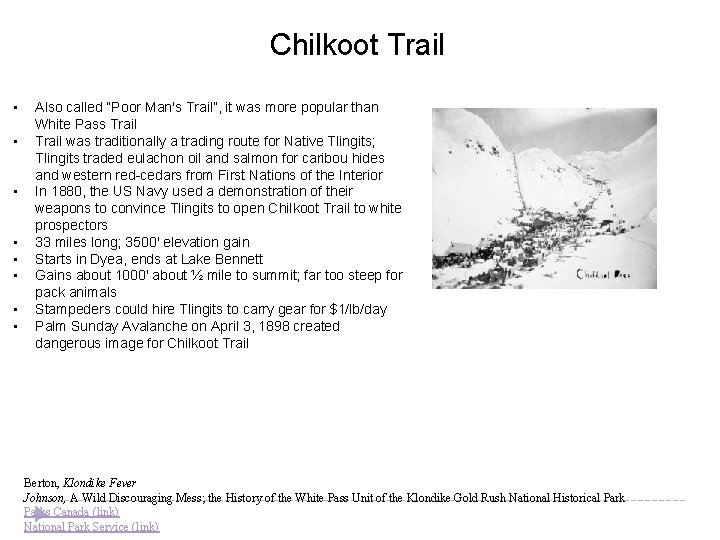
Chilkoot Trail • • Also called “Poor Man's Trail”, it was more popular than White Pass Trail was traditionally a trading route for Native Tlingits; Tlingits traded eulachon oil and salmon for caribou hides and western red-cedars from First Nations of the Interior In 1880, the US Navy used a demonstration of their weapons to convince Tlingits to open Chilkoot Trail to white prospectors 33 miles long; 3500' elevation gain Starts in Dyea, ends at Lake Bennett Gains about 1000' about ½ mile to summit; far too steep for pack animals Stampeders could hire Tlingits to carry gear for $1/lb/day Palm Sunday Avalanche on April 3, 1898 created dangerous image for Chilkoot Trail Berton, Klondike Fever Johnson, A Wild Discouraging Mess; the History of the White Pass Unit of the Klondike Gold Rush National Historical Parks Canada (link) National Park Service (link)
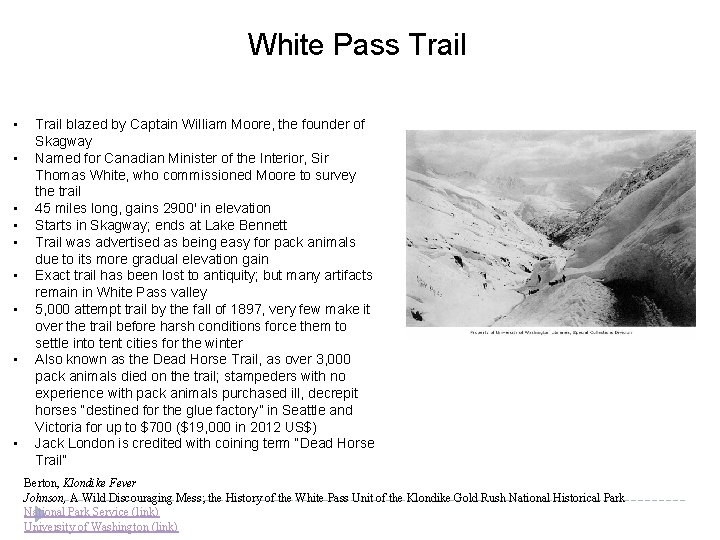
White Pass Trail • • • Trail blazed by Captain William Moore, the founder of Skagway Named for Canadian Minister of the Interior, Sir Thomas White, who commissioned Moore to survey the trail 45 miles long, gains 2900' in elevation Starts in Skagway; ends at Lake Bennett Trail was advertised as being easy for pack animals due to its more gradual elevation gain Exact trail has been lost to antiquity; but many artifacts remain in White Pass valley 5, 000 attempt trail by the fall of 1897, very few make it over the trail before harsh conditions force them to settle into tent cities for the winter Also known as the Dead Horse Trail, as over 3, 000 pack animals died on the trail; stampeders with no experience with pack animals purchased ill, decrepit horses “destined for the glue factory” in Seattle and Victoria for up to $700 ($19, 000 in 2012 US$) Jack London is credited with coining term “Dead Horse Trail” Berton, Klondike Fever Johnson, A Wild Discouraging Mess; the History of the White Pass Unit of the Klondike Gold Rush National Historical Park National Park Service (link) University of Washington (link)
Supplies • • Samuel Steele, Superintendent of Northwest Mounted Police, instituted the “one ton rule” to prevent inexperienced stampeders from starving to death in harsh Yukon Example items on typical packing list: 400 lbs flour; 100 lbs sugar; 100 lbs beans; 50 lbs evaporated onions; 200 lbs beans; 25 lbs evaporated apricots; 8 lbs baking soda Scales were set up near the international border: the summit of White Pass and Chilkoot Pass Each stampeder needed 2, 000 pounds of gear; 1, 150 lbs was food Stampeders typically carried about 50 -60 lbs at a time, shuttling their 2, 000 lbs between cache points At 50 lbs/trip, without a Tlingit packer or pack animal, a man could walk approximately 3, 000 total miles on trail shuttling goods Scams abounded: a Trans-Alaska Gopher Company claimed to sell trained gophers capable of finding gold through ice and gravel Berton, Klondike Fever Johnson, A Wild Discouraging Mess; the History of the White Pass Unit of the Klondike Gold Rush National Historical Park National Park Service (link) University of Washington (link)
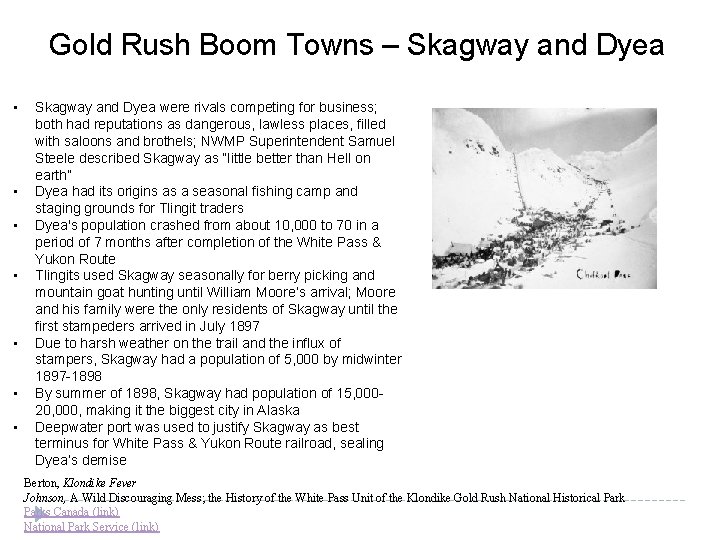
Gold Rush Boom Towns – Skagway and Dyea • • Skagway and Dyea were rivals competing for business; both had reputations as dangerous, lawless places, filled with saloons and brothels; NWMP Superintendent Samuel Steele described Skagway as “little better than Hell on earth” Dyea had its origins as a seasonal fishing camp and staging grounds for Tlingit traders Dyea's population crashed from about 10, 000 to 70 in a period of 7 months after completion of the White Pass & Yukon Route Tlingits used Skagway seasonally for berry picking and mountain goat hunting until William Moore’s arrival; Moore and his family were the only residents of Skagway until the first stampeders arrived in July 1897 Due to harsh weather on the trail and the influx of stampers, Skagway had a population of 5, 000 by midwinter 1897 -1898 By summer of 1898, Skagway had population of 15, 00020, 000, making it the biggest city in Alaska Deepwater port was used to justify Skagway as best terminus for White Pass & Yukon Route railroad, sealing Dyea’s demise Berton, Klondike Fever Johnson, A Wild Discouraging Mess; the History of the White Pass Unit of the Klondike Gold Rush National Historical Parks Canada (link) National Park Service (link)
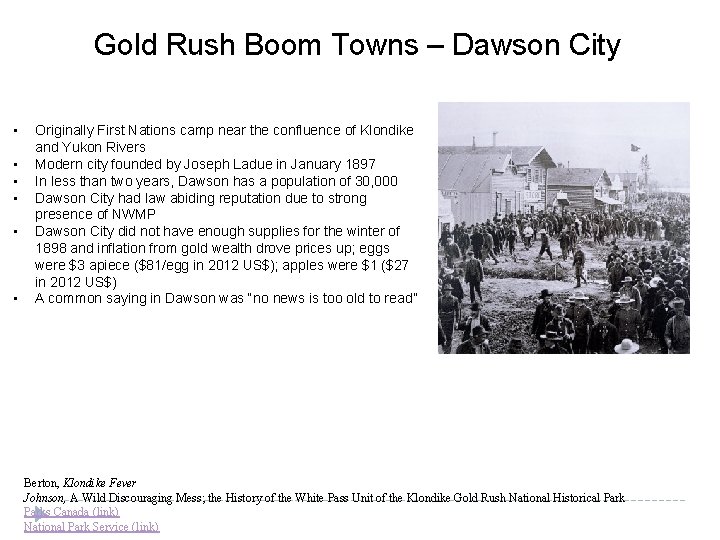
Gold Rush Boom Towns – Dawson City • • • Originally First Nations camp near the confluence of Klondike and Yukon Rivers Modern city founded by Joseph Ladue in January 1897 In less than two years, Dawson has a population of 30, 000 Dawson City had law abiding reputation due to strong presence of NWMP Dawson City did not have enough supplies for the winter of 1898 and inflation from gold wealth drove prices up; eggs were $3 apiece ($81/egg in 2012 US$); apples were $1 ($27 in 2012 US$) A common saying in Dawson was “no news is too old to read” Berton, Klondike Fever Johnson, A Wild Discouraging Mess; the History of the White Pass Unit of the Klondike Gold Rush National Historical Parks Canada (link) National Park Service (link)
Klondike Gold Rush Timeline • • • • 1886 – William Moore arrives in Skagway August 16, 1896 – George Carmack, Skookum Jim, and Dawson Charley discover gold Mid July 1897 – S. S. Excelsior and S. S. Portland arrive in San Francisco and Seattle, respectively, carrying $1. 1 million in Klondike gold ($30 million in 2012 US$) Late July 1897 – first stampeders arrive in Skagway and Dyea September 1897 – White Pass Trail becomes impassable, stranding thousands and creating tent cities Winter 1897 – Soapy Smith arrives in Skagway February 1898 – Northwest Mounted Police take control of summit; Samuel Steele institutes One Ton Rule April 1898 – Palm Sunday Avalanche kills at least 60 on Chilkoot Trail May 29, 1898 – 800 boats leave shores on Lake Bennett on break-up day; a total of 7, 000 boats would follow soon after July 1898 – 10, 000 claims have already been staked in the Klondike; Dawson City, a wilderness less than two years earlier, is now home to 30, 000 July 8, 1898 – Soapy Smith shot and killed by Frank Reid September 1898 – “Three Lucky Swedes” strike gold in Nome, prompting many to abandon Klondike and move west July 29, 1900 – White Pass & Yukon Route Railroad is completed after only 2 years, 2 months, and 2 days of work Berton, Klondike Fever Johnson, A Wild Discouraging Mess; the History of the White Pass Unit of the Klondike Gold Rush National Historical Park White Pass & Yukon Route (link) Smithsonian Institute (link) University of Washington (link)
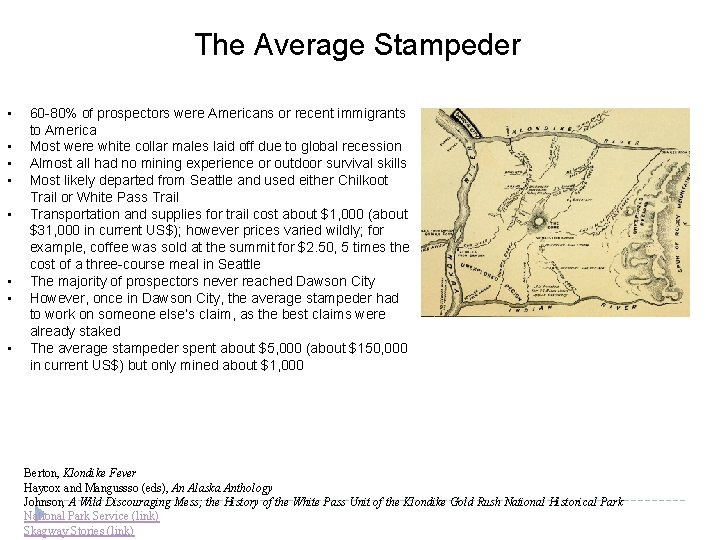
The Average Stampeder • • 60 -80% of prospectors were Americans or recent immigrants to America Most were white collar males laid off due to global recession Almost all had no mining experience or outdoor survival skills Most likely departed from Seattle and used either Chilkoot Trail or White Pass Trail Transportation and supplies for trail cost about $1, 000 (about $31, 000 in current US$); however prices varied wildly; for example, coffee was sold at the summit for $2. 50, 5 times the cost of a three-course meal in Seattle The majority of prospectors never reached Dawson City However, once in Dawson City, the average stampeder had to work on someone else’s claim, as the best claims were already staked The average stampeder spent about $5, 000 (about $150, 000 in current US$) but only mined about $1, 000 Berton, Klondike Fever Haycox and Mangussso (eds), An Alaska Anthology Johnson, A Wild Discouraging Mess; the History of the White Pass Unit of the Klondike Gold Rush National Historical Park National Park Service (link) Skagway Stories (link)
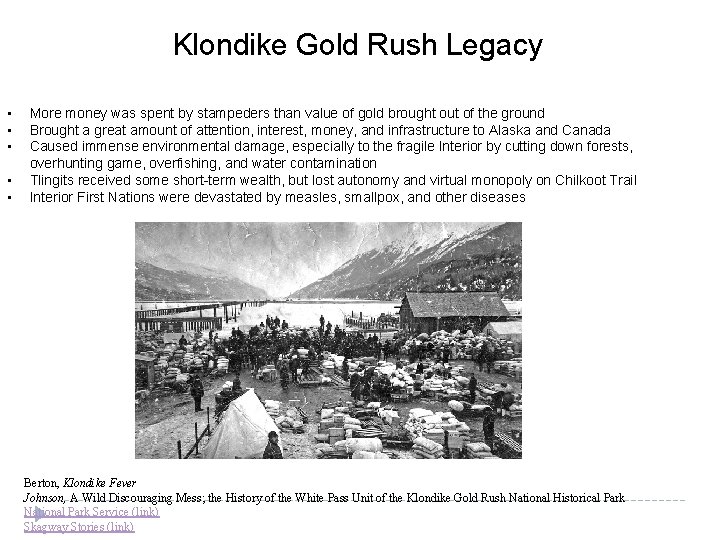
Klondike Gold Rush Legacy • • • More money was spent by stampeders than value of gold brought out of the ground Brought a great amount of attention, interest, money, and infrastructure to Alaska and Canada Caused immense environmental damage, especially to the fragile Interior by cutting down forests, overhunting game, overfishing, and water contamination Tlingits received some short-term wealth, but lost autonomy and virtual monopoly on Chilkoot Trail Interior First Nations were devastated by measles, smallpox, and other diseases Berton, Klondike Fever Johnson, A Wild Discouraging Mess; the History of the White Pass Unit of the Klondike Gold Rush National Historical Park National Park Service (link) Skagway Stories (link)
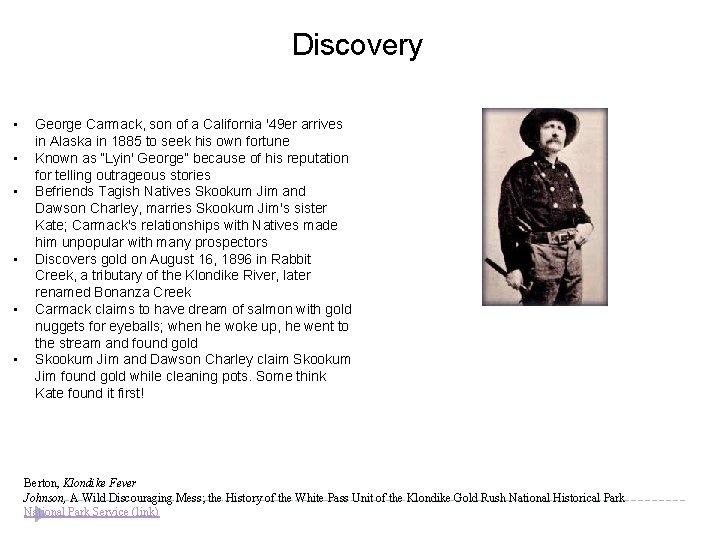
Discovery • • • George Carmack, son of a California '49 er arrives in Alaska in 1885 to seek his own fortune Known as “Lyin' George” because of his reputation for telling outrageous stories Befriends Tagish Natives Skookum Jim and Dawson Charley, marries Skookum Jim's sister Kate; Carmack's relationships with Natives made him unpopular with many prospectors Discovers gold on August 16, 1896 in Rabbit Creek, a tributary of the Klondike River, later renamed Bonanza Creek Carmack claims to have dream of salmon with gold nuggets for eyeballs; when he woke up, he went to the stream and found gold Skookum Jim and Dawson Charley claim Skookum Jim found gold while cleaning pots. Some think Kate found it first! Berton, Klondike Fever Johnson, A Wild Discouraging Mess; the History of the White Pass Unit of the Klondike Gold Rush National Historical Park National Park Service (link)
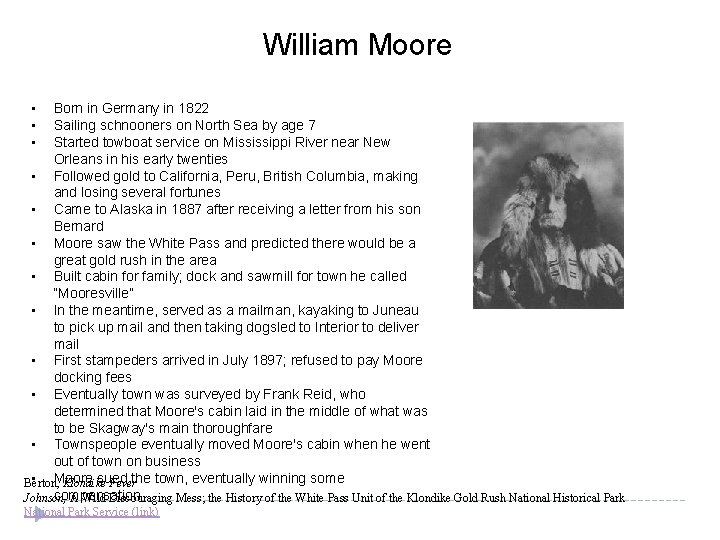
William Moore • • • Born in Germany in 1822 Sailing schnooners on North Sea by age 7 Started towboat service on Mississippi River near New Orleans in his early twenties • Followed gold to California, Peru, British Columbia, making and losing several fortunes • Came to Alaska in 1887 after receiving a letter from his son Bernard • Moore saw the White Pass and predicted there would be a great gold rush in the area • Built cabin for family; dock and sawmill for town he called “Mooresville” • In the meantime, served as a mailman, kayaking to Juneau to pick up mail and then taking dogsled to Interior to deliver mail • First stampeders arrived in July 1897; refused to pay Moore docking fees • Eventually town was surveyed by Frank Reid, who determined that Moore's cabin laid in the middle of what was to be Skagway's main thoroughfare • Townspeople eventually moved Moore's cabin when he went out of town on business • Moore sued Berton, Klondike Feverthe town, eventually winning some compensation Johnson, A Wild Discouraging Mess; the History of the White Pass Unit of the Klondike Gold Rush National Historical Park National Park Service (link)
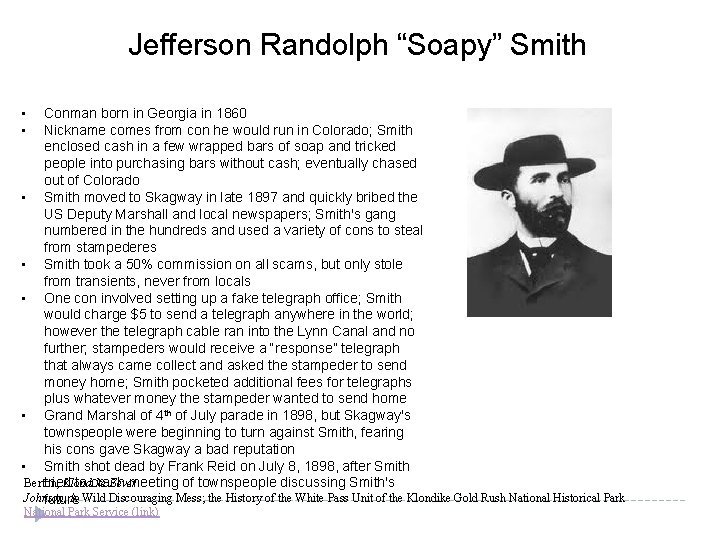
Jefferson Randolph “Soapy” Smith • • Conman born in Georgia in 1860 Nickname comes from con he would run in Colorado; Smith enclosed cash in a few wrapped bars of soap and tricked people into purchasing bars without cash; eventually chased out of Colorado • Smith moved to Skagway in late 1897 and quickly bribed the US Deputy Marshall and local newspapers; Smith's gang numbered in the hundreds and used a variety of cons to steal from stampederes • Smith took a 50% commission on all scams, but only stole from transients, never from locals • One con involved setting up a fake telegraph office; Smith would charge $5 to send a telegraph anywhere in the world; however the telegraph cable ran into the Lynn Canal and no further; stampeders would receive a “response” telegraph that always came collect and asked the stampeder to send money home; Smith pocketed additional fees for telegraphs plus whatever money the stampeder wanted to send home • Grand Marshal of 4 th of July parade in 1898, but Skagway's townspeople were beginning to turn against Smith, fearing his cons gave Skagway a bad reputation • Smith shot dead by Frank Reid on July 8, 1898, after Smith Berton, Klondike Fever tried to crash meeting of townspeople discussing Smith's Johnson, A Wild Discouraging Mess; the History of the White Pass Unit of the Klondike Gold Rush National Historical Park future National Park Service (link)
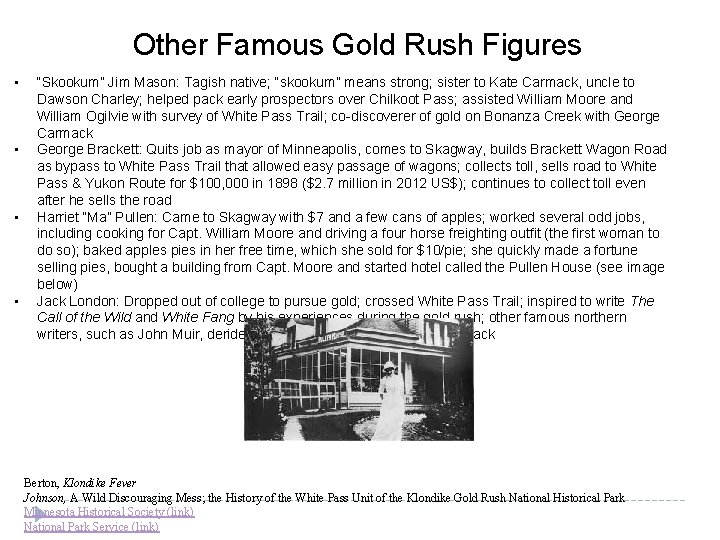
Other Famous Gold Rush Figures • • “Skookum” Jim Mason: Tagish native; “skookum” means strong; sister to Kate Carmack, uncle to Dawson Charley; helped pack early prospectors over Chilkoot Pass; assisted William Moore and William Ogilvie with survey of White Pass Trail; co-discoverer of gold on Bonanza Creek with George Carmack George Brackett: Quits job as mayor of Minneapolis, comes to Skagway, builds Brackett Wagon Road as bypass to White Pass Trail that allowed easy passage of wagons; collects toll, sells road to White Pass & Yukon Route for $100, 000 in 1898 ($2. 7 million in 2012 US$); continues to collect toll even after he sells the road Harriet “Ma” Pullen: Came to Skagway with $7 and a few cans of apples; worked several odd jobs, including cooking for Capt. William Moore and driving a four horse freighting outfit (the first woman to do so); baked apples pies in her free time, which she sold for $10/pie; she quickly made a fortune selling pies, bought a building from Capt. Moore and started hotel called the Pullen House (see image below) Jack London: Dropped out of college to pursue gold; crossed White Pass Trail; inspired to write The Call of the Wild and White Fang by his experiences during the gold rush; other famous northern writers, such as John Muir, derided London as a “nature faker” and a hack Berton, Klondike Fever Johnson, A Wild Discouraging Mess; the History of the White Pass Unit of the Klondike Gold Rush National Historical Park Minnesota Historical Society (link) National Park Service (link)
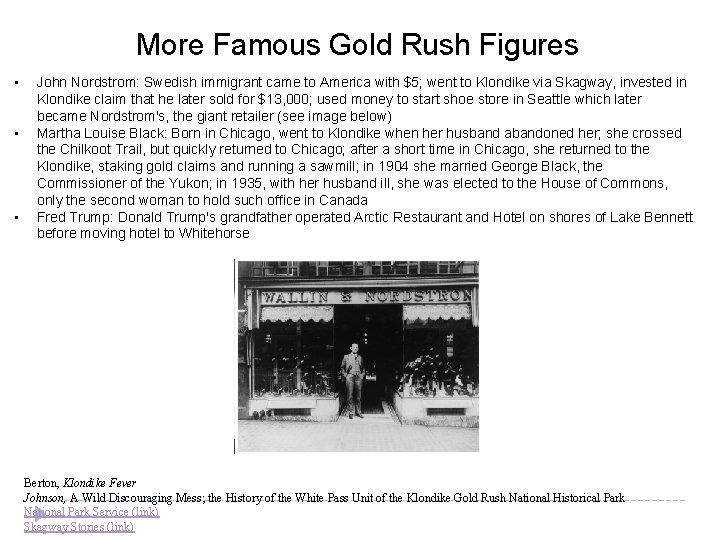
More Famous Gold Rush Figures • • • John Nordstrom: Swedish immigrant came to America with $5; went to Klondike via Skagway, invested in Klondike claim that he later sold for $13, 000; used money to start shoe store in Seattle which later became Nordstrom's, the giant retailer (see image below) Martha Louise Black: Born in Chicago, went to Klondike when her husband abandoned her; she crossed the Chilkoot Trail, but quickly returned to Chicago; after a short time in Chicago, she returned to the Klondike, staking gold claims and running a sawmill; in 1904 she married George Black, the Commissioner of the Yukon; in 1935, with her husband ill, she was elected to the House of Commons, only the second woman to hold such office in Canada Fred Trump: Donald Trump's grandfather operated Arctic Restaurant and Hotel on shores of Lake Bennett before moving hotel to Whitehorse Berton, Klondike Fever Johnson, A Wild Discouraging Mess; the History of the White Pass Unit of the Klondike Gold Rush National Historical Park National Park Service (link) Skagway Stories (link)
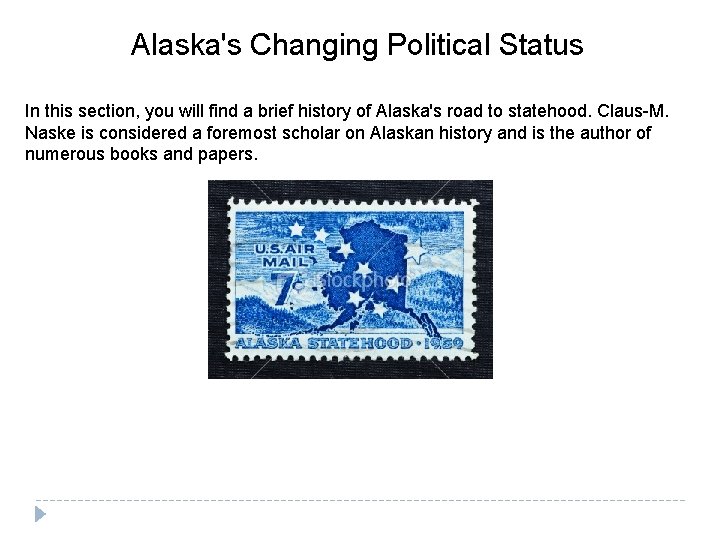
Alaska's Changing Political Status In this section, you will find a brief history of Alaska's road to statehood. Claus-M. Naske is considered a foremost scholar on Alaskan history and is the author of numerous books and papers.
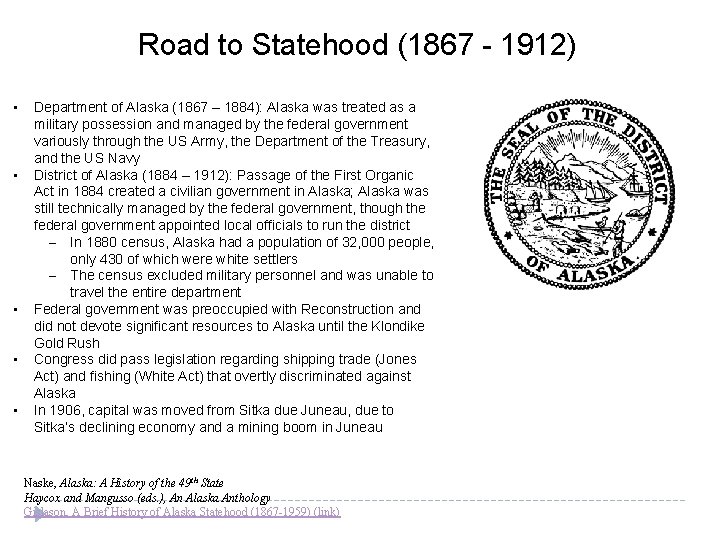
Road to Statehood (1867 - 1912) • • • Department of Alaska (1867 – 1884): Alaska was treated as a military possession and managed by the federal government variously through the US Army, the Department of the Treasury, and the US Navy District of Alaska (1884 – 1912): Passage of the First Organic Act in 1884 created a civilian government in Alaska; Alaska was still technically managed by the federal government, though the federal government appointed local officials to run the district – In 1880 census, Alaska had a population of 32, 000 people, only 430 of which were white settlers – The census excluded military personnel and was unable to travel the entire department Federal government was preoccupied with Reconstruction and did not devote significant resources to Alaska until the Klondike Gold Rush Congress did pass legislation regarding shipping trade (Jones Act) and fishing (White Act) that overtly discriminated against Alaska In 1906, capital was moved from Sitka due Juneau, due to Sitka’s declining economy and a mining boom in Juneau Naske, Alaska: A History of the 49 th State Haycox and Mangusso (eds. ), An Alaska Anthology Gislason, A Brief History of Alaska Statehood (1867 -1959) (link)
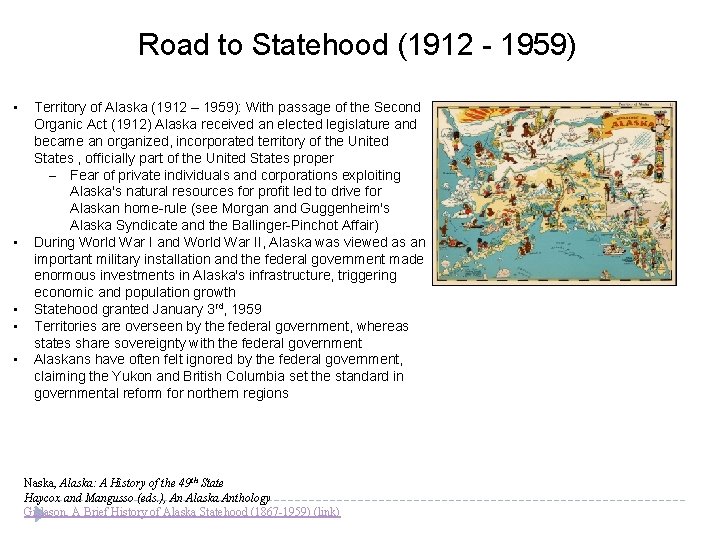
Road to Statehood (1912 - 1959) • • • Territory of Alaska (1912 – 1959): With passage of the Second Organic Act (1912) Alaska received an elected legislature and became an organized, incorporated territory of the United States , officially part of the United States proper – Fear of private individuals and corporations exploiting Alaska's natural resources for profit led to drive for Alaskan home-rule (see Morgan and Guggenheim's Alaska Syndicate and the Ballinger-Pinchot Affair) During World War I and World War II, Alaska was viewed as an important military installation and the federal government made enormous investments in Alaska's infrastructure, triggering economic and population growth Statehood granted January 3 rd, 1959 Territories are overseen by the federal government, whereas states share sovereignty with the federal government Alaskans have often felt ignored by the federal government, claiming the Yukon and British Columbia set the standard in governmental reform for northern regions Naska, Alaska: A History of the 49 th State Haycox and Mangusso (eds. ), An Alaska Anthology Gislason, A Brief History of Alaska Statehood (1867 -1959) (link)
Alaska Day • • • The United States flag was raised officially raised in Sitka on October 18, 1867; the day is now celebrated as Alaska Day After purchase by the United States, Alaska changed from the Julian calendar to the Gregorian calendar With the calendar switch, Alaska followed Friday, October 6, 1867 with Friday, October 18, 1867 Naska, Alaska: A History of the 49 th State Alaska Day Festival (link)