
Rural transformation and nutrition transition Same pathways different
- Slides: 23
Rural transformation and nutrition transition: Same pathways, different speeds? Will Masters Friedman School of Nutrition Science & Policy and Department of Economics, Tufts University http: //nutrition. tufts. edu/profile/william-masters With Winnie Bell and Keith Lividini, Ph. D candidates at Tufts University CGIAR Research Program on Policies, Institutions and Markets Workshop on Rural Transformation in the 21 st Century Vancouver, BC – 28 July 2018
Rural transformation and nutrition transition: Same pathways, different speeds? All data shown are national totals Aim is “factfulness” (Rosling), to see both forest and trees
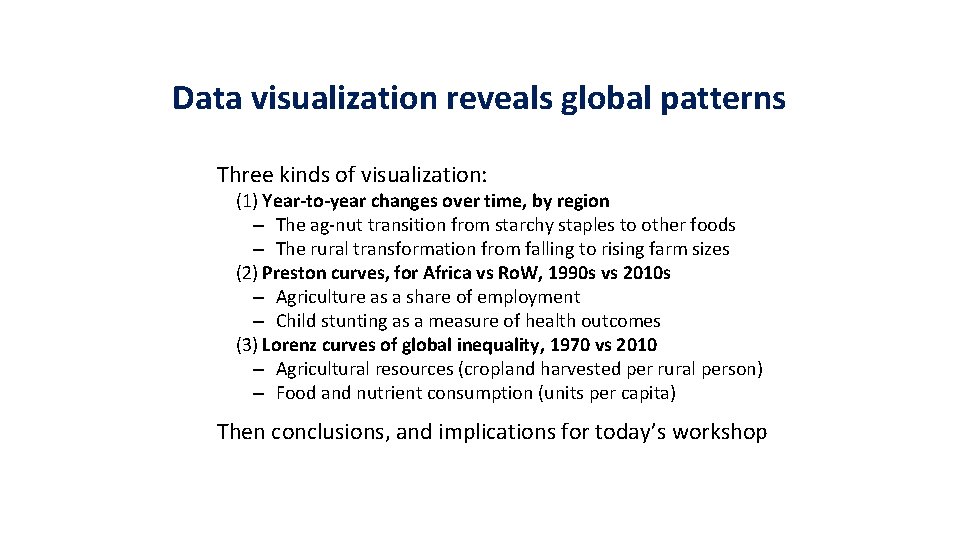
Data visualization reveals global patterns Three kinds of visualization: (1) Year-to-year changes over time, by region – The ag-nut transition from starchy staples to other foods – The rural transformation from falling to rising farm sizes (2) Preston curves, for Africa vs Ro. W, 1990 s vs 2010 s – Agriculture as a share of employment – Child stunting as a measure of health outcomes (3) Lorenz curves of global inequality, 1970 vs 2010 – Agricultural resources (cropland harvested per rural person) – Food and nutrient consumption (units per capita) Then conclusions, and implications for today’s workshop
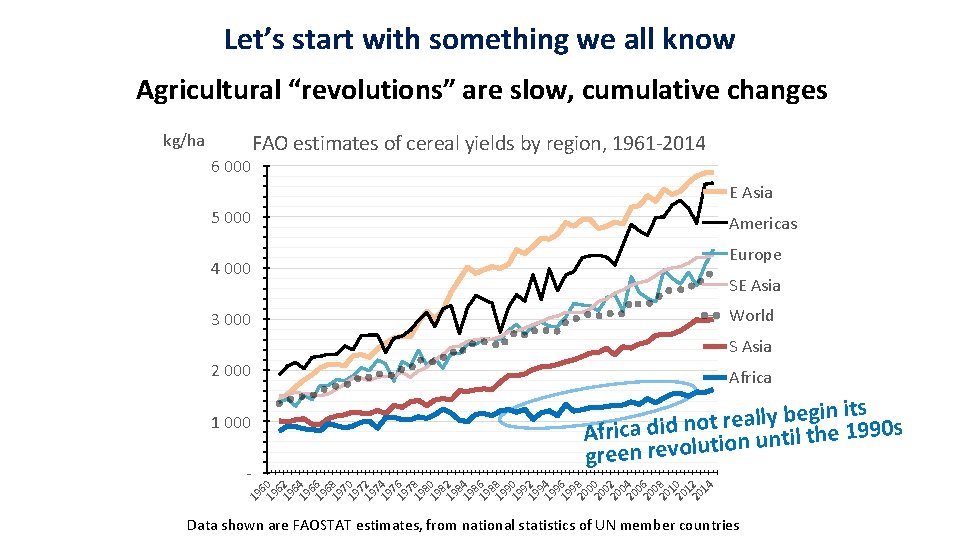
Let’s start with something we all know Agricultural “revolutions” are slow, cumulative changes kg/ha 6 000 FAO estimates of cereal yields by region, 1961 -2014 E Asia 5 000 Americas Europe 4 000 SE Asia World 3 000 S Asia 2 000 1 000 its n i g e b y l l a e r Africa did nottion until the 1990 s green revolu 19 6 19 0 6 19 2 6 19 4 6 19 6 6 19 8 7 19 0 7 19 2 7 19 4 7 19 6 7 19 8 8 19 0 8 19 2 8 19 4 8 19 6 8 19 8 9 19 0 9 19 2 9 19 4 9 19 6 9 20 8 0 20 0 0 20 2 0 20 4 0 20 6 0 20 8 1 20 0 1 20 2 14 - Africa Data shown are FAOSTAT estimates, from national statistics of UN member countries
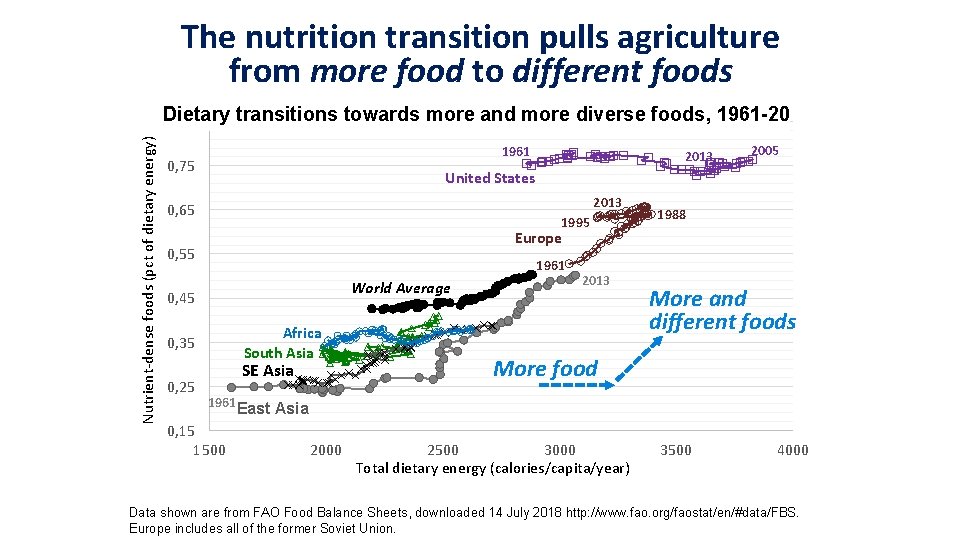
The nutrition transition pulls agriculture from more food to different foods Nutrient-dense foods (pct of dietary energy) Dietary transitions towards more and more diverse foods, 1961 -2013 0, 85 1961 0, 75 2005 United States 2013 0, 65 1995 1988 Europe 0, 55 1961 World Average 0, 45 Africa South Asia 0, 35 0, 25 2013 SE Asia 2013 More and different foods More food 1961 East Asia 0, 15 1500 2000 2500 3000 Total dietary energy (calories/capita/year) 3500 4000 Data shown are from FAO Food Balance Sheets, downloaded 14 July 2018 http: //www. fao. org/faostat/en/#data/FBS. Europe includes all of the former Soviet Union.
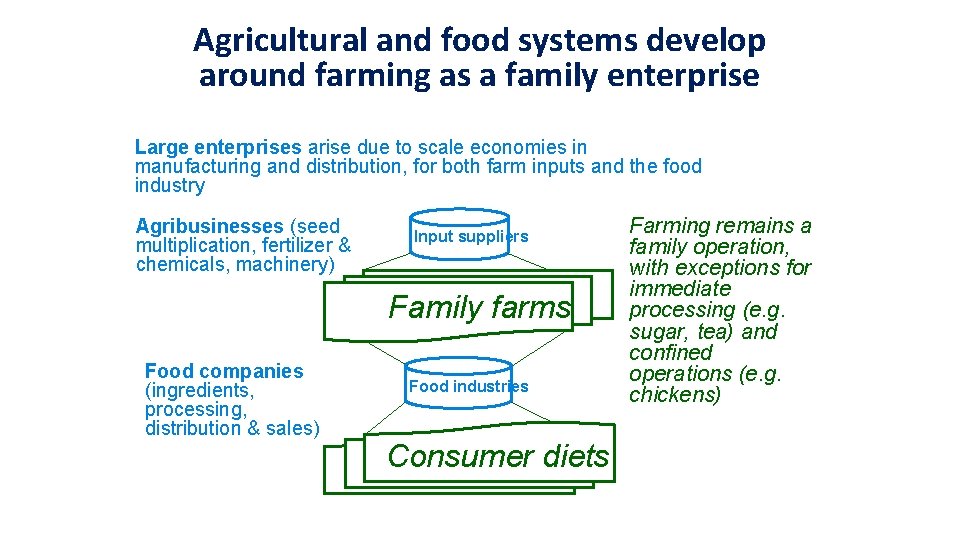
Agricultural and food systems develop around farming as a family enterprise Large enterprises arise due to scale economies in manufacturing and distribution, for both farm inputs and the food industry Agribusinesses (seed multiplication, fertilizer & chemicals, machinery) Input suppliers Family farms Food companies (ingredients, processing, distribution & sales) Food industries Consumer diets Farming remains a family operation, with exceptions for immediate processing (e. g. sugar, tea) and confined operations (e. g. chickens)
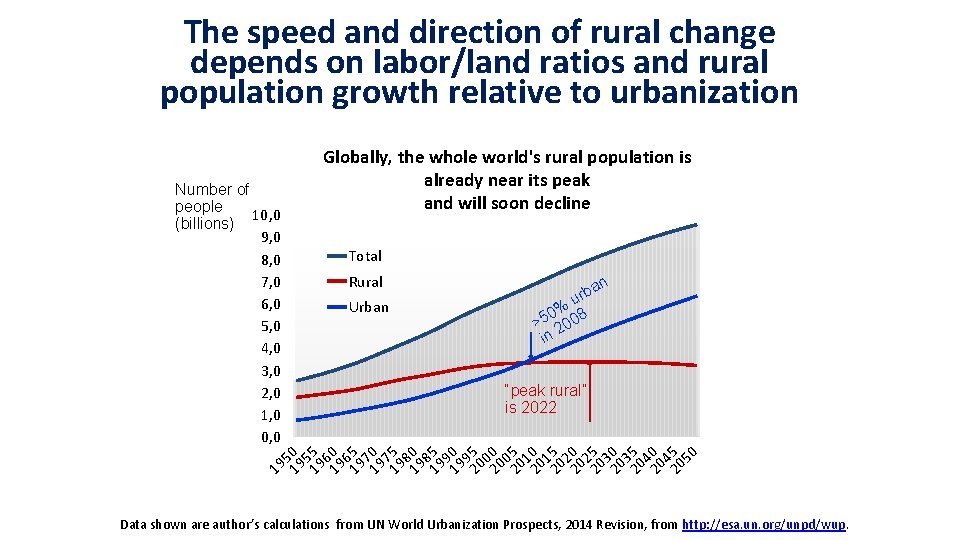
The speed and direction of rural change depends on labor/land ratios and rural population growth relative to urbanization Total Rural Urban n a urb 0% 08 5 > 20 in “peak rural” is 2022 19 5 19 0 5 19 5 6 19 0 6 19 5 7 19 0 7 19 5 8 19 0 8 19 5 9 19 0 9 20 5 0 20 0 0 20 5 1 20 0 1 20 5 2 20 0 2 20 5 3 20 0 3 20 5 4 20 0 4 20 5 50 Number of people 10, 0 (billions) 9, 0 8, 0 7, 0 6, 0 5, 0 4, 0 3, 0 2, 0 1, 0 0, 0 Globally, the whole world's rural population is already near its peak and will soon decline Data shown are author’s calculations from UN World Urbanization Prospects, 2014 Revision, from http: //esa. un. org/unpd/wup.
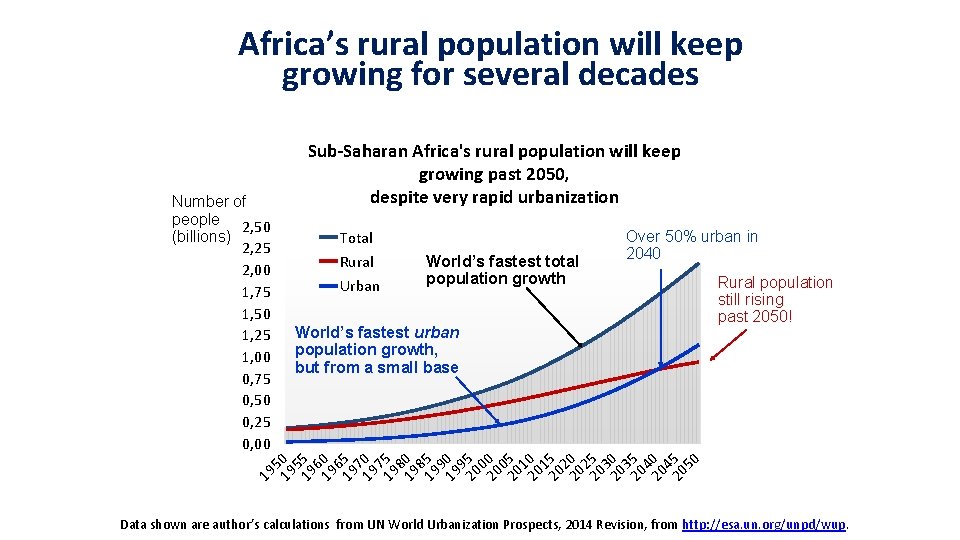
Africa’s rural population will keep growing for several decades Total Rural Urban World’s fastest total population growth Over 50% urban in 2040 World’s fastest urban population growth, but from a small base Rural population still rising past 2050! 19 5 19 0 5 19 5 6 19 0 6 19 5 7 19 0 7 19 5 8 19 0 8 19 5 9 19 0 9 20 5 0 20 0 0 20 5 1 20 0 1 20 5 2 20 0 2 20 5 3 20 0 3 20 5 4 20 0 4 20 5 50 Number of people 2, 50 (billions) 2, 25 2, 00 1, 75 1, 50 1, 25 1, 00 0, 75 0, 50 0, 25 0, 00 Sub-Saharan Africa's rural population will keep growing past 2050, despite very rapid urbanization Data shown are author’s calculations from UN World Urbanization Prospects, 2014 Revision, from http: //esa. un. org/unpd/wup.
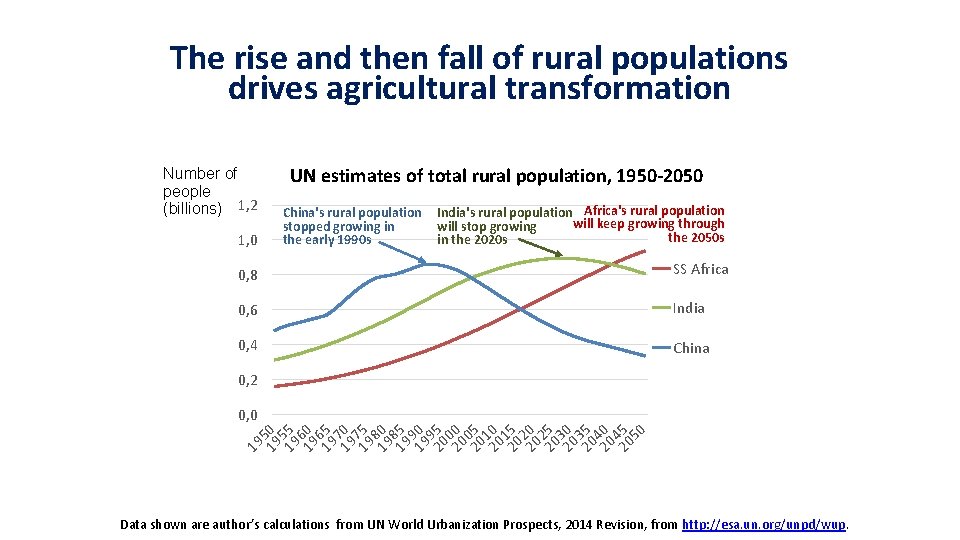
The rise and then fall of rural populations drives agricultural transformation Number of people (billions) 1, 2 1, 0 UN estimates of total rural population, 1950 -2050 China's rural population stopped growing in the early 1990 s India's rural population Africa's rural population will keep growing through will stop growing the 2050 s in the 2020 s 0, 8 SS Africa 0, 6 India 0, 4 China 0, 2 19 1950 1955 1960 1965 1970 1975 1980 1985 1990 2095 2000 2005 2010 2015 2020 2025 2030 2035 2040 2045 50 0, 0 Data shown are author’s calculations from UN World Urbanization Prospects, 2014 Revision, from http: //esa. un. org/unpd/wup.
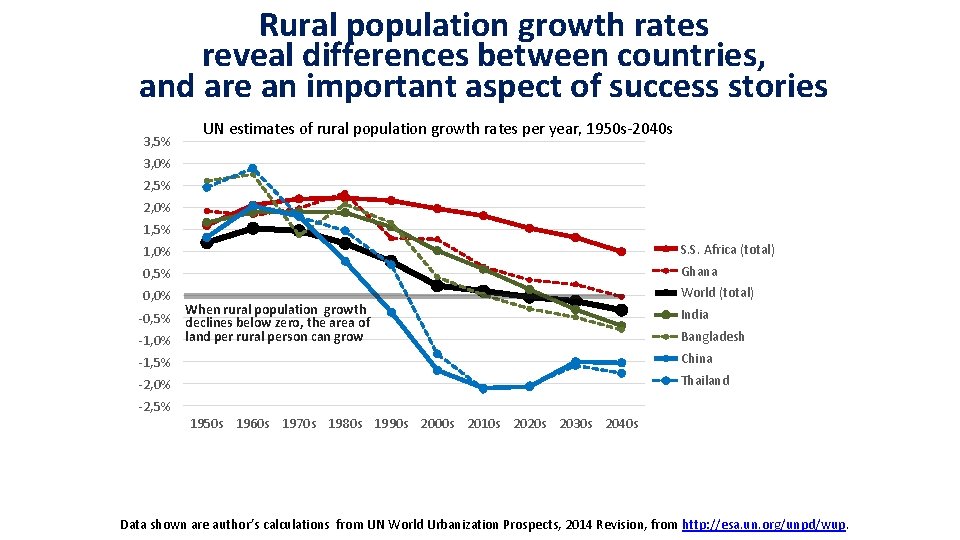
Rural population growth rates reveal differences between countries, and are an important aspect of success stories 3, 5% UN estimates of rural population growth rates per year, 1950 s-2040 s 3, 0% 2, 5% 2, 0% 1, 5% 1, 0% S. S. Africa (total) 0, 5% Ghana 0, 0% World (total) -0, 5% -1, 0% When rural population growth declines below zero, the area of land per rural person can grow India Bangladesh -1, 5% China -2, 0% Thailand -2, 5% 1950 s 1960 s 1970 s 1980 s 1990 s 2000 s 2010 s 2020 s 2030 s 2040 s Data shown are author’s calculations from UN World Urbanization Prospects, 2014 Revision, from http: //esa. un. org/unpd/wup.
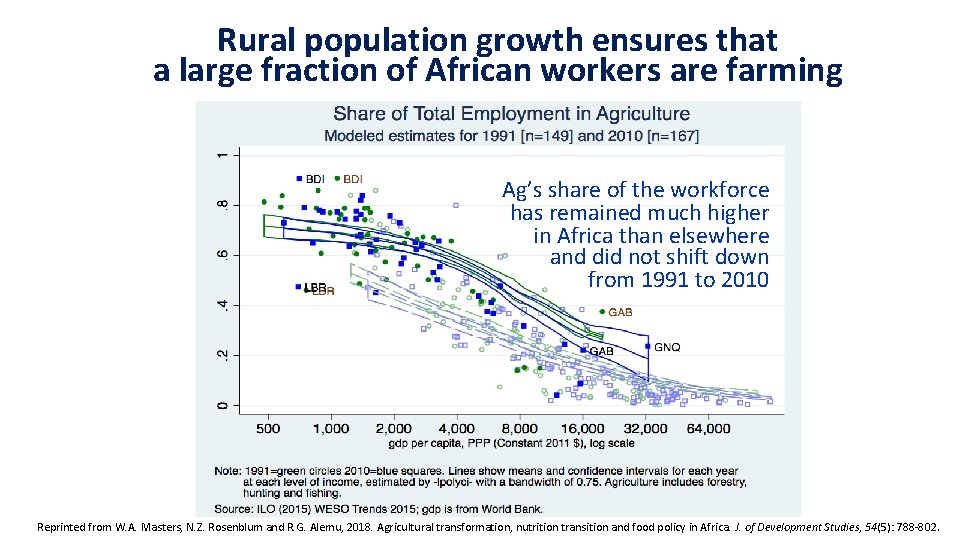
Rural population growth ensures that a large fraction of African workers are farming Ag’s share of the workforce has remained much higher in Africa than elsewhere and did not shift down from 1991 to 2010 Reprinted from W. A. Masters, N. Z. Rosenblum and R. G. Alemu, 2018. Agricultural transformation, nutrition transition and food policy in Africa. J. of Development Studies, 54(5): 788 -802.
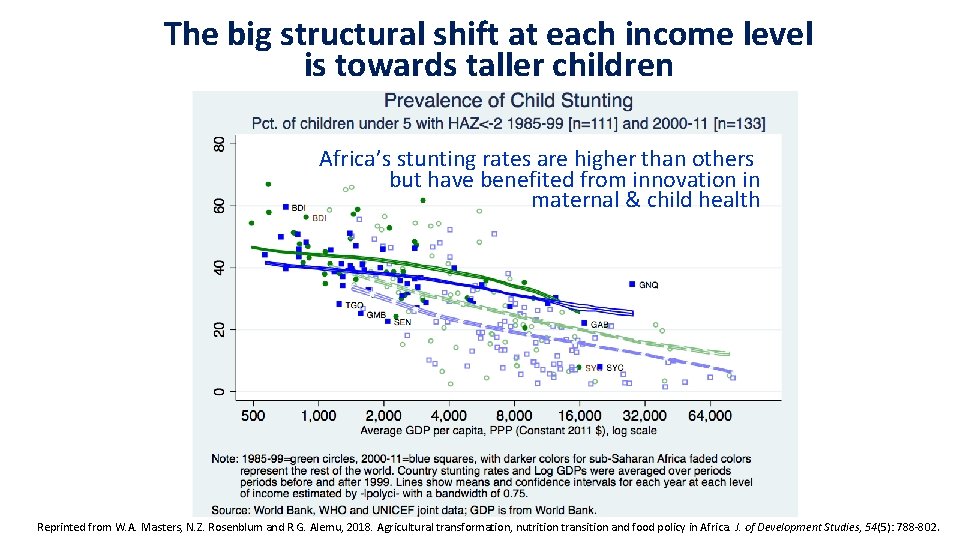
The big structural shift at each income level is towards taller children Africa’s stunting rates are higher than others but have benefited from innovation in maternal & child health Reprinted from W. A. Masters, N. Z. Rosenblum and R. G. Alemu, 2018. Agricultural transformation, nutrition transition and food policy in Africa. J. of Development Studies, 54(5): 788 -802.
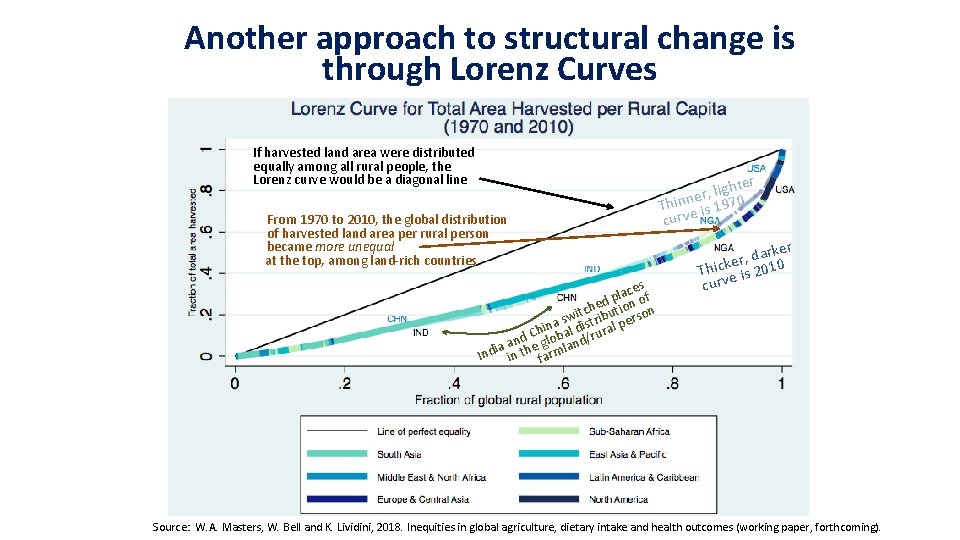
Another approach to structural change is through Lorenz Curves If harvested land area were distributed equally among all rural people, the Lorenz curve would be a diagonal line From 1970 to 2010, the global distribution of harvested land area per rural person became more unequal at the top, among land-rich countries s laceof p d chebution son t i w i r na s l distr ral pe i h d C globa nd/ru n a e la ia Ind in th farm hter g i l , r e Thinne is 1970 curv ker r a d , er Thicke is 2010 curv Source: W. A. Masters, W. Bell and K. Lividini, 2018. Inequities in global agriculture, dietary intake and health outcomes (working paper, forthcoming).
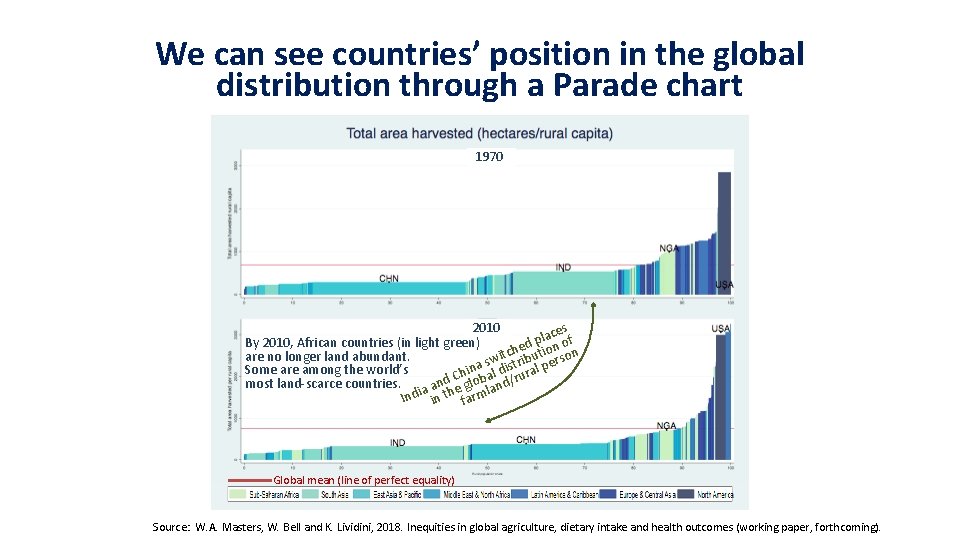
We can see countries’ position in the global distribution through a Parade chart 1970 2010 s laceof p By 2010, African countries (in light green) d chebution son t i are no longer land abundant. w i r na s l distr ral pe Some are among the world’s i h C ba ru most land-scarce countries. andhe glo land/ a i Ind in t farm Global mean (line of perfect equality) Source: W. A. Masters, W. Bell and K. Lividini, 2018. Inequities in global agriculture, dietary intake and health outcomes (working paper, forthcoming).
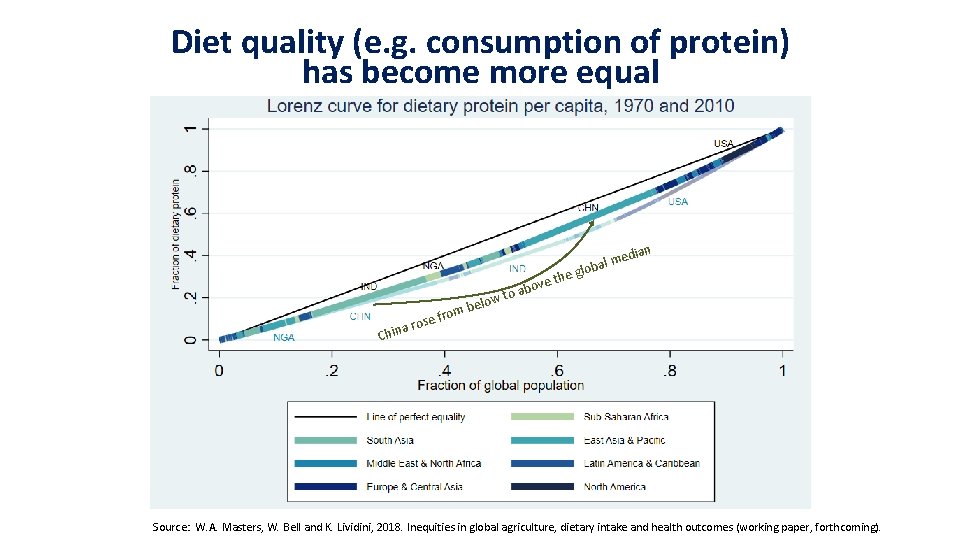
Diet quality (e. g. consumption of protein) has become more equal fr ose r a n i low m be the bove gl me obal dian to a o Ch Source: W. A. Masters, W. Bell and K. Lividini, 2018. Inequities in global agriculture, dietary intake and health outcomes (working paper, forthcoming).
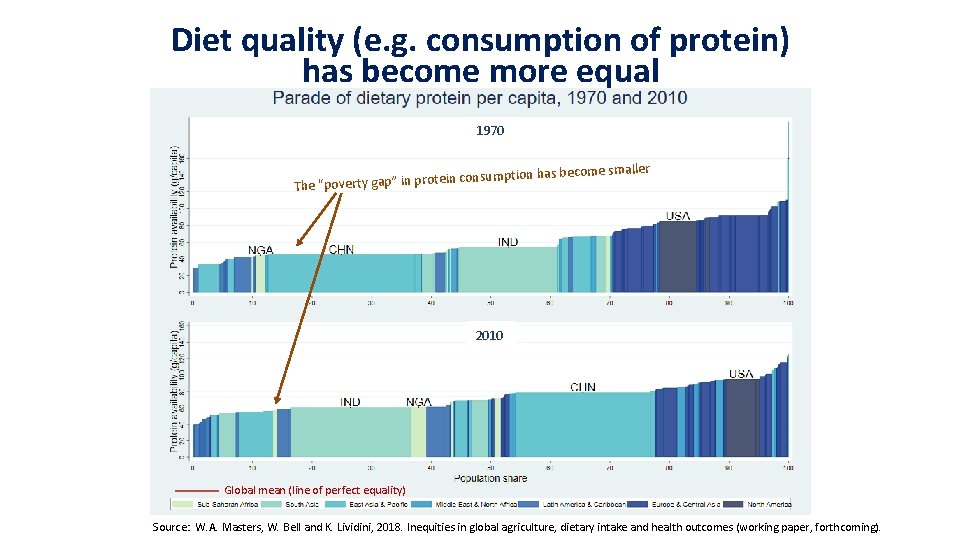
Diet quality (e. g. consumption of protein) has become more equal 1970 r ption has become smalle ein consum The “poverty gap” in prot 2010 Global mean (line of perfect equality) Source: W. A. Masters, W. Bell and K. Lividini, 2018. Inequities in global agriculture, dietary intake and health outcomes (working paper, forthcoming).
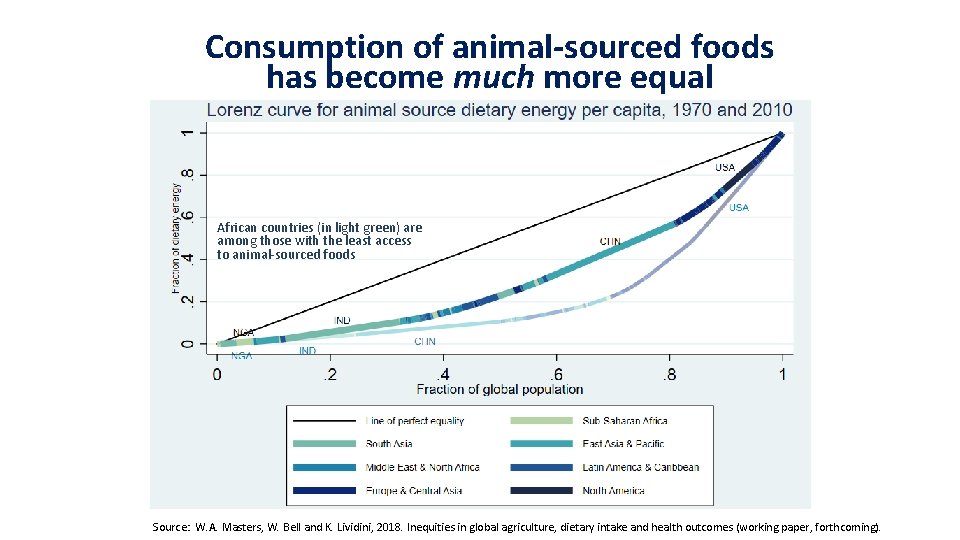
Consumption of animal-sourced foods has become much more equal African countries (in light green) are among those with the least access to animal-sourced foods Source: W. A. Masters, W. Bell and K. Lividini, 2018. Inequities in global agriculture, dietary intake and health outcomes (working paper, forthcoming).
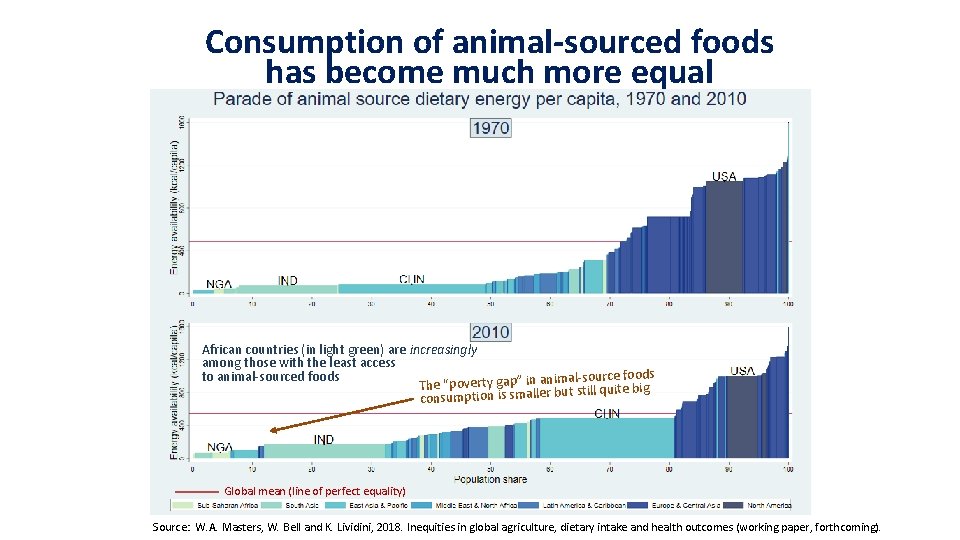
Consumption of animal-sourced foods has become much more equal African countries (in light green) are increasingly among those with the least access to animal-sourced foods imal-source foods The “poverty gap” in an t still quite big consumption is smaller bu Global mean (line of perfect equality) Source: W. A. Masters, W. Bell and K. Lividini, 2018. Inequities in global agriculture, dietary intake and health outcomes (working paper, forthcoming).
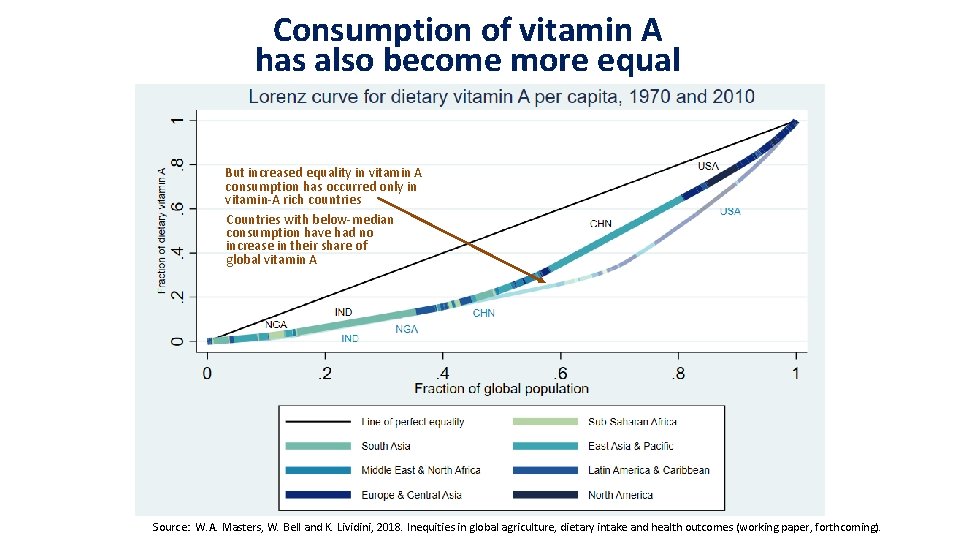
Consumption of vitamin A has also become more equal But increased equality in vitamin A consumption has occurred only in vitamin-A rich countries Countries with below-median consumption have had no increase in their share of global vitamin A Source: W. A. Masters, W. Bell and K. Lividini, 2018. Inequities in global agriculture, dietary intake and health outcomes (working paper, forthcoming).
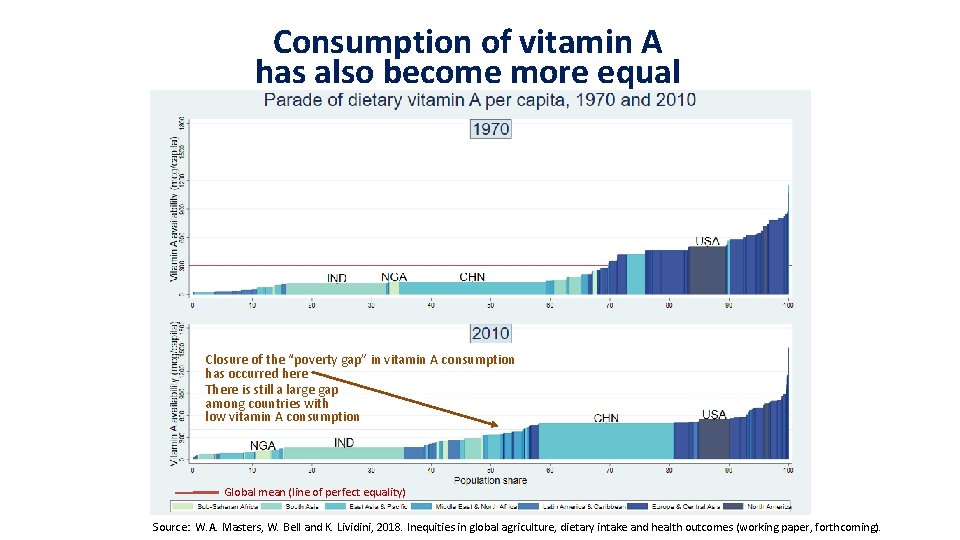
Consumption of vitamin A has also become more equal Closure of the “poverty gap” in vitamin A consumption has occurred here There is still a large gap among countries with low vitamin A consumption Global mean (line of perfect equality) Source: W. A. Masters, W. Bell and K. Lividini, 2018. Inequities in global agriculture, dietary intake and health outcomes (working paper, forthcoming).
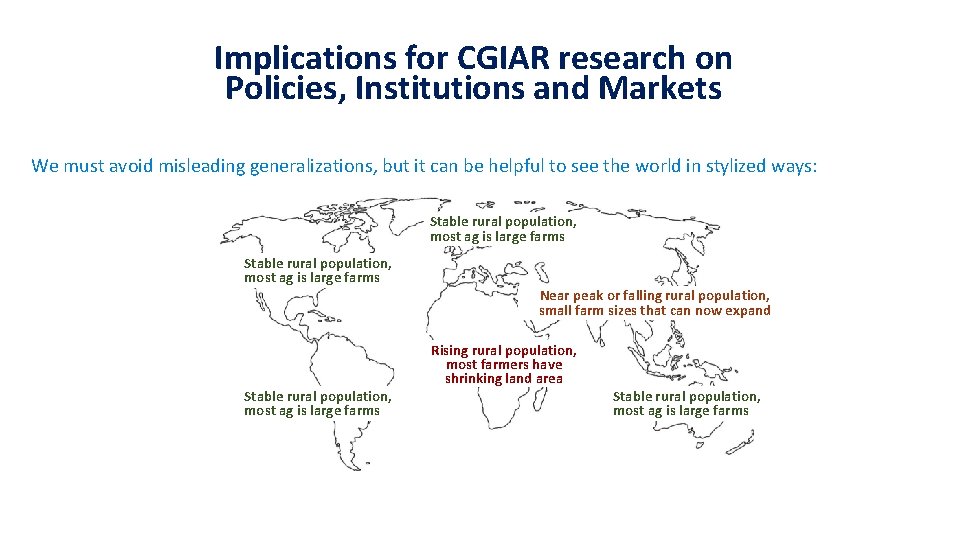
Implications for CGIAR research on Policies, Institutions and Markets We must avoid misleading generalizations, but it can be helpful to see the world in stylized ways: Stable rural population, most ag is large farms Near peak or falling rural population, small farm sizes that can now expand Rising rural population, most farmers have shrinking land area Stable rural population, most ag is large farms
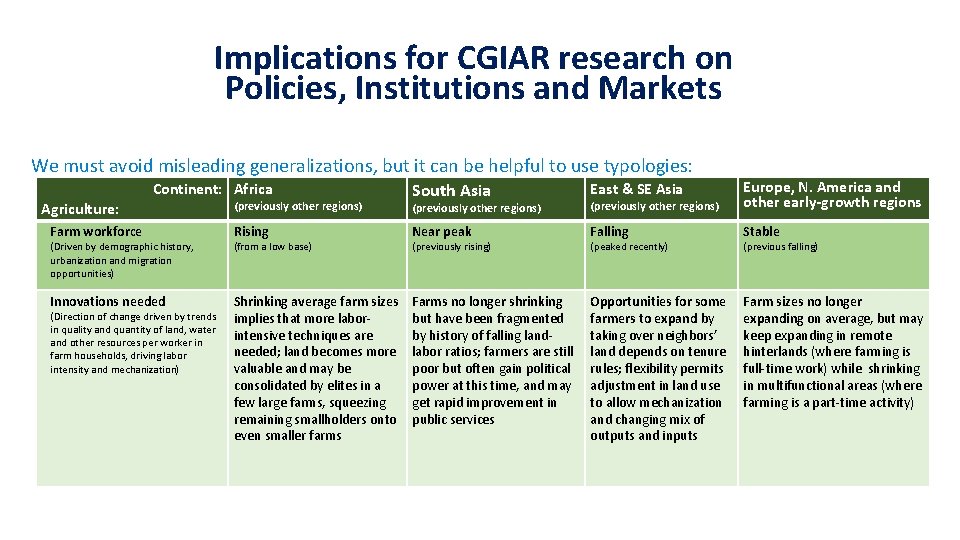
Implications for CGIAR research on Policies, Institutions and Markets We must avoid misleading generalizations, but it can be helpful to use typologies: Agriculture: Continent: Africa (previously other regions) South Asia East & SE Asia (previously other regions) Europe, N. America and other early-growth regions Farm workforce Rising Near peak Falling Stable Innovations needed Shrinking average farm sizes implies that more laborintensive techniques are needed; land becomes more valuable and may be consolidated by elites in a few large farms, squeezing remaining smallholders onto even smaller farms Farms no longer shrinking but have been fragmented by history of falling landlabor ratios; farmers are still poor but often gain political power at this time, and may get rapid improvement in public services Opportunities for some farmers to expand by taking over neighbors’ land depends on tenure rules; flexibility permits adjustment in land use to allow mechanization and changing mix of outputs and inputs Farm sizes no longer expanding on average, but may keep expanding in remote hinterlands (where farming is full-time work) while shrinking in multifunctional areas (where farming is a part-time activity) (Driven by demographic history, urbanization and migration opportunities) (Direction of change driven by trends in quality and quantity of land, water and other resources per worker in farm households, driving labor intensity and mechanization) (from a low base) (previously rising) (peaked recently) (previous falling)
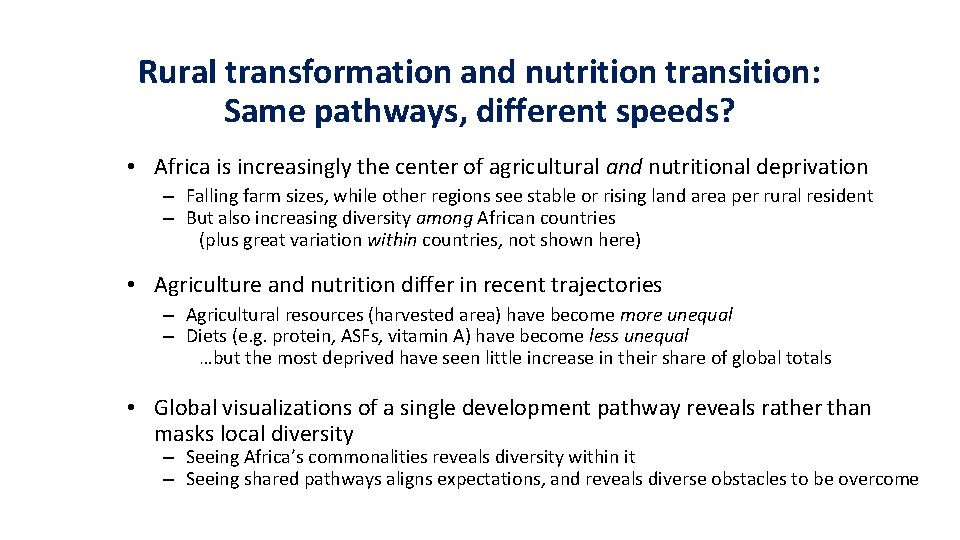
Rural transformation and nutrition transition: Same pathways, different speeds? • Africa is increasingly the center of agricultural and nutritional deprivation – Falling farm sizes, while other regions see stable or rising land area per rural resident – But also increasing diversity among African countries (plus great variation within countries, not shown here) • Agriculture and nutrition differ in recent trajectories – Agricultural resources (harvested area) have become more unequal – Diets (e. g. protein, ASFs, vitamin A) have become less unequal …but the most deprived have seen little increase in their share of global totals • Global visualizations of a single development pathway reveals rather than masks local diversity – Seeing Africa’s commonalities reveals diversity within it – Seeing shared pathways aligns expectations, and reveals diverse obstacles to be overcome