
Rural Organization 10 10 1 the traditional organic

- Slides: 27
Rural Organization 10 10. 1, the traditional, organic organization of Chinese rural life. l 10. 2, look at the rural collectives. l 10. 3, examines the second revolution in the Chinese countryside. l 10. 4, examines the emergence of rural land markets l
The Chinese village 10. 1 The national government promotes the idea of administrative village l Villages vary enormously in their level of modernization and connection to the outside world. l Chinese countryside as being loosely organized into “standard market areas”. l
Agricultural collectives 10. 2 l The most fundamental change was the organization of farmers into collectives. l Socialist economy , procure a stead supply of agricultural produce at a low relative price. l Mao famously said that Chinese” poor and blank” mean that they could be remade into socialist citizens.
Features of the agricultural collectives 10. 2. 1 l The land was pooled and worked in common. l The collective served as the basic accounting unit. l Net income was distributed to households on the basis of work points. l 大寨運動
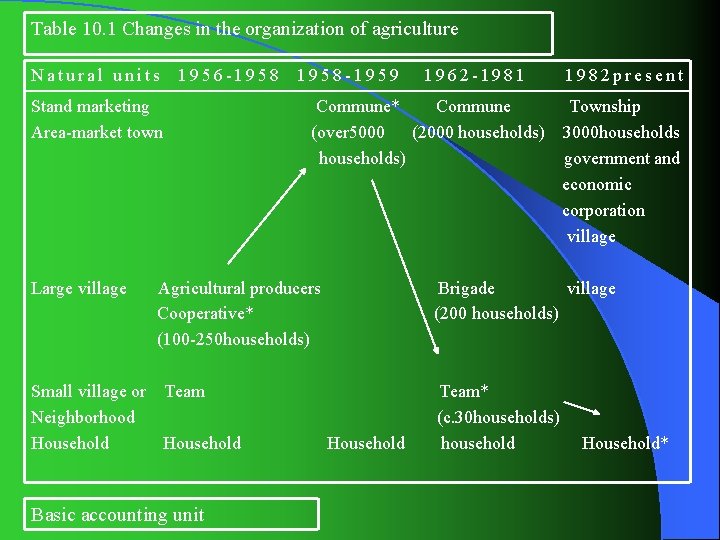
Table 10. 1 Changes in the organization of agriculture Natural units 1956 -1958 -1959 Stand marketing Area-market town Large village Commune* Commune (over 5000 (2000 households) Agricultural producers Cooperative* (100 -250 households) Small village or Team Neighborhood Household Basic accounting unit 1962 -1981 1982 present Township 3000 households government and economic corporation village Brigade village (200 households) Household Team* (c. 30 households) household Household*
Discussion of Collectives 10. 2. 2 In this task it is clear that the collectives failed. l Productive services were provided by rural credit cooperatives(RTCs) and supply and marketing cooperatives(SMCs) l The social functions of the collectives included the provision of social services l Collective registration was used to control migration and prevent population movements l
The Agricultural Policy environment of the Collectives: ”Grain First” 10. 2. 3 l The collective had little autonomy to decide how much land would b used for various kinds of crops l The additional inputs cost more than the value of the additional grain produced. l During the Cultural Revolution, areas that were not well suited to grain were pressured to grow grain anyway.
The second revolution in the countryside: Rural reform, 1979 -1984 l 10. 3 鄉村第二階段的改革: 鄉村再造 l 兩個政策的訂定 (1) an across the board increase in agricultural procurement prices. l (2) a reaffirmation of the right to self-management of collectives. l
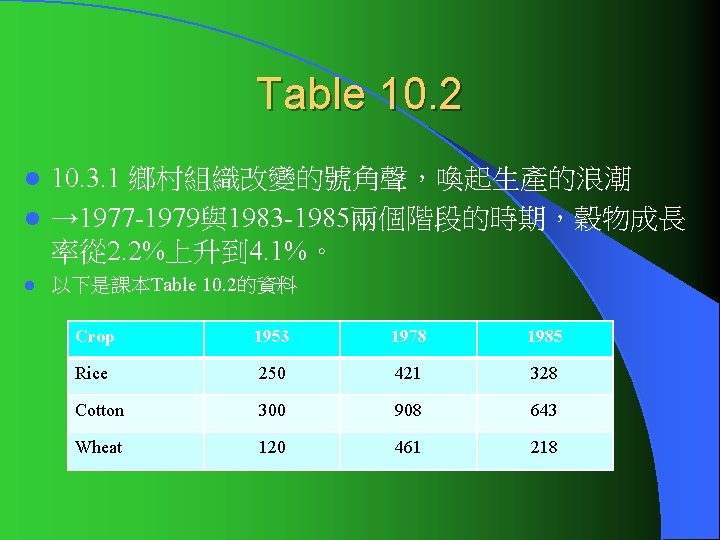
Table 10. 2 10. 3. 1 鄉村組織改變的號角聲,喚起生產的浪潮 l → 1977 -1979與1983 -1985兩個階段的時期,穀物成長 率從 2. 2%上升到 4. 1%。 l l 以下是課本Table 10. 2的資料 Crop 1953 1978 1985 Rice 250 421 328 Cotton 300 908 643 Wheat 120 461 218