
RURAL LIFE AND SOCIETY Land Revenue System Under

- Slides: 26
RURAL LIFE AND SOCIETY
�Land Revenue System Under British got Diwani rights of Bengal, Bihar, and Orissa in 1765. The major aim of British East India Company was to increase their land revenue collection. So its policies were aimed at getting maximum income from land without caring about its consequences on cultivators and peasants.
� � � � On 12 August 1765, the Mughal emperor appointed the East India Company as the Diwan of Bengal. The actual event most probably took place in Robert Clive’s tent, with a few Englishmen and Indians as witnesses. As Diwan, the Company became the chief financial administrator of the territory under its control. Now it had to think of administering the land organising its revenue resources. This had to be done in a way that could yield enough revenue to meet the growing expenses of the company. A trading company had also to ensure that it could buy the products it needed and sell what it wanted.
�Land Revenue Systems in British India : �Three major systems of land revenue collection existed in India. They were – Zaminidari, Ryotwari and Mahalwari.
Permanent Settlement � The Permanent Settlement, also known as the Permanent Settlement of Bengal, was an agreement between the East India Company and Bengali landlords to fix revenues to be raised from land that had far-reaching consequences for both agricultural methods and productivity in the entire British Empire and the political realities of the Indian countryside. It was concluded in 1793 by the Company administration headed by Charles, Earl Cornwallis. [1] It formed one part of a larger body of legislation, known as the Cornwallis Code. The Cornwallis Code of 1793 divided the East India Company's service personnel into three branches: revenue, judicial, and commercial. Revenues were collected by zamindars, native Indians who were treated as landowners. This division created an Indian landed class that supported British authority.
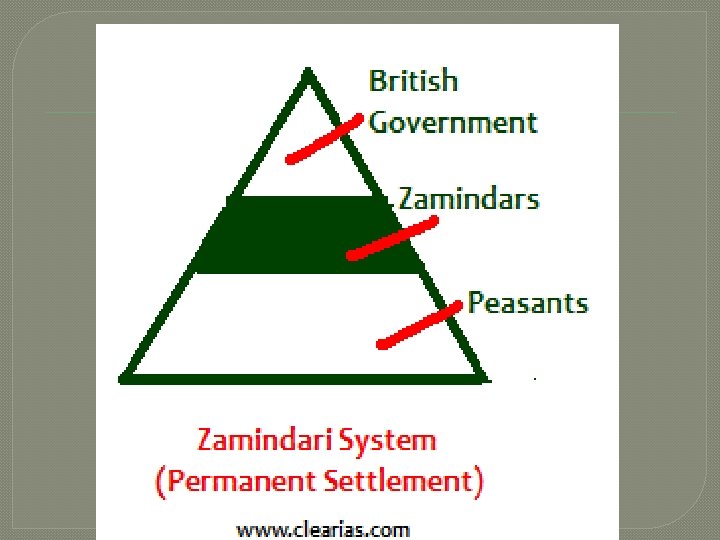
Permanent Settlement � Zamindari System was introduced by Cornwallis in 1793 through Permanent Settlement Act. � It was introduced in provinces of Bengal, Bihar, Orissa and Varanasi. � Also known as Permanent Settlement System. � Zamindars were recognized as owner of the lands. Zamindars were given the rights to collect the rent from the peasants. � The realized amount would be divided into 11 parts. 1/11 of the share belongs to Zamindars and 10/11 of the share belongs to East India Company.
Advantages �The Zaminnders Turned out to be firm Supporter of British. �By Fixing the land revenue, the British government ensured that it received the same fixed amount on a fixed date. �It was easier to deal with a few zaminders than hundreds of Farmers.
Disadvantages � The Zaminnders ill treated the to Extract Revenue. � Small farmers who had to either sell or mortgage their land to pay the revenue become landless labourers. � Many land Owners were evicted from their land by the British because their land did not have pattas to prove that they owned the land. � To meet increase expenses the government had to increase tax in other provinces.
Ryotwari system � � Ryotwari system, one of the three principal methods of revenue collection in. British India. It was prevalent in most of southern India, being the standard system of the Madras Presidency (a British-controlled area now constituting much of present-day Tamil Nadu and portions of neighbouring states). The system was devised by Capt. Alexander Read and Thomas (later Sir Thomas) Munro at the end of the 18 th century and introduced by the latter when he was governor (1820– 27) of Madras (now Chennai). The principle was the direct collection of the land revenue from each individual cultivator by government agents. For this purpose all holdings were measured and assessed according to crop potential and actual cultivation. The advantages of this system were the elimination of middlemen, who often oppressed villagers, and an assessment of the tax on land actually cultivated and not merely occupied. Offsetting these advantages was the cost of detailed measurement and of individual collection. This system also gave much power to subordinate revenue officials, whose activities were inadequately supervised.
� Ryotwari System was introduced by Thomas Munro in 1820. � Major areas of introduction include Madras, Bombay, parts of Assam and Coorgh provinces of British India. � In Ryotwari System the ownership rights were handed over to the peasants. British Government collected taxes directly from the peasants. � The revenue rates of Ryotwari System were 50% where the lands were dry and 60% in irrigated land.
Mahalwari system, �Mahalwari system, one of the three main revenue systems of land tenure in British India, the other two being the zamindar (landlord) and the ryotwari (individual cultivator). The word mahalwari is derived from the Hindi mahal, meaning a house or, by extension, a district.
� Mahalwari System � Mahalwari system was introduced in 1833 during the period of William Bentick. � It was introduced in Central Province, North-West Frontier, Agra, Punjab, Gangetic Valley, etc of British India. � The Mahalwari system had many provisions of both the Zamindari System and Ryotwari System. � In this system, the land was divided into Mahals. Each Mahal comprises one or more villages. � Ownership rights were vested with the peasants. � The villages committee was held responsible for collection of the taxes.
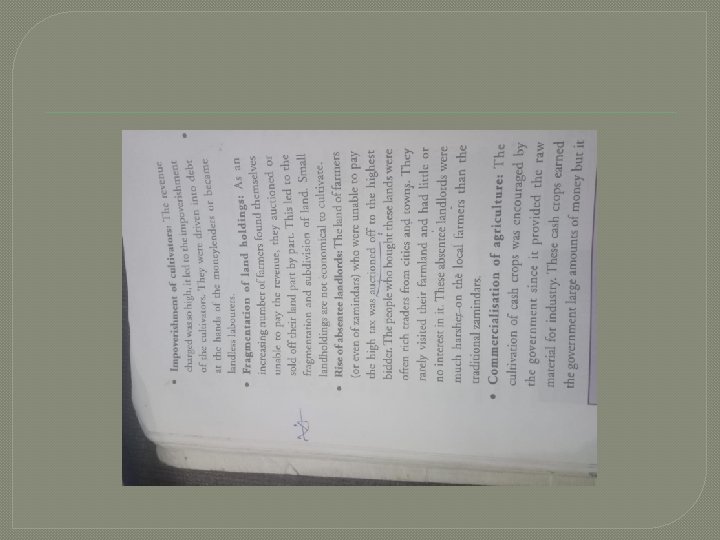
Impact Of Revenue system on Cultivation �The new land revenue system introduces by British changed the face of of Agriculture and land ownership in India. �Impoverished Cultivators: - The revenue changed was so high it led to impoverishment of the Cultivators. They were driven in to dept at the hands of the moneylanders or became landless labourer.
�Fragmentation of Land Holdings: - As an increasing number of farmers found themselves unable to pay the revenue, they auctioned or sold off their land part by part. This led to the fragmentation and subdivision of land. Small landholdings are not economical to cultivate.
�Rise of absentee landlords: -The land farmers /Zaminders who were unable to pay the high tax was auctioned off to the highest bidder. The people who bought these lands were often rich traders from cities and towns. They rarely visited their farmland had little or no interest in it. These absentee landlords were much harsher on the local farmers than the traditional zaminders.
�Commercialization of Agriculture: -The cultivation of cash crops was encouraged by the government since it provided for industry. These cash crops earned the government large amount of money but it was grown at the cost of food shortage.
�Neglect of land reforms: -The British introduced ownership of land to ensure a stedy revenue. It was believed that ownership would motivate the farmers to improve their land to increase output. However the landlord were either absentee landlord with little interest in improving the land, or they were too poor to carry out reforms. This resulted in a steady erosion of the quality of land the life of the reforms.
PEASANTS REVOLT � Peasant Movement. Details � Indigo Revolt (1859 -60)Indigo was recognized as a chief cash crop for the East India Company’s investments. � It is also known as ‘Nil Bidroho’ � All categories of the rural population, missionaries, the Bengal intelligentsia and Muslims. � This indigo revolt gave birth to a political movement and stimulated national sentiment against the British rulers among Indian masses. � Read more about Indigo Rebellion in the linked article.
� Rangpur Dhing (1783)Rangpur uprising took place in Bengal � It is called the first tough peasant rebellion against the rule of the East India Company. � It evidently uncovered the evils like Ijaradari scheme related to the system of colonial exploitation. � It paved the way formulating a land settlement that would be permanent in nature � The rebellion spread over a significant area, including Ranchi, Hazaribagh, Palamau and Manbhum. � After two years of strong confrontation, they lost to modern weapons of the British. � Read more about Rangpur Dhing in the linked article.
� Kol Rebellion (1832)The Kols and other tribes enjoyed independence underneath their chiefs but the British entry threatened their independence. � The handover of tribal lands and the encroachment of moneylenders, merchants and British laws generated a lot of pressure. � The Kol tribal planned an insurgency in 183132 which was engaged primarily against Government officers and private moneylenders.
� � � Mappila Rebellion in Malabar (1841 -1920)Mappila uprising was sequences of rebellions by the Mappila Muslims of Malabar region of Kerala. The main causes were, increase in land tax, the security of tenure and exploitation of the poor peasantry by the landlords. The revolt goes fell into the trap of Hindu-Muslim riot. During this period there was Khilafat movement was raised for the fulfilment of freedom for Muslims. The 1921 uprising was a manifestation of long-lasting agrarian dissatisfaction, which was only strengthened by the religious and ethnic uniqueness and by their political alienation. Read about Moplah Rebellion in the linked article.
� Santhal Rebellion (1855)It was a native rebellion in present-day Jharkhand against both the British colonial authority and zamindari system by the Santhal people � It was planned by four Murmu brothers Sidhu, Kahnu, Chand Bhairav � The rebellion was suppressed thoroughly and largely shadowed by that of the other rebellions. � Read more about Santhal Uprising in the linked article.
� � � � Deccan Uprising (1875)Along with the Permanent Settlement, the British extended their presence beyond Bengal. Ryotwari Settlement was the revenue system that was introduced in the Bombay Deccan region The revolt started in Poona and henceforth it spread to Ahmednagar. This uprising also involved a social boycott of the moneylender. Read about Deccan Riots in the linked article. Munda Ulgulan (1899 - 1900)Birsa Munda-led this movement in the region south of Ranchi The Mundas conventionally enjoyed a special rent rate as the original clearer (Khuntkatti) of the forest. But this was eroded by the jagirdars and thikadars arrived as traders and moneylenders. As a result of this rebellion, the government enacted the Chotanagpur Tenancy Act 1908, recognized Khuntkatti rights, banned Beth Begari (forced labour)
� Narkelberia Uprising (1782 -1831)Led by Titu Mir/ Mir Nithar Ali � In West Bengal � against landlords, mainly Hindu, who imposed a beard-tax on the Faraizis, and British indigo planters � merged into the Wahabi movement � The Pagal Panthis. Led by Karam Shah � To fight the oppression of the zamindars. � Faraizi Revolt. Led by Shariat-Allah and his son Dadu Mian � to expel the English intruders from Bengal