
Rural Economic and Enterprise Development A framework for
- Slides: 27
Rural Economic and Enterprise Development: A framework for analysis and joint action Bloemfontein, South Africa 25 January, 2004 Junior Davis and Felicity Proctor Natural Resources Institute (UK) j. davis@gre. ac. uk f. j. proctor@gre. ac. uk 1
Workshop Objectives § Present the Rural Economic and Enterprise Development (REED) Framework § Exchange relevant current and planned project and programme experience between practitioners and review in the light of the REED framework § Review the potential utility of the REED framework in the South African context § Consider options for follow up action research and learning in partnership with the NRI led programme 2
Hoped for Outputs § Better understanding of REED as a framework to support multi-stakeholder processes for rural economic development and poverty reduction § Shared learning between South African programme practitioners set within rural and local economic development § Emergence of a learning platform/network on REED/LED to support ongoing and future programme interventions § Agreement on whether and how to take forward work on the validation of REED in the South African context and possible future uptake 3
What is Local Economic Development § Local economic development is about local people working together to achieve sustainable economic growth that brings economic benefits and quality of life improvements for all in the community. “Community” is here defined as a city, town, metropolitan area, or sub national region (World Bank, 2004). 4
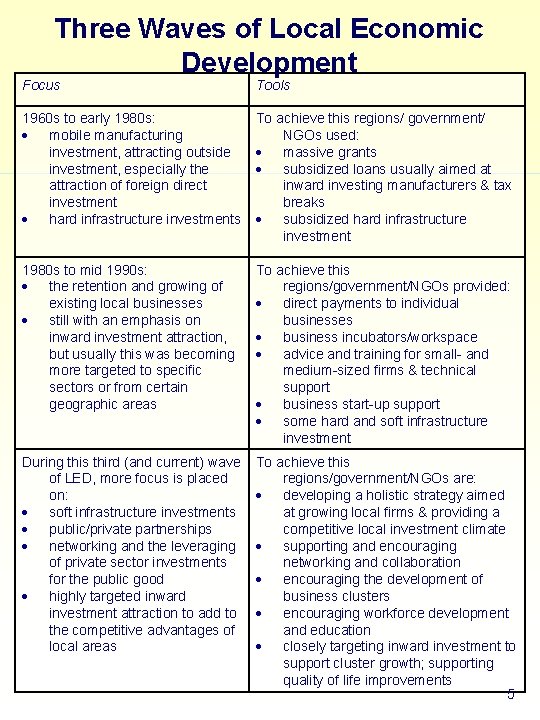
Three Waves of Local Economic Development Focus Tools 1960 s to early 1980 s: mobile manufacturing investment, attracting outside investment, especially the attraction of foreign direct investment hard infrastructure investments To achieve this regions/ government/ NGOs used: massive grants subsidized loans usually aimed at inward investing manufacturers & tax breaks subsidized hard infrastructure investment 1980 s to mid 1990 s: the retention and growing of existing local businesses still with an emphasis on inward investment attraction, but usually this was becoming more targeted to specific sectors or from certain geographic areas To achieve this regions/government/NGOs provided: direct payments to individual businesses business incubators/workspace advice and training for small- and medium-sized firms & technical support business start-up support some hard and soft infrastructure investment During this third (and current) wave of LED, more focus is placed on: soft infrastructure investments public/private partnerships networking and the leveraging of private sector investments for the public good highly targeted inward investment attraction to add to the competitive advantages of local areas To achieve this regions/government/NGOs are: developing a holistic strategy aimed at growing local firms & providing a competitive local investment climate supporting and encouraging networking and collaboration encouraging the development of business clusters encouraging workforce development and education closely targeting inward investment to support cluster growth; supporting quality of life improvements 5
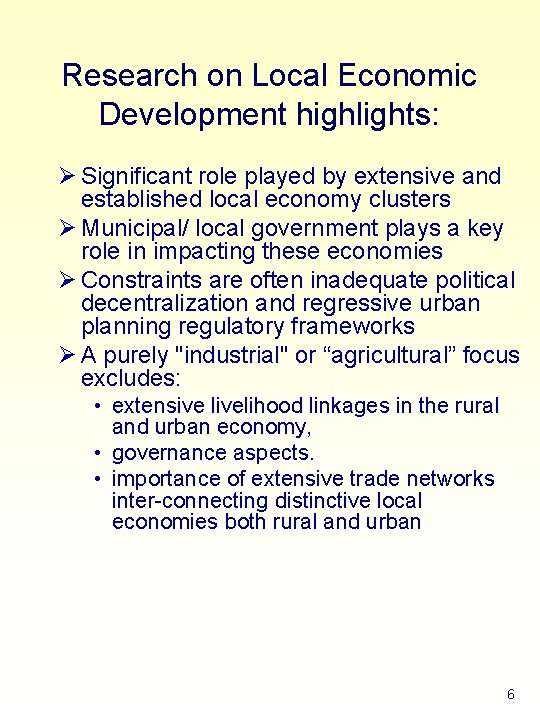
Research on Local Economic Development highlights: Ø Significant role played by extensive and established local economy clusters Ø Municipal/ local government plays a key role in impacting these economies Ø Constraints are often inadequate political decentralization and regressive urban planning regulatory frameworks Ø A purely "industrial" or “agricultural” focus excludes: • extensive livelihood linkages in the rural and urban economy, • governance aspects. • importance of extensive trade networks inter-connecting distinctive local economies both rural and urban 6
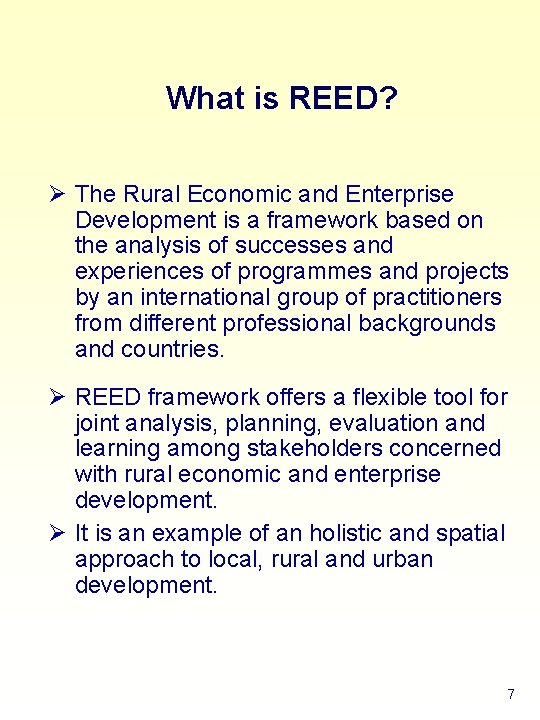
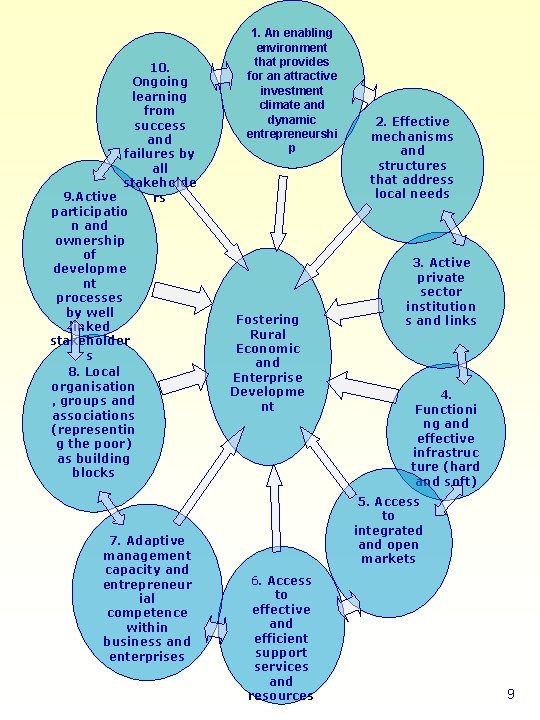
What is REED? Ø The Rural Economic and Enterprise Development is a framework based on the analysis of successes and experiences of programmes and projects by an international group of practitioners from different professional backgrounds and countries. Ø REED framework offers a flexible tool for joint analysis, planning, evaluation and learning among stakeholders concerned with rural economic and enterprise development. Ø It is an example of an holistic and spatial approach to local, rural and urban development. 7
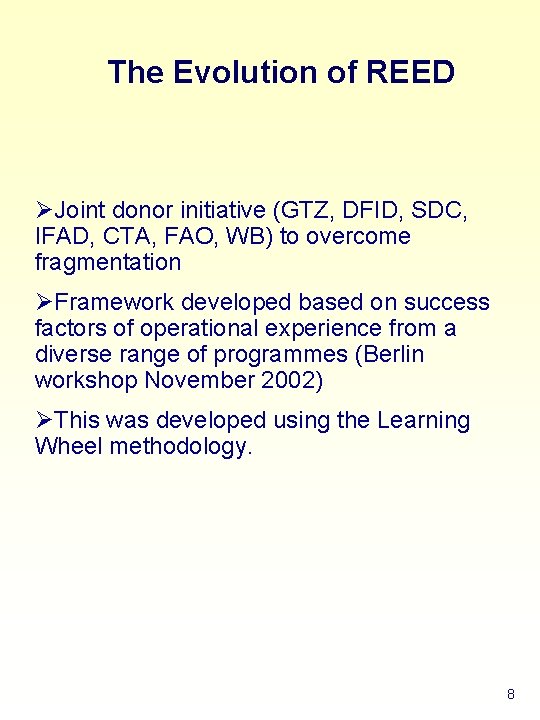
The Evolution of REED ØJoint donor initiative (GTZ, DFID, SDC, IFAD, CTA, FAO, WB) to overcome fragmentation ØFramework developed based on success factors of operational experience from a diverse range of programmes (Berlin workshop November 2002) ØThis was developed using the Learning Wheel methodology. 8
10. Ongoing learning from success and failures by all stakeholde 9. Active rs participatio n and ownership of developme nt processes by well linked stakeholder s 8. Local organisation , groups and associations (representin g the poor) as building blocks 7. Adaptive management capacity and entrepreneur ial competence within business and enterprises 1. An enabling environment that provides for an attractive investment climate and dynamic entrepreneurshi p Fostering Rural Economic and Enterprise Developme nt 2. Effective mechanisms and structures that address local needs 3. Active private sector institution s and links 4. Functioni ng and effective infrastruc ture (hard and soft) 5. Access to integrated and open markets 6. Access to effective and efficient support services and resources 9
Using REED: in the planning process Use of the framework in the planning process for poverty oriented LED in rural and urban areas üAs a checklist in the planning process üAs a tool to define priorities with stakeholders and decision makers üAs a guideline in participatory planning with stakeholders üAs a tool for joint planning with different projects and donors üAs resource material for the REED/LED planning process 10
Using REED: in prioritising interventions Using the framework as a tool for selecting amongst intervention priorities (gateway function) For example: ü local and regional economic development ü promotion of value chains ü training and human resource development ü rural and urban business development services ü microfinance ü. . 11
Using REED: in monitoring & evaluation Use the framework for monitoring and evaluation: ü As a guideline to establish a M & E System üAs a tool for discussions with decision makers on changes observed üAs a tool for joint evaluation of different projects in the same region üTo help define indicators for results and impacts on different levels üAs a tool to establish benchmarks for regions and countries 12
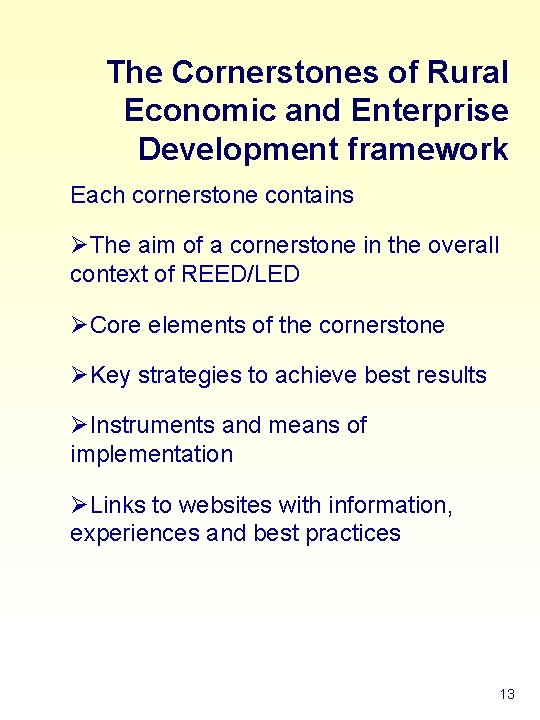
The Cornerstones of Rural Economic and Enterprise Development framework Each cornerstone contains ØThe aim of a cornerstone in the overall context of REED/LED ØCore elements of the cornerstone ØKey strategies to achieve best results ØInstruments and means of implementation ØLinks to websites with information, experiences and best practices 13
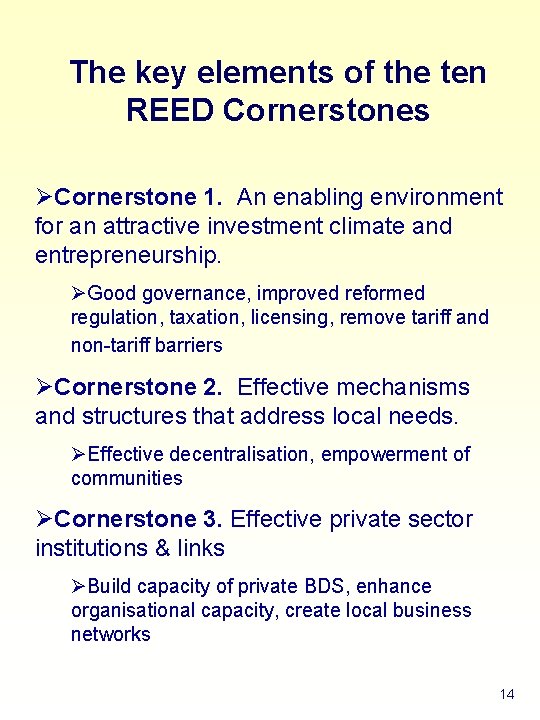
The key elements of the ten REED Cornerstones ØCornerstone 1. An enabling environment for an attractive investment climate and entrepreneurship. ØGood governance, improved reformed regulation, taxation, licensing, remove tariff and non-tariff barriers ØCornerstone 2. Effective mechanisms and structures that address local needs. ØEffective decentralisation, empowerment of communities ØCornerstone 3. Effective private sector institutions & links ØBuild capacity of private BDS, enhance organisational capacity, create local business networks 14
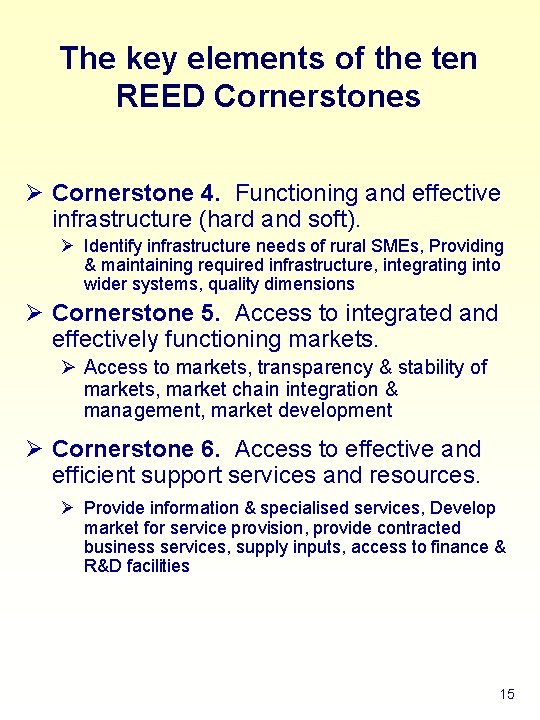
The key elements of the ten REED Cornerstones Ø Cornerstone 4. Functioning and effective infrastructure (hard and soft). Ø Identify infrastructure needs of rural SMEs, Providing & maintaining required infrastructure, integrating into wider systems, quality dimensions Ø Cornerstone 5. Access to integrated and effectively functioning markets. Ø Access to markets, transparency & stability of markets, market chain integration & management, market development Ø Cornerstone 6. Access to effective and efficient support services and resources. Ø Provide information & specialised services, Develop market for service provision, provide contracted business services, supply inputs, access to finance & R&D facilities 15
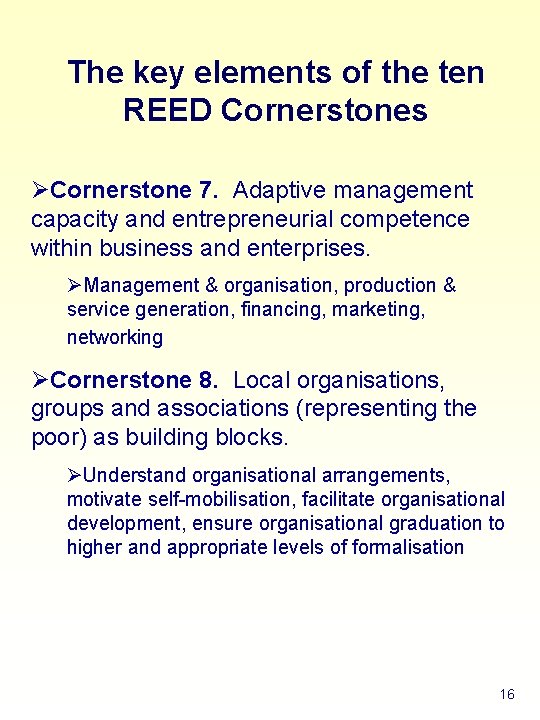
The key elements of the ten REED Cornerstones ØCornerstone 7. Adaptive management capacity and entrepreneurial competence within business and enterprises. ØManagement & organisation, production & service generation, financing, marketing, networking ØCornerstone 8. Local organisations, groups and associations (representing the poor) as building blocks. ØUnderstand organisational arrangements, motivate self-mobilisation, facilitate organisational development, ensure organisational graduation to higher and appropriate levels of formalisation 16
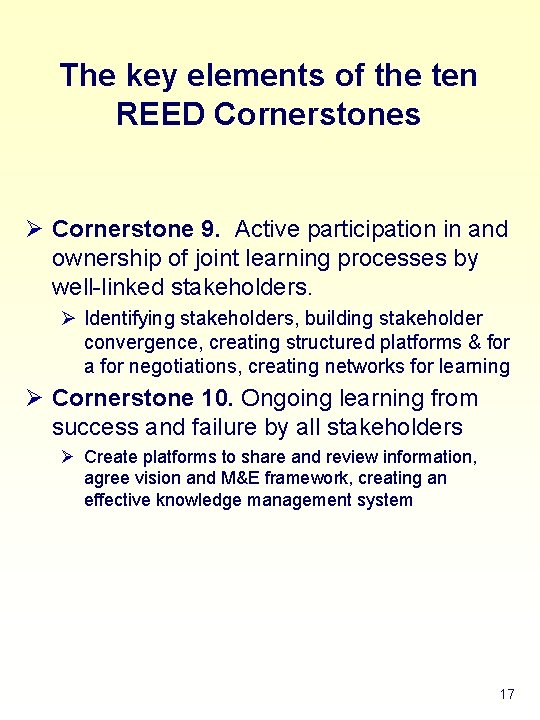
The key elements of the ten REED Cornerstones Ø Cornerstone 9. Active participation in and ownership of joint learning processes by well-linked stakeholders. Ø Identifying stakeholders, building stakeholder convergence, creating structured platforms & for a for negotiations, creating networks for learning Ø Cornerstone 10. Ongoing learning from success and failure by all stakeholders Ø Create platforms to share and review information, agree vision and M&E framework, creating an effective knowledge management system 17
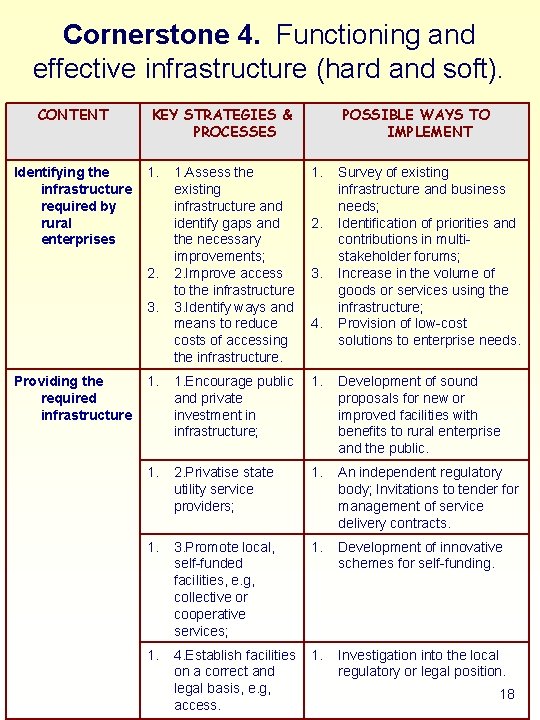
Cornerstone 4. Functioning and effective infrastructure (hard and soft). CONTENT Identifying the infrastructure required by rural enterprises KEY STRATEGIES & PROCESSES 1. Assess the existing infrastructure and identify gaps and the necessary improvements; 2. Improve access to the infrastructure 3. Identify ways and means to reduce costs of accessing the infrastructure. 1. 1. Encourage public and private investment in infrastructure; 1. Development of sound proposals for new or improved facilities with benefits to rural enterprise and the public. 1. 2. Privatise state utility service providers; 1. An independent regulatory body; Invitations to tender for management of service delivery contracts. 1. 3. Promote local, self-funded facilities, e. g, collective or cooperative services; 1. Development of innovative schemes for self-funding. 1. 4. Establish facilities on a correct and legal basis, e. g, access. 1. Investigation into the local regulatory or legal position. 2. 3. Providing the required infrastructure POSSIBLE WAYS TO IMPLEMENT 2. 3. 4. Survey of existing infrastructure and business needs; Identification of priorities and contributions in multistakeholder forums; Increase in the volume of goods or services using the infrastructure; Provision of low-cost solutions to enterprise needs. 18
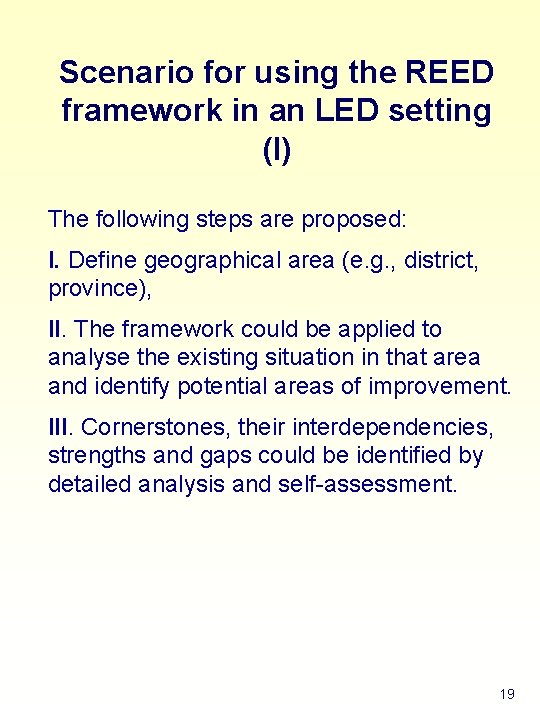
Scenario for using the REED framework in an LED setting (l) The following steps are proposed: l. Define geographical area (e. g. , district, province), II. The framework could be applied to analyse the existing situation in that area and identify potential areas of improvement. III. Cornerstones, their interdependencies, strengths and gaps could be identified by detailed analysis and self-assessment. 19
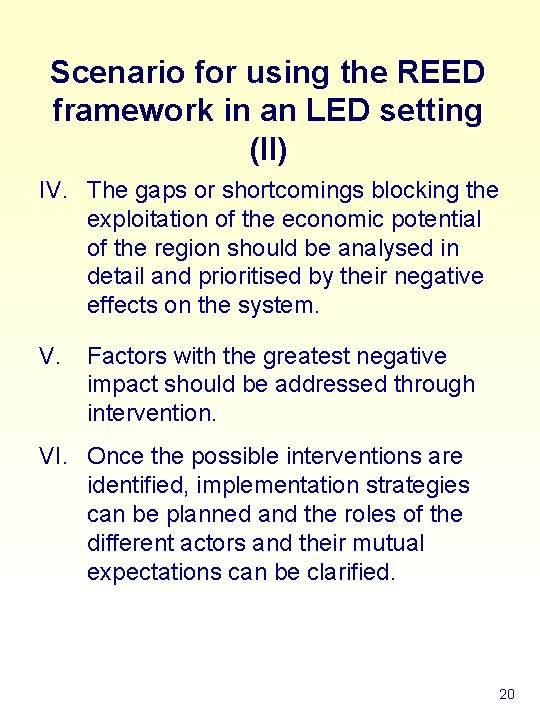
Scenario for using the REED framework in an LED setting (ll) IV. The gaps or shortcomings blocking the exploitation of the economic potential of the region should be analysed in detail and prioritised by their negative effects on the system. V. Factors with the greatest negative impact should be addressed through intervention. VI. Once the possible interventions are identified, implementation strategies can be planned and the roles of the different actors and their mutual expectations can be clarified. 20
How REED can add value 1. Thinking about economic and livelihood strategies to compliment other spatial planning and management efforts is new. Critical linkages which combine to direct resources and interventions strategically and spatially need to be considered. 2. Public administrations should conceptualize REED/LED strategies in a trans-locational (village, small towns, cities) perspective, including its institutional setting and prioritise according to cost effectiveness and socio-economic impact. 3. REED provides a common platform and mechanism to link policy, procedures and interventions from a multidisciplinary perspective. 21
NRI Action research and shared learning on REED Ø The research aims to develop further the conceptual framework and project tool for the fostering of rural economic and enterprise development in South Africa and Bangladesh Ø In pursuit of this, the project aims to: Ø Apply the REED framework and share emerging practice on pro-poor public policy and institutional support at local and national government levels Ø Refine and develop the conceptual framework so that it can address gaps in the framework 22
Approach ØCollaboration with In-country partners ØCollaboration with UK and EU partners ØConsultation with key stakeholders ØPolicy and Institutional focus ØPolicy dialogue 23
Methodological issues ØStudy site selection criteria ØUnit of analysis ØQuantitative and Qualitative Research 24
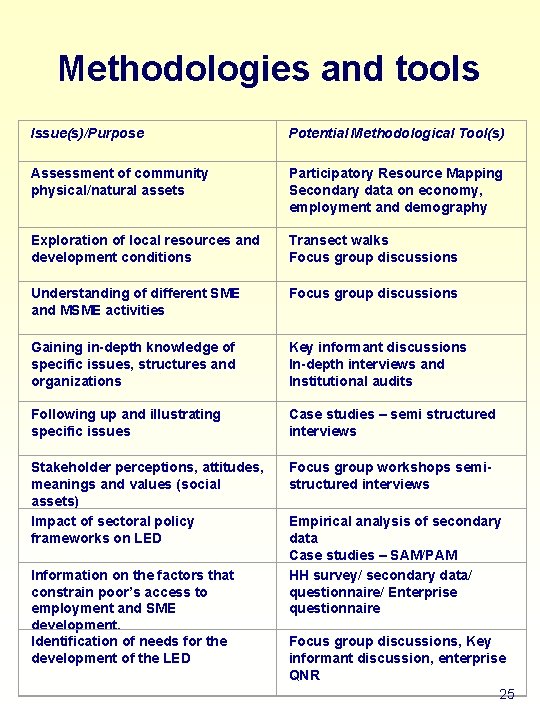
Methodologies and tools Issue(s)/Purpose Potential Methodological Tool(s) Assessment of community physical/natural assets Participatory Resource Mapping Secondary data on economy, employment and demography Exploration of local resources and development conditions Transect walks Focus group discussions Understanding of different SME and MSME activities Focus group discussions Gaining in-depth knowledge of specific issues, structures and organizations Key informant discussions In-depth interviews and Institutional audits Following up and illustrating specific issues Case studies – semi structured interviews Stakeholder perceptions, attitudes, meanings and values (social assets) Impact of sectoral policy frameworks on LED Focus group workshops semistructured interviews Information on the factors that constrain poor’s access to employment and SME development. Identification of needs for the development of the LED Empirical analysis of secondary data Case studies – SAM/PAM HH survey/ secondary data/ questionnaire/ Enterprise questionnaire Focus group discussions, Key informant discussion, enterprise QNR 25
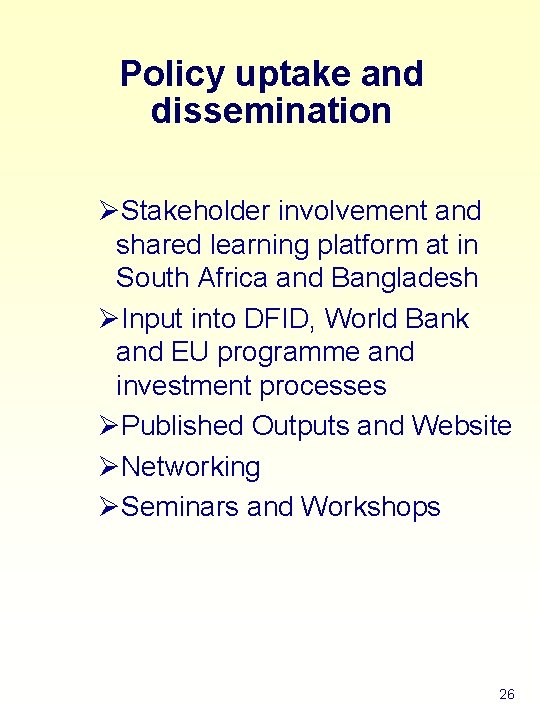
Policy uptake and dissemination ØStakeholder involvement and shared learning platform at in South Africa and Bangladesh ØInput into DFID, World Bank and EU programme and investment processes ØPublished Outputs and Website ØNetworking ØSeminars and Workshops 26
Thanks for your attention! For related reports see: The Natural Resources Institute website http: //www. nri. org/projects/reed 27