
Rural Development Programme for England RDPE GROWTH PROGRAMME

- Slides: 33
Rural Development Programme for England (RDPE) GROWTH PROGRAMME KAREN SPRIGGS Rural Payments Agency one agency 1
Purpose • Introduction to the Rural Development Programme for England (RDPE) • Growth Programme Calls • Eligibility criteria • Application process and timescales PROTECT one agency 2
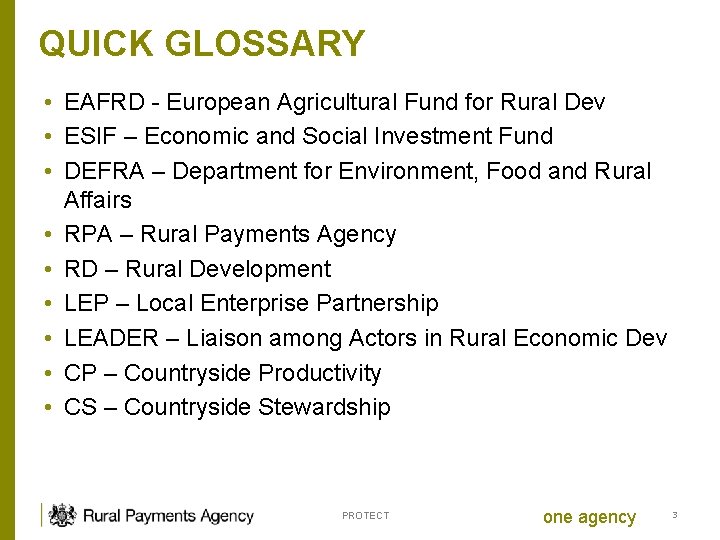
QUICK GLOSSARY • EAFRD - European Agricultural Fund for Rural Dev • ESIF – Economic and Social Investment Fund • DEFRA – Department for Environment, Food and Rural Affairs • RPA – Rural Payments Agency • RD – Rural Development • LEP – Local Enterprise Partnership • LEADER – Liaison among Actors in Rural Economic Dev • CP – Countryside Productivity • CS – Countryside Stewardship PROTECT one agency 3
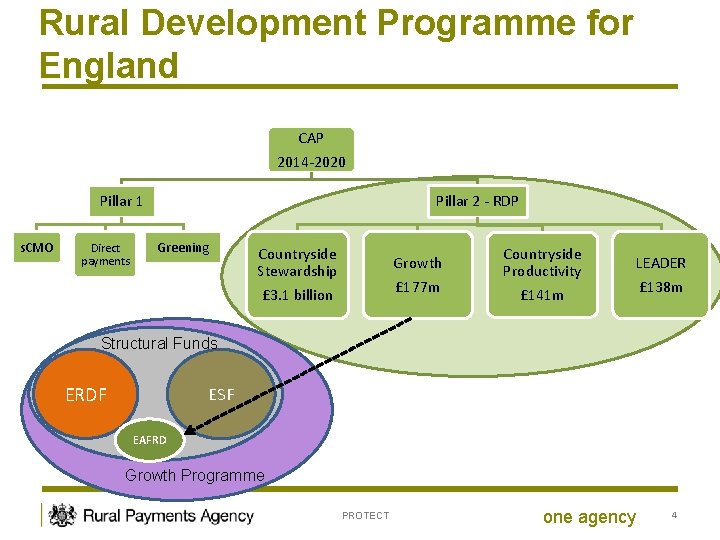
Rural Development Programme for England CAP 2014 -2020 Pillar 1 s. CMO Direct payments Pillar 2 - RDP Greening Countryside Stewardship Growth £ 177 m £ 3. 1 billion Countryside Productivity £ 141 m LEADER £ 138 m Structural Funds ERDF ESF EAFRD Growth Programme PROTECT one agency 4
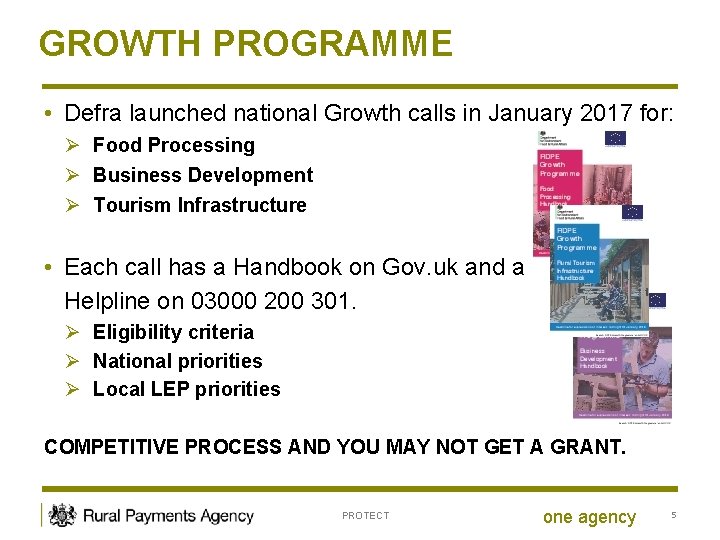
GROWTH PROGRAMME • Defra launched national Growth calls in January 2017 for: Ø Food Processing Ø Business Development Ø Tourism Infrastructure • Each call has a Handbook on Gov. uk and a Helpline on 03000 200 301. Ø Eligibility criteria Ø National priorities Ø Local LEP priorities COMPETITIVE PROCESS AND YOU MAY NOT GET A GRANT. PROTECT one agency 5
Growth Programme Roles? • RPA ROLE – Delivers the grant process. – Assesses EOIs and full applications for eligibility, value for money and local strategic fit. – Processes claims for payment. • ESIF SUB COMMITTEE ROLE – Advises on local strategic priority as part of the EOI stage. PROTECT one agency 6
BUSINESS DEVELOPMENT PROTECT one agency 7
What are the grants for? • For micro, small businesses and farmers diversifying into non-agricultural activity, to grow and create more jobs. • Grant funding can help pay for: Ø Constructing or improving buildings Ø Buying new equipment and machinery How much money can you apply for? • Up to 40% of the eligible costs of a project. • Minimum grant is £ 35, 000. • State aid rules limit funding to € 200, 000, around £ 170, 000. PROTECT one agency 8
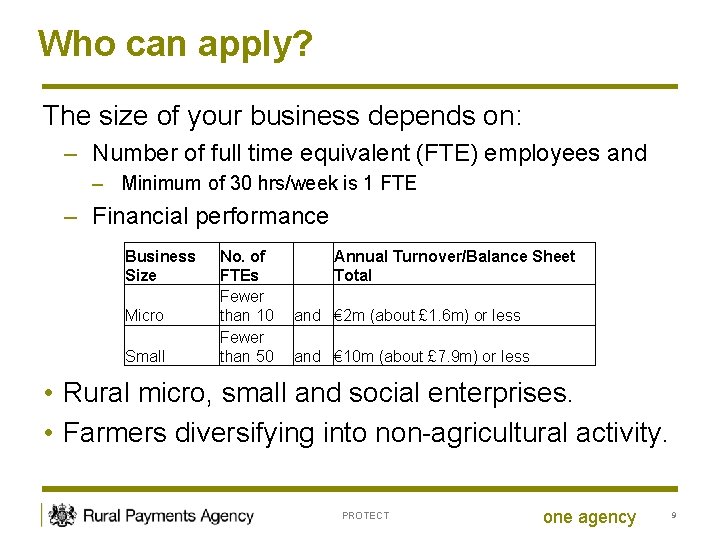
Who can apply? The size of your business depends on: – Number of full time equivalent (FTE) employees and – Minimum of 30 hrs/week is 1 FTE – Financial performance Business Size Micro Small No. of FTEs Fewer than 10 Fewer than 50 Annual Turnover/Balance Sheet Total and € 2 m (about £ 1. 6 m) or less and € 10 m (about £ 7. 9 m) or less • Rural micro, small and social enterprises. • Farmers diversifying into non-agricultural activity. PROTECT one agency 9
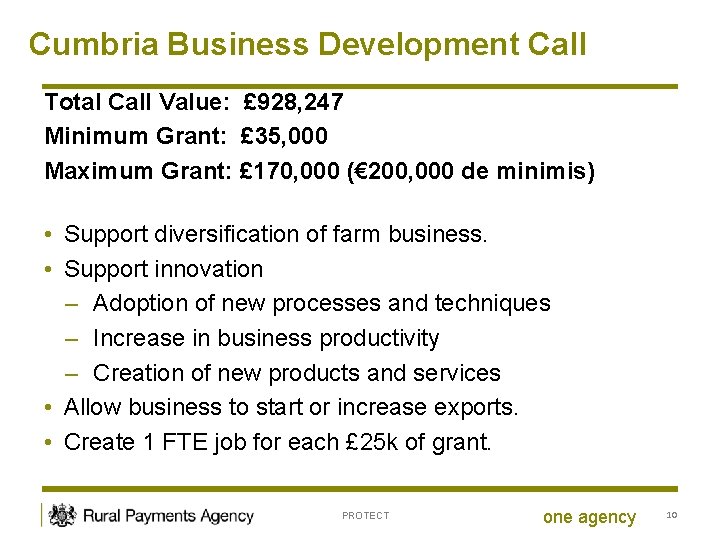
Cumbria Business Development Call Total Call Value: £ 928, 247 Minimum Grant: £ 35, 000 Maximum Grant: £ 170, 000 (€ 200, 000 de minimis) • Support diversification of farm business. • Support innovation – Adoption of new processes and techniques – Increase in business productivity – Creation of new products and services • Allow business to start or increase exports. • Create 1 FTE job for each £ 25 k of grant. PROTECT one agency 10
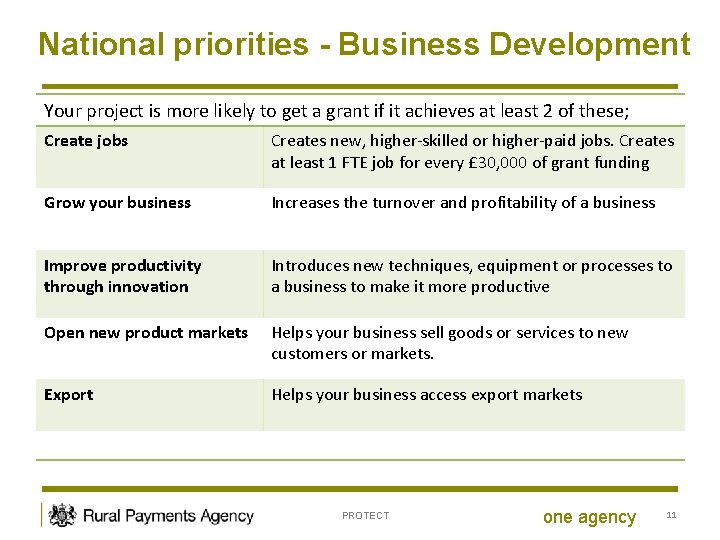
National priorities - Business Development Your project is more likely to get a grant if it achieves at least 2 of these; Create jobs Creates new, higher-skilled or higher-paid jobs. Creates at least 1 FTE job for every £ 30, 000 of grant funding Grow your business Increases the turnover and profitability of a business Improve productivity through innovation Introduces new techniques, equipment or processes to a business to make it more productive Open new product markets Helps your business sell goods or services to new customers or markets. Export Helps your business access export markets PROTECT one agency 11
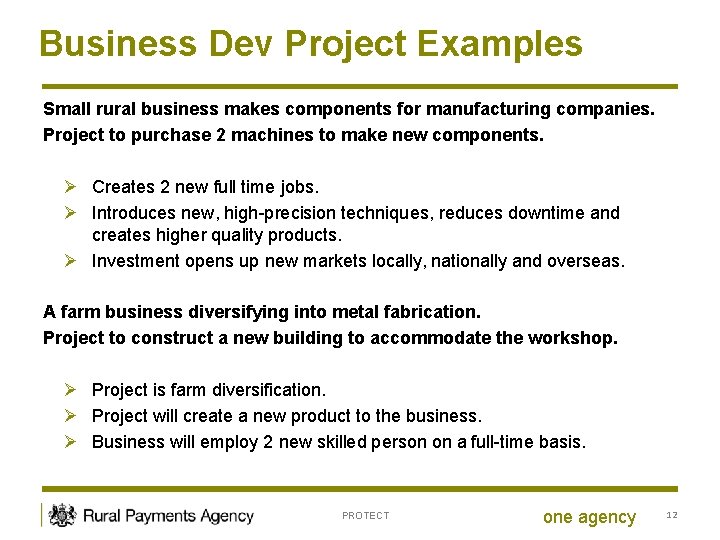
Business Dev Project Examples Small rural business makes components for manufacturing companies. Project to purchase 2 machines to make new components. Ø Creates 2 new full time jobs. Ø Introduces new, high-precision techniques, reduces downtime and creates higher quality products. Ø Investment opens up new markets locally, nationally and overseas. A farm business diversifying into metal fabrication. Project to construct a new building to accommodate the workshop. Ø Project is farm diversification. Ø Project will create a new product to the business. Ø Business will employ 2 new skilled person on a full-time basis. PROTECT one agency 12
FOOD PROCESSING PROTECT one agency 13
What are the grants for? To support food and drink businesses, that process agricultural and horticultural products, to grow and create new jobs. Grant funding can help pay for: Ø Constructing or improving buildings Ø Buying new equipment and machinery How much money can you apply for? • Up to 40% of the eligible costs of a project. • Minimum grant is £ 35, 000. • Maximum grant set by the Call is £ 250, 000. PROTECT one agency 14
Who can apply? If your raw materials are Annex I: • You can be any size of business, urban or rural. • You can apply for up to 40% whatever size business you are. • Annex 1 in and out is limited to the maximum call grant value (£ 250 k). • Annex 1 in but not out is limited to de minimis (£ 170 k). If neither your raw material or your end product is on the Annex 1 list. • You can only apply if you are a micro or small business in a rural area, or a farmer diversifying. • You can apply for up to 40%. • Maximum grant value is limited to de minimis (£ 170 k). PROTECT one agency 15
Cumbria Food Processing Call ØTotal Call: £ 1, 392, 370 ØMinimum Grant: £ 35, 000 ØMaximum Grant: £ 250, 000 • Located within the Food Enterprise Zone or clusters of 3 or more food and drink enterprises. • Support local food initiatives – Process local food and sell locally • Support innovation – New processes and techniques, increasing productivity and creating new products • Start or increase exports PROTECT one agency 16
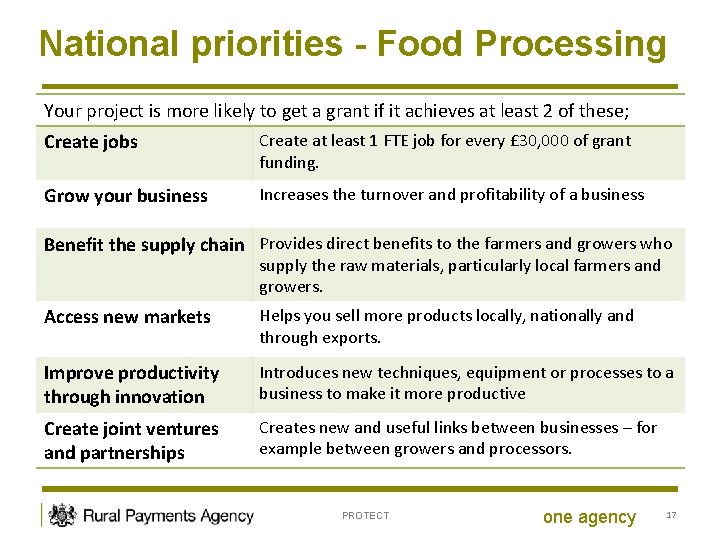
National priorities - Food Processing Your project is more likely to get a grant if it achieves at least 2 of these; Create jobs Create at least 1 FTE job for every £ 30, 000 of grant funding. Grow your business Increases the turnover and profitability of a business Benefit the supply chain Provides direct benefits to the farmers and growers who supply the raw materials, particularly local farmers and growers. Access new markets Helps you sell more products locally, nationally and through exports. Improve productivity through innovation Introduces new techniques, equipment or processes to a business to make it more productive Create joint ventures and partnerships Creates new and useful links between businesses – for example between growers and processors. PROTECT one agency 17
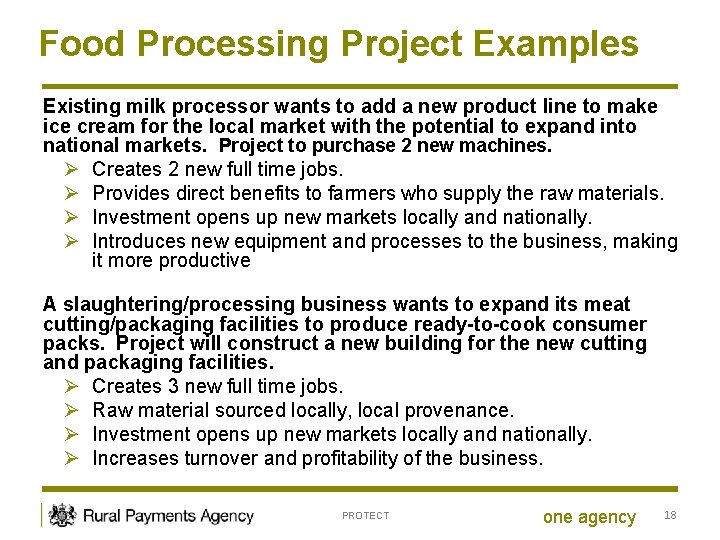
Food Processing Project Examples Existing milk processor wants to add a new product line to make ice cream for the local market with the potential to expand into national markets. Project to purchase 2 new machines. Ø Creates 2 new full time jobs. Ø Provides direct benefits to farmers who supply the raw materials. Ø Investment opens up new markets locally and nationally. Ø Introduces new equipment and processes to the business, making it more productive A slaughtering/processing business wants to expand its meat cutting/packaging facilities to produce ready-to-cook consumer packs. Project will construct a new building for the new cutting and packaging facilities. Ø Creates 3 new full time jobs. Ø Raw material sourced locally, local provenance. Ø Investment opens up new markets locally and nationally. Ø Increases turnover and profitability of the business. PROTECT one agency 18
RURAL TOURISM INFRASTRUCTURE PROTECT one agency 19
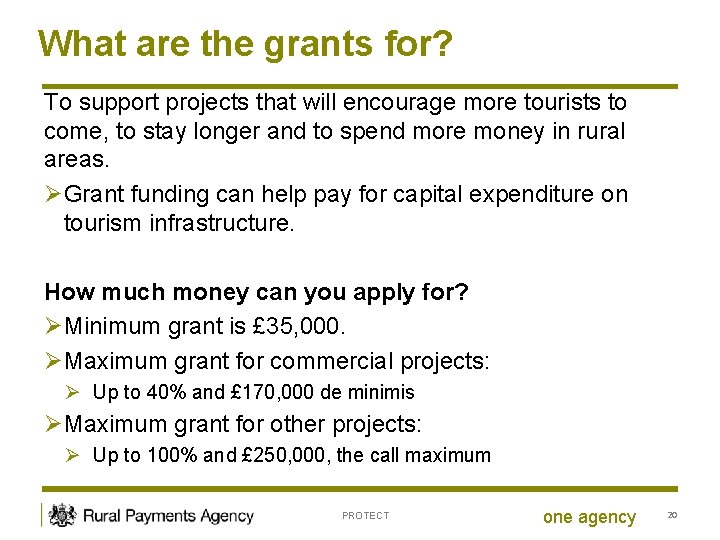
What are the grants for? To support projects that will encourage more tourists to come, to stay longer and to spend more money in rural areas. ØGrant funding can help pay for capital expenditure on tourism infrastructure. How much money can you apply for? ØMinimum grant is £ 35, 000. ØMaximum grant for commercial projects: Ø Up to 40% and £ 170, 000 de minimis ØMaximum grant for other projects: Ø Up to 100% and £ 250, 000, the call maximum PROTECT one agency 20
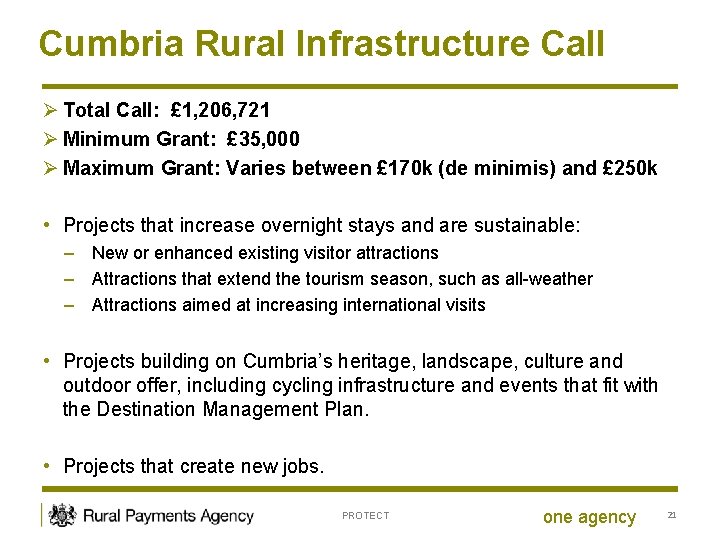
Cumbria Rural Infrastructure Call Ø Total Call: £ 1, 206, 721 Ø Minimum Grant: £ 35, 000 Ø Maximum Grant: Varies between £ 170 k (de minimis) and £ 250 k • Projects that increase overnight stays and are sustainable: – New or enhanced existing visitor attractions – Attractions that extend the tourism season, such as all-weather – Attractions aimed at increasing international visits • Projects building on Cumbria’s heritage, landscape, culture and outdoor offer, including cycling infrastructure and events that fit with the Destination Management Plan. • Projects that create new jobs. PROTECT one agency 21
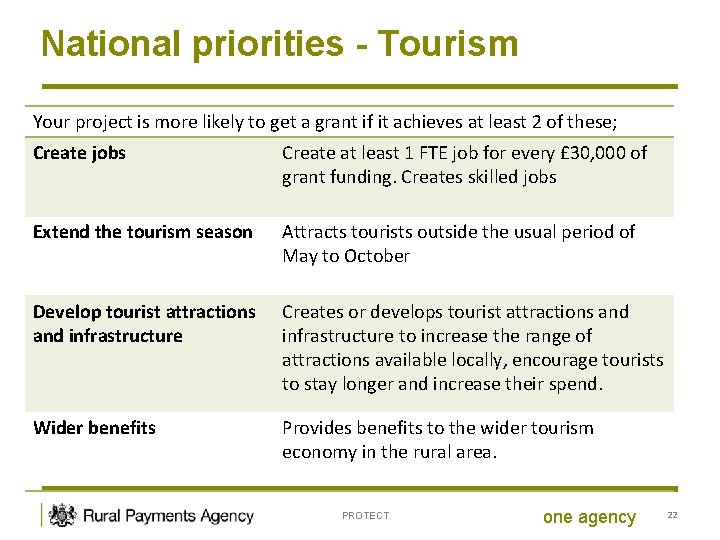
National priorities - Tourism Your project is more likely to get a grant if it achieves at least 2 of these; Create jobs Create at least 1 FTE job for every £ 30, 000 of grant funding. Creates skilled jobs Extend the tourism season Attracts tourists outside the usual period of May to October Develop tourist attractions and infrastructure Creates or develops tourist attractions and infrastructure to increase the range of attractions available locally, encourage tourists to stay longer and increase their spend. Wider benefits Provides benefits to the wider tourism economy in the rural area. PROTECT one agency 22
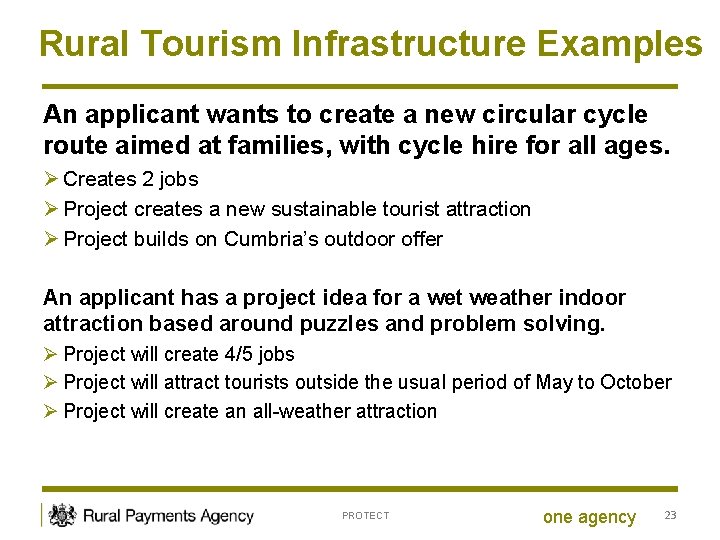
Rural Tourism Infrastructure Examples An applicant wants to create a new circular cycle route aimed at families, with cycle hire for all ages. Ø Creates 2 jobs Ø Project creates a new sustainable tourist attraction Ø Project builds on Cumbria’s outdoor offer An applicant has a project idea for a wet weather indoor attraction based around puzzles and problem solving. Ø Project will create 4/5 jobs Ø Project will attract tourists outside the usual period of May to October Ø Project will create an all-weather attraction PROTECT one agency 23
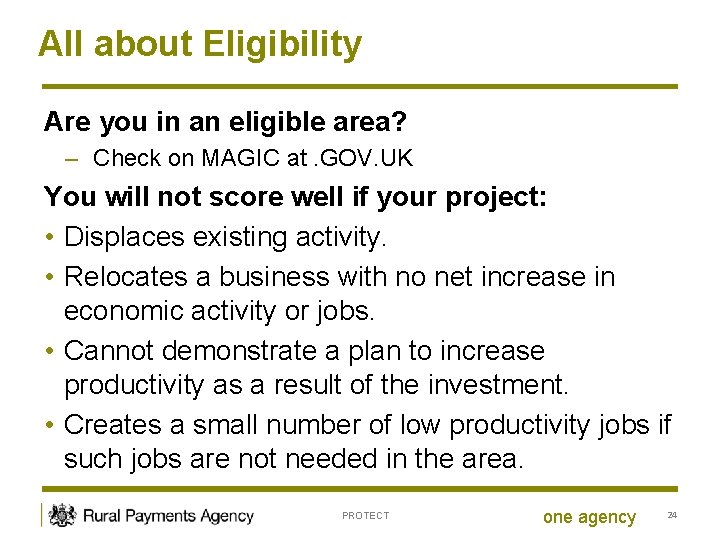
All about Eligibility Are you in an eligible area? – Check on MAGIC at. GOV. UK You will not score well if your project: • Displaces existing activity. • Relocates a business with no net increase in economic activity or jobs. • Cannot demonstrate a plan to increase productivity as a result of the investment. • Creates a small number of low productivity jobs if such jobs are not needed in the area. PROTECT one agency 24
Ineligible costs (more in the handbook) Some examples: • Costs of refurbishment and simple like-for-like replacement of buildings, machinery or equipment. • Leasing contract costs – such as overheads and insurance charges. • Costs of computers, software or printers for general business use (e. g. accounts or processing orders). • Salaries or running costs. • Developing or setting up agricultural businesses. • Costs of marketing and promotion. § Contributions in kind. PROTECT one agency 25
Making an Application to the Growth Programme one agency 26
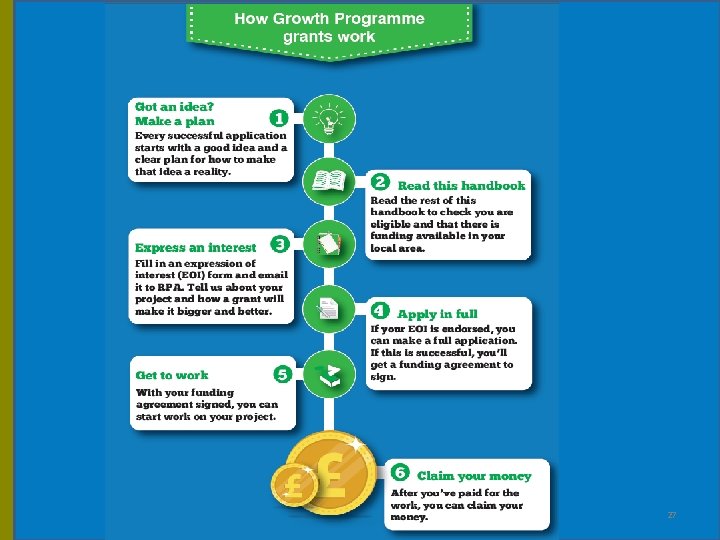
PROTECT one agency 27
Expression of Interest • EOI stage assesses your proposed project for: Ø Eligibility Ø Fit with local priorities • RPA will aim to tell you the outcome in 30 working days from receipt of your EOI. • We ask the ESIF Sub Committee for their views on the fit with local priorities during our assessment. PROTECT one agency 28
Full application • Full application stage remains competitive. • Full business case is required for the RPA to make a funding decision on your project. • When you submit you need to have: Ø Required approvals in place i. e. planning permission. Ø Secured match funding. Ø Be able to evidence the case for need/ demand. Ø Be able to demonstrate value for money against costs. PROTECT one agency 29
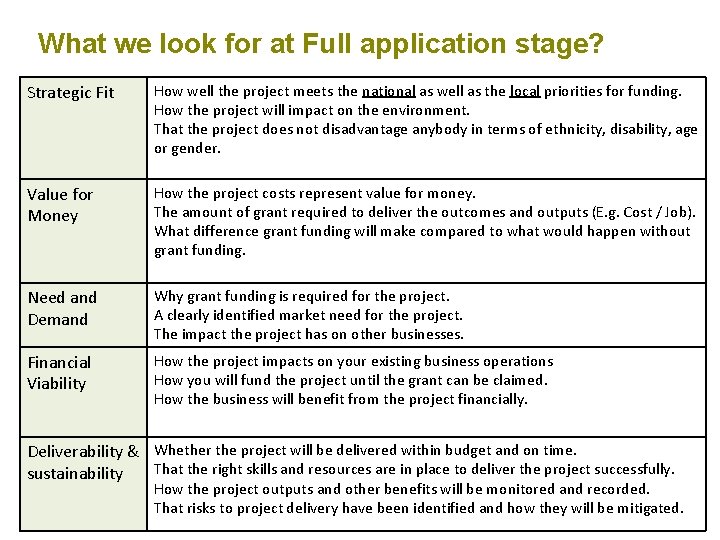
What we look for at Full application stage? Strategic Fit How well the project meets the national as well as the local priorities for funding. How the project will impact on the environment. That the project does not disadvantage anybody in terms of ethnicity, disability, age or gender. Value for Money How the project costs represent value for money. The amount of grant required to deliver the outcomes and outputs (E. g. Cost / Job). What difference grant funding will make compared to what would happen without grant funding. Need and Demand Why grant funding is required for the project. A clearly identified market need for the project. The impact the project has on other businesses. Financial Viability How the project impacts on your existing business operations How you will fund the project until the grant can be claimed. How the business will benefit from the project financially. Deliverability & Whether the project will be delivered within budget and on time. That the right skills and resources are in place to deliver the project successfully. sustainability How the project outputs and other benefits will be monitored and recorded. That risks to project delivery PROTECT have been identified and how they will be mitigated. 30 one agency
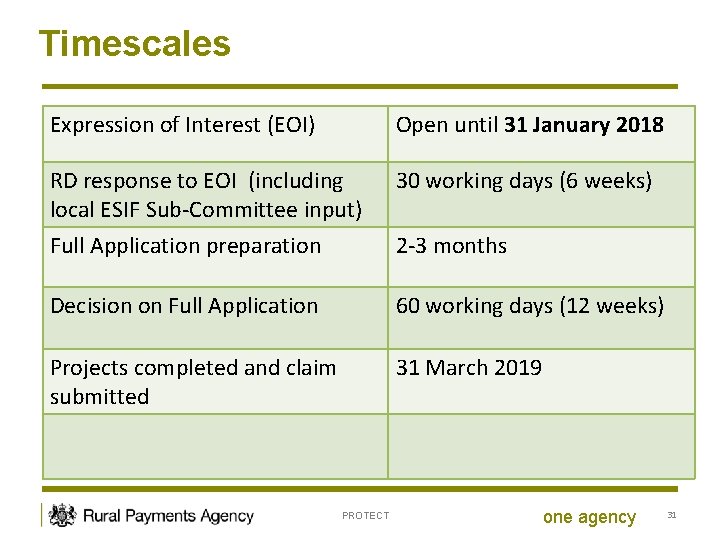
Timescales Expression of Interest (EOI) Open until 31 January 2018 RD response to EOI (including local ESIF Sub-Committee input) Full Application preparation 30 working days (6 weeks) Decision on Full Application 60 working days (12 weeks) Projects completed and claim submitted 31 March 2019 PROTECT 2 -3 months one agency 31
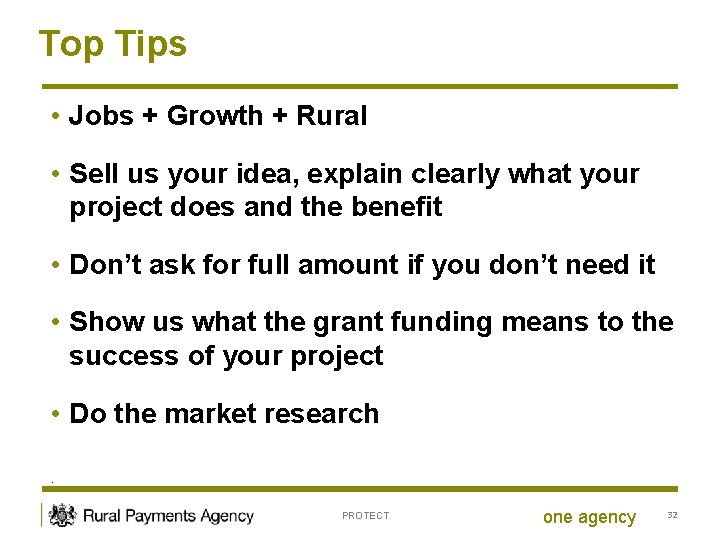
Top Tips • Jobs + Growth + Rural • Sell us your idea, explain clearly what your project does and the benefit • Don’t ask for full amount if you don’t need it • Show us what the grant funding means to the success of your project • Do the market research . PROTECT one agency 32
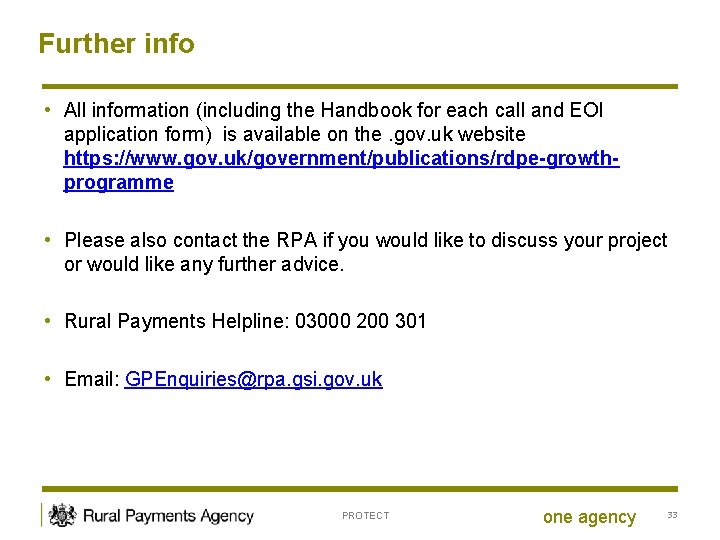
Further info • All information (including the Handbook for each call and EOI application form) is available on the. gov. uk website https: //www. gov. uk/government/publications/rdpe-growthprogramme • Please also contact the RPA if you would like to discuss your project or would like any further advice. • Rural Payments Helpline: 03000 200 301 • Email: GPEnquiries@rpa. gsi. gov. uk PROTECT one agency 33